Characterizing and mining numerical
pattern
An FCA point of view
Declarative Approaches for Enumerating Interesting
Patterns
http://liris.cnrs.fr/dag/
Mehdi Kaytoue – Post-doctorant DAG
June 2012
mkaytoue@liris.cnrs.fr
http://liris.cnrs.fr/mehdi.kaytoue
Outline
1 Introducing Formal Concept Analysis
2 Main research question
3 Elements of answer
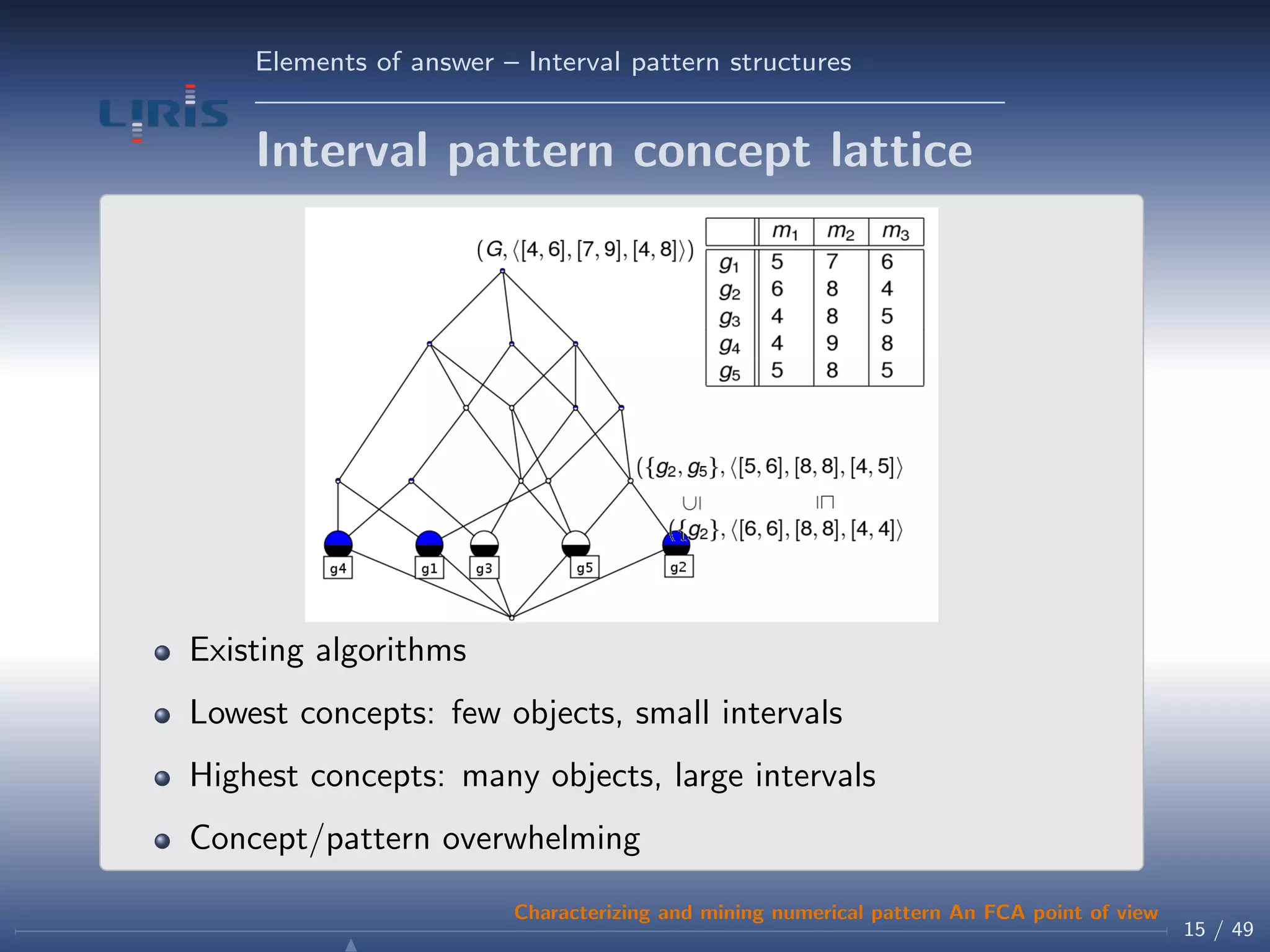
Interval pattern structures
Towards condensed representations
Introducing similarity
Extracting biclusters of similar values
Triadic Concept Analysis for biclustering
4 Conclusion and perspectives
2 / 49
Characterizing and mining numerical pattern An FCA point of view
Introducing Formal Concept Analysis
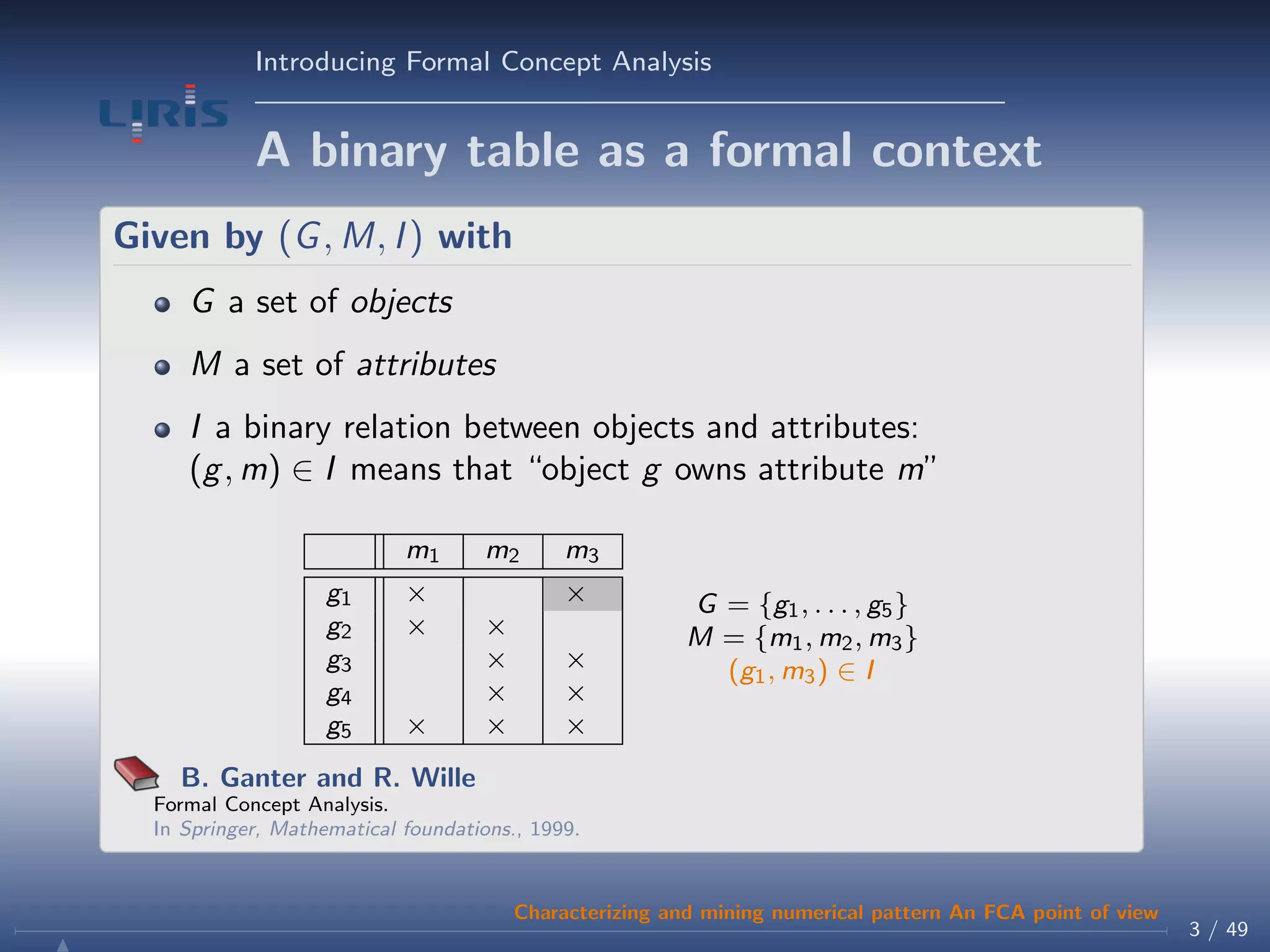
A binary table as a formal context
Given by (G, M, I) with
G a set of objects
M a set of attributes
I a binary relation between objects and attributes:
(g, m) ∈ I means that “object g owns attribute m”
m1 m2 m3
g1 × ×
g2 × ×
g3 × ×
g4 × ×
g5 × × ×
G = {g1, . . . , g5}
M = {m1, m2, m3}
(g1, m3) ∈ I
B. Ganter and R. Wille
Formal Concept Analysis.
In Springer, Mathematical foundations., 1999.
3 / 49
Characterizing and mining numerical pattern An FCA point of view
Introducing Formal Concept Analysis
A maximal rectangle as a formal concept
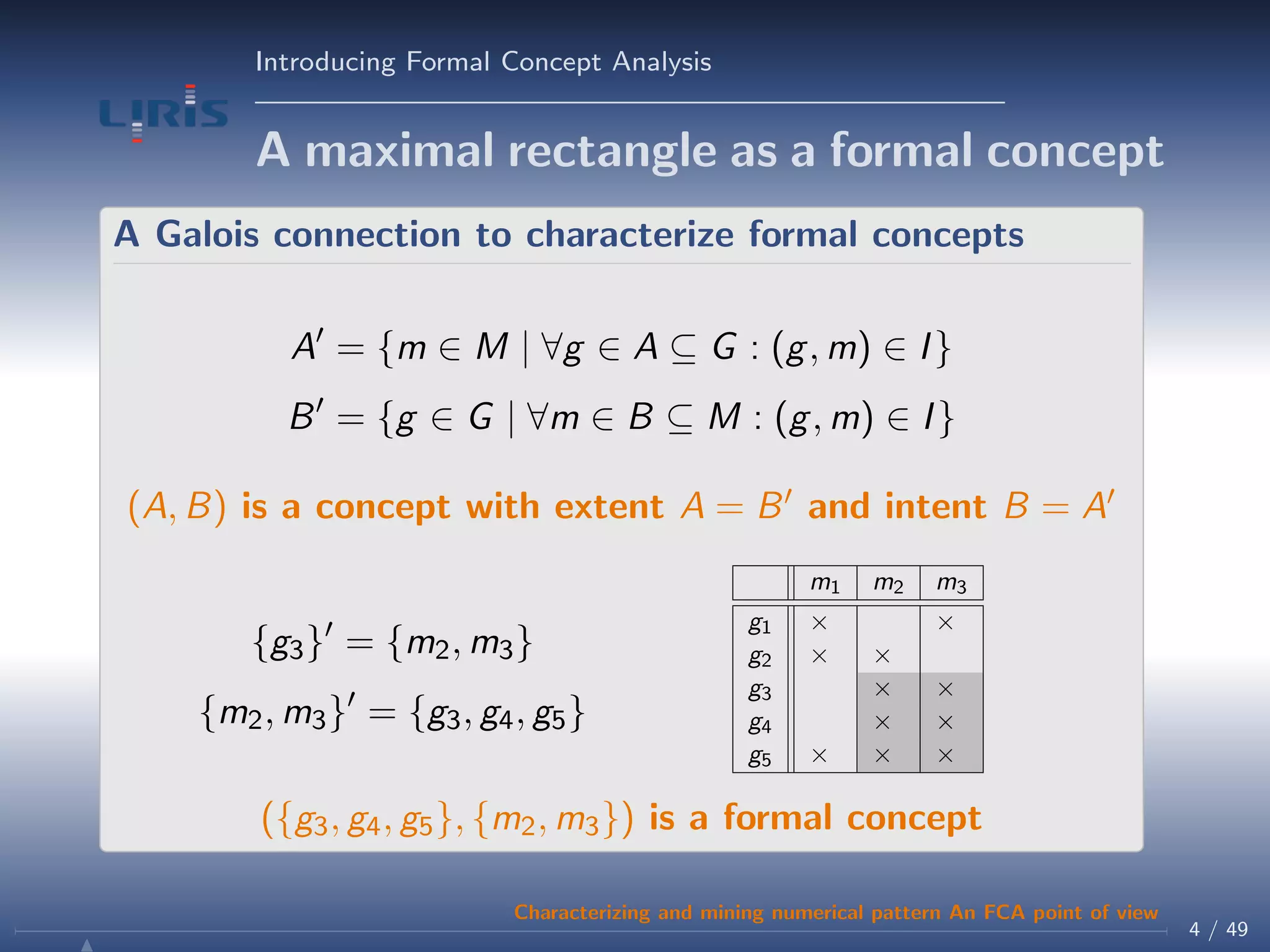
A Galois connection to characterize formal concepts
A = {m ∈ M | ∀g ∈ A ⊆ G : (g, m) ∈ I}
B = {g ∈ G | ∀m ∈ B ⊆ M : (g, m) ∈ I}
(A, B) is a concept with extent A = B and intent B = A
{g3} = {m2, m3}
{m2, m3} = {g3, g4, g5}
m1 m2 m3
g1 × ×
g2 × ×
g3 × ×
g4 × ×
g5 × × ×
({g3, g4, g5}, {m2, m3}) is a formal concept
4 / 49
Characterizing and mining numerical pattern An FCA point of view
Introducing Formal Concept Analysis
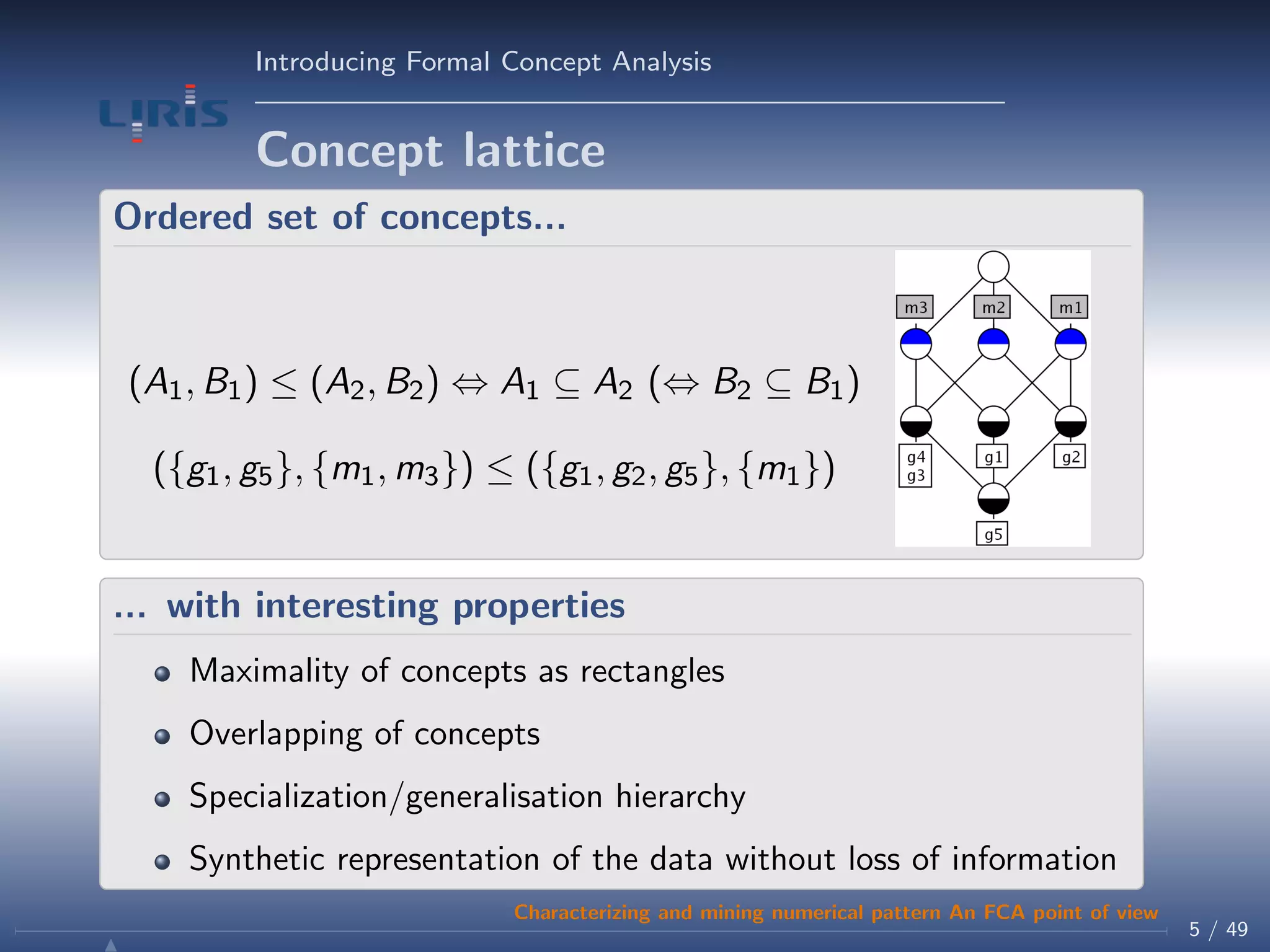
Concept lattice
Ordered set of concepts...
(A1, B1) ≤ (A2, B2) ⇔ A1 ⊆ A2 (⇔ B2 ⊆ B1)
({g1, g5}, {m1, m3}) ≤ ({g1, g2, g5}, {m1})
... with interesting properties
Maximality of concepts as rectangles
Overlapping of concepts
Specialization/generalisation hierarchy
Synthetic representation of the data without loss of information
5 / 49
Characterizing and mining numerical pattern An FCA point of view
1 Introducing Formal Concept Analysis
2 Main research question
3 Elements of answer
Interval pattern structures
Towards condensed representations
Introducing similarity
Extracting biclusters of similar values
Triadic Concept Analysis for biclustering
4 Conclusion and perspectives
Main research question
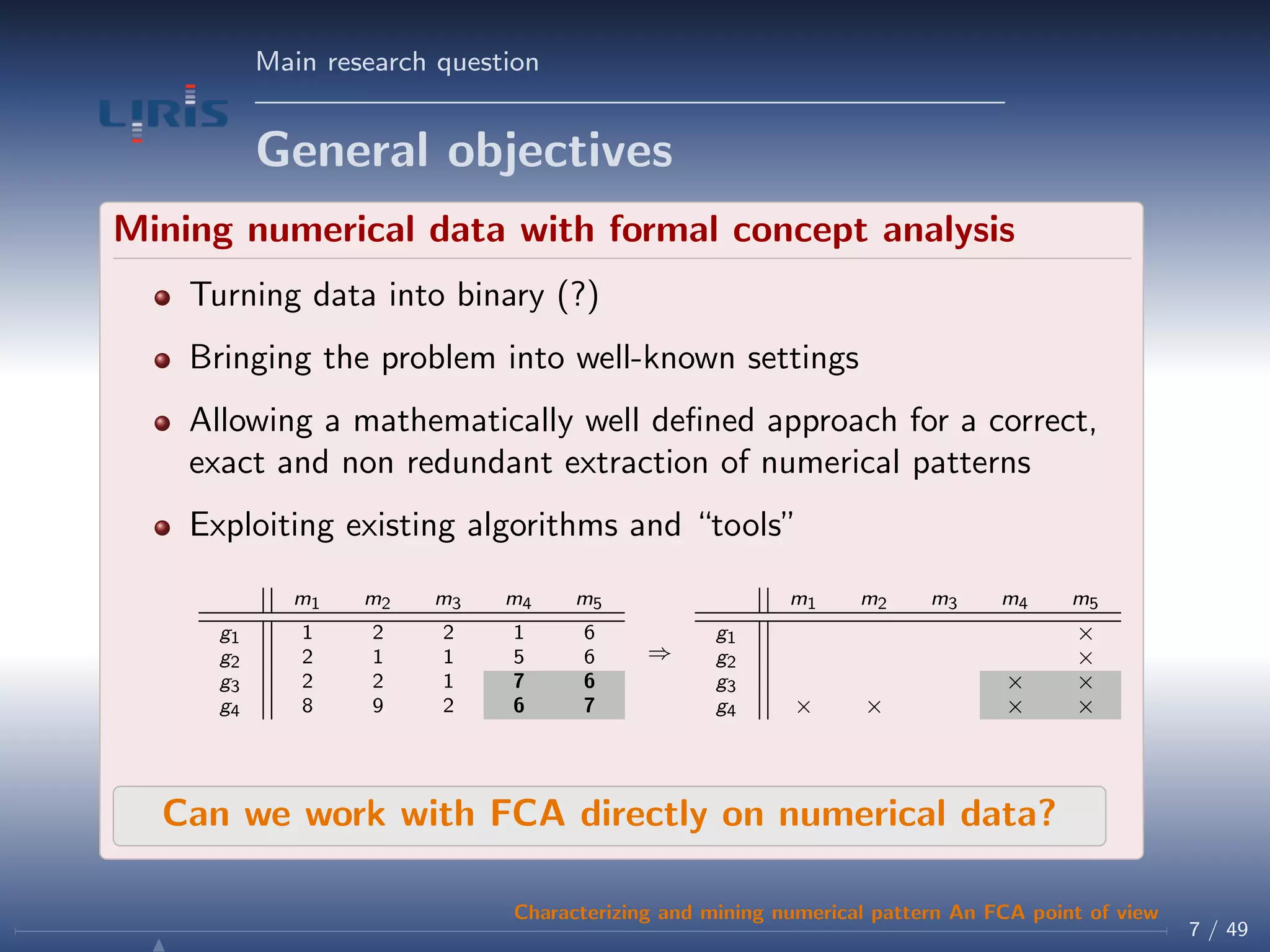
General objectives
Mining numerical data with formal concept analysis
Turning data into binary (?)
Bringing the problem into well-known settings
Allowing a mathematically well defined approach for a correct,
exact and non redundant extraction of numerical patterns
Exploiting existing algorithms and “tools”
m1 m2 m3 m4 m5
g1 1 2 2 1 6
g2 2 1 1 5 6
g3 2 2 1 7 6
g4 8 9 2 6 7
⇒
m1 m2 m3 m4 m5
g1 ×
g2 ×
g3 × ×
g4 × × × ×
Can we work with FCA directly on numerical data?
7 / 49
Characterizing and mining numerical pattern An FCA point of view
1 Introducing Formal Concept Analysis
2 Main research question
3 Elements of answer
Interval pattern structures
Towards condensed representations
Introducing similarity
Extracting biclusters of similar values
Triadic Concept Analysis for biclustering
4 Conclusion and perspectives
Elements of answer – Interval pattern structures
Outline
1 Introducing Formal Concept Analysis
2 Main research question
3 Elements of answer
Interval pattern structures
Towards condensed representations
Introducing similarity
Extracting biclusters of similar values
Triadic Concept Analysis for biclustering
4 Conclusion and perspectives
9 / 49
Characterizing and mining numerical pattern An FCA point of view
Elements of answer – Interval pattern structures
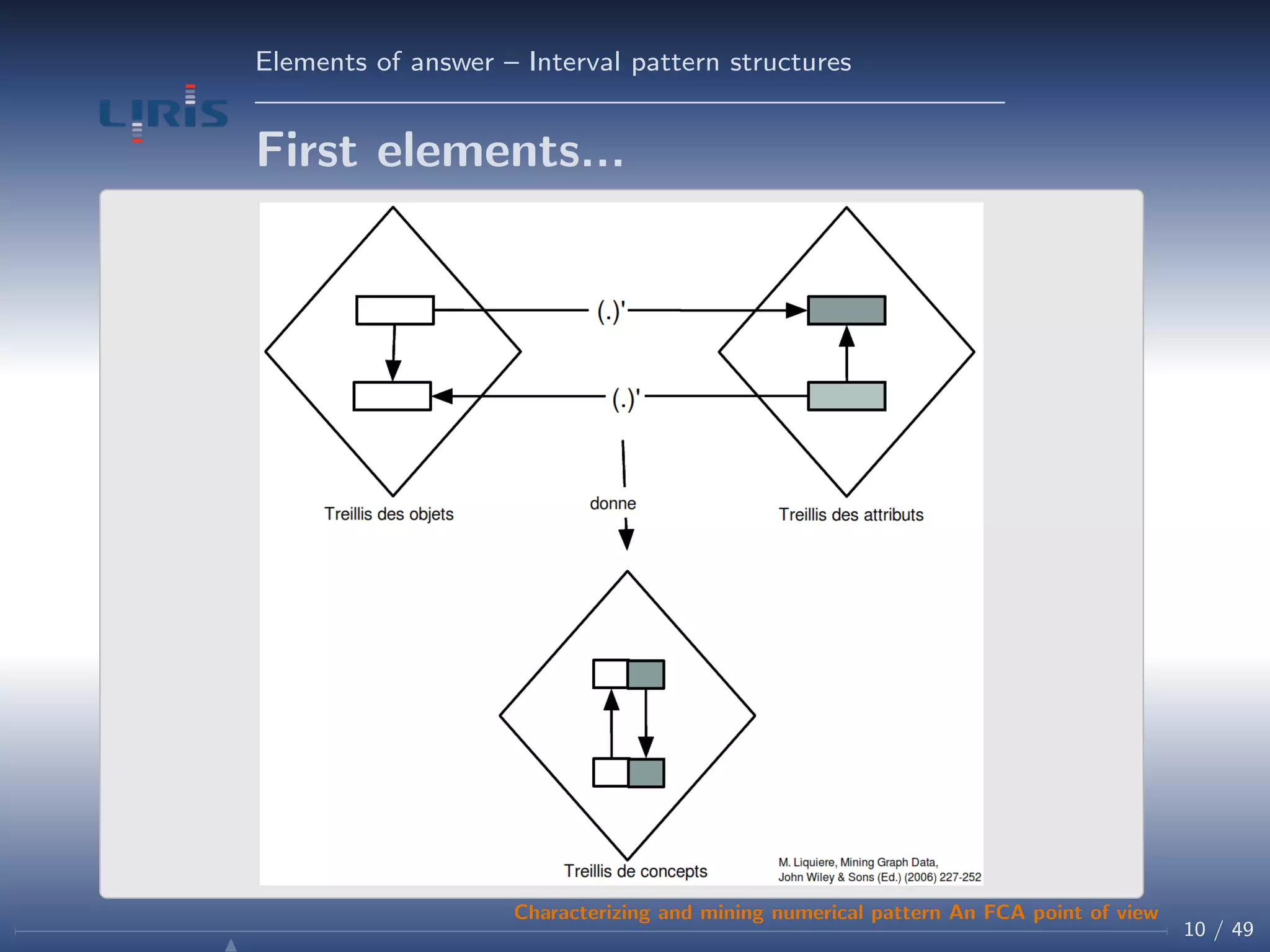
First elements...
10 / 49
Characterizing and mining numerical pattern An FCA point of view
Elements of answer – Interval pattern structures
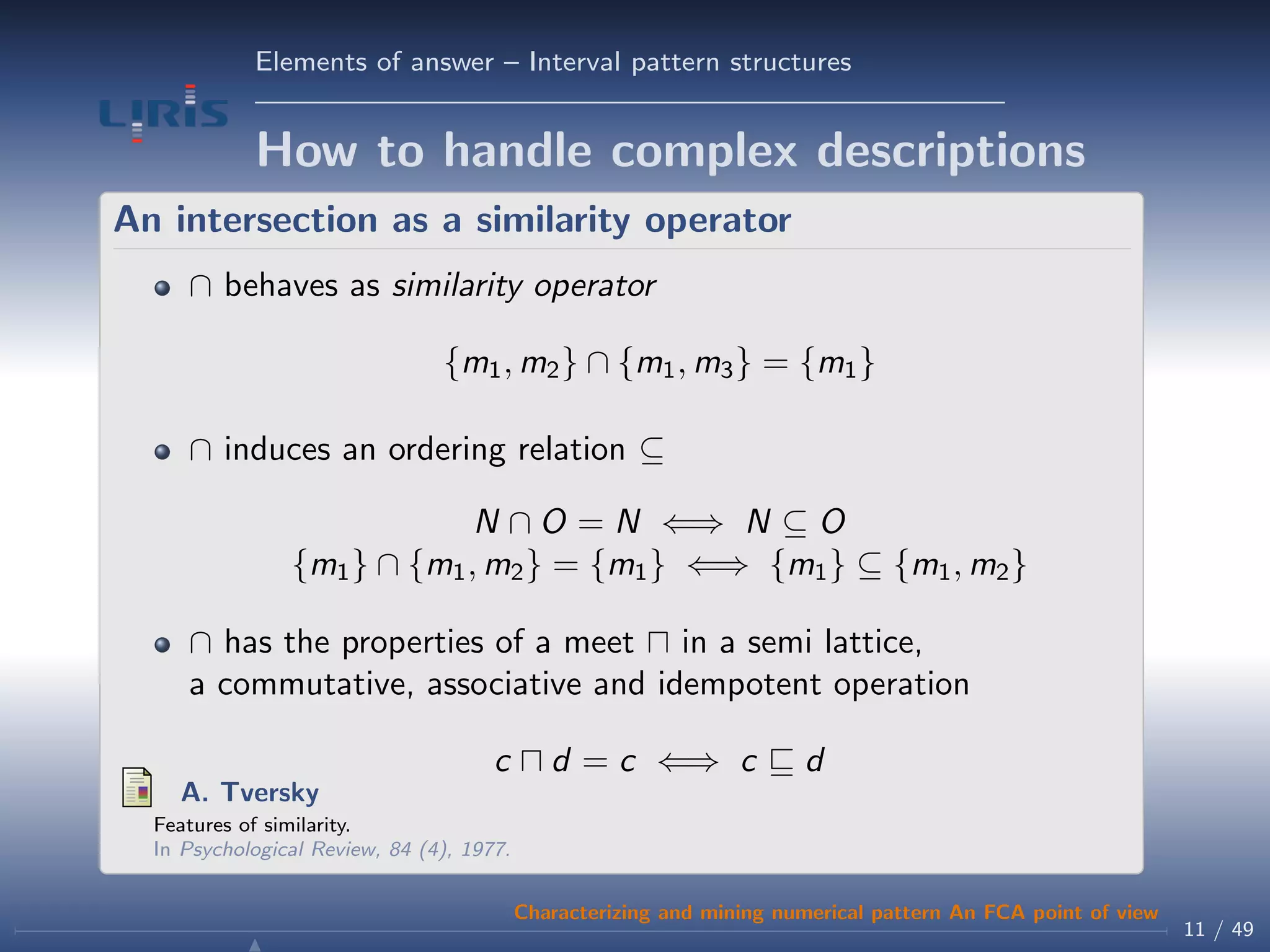
How to handle complex descriptions
An intersection as a similarity operator
∩ behaves as similarity operator
{m1, m2} ∩ {m1, m3} = {m1}
∩ induces an ordering relation ⊆
N ∩ O = N ⇐⇒ N ⊆ O
{m1} ∩ {m1, m2} = {m1} ⇐⇒ {m1} ⊆ {m1, m2}
∩ has the properties of a meet in a semi lattice,
a commutative, associative and idempotent operation
c d = c ⇐⇒ c d
A. Tversky
Features of similarity.
In Psychological Review, 84 (4), 1977.
11 / 49
Characterizing and mining numerical pattern An FCA point of view
Elements of answer – Interval pattern structures
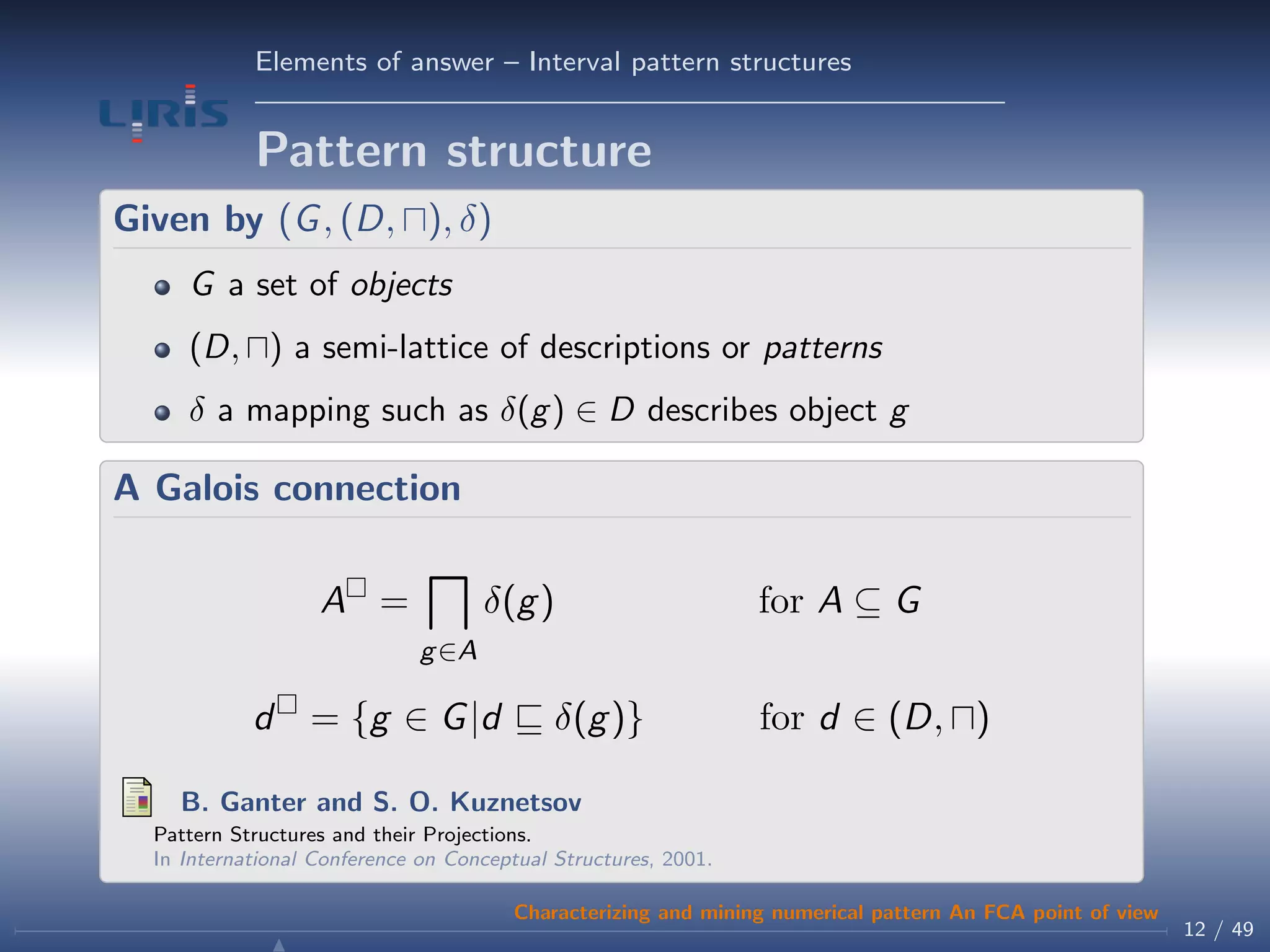
Pattern structure
Given by (G, (D, ), δ)
G a set of objects
(D, ) a semi-lattice of descriptions or patterns
δ a mapping such as δ(g) ∈ D describes object g
A Galois connection
A =
g∈A
δ(g) for A ⊆ G
d = {g ∈ G|d δ(g)} for d ∈ (D, )
B. Ganter and S. O. Kuznetsov
Pattern Structures and their Projections.
In International Conference on Conceptual Structures, 2001.
12 / 49
Characterizing and mining numerical pattern An FCA point of view
Elements of answer – Interval pattern structures
Ordering descriptions in numerical data
(D, ) as a meet-semi-lattice with as a “convexification”
m1 m2 m3
g1 5 7 6
g2 6 8 4
g3 4 8 5
g4 4 9 8
g5 5 8 5
4 5 6
[4,5] [5,6]
[4,6]
13 / 49
Characterizing and mining numerical pattern An FCA point of view
Elements of answer – Interval pattern structures
Numerical data are pattern structures
Interval pattern structures
m1 m2 m3
g1 5 7 6
g2 6 8 4
g3 4 8 5
g4 4 9 8
g5 5 8 5
{g1, g2} =
g∈{g1,g2}
δ(g)
= 5, 7, 6 6, 8, 4
= [5, 6], [7, 8], [4, 6]
[5, 6], [7, 8], [4, 6] = {g ∈ G| [5, 6], [7, 8], [4, 6] δ(g)}
= {g1, g2, g5}
({g1, g2, g5}, [5, 6], [7, 8], [4, 6] ) is a (pattern) concept
14 / 49
Characterizing and mining numerical pattern An FCA point of view
Elements of answer – Interval pattern structures
Interval pattern concept lattice
Existing algorithms
Lowest concepts: few objects, small intervals
Highest concepts: many objects, large intervals
Concept/pattern overwhelming
15 / 49
Characterizing and mining numerical pattern An FCA point of view
Elements of answer – Interval pattern structures
Links with conceptual scaling
Interordinal scaling [Ganter & Wille]
A scale to encode intervals of attribute values
m1 ≤ 4 m1 ≤ 5 m1 ≤ 6 m1 ≥ 4 m1 ≥ 5 m1 ≥ 6
4 × × × ×
5 × × × ×
6 × × × ×
Equivalent concept lattice
({g1, g2, g5}, {m1 ≤ 6, m1 ≥ 4, m1 ≥ 5, ... , ... })
({g1, g2, g5}, [5, 6] , ... , ... )
Why should we use pattern structures as we have scaling?
Processing a pattern structure is more efficient
M. Kaytoue, S. O. Kuznetsov, A. Napoli and S. Duplessis
Mining Gene Expression Data with Pattern Structures in Formal Concept Analysis.
In Information Sciences. Spec. Iss.: Lattices (Elsevier), 181(10): 1989-2001 (2011).
16 / 49
Characterizing and mining numerical pattern An FCA point of view
Elements of answer – Towards condensed representations
Outline
1 Introducing Formal Concept Analysis
2 Main research question
3 Elements of answer
Interval pattern structures
Towards condensed representations
Introducing similarity
Extracting biclusters of similar values
Triadic Concept Analysis for biclustering
4 Conclusion and perspectives
17 / 49
Characterizing and mining numerical pattern An FCA point of view
Elements of answer – Towards condensed representations
Interval pattern search space
Counting all possible interval patterns
[am1 , bm1 ], [am2 , bm2 ], ...
where ami , bmi ∈ Wmi
m1 m2 m3
g1 5 7 6
g2 6 8 4
g3 4 8 5
g4 4 9 8
g5 5 8 5
i∈{1,...,|M|}
|Wmi | × (|Wmi | + 1)
2
360 possible interval patterns in our small example
M. Kaytoue, S. O. Kuznetsov, and A. Napoli
Revisiting Numerical Pattern Mining with Formal Concept Analysis.
In International Joint Conference on Artificial Intelligence (IJCAI), 2011.
18 / 49
Characterizing and mining numerical pattern An FCA point of view
Elements of answer – Towards condensed representations
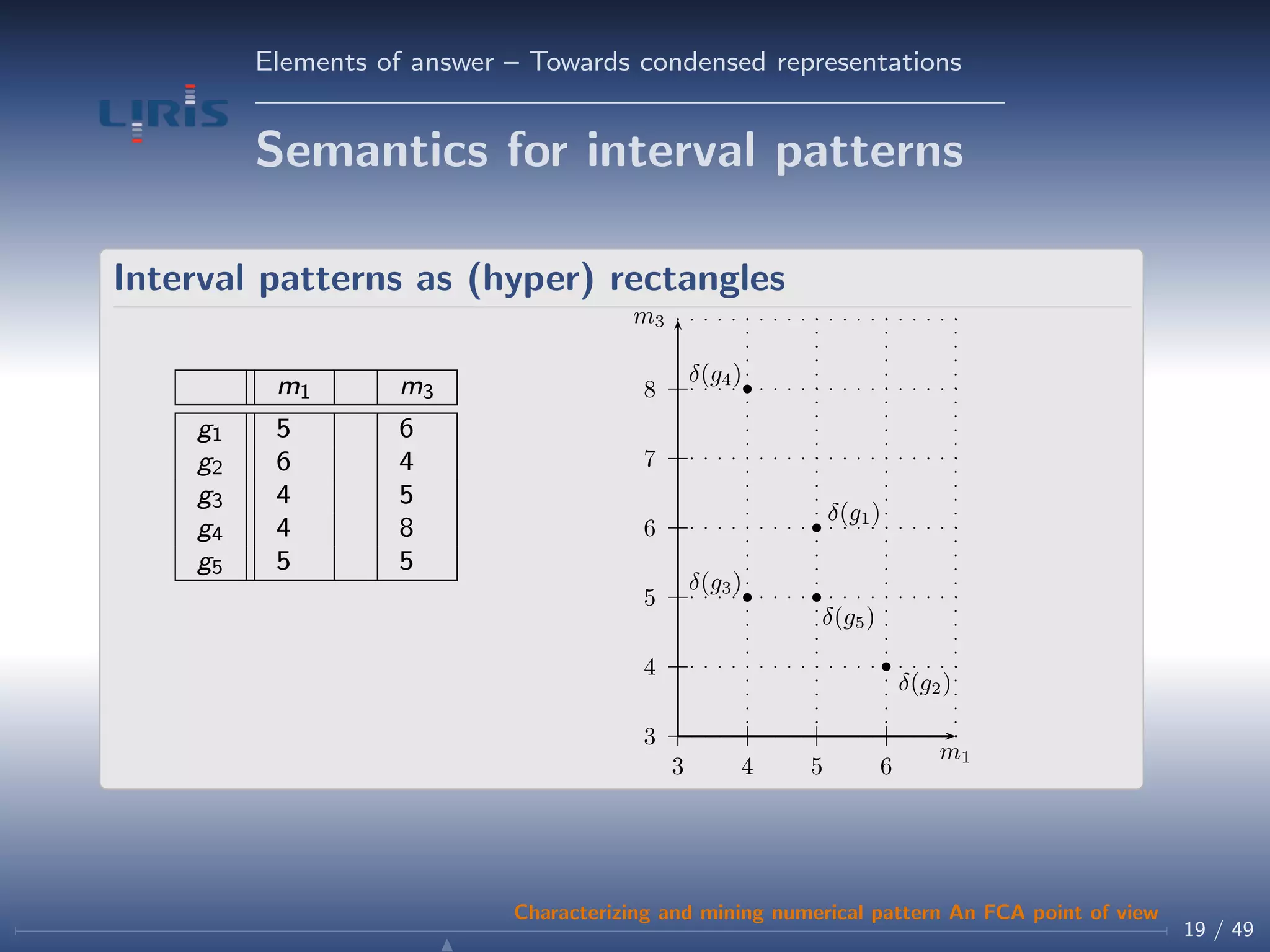
Semantics for interval patterns
Interval patterns as (hyper) rectangles
m1 m3
g1 5 6
g2 6 4
g3 4 5
g4 4 8
g5 5 5
3
4
5
6
7
8
3 4 5 6
m1
m3
δ(g1)
δ(g2)
δ(g3)
δ(g4)
δ(g5)
19 / 49
Characterizing and mining numerical pattern An FCA point of view
Elements of answer – Towards condensed representations
Semantics for interval patterns
Interval patterns as (hyper) rectangles
m1 m3
g1 5 6
g2 6 4
g3 4 5
g4 4 8
g5 5 5
[4, 5], [5, 6] = {g1, g3, g5}
3
4
5
6
7
8
3 4 5 6
m1
m3
δ(g1)
δ(g2)
δ(g3)
δ(g4)
δ(g5)
19 / 49
Characterizing and mining numerical pattern An FCA point of view
Elements of answer – Towards condensed representations
Semantics for interval patterns
Interval patterns as (hyper) rectangles
m1 m3
g1 5 6
g2 6 4
g3 4 5
g4 4 8
g5 5 5
[4, 5], [5, 6] = {g1, g3, g5}
[4, 5], [4, 6] = {g1, g3, g5}
3
4
5
6
7
8
3 4 5 6
m1
m3
δ(g1)
δ(g2)
δ(g3)
δ(g4)
δ(g5)
19 / 49
Characterizing and mining numerical pattern An FCA point of view
Elements of answer – Towards condensed representations
Semantics for interval patterns
Interval patterns as (hyper) rectangles
m1 m3
g1 5 6
g2 6 4
g3 4 5
g4 4 8
g5 5 5
[4, 5], [5, 6] = {g1, g3, g5}
[4, 5], [4, 6] = {g1, g3, g5}
[4, 6], [5, 6] = {g1, g3, g5} 3
4
5
6
7
8
3 4 5 6
m1
m3
δ(g1)
δ(g2)
δ(g3)
δ(g4)
δ(g5)
19 / 49
Characterizing and mining numerical pattern An FCA point of view
Elements of answer – Towards condensed representations
A condensed representation
Equivalence classes of interval patterns
Two interval patterns with same image are said to be equivalent
c ∼= d ⇐⇒ c = d
Equivalence class of a pattern d
[d] = {c|c ∼= d}
with a unique closed pattern: the smallest rectangle
and one or several generators: the largest rectangles
Y. Bastide, R. Taouil, N. Pasquier, G. Stumme, and L. Lakhal.
Mining frequent patterns with counting inference.
SIGKDD Expl., 2(2):66–75, 2000.
In our example: 360 patterns ; 18 closed ; 44 generators
20 / 49
Characterizing and mining numerical pattern An FCA point of view
Elements of answer – Towards condensed representations
A condensed representation
Remarks
4 5 6
[4,5] [5,6]
[4,6]
Compression rate varies between 107
and 109
Interordinal scaling: encodes 30.000 binary patterns
not efficient even with best algorithms (e.g. LCMv2)
redundancy problem discarding its use for generator extraction
MDL, quantitative association rule mining, k-anonymisation
Need of fault-tolerant condensed representations
21 / 49
Characterizing and mining numerical pattern An FCA point of view
Elements of answer – Introducing similarity
Outline
1 Introducing Formal Concept Analysis
2 Main research question
3 Elements of answer
Interval pattern structures
Towards condensed representations
Introducing similarity
Extracting biclusters of similar values
Triadic Concept Analysis for biclustering
4 Conclusion and perspectives
22 / 49
Characterizing and mining numerical pattern An FCA point of view
Elements of answer – Introducing similarity
Introducing a similarity relation
Grouping in a same concept objects having similar values?
A natural similarity relation on numbers
a θ b ⇔ |a − b| ≤ θ e.g. 4 1 5 4 1 6
Similarity operator in pattern structures
4 5 6
[4,5] [5,6]
[4,6]
How to consider a similarity relation w.r.t. a distance?
23 / 49
Characterizing and mining numerical pattern An FCA point of view
Elements of answer – Introducing similarity
Introducing a similarity relation
Grouping in a same concept objects having similar values?
A natural similarity relation on numbers
a θ b ⇔ |a − b| ≤ θ e.g. 4 1 5 4 1 6
Similarity operator in pattern structures
θ = 2
4 5 6
[4,5] [5,6]
[4,6]
How to consider a similarity relation w.r.t. a distance?
23 / 49
Characterizing and mining numerical pattern An FCA point of view
Elements of answer – Introducing similarity
Introducing a similarity relation
Grouping in a same concept objects having similar values?
A natural similarity relation on numbers
a θ b ⇔ |a − b| ≤ θ e.g. 4 1 5 4 1 6
Similarity operator in pattern structures
θ = 1
4 5 6
[4,5] [5,6]
[4,6]
How to consider a similarity relation w.r.t. a distance?
23 / 49
Characterizing and mining numerical pattern An FCA point of view
Elements of answer – Introducing similarity
Introducing a similarity relation
Grouping in a same concept objects having similar values?
A natural similarity relation on numbers
a θ b ⇔ |a − b| ≤ θ e.g. 4 1 5 4 1 6
Similarity operator in pattern structures
θ = 04 5 6
[4,5] [5,6]
[4,6]
How to consider a similarity relation w.r.t. a distance?
23 / 49
Characterizing and mining numerical pattern An FCA point of view
Elements of answer – Introducing similarity
Towards a similarity between values
Introduce an element ∗ ∈ (D, ) denoting dissimilarity
c d = ∗ iff c θ d
c d = ∗ iff c θ d
Example with θ = 1
m1 m2 m3
g1 5 7 6
g2 6 8 4
g3 4 8 5
g4 4 9 8
g5 5 8 5
{g3, g4} = [4, 4], [8, 9], ∗
[4, 4], [8, 9], ∗ = {g3, g4}
({g3, g4}, [4, 4], [8, 9], ∗ ) is a pattern concept:
g3 and g4 have similar values for attributes m1 and m2 only
24 / 49
Characterizing and mining numerical pattern An FCA point of view
Elements of answer – Introducing similarity
Towards a similarity between values
Introduce an element ∗ ∈ (D, ) denoting dissimilarity
c d = ∗ iff c θ d
c d = ∗ iff c θ d
Example with θ = 1
m1 m2 m3
g1 5 7 6
g2 6 8 4
g3 4 8 5
g4 4 9 8
g5 5 8 5
{g3, g4} = [4, 4], [8, 9], ∗
[4, 4], [8, 9], ∗ = {g3, g4}
({g3, g4}, [4, 4], [8, 9], ∗ ) is a pattern concept:
g3 and g4 have similar values for attributes m1 and m2 only
Is {g3, g4} maximal w.r.t. similarity? We can add g5...
24 / 49
Characterizing and mining numerical pattern An FCA point of view
Elements of answer – Introducing similarity
Classes of tolerance in numerical data
Towards maximal sets of similar values
θ a tolerance relation : reflexive, symmetric, not transitive
Consider an attribute taking values in {6, 8, 11, 16, 17} and θ = 5
8 5 11, 11 5 16 but 8 5 16
A class of tolerance as a maximal set of pairwise similar values
{6, 8, 11} {11, 16} {16, 17}
[6, 11] [11, 16] [16, 17]
S. O. Kuznetsov
Galois Connections in Data Analysis: Contributions from the Soviet Era and Modern Russian Research.
In Formal Concept Analysis, Foundations and Applications, 2005.
25 / 49
Characterizing and mining numerical pattern An FCA point of view
Elements of answer – Introducing similarity
Tolerance in pattern structures
Projecting the pattern structure
Each value is replaced by the interval characterizing its class of
tolerance (if unique)
Each pattern d is projected with a mapping ψ(d) d
(pre-processing)
rod
Example with θ = 1
m1 m2 m3
g1 5 7 6
g2 6 8 4
g3 4 8 5
g4 4 9 8
g5 5 8 5
{g3, g4} = ψ( [4, 4], [8, 9], ∗ )
= [4, 5], [8, 9], ∗
[4, 5], [8, 9], ∗ = {g3, g4, g5}
26 / 49
Characterizing and mining numerical pattern An FCA point of view
Elements of answer – Introducing similarity
Similarity and scaling
m1 m2 m3
g1 6 0 [1, 2]
g2 8 4 [2, 5]
g3 11 8 [4, 5]
g4 16 8 [6, 9]
g5 17 12 [7, 10]
5 6 8 11 16 17
6 × × ×
8 × × ×
11 × × × ×
16 × × ×
17 × ×
(m1,11)
(m1,16)
(m1,[6,11])
(m1,[11,16])
(m1,[16,17])
(m2,4)
(m2,8)
(m2,[0,4])
(m2,[4,8])
(m2,[8,12])
(m3,[1,5])
(m3,[4,9])
(m3,[6,10])
(m3,[4,5])
(m3,[6,9])
g1 × × ×
g2 × × × × ×
g3 × × × × × × × × ×
g4 × × × × × × × × ×
g5 × × ×
27 / 49
Characterizing and mining numerical pattern An FCA point of view
Elements of answer – Extracting biclusters of similar values
Outline
1 Introducing Formal Concept Analysis
2 Main research question
3 Elements of answer
Interval pattern structures
Towards condensed representations
Introducing similarity
Extracting biclusters of similar values
Triadic Concept Analysis for biclustering
4 Conclusion and perspectives
28 / 49
Characterizing and mining numerical pattern An FCA point of view
Elements of answer – Extracting biclusters of similar values
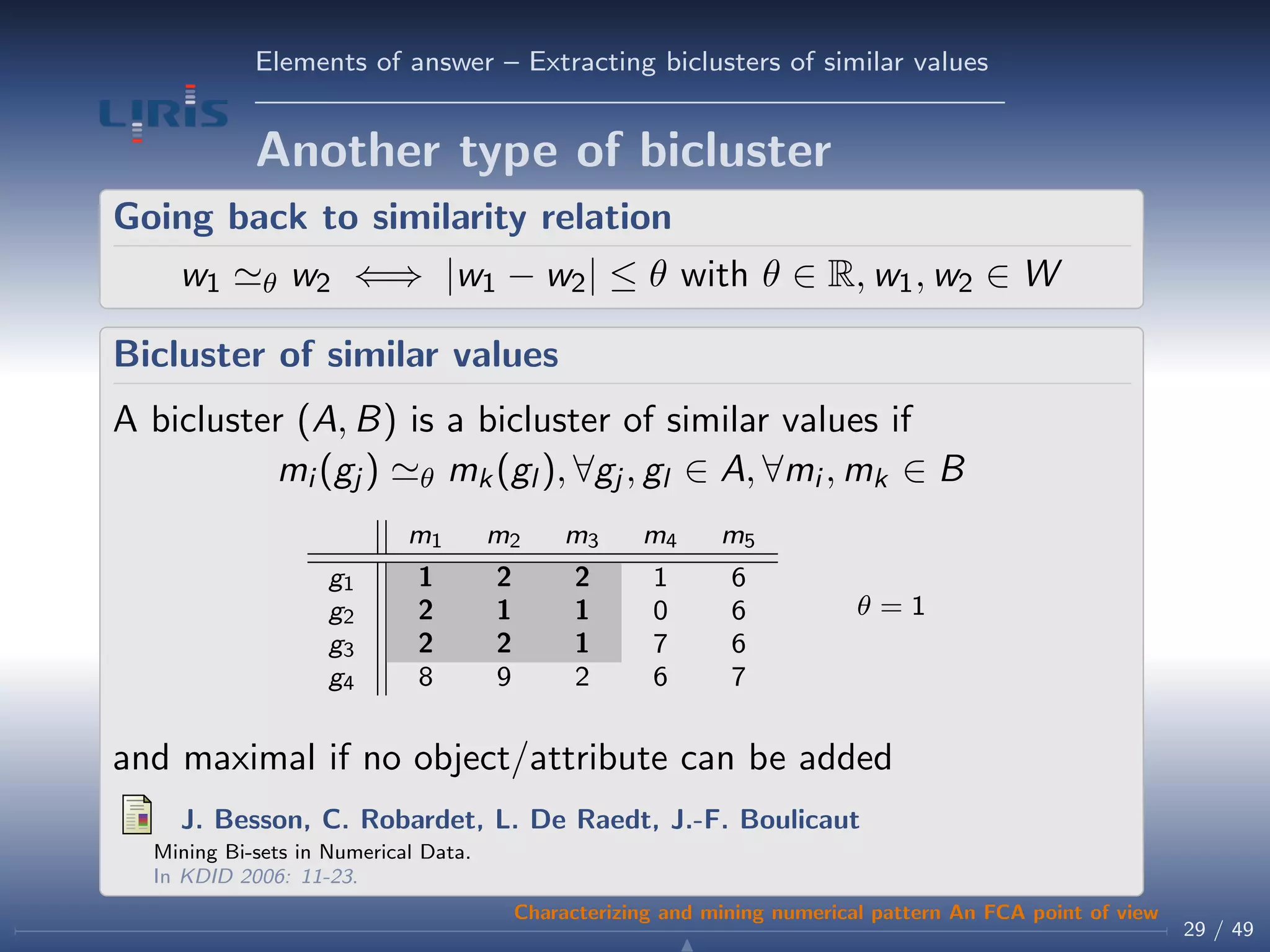
Another type of bicluster
Going back to similarity relation
w1 θ w2 ⇐⇒ |w1 − w2| ≤ θ with θ ∈ R, w1, w2 ∈ W
Bicluster of similar values
A bicluster (A, B) is a bicluster of similar values if
mi (gj ) θ mk(gl ), ∀gj , gl ∈ A, ∀mi , mk ∈ B
m1 m2 m3 m4 m5
g1 1 2 2 1 6
g2 2 1 1 0 6
g3 2 2 1 7 6
g4 8 9 2 6 7
θ = 1
and maximal if no object/attribute can be added
J. Besson, C. Robardet, L. De Raedt, J.-F. Boulicaut
Mining Bi-sets in Numerical Data.
In KDID 2006: 11-23.
29 / 49
Characterizing and mining numerical pattern An FCA point of view
Elements of answer – Extracting biclusters of similar values
Can we use the interval pattern lattice?
Concept example ({g2, g3}, [2, 2], [1, 2], [1, 1], [0, 7], [6, 6] )
m1 m2 m3 m4 m5
g1 1 2 2 1 6
g2 2 1 1 0 6
g3 2 2 1 7 6
g4 8 9 2 6 7
θ = 1
3 statements to verify
Some intervals have a “size” larger than θ
Some values in two different columns may not be similar
Rectangle may not be maximal
M. Kaytoue, S. O. Kuznetsov, and A. Napoli
Biclustering Numerical Data in Formal Concept Analysis.
In International Conference on Formal Concept Analysis (ICFCA), 2011.
30 / 49
Characterizing and mining numerical pattern An FCA point of view
Elements of answer – Extracting biclusters of similar values
First statement
Avoiding intervals with size larger than θ
[a1, b1] [a2, b2] =
[min(a1, a2), max(b1, b2)] if|max(b1, b2) − min(a1, a2)| ≤ θ
∗ otherwise
Going back to our example, with θ = 1
({g2, g3}, [2, 2], [1, 2], [1, 1], ∗, [6, 6] )
m1 m2 m3 m4 m5
g1 1 2 2 1 6
g2 2 1 1 0 6
g3 2 2 1 7 6
g4 8 9 2 6 7
31 / 49
Characterizing and mining numerical pattern An FCA point of view
Elements of answer – Extracting biclusters of similar values
Second statement
Values from two columns should be similar
From
({g2, g3}, [2, 2], [1, 2], [1, 1], ∗, [6, 6] )
we group attributes such as their values form a class of tolerance:
m1 m2 m3 m4 m5
g1 1 2 2 1 6
g2 2 1 1 0 6
g3 2 2 1 7 6
g4 8 9 2 6 7
m1 m2 m3 m4 m5
g1 1 2 2 1 6
g2 2 1 1 0 6
g3 2 2 1 7 6
g4 8 9 2 6 7
({g2, g3}, {m1, m2, m3}) ({g2, g3}, {m5})
32 / 49
Characterizing and mining numerical pattern An FCA point of view
Elements of answer – Extracting biclusters of similar values
Third statement
Maximal bicluster of similar values
⊥
({g1}, 1, 2, 2, 1,6 ) ({g2}, 2,1,1, 0,6 ) ({g3}, 2,2,1,7,6 ) ({g4}, 8, 9,2,6,7 )
({g1, g2},
[1,2],[1,2],[1,2], [0, 1],6 )
({g1, g3},
[1,2],2,[1,2], ∗,6 )
({g2, g3},
2,[1,2],1, ∗,6
({g3, g4},
∗, ∗, [1,2], [6, 7], [6, 7] )
({g1, g2, g3},
[1, 2], [1, 2], [1, 2], ∗,6 )
({g1, g2, g3, g4},
∗, ∗, [1, 2], ∗, [6, 7] )
Constructing maximal biclusters: bottom-up/top-down
33 / 49
Characterizing and mining numerical pattern An FCA point of view
Elements of answer – Triadic Concept Analysis for biclustering
Outline
1 Introducing Formal Concept Analysis
2 Main research question
3 Elements of answer
Interval pattern structures
Towards condensed representations
Introducing similarity
Extracting biclusters of similar values
Triadic Concept Analysis for biclustering
4 Conclusion and perspectives
34 / 49
Characterizing and mining numerical pattern An FCA point of view
Elements of answer – Triadic Concept Analysis for biclustering
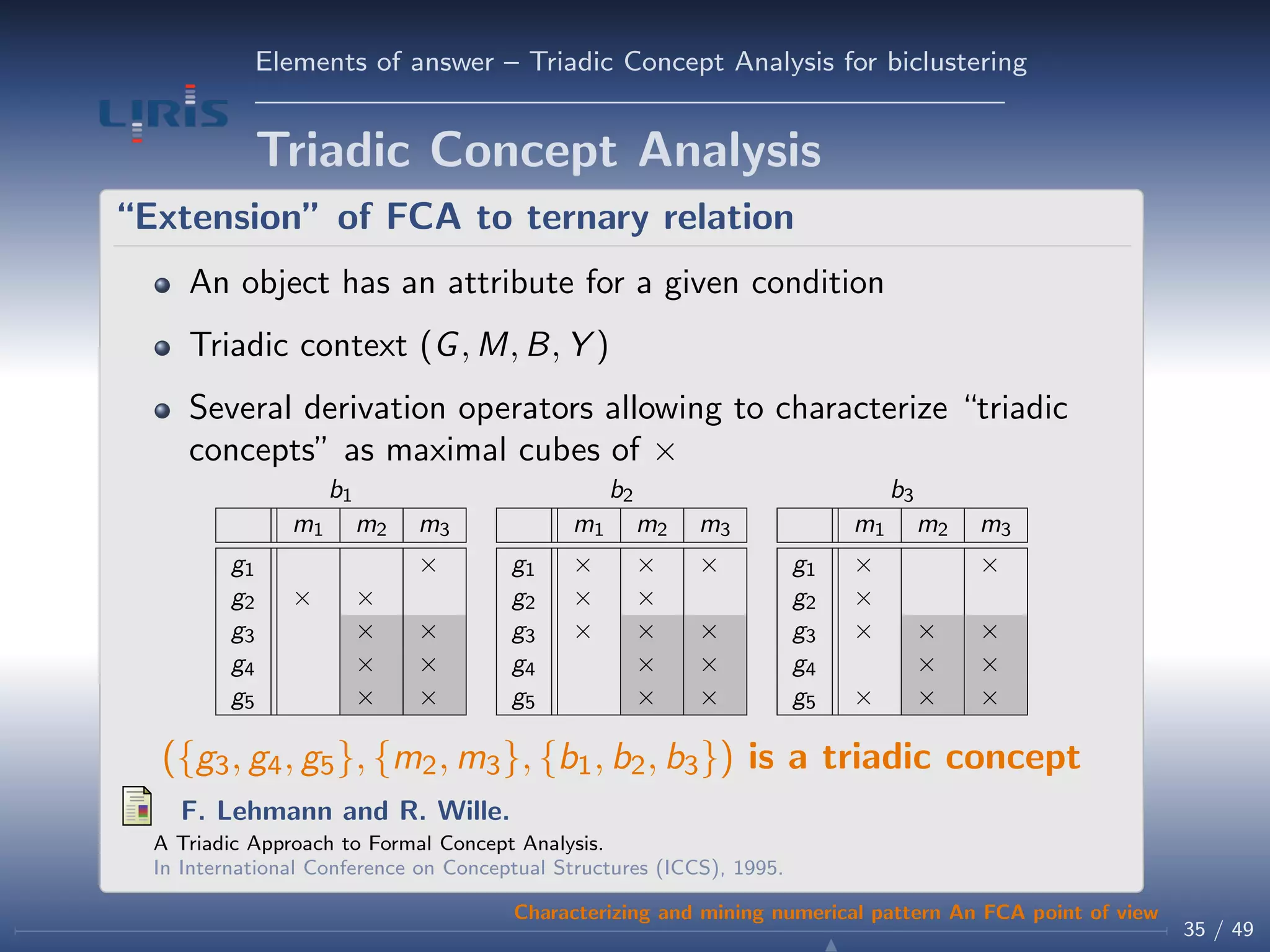
Triadic Concept Analysis
“Extension” of FCA to ternary relation
An object has an attribute for a given condition
Triadic context (G, M, B, Y )
Several derivation operators allowing to characterize “triadic
concepts” as maximal cubes of ×
b1 b2 b3
m1 m2 m3
g1 ×
g2 × ×
g3 × ×
g4 × ×
g5 × ×
m1 m2 m3
g1 × × ×
g2 × ×
g3 × × ×
g4 × ×
g5 × ×
m1 m2 m3
g1 × ×
g2 ×
g3 × × ×
g4 × ×
g5 × × ×
({g3, g4, g5}, {m2, m3}, {b1, b2, b3}) is a triadic concept
F. Lehmann and R. Wille.
A Triadic Approach to Formal Concept Analysis.
In International Conference on Conceptual Structures (ICCS), 1995.
35 / 49
Characterizing and mining numerical pattern An FCA point of view
Elements of answer – Triadic Concept Analysis for biclustering
Basic idea
Principle
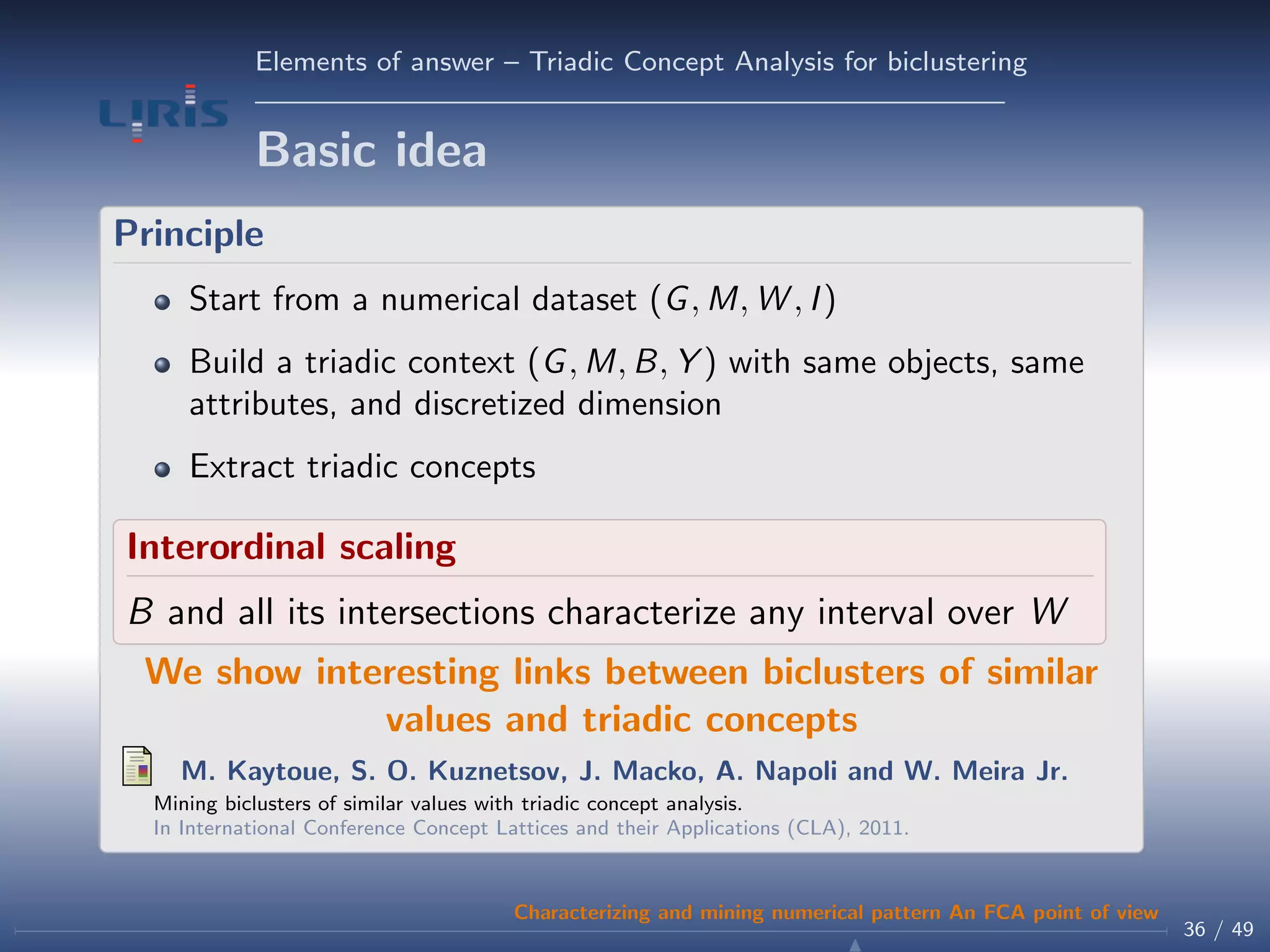
Start from a numerical dataset (G, M, W , I)
Build a triadic context (G, M, B, Y ) with same objects, same
attributes, and discretized dimension
Extract triadic concepts
Interordinal scaling
B and all its intersections characterize any interval over W
We show interesting links between biclusters of similar
values and triadic concepts
M. Kaytoue, S. O. Kuznetsov, J. Macko, A. Napoli and W. Meira Jr.
Mining biclusters of similar values with triadic concept analysis.
In International Conference Concept Lattices and their Applications (CLA), 2011.
36 / 49
Characterizing and mining numerical pattern An FCA point of view
Elements of answer – Triadic Concept Analysis for biclustering
Discretization method
Interodinal scaling (existing discretization scale)
Let (G, M, W , I) be a numerical dataset (with W the set of
data-values.
Now consider the set
T = {[min(W ), w], ∀w ∈ W } ∪ {[w, max(W )], ∀w ∈ W }.
Known fact: T and all its intersections characterize any interval
of values on W .
Example
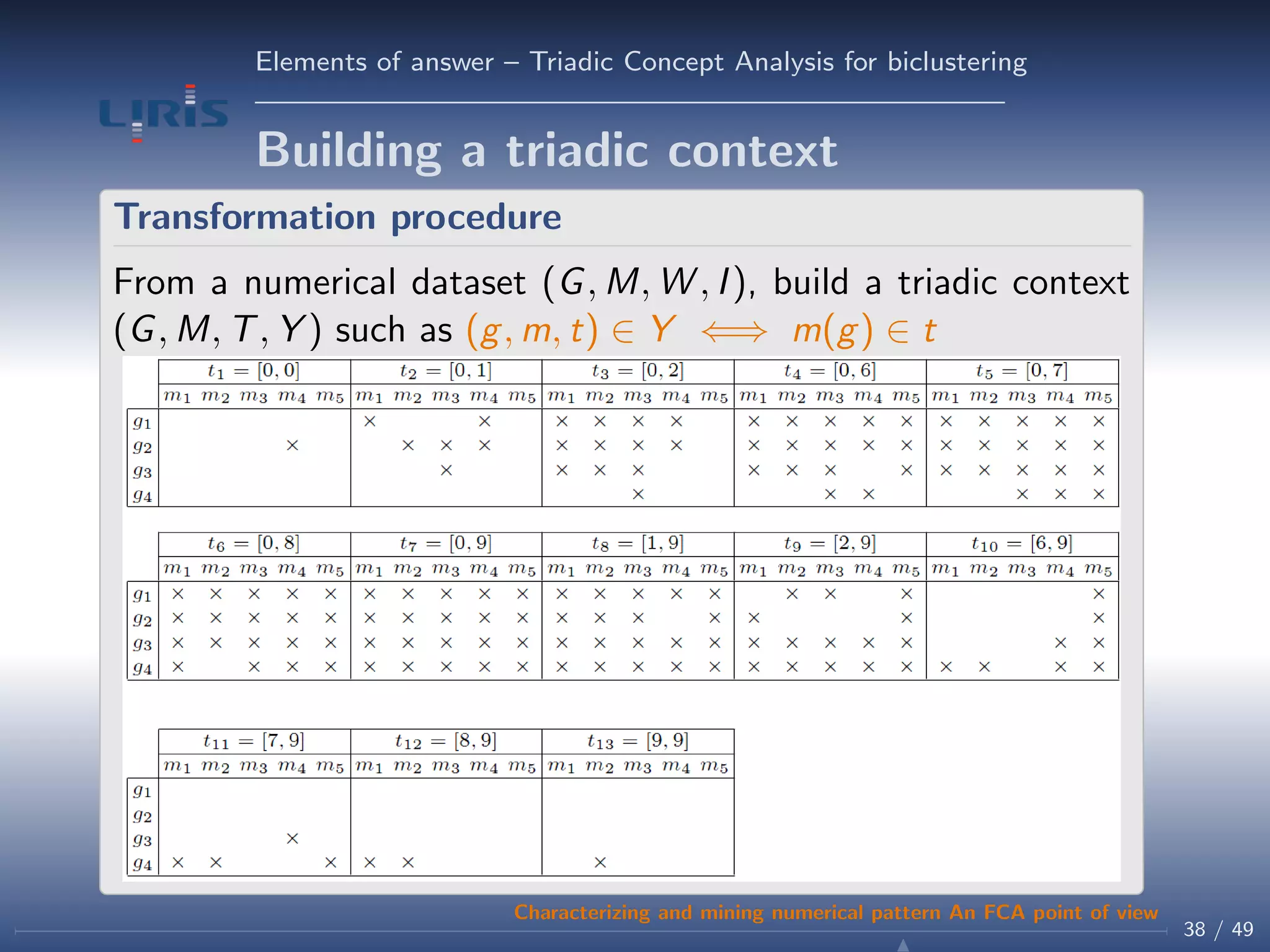
With W = {0, 1, 2, 6, 7, 8, 9}, one has
T = {[0, 0], [0, 1], [0, 2], ..., [0, 9], [1, 9], [2, 9], ..., [9, 9]}
and for example [0, 8] ∩ [2, 9] = [2, 8]
37 / 49
Characterizing and mining numerical pattern An FCA point of view
Elements of answer – Triadic Concept Analysis for biclustering
Building a triadic context
Transformation procedure
From a numerical dataset (G, M, W , I), build a triadic context
(G, M, T, Y ) such as (g, m, t) ∈ Y ⇐⇒ m(g) ∈ t
38 / 49
Characterizing and mining numerical pattern An FCA point of view
Elements of answer – Triadic Concept Analysis for biclustering
First contribution
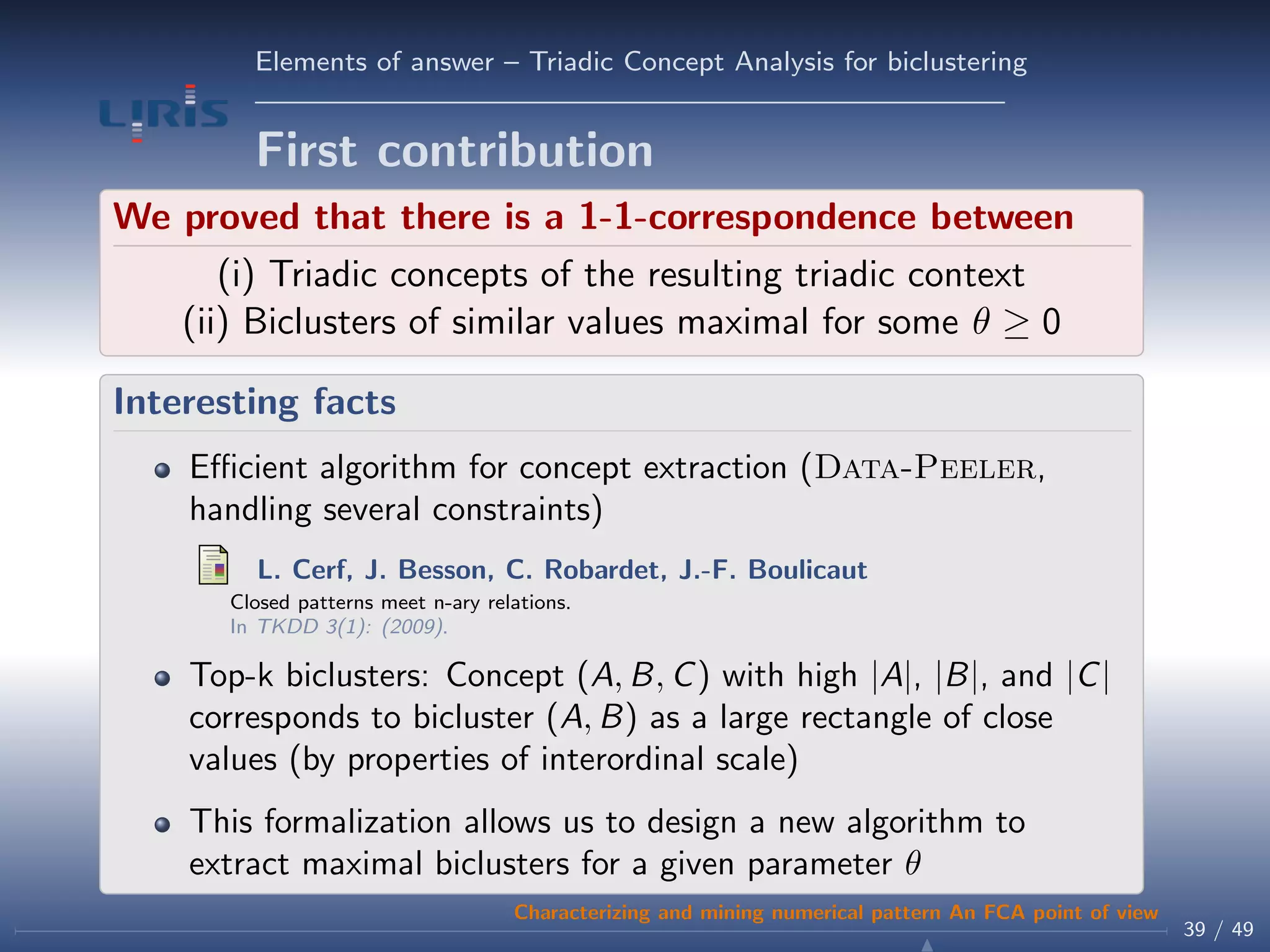
We proved that there is a 1-1-correspondence between
(i) Triadic concepts of the resulting triadic context
(ii) Biclusters of similar values maximal for some θ ≥ 0
Interesting facts
Efficient algorithm for concept extraction (Data-Peeler,
handling several constraints)
L. Cerf, J. Besson, C. Robardet, J.-F. Boulicaut
Closed patterns meet n-ary relations.
In TKDD 3(1): (2009).
Top-k biclusters: Concept (A, B, C) with high |A|, |B|, and |C|
corresponds to bicluster (A, B) as a large rectangle of close
values (by properties of interordinal scale)
This formalization allows us to design a new algorithm to
extract maximal biclusters for a given parameter θ
39 / 49
Characterizing and mining numerical pattern An FCA point of view
Elements of answer – Triadic Concept Analysis for biclustering
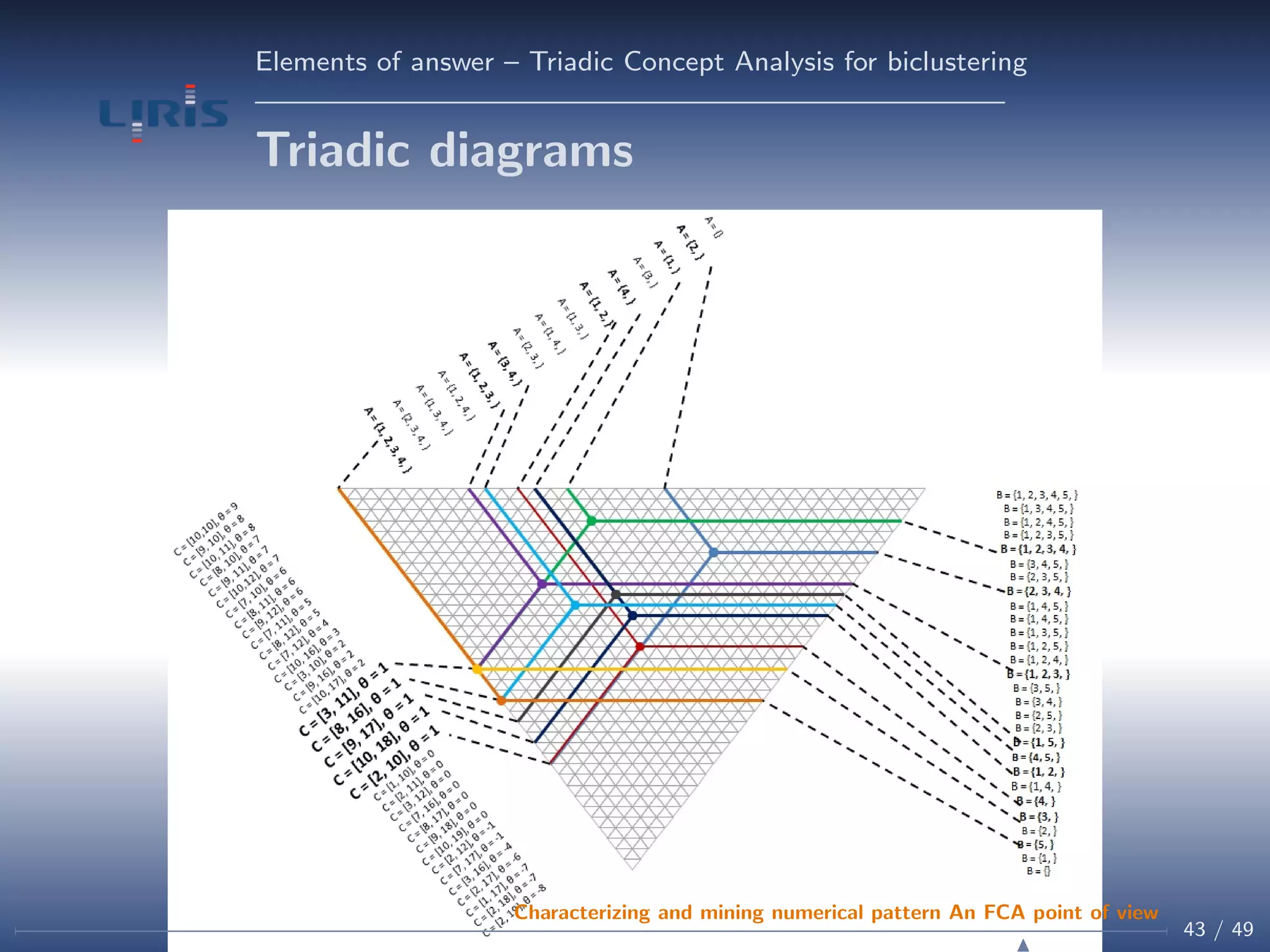
Triadic diagram
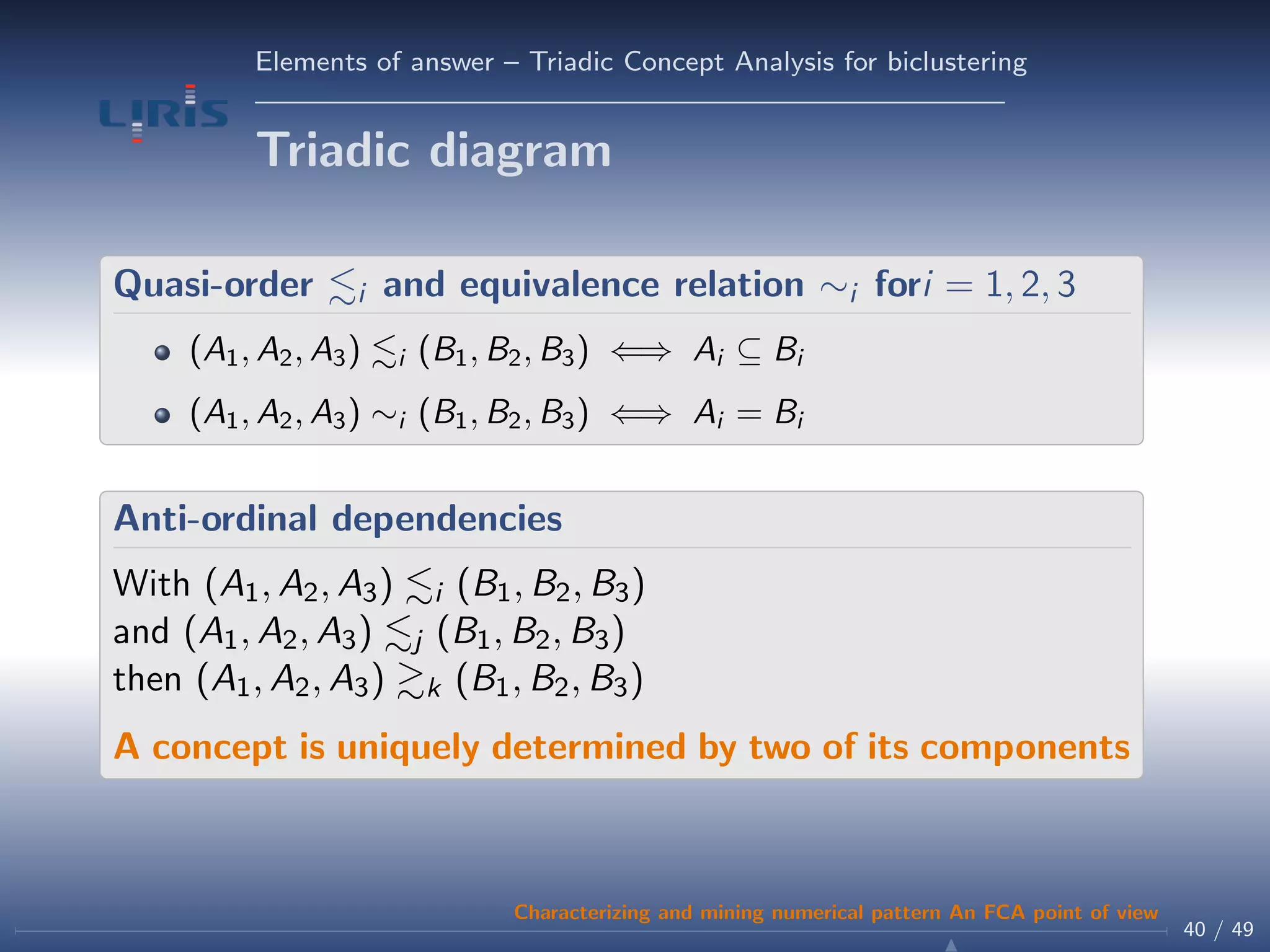
Quasi-order i and equivalence relation ∼i fori = 1, 2, 3
(A1, A2, A3) i (B1, B2, B3) ⇐⇒ Ai ⊆ Bi
(A1, A2, A3) ∼i (B1, B2, B3) ⇐⇒ Ai = Bi
Anti-ordinal dependencies
With (A1, A2, A3) i (B1, B2, B3)
and (A1, A2, A3) j (B1, B2, B3)
then (A1, A2, A3) k (B1, B2, B3)
A concept is uniquely determined by two of its components
40 / 49
Characterizing and mining numerical pattern An FCA point of view
Elements of answer – Triadic Concept Analysis for biclustering
Triadic diagram
Equivalence and factor sets, i = 1, 2, 3
[(A1, A2, A3)]i is the equivalence class of concepts w.r.t. ∼i
i induces an order ≤i on the factor set I(K)/ ∼i s.t.
[(A1, A2, A3)]i ≤ [(B1, B2, B3)]i ⇐⇒ Ai ⊆ Bi
(I(K)/ ∼i , ≤i ) is the ordered set of all extents
(i=1)/intents(i=2)/modus(i=3) of K
41 / 49
Characterizing and mining numerical pattern An FCA point of view
Elements of answer – Triadic Concept Analysis for biclustering
Triadic diagrams
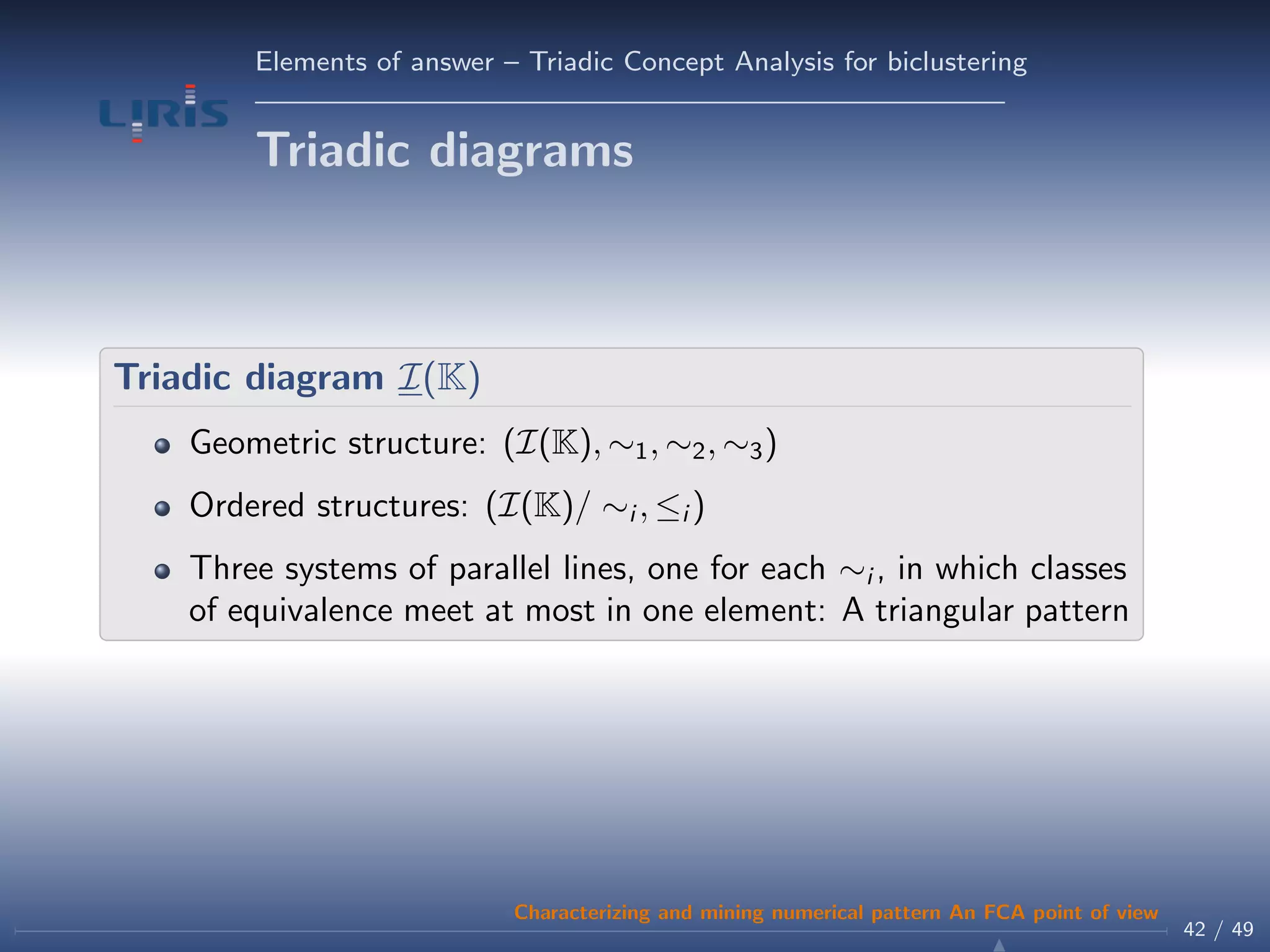
Triadic diagram I(K)
Geometric structure: (I(K), ∼1, ∼2, ∼3)
Ordered structures: (I(K)/ ∼i , ≤i )
Three systems of parallel lines, one for each ∼i , in which classes
of equivalence meet at most in one element: A triangular pattern
42 / 49
Characterizing and mining numerical pattern An FCA point of view
Elements of answer – Triadic Concept Analysis for biclustering
Triadic diagrams
43 / 49
Characterizing and mining numerical pattern An FCA point of view
Elements of answer – Triadic Concept Analysis for biclustering
Triadic diagrams
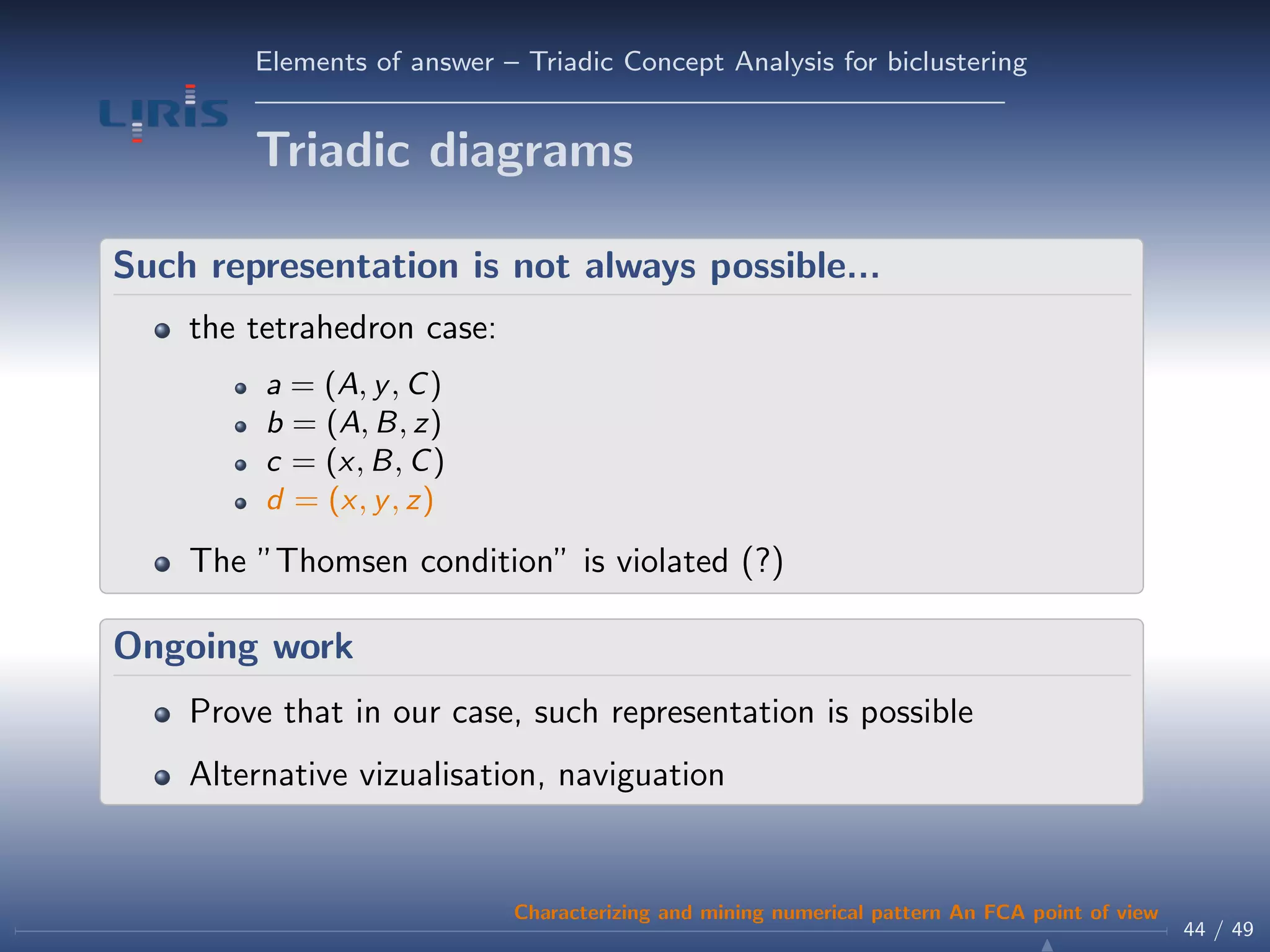
Such representation is not always possible...
the tetrahedron case:
a = (A, y, C)
b = (A, B, z)
c = (x, B, C)
d = (x, y, z)
The ”Thomsen condition” is violated (?)
Ongoing work
Prove that in our case, such representation is possible
Alternative vizualisation, naviguation
44 / 49
Characterizing and mining numerical pattern An FCA point of view
Elements of answer – Triadic Concept Analysis for biclustering
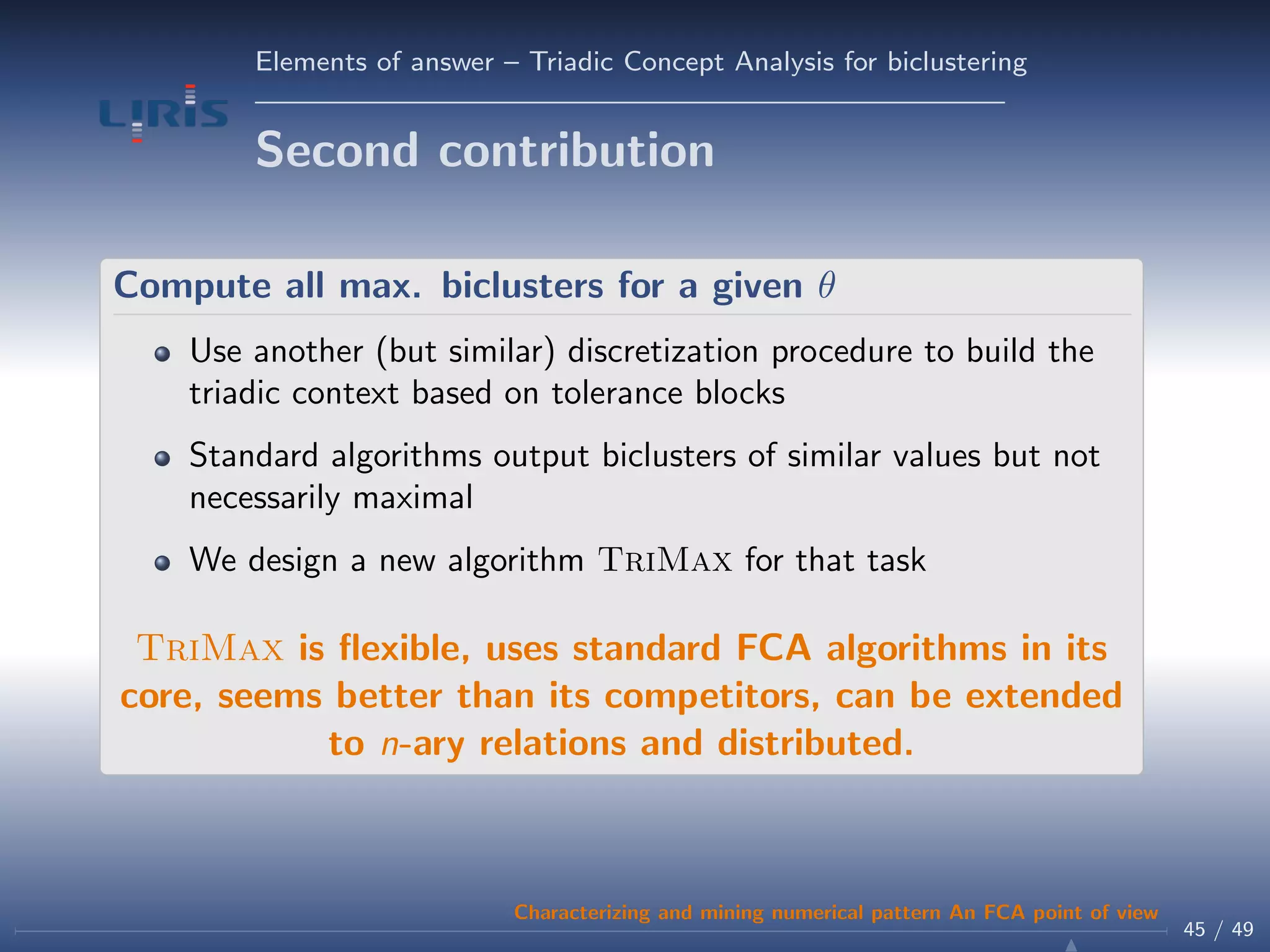
Second contribution
Compute all max. biclusters for a given θ
Use another (but similar) discretization procedure to build the
triadic context based on tolerance blocks
Standard algorithms output biclusters of similar values but not
necessarily maximal
We design a new algorithm TriMax for that task
TriMax is flexible, uses standard FCA algorithms in its
core, seems better than its competitors, can be extended
to n-ary relations and distributed.
45 / 49
Characterizing and mining numerical pattern An FCA point of view
Elements of answer – Triadic Concept Analysis for biclustering
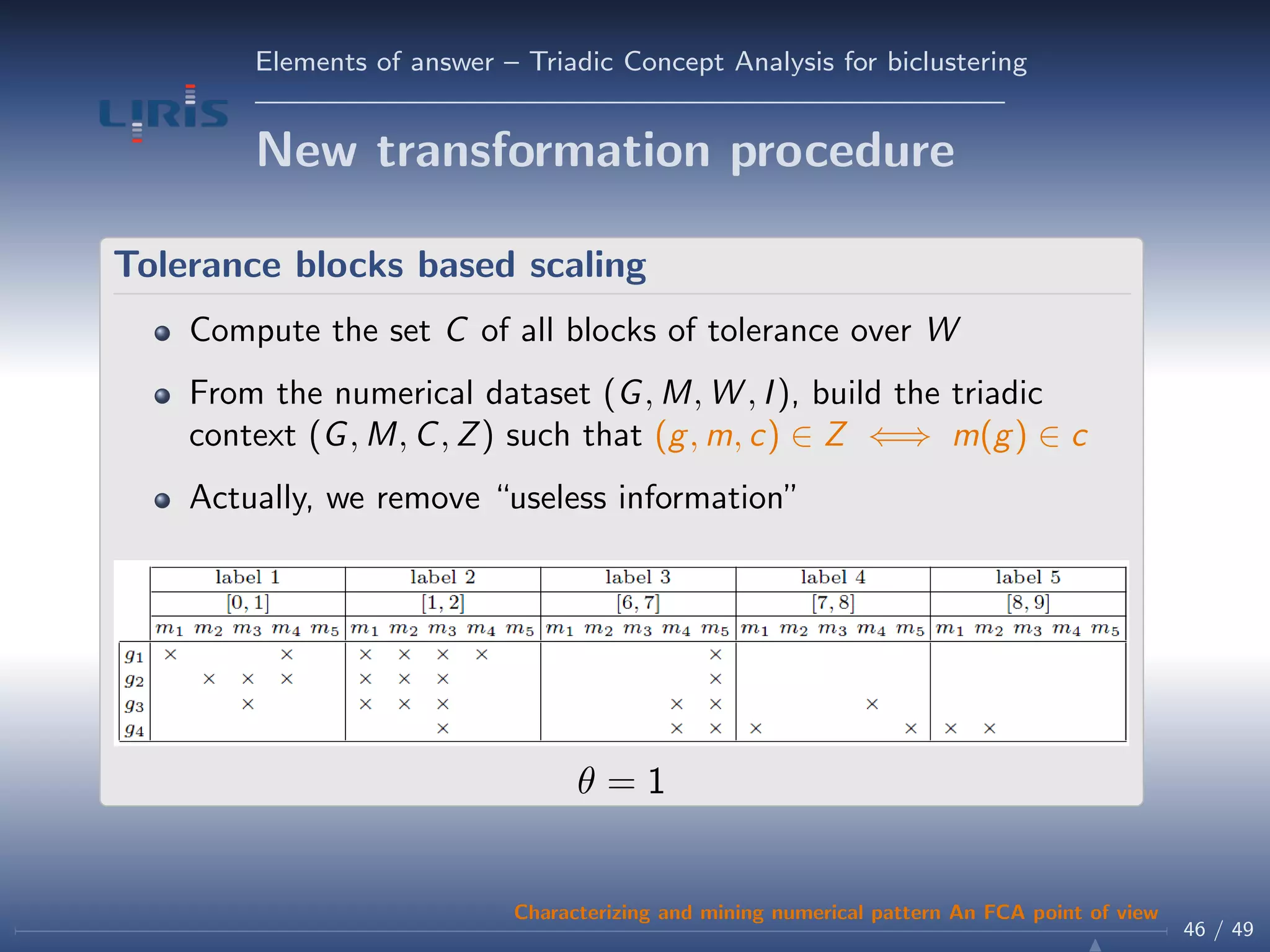
New transformation procedure
Tolerance blocks based scaling
Compute the set C of all blocks of tolerance over W
From the numerical dataset (G, M, W , I), build the triadic
context (G, M, C, Z) such that (g, m, c) ∈ Z ⇐⇒ m(g) ∈ c
Actually, we remove “useless information”
θ = 1
46 / 49
Characterizing and mining numerical pattern An FCA point of view
Elements of answer – Triadic Concept Analysis for biclustering
Second contribution
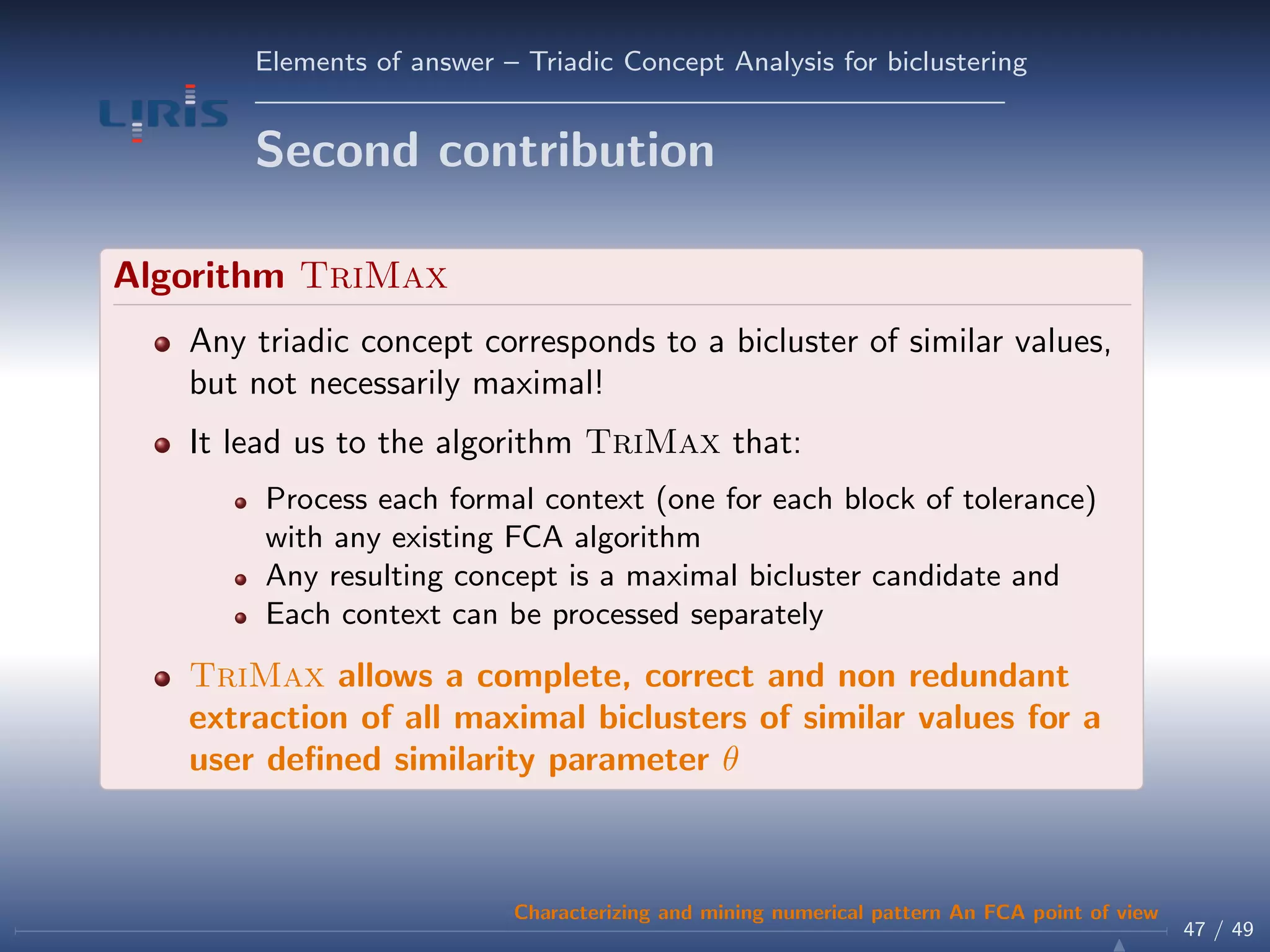
Algorithm TriMax
Any triadic concept corresponds to a bicluster of similar values,
but not necessarily maximal!
It lead us to the algorithm TriMax that:
Process each formal context (one for each block of tolerance)
with any existing FCA algorithm
Any resulting concept is a maximal bicluster candidate and
Each context can be processed separately
TriMax allows a complete, correct and non redundant
extraction of all maximal biclusters of similar values for a
user defined similarity parameter θ
47 / 49
Characterizing and mining numerical pattern An FCA point of view
1 Introducing Formal Concept Analysis
2 Main research question
3 Elements of answer
Interval pattern structures
Towards condensed representations
Introducing similarity
Extracting biclusters of similar values
Triadic Concept Analysis for biclustering
4 Conclusion and perspectives
Conclusion and perspectives
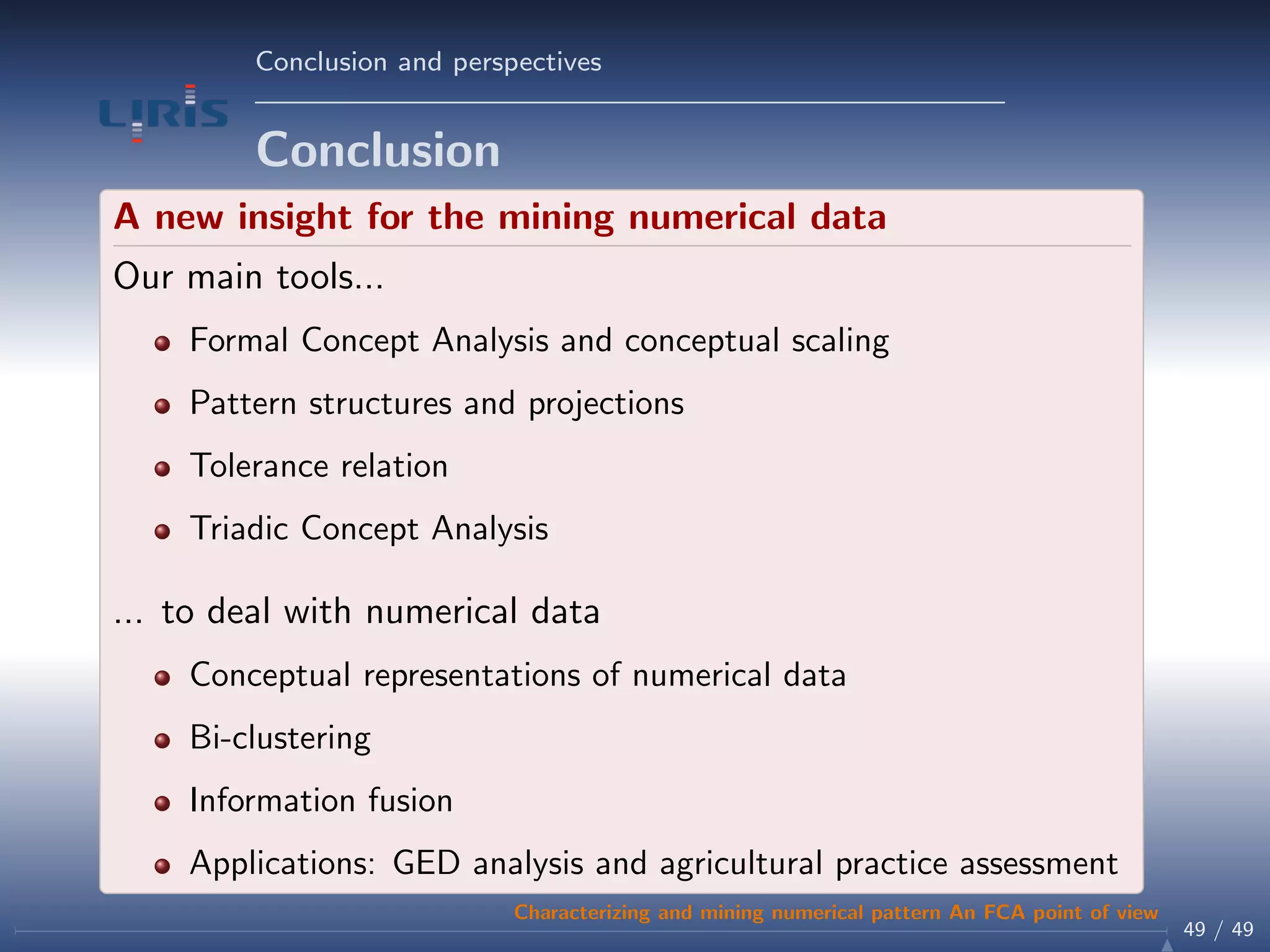
Conclusion
A new insight for the mining numerical data
Our main tools...
Formal Concept Analysis and conceptual scaling
Pattern structures and projections
Tolerance relation
Triadic Concept Analysis
... to deal with numerical data
Conceptual representations of numerical data
Bi-clustering
Information fusion
Applications: GED analysis and agricultural practice assessment
49 / 49
Characterizing and mining numerical pattern An FCA point of view

Characterizing and mining numerical patterns, an FCA point of view

  • 1.
    Characterizing and miningnumerical pattern An FCA point of view Declarative Approaches for Enumerating Interesting Patterns http://liris.cnrs.fr/dag/ Mehdi Kaytoue – Post-doctorant DAG June 2012 mkaytoue@liris.cnrs.fr http://liris.cnrs.fr/mehdi.kaytoue
  • 2.
    Outline 1 Introducing FormalConcept Analysis 2 Main research question 3 Elements of answer Interval pattern structures Towards condensed representations Introducing similarity Extracting biclusters of similar values Triadic Concept Analysis for biclustering 4 Conclusion and perspectives 2 / 49 Characterizing and mining numerical pattern An FCA point of view
  • 3.
    Introducing Formal ConceptAnalysis A binary table as a formal context Given by (G, M, I) with G a set of objects M a set of attributes I a binary relation between objects and attributes: (g, m) ∈ I means that “object g owns attribute m” m1 m2 m3 g1 × × g2 × × g3 × × g4 × × g5 × × × G = {g1, . . . , g5} M = {m1, m2, m3} (g1, m3) ∈ I B. Ganter and R. Wille Formal Concept Analysis. In Springer, Mathematical foundations., 1999. 3 / 49 Characterizing and mining numerical pattern An FCA point of view
  • 4.
    Introducing Formal ConceptAnalysis A maximal rectangle as a formal concept A Galois connection to characterize formal concepts A = {m ∈ M | ∀g ∈ A ⊆ G : (g, m) ∈ I} B = {g ∈ G | ∀m ∈ B ⊆ M : (g, m) ∈ I} (A, B) is a concept with extent A = B and intent B = A {g3} = {m2, m3} {m2, m3} = {g3, g4, g5} m1 m2 m3 g1 × × g2 × × g3 × × g4 × × g5 × × × ({g3, g4, g5}, {m2, m3}) is a formal concept 4 / 49 Characterizing and mining numerical pattern An FCA point of view
  • 5.
    Introducing Formal ConceptAnalysis Concept lattice Ordered set of concepts... (A1, B1) ≤ (A2, B2) ⇔ A1 ⊆ A2 (⇔ B2 ⊆ B1) ({g1, g5}, {m1, m3}) ≤ ({g1, g2, g5}, {m1}) ... with interesting properties Maximality of concepts as rectangles Overlapping of concepts Specialization/generalisation hierarchy Synthetic representation of the data without loss of information 5 / 49 Characterizing and mining numerical pattern An FCA point of view
  • 6.
    1 Introducing FormalConcept Analysis 2 Main research question 3 Elements of answer Interval pattern structures Towards condensed representations Introducing similarity Extracting biclusters of similar values Triadic Concept Analysis for biclustering 4 Conclusion and perspectives
  • 7.
    Main research question Generalobjectives Mining numerical data with formal concept analysis Turning data into binary (?) Bringing the problem into well-known settings Allowing a mathematically well defined approach for a correct, exact and non redundant extraction of numerical patterns Exploiting existing algorithms and “tools” m1 m2 m3 m4 m5 g1 1 2 2 1 6 g2 2 1 1 5 6 g3 2 2 1 7 6 g4 8 9 2 6 7 ⇒ m1 m2 m3 m4 m5 g1 × g2 × g3 × × g4 × × × × Can we work with FCA directly on numerical data? 7 / 49 Characterizing and mining numerical pattern An FCA point of view
  • 8.
    1 Introducing FormalConcept Analysis 2 Main research question 3 Elements of answer Interval pattern structures Towards condensed representations Introducing similarity Extracting biclusters of similar values Triadic Concept Analysis for biclustering 4 Conclusion and perspectives
  • 9.
    Elements of answer– Interval pattern structures Outline 1 Introducing Formal Concept Analysis 2 Main research question 3 Elements of answer Interval pattern structures Towards condensed representations Introducing similarity Extracting biclusters of similar values Triadic Concept Analysis for biclustering 4 Conclusion and perspectives 9 / 49 Characterizing and mining numerical pattern An FCA point of view
  • 10.
    Elements of answer– Interval pattern structures First elements... 10 / 49 Characterizing and mining numerical pattern An FCA point of view
  • 11.
    Elements of answer– Interval pattern structures How to handle complex descriptions An intersection as a similarity operator ∩ behaves as similarity operator {m1, m2} ∩ {m1, m3} = {m1} ∩ induces an ordering relation ⊆ N ∩ O = N ⇐⇒ N ⊆ O {m1} ∩ {m1, m2} = {m1} ⇐⇒ {m1} ⊆ {m1, m2} ∩ has the properties of a meet in a semi lattice, a commutative, associative and idempotent operation c d = c ⇐⇒ c d A. Tversky Features of similarity. In Psychological Review, 84 (4), 1977. 11 / 49 Characterizing and mining numerical pattern An FCA point of view
  • 12.
    Elements of answer– Interval pattern structures Pattern structure Given by (G, (D, ), δ) G a set of objects (D, ) a semi-lattice of descriptions or patterns δ a mapping such as δ(g) ∈ D describes object g A Galois connection A = g∈A δ(g) for A ⊆ G d = {g ∈ G|d δ(g)} for d ∈ (D, ) B. Ganter and S. O. Kuznetsov Pattern Structures and their Projections. In International Conference on Conceptual Structures, 2001. 12 / 49 Characterizing and mining numerical pattern An FCA point of view
  • 13.
    Elements of answer– Interval pattern structures Ordering descriptions in numerical data (D, ) as a meet-semi-lattice with as a “convexification” m1 m2 m3 g1 5 7 6 g2 6 8 4 g3 4 8 5 g4 4 9 8 g5 5 8 5 4 5 6 [4,5] [5,6] [4,6] 13 / 49 Characterizing and mining numerical pattern An FCA point of view
  • 14.
    Elements of answer– Interval pattern structures Numerical data are pattern structures Interval pattern structures m1 m2 m3 g1 5 7 6 g2 6 8 4 g3 4 8 5 g4 4 9 8 g5 5 8 5 {g1, g2} = g∈{g1,g2} δ(g) = 5, 7, 6 6, 8, 4 = [5, 6], [7, 8], [4, 6] [5, 6], [7, 8], [4, 6] = {g ∈ G| [5, 6], [7, 8], [4, 6] δ(g)} = {g1, g2, g5} ({g1, g2, g5}, [5, 6], [7, 8], [4, 6] ) is a (pattern) concept 14 / 49 Characterizing and mining numerical pattern An FCA point of view
  • 15.
    Elements of answer– Interval pattern structures Interval pattern concept lattice Existing algorithms Lowest concepts: few objects, small intervals Highest concepts: many objects, large intervals Concept/pattern overwhelming 15 / 49 Characterizing and mining numerical pattern An FCA point of view
  • 16.
    Elements of answer– Interval pattern structures Links with conceptual scaling Interordinal scaling [Ganter & Wille] A scale to encode intervals of attribute values m1 ≤ 4 m1 ≤ 5 m1 ≤ 6 m1 ≥ 4 m1 ≥ 5 m1 ≥ 6 4 × × × × 5 × × × × 6 × × × × Equivalent concept lattice ({g1, g2, g5}, {m1 ≤ 6, m1 ≥ 4, m1 ≥ 5, ... , ... }) ({g1, g2, g5}, [5, 6] , ... , ... ) Why should we use pattern structures as we have scaling? Processing a pattern structure is more efficient M. Kaytoue, S. O. Kuznetsov, A. Napoli and S. Duplessis Mining Gene Expression Data with Pattern Structures in Formal Concept Analysis. In Information Sciences. Spec. Iss.: Lattices (Elsevier), 181(10): 1989-2001 (2011). 16 / 49 Characterizing and mining numerical pattern An FCA point of view
  • 17.
    Elements of answer– Towards condensed representations Outline 1 Introducing Formal Concept Analysis 2 Main research question 3 Elements of answer Interval pattern structures Towards condensed representations Introducing similarity Extracting biclusters of similar values Triadic Concept Analysis for biclustering 4 Conclusion and perspectives 17 / 49 Characterizing and mining numerical pattern An FCA point of view
  • 18.
    Elements of answer– Towards condensed representations Interval pattern search space Counting all possible interval patterns [am1 , bm1 ], [am2 , bm2 ], ... where ami , bmi ∈ Wmi m1 m2 m3 g1 5 7 6 g2 6 8 4 g3 4 8 5 g4 4 9 8 g5 5 8 5 i∈{1,...,|M|} |Wmi | × (|Wmi | + 1) 2 360 possible interval patterns in our small example M. Kaytoue, S. O. Kuznetsov, and A. Napoli Revisiting Numerical Pattern Mining with Formal Concept Analysis. In International Joint Conference on Artificial Intelligence (IJCAI), 2011. 18 / 49 Characterizing and mining numerical pattern An FCA point of view
  • 19.
    Elements of answer– Towards condensed representations Semantics for interval patterns Interval patterns as (hyper) rectangles m1 m3 g1 5 6 g2 6 4 g3 4 5 g4 4 8 g5 5 5 3 4 5 6 7 8 3 4 5 6 m1 m3 δ(g1) δ(g2) δ(g3) δ(g4) δ(g5) 19 / 49 Characterizing and mining numerical pattern An FCA point of view
  • 20.
    Elements of answer– Towards condensed representations Semantics for interval patterns Interval patterns as (hyper) rectangles m1 m3 g1 5 6 g2 6 4 g3 4 5 g4 4 8 g5 5 5 [4, 5], [5, 6] = {g1, g3, g5} 3 4 5 6 7 8 3 4 5 6 m1 m3 δ(g1) δ(g2) δ(g3) δ(g4) δ(g5) 19 / 49 Characterizing and mining numerical pattern An FCA point of view
  • 21.
    Elements of answer– Towards condensed representations Semantics for interval patterns Interval patterns as (hyper) rectangles m1 m3 g1 5 6 g2 6 4 g3 4 5 g4 4 8 g5 5 5 [4, 5], [5, 6] = {g1, g3, g5} [4, 5], [4, 6] = {g1, g3, g5} 3 4 5 6 7 8 3 4 5 6 m1 m3 δ(g1) δ(g2) δ(g3) δ(g4) δ(g5) 19 / 49 Characterizing and mining numerical pattern An FCA point of view
  • 22.
    Elements of answer– Towards condensed representations Semantics for interval patterns Interval patterns as (hyper) rectangles m1 m3 g1 5 6 g2 6 4 g3 4 5 g4 4 8 g5 5 5 [4, 5], [5, 6] = {g1, g3, g5} [4, 5], [4, 6] = {g1, g3, g5} [4, 6], [5, 6] = {g1, g3, g5} 3 4 5 6 7 8 3 4 5 6 m1 m3 δ(g1) δ(g2) δ(g3) δ(g4) δ(g5) 19 / 49 Characterizing and mining numerical pattern An FCA point of view
  • 23.
    Elements of answer– Towards condensed representations A condensed representation Equivalence classes of interval patterns Two interval patterns with same image are said to be equivalent c ∼= d ⇐⇒ c = d Equivalence class of a pattern d [d] = {c|c ∼= d} with a unique closed pattern: the smallest rectangle and one or several generators: the largest rectangles Y. Bastide, R. Taouil, N. Pasquier, G. Stumme, and L. Lakhal. Mining frequent patterns with counting inference. SIGKDD Expl., 2(2):66–75, 2000. In our example: 360 patterns ; 18 closed ; 44 generators 20 / 49 Characterizing and mining numerical pattern An FCA point of view
  • 24.
    Elements of answer– Towards condensed representations A condensed representation Remarks 4 5 6 [4,5] [5,6] [4,6] Compression rate varies between 107 and 109 Interordinal scaling: encodes 30.000 binary patterns not efficient even with best algorithms (e.g. LCMv2) redundancy problem discarding its use for generator extraction MDL, quantitative association rule mining, k-anonymisation Need of fault-tolerant condensed representations 21 / 49 Characterizing and mining numerical pattern An FCA point of view
  • 25.
    Elements of answer– Introducing similarity Outline 1 Introducing Formal Concept Analysis 2 Main research question 3 Elements of answer Interval pattern structures Towards condensed representations Introducing similarity Extracting biclusters of similar values Triadic Concept Analysis for biclustering 4 Conclusion and perspectives 22 / 49 Characterizing and mining numerical pattern An FCA point of view
  • 26.
    Elements of answer– Introducing similarity Introducing a similarity relation Grouping in a same concept objects having similar values? A natural similarity relation on numbers a θ b ⇔ |a − b| ≤ θ e.g. 4 1 5 4 1 6 Similarity operator in pattern structures 4 5 6 [4,5] [5,6] [4,6] How to consider a similarity relation w.r.t. a distance? 23 / 49 Characterizing and mining numerical pattern An FCA point of view
  • 27.
    Elements of answer– Introducing similarity Introducing a similarity relation Grouping in a same concept objects having similar values? A natural similarity relation on numbers a θ b ⇔ |a − b| ≤ θ e.g. 4 1 5 4 1 6 Similarity operator in pattern structures θ = 2 4 5 6 [4,5] [5,6] [4,6] How to consider a similarity relation w.r.t. a distance? 23 / 49 Characterizing and mining numerical pattern An FCA point of view
  • 28.
    Elements of answer– Introducing similarity Introducing a similarity relation Grouping in a same concept objects having similar values? A natural similarity relation on numbers a θ b ⇔ |a − b| ≤ θ e.g. 4 1 5 4 1 6 Similarity operator in pattern structures θ = 1 4 5 6 [4,5] [5,6] [4,6] How to consider a similarity relation w.r.t. a distance? 23 / 49 Characterizing and mining numerical pattern An FCA point of view
  • 29.
    Elements of answer– Introducing similarity Introducing a similarity relation Grouping in a same concept objects having similar values? A natural similarity relation on numbers a θ b ⇔ |a − b| ≤ θ e.g. 4 1 5 4 1 6 Similarity operator in pattern structures θ = 04 5 6 [4,5] [5,6] [4,6] How to consider a similarity relation w.r.t. a distance? 23 / 49 Characterizing and mining numerical pattern An FCA point of view
  • 30.
    Elements of answer– Introducing similarity Towards a similarity between values Introduce an element ∗ ∈ (D, ) denoting dissimilarity c d = ∗ iff c θ d c d = ∗ iff c θ d Example with θ = 1 m1 m2 m3 g1 5 7 6 g2 6 8 4 g3 4 8 5 g4 4 9 8 g5 5 8 5 {g3, g4} = [4, 4], [8, 9], ∗ [4, 4], [8, 9], ∗ = {g3, g4} ({g3, g4}, [4, 4], [8, 9], ∗ ) is a pattern concept: g3 and g4 have similar values for attributes m1 and m2 only 24 / 49 Characterizing and mining numerical pattern An FCA point of view
  • 31.
    Elements of answer– Introducing similarity Towards a similarity between values Introduce an element ∗ ∈ (D, ) denoting dissimilarity c d = ∗ iff c θ d c d = ∗ iff c θ d Example with θ = 1 m1 m2 m3 g1 5 7 6 g2 6 8 4 g3 4 8 5 g4 4 9 8 g5 5 8 5 {g3, g4} = [4, 4], [8, 9], ∗ [4, 4], [8, 9], ∗ = {g3, g4} ({g3, g4}, [4, 4], [8, 9], ∗ ) is a pattern concept: g3 and g4 have similar values for attributes m1 and m2 only Is {g3, g4} maximal w.r.t. similarity? We can add g5... 24 / 49 Characterizing and mining numerical pattern An FCA point of view
  • 32.
    Elements of answer– Introducing similarity Classes of tolerance in numerical data Towards maximal sets of similar values θ a tolerance relation : reflexive, symmetric, not transitive Consider an attribute taking values in {6, 8, 11, 16, 17} and θ = 5 8 5 11, 11 5 16 but 8 5 16 A class of tolerance as a maximal set of pairwise similar values {6, 8, 11} {11, 16} {16, 17} [6, 11] [11, 16] [16, 17] S. O. Kuznetsov Galois Connections in Data Analysis: Contributions from the Soviet Era and Modern Russian Research. In Formal Concept Analysis, Foundations and Applications, 2005. 25 / 49 Characterizing and mining numerical pattern An FCA point of view
  • 33.
    Elements of answer– Introducing similarity Tolerance in pattern structures Projecting the pattern structure Each value is replaced by the interval characterizing its class of tolerance (if unique) Each pattern d is projected with a mapping ψ(d) d (pre-processing) rod Example with θ = 1 m1 m2 m3 g1 5 7 6 g2 6 8 4 g3 4 8 5 g4 4 9 8 g5 5 8 5 {g3, g4} = ψ( [4, 4], [8, 9], ∗ ) = [4, 5], [8, 9], ∗ [4, 5], [8, 9], ∗ = {g3, g4, g5} 26 / 49 Characterizing and mining numerical pattern An FCA point of view
  • 34.
    Elements of answer– Introducing similarity Similarity and scaling m1 m2 m3 g1 6 0 [1, 2] g2 8 4 [2, 5] g3 11 8 [4, 5] g4 16 8 [6, 9] g5 17 12 [7, 10] 5 6 8 11 16 17 6 × × × 8 × × × 11 × × × × 16 × × × 17 × × (m1,11) (m1,16) (m1,[6,11]) (m1,[11,16]) (m1,[16,17]) (m2,4) (m2,8) (m2,[0,4]) (m2,[4,8]) (m2,[8,12]) (m3,[1,5]) (m3,[4,9]) (m3,[6,10]) (m3,[4,5]) (m3,[6,9]) g1 × × × g2 × × × × × g3 × × × × × × × × × g4 × × × × × × × × × g5 × × × 27 / 49 Characterizing and mining numerical pattern An FCA point of view
  • 35.
    Elements of answer– Extracting biclusters of similar values Outline 1 Introducing Formal Concept Analysis 2 Main research question 3 Elements of answer Interval pattern structures Towards condensed representations Introducing similarity Extracting biclusters of similar values Triadic Concept Analysis for biclustering 4 Conclusion and perspectives 28 / 49 Characterizing and mining numerical pattern An FCA point of view
  • 36.
    Elements of answer– Extracting biclusters of similar values Another type of bicluster Going back to similarity relation w1 θ w2 ⇐⇒ |w1 − w2| ≤ θ with θ ∈ R, w1, w2 ∈ W Bicluster of similar values A bicluster (A, B) is a bicluster of similar values if mi (gj ) θ mk(gl ), ∀gj , gl ∈ A, ∀mi , mk ∈ B m1 m2 m3 m4 m5 g1 1 2 2 1 6 g2 2 1 1 0 6 g3 2 2 1 7 6 g4 8 9 2 6 7 θ = 1 and maximal if no object/attribute can be added J. Besson, C. Robardet, L. De Raedt, J.-F. Boulicaut Mining Bi-sets in Numerical Data. In KDID 2006: 11-23. 29 / 49 Characterizing and mining numerical pattern An FCA point of view
  • 37.
    Elements of answer– Extracting biclusters of similar values Can we use the interval pattern lattice? Concept example ({g2, g3}, [2, 2], [1, 2], [1, 1], [0, 7], [6, 6] ) m1 m2 m3 m4 m5 g1 1 2 2 1 6 g2 2 1 1 0 6 g3 2 2 1 7 6 g4 8 9 2 6 7 θ = 1 3 statements to verify Some intervals have a “size” larger than θ Some values in two different columns may not be similar Rectangle may not be maximal M. Kaytoue, S. O. Kuznetsov, and A. Napoli Biclustering Numerical Data in Formal Concept Analysis. In International Conference on Formal Concept Analysis (ICFCA), 2011. 30 / 49 Characterizing and mining numerical pattern An FCA point of view
  • 38.
    Elements of answer– Extracting biclusters of similar values First statement Avoiding intervals with size larger than θ [a1, b1] [a2, b2] = [min(a1, a2), max(b1, b2)] if|max(b1, b2) − min(a1, a2)| ≤ θ ∗ otherwise Going back to our example, with θ = 1 ({g2, g3}, [2, 2], [1, 2], [1, 1], ∗, [6, 6] ) m1 m2 m3 m4 m5 g1 1 2 2 1 6 g2 2 1 1 0 6 g3 2 2 1 7 6 g4 8 9 2 6 7 31 / 49 Characterizing and mining numerical pattern An FCA point of view
  • 39.
    Elements of answer– Extracting biclusters of similar values Second statement Values from two columns should be similar From ({g2, g3}, [2, 2], [1, 2], [1, 1], ∗, [6, 6] ) we group attributes such as their values form a class of tolerance: m1 m2 m3 m4 m5 g1 1 2 2 1 6 g2 2 1 1 0 6 g3 2 2 1 7 6 g4 8 9 2 6 7 m1 m2 m3 m4 m5 g1 1 2 2 1 6 g2 2 1 1 0 6 g3 2 2 1 7 6 g4 8 9 2 6 7 ({g2, g3}, {m1, m2, m3}) ({g2, g3}, {m5}) 32 / 49 Characterizing and mining numerical pattern An FCA point of view
  • 40.
    Elements of answer– Extracting biclusters of similar values Third statement Maximal bicluster of similar values ⊥ ({g1}, 1, 2, 2, 1,6 ) ({g2}, 2,1,1, 0,6 ) ({g3}, 2,2,1,7,6 ) ({g4}, 8, 9,2,6,7 ) ({g1, g2}, [1,2],[1,2],[1,2], [0, 1],6 ) ({g1, g3}, [1,2],2,[1,2], ∗,6 ) ({g2, g3}, 2,[1,2],1, ∗,6 ({g3, g4}, ∗, ∗, [1,2], [6, 7], [6, 7] ) ({g1, g2, g3}, [1, 2], [1, 2], [1, 2], ∗,6 ) ({g1, g2, g3, g4}, ∗, ∗, [1, 2], ∗, [6, 7] ) Constructing maximal biclusters: bottom-up/top-down 33 / 49 Characterizing and mining numerical pattern An FCA point of view
  • 41.
    Elements of answer– Triadic Concept Analysis for biclustering Outline 1 Introducing Formal Concept Analysis 2 Main research question 3 Elements of answer Interval pattern structures Towards condensed representations Introducing similarity Extracting biclusters of similar values Triadic Concept Analysis for biclustering 4 Conclusion and perspectives 34 / 49 Characterizing and mining numerical pattern An FCA point of view
  • 42.
    Elements of answer– Triadic Concept Analysis for biclustering Triadic Concept Analysis “Extension” of FCA to ternary relation An object has an attribute for a given condition Triadic context (G, M, B, Y ) Several derivation operators allowing to characterize “triadic concepts” as maximal cubes of × b1 b2 b3 m1 m2 m3 g1 × g2 × × g3 × × g4 × × g5 × × m1 m2 m3 g1 × × × g2 × × g3 × × × g4 × × g5 × × m1 m2 m3 g1 × × g2 × g3 × × × g4 × × g5 × × × ({g3, g4, g5}, {m2, m3}, {b1, b2, b3}) is a triadic concept F. Lehmann and R. Wille. A Triadic Approach to Formal Concept Analysis. In International Conference on Conceptual Structures (ICCS), 1995. 35 / 49 Characterizing and mining numerical pattern An FCA point of view
  • 43.
    Elements of answer– Triadic Concept Analysis for biclustering Basic idea Principle Start from a numerical dataset (G, M, W , I) Build a triadic context (G, M, B, Y ) with same objects, same attributes, and discretized dimension Extract triadic concepts Interordinal scaling B and all its intersections characterize any interval over W We show interesting links between biclusters of similar values and triadic concepts M. Kaytoue, S. O. Kuznetsov, J. Macko, A. Napoli and W. Meira Jr. Mining biclusters of similar values with triadic concept analysis. In International Conference Concept Lattices and their Applications (CLA), 2011. 36 / 49 Characterizing and mining numerical pattern An FCA point of view
  • 44.
    Elements of answer– Triadic Concept Analysis for biclustering Discretization method Interodinal scaling (existing discretization scale) Let (G, M, W , I) be a numerical dataset (with W the set of data-values. Now consider the set T = {[min(W ), w], ∀w ∈ W } ∪ {[w, max(W )], ∀w ∈ W }. Known fact: T and all its intersections characterize any interval of values on W . Example With W = {0, 1, 2, 6, 7, 8, 9}, one has T = {[0, 0], [0, 1], [0, 2], ..., [0, 9], [1, 9], [2, 9], ..., [9, 9]} and for example [0, 8] ∩ [2, 9] = [2, 8] 37 / 49 Characterizing and mining numerical pattern An FCA point of view
  • 45.
    Elements of answer– Triadic Concept Analysis for biclustering Building a triadic context Transformation procedure From a numerical dataset (G, M, W , I), build a triadic context (G, M, T, Y ) such as (g, m, t) ∈ Y ⇐⇒ m(g) ∈ t 38 / 49 Characterizing and mining numerical pattern An FCA point of view
  • 46.
    Elements of answer– Triadic Concept Analysis for biclustering First contribution We proved that there is a 1-1-correspondence between (i) Triadic concepts of the resulting triadic context (ii) Biclusters of similar values maximal for some θ ≥ 0 Interesting facts Efficient algorithm for concept extraction (Data-Peeler, handling several constraints) L. Cerf, J. Besson, C. Robardet, J.-F. Boulicaut Closed patterns meet n-ary relations. In TKDD 3(1): (2009). Top-k biclusters: Concept (A, B, C) with high |A|, |B|, and |C| corresponds to bicluster (A, B) as a large rectangle of close values (by properties of interordinal scale) This formalization allows us to design a new algorithm to extract maximal biclusters for a given parameter θ 39 / 49 Characterizing and mining numerical pattern An FCA point of view
  • 47.
    Elements of answer– Triadic Concept Analysis for biclustering Triadic diagram Quasi-order i and equivalence relation ∼i fori = 1, 2, 3 (A1, A2, A3) i (B1, B2, B3) ⇐⇒ Ai ⊆ Bi (A1, A2, A3) ∼i (B1, B2, B3) ⇐⇒ Ai = Bi Anti-ordinal dependencies With (A1, A2, A3) i (B1, B2, B3) and (A1, A2, A3) j (B1, B2, B3) then (A1, A2, A3) k (B1, B2, B3) A concept is uniquely determined by two of its components 40 / 49 Characterizing and mining numerical pattern An FCA point of view
  • 48.
    Elements of answer– Triadic Concept Analysis for biclustering Triadic diagram Equivalence and factor sets, i = 1, 2, 3 [(A1, A2, A3)]i is the equivalence class of concepts w.r.t. ∼i i induces an order ≤i on the factor set I(K)/ ∼i s.t. [(A1, A2, A3)]i ≤ [(B1, B2, B3)]i ⇐⇒ Ai ⊆ Bi (I(K)/ ∼i , ≤i ) is the ordered set of all extents (i=1)/intents(i=2)/modus(i=3) of K 41 / 49 Characterizing and mining numerical pattern An FCA point of view
  • 49.
    Elements of answer– Triadic Concept Analysis for biclustering Triadic diagrams Triadic diagram I(K) Geometric structure: (I(K), ∼1, ∼2, ∼3) Ordered structures: (I(K)/ ∼i , ≤i ) Three systems of parallel lines, one for each ∼i , in which classes of equivalence meet at most in one element: A triangular pattern 42 / 49 Characterizing and mining numerical pattern An FCA point of view
  • 50.
    Elements of answer– Triadic Concept Analysis for biclustering Triadic diagrams 43 / 49 Characterizing and mining numerical pattern An FCA point of view
  • 51.
    Elements of answer– Triadic Concept Analysis for biclustering Triadic diagrams Such representation is not always possible... the tetrahedron case: a = (A, y, C) b = (A, B, z) c = (x, B, C) d = (x, y, z) The ”Thomsen condition” is violated (?) Ongoing work Prove that in our case, such representation is possible Alternative vizualisation, naviguation 44 / 49 Characterizing and mining numerical pattern An FCA point of view
  • 52.
    Elements of answer– Triadic Concept Analysis for biclustering Second contribution Compute all max. biclusters for a given θ Use another (but similar) discretization procedure to build the triadic context based on tolerance blocks Standard algorithms output biclusters of similar values but not necessarily maximal We design a new algorithm TriMax for that task TriMax is flexible, uses standard FCA algorithms in its core, seems better than its competitors, can be extended to n-ary relations and distributed. 45 / 49 Characterizing and mining numerical pattern An FCA point of view
  • 53.
    Elements of answer– Triadic Concept Analysis for biclustering New transformation procedure Tolerance blocks based scaling Compute the set C of all blocks of tolerance over W From the numerical dataset (G, M, W , I), build the triadic context (G, M, C, Z) such that (g, m, c) ∈ Z ⇐⇒ m(g) ∈ c Actually, we remove “useless information” θ = 1 46 / 49 Characterizing and mining numerical pattern An FCA point of view
  • 54.
    Elements of answer– Triadic Concept Analysis for biclustering Second contribution Algorithm TriMax Any triadic concept corresponds to a bicluster of similar values, but not necessarily maximal! It lead us to the algorithm TriMax that: Process each formal context (one for each block of tolerance) with any existing FCA algorithm Any resulting concept is a maximal bicluster candidate and Each context can be processed separately TriMax allows a complete, correct and non redundant extraction of all maximal biclusters of similar values for a user defined similarity parameter θ 47 / 49 Characterizing and mining numerical pattern An FCA point of view
  • 55.
    1 Introducing FormalConcept Analysis 2 Main research question 3 Elements of answer Interval pattern structures Towards condensed representations Introducing similarity Extracting biclusters of similar values Triadic Concept Analysis for biclustering 4 Conclusion and perspectives
  • 56.
    Conclusion and perspectives Conclusion Anew insight for the mining numerical data Our main tools... Formal Concept Analysis and conceptual scaling Pattern structures and projections Tolerance relation Triadic Concept Analysis ... to deal with numerical data Conceptual representations of numerical data Bi-clustering Information fusion Applications: GED analysis and agricultural practice assessment 49 / 49 Characterizing and mining numerical pattern An FCA point of view