
KANBAN
AN AGILE DEVELOPMENT METHODOLOGY
Tzar Umang
Proprietor – Tzar Enterprises
Founder – ICT Council of Northern Tarlac
What is Kanban?
 Literally, Kanban is a Japanese word that means "visual card".
 At Toyota, Kanban is the term used for the visual & physical signaling
system that ties together the whole Lean Production system.
 Kanban as used in Lean Production is over a half century old.
 It is being adopted newly to some disciplines as software.
How does Kanban work?
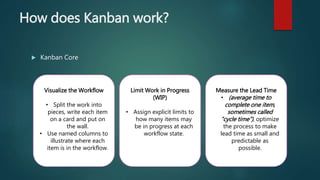
 Kanban Core
Visualize the Workflow
• Split the work into
pieces, write each item
on a card and put on
the wall.
• Use named columns to
illustrate where each
item is in the workflow.
Limit Work in Progress
(WIP)
• Assign explicit limits to
how many items may
be in progress at each
workflow state.
Measure the Lead Time
• (average time to
complete one item,
sometimes called
“cycle time”), optimize
the process to make
lead time as small and
predictable as
possible.
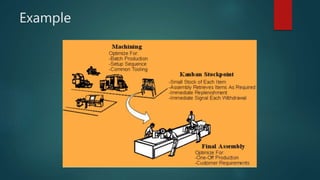
Example
Example
Atrium Bakery Kanban
Boards for each zone…
Why Kanban?
 Kanban is faster, more efficient, and saves significant money over most
other production models.
 A kanban system is also far more directly responsive to customer demand.
 Kanban is a system that visually indicates when production should start
and stop.
Can I combine Kanban with my current
process?
 Yes. In fact, you should combine it.
 In Kanban the first step is to visualize your current process, just as it is, in
order to see where the bottlenecks are.
 Then you introduce WIP limits and start a path of evolution that may or
may not modify or replace your current process over time.
What are the benefits of Kanban?
 Some commonly observed benefits are:
 Bottlenecks become clearly visible in real-time. This leads people to
collaborate to optimize the whole value chain rather than just their part.
 Useful for situations where operations and support teams have a high rate
of uncertainty and variability.
 Tends to naturally spread throughout the organization to other
departments such as HR and sales, thereby increasing visibility of
everything that is going on at the company.
What are the benefits of Kanban?
Reduce Inventory
 Kanban will reduce inventory, on average, by 25 to 75%. This saves any
company significantly in terms of rent, electricity, and storage space.
 In addition, all of the space freed by the implementation of a kanban
system can be used for future expansions or new opportunities
What are the benefits of Kanban?
 Improve work flow
 The visually organized environment ensures all parts are easily found and
continually stocked.
 The speed of moving from one task to another is significantly reduced by
the creation of clearly marked flow lanes, kanban cards, and clearly marked
labels.
What are the benefits of Kanban?
 Prevent Overproduction
 Because parts are only created at the visual signal by the kanban label
(link), inventory is much less likely to be overproduced. Resulting in
significant savings in the holding of stock.
What are the benefits of Kanban?
 Improves responsiveness to changes in demand
 Unlike a predictive system, kanban immediately reacts to the environment.
By responding to clearly and easily read kanban cards the lag time
between a shift in demand and a shift in production is almost non-existent.
 Minimize risk of obsolete inventory, because inventory is only created as it
is needed.
Tzar C. Umang
Tzar Enterprises
tzarumang@gmail.com

Kanban

  • 1.
    KANBAN AN AGILE DEVELOPMENTMETHODOLOGY Tzar Umang Proprietor – Tzar Enterprises Founder – ICT Council of Northern Tarlac
  • 2.
    What is Kanban? Literally, Kanban is a Japanese word that means "visual card".  At Toyota, Kanban is the term used for the visual & physical signaling system that ties together the whole Lean Production system.  Kanban as used in Lean Production is over a half century old.  It is being adopted newly to some disciplines as software.
  • 3.
    How does Kanbanwork?  Kanban Core Visualize the Workflow • Split the work into pieces, write each item on a card and put on the wall. • Use named columns to illustrate where each item is in the workflow. Limit Work in Progress (WIP) • Assign explicit limits to how many items may be in progress at each workflow state. Measure the Lead Time • (average time to complete one item, sometimes called “cycle time”), optimize the process to make lead time as small and predictable as possible.
  • 4.
  • 5.
  • 6.
    Why Kanban?  Kanbanis faster, more efficient, and saves significant money over most other production models.  A kanban system is also far more directly responsive to customer demand.  Kanban is a system that visually indicates when production should start and stop.
  • 7.
    Can I combineKanban with my current process?  Yes. In fact, you should combine it.  In Kanban the first step is to visualize your current process, just as it is, in order to see where the bottlenecks are.  Then you introduce WIP limits and start a path of evolution that may or may not modify or replace your current process over time.
  • 8.
    What are thebenefits of Kanban?  Some commonly observed benefits are:  Bottlenecks become clearly visible in real-time. This leads people to collaborate to optimize the whole value chain rather than just their part.  Useful for situations where operations and support teams have a high rate of uncertainty and variability.  Tends to naturally spread throughout the organization to other departments such as HR and sales, thereby increasing visibility of everything that is going on at the company.
  • 9.
    What are thebenefits of Kanban? Reduce Inventory  Kanban will reduce inventory, on average, by 25 to 75%. This saves any company significantly in terms of rent, electricity, and storage space.  In addition, all of the space freed by the implementation of a kanban system can be used for future expansions or new opportunities
  • 10.
    What are thebenefits of Kanban?  Improve work flow  The visually organized environment ensures all parts are easily found and continually stocked.  The speed of moving from one task to another is significantly reduced by the creation of clearly marked flow lanes, kanban cards, and clearly marked labels.
  • 11.
    What are thebenefits of Kanban?  Prevent Overproduction  Because parts are only created at the visual signal by the kanban label (link), inventory is much less likely to be overproduced. Resulting in significant savings in the holding of stock.
  • 12.
    What are thebenefits of Kanban?  Improves responsiveness to changes in demand  Unlike a predictive system, kanban immediately reacts to the environment. By responding to clearly and easily read kanban cards the lag time between a shift in demand and a shift in production is almost non-existent.  Minimize risk of obsolete inventory, because inventory is only created as it is needed.
  • 13.
    Tzar C. Umang TzarEnterprises tzarumang@gmail.com