Forestry 101 Eli Sagor [email_address] (612) 624-6948 MCC mid-year retreat, July 2006
Outline About forestry Forest types Silvicultural systems Combinations Q&A
About forestry
Outline About forestry Forest types Silvicultural systems Combinations Q&A
Sound forestry isโ€ฆ โ€ฆ production of a  renewable  resource โ€ฆ a $7 billion industry in Minnesota โ€ฆ beneficial to wildlife and water โ€ฆ conducted by professional foresters and loggers
Sound forestry isโ€ฆ โ€ฆ not necessarily timber-focused โ€ฆ a responsible way to make money from the land โ€ฆ a way to keep forest land forested โ€ฆ a way to restore lost habitat elements
ย 
ย 
ย 
Sound forestry is NOTโ€ฆ โ€ฆ clearing land to build shopping malls โ€ฆ a โ€œcut & runโ€ extractive industry
Some important concepts
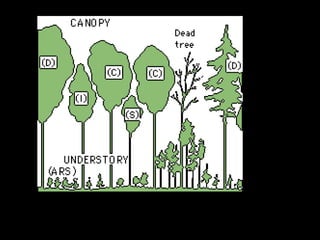
Kraft Crown Classification Dominant crowns extending above main canopy receiving direct sunlight from above and from sides Codominant crowns at general level of crown cover receiving direct sunlight from above but little from the sides
Kraft Crown Classification Intermediate shorter but with crowns  extending into the main canopy receiving direct sunlight from above but not from the sides Suppressed crowns entirely below the main canopy receiving no direct light from above or from the sides
ย 
Shade Tolerance A tree speciesโ€™ ability to grow and thrive under low light conditions. Some trees need full sun, others can grow under a dense canopy.
Outline About forestry Forest types Silvicultural systems Combinations Q&A
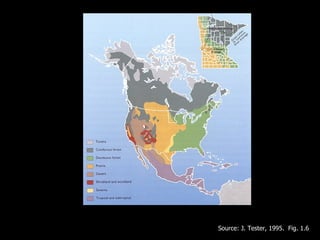
Source: J. Tester, 1995.  Fig. 1.6
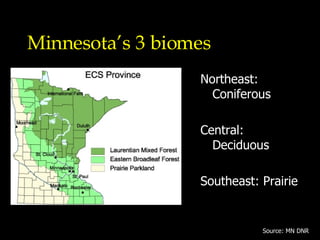
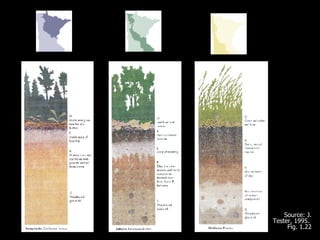
Minnesotaโ€™s 3 biomes Northeast: Coniferous Central: Deciduous Southeast: Prairie Source: MN DNR
Source: J. Tester, 1995.  Fig. 1.22
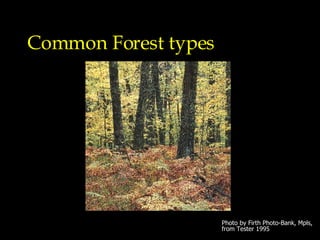
Common Forest types Photo by Firth Photo-Bank, Mpls, from Tester 1995
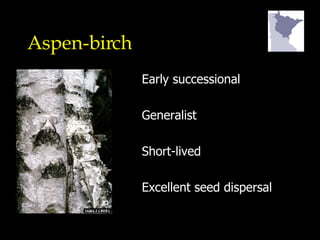
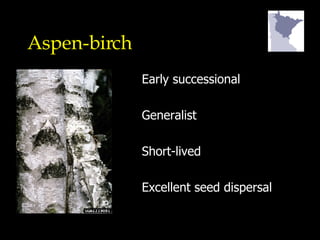
Aspen-birch Early successional Generalist Short-lived Excellent seed dispersal
Aspen-birch Natural disturbance that maintains this type: severe fire or extensive windthrow  Transition to white-red pine or fir-spruce, depending on site
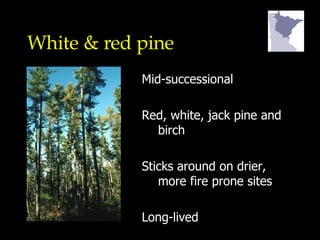
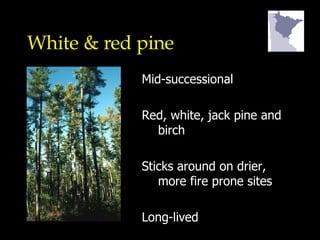
White & red pine Mid-successional Red, white, jack pine and birch Sticks around on drier, more fire prone sites Long-lived
White & red pine Natural disturbance that maintains this type: Severe fire / extensive windthrow
Black spruce Found on wet, low areas Not much competitionโ€ฆ Dominant boreal forest type
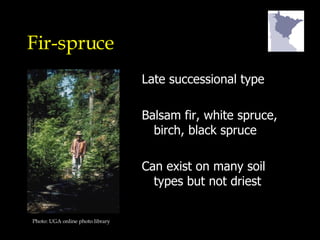
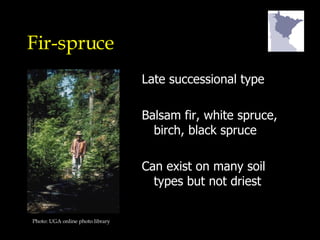
Fir-spruce Late successional type Balsam fir, white spruce, birch, black spruce Can exist on many soil types but not driest Photo: UGA online photo library
Fir-spruce Natural disturbance that maintains this type: small or larger gaps from windthrow, insects, or tree death
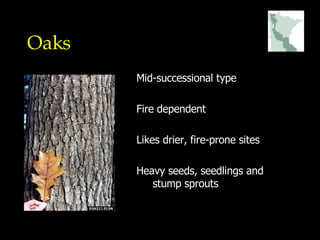
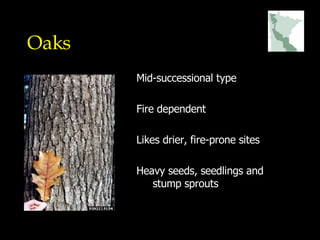
Oaks Mid-successional type Fire dependent Likes drier, fire-prone sites Heavy seeds, seedlings and stump sprouts
Oaks Natural disturbance that maintains this forest type: Fire
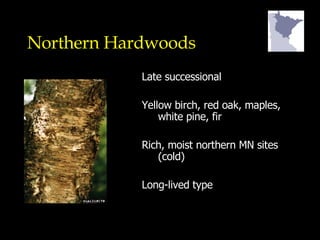
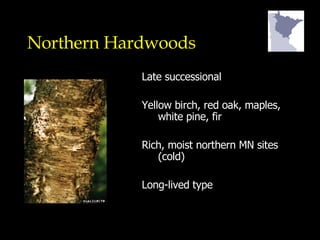
Northern Hardwoods Late successional Yellow birch, red oak, maples, white pine, fir Rich, moist northern MN sites (cold) Long-lived type
Northern Hardwoods Natural disturbance that maintains this forest type: small gaps, windthrow
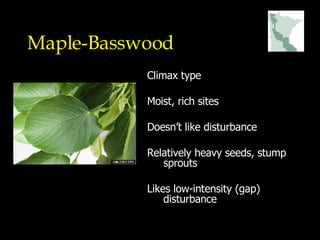
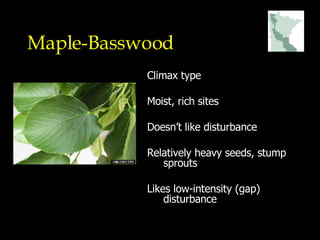
Maple-Basswood Climax type Moist, rich sites  Doesnโ€™t like disturbance Relatively heavy seeds, stump sprouts Likes low-intensity (gap) disturbance
Maple-Basswood Natural disturbance that maintains this forest type: small gaps from windthrow or tree death Small gap disturbance every 40-150 yrs Catastrophic disturbance 400-1000 yrs MN DNR
Outline About forestry Forest types Silvicultural systems Combinations Q&A
Silviculture The art and science of controlling the establishment, growth, composition, and health of forests and woodlands  to meet the landownerโ€™s objectives. (Modified from J. Helms 1998)
The toolbox Clearcut harvesting โ€œ Selectiveโ€ or partial harvesting Prescribed burning:  to control understory competition to prepare a cleared site for planting to favor natural regeneration of desired species to reduce fuel loads Planting of desired species and/or genetically improved stock Protecting stands from damage from wildlife (deer!) Thinning at various times in the rotation Pruning: to improve log quality to reduce disease effects Spraying herbicides or pesticides Cutting to reduce insect threats  Salvage cutting  Fire suppression And moreโ€ฆ
Forest management systems Clearcutting Selection Group selection Single-tree selection Intermediate treatments
Clearcutting Clear all vegetation Prepare the site Plant trees (generally) Spray herbicide to control competition Thin (generally) Clearcut, and start over
(Wisconsin DNR image)
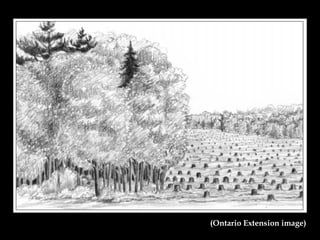
(Ontario Extension image)
ย 
ย 
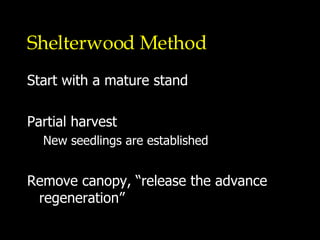
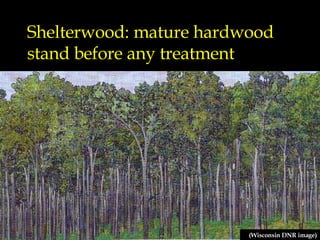
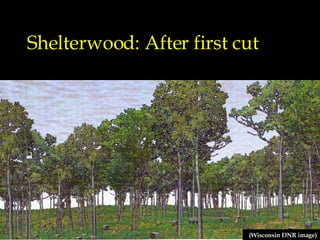
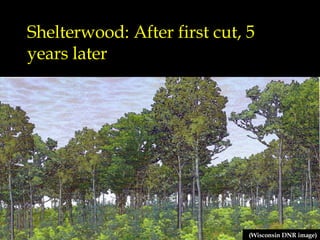
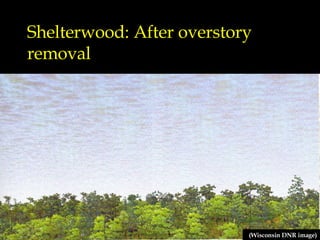
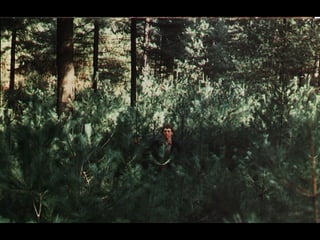
Shelterwood Method Start with a mature stand Partial harvest New seedlings are established Remove canopy, โ€œrelease the advance regenerationโ€
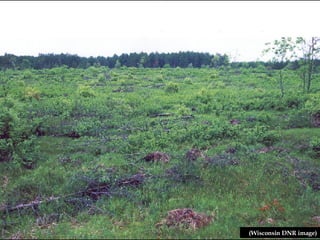
Shelterwood: mature hardwood stand before any treatment (Wisconsin DNR image)
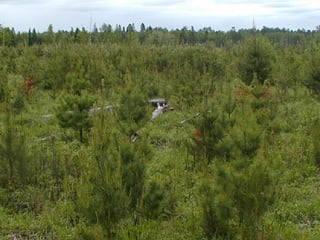
Shelterwood: After first cut (Wisconsin DNR image)
Shelterwood: After first cut, 5 years later (Wisconsin DNR image)
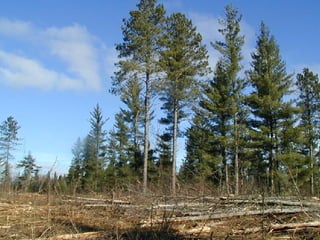
Shelterwood: After overstory removal (Wisconsin DNR image)
(Ontario Extension image)
ย 
ย 
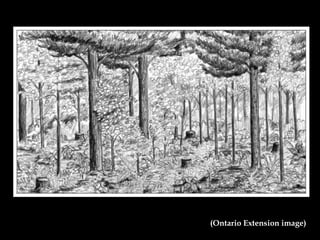
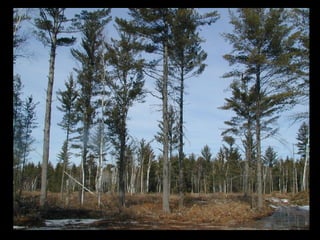
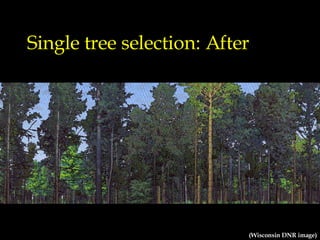
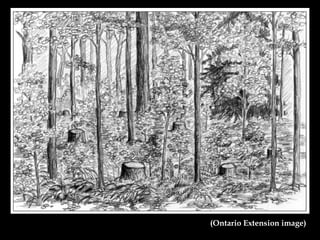
Selection System Start with mature stand Remove single trees or groups Repeat as needed
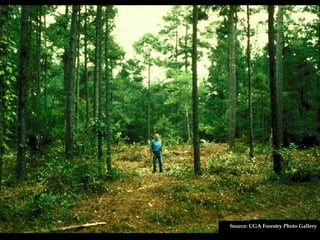
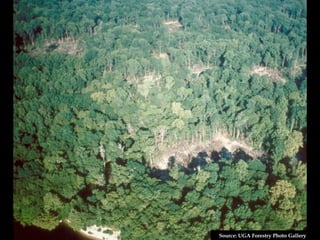
Group Selection Start with a mature stand Remove small groups of trees to create patches of regeneration Repeat periodically in different areas
Source: UGA Forestry Photo Gallery
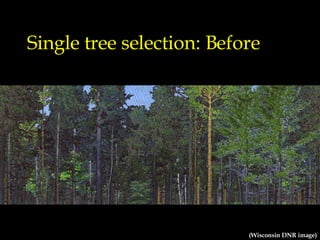
Single tree selection: Before (Wisconsin DNR image)
Single tree selection: After (Wisconsin DNR image)
(Ontario Extension image)
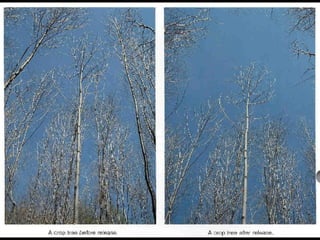
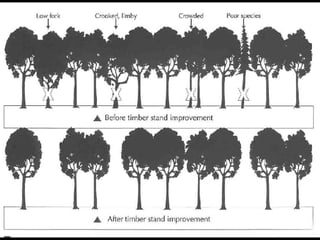
Thinnings Improve the future growth of existing trees Row or selection thinnings Timber stand improvement
ย 
ย 
Outline About forestry Forest types Silvicultural systems Combinations Q&A
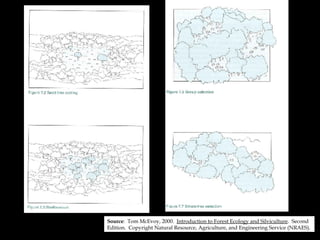
Forest Management 101 Favor the right species for the site Know and mimic natural disturbance regimes
Source :  Tom McEvoy, 2000.  Introduction to Forest Ecology and Silviculture .  Second Edition.  Copyright Natural Resource, Agriculture, and Engineering Service (NRAES).
Aspen-birch Early successional Generalist Short-lived Excellent seed dispersal
White & red pine Mid-successional Red, white, jack pine and birch Sticks around on drier, more fire prone sites Long-lived
Fir-spruce Late successional type Balsam fir, white spruce, birch, black spruce Can exist on many soil types but not driest Photo: UGA online photo library
Oaks Mid-successional type Fire dependent Likes drier, fire-prone sites Heavy seeds, seedlings and stump sprouts
Northern Hardwoods Late successional Yellow birch, red oak, maples, white pine, fir Rich, moist northern MN sites (cold) Long-lived type
Maple-Basswood Climax type Moist, rich sites  Doesnโ€™t like disturbance Relatively heavy seeds, stump sprouts Likes low-intensity (gap) disturbance
[email_address]

Minnesota Forestry 101