Group Members
E10MBA090
E10MBA094
E10MBA143
E10MBA146
Forest Act 1927
Act xvi of 1927
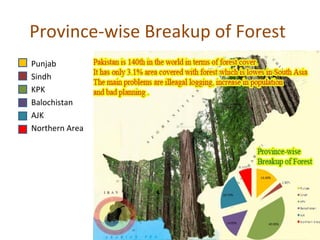
Province-wise Breakup of Forest
• Punjab
• Sindh
• KPK
• Balochistan
• AJK
• Northern Area
Area of Forest
• 3.1% or about 1,687,000 ha of Pakistan is
forested. Pakistan had 340,000 ha of planted
forest.
• Change in Forest Cover
During the last decade, Pakistan lost an average
of 42,000 ha or 1.66% per year. In total, during
last decade, Pakistan lost 33.2% of its forest
cover, or around 840,000 ha. Pakistan's forests
contain 213 million metric tons of carbon in living
forest biomass.
Year % Share of Forestry in GDP
• 1999-2000 0.66
• 2000-2001 0.71
• 2001-2002 0.66
• 2002-2003 0.70
• 2003-2004 0.67
• 2006-2007 0.20
• 2008-2010 0.10
• Note: Only those forest products, which go through
market channel, are valued and reflected
in national accounting system. Majority of products
are used locally and hence do not
contribute to GDP. Environmental services of forests are also ignored.
The Forest Act, 1927
• History
The basic purpose of legislation has been to protect the forests
from misuse and damage done by either man or animal.
• Forest Policy Objectives
1. Lays down procedures for constituting and managing different kinds of
forests like reserved and protected Forests;
2. Provides rules to restrict people’s action in and around public and
community forests;
3. Prescribes duties of the public and the public servants in relation to
forests; and
4. Chalks out penalties for violating rules.
Ownership Arrangements.
 In Pakistan, forests are held under a variety of ownership
arrangements.
 According to legal classification, forests are divided
between
• Public Forests (state-owned)
• Private Forests (non-state).
 These are further divided into subcategories.
 The main categories of public forests are
I. Reserved
II. Protected
 The main part of private forests
I. Wasteland forests
Reserved Forests
• The most well stocked forests (commercially profitable) were
declared as reserved forests It is the strictest tenure class in which
locals have no rights. The right of passage, water, and grazing are
allowed as concessions with government approval.
• Demarcation of Forests
The first step in the establishment of state’s control over forests
was a
demarcation between reserved and wasteland forests
• Forest Officer
At present the Forest Officer is the person responsible to protect, rather
police, and these powers are vested in him under the Forest Act of 1927.
ordinarily be a person not holding any forest-office except that of Forest
Settlement-officer.
Powers of forest officer
 Under section 8 of chapter II of the
Forest Act of 1927, “the government may invest any
Forest Officer with the following powers,
 The powers to enter upon any land Law even gives some
police responsibilities, including the power to
arrest, to forest officers. And to survey, demarcate and
map the same;
 The powers of civil court to compel the attendance of
the accused and witnesses and the production of
documents and material objects
Village Forest
Forest Act 1927
Formation of Village ForestFormation of Village Forest
Rights to any village communityRights to any village community
Rules for managementRules for management
Duties of village communityDuties of village community
Unclassed Forests
Definition
An area recorded as forest but not included
in reserved or protected forest category.
Ownership status of such forests varies
from state to state.
Unclassed Forests
• Declaration of unclassed forest
• Direct to follow the rules
• Rules for management
Protected Forests
protected forests are the one in which human
intervention is not prohibited… but hunting and
poaching of animals is against the law.
Protected Forests
DECLARE ANY TREES OR
CLASS OF TREES IN A
PROTECTED FOREST TO BE
RESERVED
Power to Issue Notification
Reserving Trees
Power to make rules for
protected forests
(a) cutting, sawing, conversion and removal of trees and
timber.
(b) cutting of grass and pasturing of cattle
(c) hunting, shooting, fishing, poisoning water and setting
trap or snare
d) protection and management of any portion of the forest
(e) quarrying or mining of stones or minerals, burning of lime
or charcoal
(f) soil, water, natural vegetation, fish, wild animals and wild
birds
g) construction of a building, structure, hutment and cattle
pen
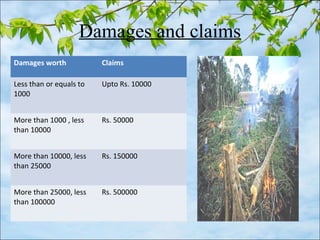
Damages and claims
Damages worth Claims
Less than or equals to
1000
Upto Rs. 10000
More than 1000 , less
than 10000
Rs. 50000
More than 10000, less
than 25000
Rs. 150000
More than 25000, less
than 100000
Rs. 500000
. Power To Declare Forest No
Longer Protected
The Government shall not
declare or notify a protected
forest or any part of the
protected forest as being no
longer protected forest.
PENALTIES
AND
PROCEDURE
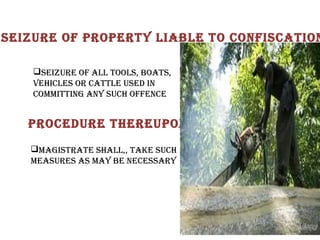
SEIzURE Of PROPERTy LIAbLE TO CONfISCATION
SEIzURE Of ALL TOOLS, bOATS,
vEhICLES OR CATTLE USED IN
COmmITTINg ANy SUCh OffENCE
PROCEDURE ThEREUPON
mAgISTRATE ShALL,, TAkE SUCh
mEASURES AS mAy bE NECESSARy
Power to
release
ProPerty
on the execution of a bond by
the owner of the ProPerty
before the Magistrate
disPosal of Produce in resPect of wich
forest offence was coMMitted
forest Produce May be disPosed of
in such Manner as the court directs 
aPPeal froM orders under section 55,
section 56, or section 57
orders Made by Magistrate are ordinarily aPPealable, and the
order Passed on such aPPeal shall be final.
Power to release a seized ProPerty
iMMediate release of any
ProPerty, which is wrongfully
seized under this act
PunishMent for wrongful seizure
iMPrisonMent for a terM which
May extend to six Months
or with fine which May extend to
five hundred ruPees, or with both.
Penalty for counterfeiting or defacing
Marks on trees and tiMber and for
altering boundary Marks
if a Person, with intent to cause daMage or injury
to the Public or to any other Person, shall be
liable to
 iMPrisonMent for a terM which May extend to
two years
or fine which May extend to one Million ruPees or
to both
reward in forest cases.
aMount shall not be More than
three fourth of the aMount of
coMPensation recovered froM the
Person

Forest act 1927

  • 1.
  • 2.
  • 3.
    Province-wise Breakup ofForest • Punjab • Sindh • KPK • Balochistan • AJK • Northern Area
  • 4.
    Area of Forest •3.1% or about 1,687,000 ha of Pakistan is forested. Pakistan had 340,000 ha of planted forest. • Change in Forest Cover During the last decade, Pakistan lost an average of 42,000 ha or 1.66% per year. In total, during last decade, Pakistan lost 33.2% of its forest cover, or around 840,000 ha. Pakistan's forests contain 213 million metric tons of carbon in living forest biomass.
  • 5.
    Year % Shareof Forestry in GDP • 1999-2000 0.66 • 2000-2001 0.71 • 2001-2002 0.66 • 2002-2003 0.70 • 2003-2004 0.67 • 2006-2007 0.20 • 2008-2010 0.10 • Note: Only those forest products, which go through market channel, are valued and reflected in national accounting system. Majority of products are used locally and hence do not contribute to GDP. Environmental services of forests are also ignored.
  • 6.
    The Forest Act,1927 • History The basic purpose of legislation has been to protect the forests from misuse and damage done by either man or animal. • Forest Policy Objectives 1. Lays down procedures for constituting and managing different kinds of forests like reserved and protected Forests; 2. Provides rules to restrict people’s action in and around public and community forests; 3. Prescribes duties of the public and the public servants in relation to forests; and 4. Chalks out penalties for violating rules.
  • 7.
    Ownership Arrangements.  InPakistan, forests are held under a variety of ownership arrangements.  According to legal classification, forests are divided between • Public Forests (state-owned) • Private Forests (non-state).  These are further divided into subcategories.  The main categories of public forests are I. Reserved II. Protected  The main part of private forests I. Wasteland forests
  • 8.
    Reserved Forests • Themost well stocked forests (commercially profitable) were declared as reserved forests It is the strictest tenure class in which locals have no rights. The right of passage, water, and grazing are allowed as concessions with government approval. • Demarcation of Forests The first step in the establishment of state’s control over forests was a demarcation between reserved and wasteland forests • Forest Officer At present the Forest Officer is the person responsible to protect, rather police, and these powers are vested in him under the Forest Act of 1927. ordinarily be a person not holding any forest-office except that of Forest Settlement-officer.
  • 9.
    Powers of forestofficer  Under section 8 of chapter II of the Forest Act of 1927, “the government may invest any Forest Officer with the following powers,  The powers to enter upon any land Law even gives some police responsibilities, including the power to arrest, to forest officers. And to survey, demarcate and map the same;  The powers of civil court to compel the attendance of the accused and witnesses and the production of documents and material objects
  • 10.
  • 11.
    Formation of VillageForestFormation of Village Forest Rights to any village communityRights to any village community Rules for managementRules for management Duties of village communityDuties of village community
  • 12.
    Unclassed Forests Definition An arearecorded as forest but not included in reserved or protected forest category. Ownership status of such forests varies from state to state.
  • 13.
    Unclassed Forests • Declarationof unclassed forest • Direct to follow the rules • Rules for management
  • 14.
  • 15.
    protected forests arethe one in which human intervention is not prohibited… but hunting and poaching of animals is against the law. Protected Forests
  • 16.
    DECLARE ANY TREESOR CLASS OF TREES IN A PROTECTED FOREST TO BE RESERVED Power to Issue Notification Reserving Trees
  • 17.
    Power to makerules for protected forests (a) cutting, sawing, conversion and removal of trees and timber. (b) cutting of grass and pasturing of cattle (c) hunting, shooting, fishing, poisoning water and setting trap or snare d) protection and management of any portion of the forest (e) quarrying or mining of stones or minerals, burning of lime or charcoal (f) soil, water, natural vegetation, fish, wild animals and wild birds g) construction of a building, structure, hutment and cattle pen
  • 18.
    Damages and claims Damagesworth Claims Less than or equals to 1000 Upto Rs. 10000 More than 1000 , less than 10000 Rs. 50000 More than 10000, less than 25000 Rs. 150000 More than 25000, less than 100000 Rs. 500000
  • 19.
    . Power ToDeclare Forest No Longer Protected The Government shall not declare or notify a protected forest or any part of the protected forest as being no longer protected forest.
  • 20.
  • 21.
    SEIzURE Of PROPERTyLIAbLE TO CONfISCATION SEIzURE Of ALL TOOLS, bOATS, vEhICLES OR CATTLE USED IN COmmITTINg ANy SUCh OffENCE PROCEDURE ThEREUPON mAgISTRATE ShALL,, TAkE SUCh mEASURES AS mAy bE NECESSARy
  • 22.
    Power to release ProPerty on theexecution of a bond by the owner of the ProPerty before the Magistrate
  • 23.
    disPosal of Producein resPect of wich forest offence was coMMitted forest Produce May be disPosed of in such Manner as the court directs 
  • 24.
    aPPeal froM ordersunder section 55, section 56, or section 57 orders Made by Magistrate are ordinarily aPPealable, and the order Passed on such aPPeal shall be final. Power to release a seized ProPerty iMMediate release of any ProPerty, which is wrongfully seized under this act PunishMent for wrongful seizure iMPrisonMent for a terM which May extend to six Months or with fine which May extend to five hundred ruPees, or with both.
  • 25.
    Penalty for counterfeitingor defacing Marks on trees and tiMber and for altering boundary Marks if a Person, with intent to cause daMage or injury to the Public or to any other Person, shall be liable to  iMPrisonMent for a terM which May extend to two years or fine which May extend to one Million ruPees or to both
  • 26.
    reward in forestcases. aMount shall not be More than three fourth of the aMount of coMPensation recovered froM the Person