Forest History and Management
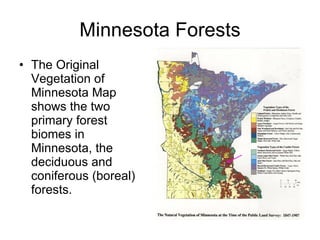
Minnesota Forests The Original Vegetation of Minnesota Map shows the two primary forest biomes in Minnesota, the deciduous and coniferous (boreal) forests.
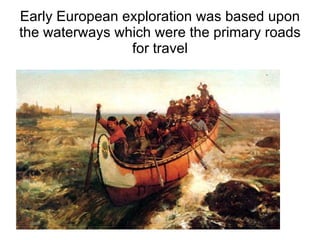
Early European exploration was based upon the waterways which were the primary roads for travel
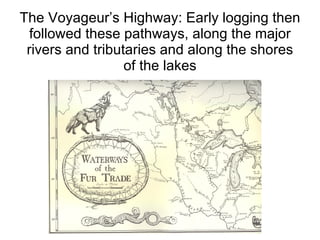
The Voyageur’s Highway: Early logging then followed these pathways, along the major rivers and tributaries and along the shores of the lakes
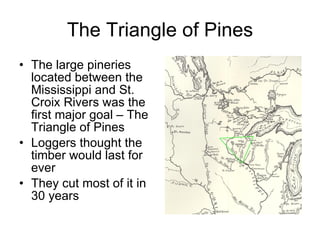
The Triangle of Pines The large pineries located between the Mississippi and St. Croix Rivers was the first major goal – The Triangle of Pines Loggers thought the timber would last for ever They cut most of it in 30 years
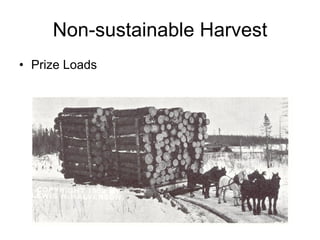
Non-sustainable Harvest Prize Loads
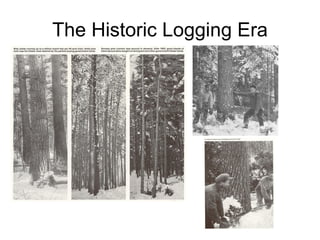
The Historic Logging Era
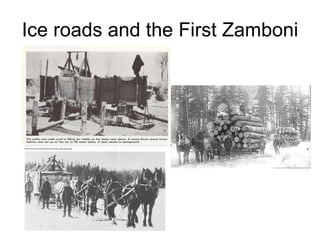
Ice roads and the First Zamboni
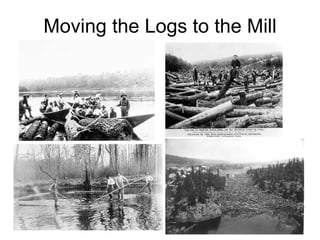
Moving the Logs to the Mill
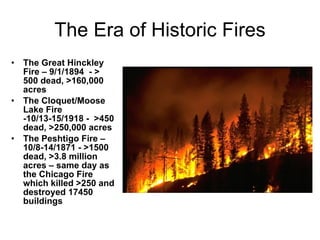
The Era of Historic Fires The Great Hinckley Fire – 9/1/1894  - > 500 dead, >160,000 acres  The Cloquet/Moose Lake Fire -10/13-15/1918 -  >450 dead, >250,000 acres The Peshtigo Fire – 10/8-14/1871 - >1500 dead, >3.8 million acres – same day as the Chicago Fire which killed >250 and destroyed 17450 buildings
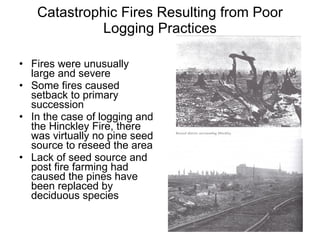
Catastrophic Fires Resulting from Poor Logging Practices Fires were unusually large and severe Some fires caused setback to primary succession In the case of logging and the Hinckley Fire, there was virtually no pine seed source to reseed the area Lack of seed source and post fire farming had caused the pines have been replaced by deciduous species
Change After the Fires Civil War General C. C. Andrews was named the first Chief Fire Warden of Minnesota (1895-1911) who pushed for sustainable harvests and lands to be set aside Smaller logging companies were bought out by larger corporate interests like Weyerhauser
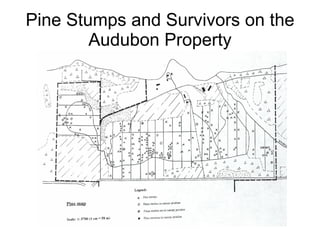
Pine Stumps and Survivors on the Audubon Property
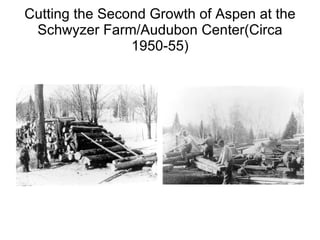
Cutting the Second Growth of Aspen at the Schwyzer Farm/Audubon Center(Circa 1950-55)
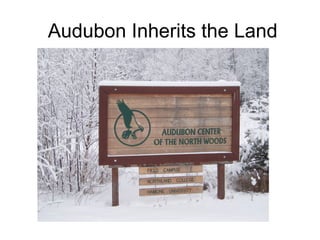
Audubon Inherits the Land
The Future of Forests Management options range from non-sustainable to sustainable Who monitors compliance? How do today’s forests compare with pre-settlement forests? What percentage of old growth/climax should there be?  How much is left? What has happened to forest diversity?
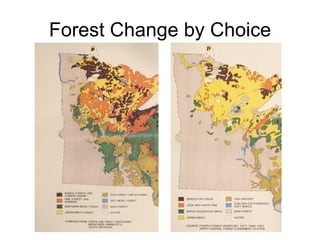
Forest Change by Choice
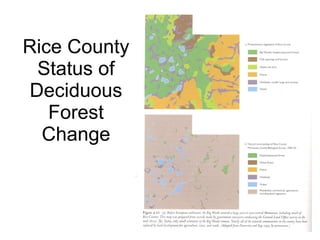
Rice County Status of Deciduous Forest Change
The Forest Stewardship Council The Forest Stewardship council (FSC) is an independent international nonprofit organization founded in 1993 that promotes responsible forestry.  FSC encourages the development of national and regional forest management standards and provides public education and information about independent, third-party certification as a tool for ensuring that forests are protected for future generations.  Independent, certification organizations are accredited by FSC to carry out assessments of forest management to determine if standards have been met. These certifiers also verify that companies claiming to sell FSC certified products have tracked their supply back to FSC certified sources.  FSC-US, based in Washington, DC, is the U.S. “chapter” of FSC International, based in Bonn Germany. For more information about FSC at the International level, please visit  www.fscoax.org .  In the U.S., the FSC recognizes two accredited certifiers—Scientific Certification Systems (SCS) in Oakland, California, and SmartWood headquartered in New York.  Website (U.S.):  www.fscus.org
The American Tree Farm The American Tree Farm program started in 1941 to recognize good forest management. A Tree Farm committee comprised of industry, landowners, federal and state agencies, and others modernized these standards in 1998. The American Tree Farm system is sponsored nationally by the American Forest Foundation and is the world’s oldest sustainable forestry and certification program.  Property owners with more than 10 acres of forestland must have a management plan, actively manage the forest, protect it from fire and insects, protect water quality, and provide for wildlife and recreation.  Every five years Tree Farms are re-inspected to assure that landowners continue to meet the System’s rigorous forestry certification criteria.  Although foresters make recommendations and present options, private landowners make decisions about how to manage their land. Website:  www.treefarmsystem.org
International Standards Organization (ISO) The International Standards Organization (ISO) formed in 1947 and promotes worldwide standards, international consistency and world trade.  There are two standards; ISO 14000 which deals with the objective of sustainable development discussed and ISO 14001 which does not establish performance requirements or specific criteria that define sustainable forestry.  It establishes a system for auditing, monitoring and improving environmental performance within a company to determine if the organization is achieving its stated environmental policies and objectives.  It also allows organizations to self-declare they are conforming to standards.  Since it is not a labeling program, no chain-of-custody certification is conducted. Website:  www.iso.ch/iso/en/isooonline.frontpage
Sustainable Forest Initiative (SFISM) program The Sustainable Forest Initiative (SFI) program was developed by the American Forest and Paper Association (AF&PA) in 1994.  The SFI program is a system of principles, objectives and performance measures that integrate the perpetual growing and harvesting of trees with other forest benefits.  Participating forest product industries are encouraged to meet market demands while using environmentally responsible practices.  The SFI objectives translate these principles into action by providing those who mange forests in North America with a specific roadmap to expand the practice of sustainable forestry and to visibly improve performance.  AF&PA members and SFI program licensees can conduct formal self-verifications, work with a second party or seek third-party certification. Website:  www.aboutsfi.org
Green Tag The Green Tag program was developed in 1998 by the National Forestry Association with the National Woodland Owners Association and Association of Consulting Foresters. This nation-wide program for non-industrial, private forest owners has 10 criteria that outline its approach to forest management, including: Forest planning and management; forest health, inventory and natural diversity; logging and reforestation; road construction and protection of special sites; product utilization and aesthetics; chemical utilization; community and social relations; economic viability; record-keeping; and commitment to sustainability. Certifications are good for five years and re-verification is available by application.  Website:  www.greentag.org /
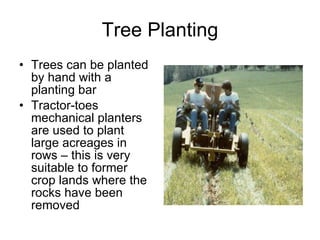
Tree Planting Trees can be planted by hand with a planting bar Tractor-toes mechanical planters are used to plant large acreages in rows – this is very suitable to former crop lands where the rocks have been removed
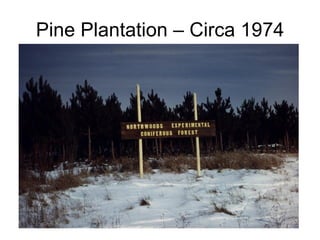
Pine Plantation – Circa 1974
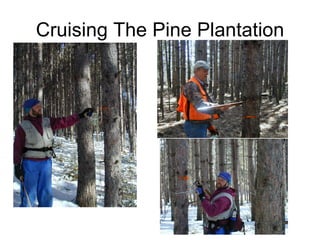
Cruising The Pine Plantation
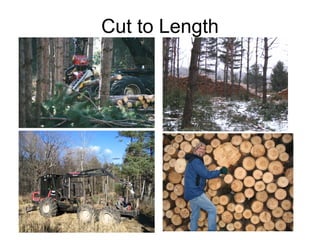
Cut to Length
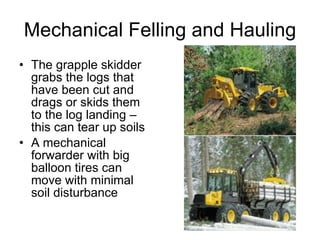
Mechanical Felling and Hauling The grapple skidder grabs the logs that have been cut and drags or skids them  to the log landing – this can tear up soils A mechanical forwarder with big balloon tires can move with minimal soil disturbance
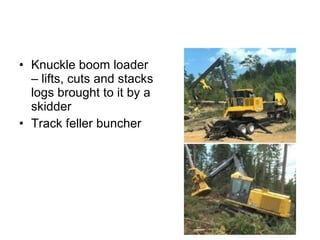
Knuckle boom loader – lifts, cuts and stacks logs brought to it by a skidder Track feller buncher
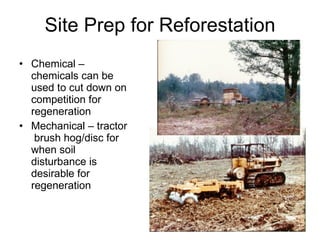
Site Prep for Reforestation Chemical – chemicals can be used to cut down on competition for regeneration Mechanical – tractor  brush hog/disc for when soil disturbance is desirable for regeneration
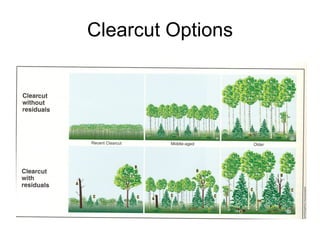
Clearcut Options
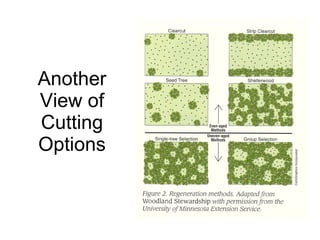
Another View of Cutting Options
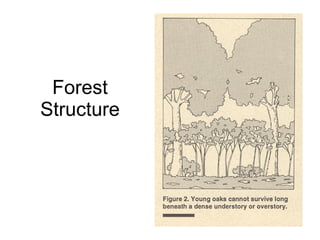
Forest Structure
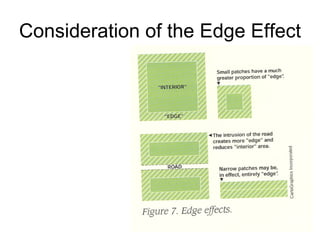
Consideration of the Edge Effect
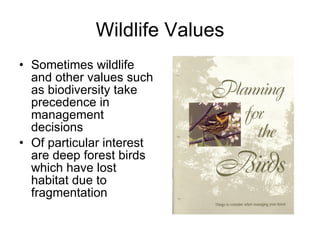
Wildlife Values Sometimes wildlife and other values such as biodiversity take precedence in management decisions Of particular interest are deep forest birds which have lost habitat due to fragmentation
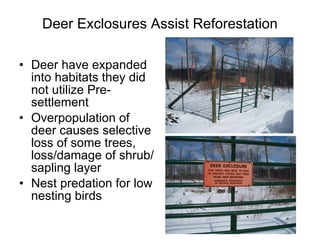
Deer Exclosures Assist Reforestation Deer have expanded into habitats they did not utilize Pre-settlement Overpopulation of deer causes selective loss of some trees, loss/damage of shrub/sapling layer Nest predation for low nesting birds
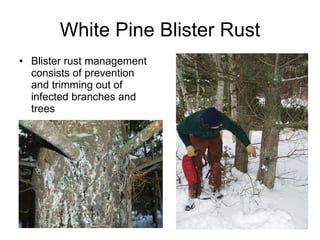
White Pine Blister Rust Blister rust management consists of prevention and trimming out of infected branches and trees
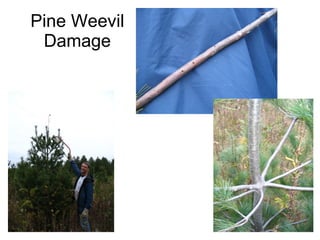
Pine Weevil Damage
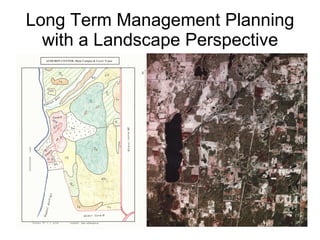
Long Term Management Planning with a Landscape Perspective

Forest history and management

  • 1.
  • 2.
    Minnesota Forests TheOriginal Vegetation of Minnesota Map shows the two primary forest biomes in Minnesota, the deciduous and coniferous (boreal) forests.
  • 3.
    Early European explorationwas based upon the waterways which were the primary roads for travel
  • 4.
    The Voyageur’s Highway:Early logging then followed these pathways, along the major rivers and tributaries and along the shores of the lakes
  • 5.
    The Triangle ofPines The large pineries located between the Mississippi and St. Croix Rivers was the first major goal – The Triangle of Pines Loggers thought the timber would last for ever They cut most of it in 30 years
  • 6.
  • 7.
  • 8.
    Ice roads andthe First Zamboni
  • 9.
    Moving the Logsto the Mill
  • 10.
    The Era ofHistoric Fires The Great Hinckley Fire – 9/1/1894 - > 500 dead, >160,000 acres The Cloquet/Moose Lake Fire -10/13-15/1918 - >450 dead, >250,000 acres The Peshtigo Fire – 10/8-14/1871 - >1500 dead, >3.8 million acres – same day as the Chicago Fire which killed >250 and destroyed 17450 buildings
  • 11.
    Catastrophic Fires Resultingfrom Poor Logging Practices Fires were unusually large and severe Some fires caused setback to primary succession In the case of logging and the Hinckley Fire, there was virtually no pine seed source to reseed the area Lack of seed source and post fire farming had caused the pines have been replaced by deciduous species
  • 12.
    Change After theFires Civil War General C. C. Andrews was named the first Chief Fire Warden of Minnesota (1895-1911) who pushed for sustainable harvests and lands to be set aside Smaller logging companies were bought out by larger corporate interests like Weyerhauser
  • 13.
    Pine Stumps andSurvivors on the Audubon Property
  • 14.
    Cutting the SecondGrowth of Aspen at the Schwyzer Farm/Audubon Center(Circa 1950-55)
  • 15.
  • 16.
    The Future ofForests Management options range from non-sustainable to sustainable Who monitors compliance? How do today’s forests compare with pre-settlement forests? What percentage of old growth/climax should there be? How much is left? What has happened to forest diversity?
  • 17.
  • 18.
    Rice County Statusof Deciduous Forest Change
  • 19.
    The Forest StewardshipCouncil The Forest Stewardship council (FSC) is an independent international nonprofit organization founded in 1993 that promotes responsible forestry. FSC encourages the development of national and regional forest management standards and provides public education and information about independent, third-party certification as a tool for ensuring that forests are protected for future generations. Independent, certification organizations are accredited by FSC to carry out assessments of forest management to determine if standards have been met. These certifiers also verify that companies claiming to sell FSC certified products have tracked their supply back to FSC certified sources. FSC-US, based in Washington, DC, is the U.S. “chapter” of FSC International, based in Bonn Germany. For more information about FSC at the International level, please visit www.fscoax.org . In the U.S., the FSC recognizes two accredited certifiers—Scientific Certification Systems (SCS) in Oakland, California, and SmartWood headquartered in New York. Website (U.S.): www.fscus.org
  • 20.
    The American TreeFarm The American Tree Farm program started in 1941 to recognize good forest management. A Tree Farm committee comprised of industry, landowners, federal and state agencies, and others modernized these standards in 1998. The American Tree Farm system is sponsored nationally by the American Forest Foundation and is the world’s oldest sustainable forestry and certification program. Property owners with more than 10 acres of forestland must have a management plan, actively manage the forest, protect it from fire and insects, protect water quality, and provide for wildlife and recreation. Every five years Tree Farms are re-inspected to assure that landowners continue to meet the System’s rigorous forestry certification criteria. Although foresters make recommendations and present options, private landowners make decisions about how to manage their land. Website: www.treefarmsystem.org
  • 21.
    International Standards Organization(ISO) The International Standards Organization (ISO) formed in 1947 and promotes worldwide standards, international consistency and world trade. There are two standards; ISO 14000 which deals with the objective of sustainable development discussed and ISO 14001 which does not establish performance requirements or specific criteria that define sustainable forestry. It establishes a system for auditing, monitoring and improving environmental performance within a company to determine if the organization is achieving its stated environmental policies and objectives. It also allows organizations to self-declare they are conforming to standards. Since it is not a labeling program, no chain-of-custody certification is conducted. Website: www.iso.ch/iso/en/isooonline.frontpage
  • 22.
    Sustainable Forest Initiative(SFISM) program The Sustainable Forest Initiative (SFI) program was developed by the American Forest and Paper Association (AF&PA) in 1994. The SFI program is a system of principles, objectives and performance measures that integrate the perpetual growing and harvesting of trees with other forest benefits. Participating forest product industries are encouraged to meet market demands while using environmentally responsible practices. The SFI objectives translate these principles into action by providing those who mange forests in North America with a specific roadmap to expand the practice of sustainable forestry and to visibly improve performance. AF&PA members and SFI program licensees can conduct formal self-verifications, work with a second party or seek third-party certification. Website: www.aboutsfi.org
  • 23.
    Green Tag TheGreen Tag program was developed in 1998 by the National Forestry Association with the National Woodland Owners Association and Association of Consulting Foresters. This nation-wide program for non-industrial, private forest owners has 10 criteria that outline its approach to forest management, including: Forest planning and management; forest health, inventory and natural diversity; logging and reforestation; road construction and protection of special sites; product utilization and aesthetics; chemical utilization; community and social relations; economic viability; record-keeping; and commitment to sustainability. Certifications are good for five years and re-verification is available by application. Website: www.greentag.org /
  • 24.
    Tree Planting Treescan be planted by hand with a planting bar Tractor-toes mechanical planters are used to plant large acreages in rows – this is very suitable to former crop lands where the rocks have been removed
  • 25.
  • 26.
  • 27.
  • 28.
    Mechanical Felling andHauling The grapple skidder grabs the logs that have been cut and drags or skids them to the log landing – this can tear up soils A mechanical forwarder with big balloon tires can move with minimal soil disturbance
  • 29.
    Knuckle boom loader– lifts, cuts and stacks logs brought to it by a skidder Track feller buncher
  • 30.
    Site Prep forReforestation Chemical – chemicals can be used to cut down on competition for regeneration Mechanical – tractor brush hog/disc for when soil disturbance is desirable for regeneration
  • 31.
  • 32.
    Another View ofCutting Options
  • 33.
  • 34.
  • 35.
    Wildlife Values Sometimeswildlife and other values such as biodiversity take precedence in management decisions Of particular interest are deep forest birds which have lost habitat due to fragmentation
  • 36.
    Deer Exclosures AssistReforestation Deer have expanded into habitats they did not utilize Pre-settlement Overpopulation of deer causes selective loss of some trees, loss/damage of shrub/sapling layer Nest predation for low nesting birds
  • 37.
    White Pine BlisterRust Blister rust management consists of prevention and trimming out of infected branches and trees
  • 38.
  • 39.
    Long Term ManagementPlanning with a Landscape Perspective