Forces Notes #1
• Force = a push or pull in a particular
direction.
• Forces can affect motion in several ways:
–They can make objects:
•start moving
•stop moving
•move faster
•move slower
•change direction
•change shape
• Forces are measured in Newtons
–You need about 1 N to lift a burger
–You need about 20 N to lift a 2 liter bottle
• Forces usually act in pairs
• Forces are measured in Newtons
• Forces usually act in pairs
• Forces act in a particular direction
• Forces usually cannot be seen, but their
EFFECTS can be seen.
Which forces are pushing, which are
pulling? AND... Do they change the
speed or direction of the object or
both speed and direction?
Which forces are pushing, which are
pulling? AND... Do they change the
speed or direction of the object or
both speed and direction?
Which forces are pushing, which are
pulling? AND... Do they change the
speed or direction of the object or
both speed and direction?
Which forces are pushing, which are
pulling? AND... Do they change the
speed or direction of the object or
both speed and direction?
Which forces are pushing, which are
pulling? AND... Do they change the
speed or direction of the object or
both speed and direction?
• Contact forces – forces exerted by two
objects touching each other.
• Noncontact forces – forces exerted
without objects touching. Examples:
•Gravity
•Electricity
•Magnetism
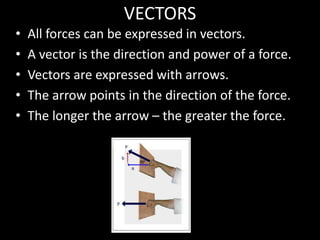
VECTORS
• All forces can be expressed in vectors.
• A vector is the direction and power of a force.
• Vectors are expressed with arrows.
• The arrow points in the direction of the force.
• The longer the arrow – the greater the force.
Quickystarty! 9/30
• Each solid rocket booster on the space shuttle
has about 14 kilonewtons of thrust. How
much combined force do they have together?
Forces Notes #2
• Net force = all the forces acting on an object at
once.
– Go to page 90 and 91 in your textbook.
– Write what “unbalanced forces” and “balanced
forces” mean.
• When the forces acting on a soccer ball are
unbalanced, the ball will move.
• When they’re balanced – the ball won’t move.
Newton’s First Law of Motion
• “Objects at rest tend to stay at rest – objects
in motion tend to stay in motion.”
• Inertia: the tendancy of an object to resist a
change of motion.
• A car and a paper airplane are both going the
same speed – but the car is much harder to
stop. It has more inertia because it has more
mass.
Standards check
• Answer questions 1 through 8 on page 94 –
skip number 5.
• Bridge Design Videos:
• https://www.khanacademy.org/partner-content/mit-k12/mit-k12-
physics/v/bridge-design--and-destruction---part-1
• https://www.khanacademy.org/partner-content/mit-k12/mit-k12-
physics/v/bridge-design--and-destruction---part-2
Popsicle Stick Bridge Budget
• http://www.syp.mtu.edu/docs/Lesson_Plans/
Building%20a%20Bridge%20on%20a%20Budg
et.pdf

Forces notes 1 and 2

  • 1.
  • 2.
    • Force =a push or pull in a particular direction. • Forces can affect motion in several ways: –They can make objects: •start moving •stop moving •move faster •move slower •change direction •change shape
  • 3.
    • Forces aremeasured in Newtons –You need about 1 N to lift a burger –You need about 20 N to lift a 2 liter bottle • Forces usually act in pairs
  • 5.
    • Forces aremeasured in Newtons • Forces usually act in pairs • Forces act in a particular direction • Forces usually cannot be seen, but their EFFECTS can be seen.
  • 6.
    Which forces arepushing, which are pulling? AND... Do they change the speed or direction of the object or both speed and direction?
  • 7.
    Which forces arepushing, which are pulling? AND... Do they change the speed or direction of the object or both speed and direction?
  • 8.
    Which forces arepushing, which are pulling? AND... Do they change the speed or direction of the object or both speed and direction?
  • 9.
    Which forces arepushing, which are pulling? AND... Do they change the speed or direction of the object or both speed and direction?
  • 10.
    Which forces arepushing, which are pulling? AND... Do they change the speed or direction of the object or both speed and direction?
  • 11.
    • Contact forces– forces exerted by two objects touching each other. • Noncontact forces – forces exerted without objects touching. Examples: •Gravity •Electricity •Magnetism
  • 12.
    VECTORS • All forcescan be expressed in vectors. • A vector is the direction and power of a force. • Vectors are expressed with arrows. • The arrow points in the direction of the force. • The longer the arrow – the greater the force.
  • 13.
    Quickystarty! 9/30 • Eachsolid rocket booster on the space shuttle has about 14 kilonewtons of thrust. How much combined force do they have together?
  • 14.
    Forces Notes #2 •Net force = all the forces acting on an object at once. – Go to page 90 and 91 in your textbook. – Write what “unbalanced forces” and “balanced forces” mean. • When the forces acting on a soccer ball are unbalanced, the ball will move. • When they’re balanced – the ball won’t move.
  • 15.
    Newton’s First Lawof Motion • “Objects at rest tend to stay at rest – objects in motion tend to stay in motion.” • Inertia: the tendancy of an object to resist a change of motion. • A car and a paper airplane are both going the same speed – but the car is much harder to stop. It has more inertia because it has more mass.
  • 17.
    Standards check • Answerquestions 1 through 8 on page 94 – skip number 5. • Bridge Design Videos: • https://www.khanacademy.org/partner-content/mit-k12/mit-k12- physics/v/bridge-design--and-destruction---part-1 • https://www.khanacademy.org/partner-content/mit-k12/mit-k12- physics/v/bridge-design--and-destruction---part-2
  • 18.
    Popsicle Stick BridgeBudget • http://www.syp.mtu.edu/docs/Lesson_Plans/ Building%20a%20Bridge%20on%20a%20Budg et.pdf