a) Will this object move by itself?
b) How can we make this object move?
c) While it is moving, how can we make the
object speed up or slow down?
d) How can make it stop?
e) How can we make it change its direction?
Activity
Forces and
Motion
FORCE
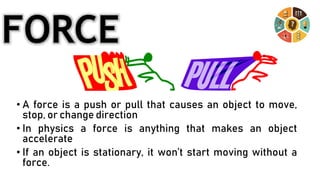
• A force is a push or pull that causes an object to move,
stop, or change direction
• In physics a force is anything that makes an object
accelerate
• If an object is stationary, it won’t start moving without a
force.
FORCE
is a push or pull acting upon an
object as a result of its
interaction with another object.
FORCES AND MOTION
Types of Forces
Contact Forces
forces where objects
touch or contact with
each other.
Action-at-a-Distance Forces
 non-contact force
 forces where objects do not
touch or contact with each
other. These forces act over
a zone or area called field.
FORCES AND MOTION
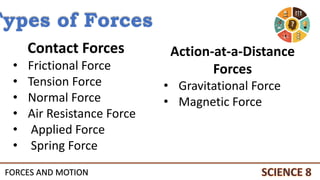
Types of Forces
Contact Forces
• Frictional Force
• Tension Force
• Normal Force
• Air Resistance Force
• Applied Force
• Spring Force
Action-at-a-Distance
Forces
• Gravitational Force
• Magnetic Force
FORCES AND MOTION
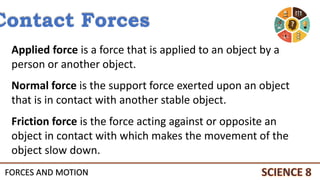
Contact Forces
Applied force is a force that is applied to an object by a
person or another object.
Normal force is the support force exerted upon an object
that is in contact with another stable object.
Friction force is the force acting against or opposite an
object in contact with which makes the movement of the
object slow down.
FORCES AND MOTION
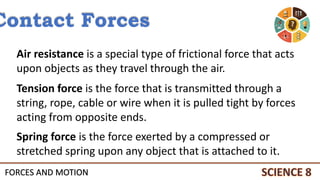
Contact Forces
Air resistance is a special type of frictional force that acts
upon objects as they travel through the air.
Tension force is the force that is transmitted through a
string, rope, cable or wire when it is pulled tight by forces
acting from opposite ends.
Spring force is the force exerted by a compressed or
stretched spring upon any object that is attached to it.
FORCES AND MOTION
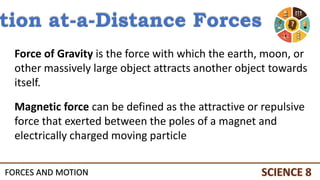
tion at-a-Distance Forces
Force of Gravity is the force with which the earth, moon, or
other massively large object attracts another object towards
itself.
Magnetic force can be defined as the attractive or repulsive
force that exerted between the poles of a magnet and
electrically charged moving particle
FORCES AND MOTION
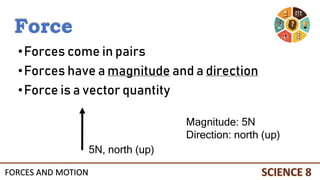
•Forces come in pairs
•Forces have a magnitude and a direction
•Force is a vector quantity
5N, north (up)
Magnitude: 5N
Direction: north (up)
Force
FORCES AND MOTION
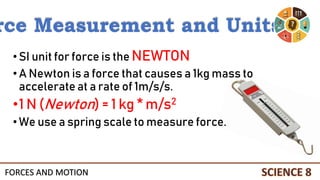
• SI unit for force is the NEWTON
• A Newton is a force that causes a 1kg mass to
accelerate at a rate of 1m/s/s.
•1 N (Newton) = 1 kg * m/s2
• We use a spring scale to measure force.
rce Measurement and Units
FORCES AND MOTION
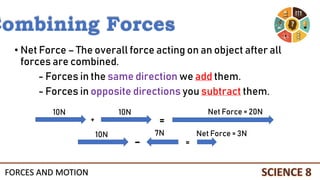
• Net Force – The overall force acting on an object after all
forces are combined.
- Forces in the same direction we add them.
- Forces in opposite directions you subtract them.
10N 10N
=
+
Net Force = 20N
10N 7N
- =
Net Force = 3N
Combining Forces
FORCES AND MOTION
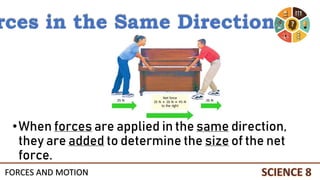
•When forces are applied in the same direction,
they are added to determine the size of the net
force.
rces in the Same Direction
FORCES AND MOTION
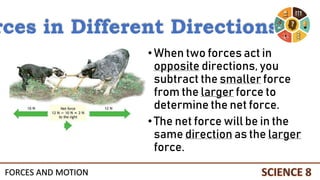
•When two forces act in
opposite directions, you
subtract the smaller force
from the larger force to
determine the net force.
•The net force will be in the
same direction as the larger
force.
rces in Different Directions
FORCES AND MOTION
MOTION
-is an act, process, or
instance of changing
place : movement.
FORCES AND MOTION
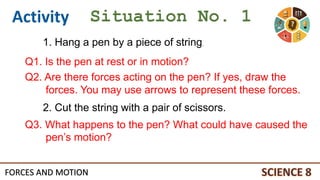
1. Hang a pen by a piece of string.
Q3. What happens to the pen? What could have caused the
pen’s motion?
Q1. Is the pen at rest or in motion?
2. Cut the string with a pair of scissors.
Q2. Are there forces acting on the pen? If yes, draw the
forces. You may use arrows to represent these forces.
FORCES AND MOTION
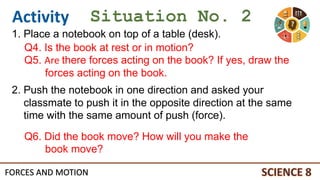
1. Place a notebook on top of a table (desk).
Q4. Is the book at rest or in motion?
Q5. Are there forces acting on the book? If yes, draw the
forces acting on the book.
2. Push the notebook in one direction and asked your
classmate to push it in the opposite direction at the same
time with the same amount of push (force).
Q6. Did the book move? How will you make the
book move?
FORCES AND MOTION
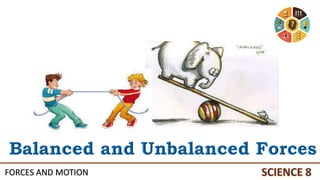
•Forces occur in pairs and they can be either
BALANCED OR UNBALANCED
Balanced and Unbalanced Forces
FORCES AND MOTION
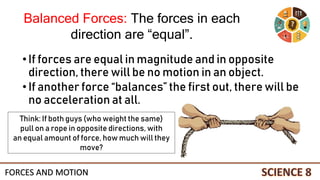
•If forces are equal in magnitude and in opposite
direction, there will be no motion in an object.
•If another force “balances” the first out, there will be
no acceleration at all.
Think: If both guys (who weight the same)
pull on a rope in opposite directions, with
an equal amount of force, how much will they
move?
Balanced Forces: The forces in each
direction are “equal”.
FORCES AND MOTION
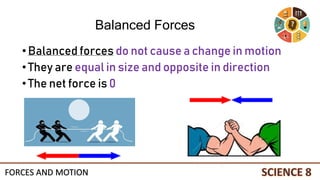
•Balanced forces do not cause a change in motion
•They are equal in size and opposite in direction
•The net force is 0
Balanced Forces
FORCES AND MOTION
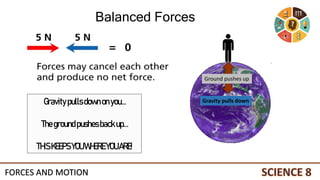
Gravitypullsdownonyou…
Thegroundpushesbackup…
THISKEEPS YOU WHERE YOUARE!
Gravity pulls down
Ground pushes up
Balanced Forces
FORCES AND MOTION
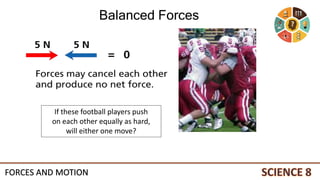
If these football players push
on each other equally as hard,
will either one move?
Balanced Forces
FORCES AND MOTION
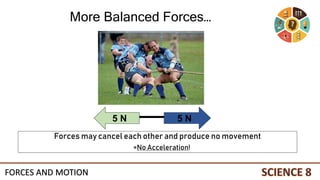
5 N
5 N
More Balanced Forces…
Forces may cancel each other and produce no movement
=No Acceleration!
FORCES AND MOTION
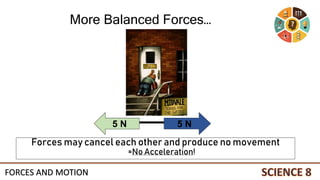
5 N
5 N
More Balanced Forces…
Forces may cancel each other and produce no movement
=No Acceleration!
FORCES AND MOTION
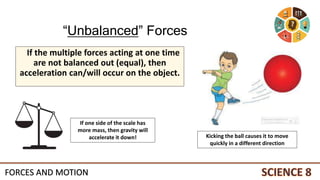
If the multiple forces acting at one time
are not balanced out (equal), then
acceleration can/will occur on the object.
Kicking the ball causes it to move
quickly in a different direction
If one side of the scale has
more mass, then gravity will
accelerate it down!
“Unbalanced” Forces
FORCES AND MOTION
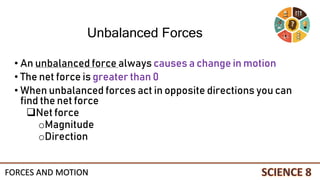
• An unbalanced force always causes a change in motion
• The net force is greater than 0
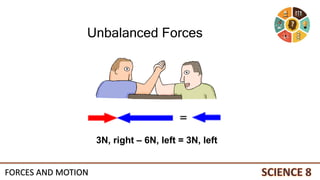
• When unbalanced forces act in opposite directions you can
find the net force
Net force
oMagnitude
oDirection
Unbalanced Forces
FORCES AND MOTION
3N, right – 6N, left = 3N, left
Unbalanced Forces
FORCES AND MOTION
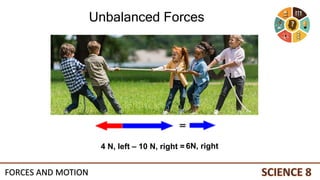
4 N, left – 10 N, right = 6N, right
Unbalanced Forces
FORCES AND MOTION
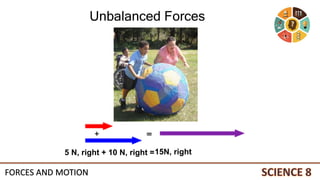
5 N, right + 10 N, right =15N, right
Unbalanced Forces
FORCES AND MOTION
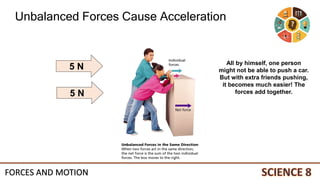
5 N
5 N
All by himself, one person
might not be able to push a car.
But with extra friends pushing,
it becomes much easier! The
forces add together.
Unbalanced Forces Cause Acceleration
FORCES AND MOTION
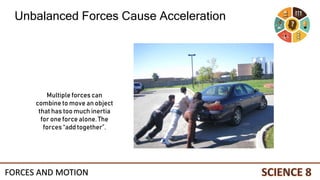
Unbalanced Forces Cause Acceleration
Multiple forces can
combine to move an object
that has too much inertia
for one force alone. The
forces “add together”.
FORCES AND MOTION
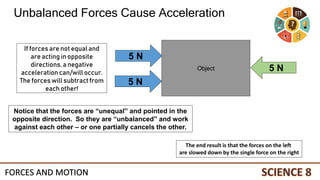
5 N
Object
Notice that the forces are “unequal” and pointed in the
opposite direction. So they are “unbalanced” and work
against each other – or one partially cancels the other.
The end result is that the forces on the left
are slowed down by the single force on the right
If forces are not equal and
are acting in opposite
directions, a negative
acceleration can/will occur.
The forces will subtract from
each other!
5 N
5 N
Unbalanced Forces Cause Acceleration
FORCES AND MOTION
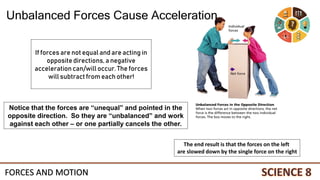
Unbalanced Forces Cause Acceleration
Notice that the forces are “unequal” and pointed in the
opposite direction. So they are “unbalanced” and work
against each other – or one partially cancels the other.
The end result is that the forces on the left
are slowed down by the single force on the right
If forces are not equal and are acting in
oppositedirections, a negative
acceleration can/will occur. The forces
will subtract from each other!
FORCES AND MOTION
Quiz: Read each statement carefully and write the letter of
the correct answer.
1. ______________ refers to when a force is equal and opposite.
A. balanced force C. magnitude
B. unbalanced force D. friction
2.When one force in a pair is greater than the other, we call this:
A. balanced force C. magnitude
B. unbalanced force D. friction
3. If two forces are acting on an object they are equal in magnitude
A. and equal in direction
B. and in opposite direction
C. cancel each other
D. none of the above
FORCES AND MOTION
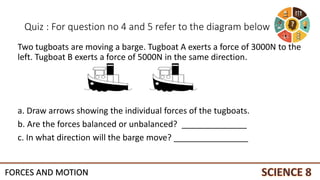
Quiz : For question no 4 and 5 refer to the diagram below
Two tugboats are moving a barge. Tugboat A exerts a force of 3000N to the
left. Tugboat B exerts a force of 5000N in the same direction.
a. Draw arrows showing the individual forces of the tugboats.
b. Are the forces balanced or unbalanced? ______________
c. In what direction will the barge move? ________________
FORCES AND MOTION
FORCES AND MOTION
FORCES AND MOTION

balanced and unbalanced.pptx

  • 1.
    a) Will thisobject move by itself? b) How can we make this object move? c) While it is moving, how can we make the object speed up or slow down? d) How can make it stop? e) How can we make it change its direction? Activity
  • 2.
  • 3.
    FORCE • A forceis a push or pull that causes an object to move, stop, or change direction • In physics a force is anything that makes an object accelerate • If an object is stationary, it won’t start moving without a force.
  • 4.
    FORCE is a pushor pull acting upon an object as a result of its interaction with another object.
  • 5.
    FORCES AND MOTION Typesof Forces Contact Forces forces where objects touch or contact with each other. Action-at-a-Distance Forces  non-contact force  forces where objects do not touch or contact with each other. These forces act over a zone or area called field.
  • 6.
    FORCES AND MOTION Typesof Forces Contact Forces • Frictional Force • Tension Force • Normal Force • Air Resistance Force • Applied Force • Spring Force Action-at-a-Distance Forces • Gravitational Force • Magnetic Force
  • 7.
    FORCES AND MOTION ContactForces Applied force is a force that is applied to an object by a person or another object. Normal force is the support force exerted upon an object that is in contact with another stable object. Friction force is the force acting against or opposite an object in contact with which makes the movement of the object slow down.
  • 8.
    FORCES AND MOTION ContactForces Air resistance is a special type of frictional force that acts upon objects as they travel through the air. Tension force is the force that is transmitted through a string, rope, cable or wire when it is pulled tight by forces acting from opposite ends. Spring force is the force exerted by a compressed or stretched spring upon any object that is attached to it.
  • 9.
    FORCES AND MOTION tionat-a-Distance Forces Force of Gravity is the force with which the earth, moon, or other massively large object attracts another object towards itself. Magnetic force can be defined as the attractive or repulsive force that exerted between the poles of a magnet and electrically charged moving particle
  • 10.
  • 11.
    •Forces come inpairs •Forces have a magnitude and a direction •Force is a vector quantity 5N, north (up) Magnitude: 5N Direction: north (up) Force FORCES AND MOTION
  • 12.
    • SI unitfor force is the NEWTON • A Newton is a force that causes a 1kg mass to accelerate at a rate of 1m/s/s. •1 N (Newton) = 1 kg * m/s2 • We use a spring scale to measure force. rce Measurement and Units FORCES AND MOTION
  • 13.
    • Net Force– The overall force acting on an object after all forces are combined. - Forces in the same direction we add them. - Forces in opposite directions you subtract them. 10N 10N = + Net Force = 20N 10N 7N - = Net Force = 3N Combining Forces FORCES AND MOTION
  • 14.
    •When forces areapplied in the same direction, they are added to determine the size of the net force. rces in the Same Direction FORCES AND MOTION
  • 15.
    •When two forcesact in opposite directions, you subtract the smaller force from the larger force to determine the net force. •The net force will be in the same direction as the larger force. rces in Different Directions FORCES AND MOTION
  • 16.
    MOTION -is an act,process, or instance of changing place : movement.
  • 17.
    FORCES AND MOTION 1.Hang a pen by a piece of string. Q3. What happens to the pen? What could have caused the pen’s motion? Q1. Is the pen at rest or in motion? 2. Cut the string with a pair of scissors. Q2. Are there forces acting on the pen? If yes, draw the forces. You may use arrows to represent these forces.
  • 18.
    FORCES AND MOTION 1.Place a notebook on top of a table (desk). Q4. Is the book at rest or in motion? Q5. Are there forces acting on the book? If yes, draw the forces acting on the book. 2. Push the notebook in one direction and asked your classmate to push it in the opposite direction at the same time with the same amount of push (force). Q6. Did the book move? How will you make the book move?
  • 19.
  • 20.
    •Forces occur inpairs and they can be either BALANCED OR UNBALANCED Balanced and Unbalanced Forces FORCES AND MOTION
  • 21.
    •If forces areequal in magnitude and in opposite direction, there will be no motion in an object. •If another force “balances” the first out, there will be no acceleration at all. Think: If both guys (who weight the same) pull on a rope in opposite directions, with an equal amount of force, how much will they move? Balanced Forces: The forces in each direction are “equal”. FORCES AND MOTION
  • 22.
    •Balanced forces donot cause a change in motion •They are equal in size and opposite in direction •The net force is 0 Balanced Forces FORCES AND MOTION
  • 23.
    Gravitypullsdownonyou… Thegroundpushesbackup… THISKEEPS YOU WHEREYOUARE! Gravity pulls down Ground pushes up Balanced Forces FORCES AND MOTION
  • 24.
    If these footballplayers push on each other equally as hard, will either one move? Balanced Forces FORCES AND MOTION
  • 25.
    5 N 5 N MoreBalanced Forces… Forces may cancel each other and produce no movement =No Acceleration! FORCES AND MOTION
  • 26.
    5 N 5 N MoreBalanced Forces… Forces may cancel each other and produce no movement =No Acceleration! FORCES AND MOTION
  • 27.
    If the multipleforces acting at one time are not balanced out (equal), then acceleration can/will occur on the object. Kicking the ball causes it to move quickly in a different direction If one side of the scale has more mass, then gravity will accelerate it down! “Unbalanced” Forces FORCES AND MOTION
  • 28.
    • An unbalancedforce always causes a change in motion • The net force is greater than 0 • When unbalanced forces act in opposite directions you can find the net force Net force oMagnitude oDirection Unbalanced Forces FORCES AND MOTION
  • 29.
    3N, right –6N, left = 3N, left Unbalanced Forces FORCES AND MOTION
  • 30.
    4 N, left– 10 N, right = 6N, right Unbalanced Forces FORCES AND MOTION
  • 31.
    5 N, right+ 10 N, right =15N, right Unbalanced Forces FORCES AND MOTION
  • 32.
    5 N 5 N Allby himself, one person might not be able to push a car. But with extra friends pushing, it becomes much easier! The forces add together. Unbalanced Forces Cause Acceleration FORCES AND MOTION
  • 33.
    Unbalanced Forces CauseAcceleration Multiple forces can combine to move an object that has too much inertia for one force alone. The forces “add together”. FORCES AND MOTION
  • 34.
    5 N Object Notice thatthe forces are “unequal” and pointed in the opposite direction. So they are “unbalanced” and work against each other – or one partially cancels the other. The end result is that the forces on the left are slowed down by the single force on the right If forces are not equal and are acting in opposite directions, a negative acceleration can/will occur. The forces will subtract from each other! 5 N 5 N Unbalanced Forces Cause Acceleration FORCES AND MOTION
  • 35.
    Unbalanced Forces CauseAcceleration Notice that the forces are “unequal” and pointed in the opposite direction. So they are “unbalanced” and work against each other – or one partially cancels the other. The end result is that the forces on the left are slowed down by the single force on the right If forces are not equal and are acting in oppositedirections, a negative acceleration can/will occur. The forces will subtract from each other! FORCES AND MOTION
  • 36.
    Quiz: Read eachstatement carefully and write the letter of the correct answer. 1. ______________ refers to when a force is equal and opposite. A. balanced force C. magnitude B. unbalanced force D. friction 2.When one force in a pair is greater than the other, we call this: A. balanced force C. magnitude B. unbalanced force D. friction 3. If two forces are acting on an object they are equal in magnitude A. and equal in direction B. and in opposite direction C. cancel each other D. none of the above FORCES AND MOTION
  • 37.
    Quiz : Forquestion no 4 and 5 refer to the diagram below Two tugboats are moving a barge. Tugboat A exerts a force of 3000N to the left. Tugboat B exerts a force of 5000N in the same direction. a. Draw arrows showing the individual forces of the tugboats. b. Are the forces balanced or unbalanced? ______________ c. In what direction will the barge move? ________________ FORCES AND MOTION
  • 38.
  • 39.

Editor's Notes

  • #13 SI – international system of units