FORCE FIELD TRANSFORMS

PRESENTED BY:
Adham Beyki
MS Kapoor
Shashank Dhariwal

1
FORCE FIELD TRANSFORM
•
•
•
•
•
•
•
•
•
•
•
•
•

INTRODUCTION
POINT OPERATORS
ELECTROSTATIC & PLANETARY FORCE FIELD
FORCE FIELD TRANSFORMS
MATHEMATICAL MODEL – Brute Force & FDA
IMPLEMENTATION – Brute Force Method
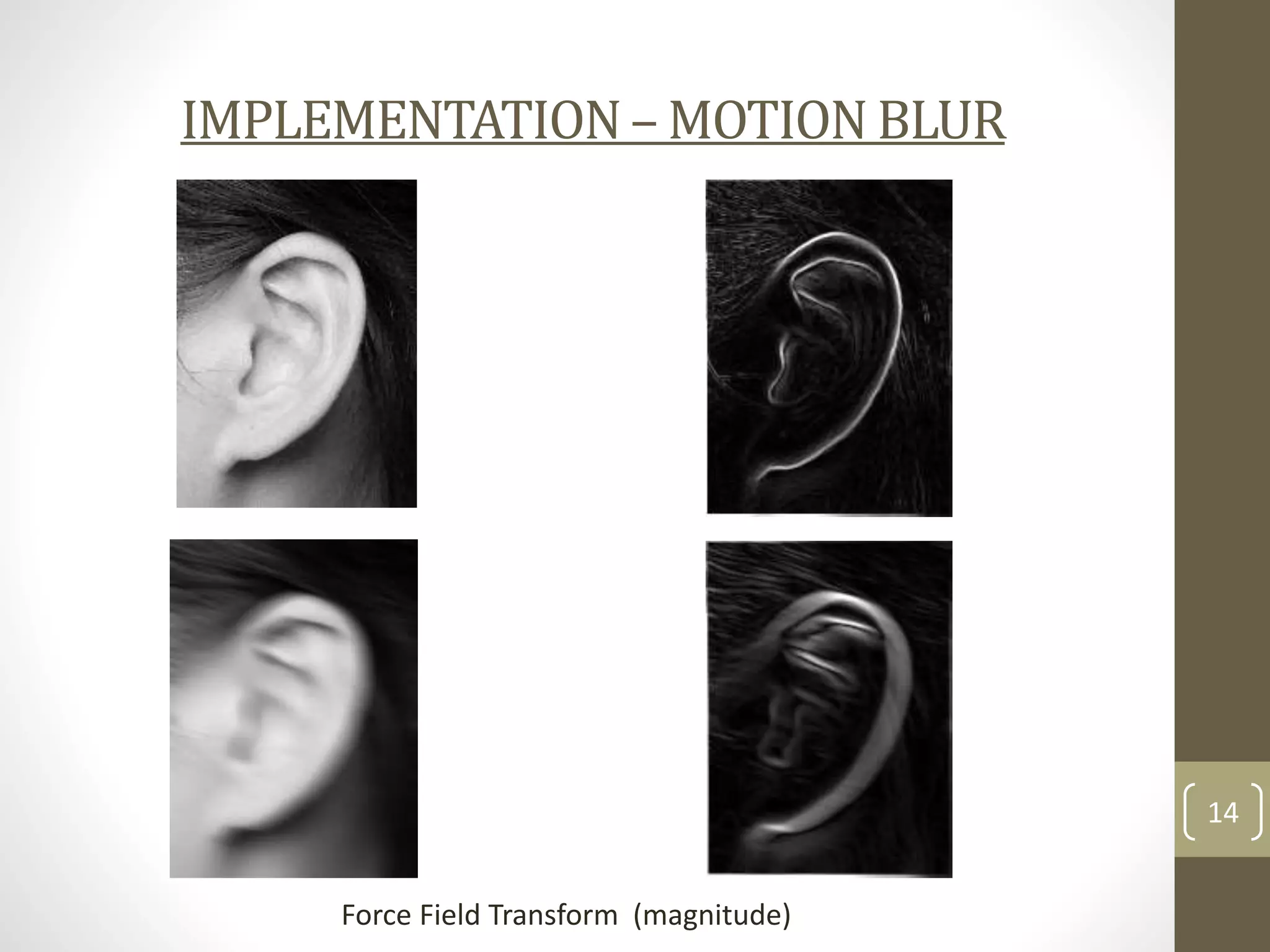
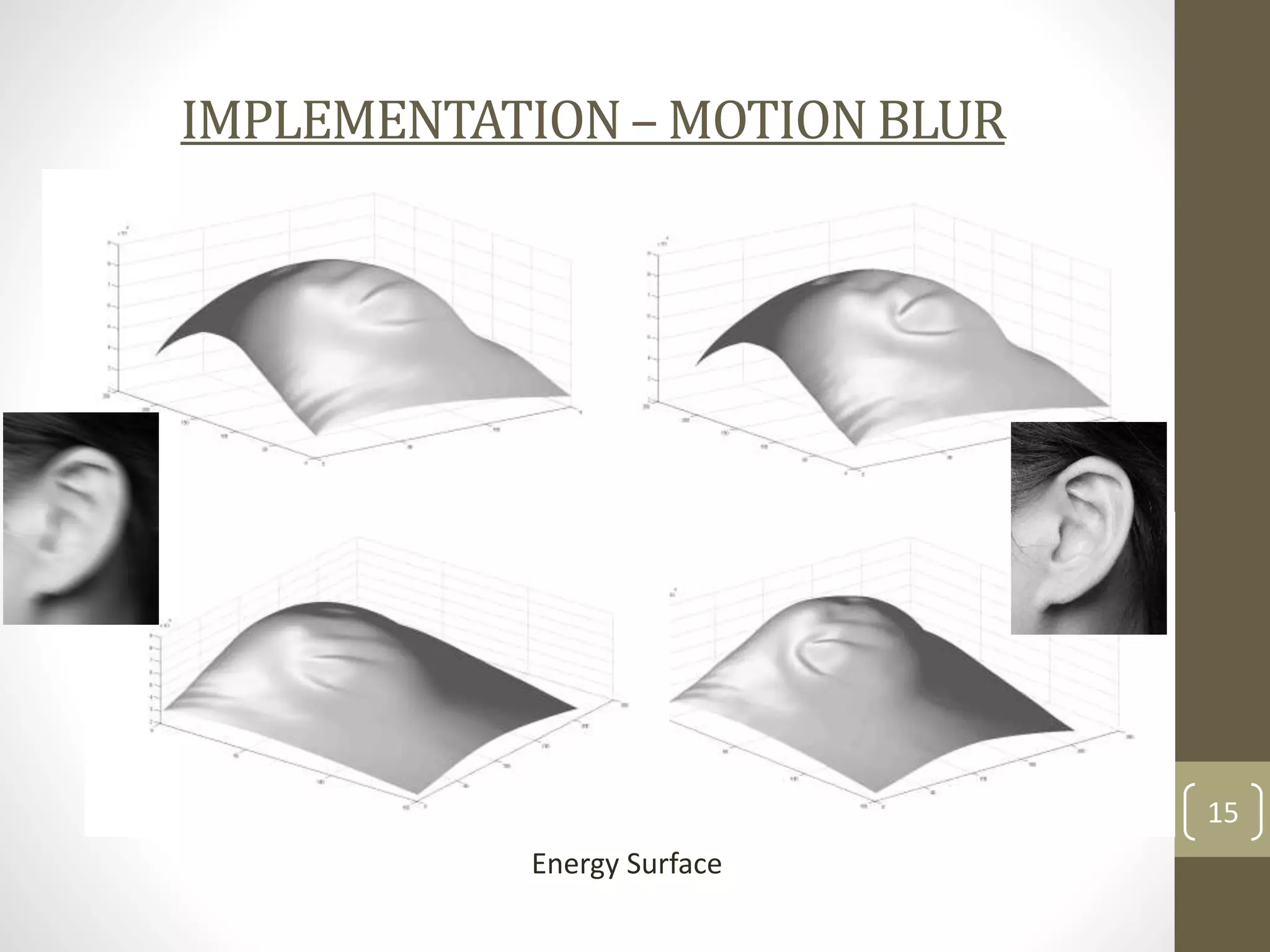
IMPLEMENTATION – Motion Blur
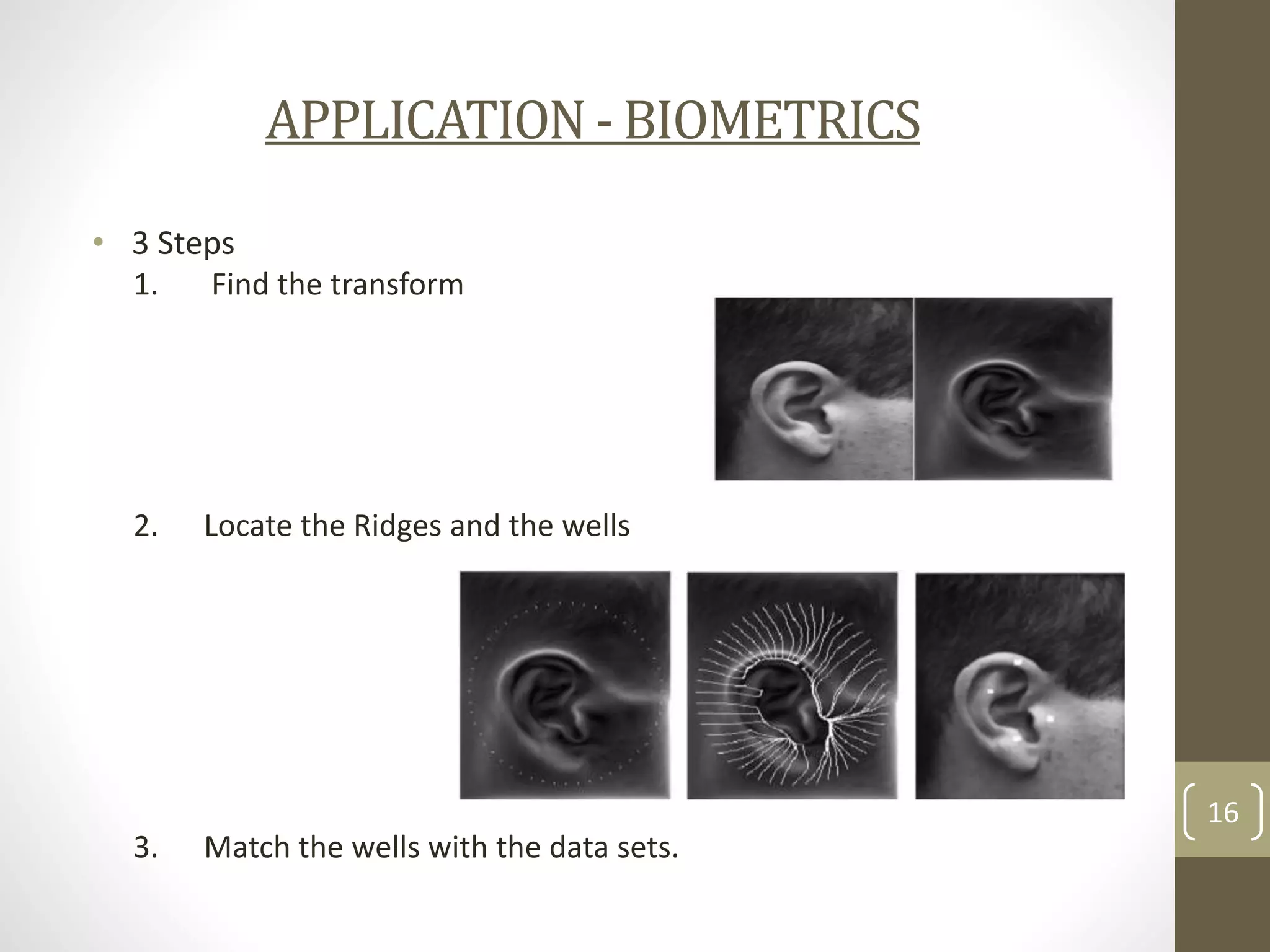
APPLICATION IN BIOMETRICS – Ear Detection
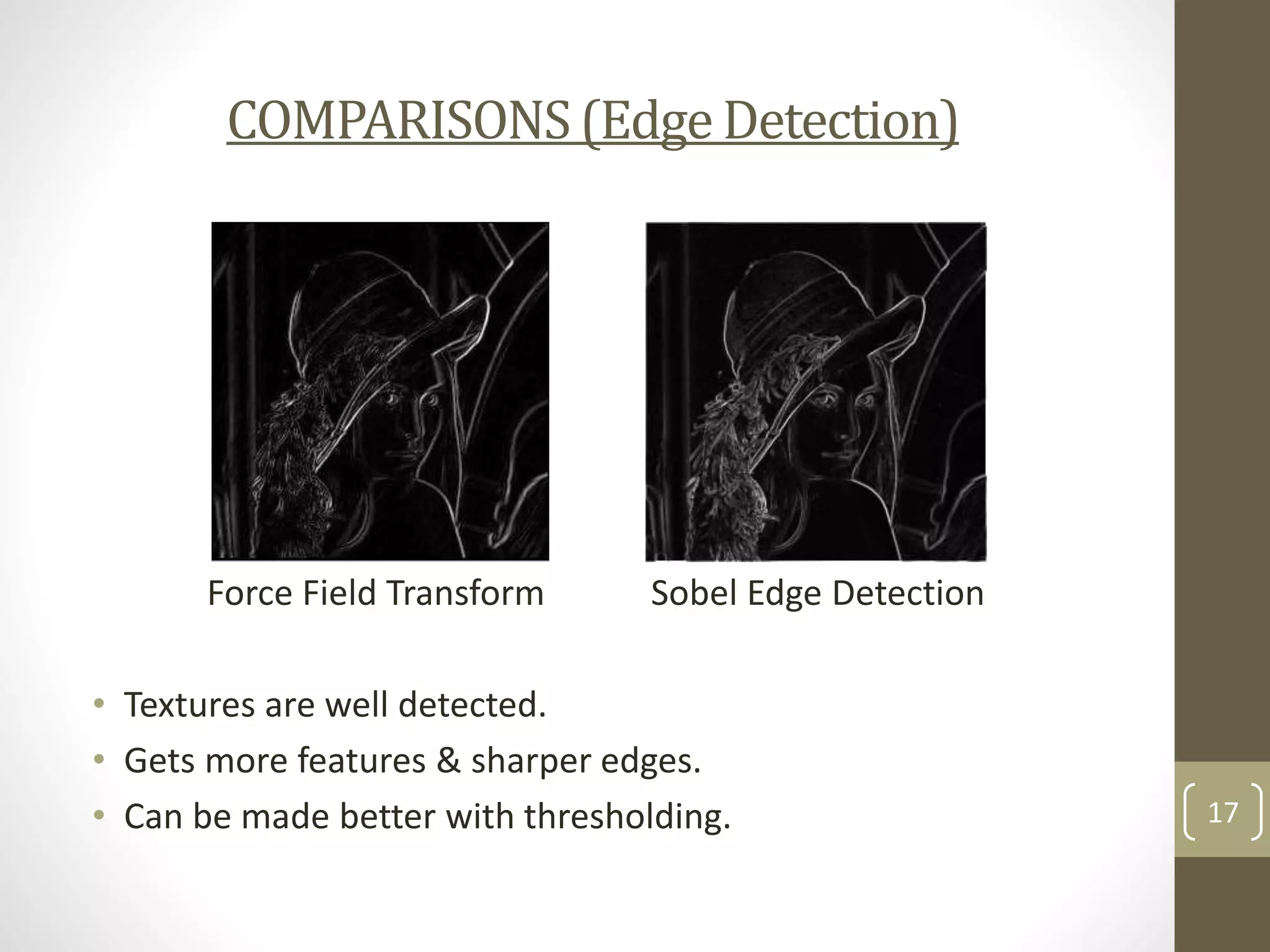
COMPARISON – Sobel Edge Detection
ADVANTAGES
DISADVANTAGES
CONTRIBUTIONS
REFERENCES

2
INTRODUCTION
4 Ws
• Who

- Dr David Hurley (then a PhD student )
Dr Mark Nixon & Dr John Carter [1]

• When

- year 2001

• Where

- University of Southampton

• Why
- Objective was to reduce dimensionality of
pattern space yet maintain discriminatory power for
classification and invariant description in context of Ear
Biometrics.

3
POINT & GROUP OPERATORS
• Point Operators : Basic operation in IP where each pixel value
is replaced with a new value obtained by
carrying out certain operations on the
previous pixel value.[2]

• Group Operators : Same as Point Operator but here the new
value of the pixel is determined by past
values of its neighbouring pixels. [2]
4
POINT & GROUP OPERATORS
• Types of Point Operators [2]
1. Histogram Operations for Brightness/contrast control
2. Thresholding Operator for finding object of interest in an
image if its brightness level is known
• Types of Group Operators – used for filtering [2]
1. Template Convolution uses weighted coefficient template
2. Averaging Operator – equally weighted (1 or 1/9)
coefficient template
3. Gaussian Averaging Operator – template coefficient are
values set by Gaussian relationship
4. Median & Mode Operator – use statistical relationship
5. Anisotropic Diffusion – uses Heat Flow eq for calculating
the coefficients of the template.
6. Force Field Transform – ‘Today’s Topic of Discussion’!!!

5
ELECTROSTATIC & PLANETARY
FORCE FIELD

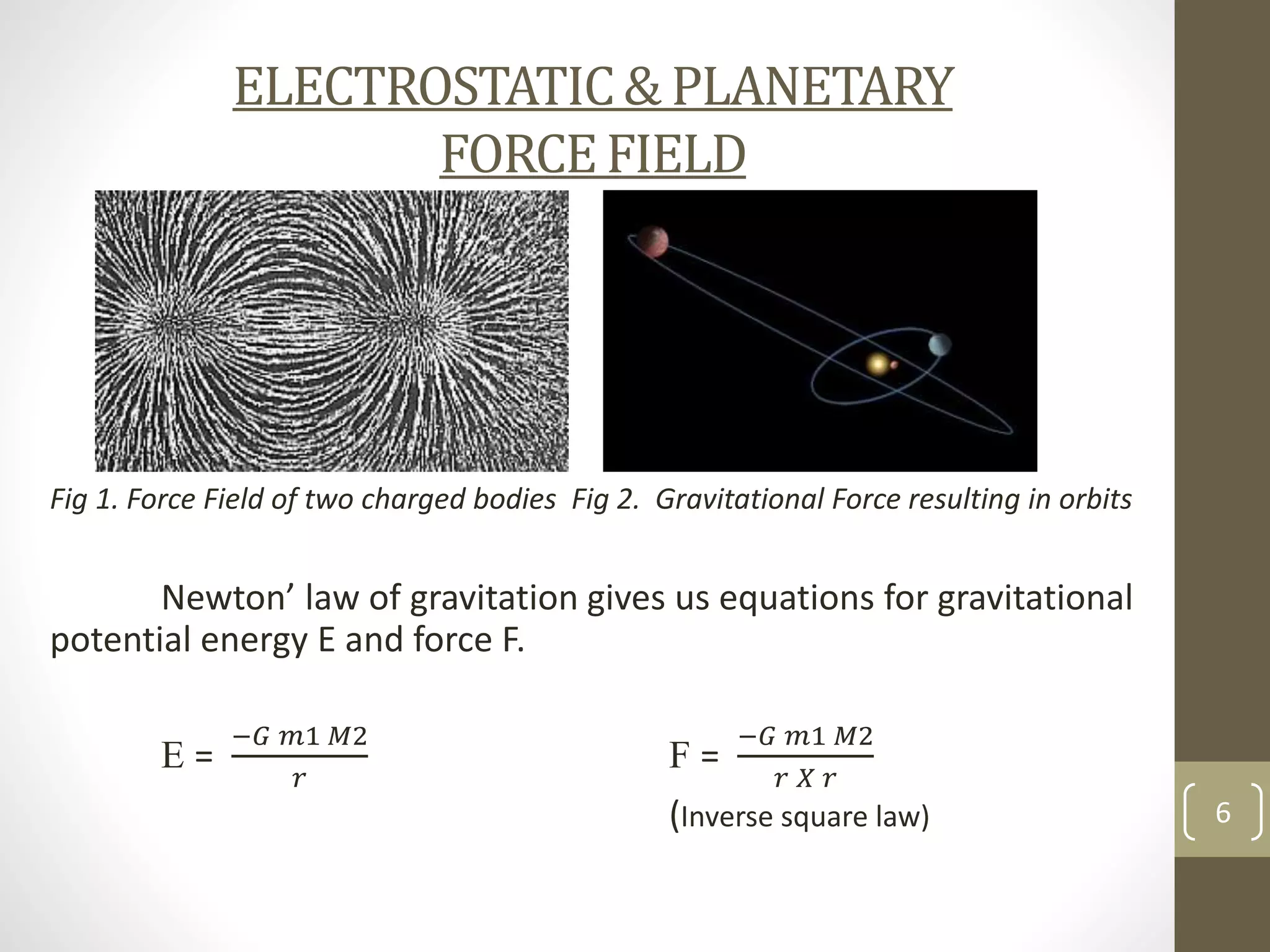
Fig 1. Force Field of two charged bodies Fig 2. Gravitational Force resulting in orbits

Newton’ law of gravitation gives us equations for gravitational
potential energy E and force F.
E=

−𝐺 𝑚1 𝑀2
𝑟

F=

−𝐺 𝑚1 𝑀2
𝑟 𝑋 𝑟

(Inverse square law)

6
FORCE FIELD TRANSFORM
(For Unit Test Pixel) [1]

7
FORCE FIELD TRANSFORM

Fig 3. Original Image

Force Field
(Magnitude)

Fig 4. Array of
Test Pixels

Field lines, channels
and wells

Potential Ridges and wells are obtained by placing 50 test
pixels which generate field lines when iterated over time [3]

8
FORCE FIELD TRANSFORM
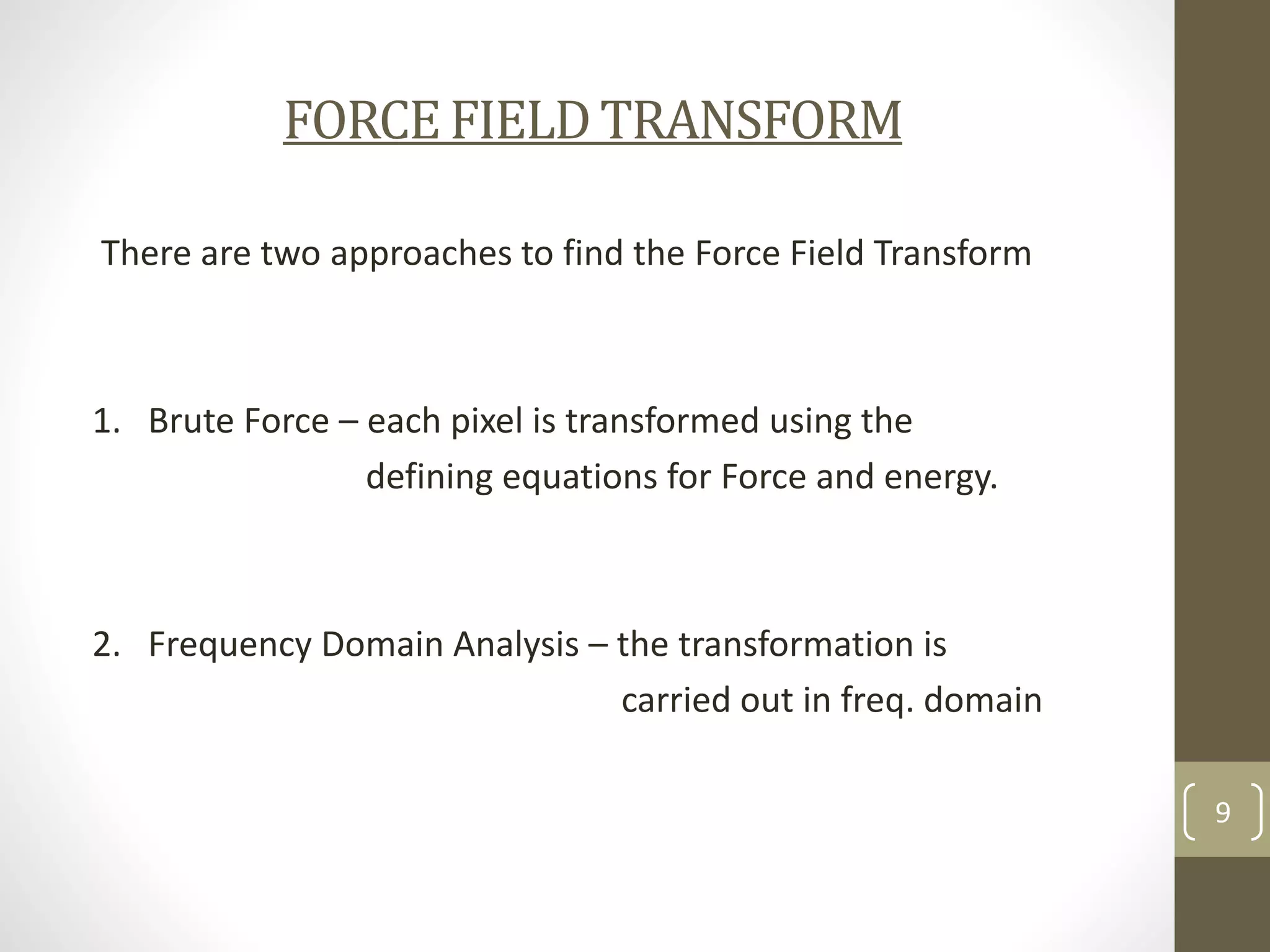
There are two approaches to find the Force Field Transform

1. Brute Force – each pixel is transformed using the
defining equations for Force and energy.

2. Frequency Domain Analysis – the transformation is
carried out in freq. domain
9
MATHEMATICAL MODEL – BRUTE FORCE
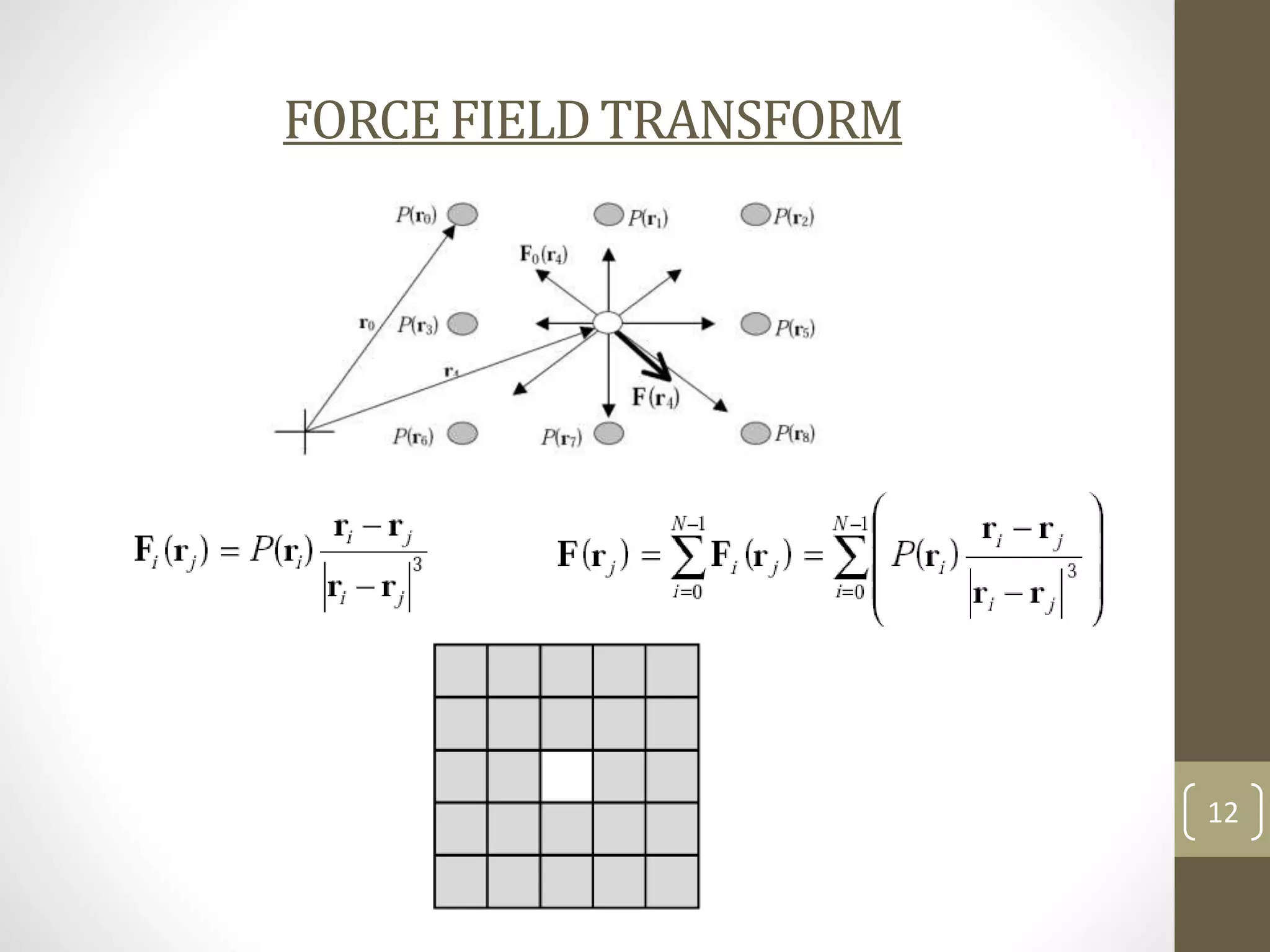
Here each pixel is transformed using the defining
equations for Force and energy. [1]
Or equivalently matrix multiplication as shown below
could be used

4X4 pixel image

where,

10
MATHEMATICAL MODEL – FREQUENCY
DOMAIN ANALYSIS
Here a MxN pixel image is convolved with a Force Field
matrix for a unit pixel.[1]

The advantage of working in frequency domain is that
the computational time reduces from O (N^2) to O(N log N).
11
FORCE FIELD TRANSFORM

12
IMPLEMENTATION – BRUTE FORCE

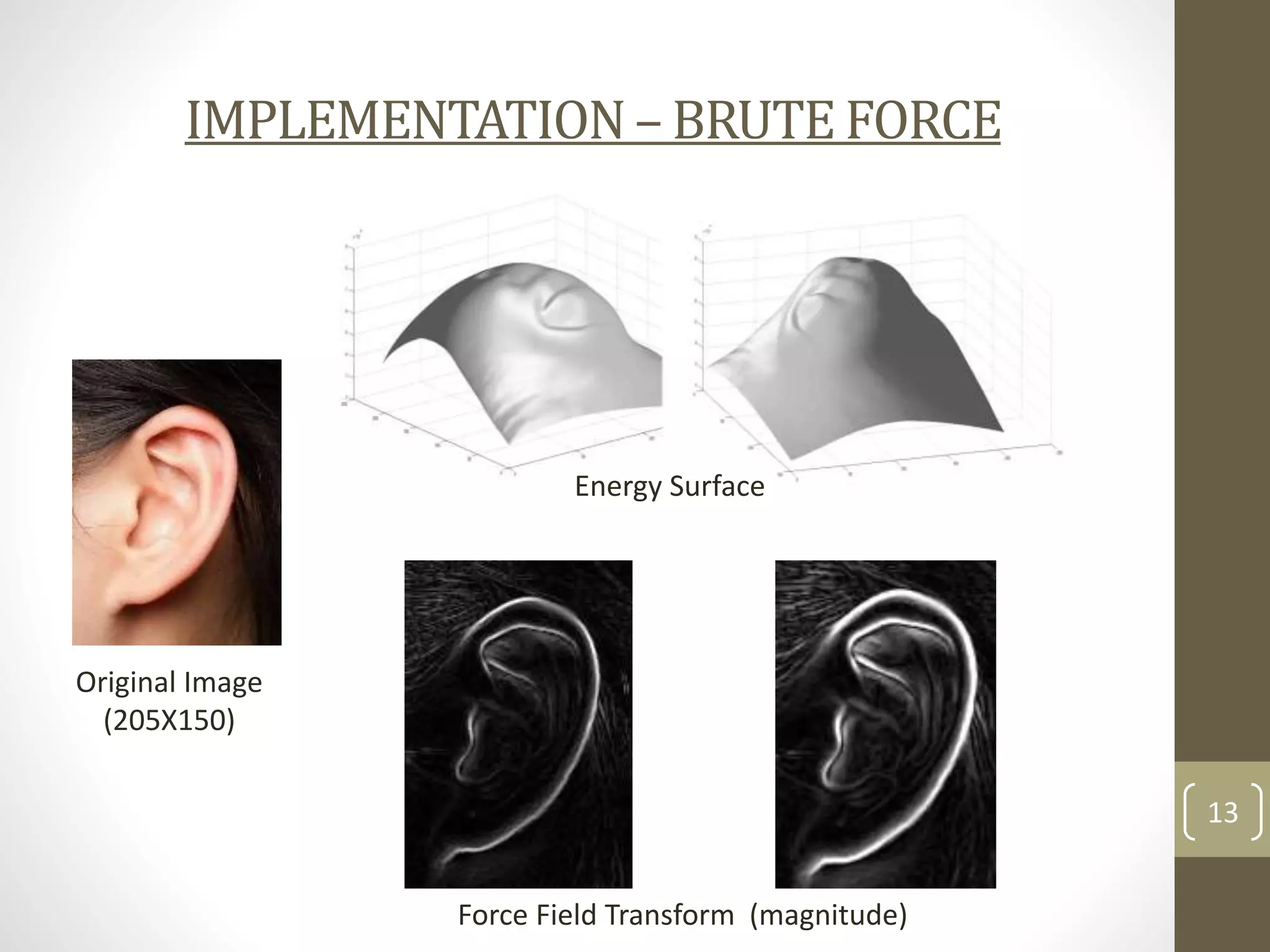
Energy Surface

Original Image
(205X150)
13
Force Field Transform (magnitude)
IMPLEMENTATION – MOTION BLUR

14
Force Field Transform (magnitude)
IMPLEMENTATION – MOTION BLUR

15
Energy Surface
APPLICATION - BIOMETRICS
• 3 Steps
1.

Find the transform

2.

Locate the Ridges and the wells

16

3.

Match the wells with the data sets.
COMPARISONS (Edge Detection)

Force Field Transform

Sobel Edge Detection

• Textures are well detected.
• Gets more features & sharper edges.
• Can be made better with thresholding.

17
ADVANTAGES
• Simplified implementation in time domain.
• Time complexity reduced considerably by working in freq.
domain (O(NlogN)).
• Impervious to distortion in image due to motion.
• Finds application in edge detection.
• Higher efficiency (99.2%) as compared to other techniques.
18
DISADVANTAGES
• At times, transform generates only one ‘well’.
• High computational costs (O(N^2)) using direct method.
• Although it can be simply implemented in time domain, we
faced difficulties in implementing it in the frequency domain.
• Not widely applicable.

19
CONTRIBUTIONS
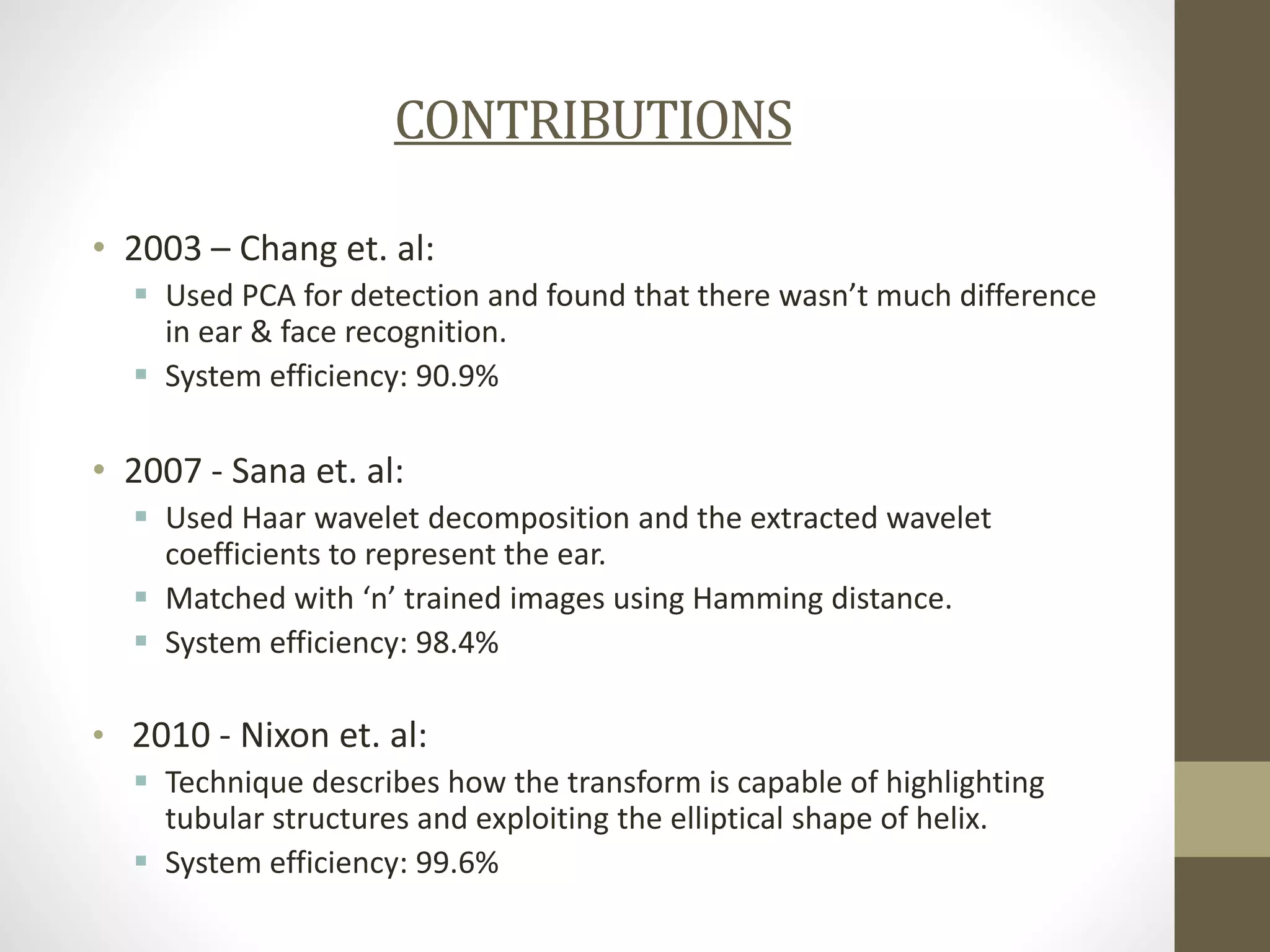
• 1989 - Iannarelli :
 Took 12 measurements around the ear by placing a
transparent compass with 8 spokes.
 Two steps of registration.

• 1999 - Moreno et. al:
 Used various neural classifiers and combination techniques
 System efficiency: 93%

• 2000 - Hurley et. al:
 Used Force Field Transform feature extraction to map the ear to an
energy field which highlighted ‘potential wells’ and ‘channels’ as
features.
 System efficiency: 99.2%
CONTRIBUTIONS
• 2003 – Chang et. al:
 Used PCA for detection and found that there wasn’t much difference
in ear & face recognition.
 System efficiency: 90.9%

• 2007 - Sana et. al:
 Used Haar wavelet decomposition and the extracted wavelet
coefficients to represent the ear.
 Matched with ‘n’ trained images using Hamming distance.
 System efficiency: 98.4%

• 2010 - Nixon et. al:
 Technique describes how the transform is capable of highlighting
tubular structures and exploiting the elliptical shape of helix.
 System efficiency: 99.6%
REFERENCES
1.
2.
3.

4.

5.

PhD Thesis of David J Hurley, 2001, University of
Southampton.
Mark Nixon & Alberto Aguado, Feature Extraction & Image
Processing, Second Edition, Elsevier Ltd, 2008.
D.J. Hurley, M.S. Nixon, J.N. Carter, Force field energy
functionals for image feature extraction, Proceedings of
the Tenth British Machine Vision Conference BMVC99,
2(1999) 604-613.
Ruma Purkait, Ear Biometric: An Aid to Personal
Identification, Anthropologist Special Volume No. 3: 215218 (2007).
D. J. Hurley, B. Arbab-Zavar, and M. S. Nixon, The Ear as a
Biometric, EURASIP (2007).

22

Force Field Transformation

  • 1.
    FORCE FIELD TRANSFORMS PRESENTEDBY: Adham Beyki MS Kapoor Shashank Dhariwal 1
  • 2.
    FORCE FIELD TRANSFORM • • • • • • • • • • • • • INTRODUCTION POINTOPERATORS ELECTROSTATIC & PLANETARY FORCE FIELD FORCE FIELD TRANSFORMS MATHEMATICAL MODEL – Brute Force & FDA IMPLEMENTATION – Brute Force Method IMPLEMENTATION – Motion Blur APPLICATION IN BIOMETRICS – Ear Detection COMPARISON – Sobel Edge Detection ADVANTAGES DISADVANTAGES CONTRIBUTIONS REFERENCES 2
  • 3.
    INTRODUCTION 4 Ws • Who -Dr David Hurley (then a PhD student ) Dr Mark Nixon & Dr John Carter [1] • When - year 2001 • Where - University of Southampton • Why - Objective was to reduce dimensionality of pattern space yet maintain discriminatory power for classification and invariant description in context of Ear Biometrics. 3
  • 4.
    POINT & GROUPOPERATORS • Point Operators : Basic operation in IP where each pixel value is replaced with a new value obtained by carrying out certain operations on the previous pixel value.[2] • Group Operators : Same as Point Operator but here the new value of the pixel is determined by past values of its neighbouring pixels. [2] 4
  • 5.
    POINT & GROUPOPERATORS • Types of Point Operators [2] 1. Histogram Operations for Brightness/contrast control 2. Thresholding Operator for finding object of interest in an image if its brightness level is known • Types of Group Operators – used for filtering [2] 1. Template Convolution uses weighted coefficient template 2. Averaging Operator – equally weighted (1 or 1/9) coefficient template 3. Gaussian Averaging Operator – template coefficient are values set by Gaussian relationship 4. Median & Mode Operator – use statistical relationship 5. Anisotropic Diffusion – uses Heat Flow eq for calculating the coefficients of the template. 6. Force Field Transform – ‘Today’s Topic of Discussion’!!! 5
  • 6.
    ELECTROSTATIC & PLANETARY FORCEFIELD Fig 1. Force Field of two charged bodies Fig 2. Gravitational Force resulting in orbits Newton’ law of gravitation gives us equations for gravitational potential energy E and force F. E= −𝐺 𝑚1 𝑀2 𝑟 F= −𝐺 𝑚1 𝑀2 𝑟 𝑋 𝑟 (Inverse square law) 6
  • 7.
    FORCE FIELD TRANSFORM (ForUnit Test Pixel) [1] 7
  • 8.
    FORCE FIELD TRANSFORM Fig3. Original Image Force Field (Magnitude) Fig 4. Array of Test Pixels Field lines, channels and wells Potential Ridges and wells are obtained by placing 50 test pixels which generate field lines when iterated over time [3] 8
  • 9.
    FORCE FIELD TRANSFORM Thereare two approaches to find the Force Field Transform 1. Brute Force – each pixel is transformed using the defining equations for Force and energy. 2. Frequency Domain Analysis – the transformation is carried out in freq. domain 9
  • 10.
    MATHEMATICAL MODEL –BRUTE FORCE Here each pixel is transformed using the defining equations for Force and energy. [1] Or equivalently matrix multiplication as shown below could be used 4X4 pixel image where, 10
  • 11.
    MATHEMATICAL MODEL –FREQUENCY DOMAIN ANALYSIS Here a MxN pixel image is convolved with a Force Field matrix for a unit pixel.[1] The advantage of working in frequency domain is that the computational time reduces from O (N^2) to O(N log N). 11
  • 12.
  • 13.
    IMPLEMENTATION – BRUTEFORCE Energy Surface Original Image (205X150) 13 Force Field Transform (magnitude)
  • 14.
    IMPLEMENTATION – MOTIONBLUR 14 Force Field Transform (magnitude)
  • 15.
    IMPLEMENTATION – MOTIONBLUR 15 Energy Surface
  • 16.
    APPLICATION - BIOMETRICS •3 Steps 1. Find the transform 2. Locate the Ridges and the wells 16 3. Match the wells with the data sets.
  • 17.
    COMPARISONS (Edge Detection) ForceField Transform Sobel Edge Detection • Textures are well detected. • Gets more features & sharper edges. • Can be made better with thresholding. 17
  • 18.
    ADVANTAGES • Simplified implementationin time domain. • Time complexity reduced considerably by working in freq. domain (O(NlogN)). • Impervious to distortion in image due to motion. • Finds application in edge detection. • Higher efficiency (99.2%) as compared to other techniques. 18
  • 19.
    DISADVANTAGES • At times,transform generates only one ‘well’. • High computational costs (O(N^2)) using direct method. • Although it can be simply implemented in time domain, we faced difficulties in implementing it in the frequency domain. • Not widely applicable. 19
  • 20.
    CONTRIBUTIONS • 1989 -Iannarelli :  Took 12 measurements around the ear by placing a transparent compass with 8 spokes.  Two steps of registration. • 1999 - Moreno et. al:  Used various neural classifiers and combination techniques  System efficiency: 93% • 2000 - Hurley et. al:  Used Force Field Transform feature extraction to map the ear to an energy field which highlighted ‘potential wells’ and ‘channels’ as features.  System efficiency: 99.2%
  • 21.
    CONTRIBUTIONS • 2003 –Chang et. al:  Used PCA for detection and found that there wasn’t much difference in ear & face recognition.  System efficiency: 90.9% • 2007 - Sana et. al:  Used Haar wavelet decomposition and the extracted wavelet coefficients to represent the ear.  Matched with ‘n’ trained images using Hamming distance.  System efficiency: 98.4% • 2010 - Nixon et. al:  Technique describes how the transform is capable of highlighting tubular structures and exploiting the elliptical shape of helix.  System efficiency: 99.6%
  • 22.
    REFERENCES 1. 2. 3. 4. 5. PhD Thesis ofDavid J Hurley, 2001, University of Southampton. Mark Nixon & Alberto Aguado, Feature Extraction & Image Processing, Second Edition, Elsevier Ltd, 2008. D.J. Hurley, M.S. Nixon, J.N. Carter, Force field energy functionals for image feature extraction, Proceedings of the Tenth British Machine Vision Conference BMVC99, 2(1999) 604-613. Ruma Purkait, Ear Biometric: An Aid to Personal Identification, Anthropologist Special Volume No. 3: 215218 (2007). D. J. Hurley, B. Arbab-Zavar, and M. S. Nixon, The Ear as a Biometric, EURASIP (2007). 22