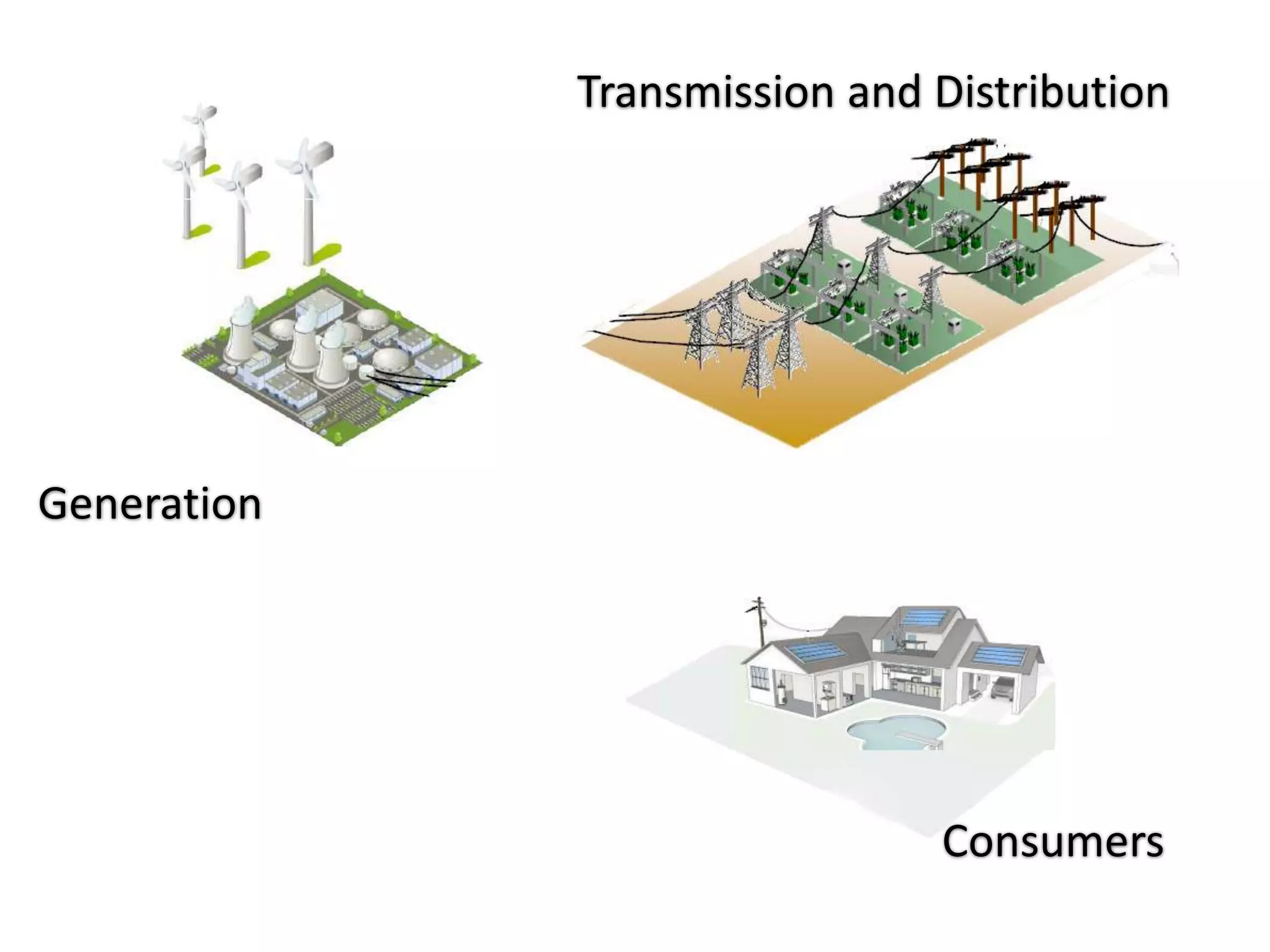
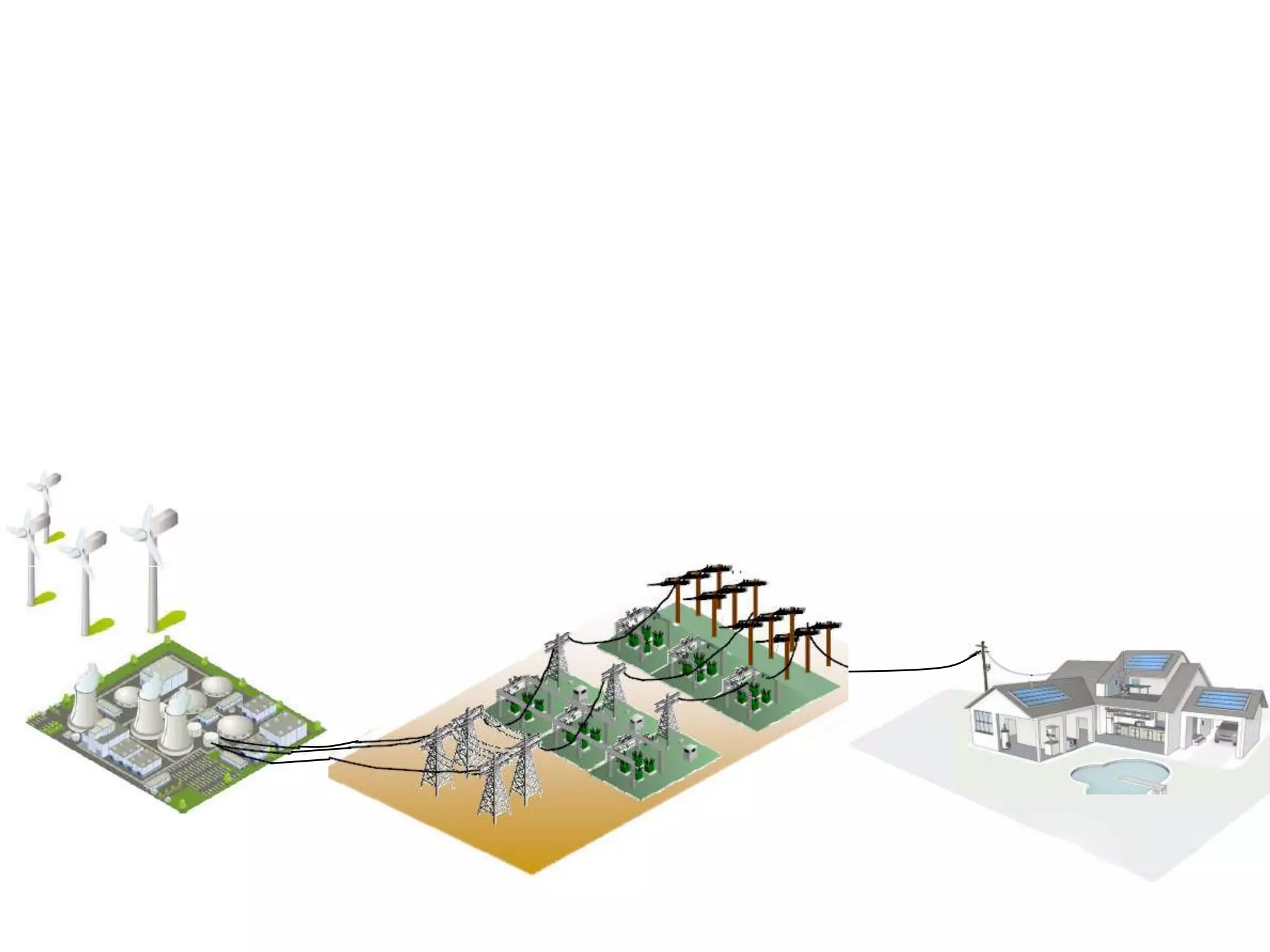
Transmission and Distribution

Generation

Consumers
Problem Definition
- To design low profile, versatile nodes capable of communication
between the system designer and the appliances.
- To design a generic entity to play administrator over a group of
control nodes.

- To make available the desired data at the administrator node, and
to maintain a database for the specified duration.
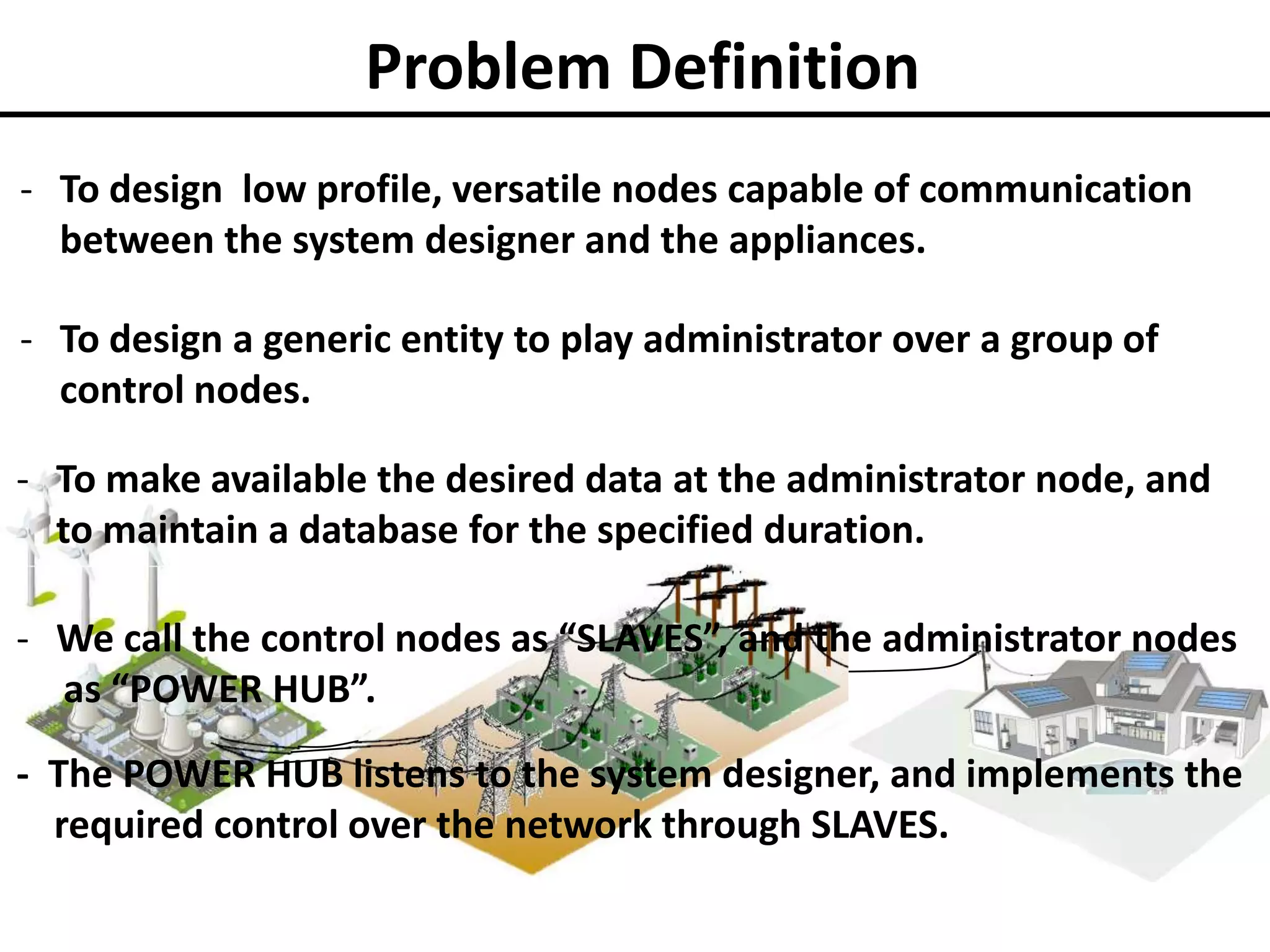
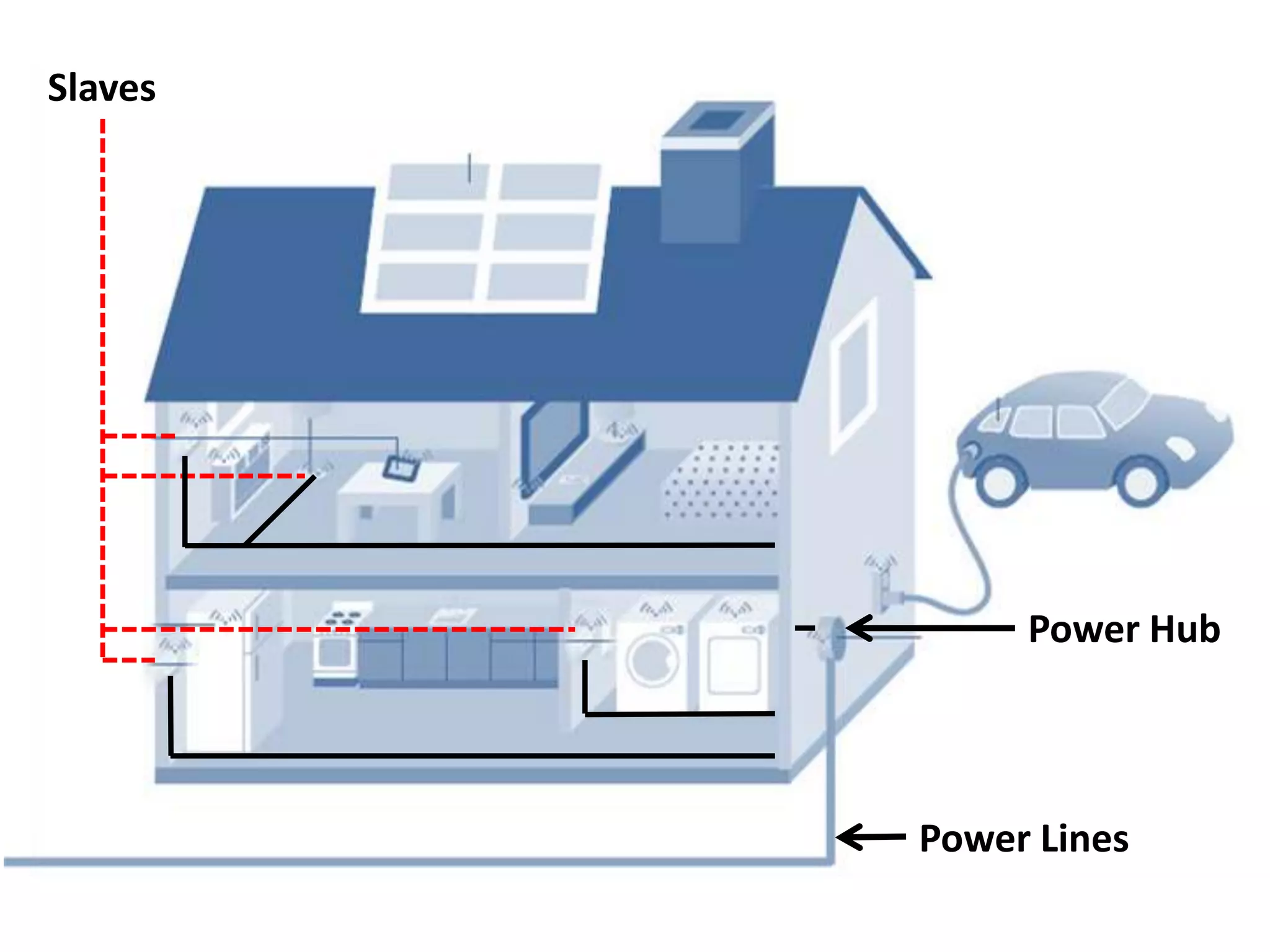
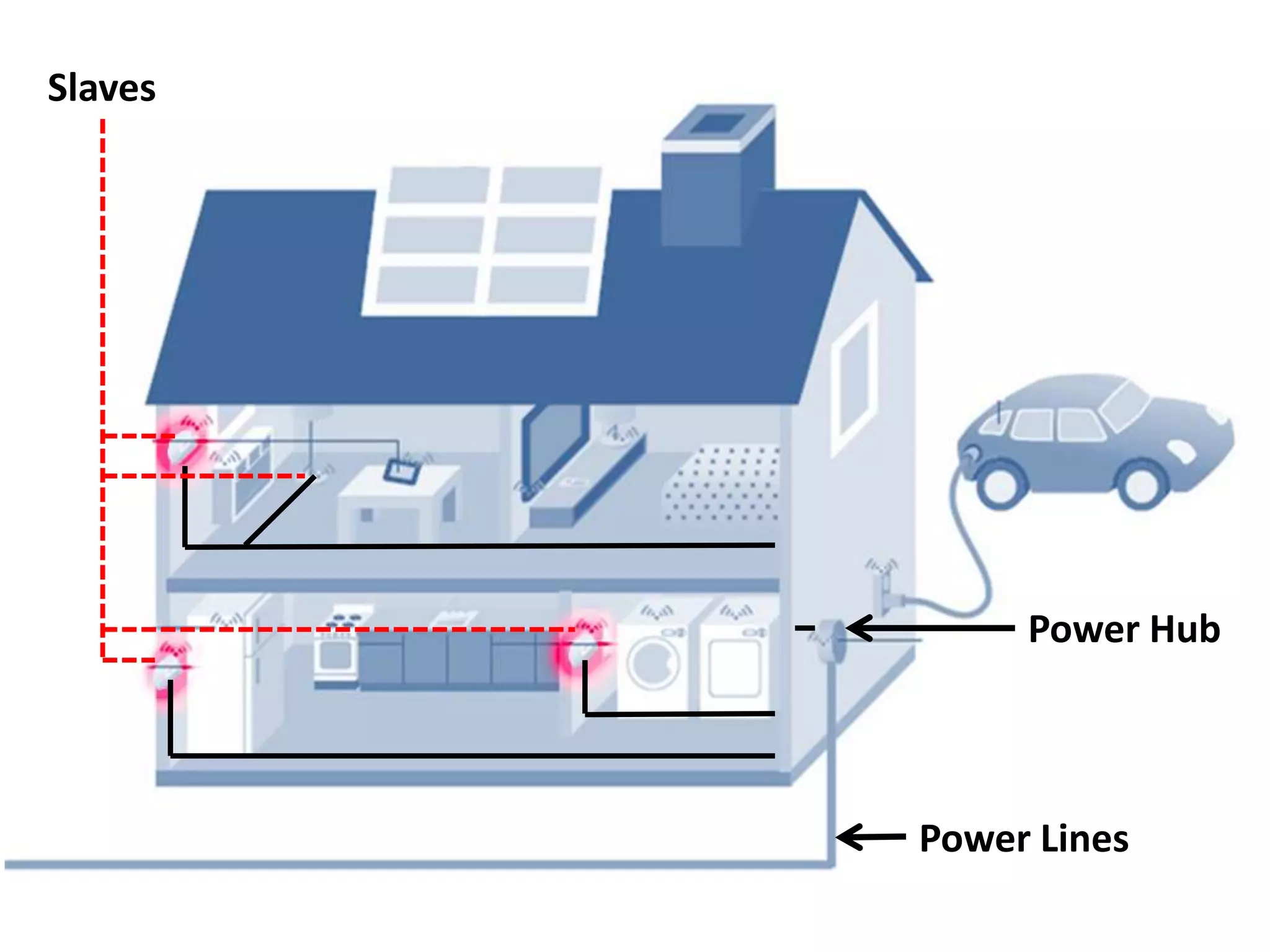
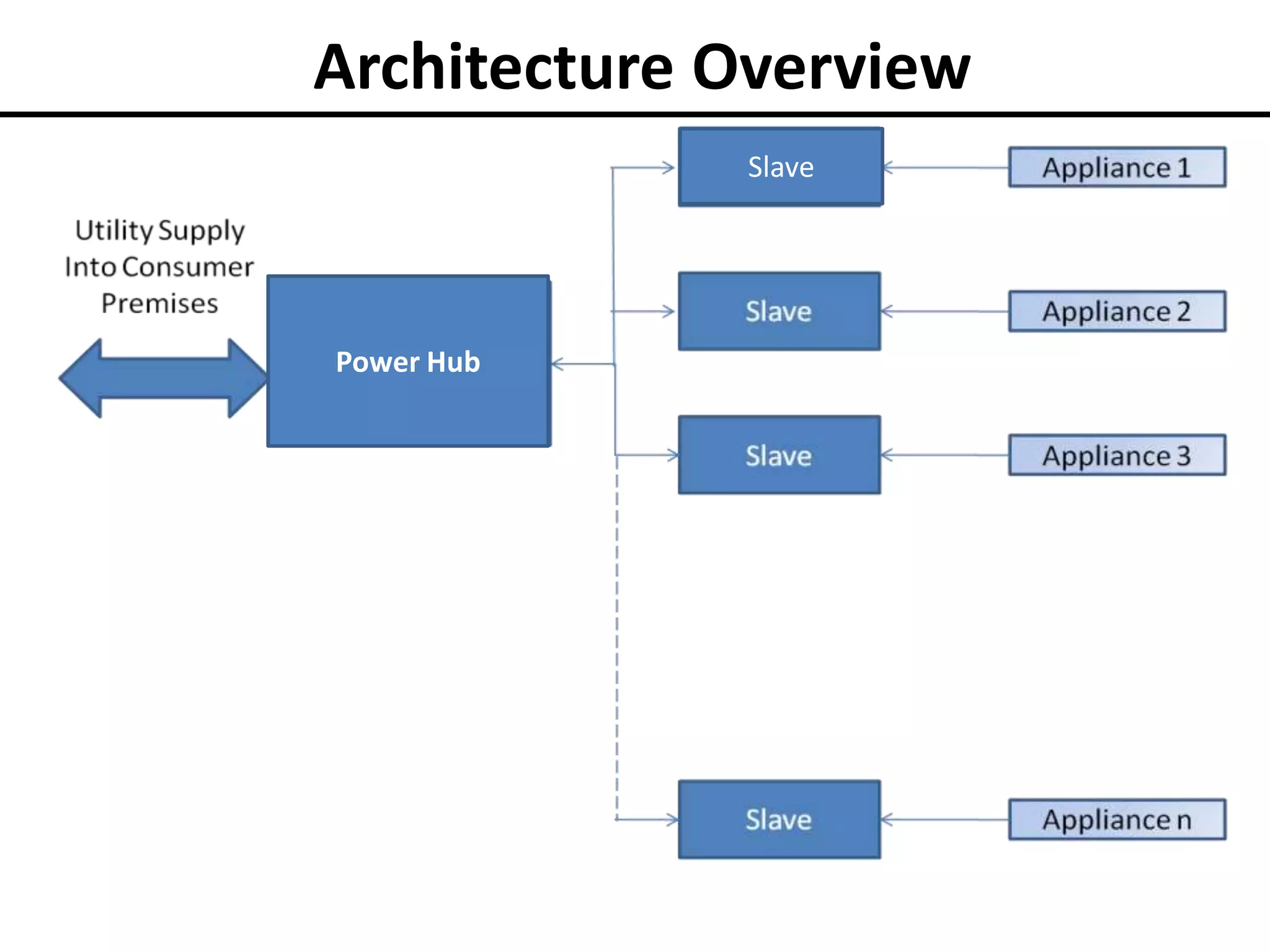
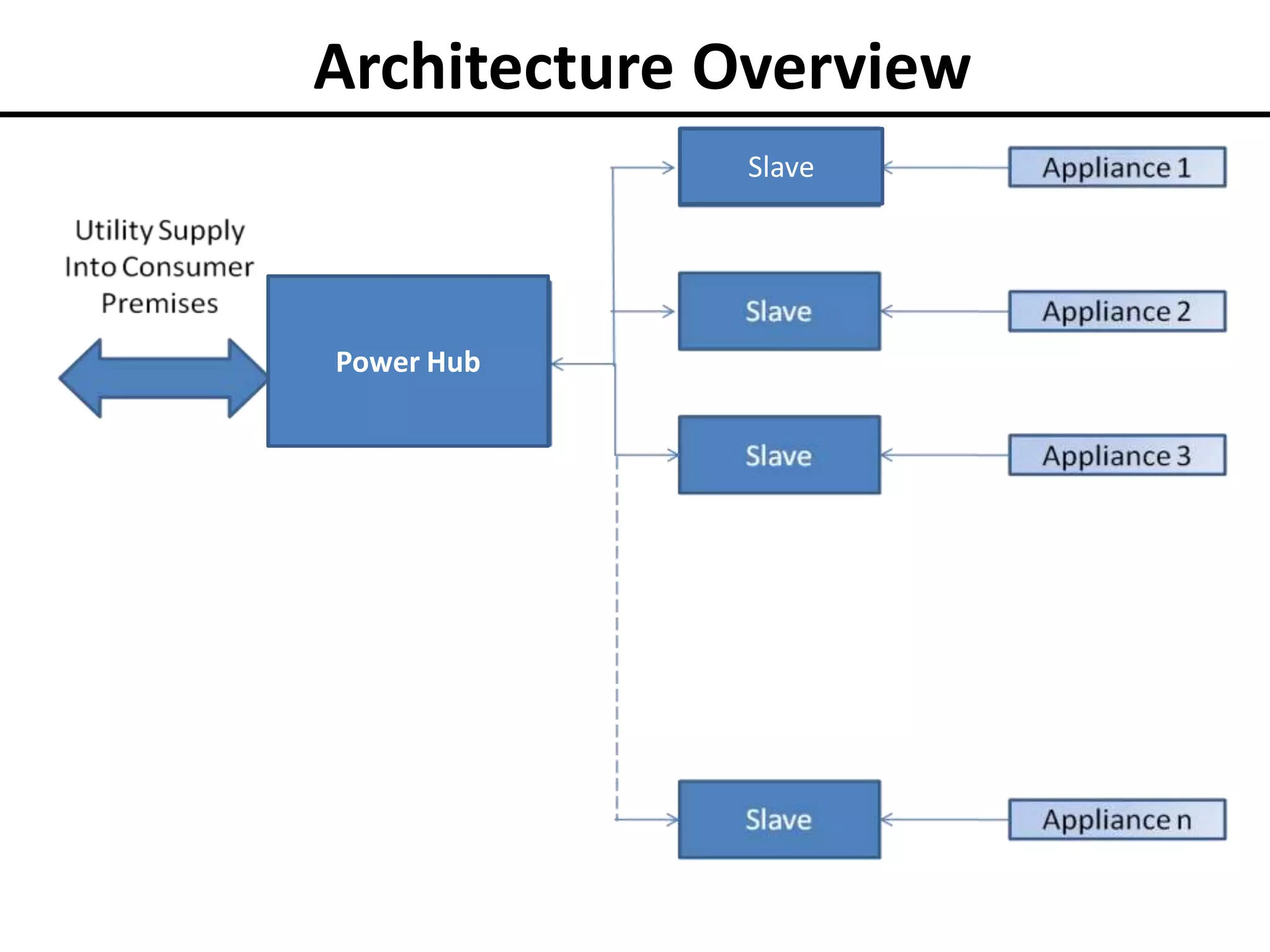
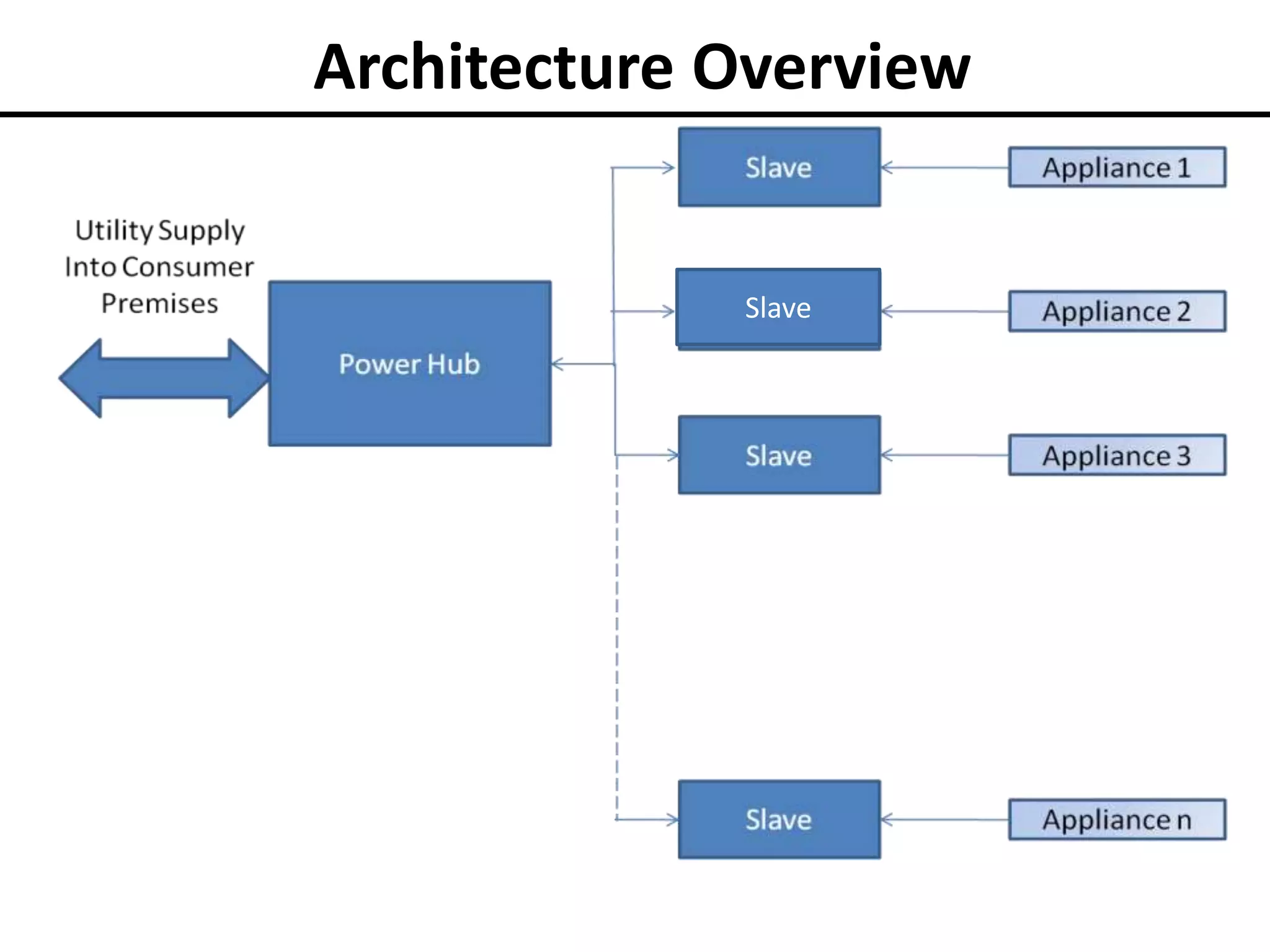
- We call the control nodes as “SLAVES”, and the administrator nodes
as “POWER HUB”.
- The POWER HUB listens to the system designer, and implements the
required control over the network through SLAVES.
Problem Definition
- To design a low profile, versatile nodes to communicate between
the system designer and the appliances.
- To design a generic entity to play administrator over a group of
control nodes.

- To make available the desired data at the administrator node, and
to maintain a database for the specified duration.
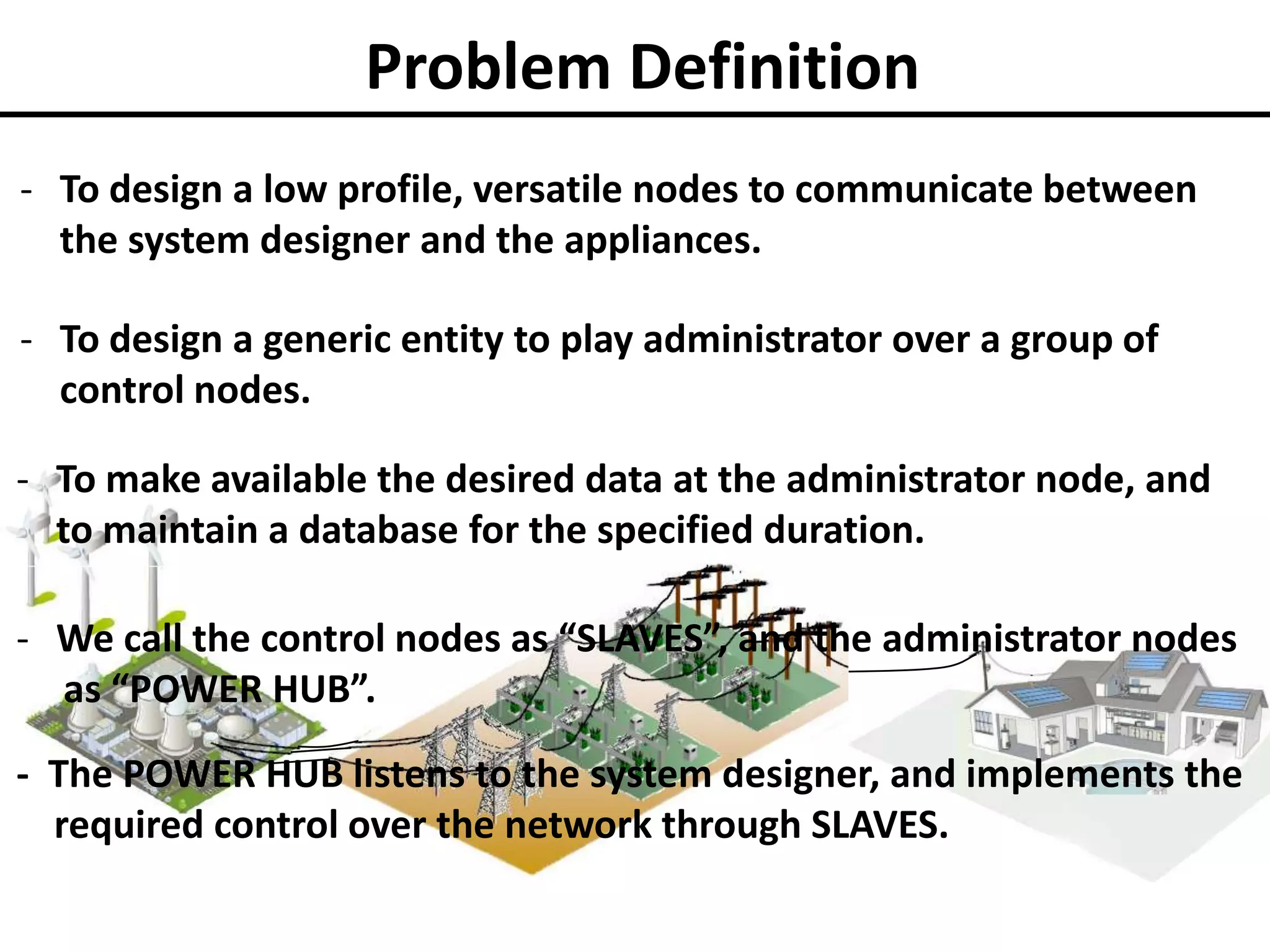
- We call the control nodes as “SLAVES”, and the administrator nodes
as “POWER HUB”.
- The POWER HUB listens to the system designer, and implements the
required control over the network through SLAVES.
Slaves

Power Hub

Power Lines
Slaves

Power Hub

Power Lines
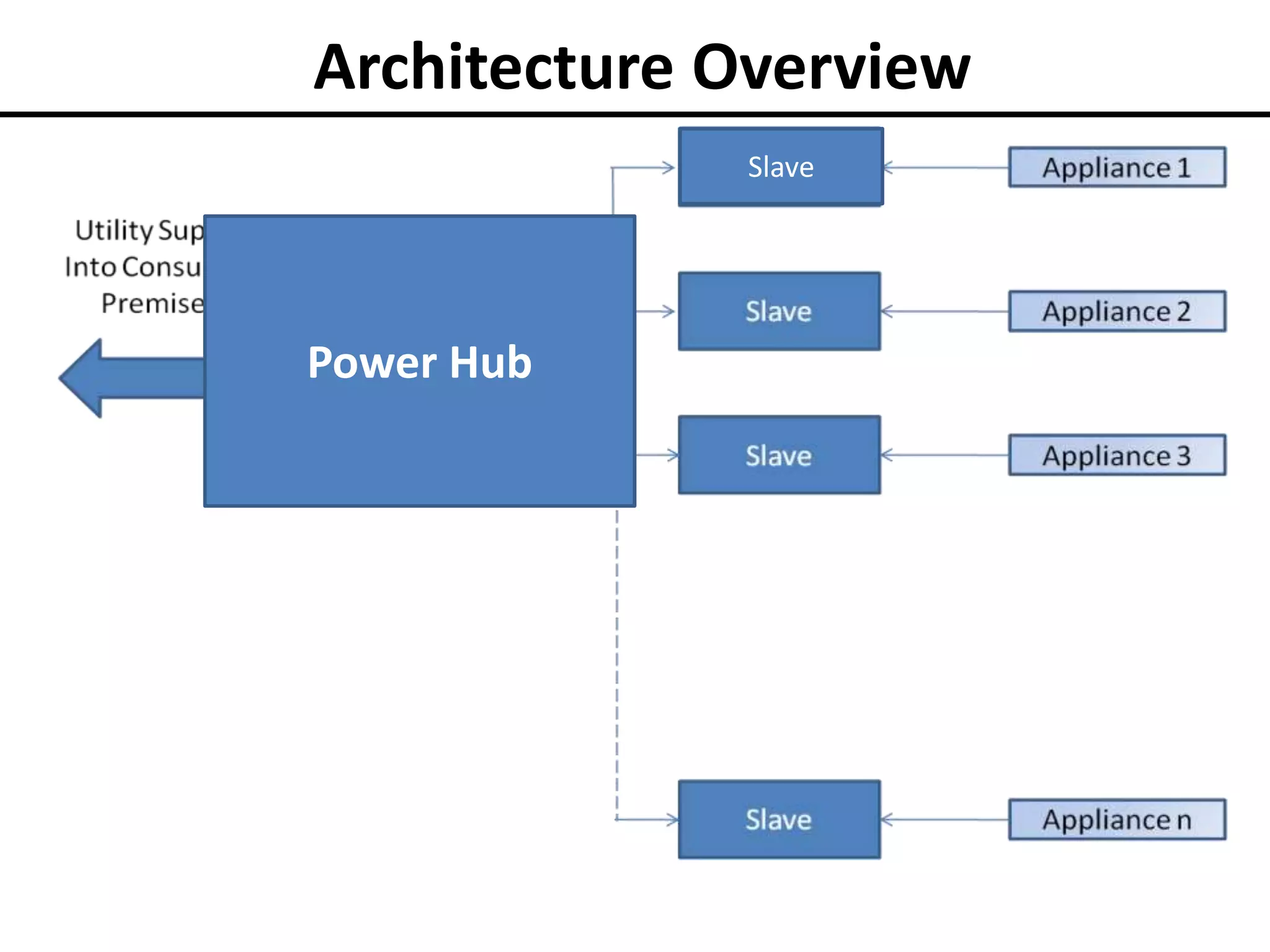
Architecture Overview
Slave

Power Hub
Architecture Overview
Slave

Power Hub
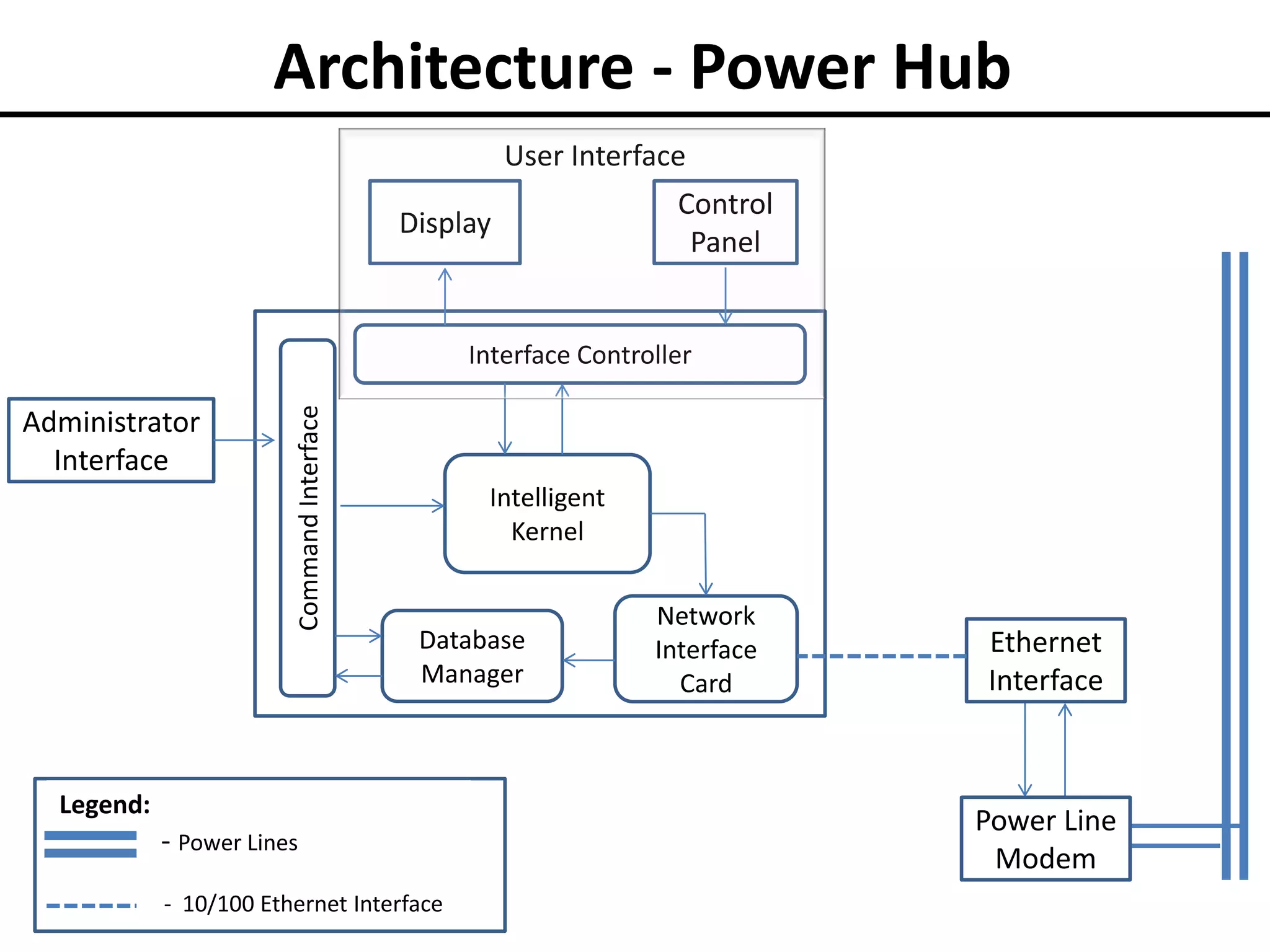
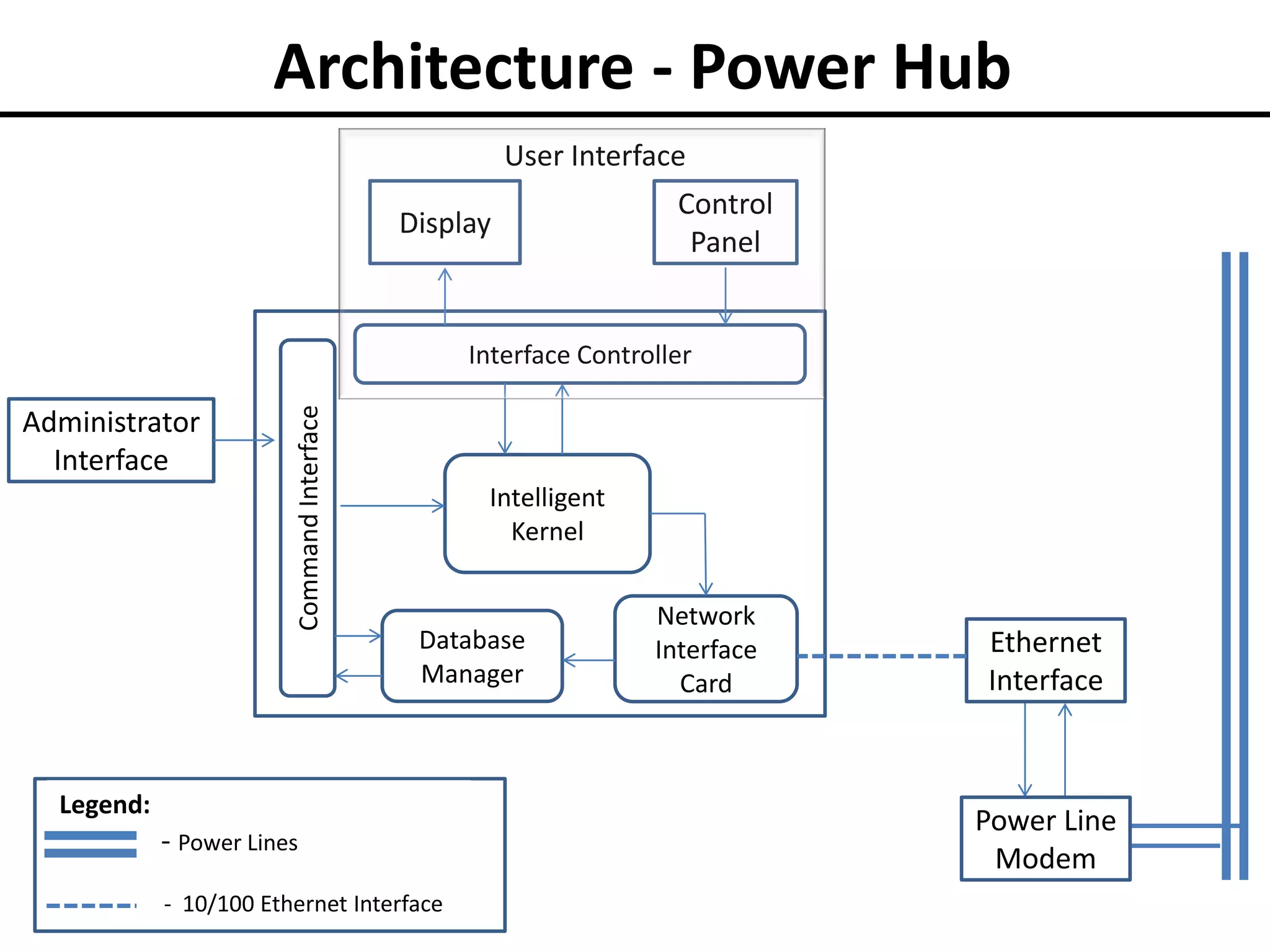
Architecture - Power Hub
User Interface

Display

Control
Panel

Administrator
Interface

Command Interface

Interface Controller

Intelligent
Kernel

Database
Manager

Legend:

- Power Lines
- 10/100 Ethernet Interface

Network
Interface
Card

Ethernet
Interface

Power Line
Modem
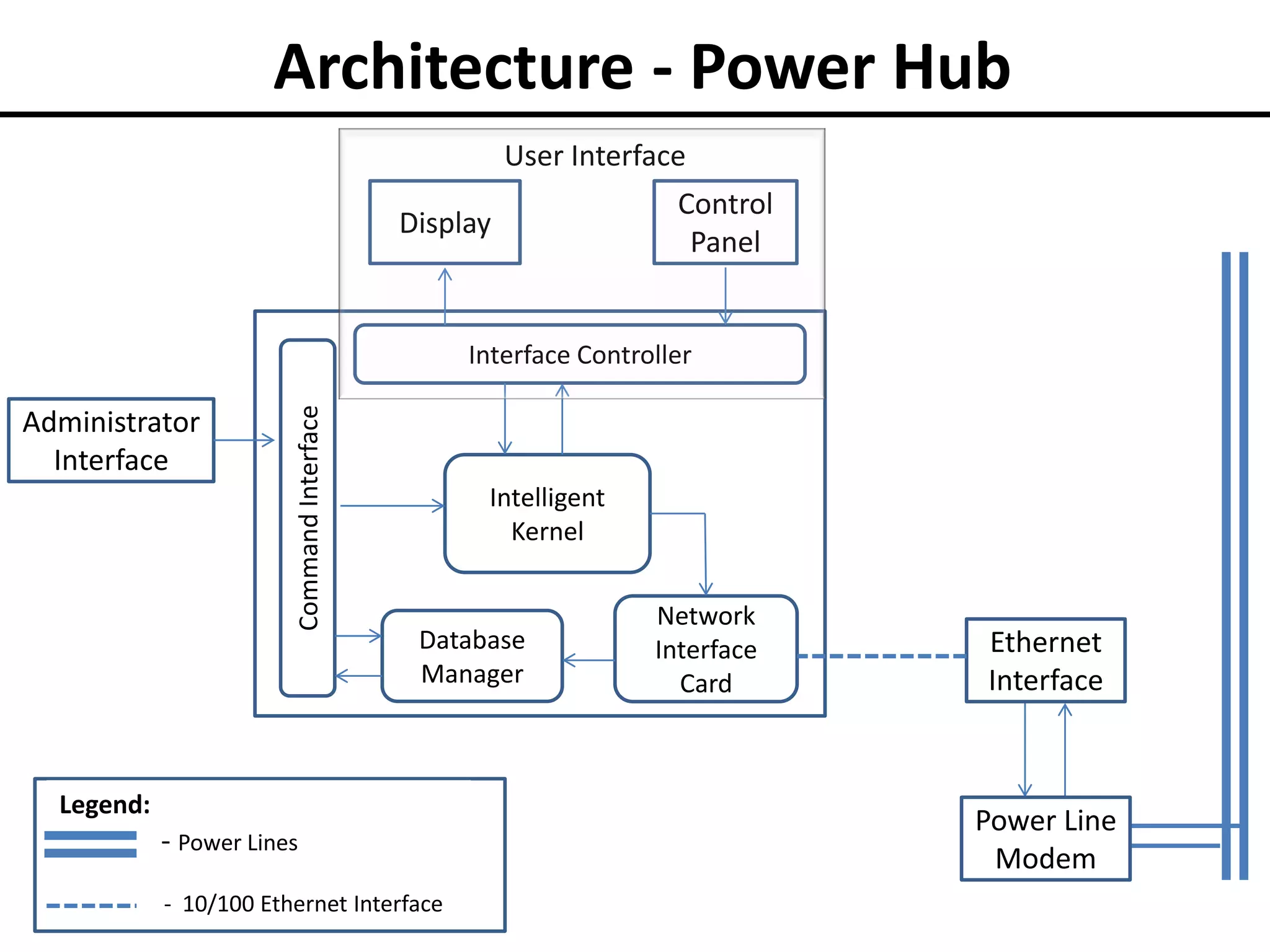
Architecture - Power Hub
User Interface

Display

Control
Panel

Administrator
Interface

Command Interface

Interface Controller

Intelligent
Kernel

Database
Manager

Legend:

- Power Lines
- 10/100 Ethernet Interface

Network
Interface
Card

Ethernet
Interface

Power Line
Modem
Architecture - Power Hub
User Interface

Display

Control
Panel

Administrator
Interface

Command Interface

Interface Controller

Intelligent
Kernel

Database
Manager

Legend:

- Power Lines
- 10/100 Ethernet Interface

Network
Interface
Card

Ethernet
Interface

Power Line
Modem
Architecture Overview
Slave

Power Hub
Architecture Overview

Slave
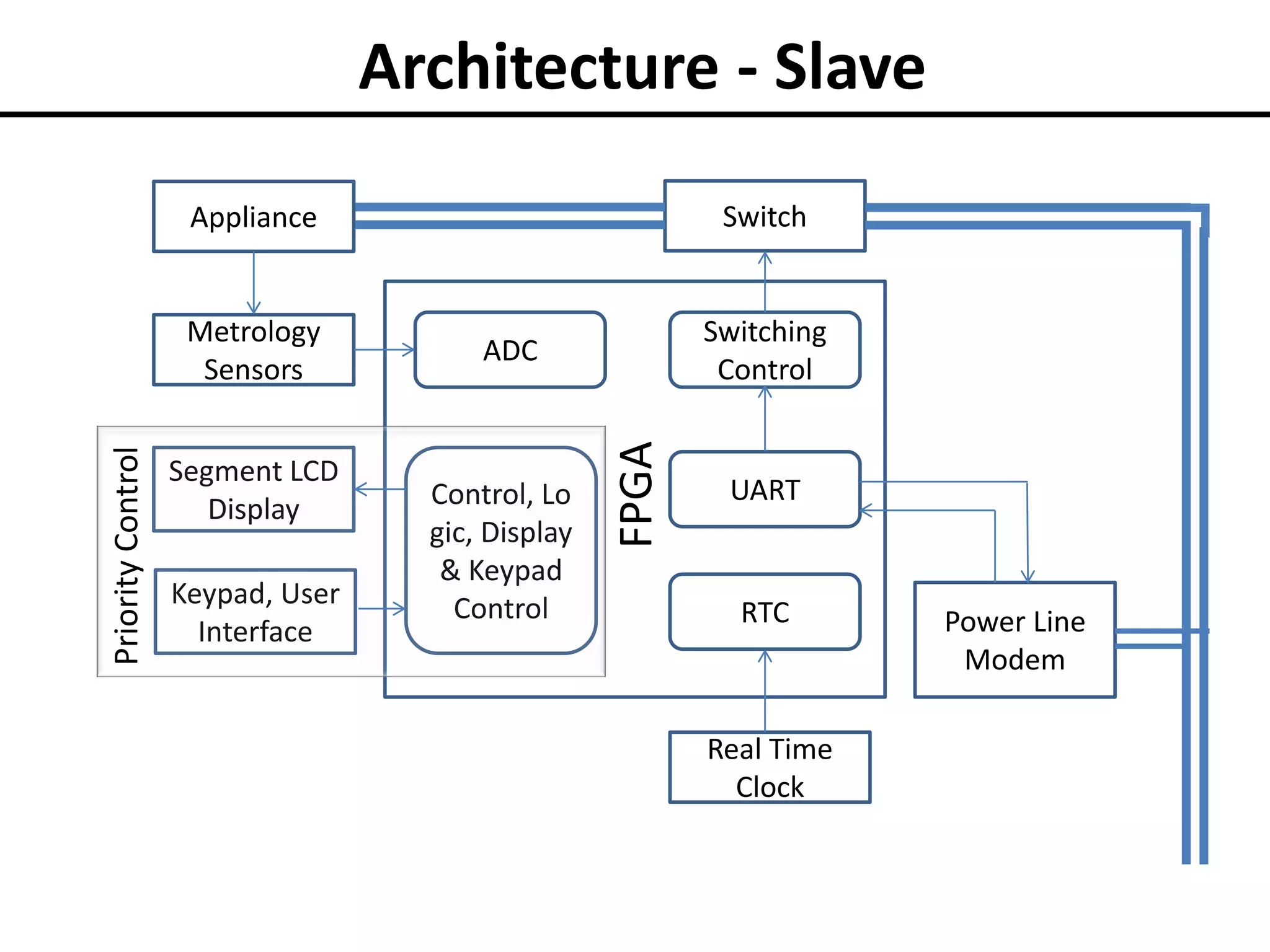
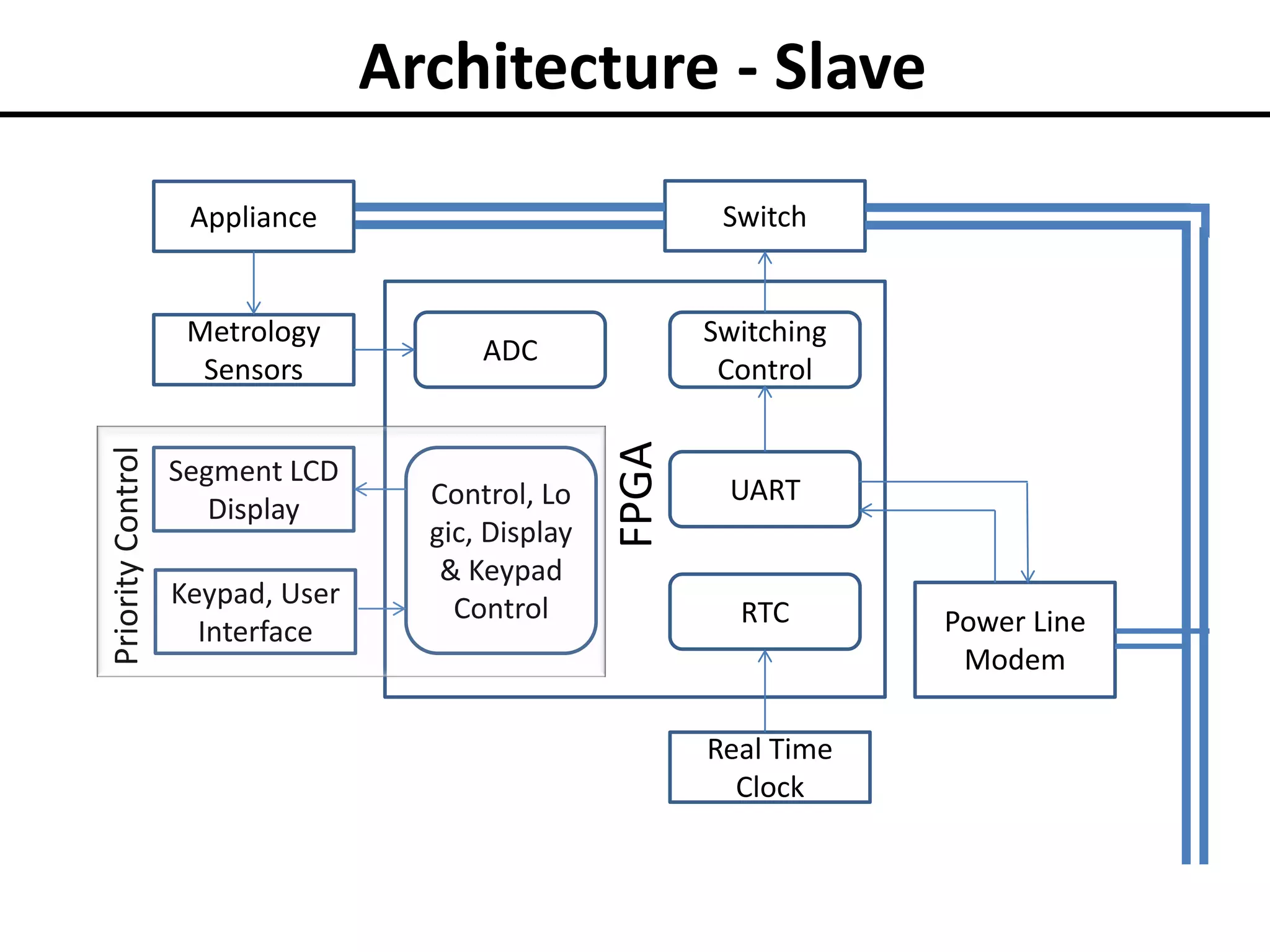
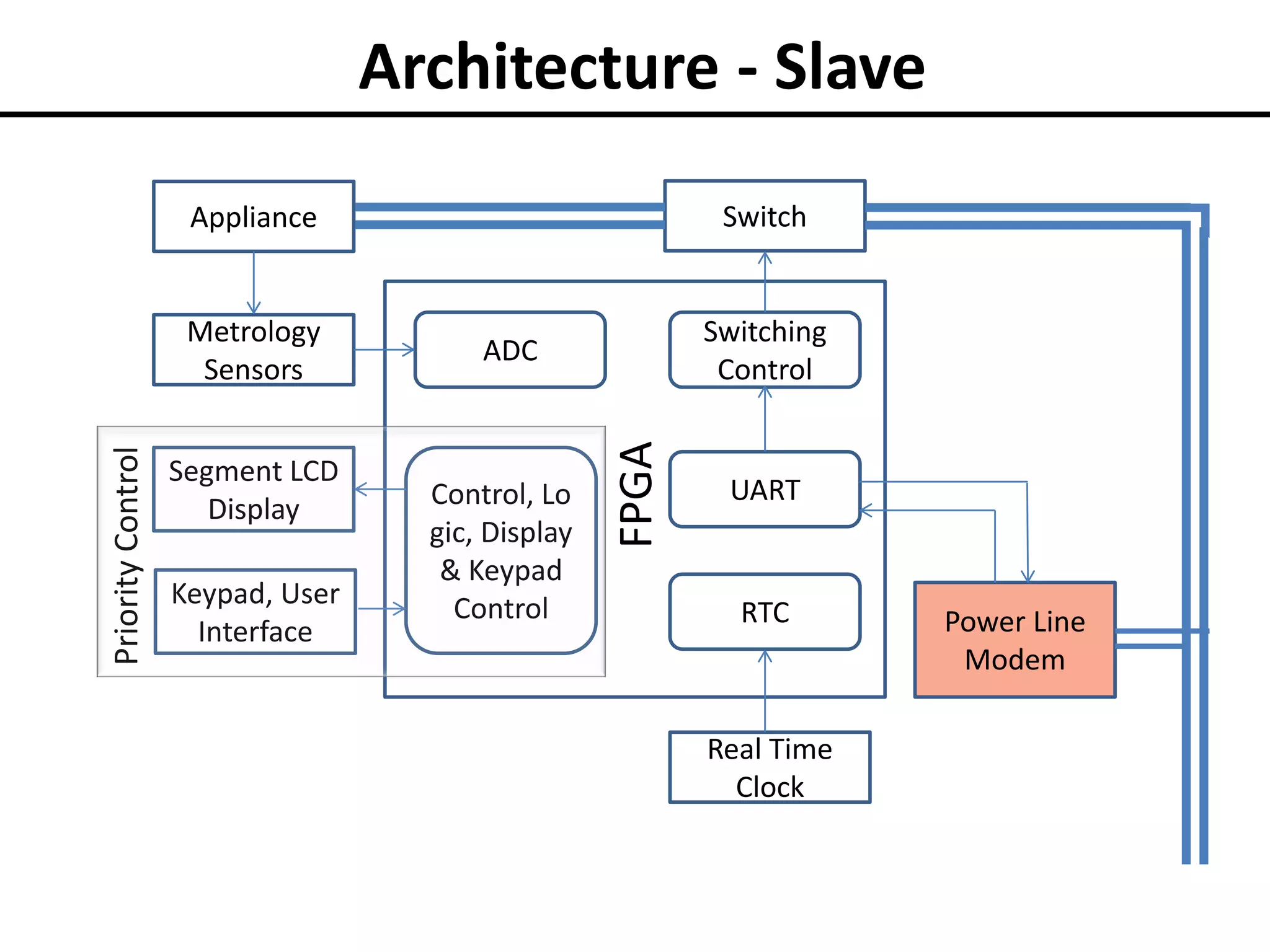
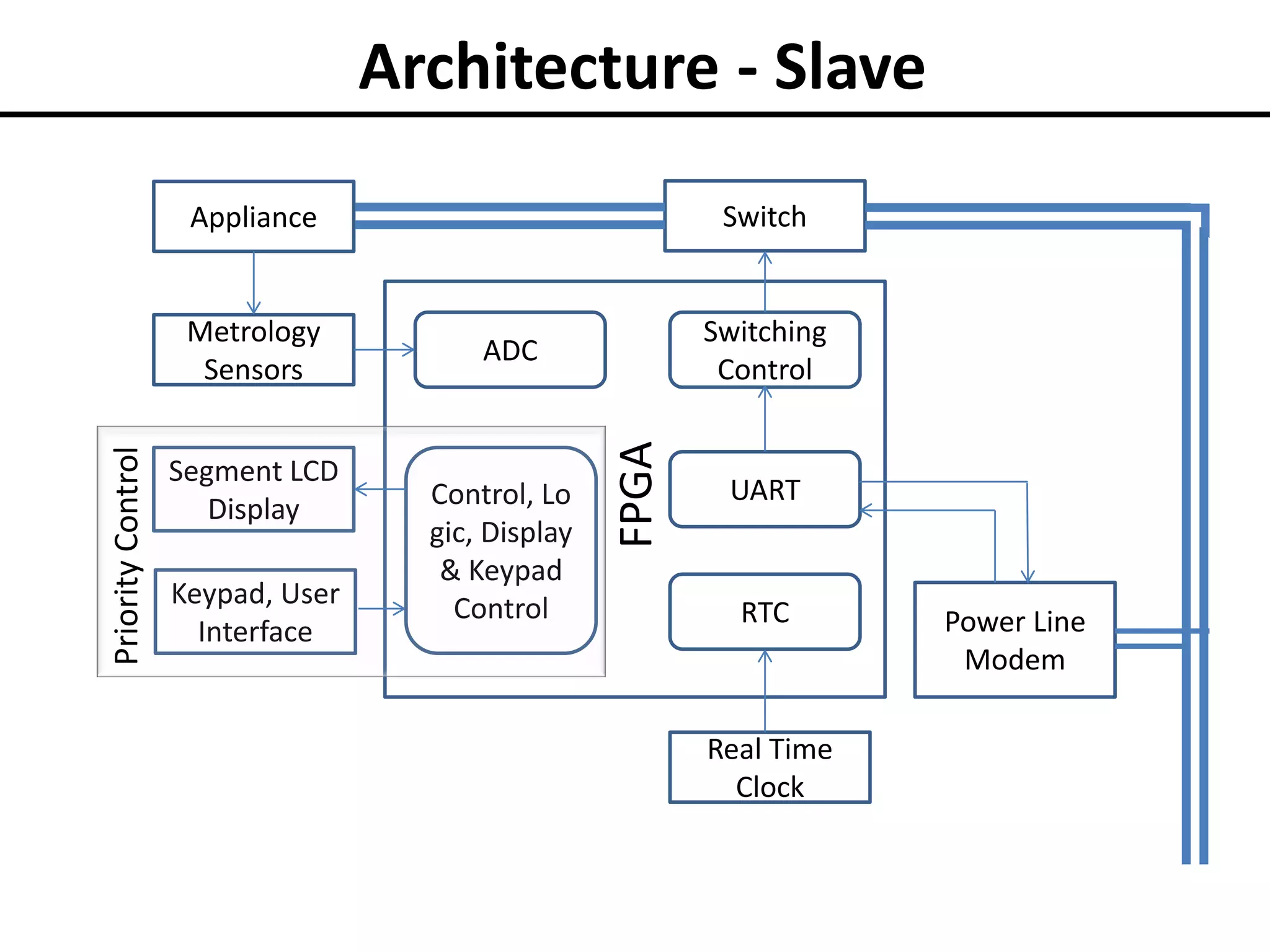
Architecture - Slave
Switch

Appliance

Segment LCD
Display
Keypad, User
Interface

Switching
Control

ADC

Control, Lo
gic, Display
& Keypad
Control

FPGA

Priority Control

Metrology
Sensors

UART

RTC

Real Time
Clock

Power Line
Modem
Architecture - Slave
Switch

Appliance

Segment LCD
Display
Keypad, User
Interface

Switching
Control

ADC

Control, Lo
gic, Display
& Keypad
Control

FPGA

Priority Control

Metrology
Sensors

UART

RTC

Real Time
Clock

Power Line
Modem
Architecture - Slave
Switch

Appliance

Segment LCD
Display
Keypad, User
Interface

Switching
Control

ADC

Control, Lo
gic, Display
& Keypad
Control

FPGA

Priority Control

Metrology
Sensors

UART

RTC

Real Time
Clock

Power Line
Modem
Architecture - Slave
Switch

Appliance

Segment LCD
Display
Keypad, User
Interface

Switching
Control

ADC

Control, Lo
gic, Display
& Keypad
Control

FPGA

Priority Control

Metrology
Sensors

UART

RTC

Real Time
Clock

Power Line
Modem
Architecture - Slave
Switch

Appliance

Segment LCD
Display
Keypad, User
Interface

Switching
Control

ADC

Control, Lo
gic, Display
& Keypad
Control

FPGA

Priority Control

Metrology
Sensors

UART

RTC

Real Time
Clock

Power Line
Modem
Architecture - Slave
Switch

Appliance

Segment LCD
Display
Keypad, User
Interface

Switching
Control

ADC

Control, Lo
gic, Display
& Keypad
Control

FPGA

Priority Control

Metrology
Sensors

UART

RTC

Real Time
Clock

Power Line
Modem
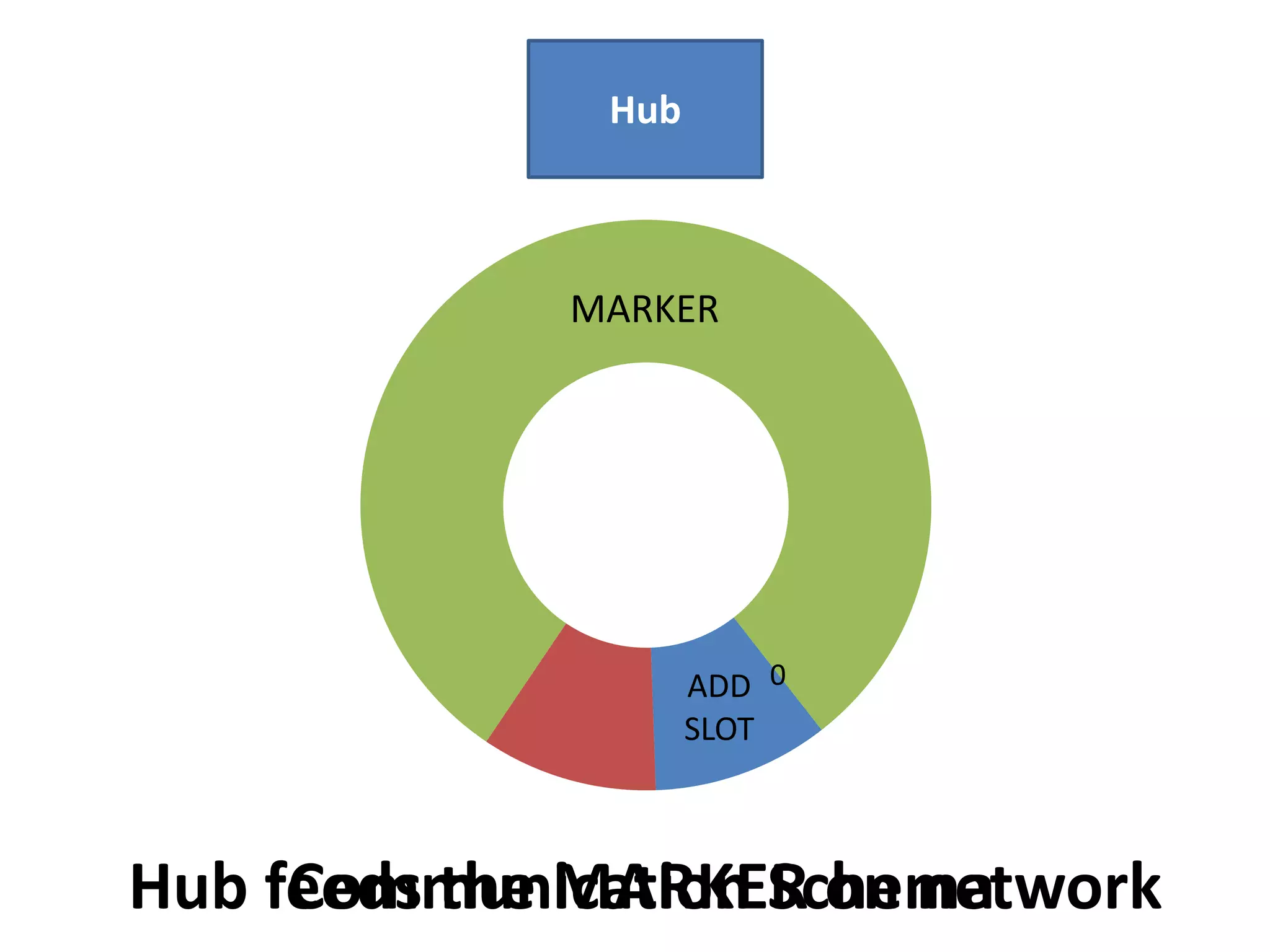
Communication Schema
Hub

MARKER

ADD 0
SLOT

Hub feeds the MARKER on network
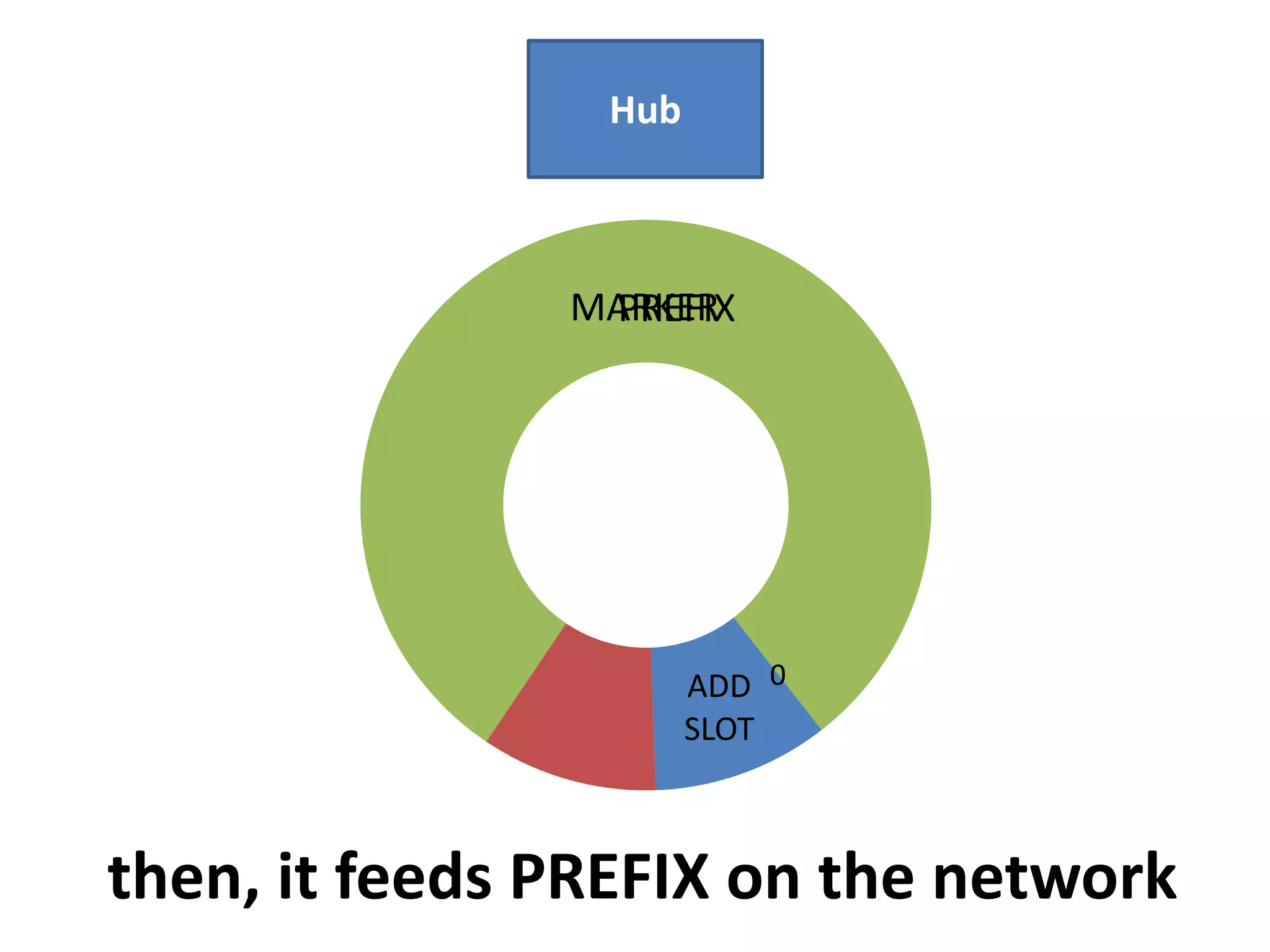
Communication Schema
Hub

MARKER
PREFIX
ADD 0
SLOT

then, it feeds PREFIX on the network
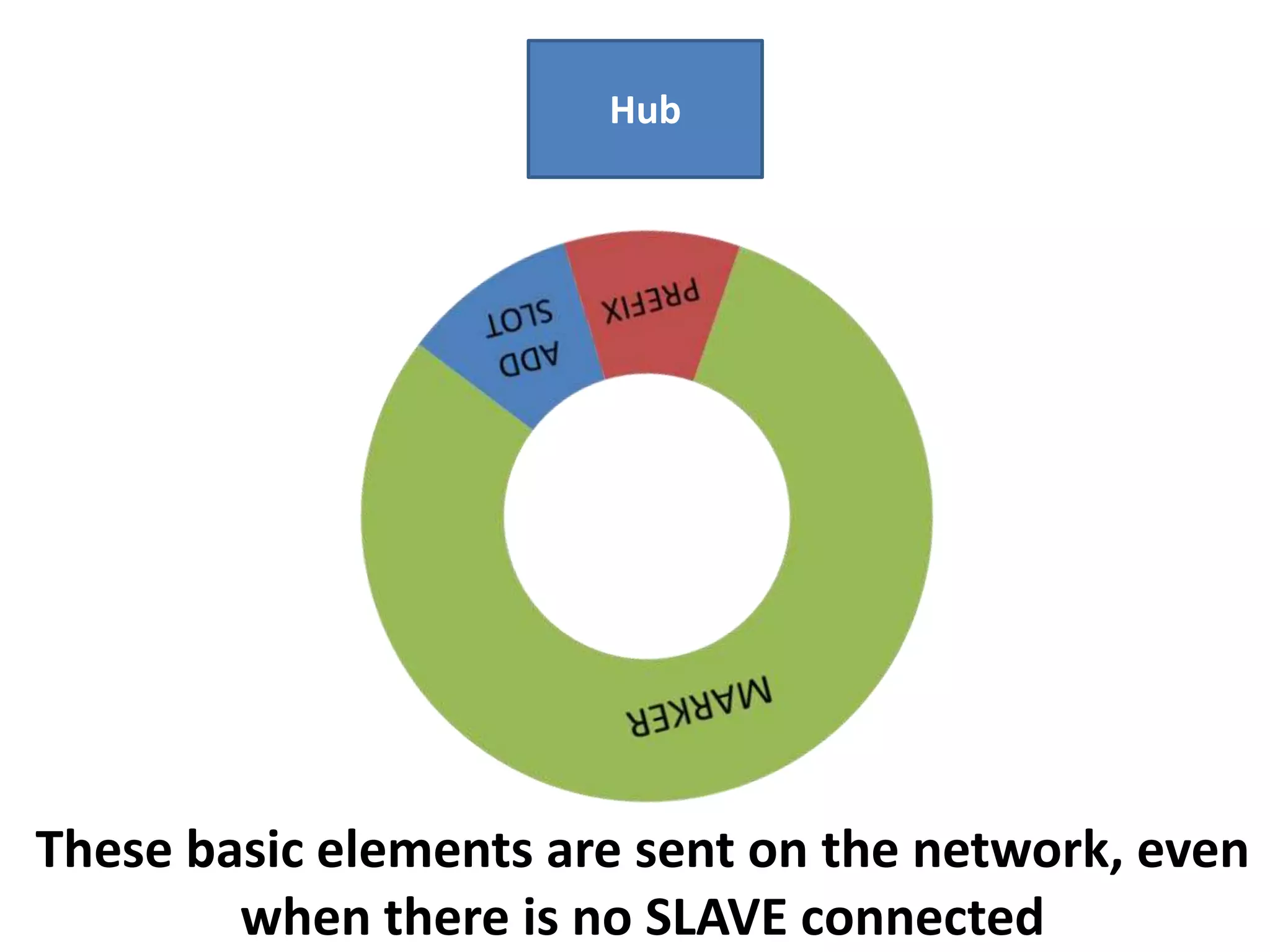
Hub

These basic elements are sent on the network, even
when there is no SLAVE connected
Hub

SLAVE 1

MARKER

PREFIX

Slave 1

ADD 0
SLOT

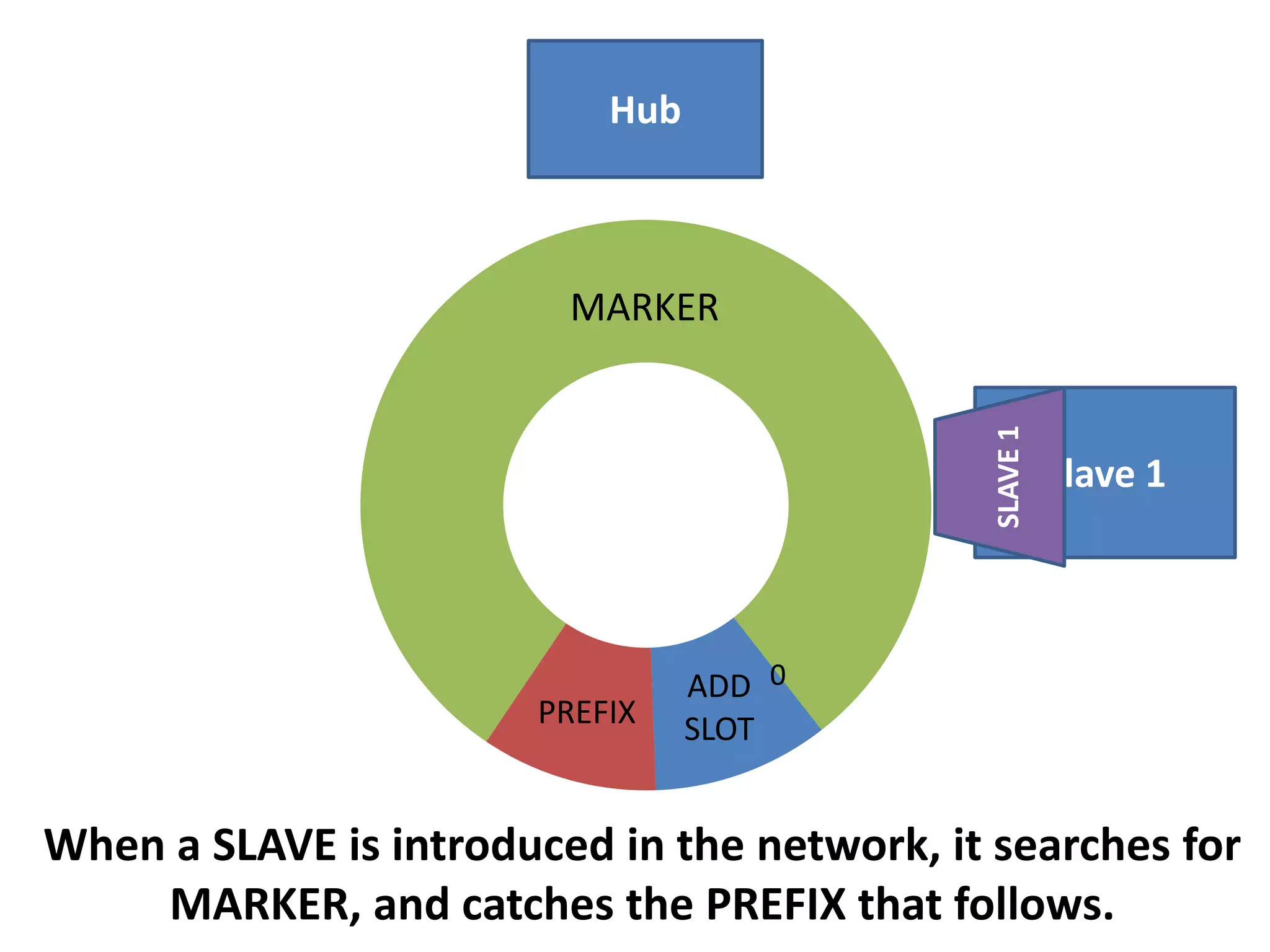
When a SLAVE is introduced in the network, it searches for
MARKER, and catches the PREFIX that follows.
Hub

0
SLAVESlave 1
1

PREFIX

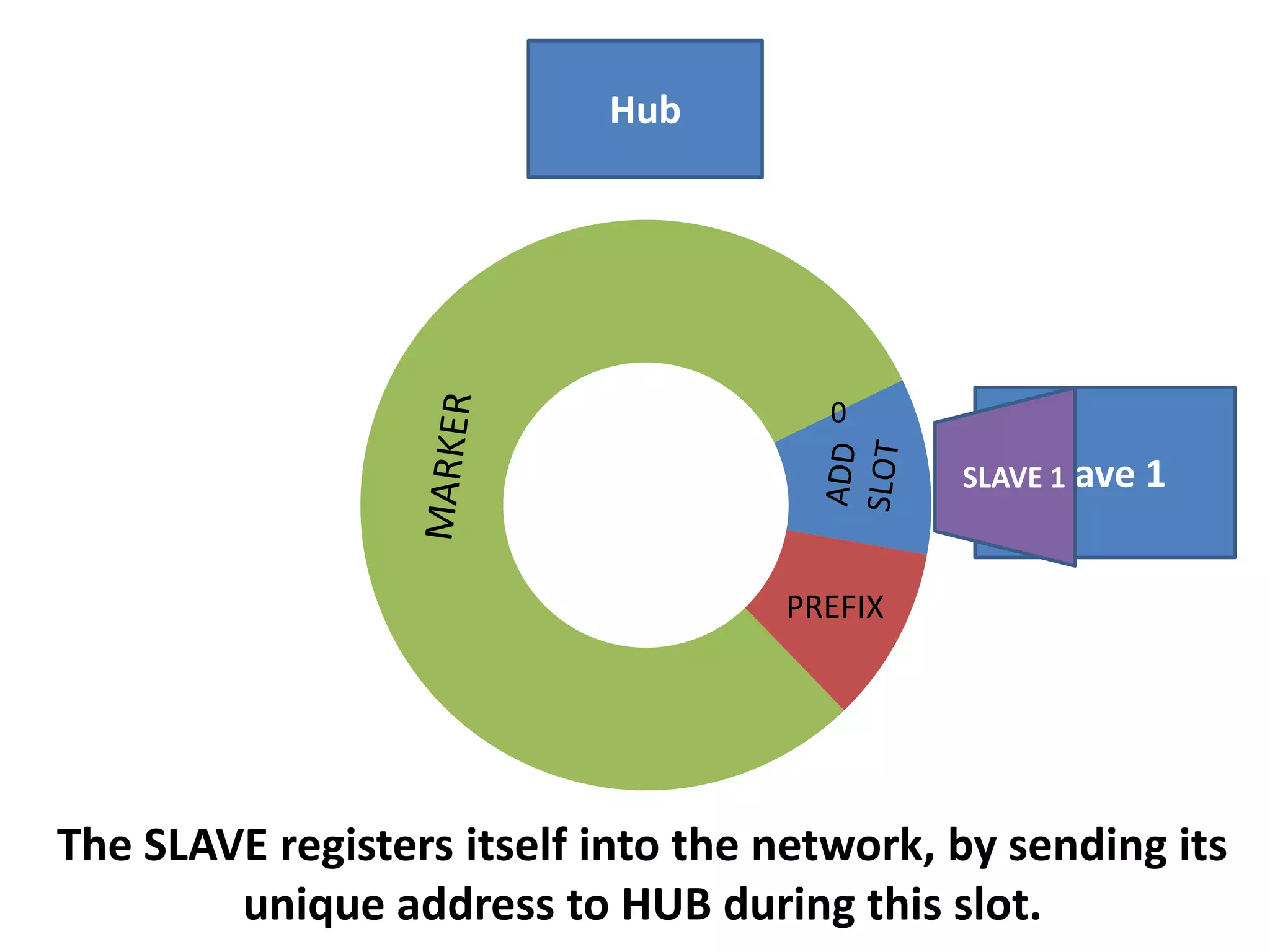
The SLAVE registers itself into the network, by sending its
unique address to HUB during this slot.
Hub

0

SLAVE 1

Slave 1

PREFIX

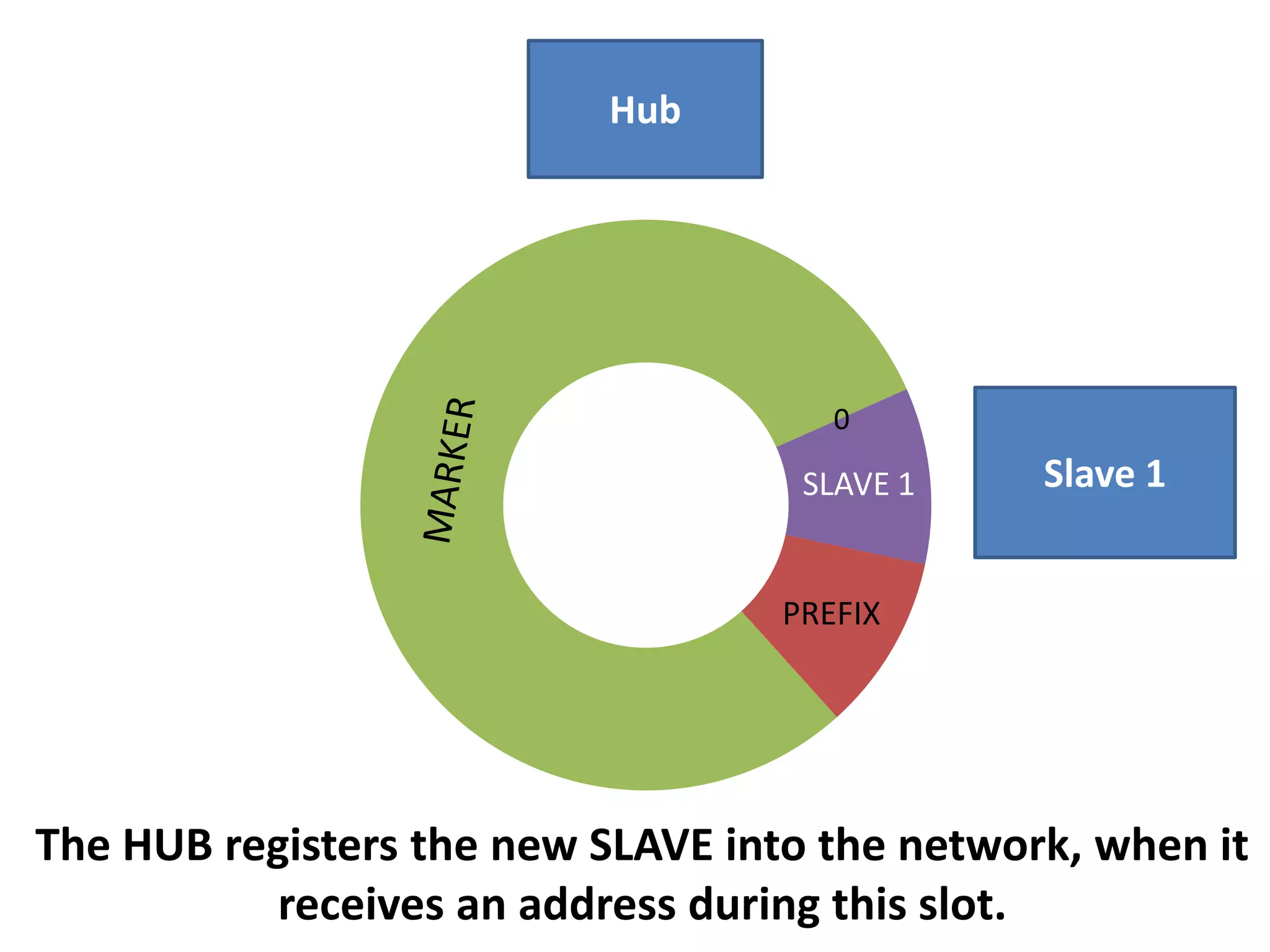
The HUB registers the new SLAVE into the network, when it
receives an address during this slot.
Hub

MARKER
PREFIX
ADD
SLOT

SLAVE 1

SLAVE 1

HUB TO
SLAVE 1

SLAVE 1 TO
HUB

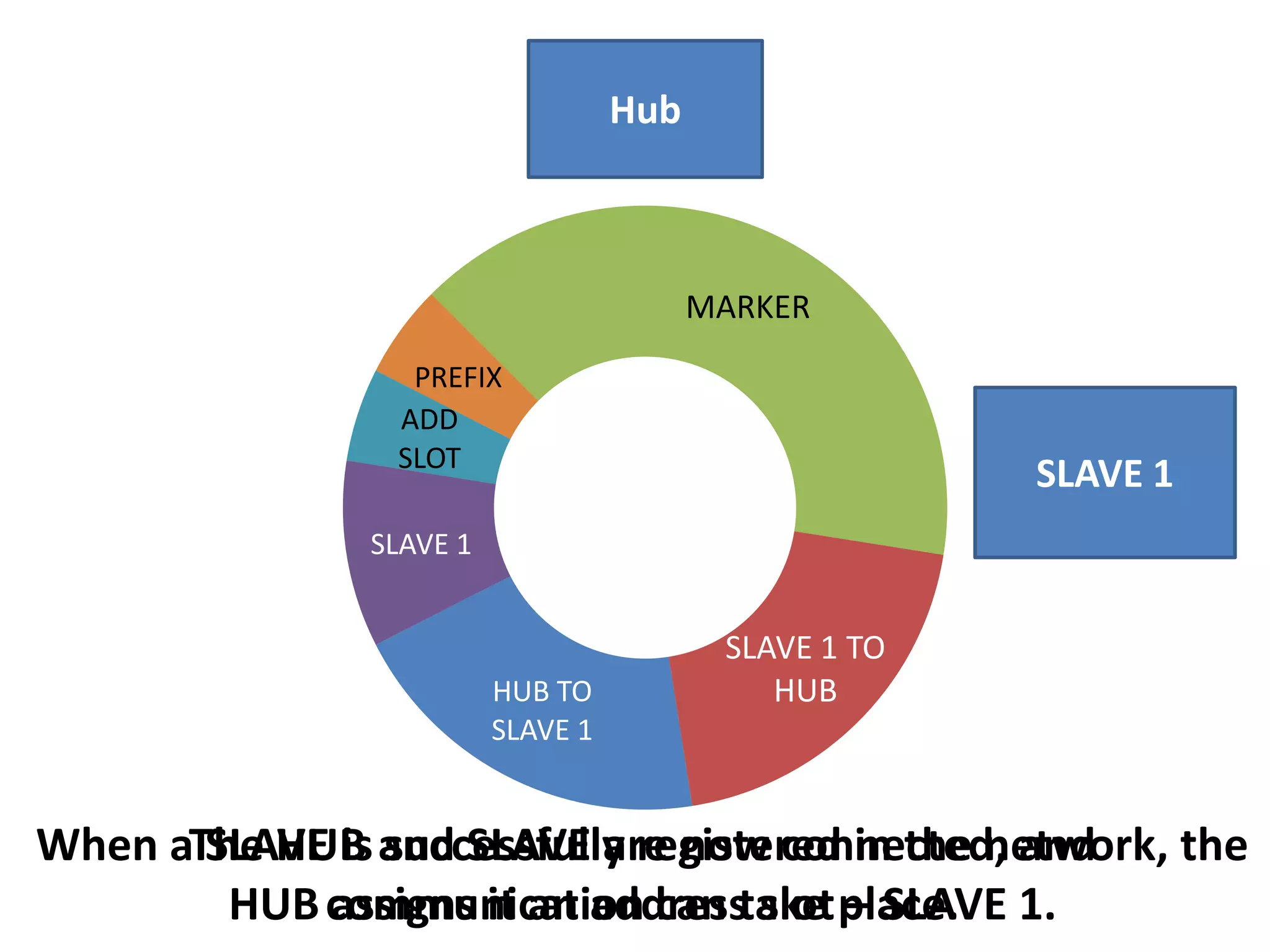
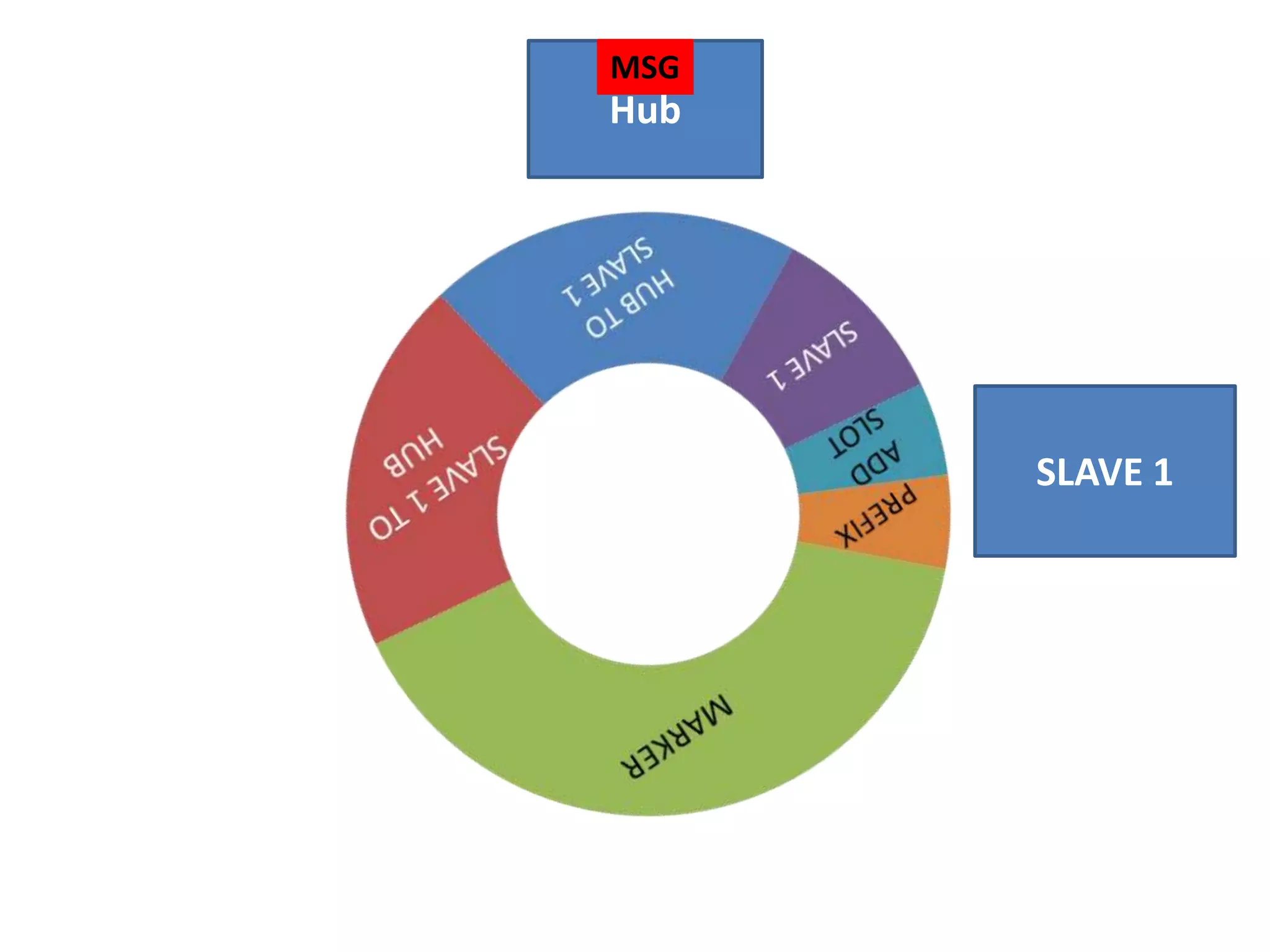
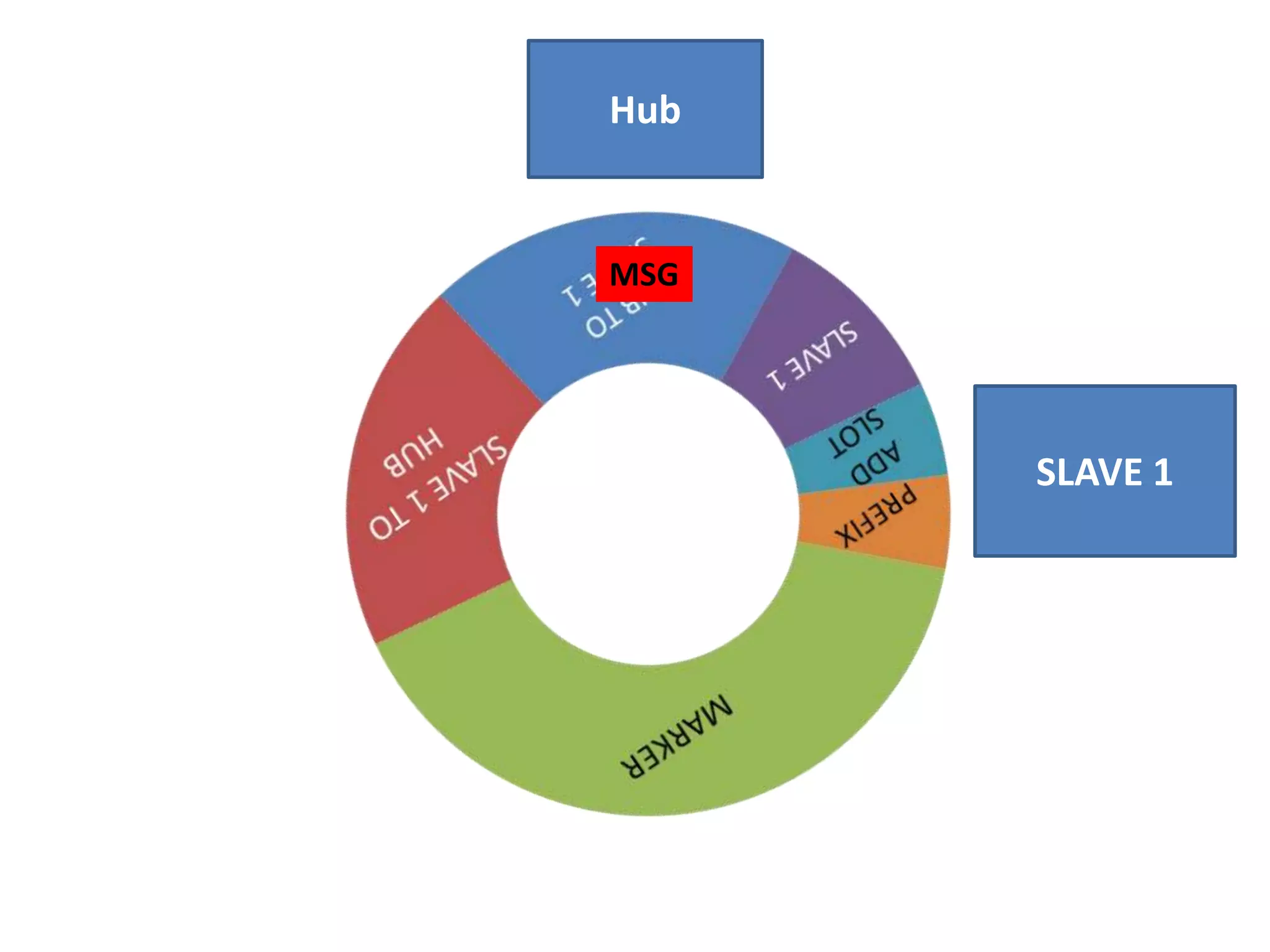
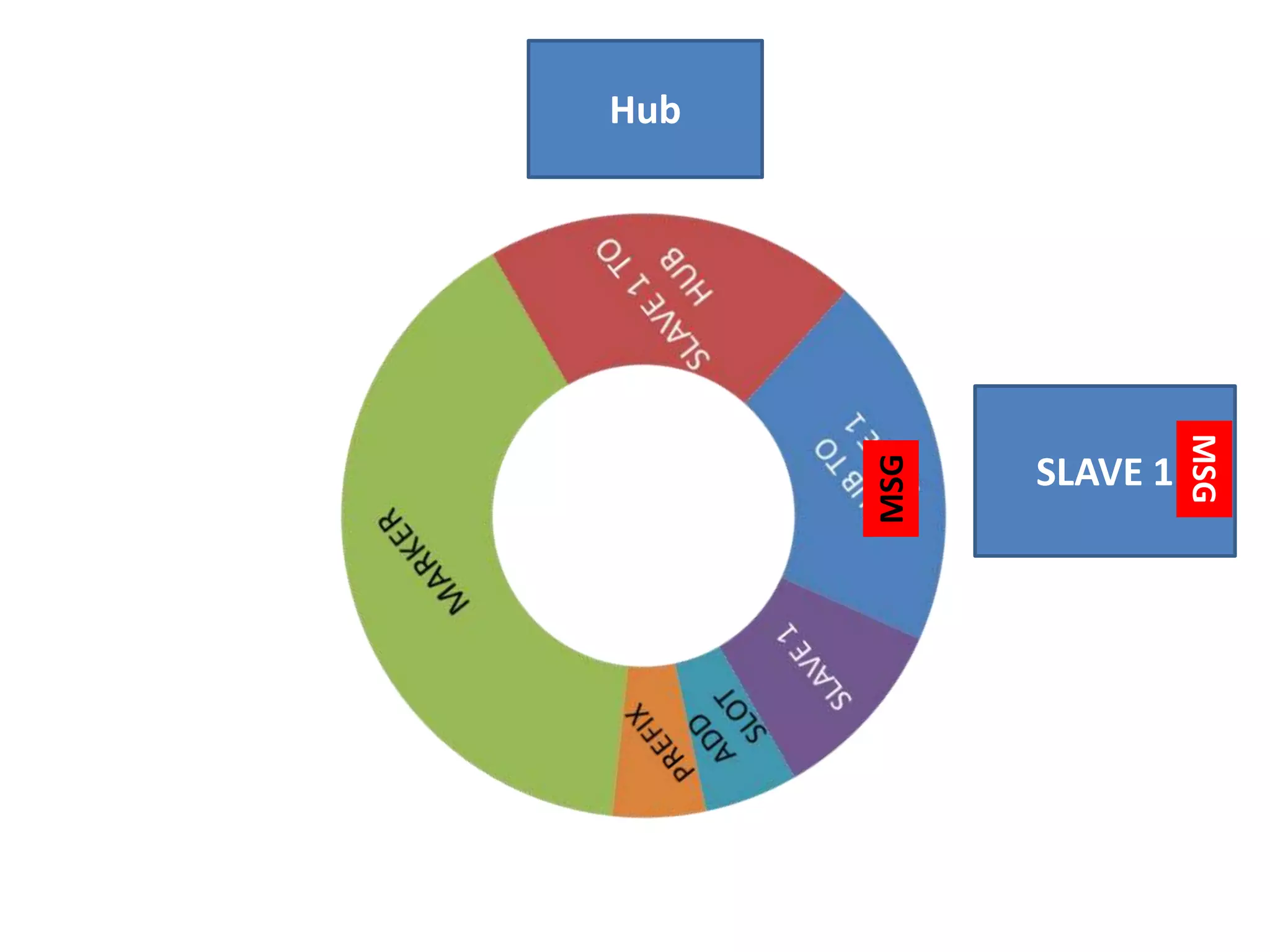
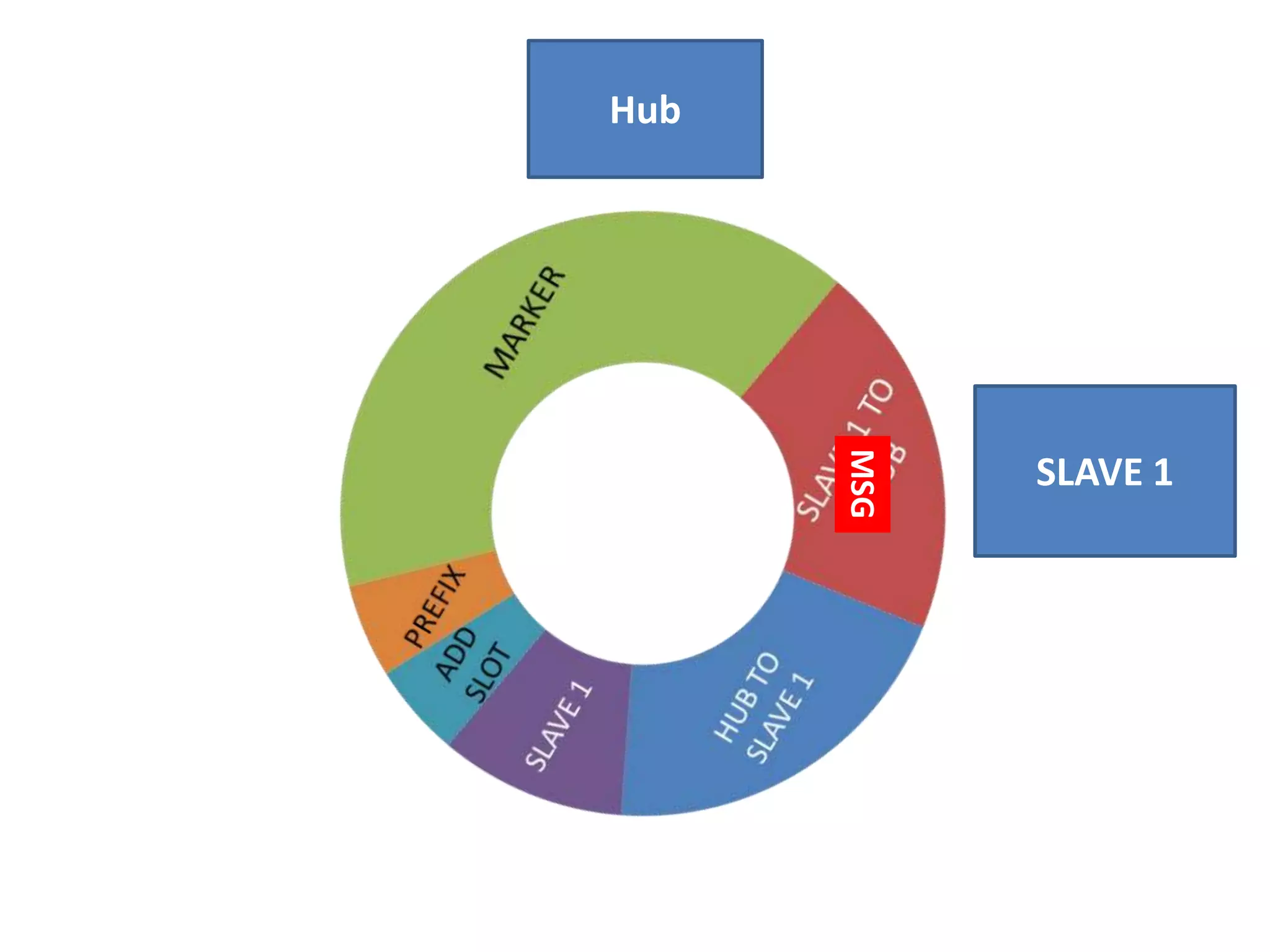
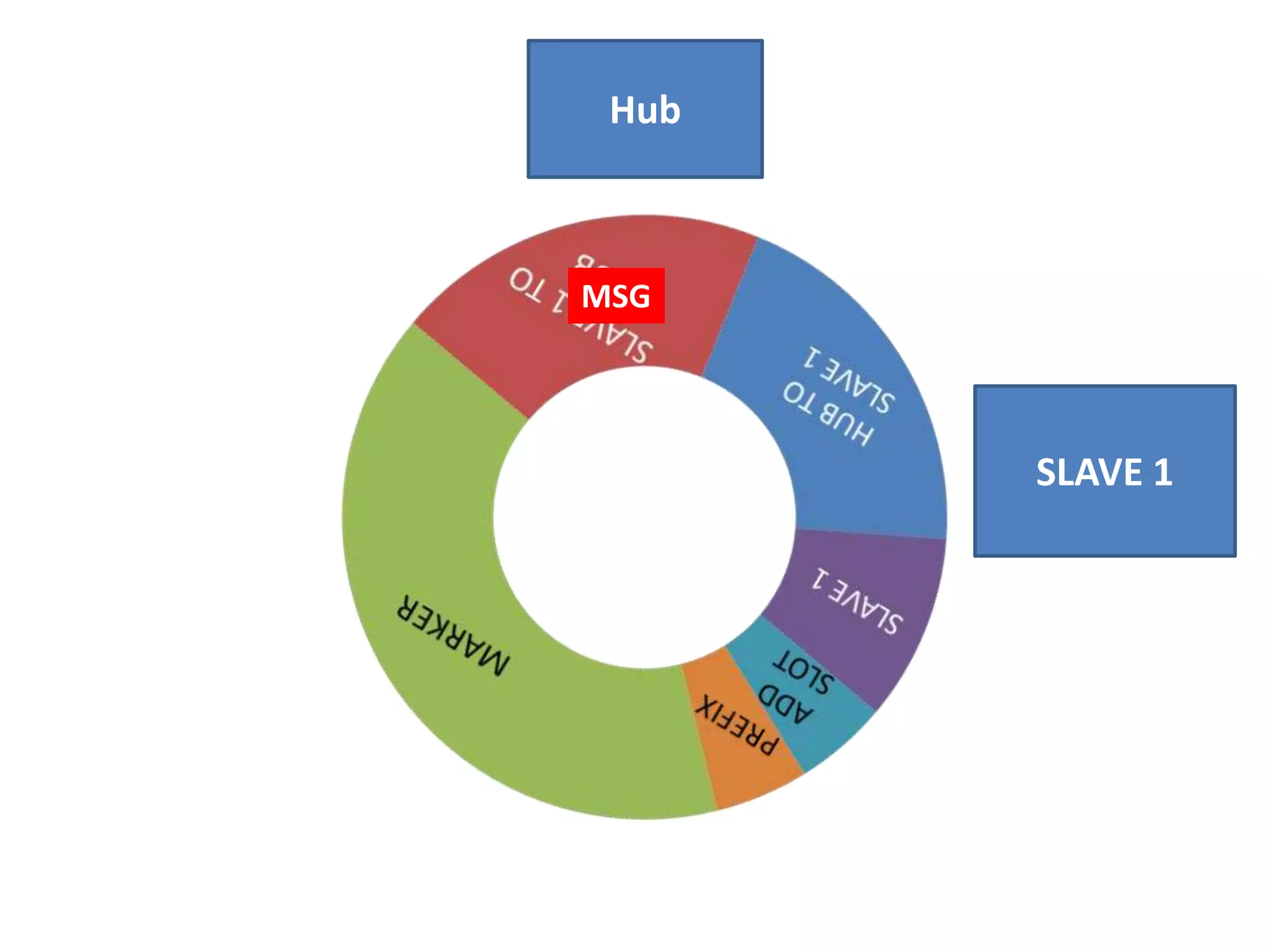
When aThe HUB and SLAVE are now connected, and
SLAVE is successfully registered in the network, the
HUB communication can take place. 1.
assigns it an address slot – SLAVE
MSG

Hub

SLAVE 1
Hub

MSG

SLAVE 1
SLAVE 1

MSG

MSG

Hub
Hub

MSG

SLAVE 1
Hub

MSG

SLAVE 1
Applications
Applications
Applications
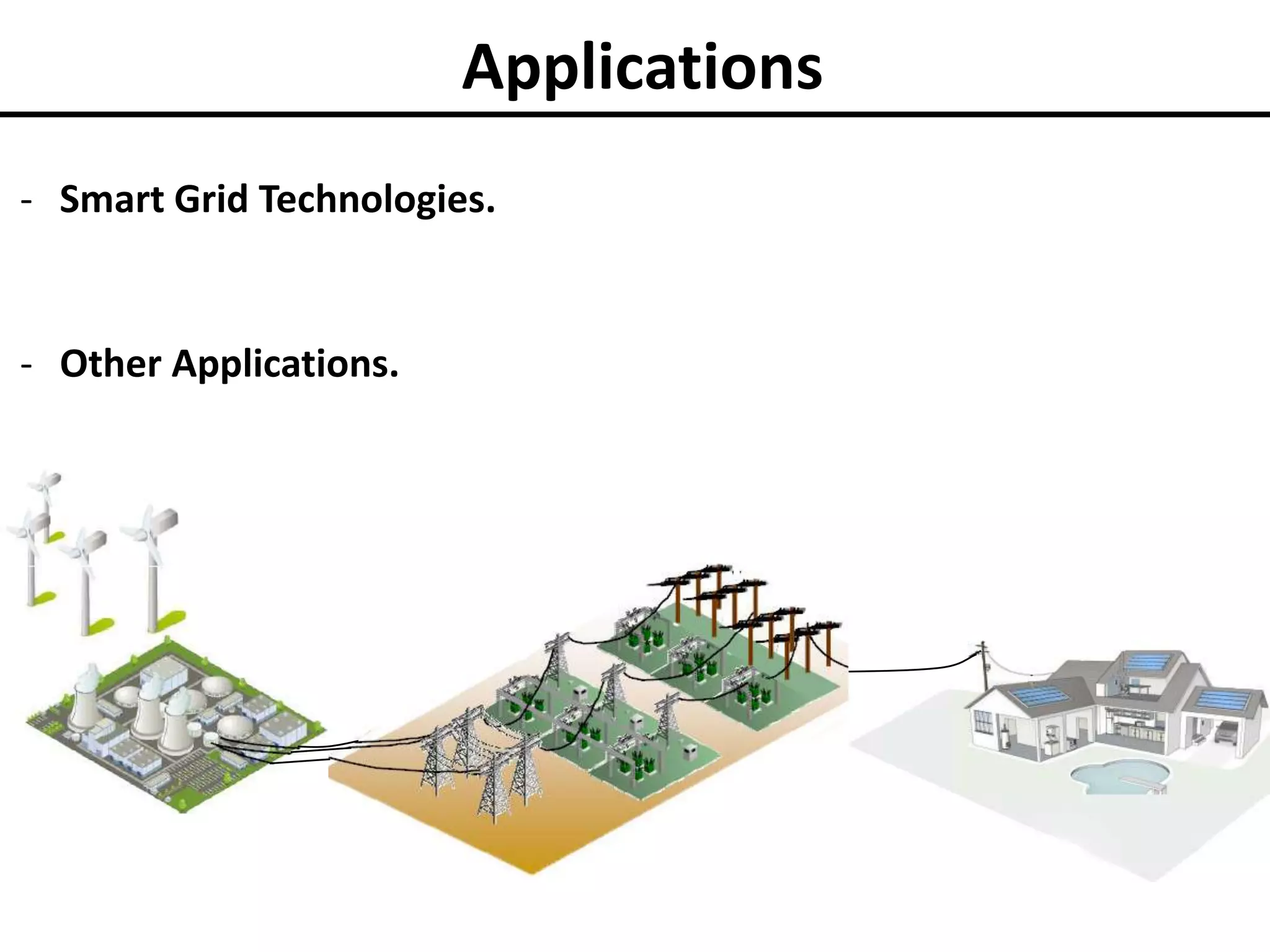
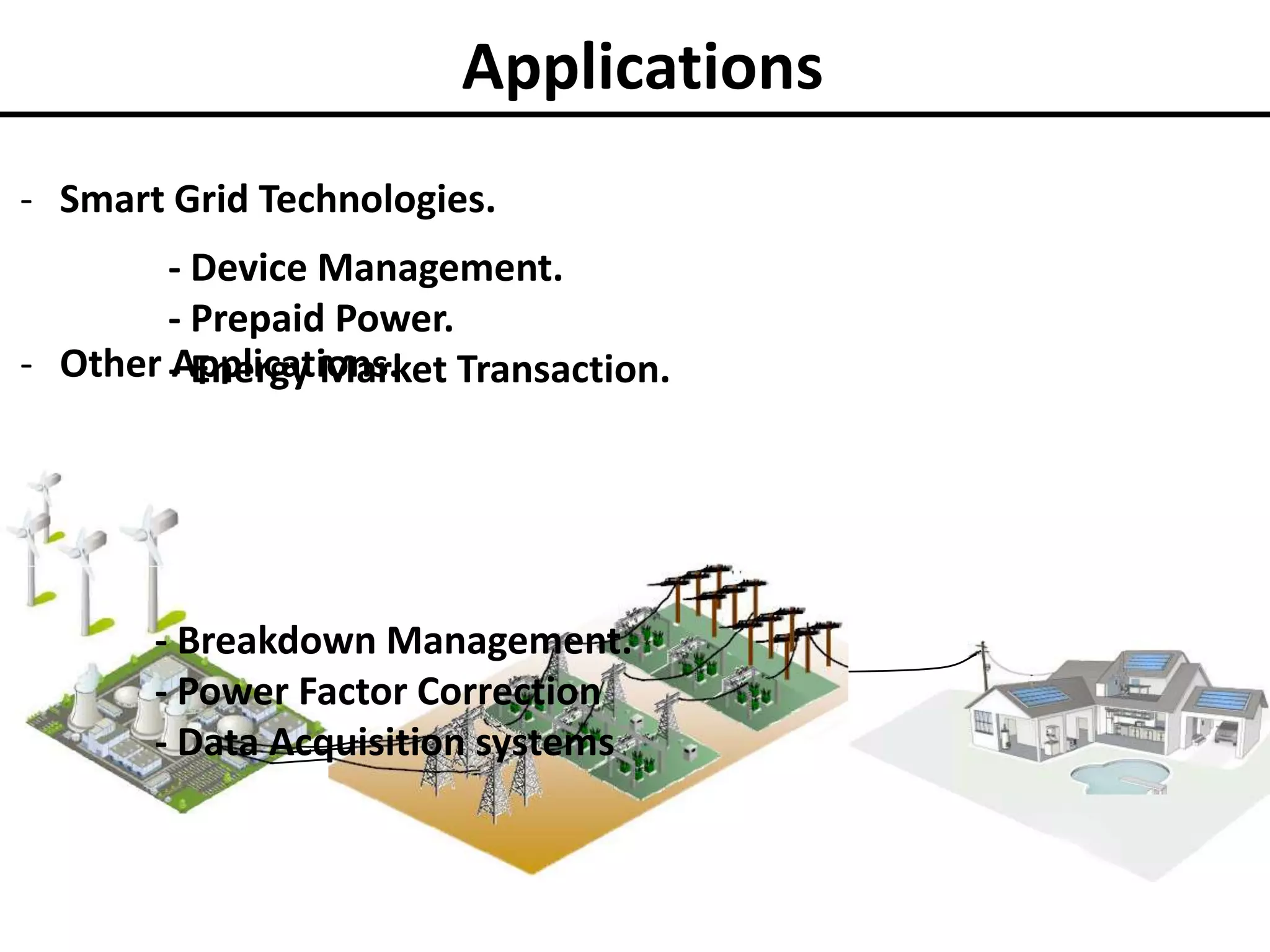
- Smart Grid Technologies.

- Other Applications.
Applications
- Smart Grid Technologies.

- Device Management.
- Prepaid Power.
- Other - Energy Market Transaction.
Applications.

- Breakdown Management.
- Power Factor Correction
- Data Acquisition systems
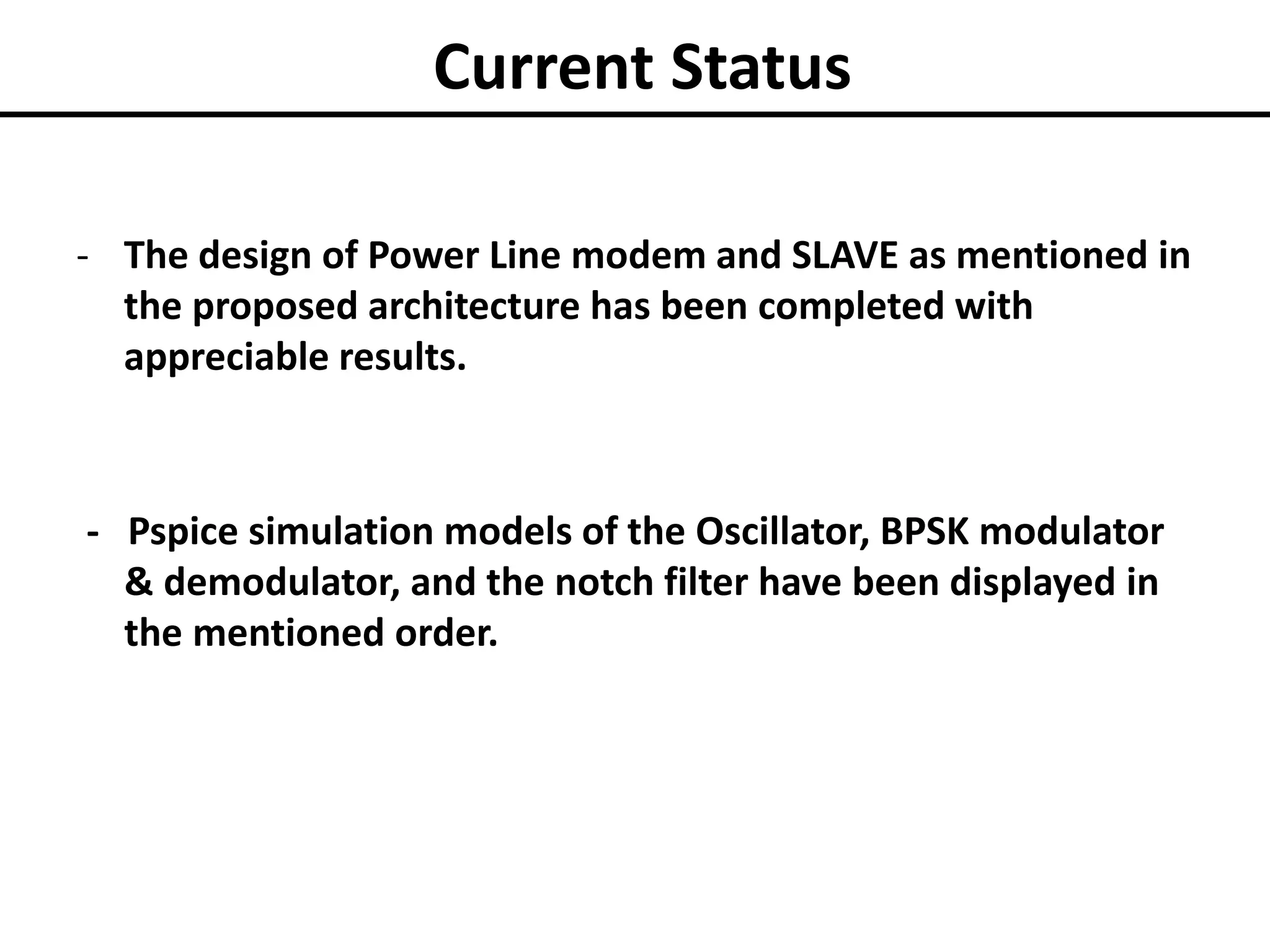
Current Status
Current Status
Current Status
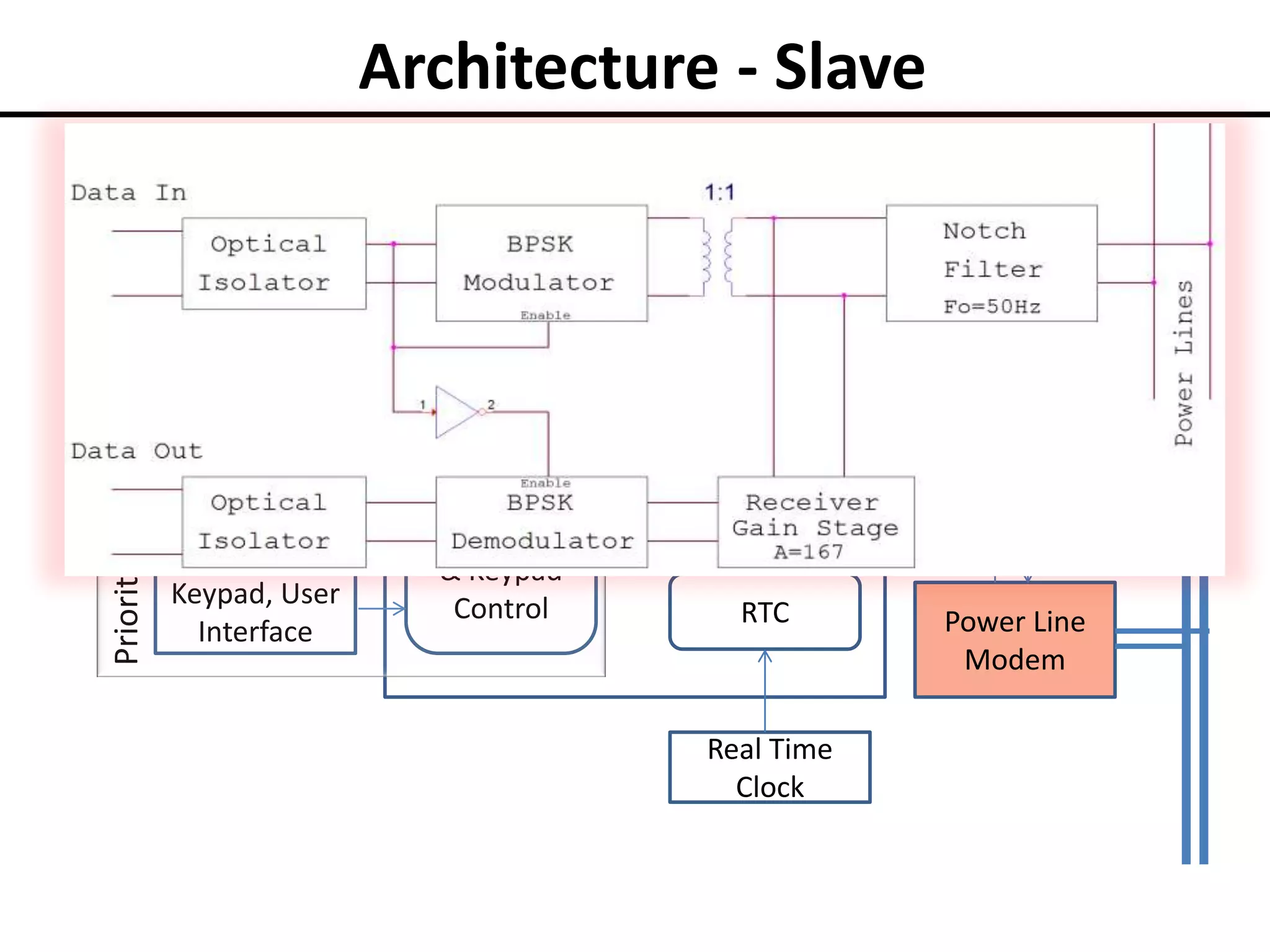
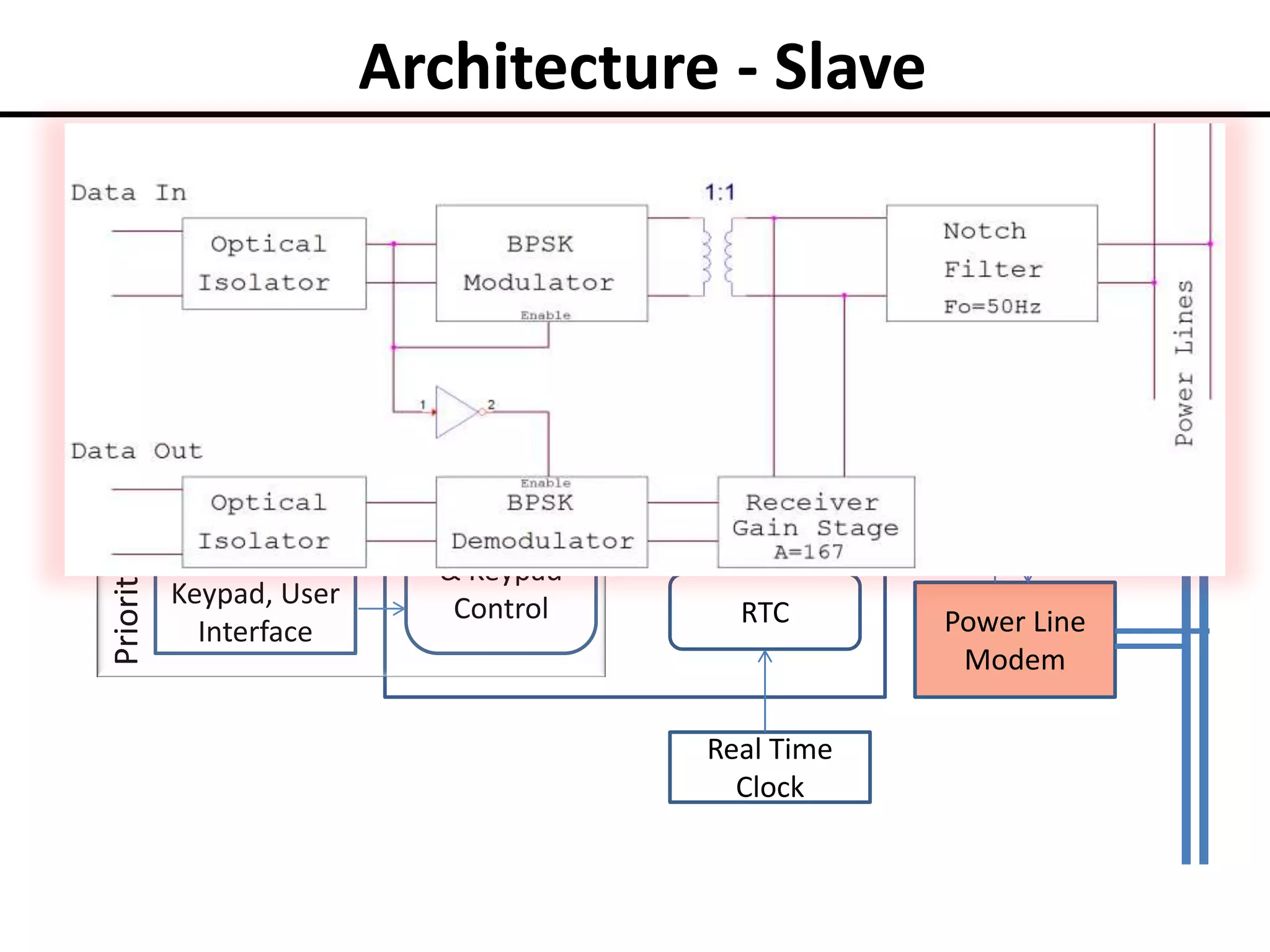
- The design of Power Line modem and SLAVE as mentioned in
the proposed architecture has been completed with
appreciable results.

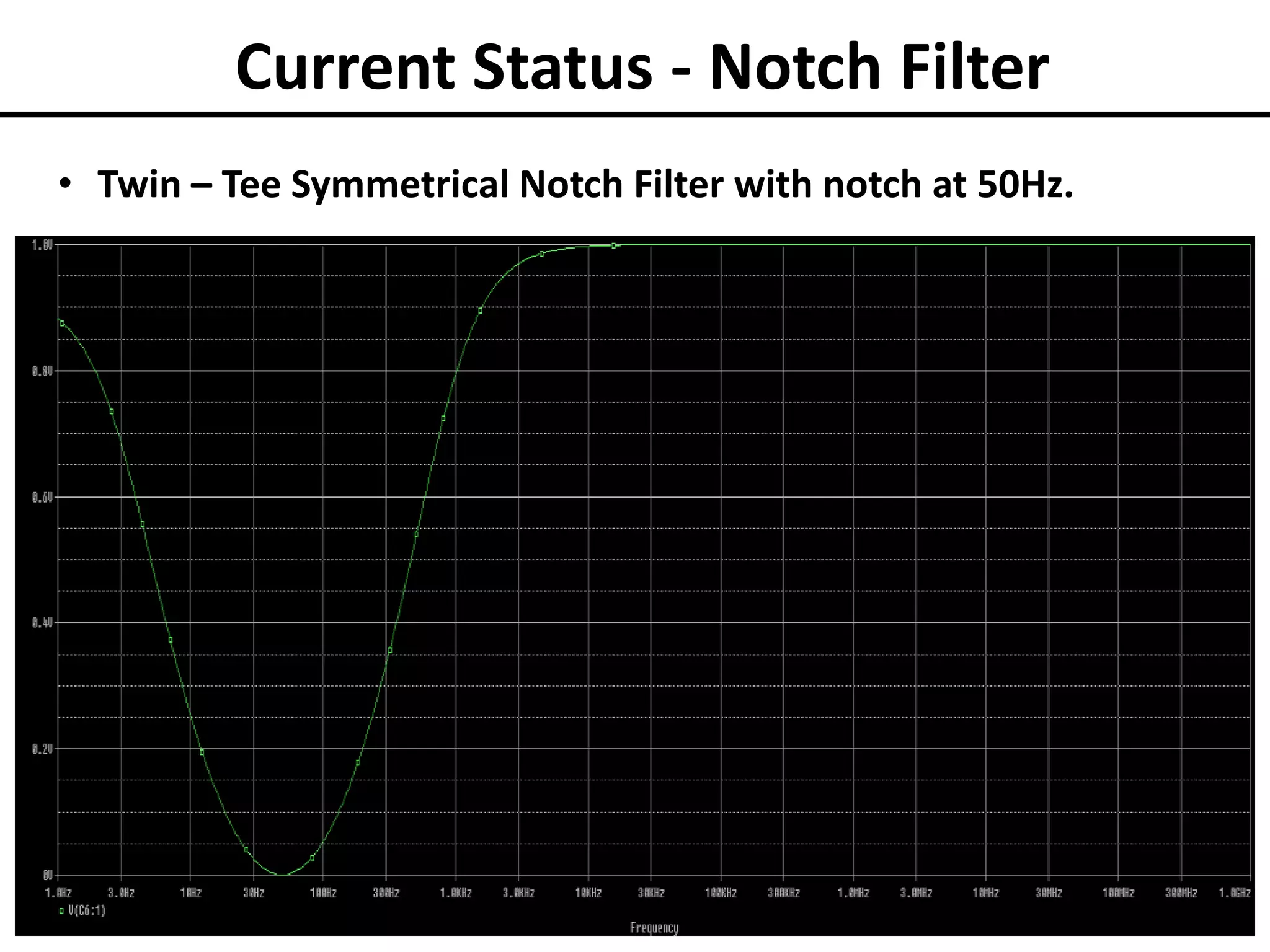
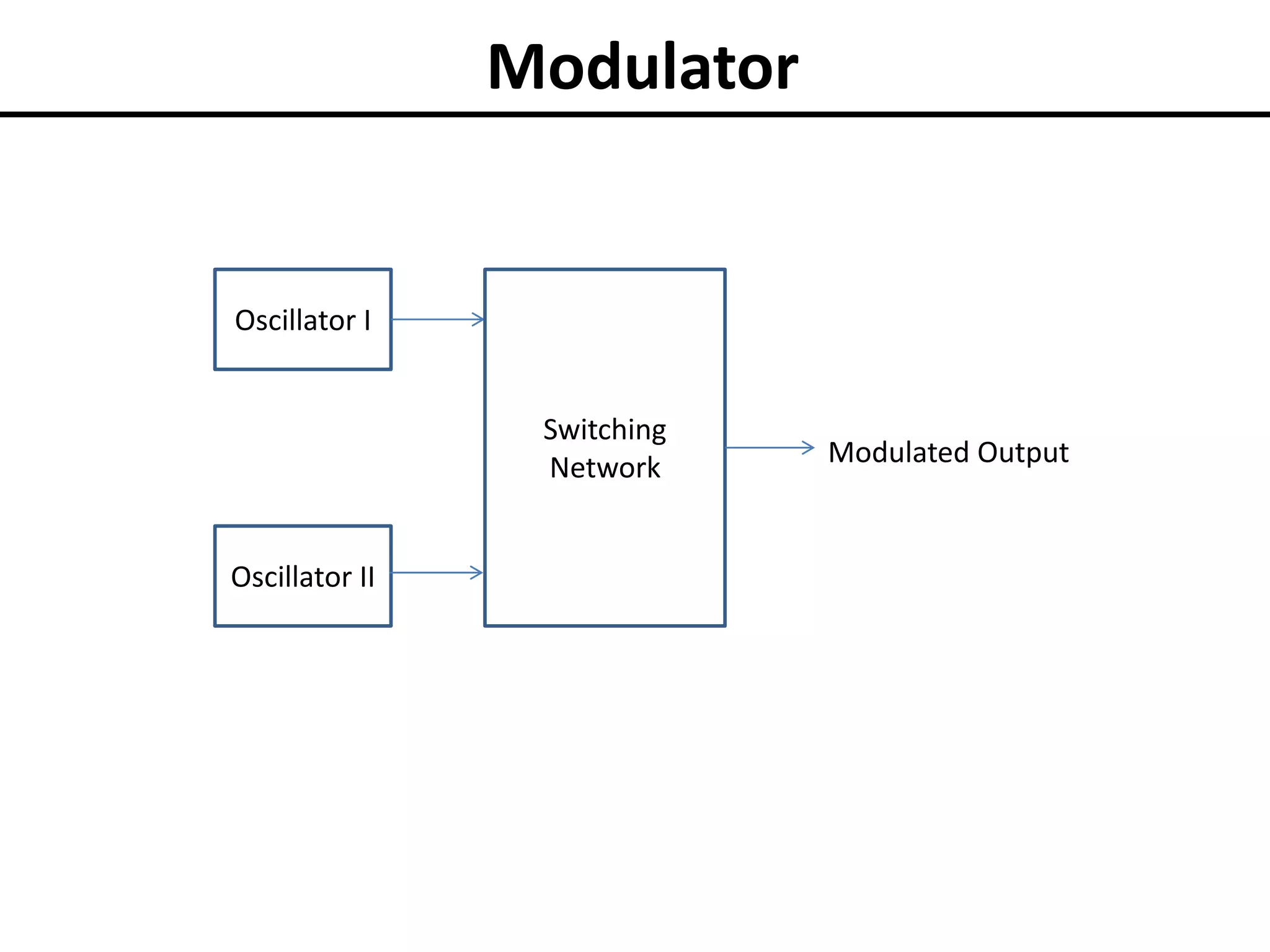
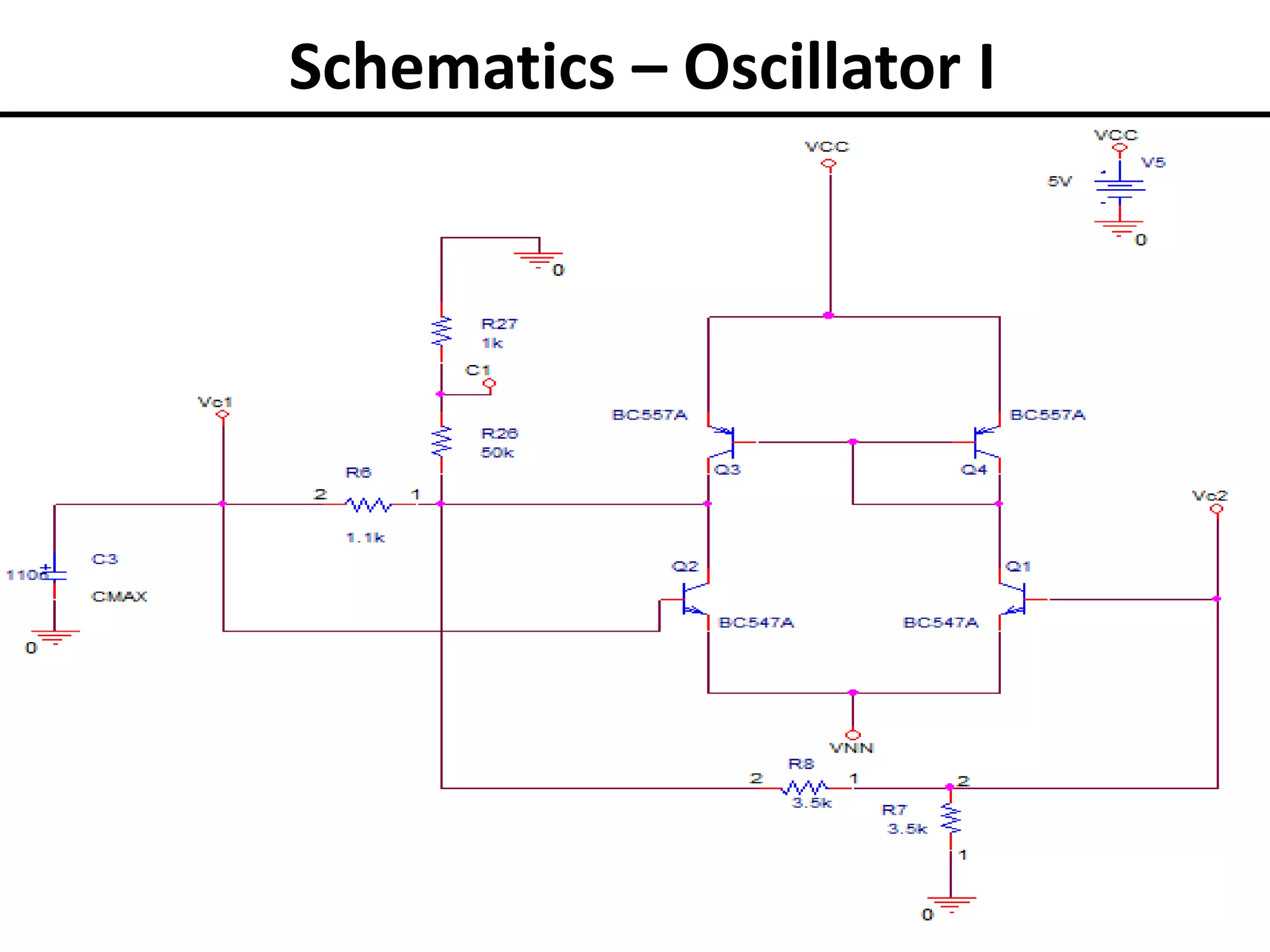
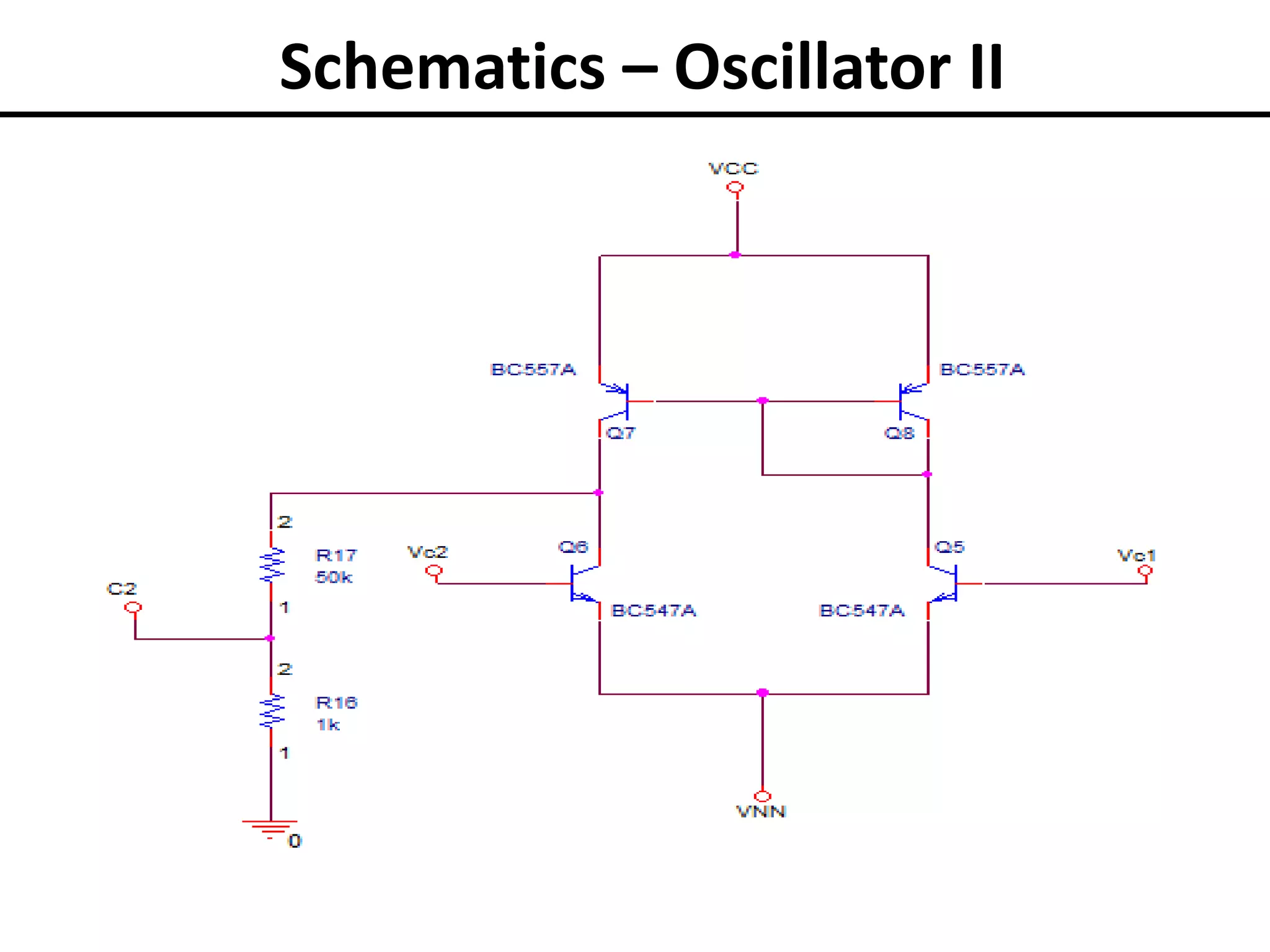
- Pspice simulation models of the Oscillator, BPSK modulator
& demodulator, and the notch filter have been displayed in
the mentioned order.
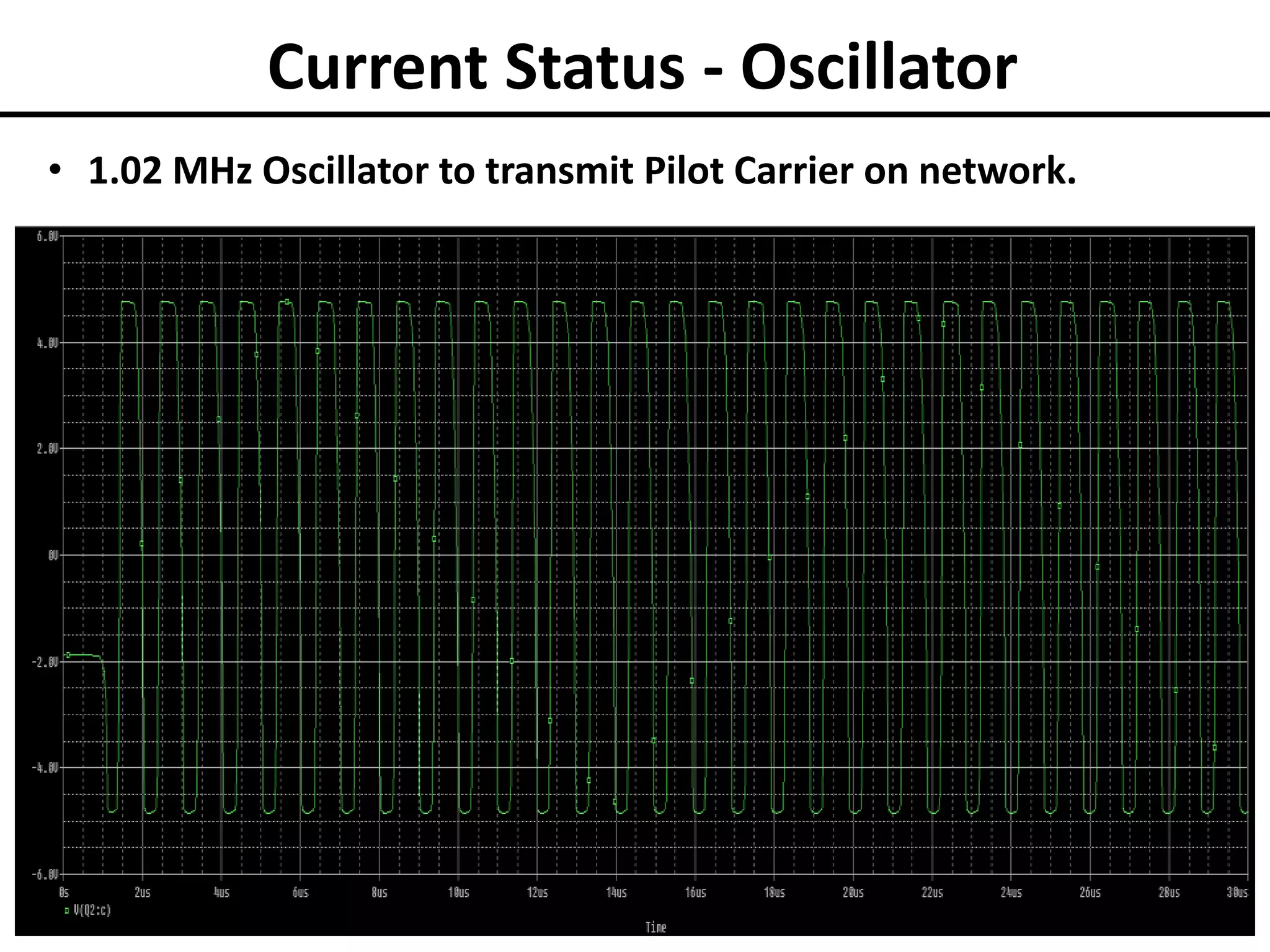
Current Status - Oscillator
• 1.02 MHz Oscillator to transmit Pilot Carrier on network.
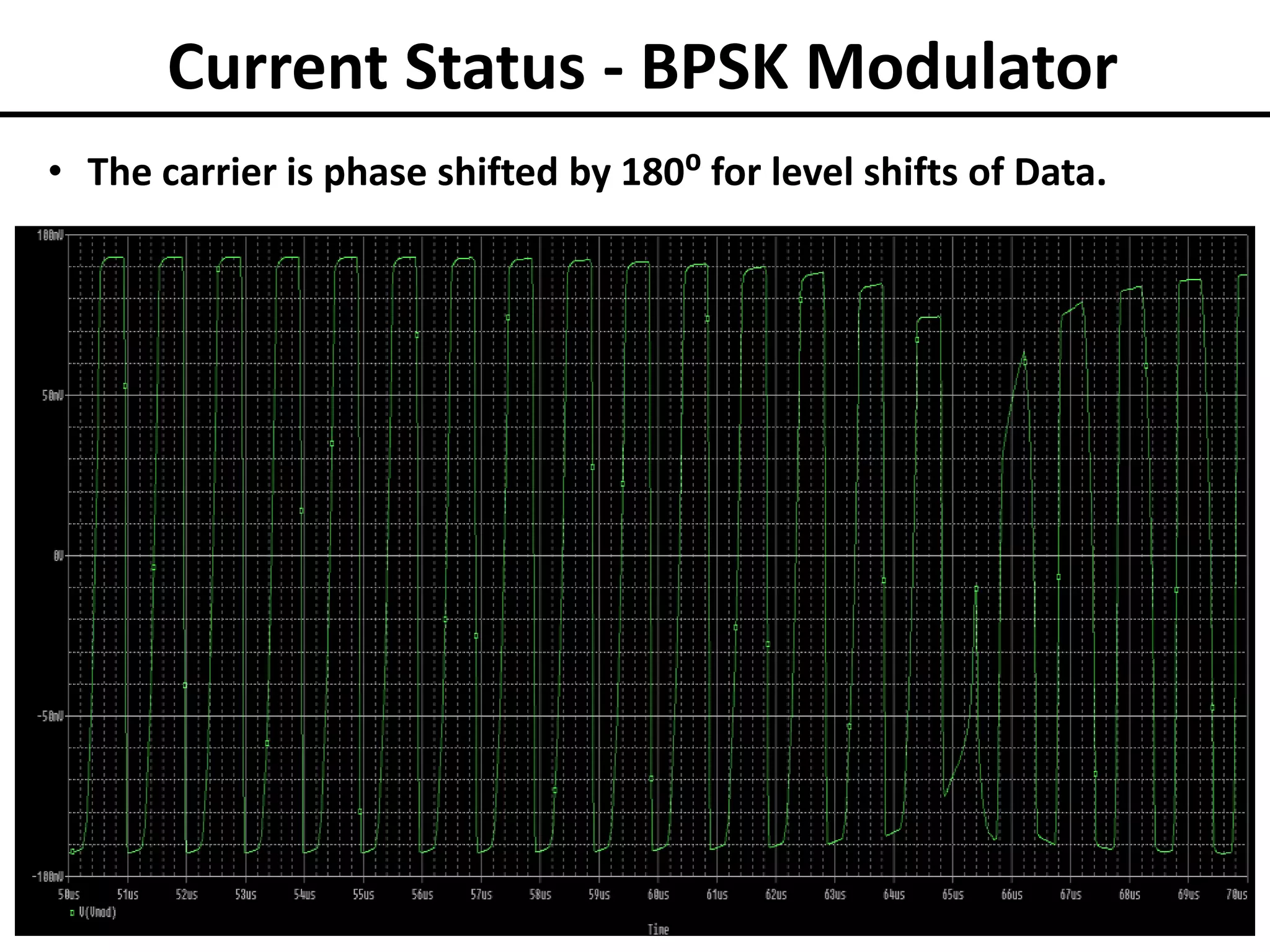
Current Status - BPSK Modulator
• The carrier is phase shifted by 180⁰ for level shifts of Data.
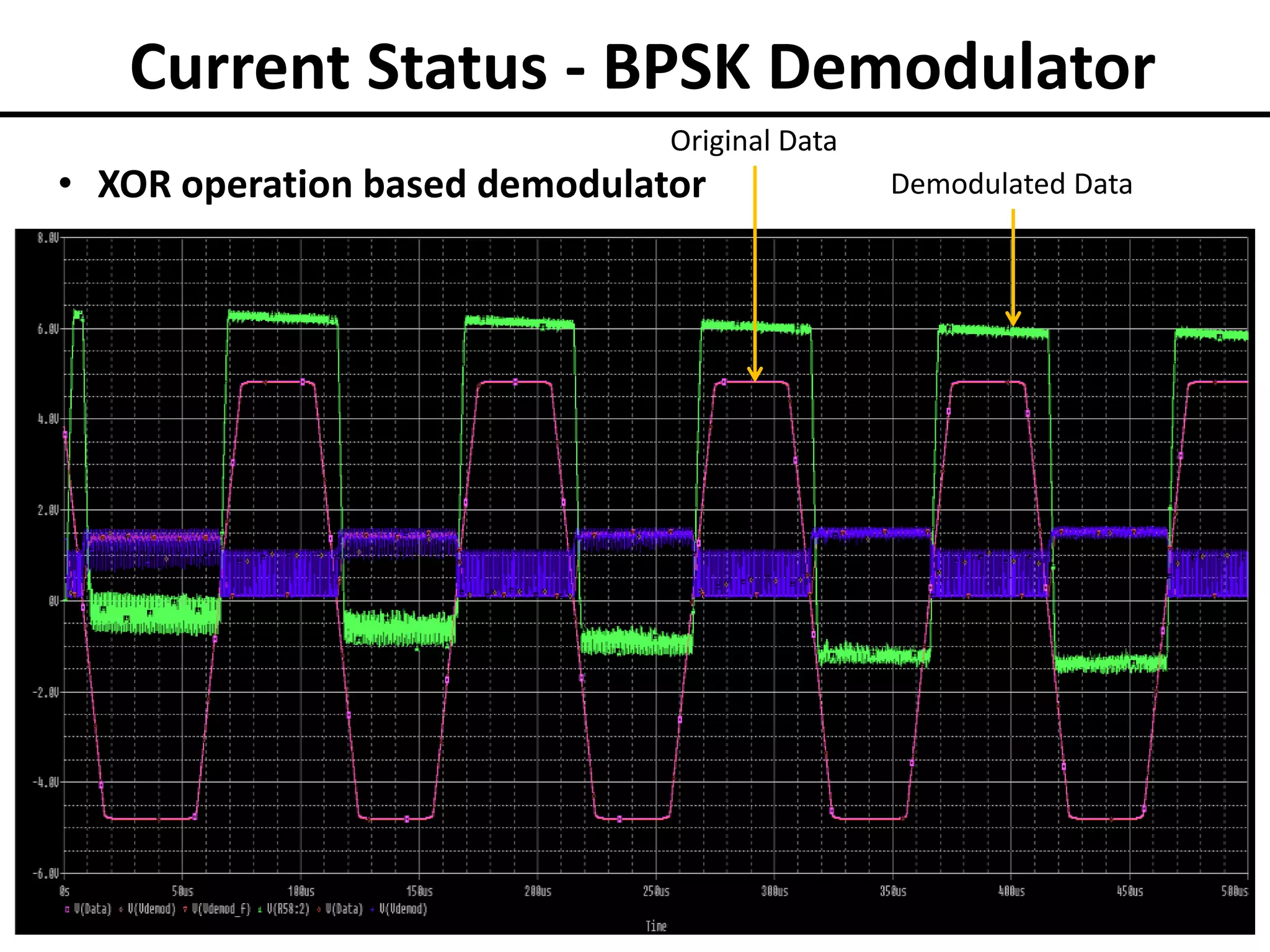
Current Status - BPSK Demodulator
Original Data

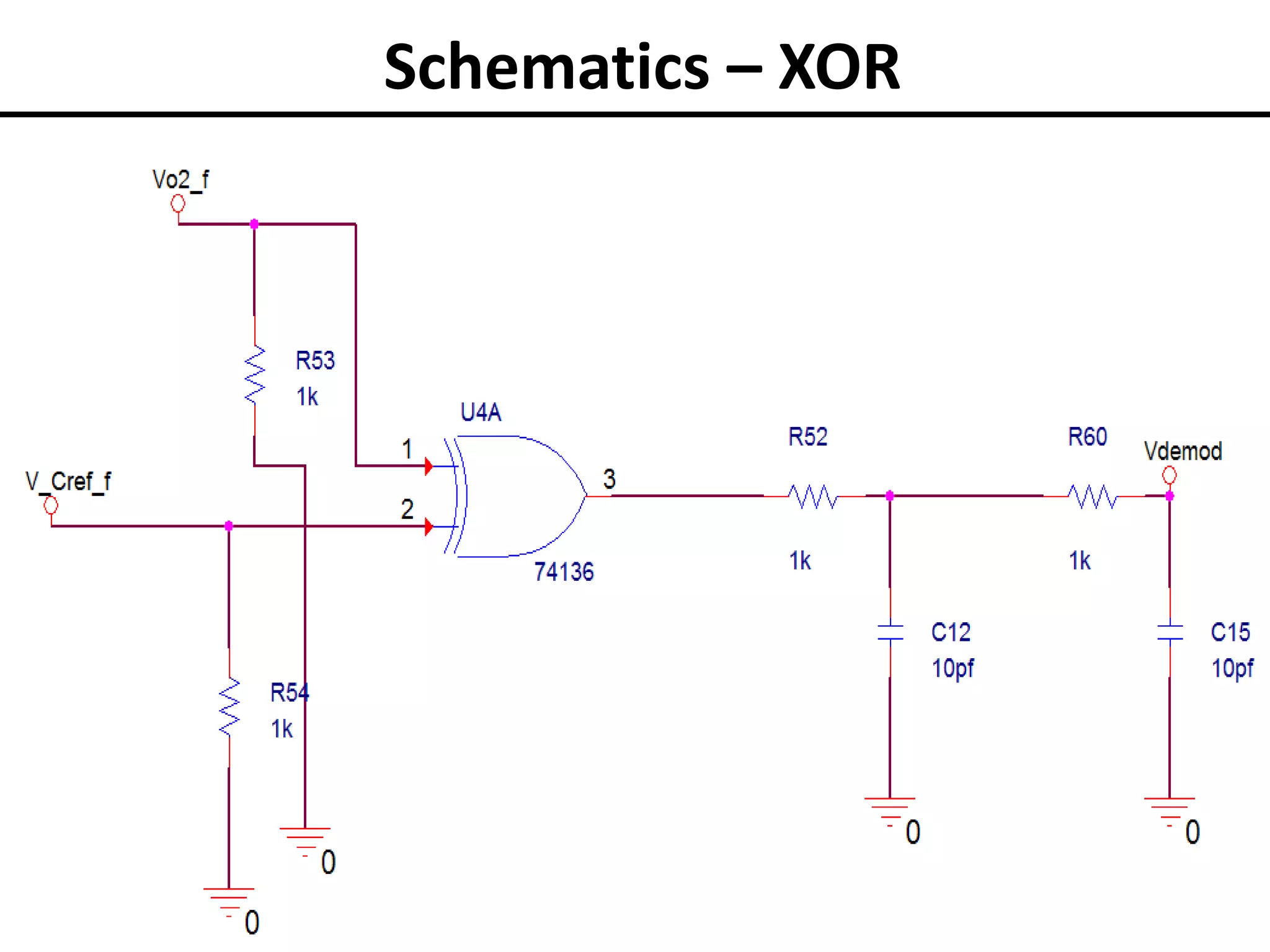
• XOR operation based demodulator

Demodulated Data
Current Status - Notch Filter
• Twin – Tee Symmetrical Notch Filter with notch at 50Hz.
THANK YOU
Modulator

Oscillator I
Switching
Network
Oscillator II

Modulated Output
Schematics – Oscillator I
Schematics – Oscillator II
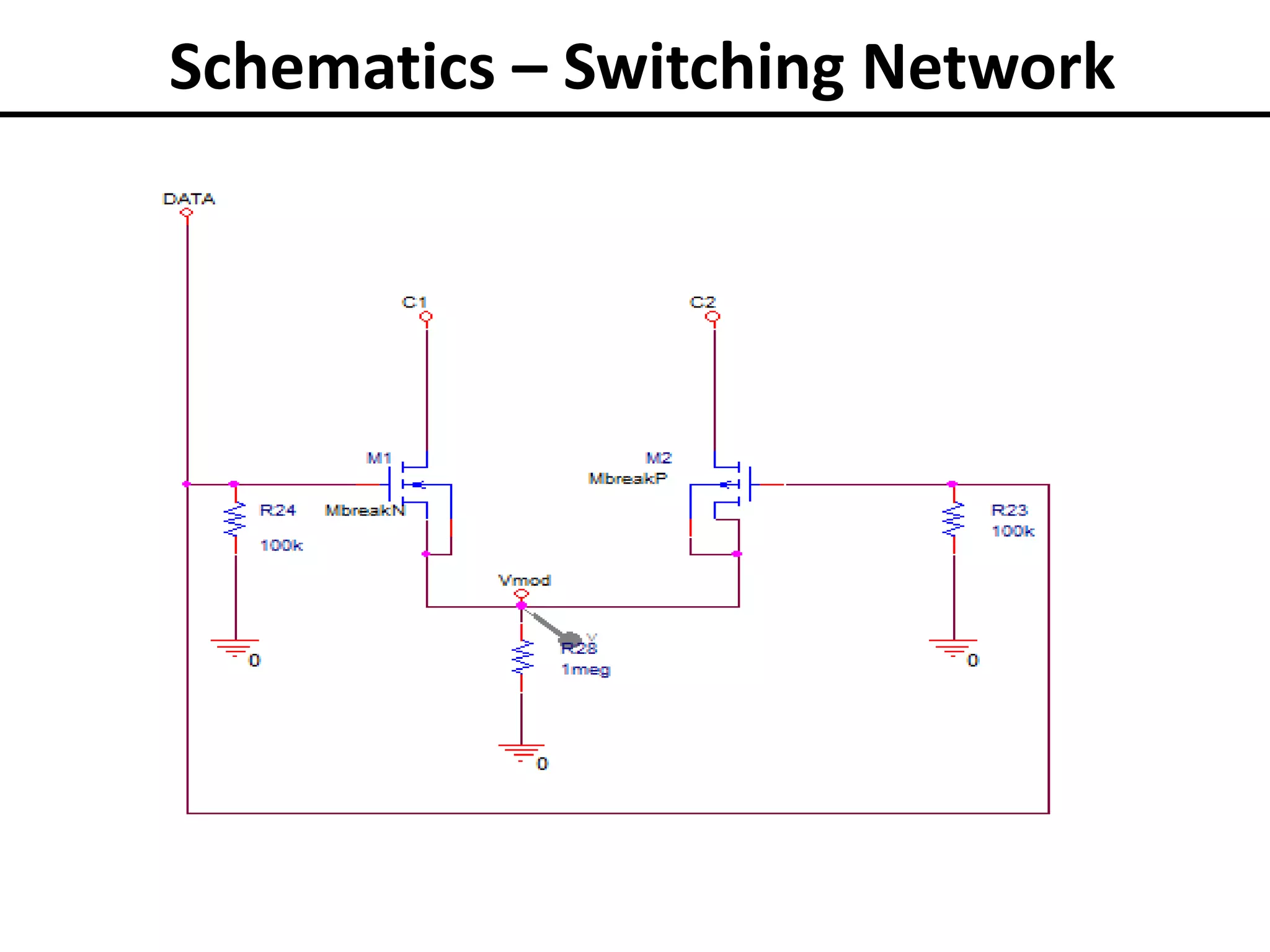
Schematics – Switching Network
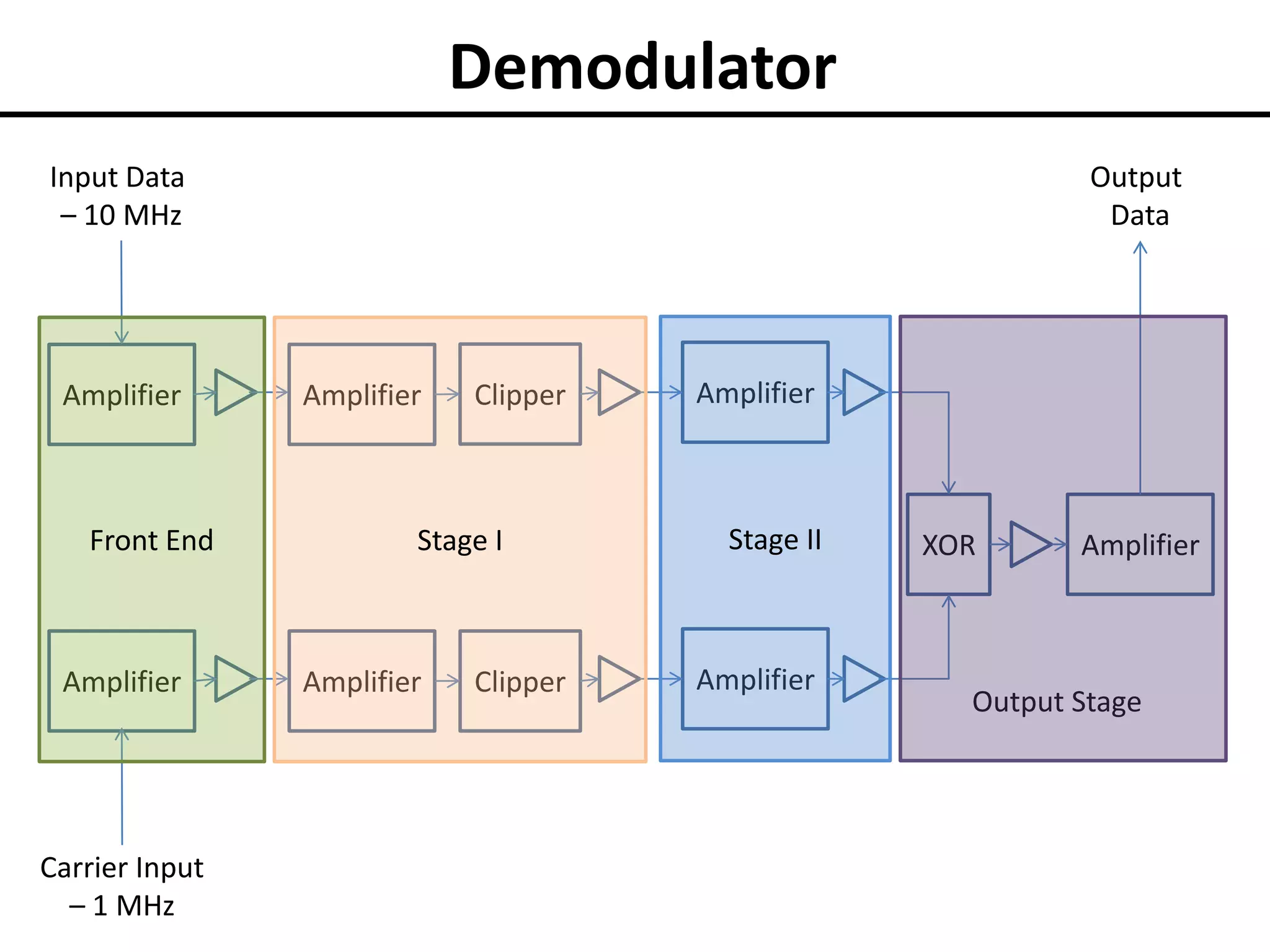
Demodulator
Input Data
– 10 MHz

Amplifier

Front End

Amplifier

Carrier Input
– 1 MHz

Output
Data

Amplifier

Clipper

Stage I

Amplifier

Clipper

Amplifier

Stage II

Amplifier

XOR

Amplifier

Output Stage
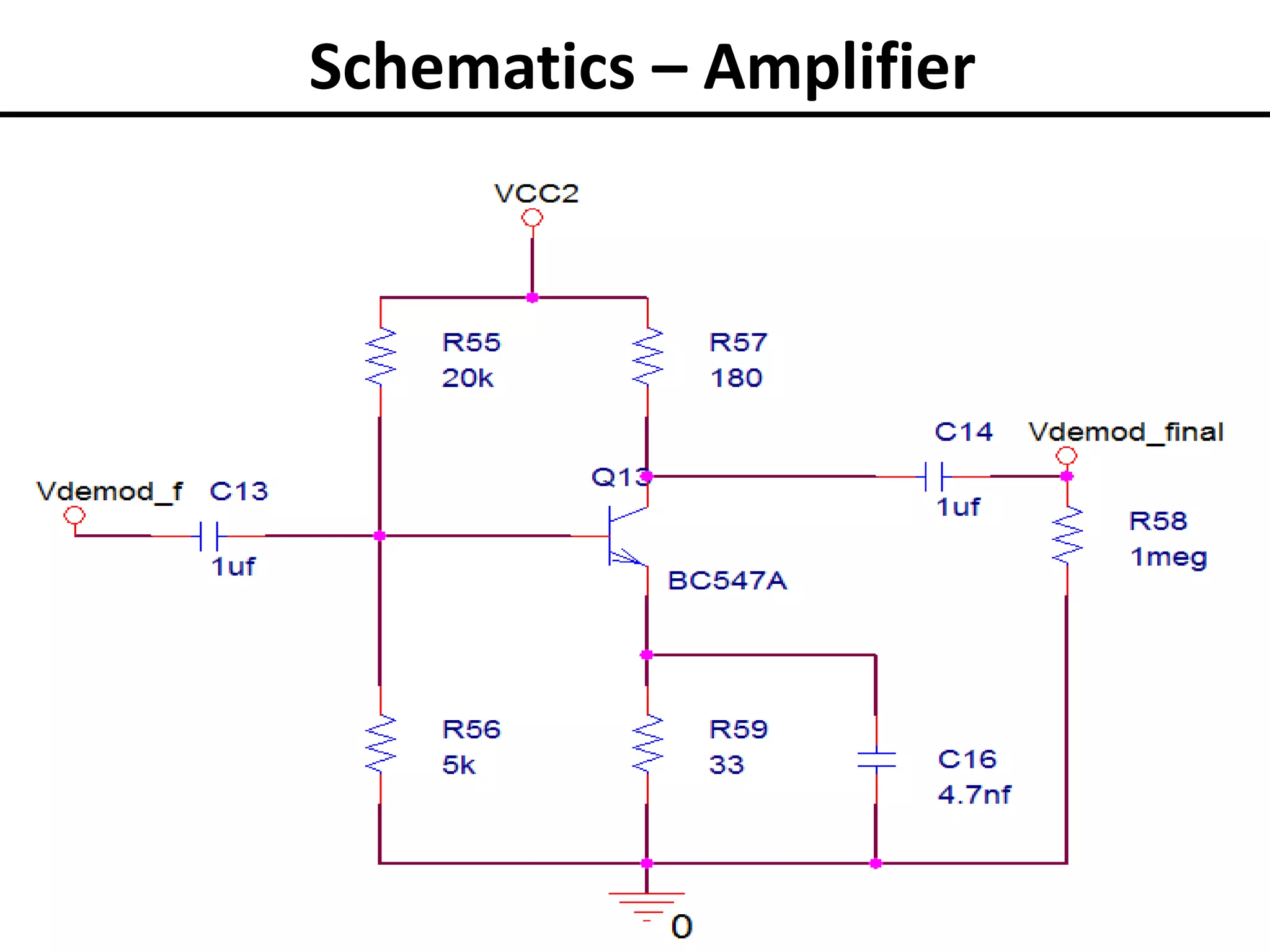
Schematics – Amplifier
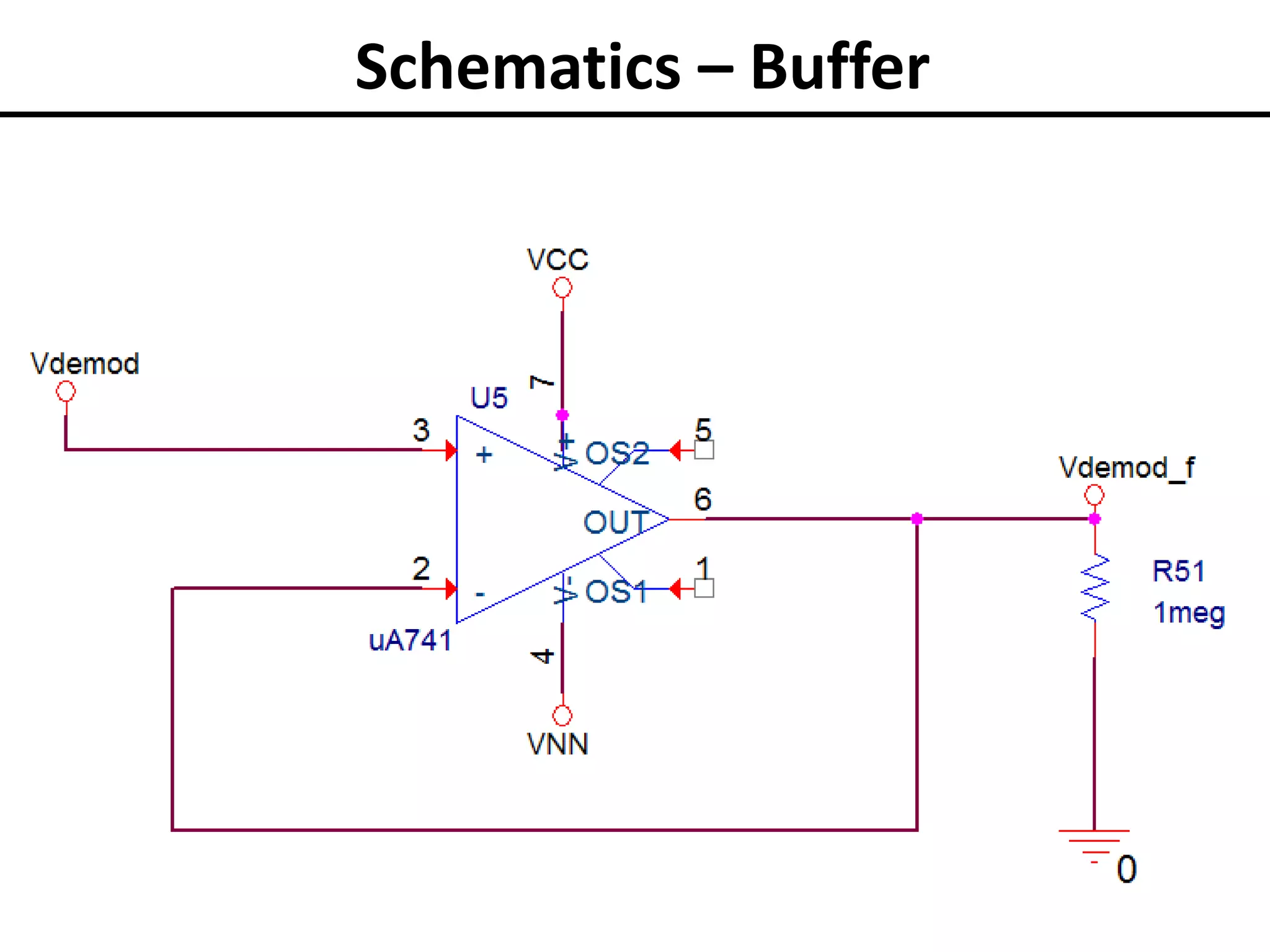
Schematics – Buffer
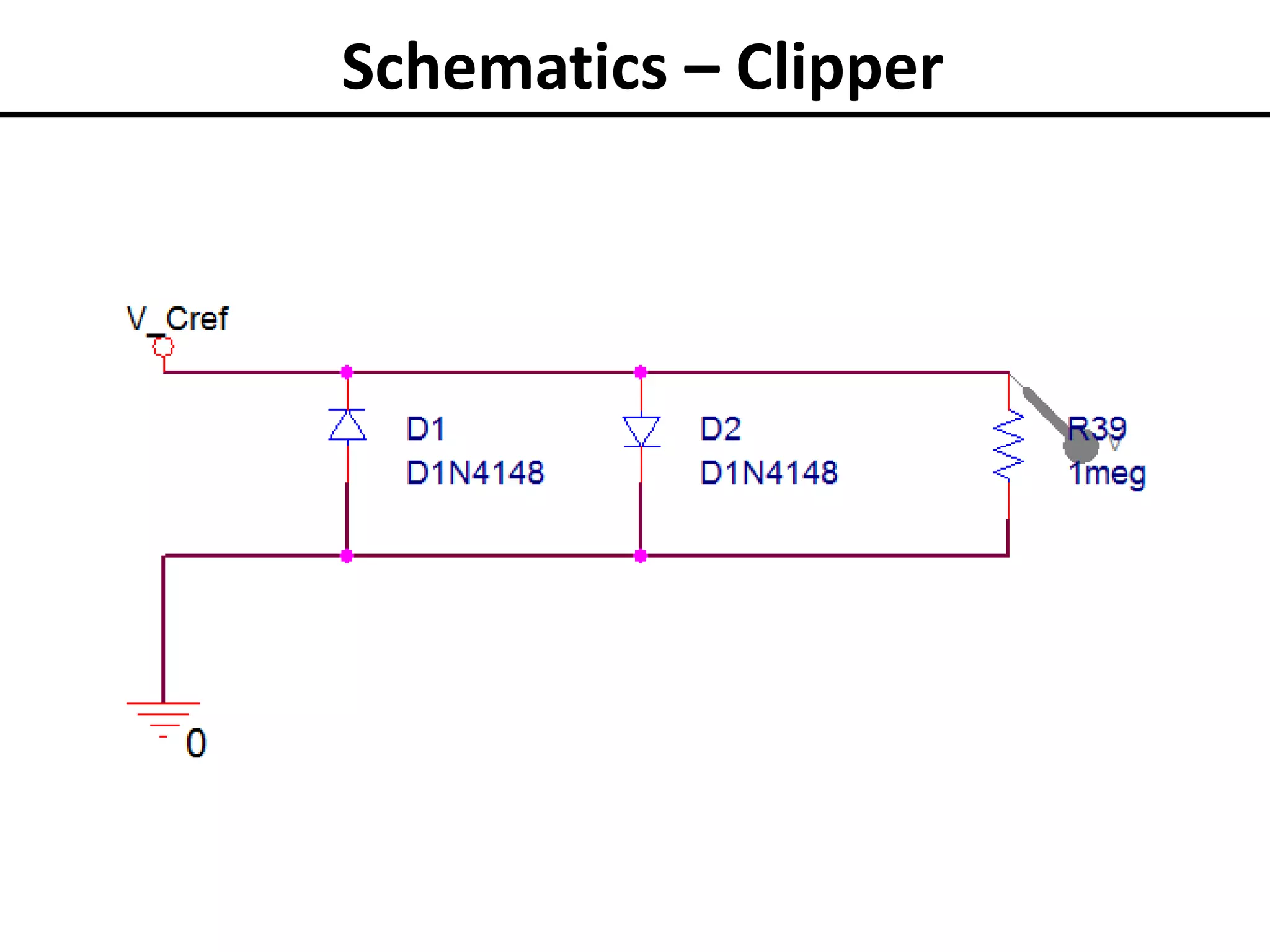
Schematics – Clipper
Schematics – XOR

Architecture for Smart Grid based Consumer End Solution

Editor's Notes

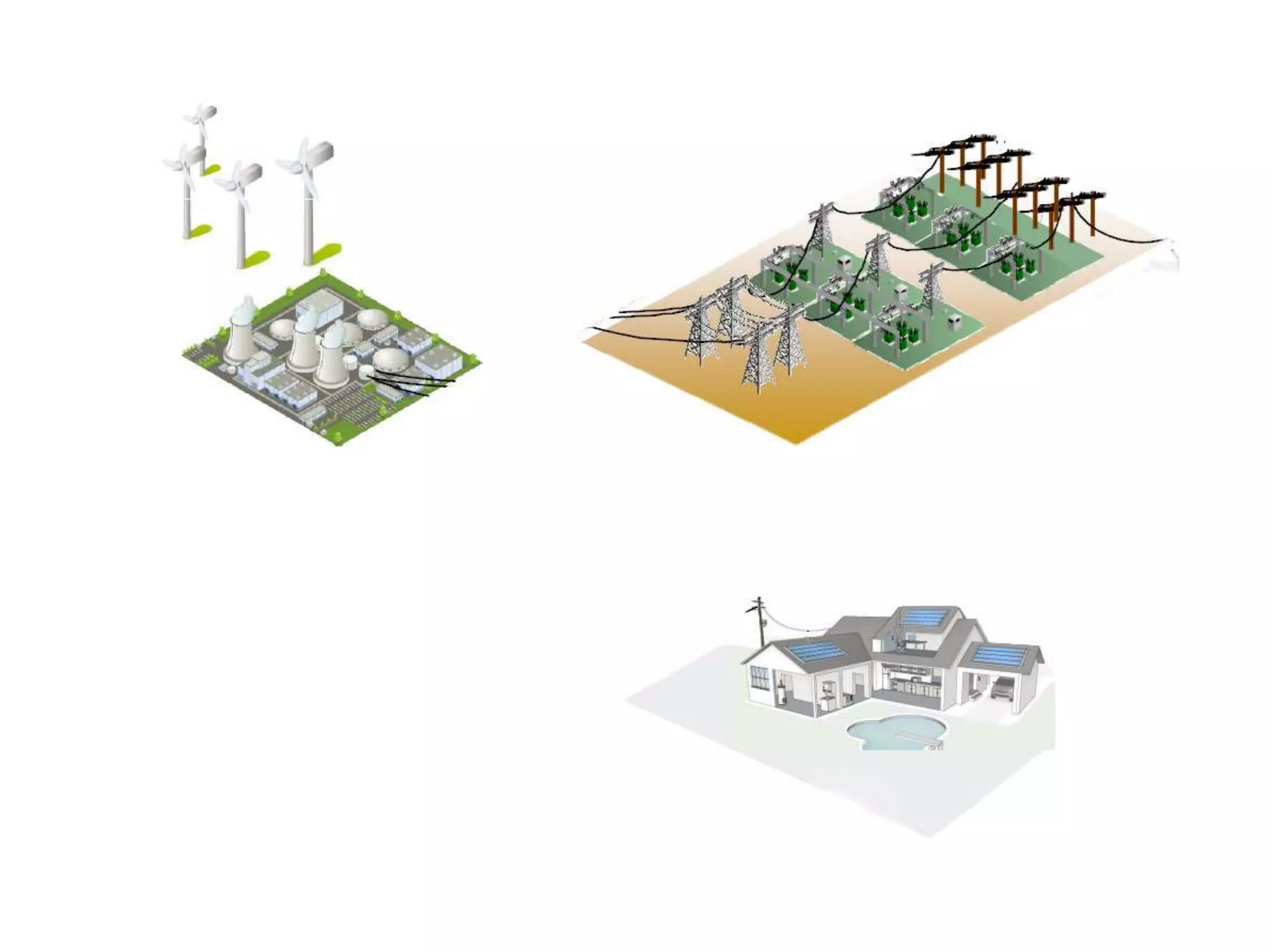
  • #2 GenerationCore System : Energy Generation from conventional sources of energy like Coal, Hydrothermal, Nuclear Power Stations. These are non Renewable sources of energy.Supporting System : Distributed energy generation are clean sources of energy like Wind source, Tidal waves, Solar energy, Hydel power.“Global investments required in the energy sector for 2003- 2030 are an estimated $16 trillion, according to the IEA. In Europe alone, some €500 billion worth of investment will be needed to upgrade the electricity transmission and distribution infrastructure”Transmission and DistributionGrids of Today : 1. Limited cross-border interconnections 2. Centralized control 3.Technology approaching age of one century 4.Large generating stationsGrids of tomorrow : 1.User specified quality, security & supply for the digital age 2.Flexible, optimal and strategic grid expansion and maintenance 3. Coordinated, local energy management of central power 4.Extensive, small, distributed generation 5.Trading of power and grid services“Solar power plants occupying less than 0.3% desert area could serve 15% of Europe’s energy needs by 2050”
  • #10 Functions / Properties of Hub :* To Transact with the grid* to maintain power consumption logs received from the Slaves,  to check the database for ambiguities in IDs of the online appliances,  to display index keys, and orders,  to display table statistics, and performs table encryption.
  • #15 Functions / Properties of Slave : To provide a connection between hub and appliance Generic framework for data collection
  • #23 - Plan to use a TDMA based cyclic communication protocol
  • #25 Entities:MARKER – unique, long sequence to force synchronization in the network.
  • #26 The element that follows the MARKER would be a prefix. Any slave that enters into the network stores the prefix, and pastes the lower bits of its first current sample after the prefix. This becomes the address of the new slave, as we see later.Entities:PREFIX: a short sequence to force randomization in address assignment, meant to work in conjunction with lower current sample bits to form a slave address.
  • #27 The third entity that we see after prefix is an empty address slot. Any new slave that enters into the network requests the Hub for address allocation by transmitting its lower address bits during this time.During this period, the hub waits for address requests. If it receives any requests, it checks its database to see that address is not already assigned to other slave already connected to the network.Next, we will see a scenario where a slave seeks connection to the network.
  • #28 The slave detects the end of marker, and stores the prefix that follows the marker.
  • #29 Then, it transmits the lower address bits derived from the current sample, and requests a connection from the hub.
  • #30 When the hub detects presence of a new slave in the network, it checks its existing database for any ambiguities between addresses. If the address is a fresh one, the hub allots a new address slot, and communication slots. This scenario is shown in the next slide.
  • #31 Thus, the communication can begin from this cycle, and the slave is now connected.
  • #32 The hub and slave can now exchange messages in the allotted time slots. The hub supervises this communication sequence through marker and address slots.Each slave can decode only its own message sequence after it identifies its own address. Other data is useless for the slave, and thus data from each slave is isolated(protected).
  • #33 The slave waits for messages from hub during this period.
  • #34 After it receives messages from hub, it transmits its own messages, may it be power consumption details, equipment health, or any other info required by the hub.
  • #35 During this period, the hub waits for message from slave 1.
  • #36 On successful reception, the hub updates its database from the response of slaves.The communication scheme is aimed at low overheads per slave, and the architecture is flexible to adopt upcoming evolutions efficiently.