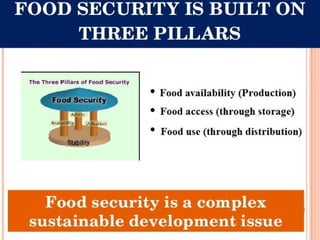
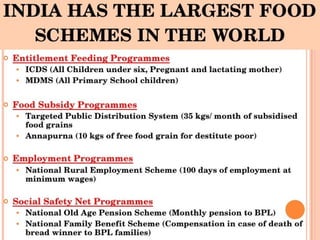
PresentationPresentation
ONON
FOOD SECURITY IN INDIA
Prepared byPrepared by
RAVI SHREY
Ph.D. Scholar, Agricultural Economics
College of Agriculture, RaipurCollege of Agriculture, Raipur
I.G.K.V, Raipur, ChhattisgarhI.G.K.V, Raipur, Chhattisgarh
INTRODUCTION
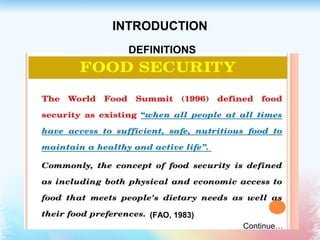
DEFINITIONS
Continue…
(FAO, 1983)
Continue…
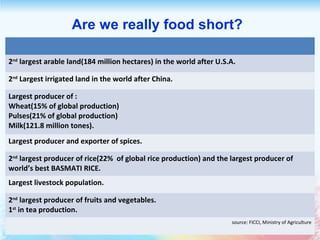
2nd
largest arable land(184 million hectares) in the world after U.S.A.
2nd
Largest irrigated land in the world after China.
Largest producer of :
Wheat(15% of global production)
Pulses(21% of global production)
Milk(121.8 million tones).
Largest producer and exporter of spices.
2nd
largest producer of rice(22% of global rice production) and the largest producer of
world’s best BASMATI RICE.
Largest livestock population.
2nd
largest producer of fruits and vegetables.
1st
in tea production.
source: FICCI, Ministry of Agriculture
Are we really food short?
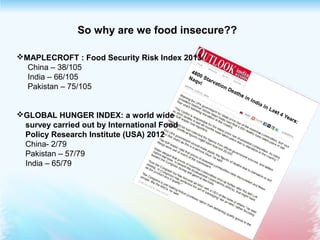
So why are we food insecure??
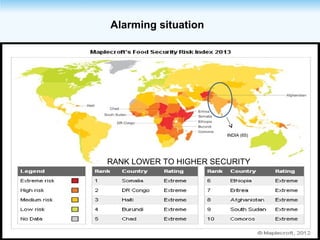
MAPLECROFT : Food Security Risk Index 2013
China – 38/105
India – 66/105
Pakistan – 75/105
GLOBAL HUNGER INDEX: a world wide
survey carried out by International Food
Policy Research Institute (USA) 2012
China- 2/79
Pakistan – 57/79
India – 65/79
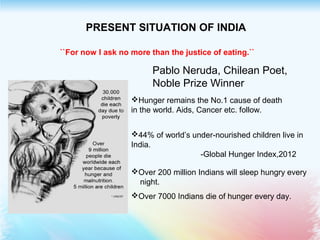
PRESENT SITUATION OF INDIA
``For now I ask no more than the justice of eating.``
Pablo Neruda, Chilean Poet,
Noble Prize Winner
Hunger remains the No.1 cause of death
in the world. Aids, Cancer etc. follow.
44% of world’s under-nourished children live in
India.
-Global Hunger Index,2012
Over 200 million Indians will sleep hungry every
night.
Over 7000 Indians die of hunger every day.
Alarming situation
INDIA (65)
RANK LOWER TO HIGHER SECURITY
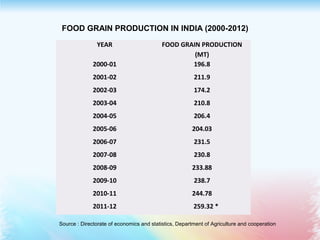
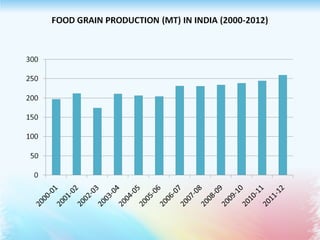
YEAR FOOD GRAIN PRODUCTION
(MT)
2000-01 196.8
2001-02 211.9
2002-03 174.2
2003-04 210.8
2004-05 206.4
2005-06 204.03
2006-07 231.5
2007-08 230.8
2008-09 233.88
2009-10 238.7
2010-11 244.78
2011-12 259.32 *
FOOD GRAIN PRODUCTION IN INDIA (2000-2012)
Source : Directorate of economics and statistics, Department of Agriculture and cooperation
150
200
250
300
2001-02 2006-07 2011-12 2016-17
MILLIONTONNES
400
600
800
1000
1200
1400
MILLION
Production Requirement Population
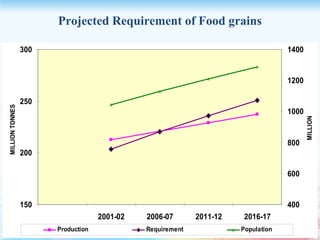
Projected Requirement of Food grains
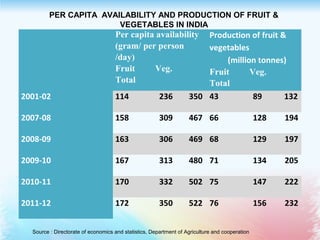
Per capita availability
(gram/ per person
/day)
Fruit Veg.
Total
Production of fruit &
vegetables
(million tonnes)
Fruit Veg.
Total
2001-02 114 236 350 43 89 132
2007-08 158 309 467 66 128 194
2008-09 163 306 469 68 129 197
2009-10 167 313 480 71 134 205
2010-11 170 332 502 75 147 222
2011-12 172 350 522 76 156 232
Source : Directorate of economics and statistics, Department of Agriculture and cooperation
PER CAPITA AVAILABILITY AND PRODUCTION OF FRUIT &
VEGETABLES IN INDIA
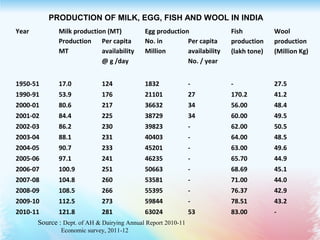
Year Milk production (MT) Egg production Fish
production
(lakh tone)
Wool
production
(Million Kg)
Production
MT
Per capita
availability
@ g /day
No. in
Million
Per capita
availability
No. / year
1950-51 17.0 124 1832 - - 27.5
1990-91 53.9 176 21101 27 170.2 41.2
2000-01 80.6 217 36632 34 56.00 48.4
2001-02 84.4 225 38729 34 60.00 49.5
2002-03 86.2 230 39823 - 62.00 50.5
2003-04 88.1 231 40403 - 64.00 48.5
2004-05 90.7 233 45201 - 63.00 49.6
2005-06 97.1 241 46235 - 65.70 44.9
2006-07 100.9 251 50663 - 68.69 45.1
2007-08 104.8 260 53581 - 71.00 44.0
2008-09 108.5 266 55395 - 76.37 42.9
2009-10 112.5 273 59844 - 78.51 43.2
2010-11 121.8 281 63024 53 83.00 -
PRODUCTION OF MILK, EGG, FISH AND WOOL IN INDIA
Source : Dept. of AH & Dairying Annual Report 2010-11
Economic survey, 2011-12
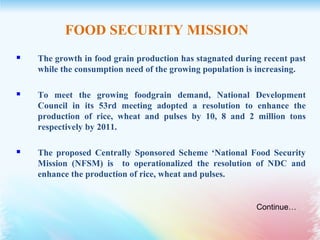
 The growth in food grain production has stagnated during recent past
while the consumption need of the growing population is increasing.
 To meet the growing foodgrain demand, National Development
Council in its 53rd meeting adopted a resolution to enhance the
production of rice, wheat and pulses by 10, 8 and 2 million tons
respectively by 2011.
 The proposed Centrally Sponsored Scheme ‘National Food Security
Mission (NFSM) is to operationalized the resolution of NDC and
enhance the production of rice, wheat and pulses.
FOOD SECURITY MISSION
Continue…
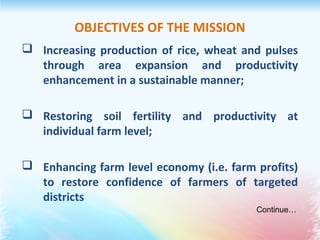
OBJECTIVES OF THE MISSION
 Increasing production of rice, wheat and pulses
through area expansion and productivity
enhancement in a sustainable manner;
 Restoring soil fertility and productivity at
individual farm level;
 Enhancing farm level economy (i.e. farm profits)
to restore confidence of farmers of targeted
districts
Continue…
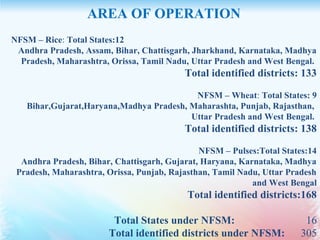
AREA OF OPERATION
NFSM – Rice: Total States:12
Andhra Pradesh, Assam, Bihar, Chattisgarh, Jharkhand, Karnataka, Madhya
Pradesh, Maharashtra, Orissa, Tamil Nadu, Uttar Pradesh and West Bengal.
Total identified districts: 133
NFSM – Wheat: Total States: 9
Bihar,Gujarat,Haryana,Madhya Pradesh, Maharashta, Punjab, Rajasthan,
Uttar Pradesh and West Bengal.
Total identified districts: 138
NFSM – Pulses:Total States:14
Andhra Pradesh, Bihar, Chattisgarh, Gujarat, Haryana, Karnataka, Madhya
Pradesh, Maharashtra, Orissa, Punjab, Rajasthan, Tamil Nadu, Uttar Pradesh
and West Bengal
Total identified districts:168
Total States under NFSM: 16
Total identified districts under NFSM: 305
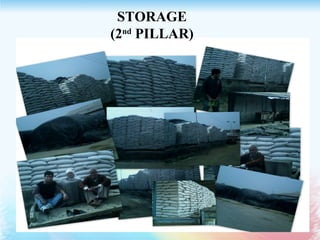
STORAGE
(2nd
PILLAR)
Cold chain logistics
India’s cold storage capacity – short by 10 million tones.
30% of the fruits and vegetables gets wasted annually(40 million tones
amounting to US$13 billion).
Key reasons-
higher level of inefficiencies in the system
lower average trucking speeds
higher turnaround times at ports
 cost of administrative delays
Procurement
MINIMUM SUPPORT PRICE
ΘApplicable on 24 crops.
ΘBenchmark for other varieties(which might
be of inferior quality) of the same crop.
GOVERNMENT CREATED HOARDING
ΘExcessive subsequent stocking.
ΘScarcity in the open market.
ΘParliament-clearance issues.
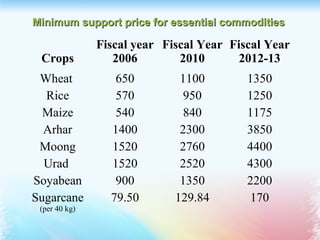
Minimum support price for essential commoditiesMinimum support price for essential commodities
Crops
Fiscal year
2006
Fiscal Year
2010
Fiscal Year
2012-13
Wheat 650 1100 1350
Rice 570 950 1250
Maize 540 840 1175
Arhar 1400 2300 3850
Moong 1520 2760 4400
Urad 1520 2520 4300
Soyabean 900 1350 2200
Sugarcane
(per 40 kg)
79.50 129.84 170
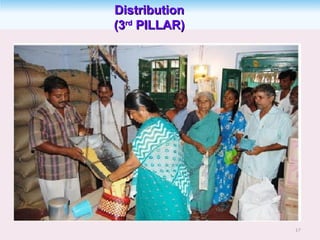
DistributionDistribution
(3(3rdrd
PILLAR)PILLAR)
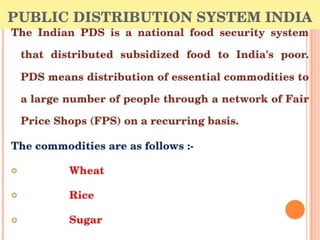
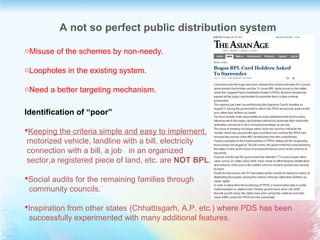
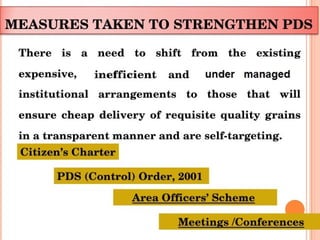
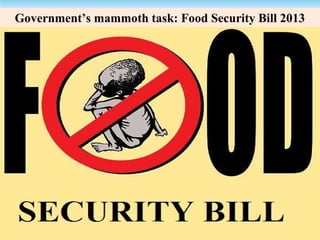
A not so perfect public distribution system
oMisuse of the schemes by non-needy.
oLoopholes in the existing system.
oNeed a better targeting mechanism.
Identification of “poor”
Keeping the criteria simple and easy to implement.
motorized vehicle, landline with a bill, electricity
connection with a bill, a job in an organized
sector,a registered piece of land, etc. are NOT BPL.
Social audits for the remaining families through
community councils.
Inspiration from other states (Chhattisgarh, A.P. etc.) where PDS has been
successfully experimented with many additional features.
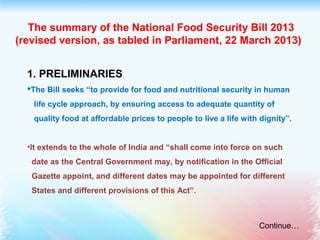
Government’s mammoth task: Food Security Bill 2013
 The summary of the National Food Security Bill 2013
(revised version, as tabled in Parliament, 22 March 2013) 
1. PRELIMINARIES
The Bill seeks “to provide for food and nutritional security in human
life cycle approach, by ensuring access to adequate quantity of
quality food at affordable prices to people to live a life with dignity”.
•It extends to the whole of India and “shall come into force on such
date as the Central Government may, by notification in the Official
Gazette appoint, and different dates may be appointed for different
States and different provisions of this Act”.
Continue…
2. ENTITLEMENTS
Public Distribution System (TPDS)
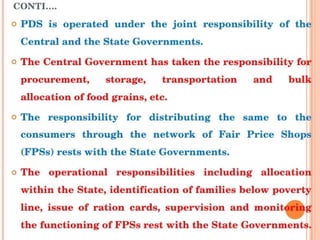
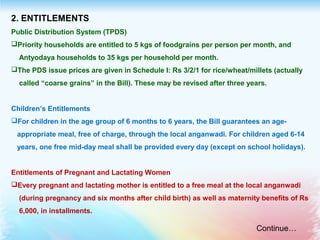
Priority households are entitled to 5 kgs of foodgrains per person per month, and
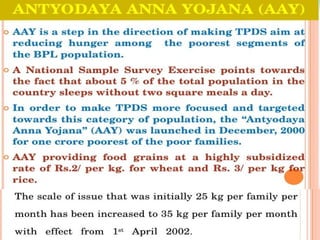
Antyodaya households to 35 kgs per household per month.
The PDS issue prices are given in Schedule I: Rs 3/2/1 for rice/wheat/millets (actually
called “coarse grains” in the Bill). These may be revised after three years.
Children’s Entitlements
For children in the age group of 6 months to 6 years, the Bill guarantees an age-
appropriate meal, free of charge, through the local anganwadi. For children aged 6-14
years, one free mid-day meal shall be provided every day (except on school holidays).
Entitlements of Pregnant and Lactating Women
Every pregnant and lactating mother is entitled to a free meal at the local anganwadi
(during pregnancy and six months after child birth) as well as maternity benefits of Rs
6,000, in installments.
Continue…
3. IDENTIFICATION OF ELIGIBLE HOUSEHOLDS
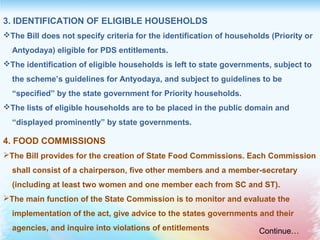
The Bill does not specify criteria for the identification of households (Priority or
Antyodaya) eligible for PDS entitlements.
The identification of eligible households is left to state governments, subject to
the scheme’s guidelines for Antyodaya, and subject to guidelines to be
“specified” by the state government for Priority households.
The lists of eligible households are to be placed in the public domain and
“displayed prominently” by state governments.
4. FOOD COMMISSIONS
The Bill provides for the creation of State Food Commissions. Each Commission
shall consist of a chairperson, five other members and a member-secretary
(including at least two women and one member each from SC and ST).
The main function of the State Commission is to monitor and evaluate the
implementation of the act, give advice to the states governments and their
agencies, and inquire into violations of entitlements Continue…
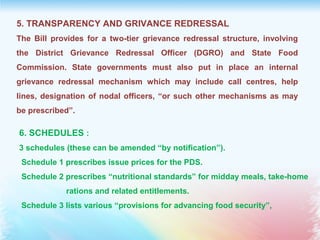
5. TRANSPARENCY AND GRIVANCE REDRESSAL
The Bill provides for a two-tier grievance redressal structure, involving
the District Grievance Redressal Officer (DGRO) and State Food
Commission. State governments must also put in place an internal
grievance redressal mechanism which may include call centres, help
lines, designation of nodal officers, “or such other mechanisms as may
be prescribed”.
6. SCHEDULES :
3 schedules (these can be amended “by notification”).
Schedule 1 prescribes issue prices for the PDS.
Schedule 2 prescribes “nutritional standards” for midday meals, take-home
rations and related entitlements.
Schedule 3 lists various “provisions for advancing food security”,
Conclusion
o Production (1st
 pillar) is more or less doing good; 
   always can and have to be bettered though.
oThe procurement policies, storage facilities (2nd
pillar) 
   and the distribution (3rd
 pillar) mechanism need 
   revamping.
oIndividual initiatives vital in this fight against food  
   insecurity.
Let’s be a part of the solution
References
Bhatia, B.M., (1983), A study in India`s Food policy.
Datt and Sundhram, Indian economy (revised edition 2002), S. Chand publication.
Department of Animal Husbandry & Dairying, Annual Report 2010-11.
Directorate of economics and statistics, Department of Agriculture and cooperation
•Economic survey, 2011-12. http://www.thehindu.com/opinion/op-ed/article75033.ece
•http://www.nfsm.gov.in
•http://www.indianexpress.com/news/nac-sticks-to-its-guns-   on-food-law/740780/
•http://news.outlookindia.com/item.aspx?663772
•http://www.asianage.com/india/bogus-bpl-card-holders
Planning commission,  Ninth Five Year Plan (1997-2002).
Radhakrishna R., Subbarao K, Indrakant S., and Ravi K., (1997), Public distribution  
: A National and International Perspective, World Bank Discussion Paper No. 380.
World bank, World Development Report  (1986). 
Food security in India Ravi presentation

Food security in India Ravi presentation

  • 2.
    PresentationPresentation ONON FOOD SECURITY ININDIA Prepared byPrepared by RAVI SHREY Ph.D. Scholar, Agricultural Economics College of Agriculture, RaipurCollege of Agriculture, Raipur I.G.K.V, Raipur, ChhattisgarhI.G.K.V, Raipur, Chhattisgarh
  • 3.
  • 4.
  • 6.
    2nd largest arable land(184million hectares) in the world after U.S.A. 2nd Largest irrigated land in the world after China. Largest producer of : Wheat(15% of global production) Pulses(21% of global production) Milk(121.8 million tones). Largest producer and exporter of spices. 2nd largest producer of rice(22% of global rice production) and the largest producer of world’s best BASMATI RICE. Largest livestock population. 2nd largest producer of fruits and vegetables. 1st in tea production. source: FICCI, Ministry of Agriculture Are we really food short?
  • 7.
    So why arewe food insecure?? MAPLECROFT : Food Security Risk Index 2013 China – 38/105 India – 66/105 Pakistan – 75/105 GLOBAL HUNGER INDEX: a world wide survey carried out by International Food Policy Research Institute (USA) 2012 China- 2/79 Pakistan – 57/79 India – 65/79
  • 8.
    PRESENT SITUATION OFINDIA ``For now I ask no more than the justice of eating.`` Pablo Neruda, Chilean Poet, Noble Prize Winner Hunger remains the No.1 cause of death in the world. Aids, Cancer etc. follow. 44% of world’s under-nourished children live in India. -Global Hunger Index,2012 Over 200 million Indians will sleep hungry every night. Over 7000 Indians die of hunger every day.
  • 9.
    Alarming situation INDIA (65) RANKLOWER TO HIGHER SECURITY
  • 12.
    YEAR FOOD GRAINPRODUCTION (MT) 2000-01 196.8 2001-02 211.9 2002-03 174.2 2003-04 210.8 2004-05 206.4 2005-06 204.03 2006-07 231.5 2007-08 230.8 2008-09 233.88 2009-10 238.7 2010-11 244.78 2011-12 259.32 * FOOD GRAIN PRODUCTION IN INDIA (2000-2012) Source : Directorate of economics and statistics, Department of Agriculture and cooperation
  • 14.
    150 200 250 300 2001-02 2006-07 2011-122016-17 MILLIONTONNES 400 600 800 1000 1200 1400 MILLION Production Requirement Population Projected Requirement of Food grains
  • 16.
    Per capita availability (gram/per person /day) Fruit Veg. Total Production of fruit & vegetables (million tonnes) Fruit Veg. Total 2001-02 114 236 350 43 89 132 2007-08 158 309 467 66 128 194 2008-09 163 306 469 68 129 197 2009-10 167 313 480 71 134 205 2010-11 170 332 502 75 147 222 2011-12 172 350 522 76 156 232 Source : Directorate of economics and statistics, Department of Agriculture and cooperation PER CAPITA AVAILABILITY AND PRODUCTION OF FRUIT & VEGETABLES IN INDIA
  • 17.
    Year Milk production(MT) Egg production Fish production (lakh tone) Wool production (Million Kg) Production MT Per capita availability @ g /day No. in Million Per capita availability No. / year 1950-51 17.0 124 1832 - - 27.5 1990-91 53.9 176 21101 27 170.2 41.2 2000-01 80.6 217 36632 34 56.00 48.4 2001-02 84.4 225 38729 34 60.00 49.5 2002-03 86.2 230 39823 - 62.00 50.5 2003-04 88.1 231 40403 - 64.00 48.5 2004-05 90.7 233 45201 - 63.00 49.6 2005-06 97.1 241 46235 - 65.70 44.9 2006-07 100.9 251 50663 - 68.69 45.1 2007-08 104.8 260 53581 - 71.00 44.0 2008-09 108.5 266 55395 - 76.37 42.9 2009-10 112.5 273 59844 - 78.51 43.2 2010-11 121.8 281 63024 53 83.00 - PRODUCTION OF MILK, EGG, FISH AND WOOL IN INDIA Source : Dept. of AH & Dairying Annual Report 2010-11 Economic survey, 2011-12
  • 18.
     The growthin food grain production has stagnated during recent past while the consumption need of the growing population is increasing.  To meet the growing foodgrain demand, National Development Council in its 53rd meeting adopted a resolution to enhance the production of rice, wheat and pulses by 10, 8 and 2 million tons respectively by 2011.  The proposed Centrally Sponsored Scheme ‘National Food Security Mission (NFSM) is to operationalized the resolution of NDC and enhance the production of rice, wheat and pulses. FOOD SECURITY MISSION Continue…
  • 19.
    OBJECTIVES OF THEMISSION  Increasing production of rice, wheat and pulses through area expansion and productivity enhancement in a sustainable manner;  Restoring soil fertility and productivity at individual farm level;  Enhancing farm level economy (i.e. farm profits) to restore confidence of farmers of targeted districts Continue…
  • 20.
    AREA OF OPERATION NFSM– Rice: Total States:12 Andhra Pradesh, Assam, Bihar, Chattisgarh, Jharkhand, Karnataka, Madhya Pradesh, Maharashtra, Orissa, Tamil Nadu, Uttar Pradesh and West Bengal. Total identified districts: 133 NFSM – Wheat: Total States: 9 Bihar,Gujarat,Haryana,Madhya Pradesh, Maharashta, Punjab, Rajasthan, Uttar Pradesh and West Bengal. Total identified districts: 138 NFSM – Pulses:Total States:14 Andhra Pradesh, Bihar, Chattisgarh, Gujarat, Haryana, Karnataka, Madhya Pradesh, Maharashtra, Orissa, Punjab, Rajasthan, Tamil Nadu, Uttar Pradesh and West Bengal Total identified districts:168 Total States under NFSM: 16 Total identified districts under NFSM: 305
  • 21.
  • 22.
    Cold chain logistics India’scold storage capacity – short by 10 million tones. 30% of the fruits and vegetables gets wasted annually(40 million tones amounting to US$13 billion). Key reasons- higher level of inefficiencies in the system lower average trucking speeds higher turnaround times at ports  cost of administrative delays
  • 23.
    Procurement MINIMUM SUPPORT PRICE ΘApplicableon 24 crops. ΘBenchmark for other varieties(which might be of inferior quality) of the same crop. GOVERNMENT CREATED HOARDING ΘExcessive subsequent stocking. ΘScarcity in the open market. ΘParliament-clearance issues.
  • 24.
    Minimum support pricefor essential commoditiesMinimum support price for essential commodities Crops Fiscal year 2006 Fiscal Year 2010 Fiscal Year 2012-13 Wheat 650 1100 1350 Rice 570 950 1250 Maize 540 840 1175 Arhar 1400 2300 3850 Moong 1520 2760 4400 Urad 1520 2520 4300 Soyabean 900 1350 2200 Sugarcane (per 40 kg) 79.50 129.84 170
  • 25.
  • 34.
    A not soperfect public distribution system oMisuse of the schemes by non-needy. oLoopholes in the existing system. oNeed a better targeting mechanism. Identification of “poor” Keeping the criteria simple and easy to implement. motorized vehicle, landline with a bill, electricity connection with a bill, a job in an organized sector,a registered piece of land, etc. are NOT BPL. Social audits for the remaining families through community councils. Inspiration from other states (Chhattisgarh, A.P. etc.) where PDS has been successfully experimented with many additional features.
  • 38.
    Government’s mammoth task:Food Security Bill 2013
  • 39.
     The summary ofthe National Food Security Bill 2013 (revised version, as tabled in Parliament, 22 March 2013)  1. PRELIMINARIES The Bill seeks “to provide for food and nutritional security in human life cycle approach, by ensuring access to adequate quantity of quality food at affordable prices to people to live a life with dignity”. •It extends to the whole of India and “shall come into force on such date as the Central Government may, by notification in the Official Gazette appoint, and different dates may be appointed for different States and different provisions of this Act”. Continue…
  • 40.
    2. ENTITLEMENTS Public DistributionSystem (TPDS) Priority households are entitled to 5 kgs of foodgrains per person per month, and Antyodaya households to 35 kgs per household per month. The PDS issue prices are given in Schedule I: Rs 3/2/1 for rice/wheat/millets (actually called “coarse grains” in the Bill). These may be revised after three years. Children’s Entitlements For children in the age group of 6 months to 6 years, the Bill guarantees an age- appropriate meal, free of charge, through the local anganwadi. For children aged 6-14 years, one free mid-day meal shall be provided every day (except on school holidays). Entitlements of Pregnant and Lactating Women Every pregnant and lactating mother is entitled to a free meal at the local anganwadi (during pregnancy and six months after child birth) as well as maternity benefits of Rs 6,000, in installments. Continue…
  • 41.
    3. IDENTIFICATION OFELIGIBLE HOUSEHOLDS The Bill does not specify criteria for the identification of households (Priority or Antyodaya) eligible for PDS entitlements. The identification of eligible households is left to state governments, subject to the scheme’s guidelines for Antyodaya, and subject to guidelines to be “specified” by the state government for Priority households. The lists of eligible households are to be placed in the public domain and “displayed prominently” by state governments. 4. FOOD COMMISSIONS The Bill provides for the creation of State Food Commissions. Each Commission shall consist of a chairperson, five other members and a member-secretary (including at least two women and one member each from SC and ST). The main function of the State Commission is to monitor and evaluate the implementation of the act, give advice to the states governments and their agencies, and inquire into violations of entitlements Continue…
  • 42.
    5. TRANSPARENCY ANDGRIVANCE REDRESSAL The Bill provides for a two-tier grievance redressal structure, involving the District Grievance Redressal Officer (DGRO) and State Food Commission. State governments must also put in place an internal grievance redressal mechanism which may include call centres, help lines, designation of nodal officers, “or such other mechanisms as may be prescribed”. 6. SCHEDULES : 3 schedules (these can be amended “by notification”). Schedule 1 prescribes issue prices for the PDS. Schedule 2 prescribes “nutritional standards” for midday meals, take-home rations and related entitlements. Schedule 3 lists various “provisions for advancing food security”,
  • 43.
  • 44.
    Let’s be apart of the solution
  • 45.
    References Bhatia, B.M., (1983), A study inIndia`s Food policy. Datt and Sundhram, Indian economy (revised edition 2002), S. Chand publication. Department of Animal Husbandry & Dairying, Annual Report 2010-11. Directorate of economics and statistics, Department of Agriculture and cooperation •Economic survey, 2011-12. http://www.thehindu.com/opinion/op-ed/article75033.ece •http://www.nfsm.gov.in •http://www.indianexpress.com/news/nac-sticks-to-its-guns-   on-food-law/740780/ •http://news.outlookindia.com/item.aspx?663772 •http://www.asianage.com/india/bogus-bpl-card-holders Planning commission,  Ninth Five Year Plan (1997-2002). Radhakrishna R., Subbarao K, Indrakant S., and Ravi K., (1997), Public distribution   : A National and International Perspective, World Bank Discussion Paper No. 380. World bank, World Development Report  (1986).