1
Presented by:
N. Lohith
BAM-12- 38
Course-in-charge:
Dr. D. Vishnu Sankar Rao
Professor and University Head
Major Advisor :
Dr. Y. Radha
Principal Scientist,
WTC, ANGRAU, Hyderabad
NATIONAL FOOD SECURITY ACT
2013: OPPORTUNITIES AND
CHALLENGES
contents
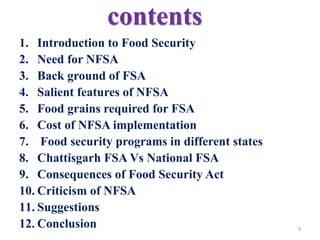
1. Introduction to Food Security
2. Need for NFSA
3. Back ground of FSA
4. Salient features of NFSA
5. Food grains required for FSA
6. Cost of NFSA implementation
7. Food security programs in different states
8. Chattisgarh FSA Vs National FSA
9. Consequences of Food Security Act
10. Criticism of NFSA
11. Suggestions
12. Conclusion 3
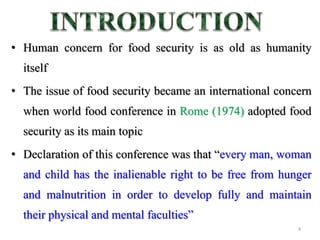
• Human concern for food security is as old as humanity
itself
• The issue of food security became an international concern
when world food conference in Rome (1974) adopted food
security as its main topic
• Declaration of this conference was that “every man, woman
and child has the inalienable right to be free from hunger
and malnutrition in order to develop fully and maintain
their physical and mental faculties”
4
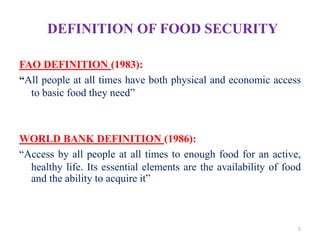
DEFINITION OF FOOD SECURITY
FAO DEFINITION (1983):
―All people at all times have both physical and economic access
to basic food they need”
WORLD BANK DEFINITION (1986):
“Access by all people at all times to enough food for an active,
healthy life. Its essential elements are the availability of food
and the ability to acquire it”
5
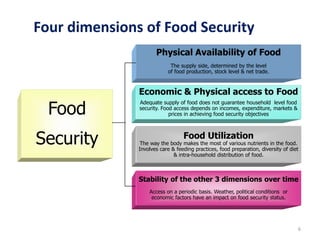
Four dimensions of Food Security
Food
Security
Physical Availability of Food
The supply side, determined by the level
of food production, stock level & net trade.
Economic & Physical access to Food
Adequate supply of food does not guarantee household level food
security. Food access depends on incomes, expenditure, markets &
prices in achieving food security objectives
Food Utilization
The way the body makes the most of various nutrients in the food.
Involves care & feeding practices, food preparation, diversity of diet
& intra-household distribution of food.
Stability of the other 3 dimensions over time
Access on a periodic basis. Weather, political conditions or
economic factors have an impact on food security status.
6
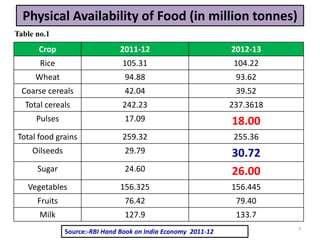
Crop 2011-12 2012-13
Rice 105.31 104.22
Wheat 94.88 93.62
Coarse cereals 42.04 39.52
Total cereals 242.23 237.3618
Pulses 17.09 18.00
Total food grains 259.32 255.36
Oilseeds 29.79 30.72
Sugar 24.60 26.00
Vegetables 156.325 156.445
Fruits 76.42 79.40
Milk 127.9 133.7
Source:-RBI Hand Book on India Economy 2011-12
Physical Availability of Food (in million tonnes)
Table no.1
7
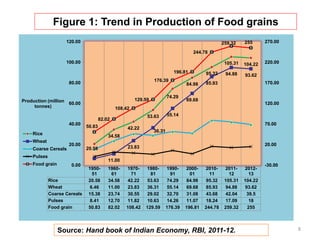
1950-
51
1960-
61
1970-
71
1980-
81
1990-
91
2000-
01
2010-
11
2011-
12
2012-
13
Rice 20.58 34.58 42.22 53.63 74.29 84.98 95.32 105.31 104.22
Wheat 6.46 11.00 23.83 36.31 55.14 69.68 85.93 94.88 93.62
Coarse Cereals 15.38 23.74 30.55 29.02 32.70 31.08 43.68 42.04 39.5
Pulses 8.41 12.70 11.82 10.63 14.26 11.07 18.24 17.09 18
Food grain 50.83 82.02 108.42 129.59 176.39 196.81 244.78 259.32 255
20.58
34.58
42.22
53.63
74.29
84.98
95.32
105.31 104.22
11.00
23.83
36.31
55.14
69.68
85.93
94.88 93.62
50.83
82.02
108.42
129.59
176.39
196.81
244.78
259.32 255
-30.00
20.00
70.00
120.00
170.00
220.00
270.00
0.00
20.00
40.00
60.00
80.00
100.00
120.00
Production (million
tonnes)
Rice
Wheat
Coarse Cereals
Pulses
Food grain
Figure 1: Trend in Production of Food grains
Source: Hand book of Indian Economy, RBI, 2011-12. 8
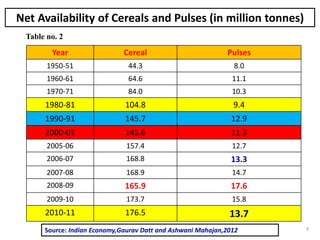
Year Cereal Pulses
1950-51 44.3 8.0
1960-61 64.6 11.1
1970-71 84.0 10.3
1980-81 104.8 9.4
1990-91 145.7 12.9
2000-01 145.6 11.3
2005-06 157.4 12.7
2006-07 168.8 13.3
2007-08 168.9 14.7
2008-09 165.9 17.6
2009-10 173.7 15.8
2010-11 176.5 13.7
Source: Indian Economy,Gaurav Datt and Ashwani Mahajan,2012
Net Availability of Cereals and Pulses (in million tonnes)
Table no. 2
9
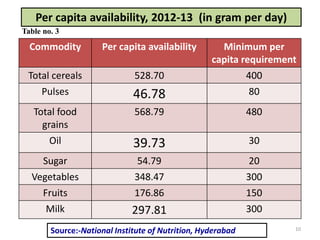
Commodity Per capita availability Minimum per
capita requirement
Total cereals 528.70 400
Pulses 46.78 80
Total food
grains
568.79 480
Oil 39.73 30
Sugar 54.79 20
Vegetables 348.47 300
Fruits 176.86 150
Milk 297.81 300
Source:-National Institute of Nutrition, Hyderabad
Per capita availability, 2012-13 (in gram per day)
Table no. 3
10
11
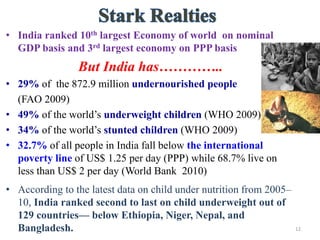
• India ranked 10th largest Economy of world on nominal
GDP basis and 3rd largest economy on PPP basis
But India has…………..
• 29% of the 872.9 million undernourished people
(FAO 2009)
• 49% of the world’s underweight children (WHO 2009)
• 34% of the world’s stunted children (WHO 2009)
• 32.7% of all people in India fall below the international
poverty line of US$ 1.25 per day (PPP) while 68.7% live on
less than US$ 2 per day (World Bank 2010)
• According to the latest data on child under nutrition from 2005–
10, India ranked second to last on child underweight out of
129 countries— below Ethiopia, Niger, Nepal, and
Bangladesh. 12
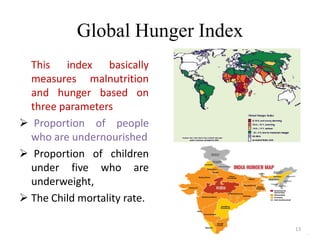
Global Hunger Index
This index basically
measures malnutrition
and hunger based on
three parameters
 Proportion of people
who are undernourished
 Proportion of children
under five who are
underweight,
 The Child mortality rate.
13
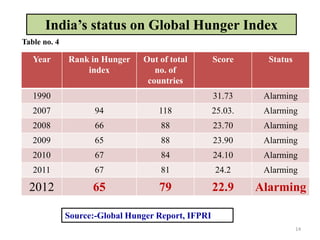
Year Rank in Hunger
index
Out of total
no. of
countries
Score Status
1990 31.73 Alarming
2007 94 118 25.03. Alarming
2008 66 88 23.70 Alarming
2009 65 88 23.90 Alarming
2010 67 84 24.10 Alarming
2011 67 81 24.2 Alarming
2012 65 79 22.9 Alarming
Source:-Global Hunger Report, IFPRI
India’s status on Global Hunger Index
Table no. 4
14
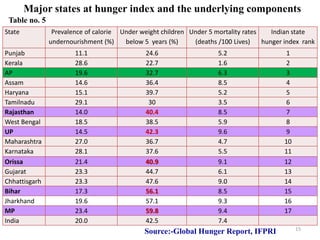
Major states at hunger index and the underlying components
State Prevalence of calorie
undernourishment (%)
Under weight children
below 5 years (%)
Under 5 mortality rates
(deaths /100 Lives)
Indian state
hunger index rank
Punjab 11.1 24.6 5.2 1
Kerala 28.6 22.7 1.6 2
AP 19.6 32.7 6.3 3
Assam 14.6 36.4 8.5 4
Haryana 15.1 39.7 5.2 5
Tamilnadu 29.1 30 3.5 6
Rajasthan 14.0 40.4 8.5 7
West Bengal 18.5 38.5 5.9 8
UP 14.5 42.3 9.6 9
Maharashtra 27.0 36.7 4.7 10
Karnataka 28.1 37.6 5.5 11
Orissa 21.4 40.9 9.1 12
Gujarat 23.3 44.7 6.1 13
Chhattisgarh 23.3 47.6 9.0 14
Bihar 17.3 56.1 8.5 15
Jharkhand 19.6 57.1 9.3 16
MP 23.4 59.8 9.4 17
India 20.0 42.5 7.4
Table no. 5
Source:-Global Hunger Report, IFPRI 15
16
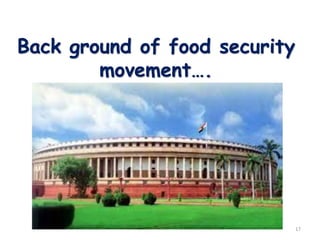
Back ground of food security
movement….
17
• 1996- Supreme Court declared that the right to live guaranteed in
any civilized society implies the right to food.
• 2001- the Court ordered the implementation of eight centrally
sponsored schemes as legal entitlements. These include
Public Distribution System (PDS)
Antyodaya Anna Yojana (AAY)
The Midday Meal Scheme (MMS)
Integrated Child Development Services (ICDS)
• 2008 - the Court ordered that Below Poverty Line (BPL) families be
entitled to 35 kg of food grains per month at subsidized prices.
18
• Then the National Food Security Bill had a stop-
start journey. Here’s a timeline of its...
• Oct 2010 - the National Advisory Council (NAC) drafted a
National Food Security Bill, proposing legal entitlements for
about 75 percent of the population.
• Jan 2011 - an Expert Committee set up by the Prime
Minister under the chairmanship of Dr. C. Rangarajan
examined the Bill and made several recommendations,
including reducing the proportion of the population entitled to
benefits and computerizing PDS.
19
• July 2011- A ministerial panel gave its approval to draft food
security Bill
• Jan 2012- The Bill was referred to the Parliament Standing
Committee on Food
• Nov 2012- A parliamentary panel sends the draft back to the food
ministry to incorporate changes after consulting with state
governments.
• 19 Mar 2013- Union Cabinet approves an amended draft
• 4 June 2013- The Cabinet discussed on approving the food security
law through an ordinance.
• 4 July 2013 - Cabinet approved the food aid program as
an ordinance.
20
• 26 Aug 2013- the bill was passed in the LokSabha
• 2 Sept 2013- the bill was passed in the Rajyasabha
• 10 Sept 2013- received the assent of the President of
India.
With this the NFSB 2013
became the Act and gave
the majority of those living
in India the right to subsidised food
grains.
21
Salient features of
NFSA….
22
The National Food Security Act, 2013 aims to
provide for food and nutritional security in
human life cycle approach, by ensuring
access to adequate quantity of quality food at
affordable prices to people to live a life with
dignity.
23
Entitlements….
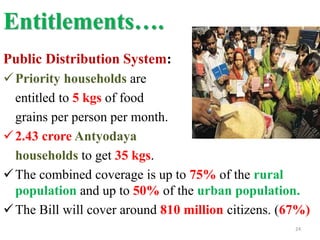
Public Distribution System:
Priority households are
entitled to 5 kgs of food
grains per person per month.
2.43 crore Antyodaya
households to get 35 kgs.
The combined coverage is up to 75% of the rural
population and up to 50% of the urban population.
The Bill will cover around 810 million citizens. (67%)
24
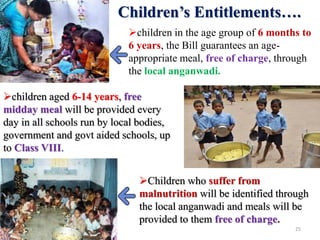
Children’s Entitlements….
children in the age group of 6 months to
6 years, the Bill guarantees an age-
appropriate meal, free of charge, through
the local anganwadi.
children aged 6-14 years, free
midday meal will be provided every
day in all schools run by local bodies,
government and govt aided schools, up
to Class VIII.
Children who suffer from
malnutrition will be identified through
the local anganwadi and meals will be
provided to them free of charge.
25
Maternal benefits of Rs 6,000, is
given in instalments (maternal
benefits to a pregnant woman
beyond two live births is denied) .
Every pregnant and lactating mother
is entitled to a free meal at the local
anganwadi (during pregnancy and
six months after childbirth).
Entitlements of Pregnant and Lactating
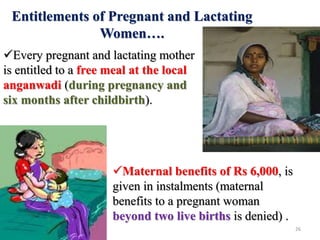
Women….
26
Identification of Eligible
Households….
The Central Government is to
determine the state-wise coverage
of the PDS, in terms of proportion
of the rural/urban population.
Then numbers of eligible persons will be
calculated from Census population figures.
The identification of eligible households is left
to state governments.
The lists of eligible households are to be
displayed publicly by state governments.
27
Food Commissions…
The act provides for the creation of State Food
Commissions
Each Commission shall consist of a chairperson, five
other members and a member-secretary (including
at least two women)
The main function of the State Commission is to
monitor and evaluate the implementation of the act,
give advice to the state governments and their
agencies, and inquire into violations of entitlements.
28
PDS Reforms….
 Doorstep delivery of foodgrains
 ICT applications and end-to-end
computerisation
 Using aadhaar (UID) for unique
identification of entitled beneficiaries
 Full transparency of records
 Preference to public institutions or bodies
in licensing of fair price shops.
29
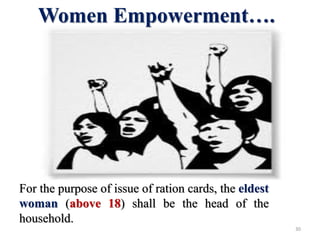
For the purpose of issue of ration cards, the eldest
woman (above 18) shall be the head of the
household.
Women Empowerment….
30
Obligations of Government and
Local Authorities….
 Central Government : provide food grains (funds) to state
governments to implement the main entitlements. It also has to
provide assistance to state governments to meet local distribution
costs.
 State governments : implementing the relevant schemes, in
accordance with the guidelines issued by the Central Government.
They are free to extend benefits and entitlements beyond what is
prescribed in the Bill, from their own resources
 Local Authorities and Panchayati Raj Institutions are
responsible for proper implementation of the act in their
respective areas 31
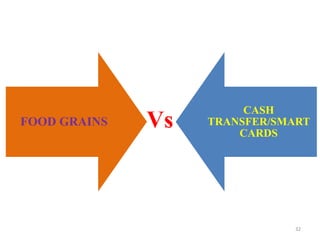
Vs
FOOD GRAINS
CASH
TRANSFER/SMART
CARDS
32
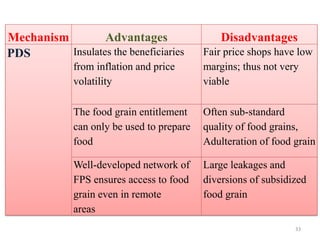
Mechanism Advantages Disadvantages
PDS Insulates the beneficiaries
from inflation and price
volatility
Fair price shops have low
margins; thus not very
viable
The food grain entitlement
can only be used to prepare
food
Often sub-standard
quality of food grains,
Adulteration of food grain
Well-developed network of
FPS ensures access to food
grain even in remote
areas
Large leakages and
diversions of subsidized
food grain
33
Mechanism Advantages Disadvantages
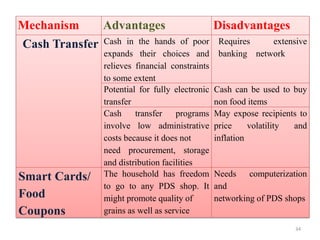
Cash Transfer Cash in the hands of poor
expands their choices and
relieves financial constraints
to some extent
Requires extensive
banking network
Potential for fully electronic
transfer
Cash can be used to buy
non food items
Cash transfer programs
involve low administrative
costs because it does not
need procurement, storage
and distribution facilities
May expose recipients to
price volatility and
inflation
Smart Cards/
Food
Coupons
The household has freedom
to go to any PDS shop. It
might promote quality of
grains as well as service
Needs computerization
and
networking of PDS shops
34
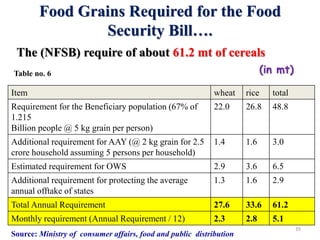
Food Grains Required for the Food
Security Bill….
The (NFSB) require of about 61.2 mt of cereals
Item wheat rice total
Requirement for the Beneficiary population (67% of
1.215
Billion people @ 5 kg grain per person)
22.0 26.8 48.8
Additional requirement for AAY (@ 2 kg grain for 2.5
crore household assuming 5 persons per household)
1.4 1.6 3.0
Estimated requirement for OWS 2.9 3.6 6.5
Additional requirement for protecting the average
annual offtake of states
1.3 1.6 2.9
Total Annual Requirement 27.6 33.6 61.2
Monthly requirement (Annual Requirement / 12) 2.3 2.8 5.1
(in mt)
Table no. 6
35
Source: Ministry of consumer affairs, food and public distribution
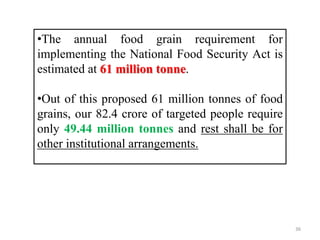
•The annual food grain requirement for
implementing the National Food Security Act is
estimated at 61 million tonne.
•Out of this proposed 61 million tonnes of food
grains, our 82.4 crore of targeted people require
only 49.44 million tonnes and rest shall be for
other institutional arrangements.
36
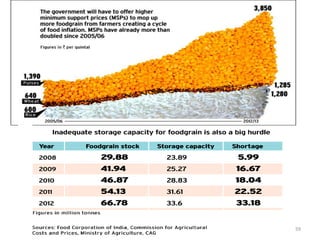
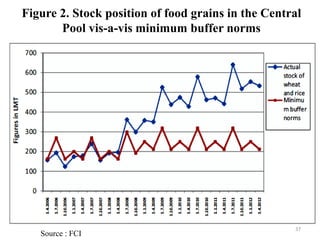
Figure 2. Stock position of food grains in the Central
Pool vis-a-vis minimum buffer norms
Source : FCI
37
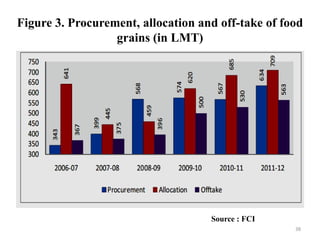
Figure 3. Procurement, allocation and off-take of food
grains (in LMT)
Source : FCI
38
Cost of NFSA implementation
39
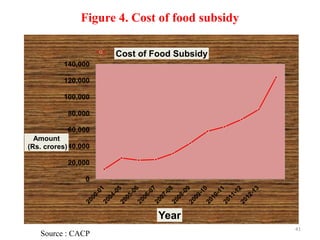
The Food Bill will cost around Rs 1.3 lakh crore
annually which is about 1.1% of GDP.
About 62 million tonnes of food grain will be
needed under the food bill.
Even if the grain quantity remains fixed each year,
the subsidy cost will keep increasing annually.
40
0
20,000
40,000
60,000
80,000
100,000
120,000
140,000
Amount
(Rs. crores)
Year
Cost of Food Subsidy
Figure 4. Cost of food subsidy
41
Source : CACP
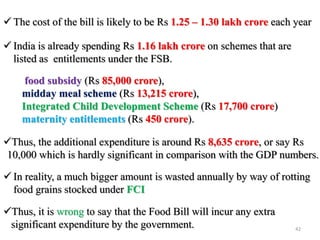
 The cost of the bill is likely to be Rs 1.25 – 1.30 lakh crore each year
 India is already spending Rs 1.16 lakh crore on schemes that are
listed as entitlements under the FSB.
food subsidy (Rs 85,000 crore),
midday meal scheme (Rs 13,215 crore),
Integrated Child Development Scheme (Rs 17,700 crore)
maternity entitlements (Rs 450 crore).
Thus, the additional expenditure is around Rs 8,635 crore, or say Rs
10,000 which is hardly significant in comparison with the GDP numbers.
 In reality, a much bigger amount is wasted annually by way of rotting
food grains stocked under FCI
Thus, it is wrong to say that the Food Bill will incur any extra
significant expenditure by the government. 42
Food Security Programs of different
states….
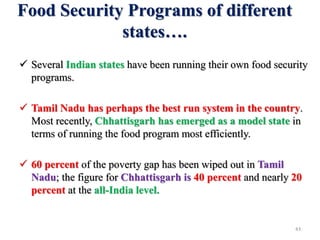
 Several Indian states have been running their own food security
programs.
 Tamil Nadu has perhaps the best run system in the country.
Most recently, Chhattisgarh has emerged as a model state in
terms of running the food program most efficiently.
 60 percent of the poverty gap has been wiped out in Tamil
Nadu; the figure for Chhattisgarh is 40 percent and nearly 20
percent at the all-India level.
43
Andhra Pradesh
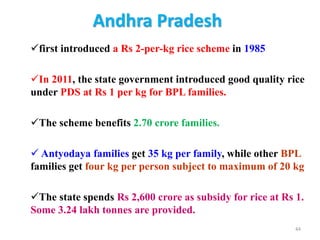
first introduced a Rs 2-per-kg rice scheme in 1985
In 2011, the state government introduced good quality rice
under PDS at Rs 1 per kg for BPL families.
The scheme benefits 2.70 crore families.
 Antyodaya families get 35 kg per family, while other BPL
families get four kg per person subject to maximum of 20 kg
The state spends Rs 2,600 crore as subsidy for rice at Rs 1.
Some 3.24 lakh tonnes are provided.
44
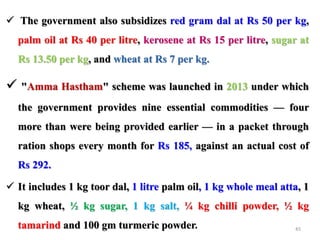
 The government also subsidizes red gram dal at Rs 50 per kg,
palm oil at Rs 40 per litre, kerosene at Rs 15 per litre, sugar at
Rs 13.50 per kg, and wheat at Rs 7 per kg.
 "Amma Hastham" scheme was launched in 2013 under which
the government provides nine essential commodities — four
more than were being provided earlier — in a packet through
ration shops every month for Rs 185, against an actual cost of
Rs 292.
 It includes 1 kg toor dal, 1 litre palm oil, 1 kg whole meal atta, 1
kg wheat, ½ kg sugar, 1 kg salt, ¼ kg chilli powder, ½ kg
tamarind and 100 gm turmeric powder. 45
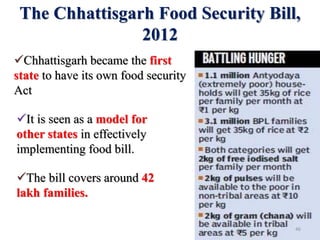
The Chhattisgarh Food Security Bill,
2012
Chhattisgarh became the first
state to have its own food security
Act
It is seen as a model for
other states in effectively
implementing food bill.
The bill covers around 42
lakh families.
46
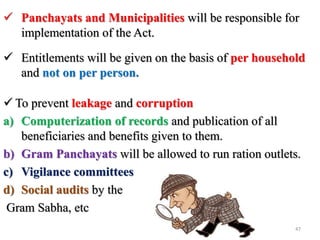
 To prevent leakage and corruption
a) Computerization of records and publication of all
beneficiaries and benefits given to them.
b) Gram Panchayats will be allowed to run ration outlets.
c) Vigilance committees
d) Social audits by the
Gram Sabha, etc
 Panchayats and Municipalities will be responsible for
implementation of the Act.
 Entitlements will be given on the basis of per household
and not on per person.
47
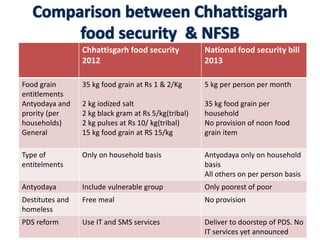
Chhattisgarh food security
2012
National food security bill
2013
Food grain
entitlements
Antyodaya and
prority (per
households)
General
35 kg food grain at Rs 1 & 2/Kg
2 kg iodized salt
2 kg black gram at Rs 5/kg(tribal)
2 kg pulses at Rs 10/ kg(tribal)
15 kg food grain at RS 15/kg
5 kg per person per month
35 kg food grain per
household
No provision of noon food
grain item
Type of
entitelments
Only on household basis Antyodaya only on household
basis
All others on per person basis
Antyodaya Include vulnerable group Only poorest of poor
Destitutes and
homeless
Free meal No provision
PDS reform Use IT and SMS services Deliver to doorstep of PDS. No
IT services yet announced
49
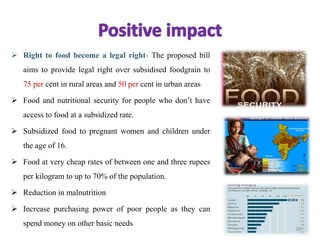
 Right to food become a legal right- The proposed bill
aims to provide legal right over subsidised foodgrain to
75 per cent in rural areas and 50 per cent in urban areas
 Food and nutritional security for people who don’t have
access to food at a subsidized rate.
 Subsidized food to pregnant women and children under
the age of 16.
 Food at very cheap rates of between one and three rupees
per kilogram to up to 70% of the population.
 Reduction in malnutrition
 Increase purchasing power of poor people as they can
spend money on other basic needs
50
 Continuance of Antyodaya Anna
Yojana (AAY) – Protection to 2.43 crore
poorest of poor families under the
Antodaya Anna Yojana (AAY) to supply
of 35 kg foodgrains per month per family
would continue.
 Bill seeks to utilize already existing
infrastructures like PDS and
aganwadi’s. This has prevented further
wastage of money to develop the
infrastructures.
51
• Bezbaruah (2013) opinioned that the successful
implementation of this ambitious food security
program will weave a meaningful safety net for a vast
majority of Indians who eke out their living in the un-
organized sector virtually devoid of any social
security system to fall back upon .
52
Negative impact
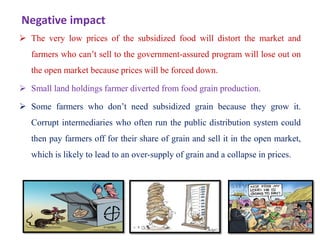
 The very low prices of the subsidized food will distort the market and
farmers who can’t sell to the government-assured program will lose out on
the open market because prices will be forced down.
 Small land holdings farmer diverted from food grain production.
 Some farmers who don’t need subsidized grain because they grow it.
Corrupt intermediaries who often run the public distribution system could
then pay farmers off for their share of grain and sell it in the open market,
which is likely to lead to an over-supply of grain and a collapse in prices.
53
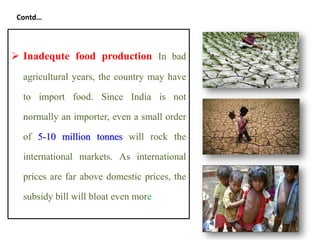
 Inadequte food production In bad
agricultural years, the country may have
to import food. Since India is not
normally an importer, even a small order
of 5-10 million tonnes will rock the
international markets. As international
prices are far above domestic prices, the
subsidy bill will bloat even more
Contd…
54
Challenges
 Lead to some impact on the farm sector as the Bill’s focus
on cereal and food grain production ―may distort the farm
production structure by not providing the right incentives
for other crops such as pulses, oilseeds and cash crops,
states need to identify the beneficiaries
 The Bill does not categories properly between BPL and APL
and both are entitled to 5 Kg grain per person per month.
55
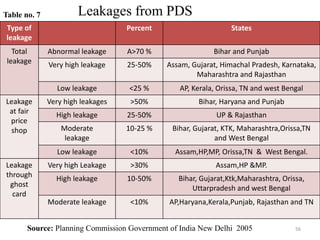
Type of
leakage
Percent States
Total
leakage
Abnormal leakage A>70 % Bihar and Punjab
Very high leakage 25-50% Assam, Gujarat, Himachal Pradesh, Karnataka,
Maharashtra and Rajasthan
Low leakage <25 % AP, Kerala, Orissa, TN and west Bengal
Leakage
at fair
price
shop
Very high leakages >50% Bihar, Haryana and Punjab
High leakage 25-50% UP & Rajasthan
Moderate
leakage
10-25 % Bihar, Gujarat, KTK, Maharashtra,Orissa,TN
and West Bengal
Low leakage <10% Assam,HP,MP, Orissa,TN & West Bengal.
Leakage
through
ghost
card
Very high Leakage >30% Assam,HP &MP.
High leakage 10-50% Bihar, Gujarat,Ktk,Maharashtra, Orissa,
Uttarpradesh and west Bengal
Moderate leakage <10% AP,Haryana,Kerala,Punjab, Rajasthan and TN
Leakages from PDS
Source: Planning Commission Government of India New Delhi 2005
Table no. 7
56
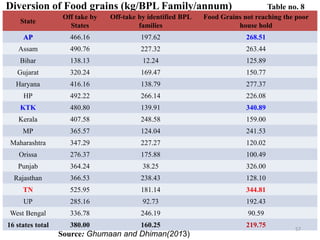
Diversion of Food grains (kg/BPL Family/annum)
State
Off take by
States
Off-take by identified BPL
families
Food Grains not reaching the poor
house hold
AP 466.16 197.62 268.51
Assam 490.76 227.32 263.44
Bihar 138.13 12.24 125.89
Gujarat 320.24 169.47 150.77
Haryana 416.16 138.79 277.37
HP 492.22 266.14 226.08
KTK 480.80 139.91 340.89
Kerala 407.58 248.58 159.00
MP 365.57 124.04 241.53
Maharashtra 347.29 227.27 120.02
Orissa 276.37 175.88 100.49
Punjab 364.24 38.25 326.00
Rajasthan 366.53 238.43 128.10
TN 525.95 181.14 344.81
UP 285.16 92.73 192.43
West Bengal 336.78 246.19 90.59
16 states total 380.00 160.25 219.75
Table no. 8
Source: Ghumaan and Dhiman(2013)
57
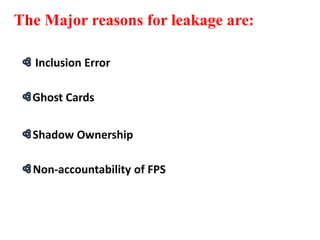
The Major reasons for leakage are:
Inclusion Error
Ghost Cards
Shadow Ownership
Non-accountability of FPS
59
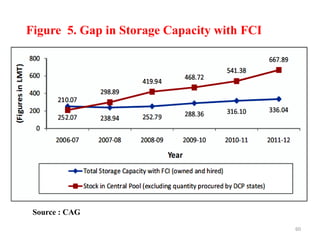
Figure 5. Gap in Storage Capacity with FCI
Source : CAG
60
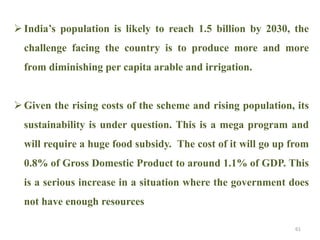
 India’s population is likely to reach 1.5 billion by 2030, the
challenge facing the country is to produce more and more
from diminishing per capita arable and irrigation.
 Given the rising costs of the scheme and rising population, its
sustainability is under question. This is a mega program and
will require a huge food subsidy. The cost of it will go up from
0.8% of Gross Domestic Product to around 1.1% of GDP. This
is a serious increase in a situation where the government does
not have enough resources
61
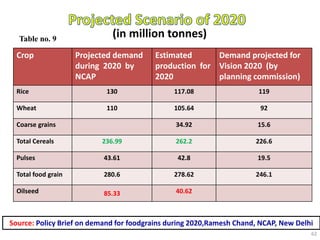
Crop Projected demand
during 2020 by
NCAP
Estimated
production for
2020
Demand projected for
Vision 2020 (by
planning commission)
Rice 130 117.08 119
Wheat 110 105.64 92
Coarse grains 34.92 15.6
Total Cereals 236.99 262.2 226.6
Pulses 43.61 42.8 19.5
Total food grain 280.6 278.62 246.1
Oilseed 85.33 40.62
(in million tonnes)
Source: Policy Brief on demand for foodgrains during 2020,Ramesh Chand, NCAP, New Delhi
Table no. 9
62
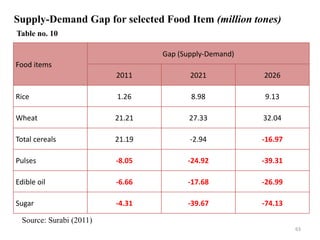
Food items
Gap (Supply-Demand)
2011 2021 2026
Rice 1.26 8.98 9.13
Wheat 21.21 27.33 32.04
Total cereals 21.19 -2.94 -16.97
Pulses -8.05 -24.92 -39.31
Edible oil -6.66 -17.68 -26.99
Sugar -4.31 -39.67 -74.13
Source: Surabi (2011)
Supply-Demand Gap for selected Food Item (million tones)
Table no. 10
63
Criticism of
NFSA….
64
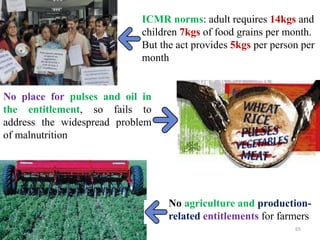
No place for pulses and oil in
the entitlement, so fails to
address the widespread problem
of malnutrition
No agriculture and production-
related entitlements for farmers
65
ICMR norms: adult requires 14kgs and
children 7kgs of food grains per month.
But the act provides 5kgs per person per
month
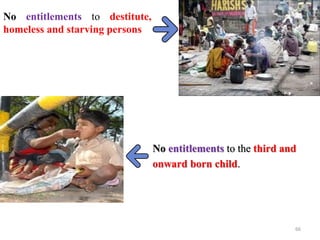
No entitlements to destitute,
homeless and starving persons
No entitlements to the third and
onward born child.
66
• Patnaik (2013) opinioned that the NFSA, in its present shape
is only a small, incremental step in the right direction with
little resemblance to the legislation that had been shaped and
drafted by the Right to Food Campaign. The legislation will
certainly deal with crucial aspects of access and availability of
food for a large section of the population, but has left out the
entire nutritional dimension of the right to food. It will
mitigate hunger, but not address the underlying problem of
malnutrition to the extent that it could potentially have.
67
• Kalkoti (2012) suggested that the only way forward to address
the issue of food for all is to pay attention to the much neglected
supply-side. Strengthening the farm production base and raising
productivity by all possible ways and means. This calls for a
combination of visionary and committed leadership with
political will to address issues of our rain dependent farming
system, predominance of small unviable holdings and tenant
farmers, and extremely weak rural infrastructure to sustain farm
development. This necessitates assessment and mobilization of
financial, technological and human resources.
68
 The Food Bill should be linked to the Mahatma Gandhi National Rural
Employment Guarantee Act (MGNREGA) which assures 100 days of
unskilled work to people in the rural areas.
 It could also be linked to education as is done in Bangladesh where school
children and their families are given access to subsidized food. In India we
have the midday meal scheme for children to improve their attendance in
schools.
 The bill should have included subsidized rates for pulses which for many
of the poorest are the only source of protein and other nutrients.
 Food and nutrition insecurity can be effective only with adequate attention
to ensuring access to safe drinking water and hygiene and sanitation
facilities.
 Need to reduce the leakages from the distribution system and make it
transparent 69
• Surender Kumar (2013) suggested that for the effective
implementation of food security act various measures should
be taken such as encouragement of Future market to avoid
wide fluctuations in prices and prevent distress selling by small
farmers, improvement communication system through ICT to
help farmers to get a better deal for their produce. Crop
insurance schemes can be promoted to protect the farmers
against Natural Calamities. The Government should encourage
the use of latest techniques; motivate each district/block to
achieve local self-sufficiency in food grain production. Thus, by
ensuring above stated measurements, India can achieve food
security in real sense and in a realistic time frame.
70
71
Conclusion
•India will not have problem of Cereals availability in the long
run (2020-21) and will have shortage of Pulse and Oilseed
production if adequate steps are not taken by the Government of
India.
•Given the inflationary tendencies in economy, Food Security
Act 2013 will increase the Real Income of the targeted
beneficiaries.
•To ensure success of Food Security in India we have to achieve
the Food Production Targets and improve the efficiency of public
distribution system.
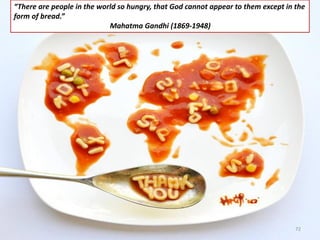
“There are people in the world so hungry, that God cannot appear to them except in the
form of bread.”
Mahatma Gandhi (1869-1948)
72
• difference between ordinance an act......
• An Act is a bill that was presented in a State legislative
home/Parliament of India, passed by both the houses of the State
legislature or Parliament, sent for accent of the State Governor or
the President of India, and then it becomes an Act.
• Whereas ordinance is a legal order or law made by the State
Government or the Union Government when the Legislature or
Parliament is not in session, this a temporary arrangement made by
the said government with regard to such a law & its
implementation in the State or the whole of the country as the case
may be. Such ordinance is legal & can be implemented for the time
being, but it has to be passed by the State legislature or the
parliament within six months & made as a proper Act.
73

202317812-national-food-security-act-2013.pdf

  • 1.
  • 2.
    Presented by: N. Lohith BAM-12-38 Course-in-charge: Dr. D. Vishnu Sankar Rao Professor and University Head Major Advisor : Dr. Y. Radha Principal Scientist, WTC, ANGRAU, Hyderabad NATIONAL FOOD SECURITY ACT 2013: OPPORTUNITIES AND CHALLENGES
  • 3.
    contents 1. Introduction toFood Security 2. Need for NFSA 3. Back ground of FSA 4. Salient features of NFSA 5. Food grains required for FSA 6. Cost of NFSA implementation 7. Food security programs in different states 8. Chattisgarh FSA Vs National FSA 9. Consequences of Food Security Act 10. Criticism of NFSA 11. Suggestions 12. Conclusion 3
  • 4.
    • Human concernfor food security is as old as humanity itself • The issue of food security became an international concern when world food conference in Rome (1974) adopted food security as its main topic • Declaration of this conference was that “every man, woman and child has the inalienable right to be free from hunger and malnutrition in order to develop fully and maintain their physical and mental faculties” 4
  • 5.
    DEFINITION OF FOODSECURITY FAO DEFINITION (1983): ―All people at all times have both physical and economic access to basic food they need” WORLD BANK DEFINITION (1986): “Access by all people at all times to enough food for an active, healthy life. Its essential elements are the availability of food and the ability to acquire it” 5
  • 6.
    Four dimensions ofFood Security Food Security Physical Availability of Food The supply side, determined by the level of food production, stock level & net trade. Economic & Physical access to Food Adequate supply of food does not guarantee household level food security. Food access depends on incomes, expenditure, markets & prices in achieving food security objectives Food Utilization The way the body makes the most of various nutrients in the food. Involves care & feeding practices, food preparation, diversity of diet & intra-household distribution of food. Stability of the other 3 dimensions over time Access on a periodic basis. Weather, political conditions or economic factors have an impact on food security status. 6
  • 7.
    Crop 2011-12 2012-13 Rice105.31 104.22 Wheat 94.88 93.62 Coarse cereals 42.04 39.52 Total cereals 242.23 237.3618 Pulses 17.09 18.00 Total food grains 259.32 255.36 Oilseeds 29.79 30.72 Sugar 24.60 26.00 Vegetables 156.325 156.445 Fruits 76.42 79.40 Milk 127.9 133.7 Source:-RBI Hand Book on India Economy 2011-12 Physical Availability of Food (in million tonnes) Table no.1 7
  • 8.
    1950- 51 1960- 61 1970- 71 1980- 81 1990- 91 2000- 01 2010- 11 2011- 12 2012- 13 Rice 20.58 34.5842.22 53.63 74.29 84.98 95.32 105.31 104.22 Wheat 6.46 11.00 23.83 36.31 55.14 69.68 85.93 94.88 93.62 Coarse Cereals 15.38 23.74 30.55 29.02 32.70 31.08 43.68 42.04 39.5 Pulses 8.41 12.70 11.82 10.63 14.26 11.07 18.24 17.09 18 Food grain 50.83 82.02 108.42 129.59 176.39 196.81 244.78 259.32 255 20.58 34.58 42.22 53.63 74.29 84.98 95.32 105.31 104.22 11.00 23.83 36.31 55.14 69.68 85.93 94.88 93.62 50.83 82.02 108.42 129.59 176.39 196.81 244.78 259.32 255 -30.00 20.00 70.00 120.00 170.00 220.00 270.00 0.00 20.00 40.00 60.00 80.00 100.00 120.00 Production (million tonnes) Rice Wheat Coarse Cereals Pulses Food grain Figure 1: Trend in Production of Food grains Source: Hand book of Indian Economy, RBI, 2011-12. 8
  • 9.
    Year Cereal Pulses 1950-5144.3 8.0 1960-61 64.6 11.1 1970-71 84.0 10.3 1980-81 104.8 9.4 1990-91 145.7 12.9 2000-01 145.6 11.3 2005-06 157.4 12.7 2006-07 168.8 13.3 2007-08 168.9 14.7 2008-09 165.9 17.6 2009-10 173.7 15.8 2010-11 176.5 13.7 Source: Indian Economy,Gaurav Datt and Ashwani Mahajan,2012 Net Availability of Cereals and Pulses (in million tonnes) Table no. 2 9
  • 10.
    Commodity Per capitaavailability Minimum per capita requirement Total cereals 528.70 400 Pulses 46.78 80 Total food grains 568.79 480 Oil 39.73 30 Sugar 54.79 20 Vegetables 348.47 300 Fruits 176.86 150 Milk 297.81 300 Source:-National Institute of Nutrition, Hyderabad Per capita availability, 2012-13 (in gram per day) Table no. 3 10
  • 11.
  • 12.
    • India ranked10th largest Economy of world on nominal GDP basis and 3rd largest economy on PPP basis But India has………….. • 29% of the 872.9 million undernourished people (FAO 2009) • 49% of the world’s underweight children (WHO 2009) • 34% of the world’s stunted children (WHO 2009) • 32.7% of all people in India fall below the international poverty line of US$ 1.25 per day (PPP) while 68.7% live on less than US$ 2 per day (World Bank 2010) • According to the latest data on child under nutrition from 2005– 10, India ranked second to last on child underweight out of 129 countries— below Ethiopia, Niger, Nepal, and Bangladesh. 12
  • 13.
    Global Hunger Index Thisindex basically measures malnutrition and hunger based on three parameters  Proportion of people who are undernourished  Proportion of children under five who are underweight,  The Child mortality rate. 13
  • 14.
    Year Rank inHunger index Out of total no. of countries Score Status 1990 31.73 Alarming 2007 94 118 25.03. Alarming 2008 66 88 23.70 Alarming 2009 65 88 23.90 Alarming 2010 67 84 24.10 Alarming 2011 67 81 24.2 Alarming 2012 65 79 22.9 Alarming Source:-Global Hunger Report, IFPRI India’s status on Global Hunger Index Table no. 4 14
  • 15.
    Major states athunger index and the underlying components State Prevalence of calorie undernourishment (%) Under weight children below 5 years (%) Under 5 mortality rates (deaths /100 Lives) Indian state hunger index rank Punjab 11.1 24.6 5.2 1 Kerala 28.6 22.7 1.6 2 AP 19.6 32.7 6.3 3 Assam 14.6 36.4 8.5 4 Haryana 15.1 39.7 5.2 5 Tamilnadu 29.1 30 3.5 6 Rajasthan 14.0 40.4 8.5 7 West Bengal 18.5 38.5 5.9 8 UP 14.5 42.3 9.6 9 Maharashtra 27.0 36.7 4.7 10 Karnataka 28.1 37.6 5.5 11 Orissa 21.4 40.9 9.1 12 Gujarat 23.3 44.7 6.1 13 Chhattisgarh 23.3 47.6 9.0 14 Bihar 17.3 56.1 8.5 15 Jharkhand 19.6 57.1 9.3 16 MP 23.4 59.8 9.4 17 India 20.0 42.5 7.4 Table no. 5 Source:-Global Hunger Report, IFPRI 15
  • 16.
  • 17.
    Back ground offood security movement…. 17
  • 18.
    • 1996- SupremeCourt declared that the right to live guaranteed in any civilized society implies the right to food. • 2001- the Court ordered the implementation of eight centrally sponsored schemes as legal entitlements. These include Public Distribution System (PDS) Antyodaya Anna Yojana (AAY) The Midday Meal Scheme (MMS) Integrated Child Development Services (ICDS) • 2008 - the Court ordered that Below Poverty Line (BPL) families be entitled to 35 kg of food grains per month at subsidized prices. 18
  • 19.
    • Then theNational Food Security Bill had a stop- start journey. Here’s a timeline of its... • Oct 2010 - the National Advisory Council (NAC) drafted a National Food Security Bill, proposing legal entitlements for about 75 percent of the population. • Jan 2011 - an Expert Committee set up by the Prime Minister under the chairmanship of Dr. C. Rangarajan examined the Bill and made several recommendations, including reducing the proportion of the population entitled to benefits and computerizing PDS. 19
  • 20.
    • July 2011-A ministerial panel gave its approval to draft food security Bill • Jan 2012- The Bill was referred to the Parliament Standing Committee on Food • Nov 2012- A parliamentary panel sends the draft back to the food ministry to incorporate changes after consulting with state governments. • 19 Mar 2013- Union Cabinet approves an amended draft • 4 June 2013- The Cabinet discussed on approving the food security law through an ordinance. • 4 July 2013 - Cabinet approved the food aid program as an ordinance. 20
  • 21.
    • 26 Aug2013- the bill was passed in the LokSabha • 2 Sept 2013- the bill was passed in the Rajyasabha • 10 Sept 2013- received the assent of the President of India. With this the NFSB 2013 became the Act and gave the majority of those living in India the right to subsidised food grains. 21
  • 22.
  • 23.
    The National FoodSecurity Act, 2013 aims to provide for food and nutritional security in human life cycle approach, by ensuring access to adequate quantity of quality food at affordable prices to people to live a life with dignity. 23
  • 24.
    Entitlements…. Public Distribution System: Priorityhouseholds are entitled to 5 kgs of food grains per person per month. 2.43 crore Antyodaya households to get 35 kgs. The combined coverage is up to 75% of the rural population and up to 50% of the urban population. The Bill will cover around 810 million citizens. (67%) 24
  • 25.
    Children’s Entitlements…. children inthe age group of 6 months to 6 years, the Bill guarantees an age- appropriate meal, free of charge, through the local anganwadi. children aged 6-14 years, free midday meal will be provided every day in all schools run by local bodies, government and govt aided schools, up to Class VIII. Children who suffer from malnutrition will be identified through the local anganwadi and meals will be provided to them free of charge. 25
  • 26.
    Maternal benefits ofRs 6,000, is given in instalments (maternal benefits to a pregnant woman beyond two live births is denied) . Every pregnant and lactating mother is entitled to a free meal at the local anganwadi (during pregnancy and six months after childbirth). Entitlements of Pregnant and Lactating Women…. 26
  • 27.
    Identification of Eligible Households…. TheCentral Government is to determine the state-wise coverage of the PDS, in terms of proportion of the rural/urban population. Then numbers of eligible persons will be calculated from Census population figures. The identification of eligible households is left to state governments. The lists of eligible households are to be displayed publicly by state governments. 27
  • 28.
    Food Commissions… The actprovides for the creation of State Food Commissions Each Commission shall consist of a chairperson, five other members and a member-secretary (including at least two women) The main function of the State Commission is to monitor and evaluate the implementation of the act, give advice to the state governments and their agencies, and inquire into violations of entitlements. 28
  • 29.
    PDS Reforms….  Doorstepdelivery of foodgrains  ICT applications and end-to-end computerisation  Using aadhaar (UID) for unique identification of entitled beneficiaries  Full transparency of records  Preference to public institutions or bodies in licensing of fair price shops. 29
  • 30.
    For the purposeof issue of ration cards, the eldest woman (above 18) shall be the head of the household. Women Empowerment…. 30
  • 31.
    Obligations of Governmentand Local Authorities….  Central Government : provide food grains (funds) to state governments to implement the main entitlements. It also has to provide assistance to state governments to meet local distribution costs.  State governments : implementing the relevant schemes, in accordance with the guidelines issued by the Central Government. They are free to extend benefits and entitlements beyond what is prescribed in the Bill, from their own resources  Local Authorities and Panchayati Raj Institutions are responsible for proper implementation of the act in their respective areas 31
  • 32.
  • 33.
    Mechanism Advantages Disadvantages PDSInsulates the beneficiaries from inflation and price volatility Fair price shops have low margins; thus not very viable The food grain entitlement can only be used to prepare food Often sub-standard quality of food grains, Adulteration of food grain Well-developed network of FPS ensures access to food grain even in remote areas Large leakages and diversions of subsidized food grain 33
  • 34.
    Mechanism Advantages Disadvantages CashTransfer Cash in the hands of poor expands their choices and relieves financial constraints to some extent Requires extensive banking network Potential for fully electronic transfer Cash can be used to buy non food items Cash transfer programs involve low administrative costs because it does not need procurement, storage and distribution facilities May expose recipients to price volatility and inflation Smart Cards/ Food Coupons The household has freedom to go to any PDS shop. It might promote quality of grains as well as service Needs computerization and networking of PDS shops 34
  • 35.
    Food Grains Requiredfor the Food Security Bill…. The (NFSB) require of about 61.2 mt of cereals Item wheat rice total Requirement for the Beneficiary population (67% of 1.215 Billion people @ 5 kg grain per person) 22.0 26.8 48.8 Additional requirement for AAY (@ 2 kg grain for 2.5 crore household assuming 5 persons per household) 1.4 1.6 3.0 Estimated requirement for OWS 2.9 3.6 6.5 Additional requirement for protecting the average annual offtake of states 1.3 1.6 2.9 Total Annual Requirement 27.6 33.6 61.2 Monthly requirement (Annual Requirement / 12) 2.3 2.8 5.1 (in mt) Table no. 6 35 Source: Ministry of consumer affairs, food and public distribution
  • 36.
    •The annual foodgrain requirement for implementing the National Food Security Act is estimated at 61 million tonne. •Out of this proposed 61 million tonnes of food grains, our 82.4 crore of targeted people require only 49.44 million tonnes and rest shall be for other institutional arrangements. 36
  • 37.
    Figure 2. Stockposition of food grains in the Central Pool vis-a-vis minimum buffer norms Source : FCI 37
  • 38.
    Figure 3. Procurement,allocation and off-take of food grains (in LMT) Source : FCI 38
  • 39.
    Cost of NFSAimplementation 39
  • 40.
    The Food Billwill cost around Rs 1.3 lakh crore annually which is about 1.1% of GDP. About 62 million tonnes of food grain will be needed under the food bill. Even if the grain quantity remains fixed each year, the subsidy cost will keep increasing annually. 40
  • 41.
    0 20,000 40,000 60,000 80,000 100,000 120,000 140,000 Amount (Rs. crores) Year Cost ofFood Subsidy Figure 4. Cost of food subsidy 41 Source : CACP
  • 42.
     The costof the bill is likely to be Rs 1.25 – 1.30 lakh crore each year  India is already spending Rs 1.16 lakh crore on schemes that are listed as entitlements under the FSB. food subsidy (Rs 85,000 crore), midday meal scheme (Rs 13,215 crore), Integrated Child Development Scheme (Rs 17,700 crore) maternity entitlements (Rs 450 crore). Thus, the additional expenditure is around Rs 8,635 crore, or say Rs 10,000 which is hardly significant in comparison with the GDP numbers.  In reality, a much bigger amount is wasted annually by way of rotting food grains stocked under FCI Thus, it is wrong to say that the Food Bill will incur any extra significant expenditure by the government. 42
  • 43.
    Food Security Programsof different states….  Several Indian states have been running their own food security programs.  Tamil Nadu has perhaps the best run system in the country. Most recently, Chhattisgarh has emerged as a model state in terms of running the food program most efficiently.  60 percent of the poverty gap has been wiped out in Tamil Nadu; the figure for Chhattisgarh is 40 percent and nearly 20 percent at the all-India level. 43
  • 44.
    Andhra Pradesh first introduceda Rs 2-per-kg rice scheme in 1985 In 2011, the state government introduced good quality rice under PDS at Rs 1 per kg for BPL families. The scheme benefits 2.70 crore families.  Antyodaya families get 35 kg per family, while other BPL families get four kg per person subject to maximum of 20 kg The state spends Rs 2,600 crore as subsidy for rice at Rs 1. Some 3.24 lakh tonnes are provided. 44
  • 45.
     The governmentalso subsidizes red gram dal at Rs 50 per kg, palm oil at Rs 40 per litre, kerosene at Rs 15 per litre, sugar at Rs 13.50 per kg, and wheat at Rs 7 per kg.  "Amma Hastham" scheme was launched in 2013 under which the government provides nine essential commodities — four more than were being provided earlier — in a packet through ration shops every month for Rs 185, against an actual cost of Rs 292.  It includes 1 kg toor dal, 1 litre palm oil, 1 kg whole meal atta, 1 kg wheat, ½ kg sugar, 1 kg salt, ¼ kg chilli powder, ½ kg tamarind and 100 gm turmeric powder. 45
  • 46.
    The Chhattisgarh FoodSecurity Bill, 2012 Chhattisgarh became the first state to have its own food security Act It is seen as a model for other states in effectively implementing food bill. The bill covers around 42 lakh families. 46
  • 47.
     To preventleakage and corruption a) Computerization of records and publication of all beneficiaries and benefits given to them. b) Gram Panchayats will be allowed to run ration outlets. c) Vigilance committees d) Social audits by the Gram Sabha, etc  Panchayats and Municipalities will be responsible for implementation of the Act.  Entitlements will be given on the basis of per household and not on per person. 47
  • 48.
    Chhattisgarh food security 2012 Nationalfood security bill 2013 Food grain entitlements Antyodaya and prority (per households) General 35 kg food grain at Rs 1 & 2/Kg 2 kg iodized salt 2 kg black gram at Rs 5/kg(tribal) 2 kg pulses at Rs 10/ kg(tribal) 15 kg food grain at RS 15/kg 5 kg per person per month 35 kg food grain per household No provision of noon food grain item Type of entitelments Only on household basis Antyodaya only on household basis All others on per person basis Antyodaya Include vulnerable group Only poorest of poor Destitutes and homeless Free meal No provision PDS reform Use IT and SMS services Deliver to doorstep of PDS. No IT services yet announced
  • 49.
  • 50.
     Right tofood become a legal right- The proposed bill aims to provide legal right over subsidised foodgrain to 75 per cent in rural areas and 50 per cent in urban areas  Food and nutritional security for people who don’t have access to food at a subsidized rate.  Subsidized food to pregnant women and children under the age of 16.  Food at very cheap rates of between one and three rupees per kilogram to up to 70% of the population.  Reduction in malnutrition  Increase purchasing power of poor people as they can spend money on other basic needs 50
  • 51.
     Continuance ofAntyodaya Anna Yojana (AAY) – Protection to 2.43 crore poorest of poor families under the Antodaya Anna Yojana (AAY) to supply of 35 kg foodgrains per month per family would continue.  Bill seeks to utilize already existing infrastructures like PDS and aganwadi’s. This has prevented further wastage of money to develop the infrastructures. 51
  • 52.
    • Bezbaruah (2013)opinioned that the successful implementation of this ambitious food security program will weave a meaningful safety net for a vast majority of Indians who eke out their living in the un- organized sector virtually devoid of any social security system to fall back upon . 52
  • 53.
    Negative impact  Thevery low prices of the subsidized food will distort the market and farmers who can’t sell to the government-assured program will lose out on the open market because prices will be forced down.  Small land holdings farmer diverted from food grain production.  Some farmers who don’t need subsidized grain because they grow it. Corrupt intermediaries who often run the public distribution system could then pay farmers off for their share of grain and sell it in the open market, which is likely to lead to an over-supply of grain and a collapse in prices. 53
  • 54.
     Inadequte foodproduction In bad agricultural years, the country may have to import food. Since India is not normally an importer, even a small order of 5-10 million tonnes will rock the international markets. As international prices are far above domestic prices, the subsidy bill will bloat even more Contd… 54
  • 55.
    Challenges  Lead tosome impact on the farm sector as the Bill’s focus on cereal and food grain production ―may distort the farm production structure by not providing the right incentives for other crops such as pulses, oilseeds and cash crops, states need to identify the beneficiaries  The Bill does not categories properly between BPL and APL and both are entitled to 5 Kg grain per person per month. 55
  • 56.
    Type of leakage Percent States Total leakage Abnormalleakage A>70 % Bihar and Punjab Very high leakage 25-50% Assam, Gujarat, Himachal Pradesh, Karnataka, Maharashtra and Rajasthan Low leakage <25 % AP, Kerala, Orissa, TN and west Bengal Leakage at fair price shop Very high leakages >50% Bihar, Haryana and Punjab High leakage 25-50% UP & Rajasthan Moderate leakage 10-25 % Bihar, Gujarat, KTK, Maharashtra,Orissa,TN and West Bengal Low leakage <10% Assam,HP,MP, Orissa,TN & West Bengal. Leakage through ghost card Very high Leakage >30% Assam,HP &MP. High leakage 10-50% Bihar, Gujarat,Ktk,Maharashtra, Orissa, Uttarpradesh and west Bengal Moderate leakage <10% AP,Haryana,Kerala,Punjab, Rajasthan and TN Leakages from PDS Source: Planning Commission Government of India New Delhi 2005 Table no. 7 56
  • 57.
    Diversion of Foodgrains (kg/BPL Family/annum) State Off take by States Off-take by identified BPL families Food Grains not reaching the poor house hold AP 466.16 197.62 268.51 Assam 490.76 227.32 263.44 Bihar 138.13 12.24 125.89 Gujarat 320.24 169.47 150.77 Haryana 416.16 138.79 277.37 HP 492.22 266.14 226.08 KTK 480.80 139.91 340.89 Kerala 407.58 248.58 159.00 MP 365.57 124.04 241.53 Maharashtra 347.29 227.27 120.02 Orissa 276.37 175.88 100.49 Punjab 364.24 38.25 326.00 Rajasthan 366.53 238.43 128.10 TN 525.95 181.14 344.81 UP 285.16 92.73 192.43 West Bengal 336.78 246.19 90.59 16 states total 380.00 160.25 219.75 Table no. 8 Source: Ghumaan and Dhiman(2013) 57
  • 58.
    The Major reasonsfor leakage are: Inclusion Error Ghost Cards Shadow Ownership Non-accountability of FPS
  • 59.
  • 60.
    Figure 5. Gapin Storage Capacity with FCI Source : CAG 60
  • 61.
     India’s populationis likely to reach 1.5 billion by 2030, the challenge facing the country is to produce more and more from diminishing per capita arable and irrigation.  Given the rising costs of the scheme and rising population, its sustainability is under question. This is a mega program and will require a huge food subsidy. The cost of it will go up from 0.8% of Gross Domestic Product to around 1.1% of GDP. This is a serious increase in a situation where the government does not have enough resources 61
  • 62.
    Crop Projected demand during2020 by NCAP Estimated production for 2020 Demand projected for Vision 2020 (by planning commission) Rice 130 117.08 119 Wheat 110 105.64 92 Coarse grains 34.92 15.6 Total Cereals 236.99 262.2 226.6 Pulses 43.61 42.8 19.5 Total food grain 280.6 278.62 246.1 Oilseed 85.33 40.62 (in million tonnes) Source: Policy Brief on demand for foodgrains during 2020,Ramesh Chand, NCAP, New Delhi Table no. 9 62
  • 63.
    Food items Gap (Supply-Demand) 20112021 2026 Rice 1.26 8.98 9.13 Wheat 21.21 27.33 32.04 Total cereals 21.19 -2.94 -16.97 Pulses -8.05 -24.92 -39.31 Edible oil -6.66 -17.68 -26.99 Sugar -4.31 -39.67 -74.13 Source: Surabi (2011) Supply-Demand Gap for selected Food Item (million tones) Table no. 10 63
  • 64.
  • 65.
    No place forpulses and oil in the entitlement, so fails to address the widespread problem of malnutrition No agriculture and production- related entitlements for farmers 65 ICMR norms: adult requires 14kgs and children 7kgs of food grains per month. But the act provides 5kgs per person per month
  • 66.
    No entitlements todestitute, homeless and starving persons No entitlements to the third and onward born child. 66
  • 67.
    • Patnaik (2013)opinioned that the NFSA, in its present shape is only a small, incremental step in the right direction with little resemblance to the legislation that had been shaped and drafted by the Right to Food Campaign. The legislation will certainly deal with crucial aspects of access and availability of food for a large section of the population, but has left out the entire nutritional dimension of the right to food. It will mitigate hunger, but not address the underlying problem of malnutrition to the extent that it could potentially have. 67
  • 68.
    • Kalkoti (2012)suggested that the only way forward to address the issue of food for all is to pay attention to the much neglected supply-side. Strengthening the farm production base and raising productivity by all possible ways and means. This calls for a combination of visionary and committed leadership with political will to address issues of our rain dependent farming system, predominance of small unviable holdings and tenant farmers, and extremely weak rural infrastructure to sustain farm development. This necessitates assessment and mobilization of financial, technological and human resources. 68
  • 69.
     The FoodBill should be linked to the Mahatma Gandhi National Rural Employment Guarantee Act (MGNREGA) which assures 100 days of unskilled work to people in the rural areas.  It could also be linked to education as is done in Bangladesh where school children and their families are given access to subsidized food. In India we have the midday meal scheme for children to improve their attendance in schools.  The bill should have included subsidized rates for pulses which for many of the poorest are the only source of protein and other nutrients.  Food and nutrition insecurity can be effective only with adequate attention to ensuring access to safe drinking water and hygiene and sanitation facilities.  Need to reduce the leakages from the distribution system and make it transparent 69
  • 70.
    • Surender Kumar(2013) suggested that for the effective implementation of food security act various measures should be taken such as encouragement of Future market to avoid wide fluctuations in prices and prevent distress selling by small farmers, improvement communication system through ICT to help farmers to get a better deal for their produce. Crop insurance schemes can be promoted to protect the farmers against Natural Calamities. The Government should encourage the use of latest techniques; motivate each district/block to achieve local self-sufficiency in food grain production. Thus, by ensuring above stated measurements, India can achieve food security in real sense and in a realistic time frame. 70
  • 71.
    71 Conclusion •India will nothave problem of Cereals availability in the long run (2020-21) and will have shortage of Pulse and Oilseed production if adequate steps are not taken by the Government of India. •Given the inflationary tendencies in economy, Food Security Act 2013 will increase the Real Income of the targeted beneficiaries. •To ensure success of Food Security in India we have to achieve the Food Production Targets and improve the efficiency of public distribution system.
  • 72.
    “There are peoplein the world so hungry, that God cannot appear to them except in the form of bread.” Mahatma Gandhi (1869-1948) 72
  • 73.
    • difference betweenordinance an act...... • An Act is a bill that was presented in a State legislative home/Parliament of India, passed by both the houses of the State legislature or Parliament, sent for accent of the State Governor or the President of India, and then it becomes an Act. • Whereas ordinance is a legal order or law made by the State Government or the Union Government when the Legislature or Parliament is not in session, this a temporary arrangement made by the said government with regard to such a law & its implementation in the State or the whole of the country as the case may be. Such ordinance is legal & can be implemented for the time being, but it has to be passed by the State legislature or the parliament within six months & made as a proper Act. 73