Economic Development Strategic
Planning
Jim Damicis
Senior Vice President
Camoin Associates
Jan 21-22,2016
1
Jim Damicis, Senior Vice President – Principal -
Camoin Associates
• Immediate Past President, Northeastern Economic
Developers Association
• IEDC, Economic Development Research Program,
International Economic Development Council
• Collaborator – Communities of the Future
• 25+ Years Experience in Economic and Community
Development
jim@camoinassociates.com
www.camoinassociates.com
Twitter: @jdamicis
Linkedin: www.linkedin.com/in/jdamicis
Blog: www.camoinassociates.com/blog/
• Comprehensive Economic Development
Strategies (CEDS)
• Stakeholder Engagement
• Workforce Development
• Market Analysis & Financial Feasibility
• Evaluation & Benchmarking Indicators
• ED Communication & Marketing
Introduction to Strategic Planning
3
what is it?
why do it?
context/key factors
benefits
process
lessons learned
Agenda
what is strategic planning?
4
Strategic planning provides a living vehicle for
community leaders to think strategically, to make
sound decisions in a sea of game-changing
circumstances, to focus efforts & to develop
consensus for collaboratively solving problems.
strategy & planning
strategy gets at...
o Where do you want to go in the future?
o Why do you want to go there?
o Vision & goals of a community
planning determines the answer to...
o What do you want to do?
o Where do you want to go?
o Who should help you get there?
o How should you go about getting there?
5
what strategic planning is NOT
not an event
about planning meetings
developing a great well-written report
fulfilling a grant or regulatory requirement
6
what strategic planning IS
engaging broad spectrum of people
inspiring people to work together
putting individual efforts toward best benefit
of collective whole
process that requires a champions
challenging & time-consuming
7
common barriers
focus on personalities & positions
o focus on shared interests & goals instead
lack of motivation for working together for
change
being in the “comfort zone”
8
key factors driving local & regional
economic development
Workforce, workforce, workforce!
Quality of place – amenities, infrastructure, housing,
recreation and culture, etc.
Regional collaboration and holistic approach to economic
development
Customer service driven – permitting and approval
processes, transparency, accountability
Networks
Complex Systems requiring adaptability rather than
predictability
Camoin Associates 9
strategic planning benefits
shapes community’s future
defines community purpose
provides one-stop information base
provides realistic appraisal
10
a critical tool
means to establish & maintain effective programs
provides guidance in structuring tactical operations
no proverbial clean slate
o must assess current projects
o use information gathered to adjust plans or establish new goals
can be used for overall plans or sub-activities
11
call # 1
explore untapped potential
help inventors commercialize ideas
help entrepreneurs launch successful enterprises
help employers grow & sustain operations
help individuals achieve meaningful career
pathways
help other investors maximize ROI
12
call # 2
continual adaptation & innovation
increased global interdependence
high paced scientific & technological change
communities of choice
o creatively & continually reinvent
o meet ever-changing needs
13
call # 3
ongoing pursuit of excellence
community as an enterprise
o rather than simply a collection of people
o set & live by high expectations
plan with inventive creativity
o reduces need for crisis reactivity
focus on continual improvement
14
ultimate strategies + action
compatible with community vision
feasible given strengths & weaknesses
implementable given leadership & resources
change-making addresses most urgent challenges
innovative enables forward movement on
most promising opportunities
15
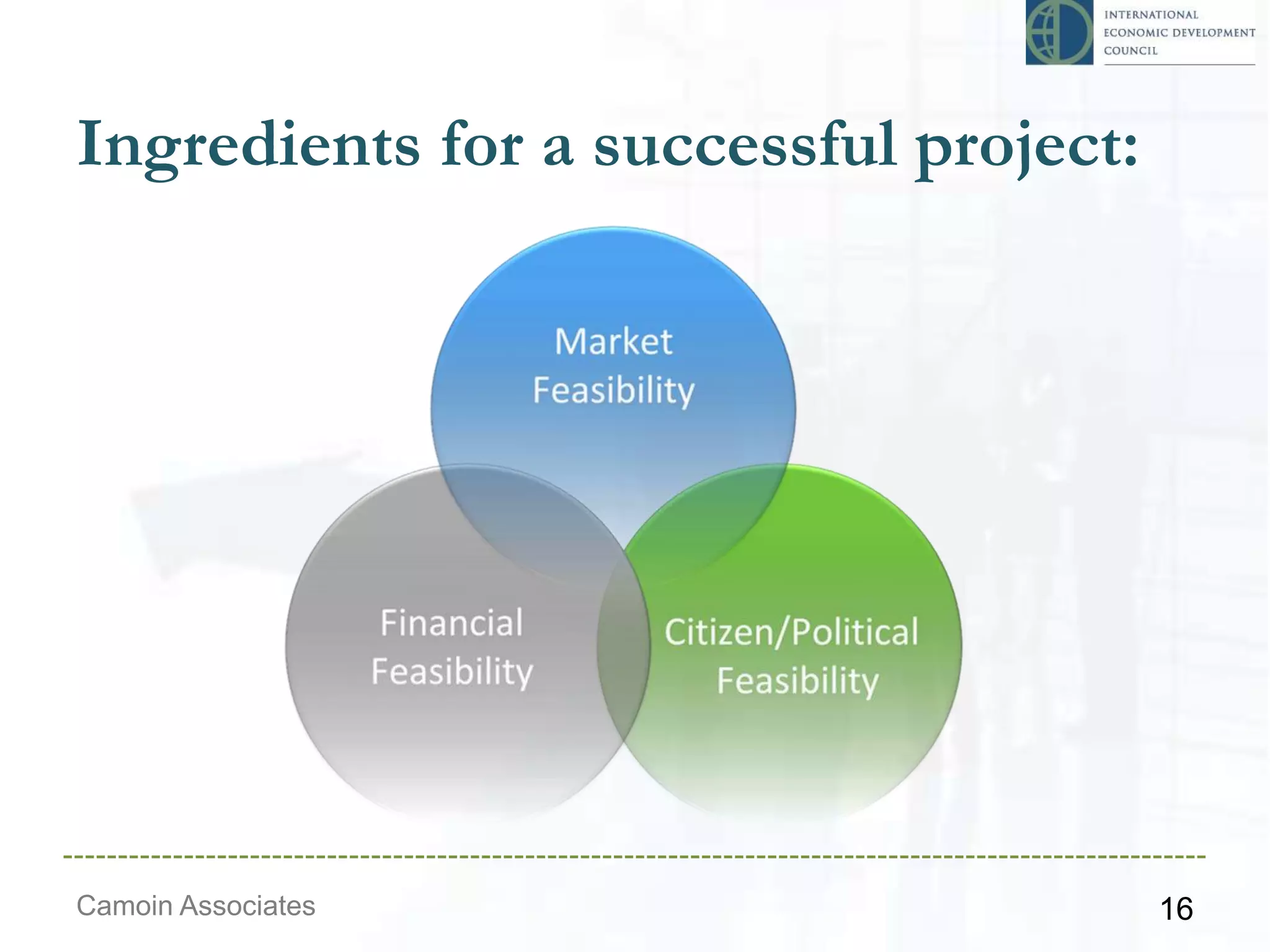
Ingredients for a successful project:
Camoin Associates 16
questions answered
where are you & what is your potential?
o needs & opportunities
o situation & context
where do you want to go & why go there?
o community vision
o development goals
17
questions answered
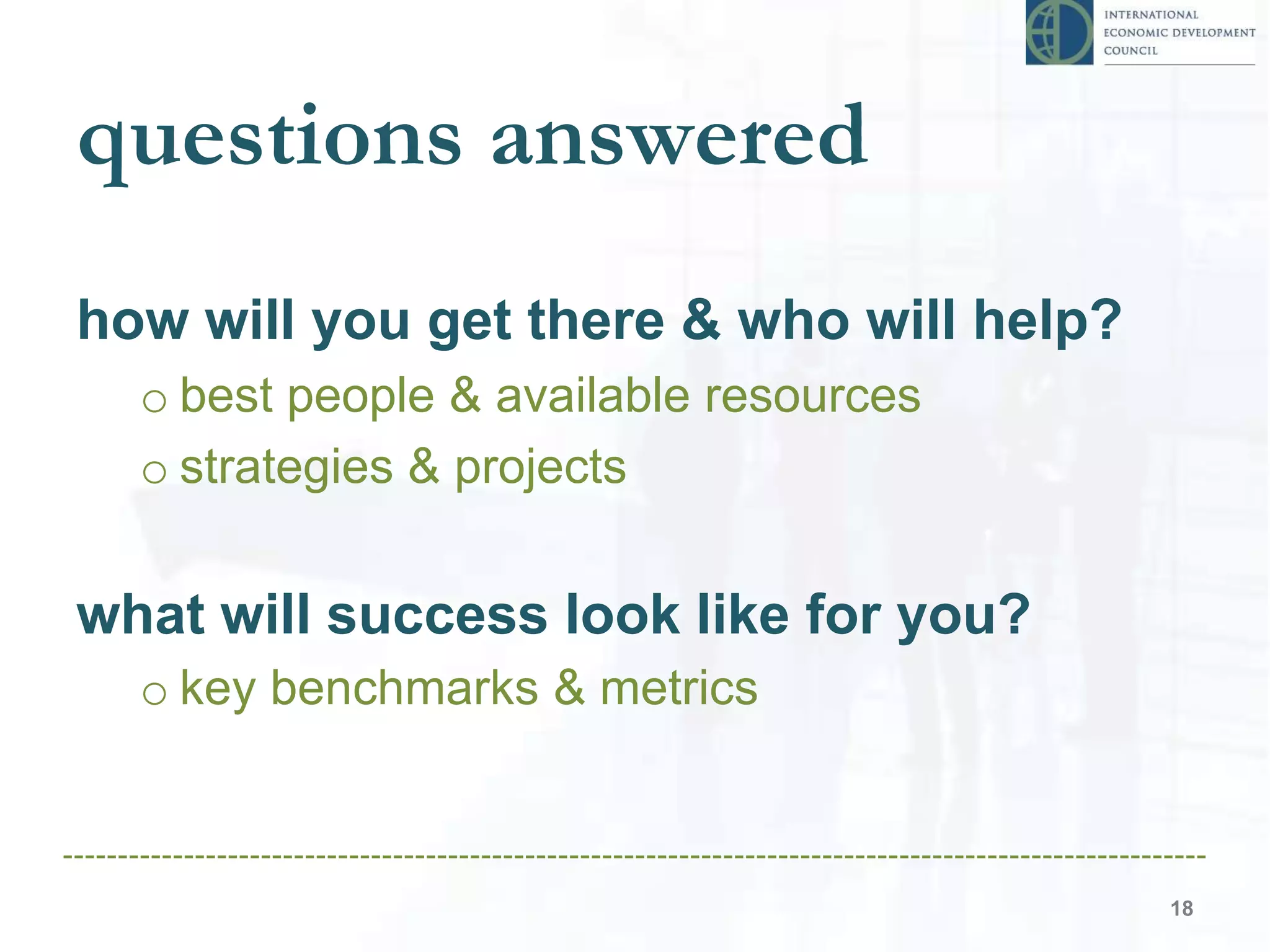
how will you get there & who will help?
o best people & available resources
o strategies & projects
what will success look like for you?
o key benchmarks & metrics
18
strategic planning process
organizing & pre-planning
o identify & recruit players & stakeholders
o create organizational structure
o determine necessary financial & technical resources
visioning
o develop shared vision
assessing the local community & economic
competitiveness
o evaluate & define your situation
19
strategic planning process cont.
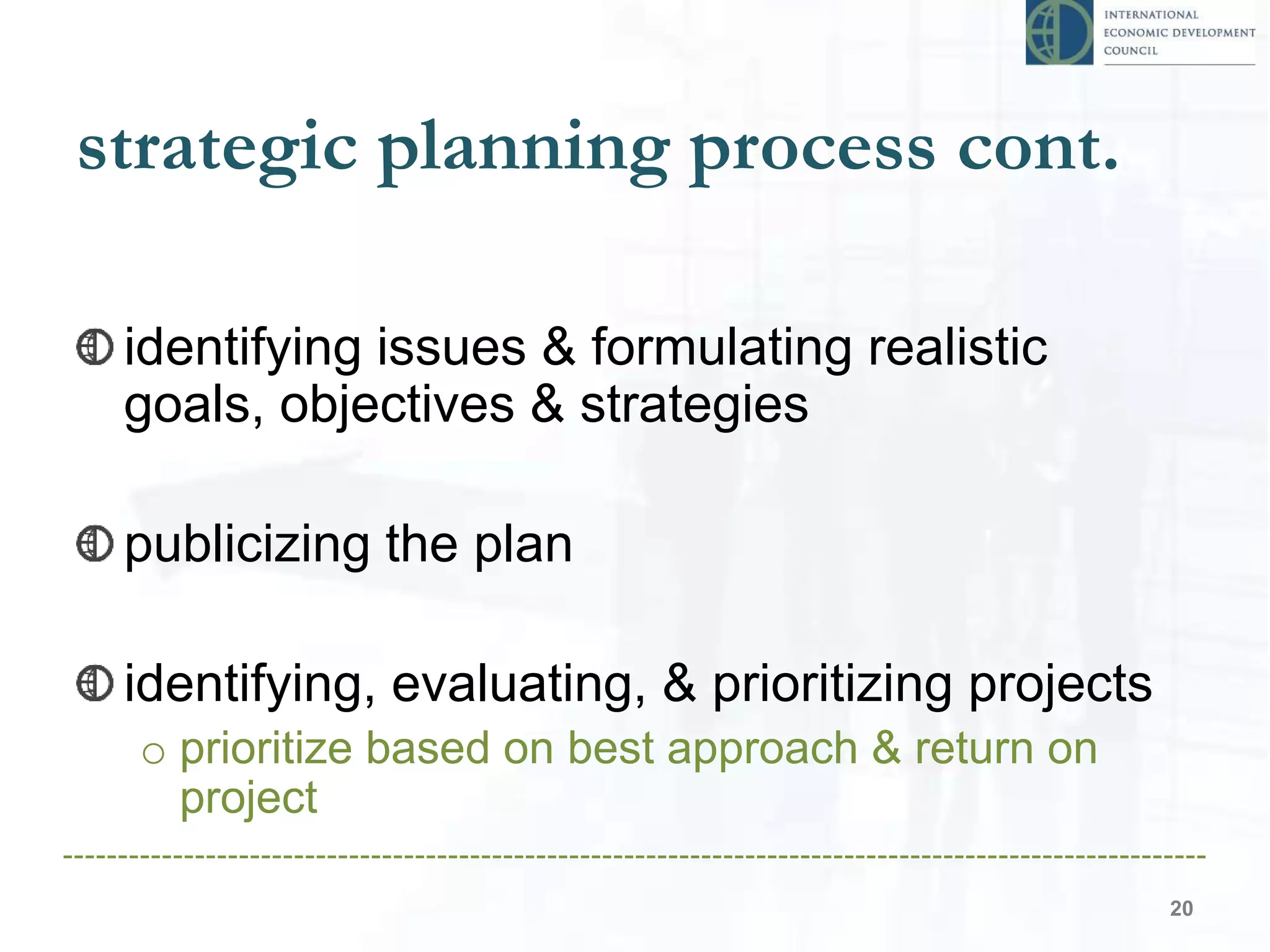
identifying issues & formulating realistic
goals, objectives & strategies
publicizing the plan
identifying, evaluating, & prioritizing projects
o prioritize based on best approach & return on
project
20
strategic planning process cont.
developing plans of action
o set out sequence of events & resources
o define physical steps
implementing plans
o may require an implementation structure or
modification of organizational structure
monitoring & evaluating outcomes
o make sure goals & projects remain realistic,
worthwhile, & relevant
21
strategic planning process cont.
retooling & adjusting
publicizing progress & outcomes
o ongoing process
22
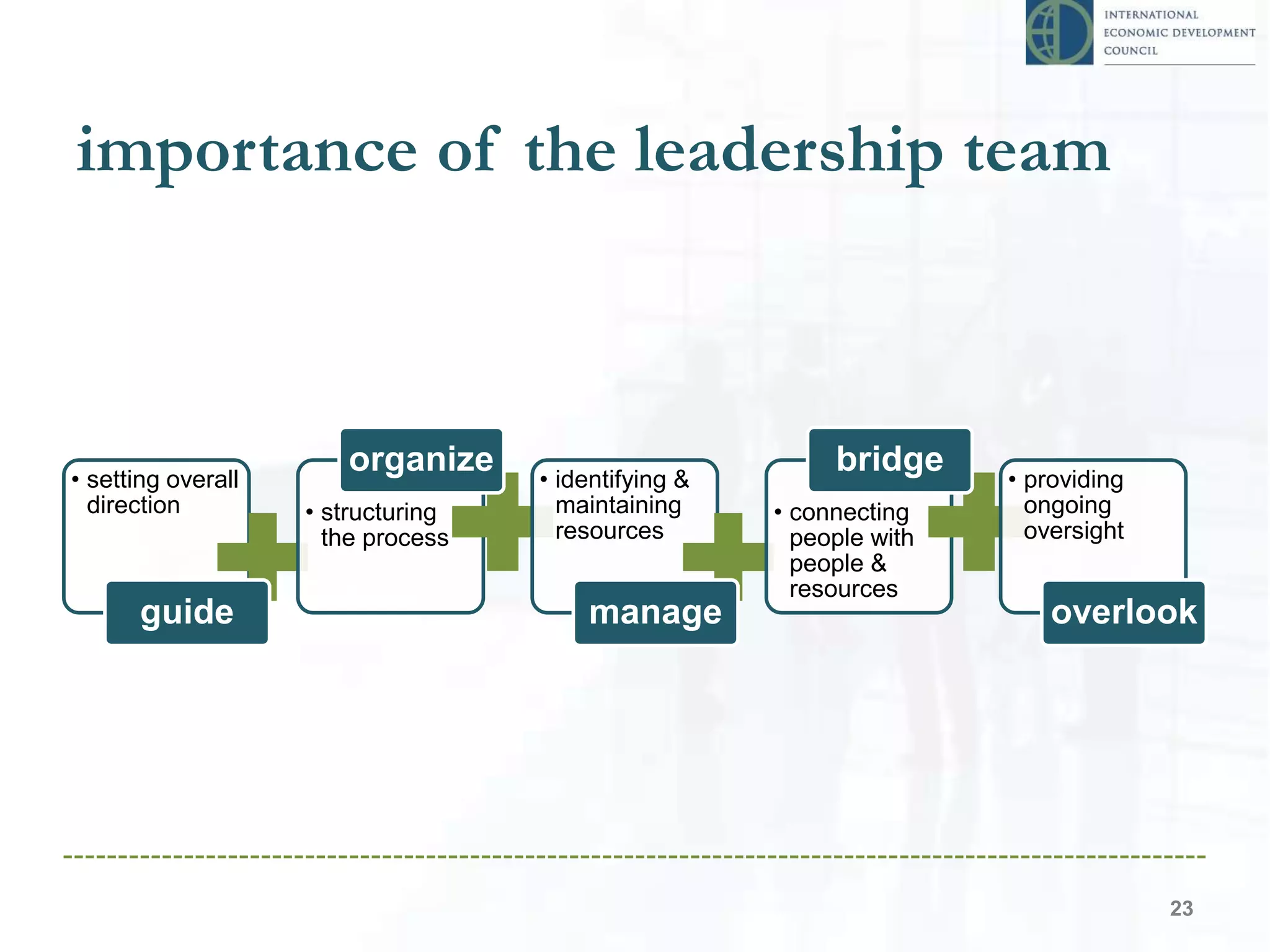
importance of the leadership team
• setting overall
direction
guide
• structuring
the process
organize • identifying &
maintaining
resources
manage
• connecting
people with
people &
resources
bridge • providing
ongoing
oversight
overlook
23
the leadership team
first...recruit those who are known for
being fair & people-focused
relationship builders
include reps from local & regional EDOs
hold regular (monthly) meetings
consider supporting committees & work group structures
select a neutral managing entity
24
factors affecting costs
scope of
plan
community
size
time to
complete plan
professional
consultants
available
budget
25
resources
U.S. Economic Development Administration
U.S. Department of Housing & Urban Development
U.S. Department of Agriculture
State Community & Economic Development Agencies
public utilities
area colleges & universities
private foundations
26
“must haves”
shared sense of urgency
clearly articulated & well-understood vision
local champions
widespread participation & buy-in (or rather
“join in”
shared commitment to progress
27
“must haves”
shared ownership (willingness to collaborate)
knowledge of what success looks like
futuristic & proactive orientation in thinking
willingness to self-invest
a let’s do it! attitude
28
“must haves”
realistic & accurate definition of the
situation
good information
cumulative goals & objectives
balanced approach
options for mutual gain
29
“must haves”
effective internal & external communications
openness to learning from others
involvement of external partners
easy-to-follow process
ongoing planning
30
“must haves”
ongoing review of the status quo
continual cultivation & acceptance of new ideas
continual recruitment of new faces to the process
community celebration of all successes
resilience
31
common barriers
not knowing how to best move forward
lack of shared community vision
apathy or complacency with status quo
poor working relationships
feeling of disconnect among citizens, leaders
inadequate volunteer support
false expectations
32
lessons from the field
Don’t bite off more than you can chew! Break large projects into
smaller digestible components based on your organization’s and
partners’ capacity to implement
Get comfortable making collective decisions without perfect information
and predictable outcomes
Give collaboration and engagement within region, diverse stakeholders,
and the public more than lip service – design and implement together
Market externally AND Internally
Understand what you can have impact over – i.e. at local level you can
impact land-use, zoning, permitting, customer service
Camoin Associates 33

Economic Development Strategic Planning

  • 1.
    Economic Development Strategic Planning JimDamicis Senior Vice President Camoin Associates Jan 21-22,2016 1
  • 2.
    Jim Damicis, SeniorVice President – Principal - Camoin Associates • Immediate Past President, Northeastern Economic Developers Association • IEDC, Economic Development Research Program, International Economic Development Council • Collaborator – Communities of the Future • 25+ Years Experience in Economic and Community Development jim@camoinassociates.com www.camoinassociates.com Twitter: @jdamicis Linkedin: www.linkedin.com/in/jdamicis Blog: www.camoinassociates.com/blog/ • Comprehensive Economic Development Strategies (CEDS) • Stakeholder Engagement • Workforce Development • Market Analysis & Financial Feasibility • Evaluation & Benchmarking Indicators • ED Communication & Marketing
  • 3.
    Introduction to StrategicPlanning 3 what is it? why do it? context/key factors benefits process lessons learned Agenda
  • 4.
    what is strategicplanning? 4 Strategic planning provides a living vehicle for community leaders to think strategically, to make sound decisions in a sea of game-changing circumstances, to focus efforts & to develop consensus for collaboratively solving problems.
  • 5.
    strategy & planning strategygets at... o Where do you want to go in the future? o Why do you want to go there? o Vision & goals of a community planning determines the answer to... o What do you want to do? o Where do you want to go? o Who should help you get there? o How should you go about getting there? 5
  • 6.
    what strategic planningis NOT not an event about planning meetings developing a great well-written report fulfilling a grant or regulatory requirement 6
  • 7.
    what strategic planningIS engaging broad spectrum of people inspiring people to work together putting individual efforts toward best benefit of collective whole process that requires a champions challenging & time-consuming 7
  • 8.
    common barriers focus onpersonalities & positions o focus on shared interests & goals instead lack of motivation for working together for change being in the “comfort zone” 8
  • 9.
    key factors drivinglocal & regional economic development Workforce, workforce, workforce! Quality of place – amenities, infrastructure, housing, recreation and culture, etc. Regional collaboration and holistic approach to economic development Customer service driven – permitting and approval processes, transparency, accountability Networks Complex Systems requiring adaptability rather than predictability Camoin Associates 9
  • 10.
    strategic planning benefits shapescommunity’s future defines community purpose provides one-stop information base provides realistic appraisal 10
  • 11.
    a critical tool meansto establish & maintain effective programs provides guidance in structuring tactical operations no proverbial clean slate o must assess current projects o use information gathered to adjust plans or establish new goals can be used for overall plans or sub-activities 11
  • 12.
    call # 1 exploreuntapped potential help inventors commercialize ideas help entrepreneurs launch successful enterprises help employers grow & sustain operations help individuals achieve meaningful career pathways help other investors maximize ROI 12
  • 13.
    call # 2 continualadaptation & innovation increased global interdependence high paced scientific & technological change communities of choice o creatively & continually reinvent o meet ever-changing needs 13
  • 14.
    call # 3 ongoingpursuit of excellence community as an enterprise o rather than simply a collection of people o set & live by high expectations plan with inventive creativity o reduces need for crisis reactivity focus on continual improvement 14
  • 15.
    ultimate strategies +action compatible with community vision feasible given strengths & weaknesses implementable given leadership & resources change-making addresses most urgent challenges innovative enables forward movement on most promising opportunities 15
  • 16.
    Ingredients for asuccessful project: Camoin Associates 16
  • 17.
    questions answered where areyou & what is your potential? o needs & opportunities o situation & context where do you want to go & why go there? o community vision o development goals 17
  • 18.
    questions answered how willyou get there & who will help? o best people & available resources o strategies & projects what will success look like for you? o key benchmarks & metrics 18
  • 19.
    strategic planning process organizing& pre-planning o identify & recruit players & stakeholders o create organizational structure o determine necessary financial & technical resources visioning o develop shared vision assessing the local community & economic competitiveness o evaluate & define your situation 19
  • 20.
    strategic planning processcont. identifying issues & formulating realistic goals, objectives & strategies publicizing the plan identifying, evaluating, & prioritizing projects o prioritize based on best approach & return on project 20
  • 21.
    strategic planning processcont. developing plans of action o set out sequence of events & resources o define physical steps implementing plans o may require an implementation structure or modification of organizational structure monitoring & evaluating outcomes o make sure goals & projects remain realistic, worthwhile, & relevant 21
  • 22.
    strategic planning processcont. retooling & adjusting publicizing progress & outcomes o ongoing process 22
  • 23.
    importance of theleadership team • setting overall direction guide • structuring the process organize • identifying & maintaining resources manage • connecting people with people & resources bridge • providing ongoing oversight overlook 23
  • 24.
    the leadership team first...recruitthose who are known for being fair & people-focused relationship builders include reps from local & regional EDOs hold regular (monthly) meetings consider supporting committees & work group structures select a neutral managing entity 24
  • 25.
    factors affecting costs scopeof plan community size time to complete plan professional consultants available budget 25
  • 26.
    resources U.S. Economic DevelopmentAdministration U.S. Department of Housing & Urban Development U.S. Department of Agriculture State Community & Economic Development Agencies public utilities area colleges & universities private foundations 26
  • 27.
    “must haves” shared senseof urgency clearly articulated & well-understood vision local champions widespread participation & buy-in (or rather “join in” shared commitment to progress 27
  • 28.
    “must haves” shared ownership(willingness to collaborate) knowledge of what success looks like futuristic & proactive orientation in thinking willingness to self-invest a let’s do it! attitude 28
  • 29.
    “must haves” realistic &accurate definition of the situation good information cumulative goals & objectives balanced approach options for mutual gain 29
  • 30.
    “must haves” effective internal& external communications openness to learning from others involvement of external partners easy-to-follow process ongoing planning 30
  • 31.
    “must haves” ongoing reviewof the status quo continual cultivation & acceptance of new ideas continual recruitment of new faces to the process community celebration of all successes resilience 31
  • 32.
    common barriers not knowinghow to best move forward lack of shared community vision apathy or complacency with status quo poor working relationships feeling of disconnect among citizens, leaders inadequate volunteer support false expectations 32
  • 33.
    lessons from thefield Don’t bite off more than you can chew! Break large projects into smaller digestible components based on your organization’s and partners’ capacity to implement Get comfortable making collective decisions without perfect information and predictable outcomes Give collaboration and engagement within region, diverse stakeholders, and the public more than lip service – design and implement together Market externally AND Internally Understand what you can have impact over – i.e. at local level you can impact land-use, zoning, permitting, customer service Camoin Associates 33