
Food security means :
0 availability,
0 accessibility and
0 affordability of food to all people at all times.
Food Security is ensured in a
country only if
0 Enough food is available for all the persons
0 All persons have the capacity to buy food of acceptable
quality and
0 There is no barrier on access to food.
Need for Food Security:
0 For the poor sections of the society
0 Natural disasters or calamity like earthquake,
drought, flood, tsunami,
0 Widespread crop failure due to drought
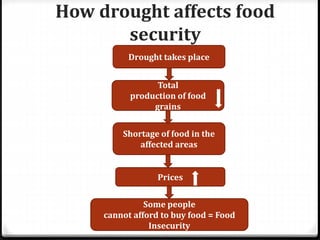
How drought affects food
security
Drought takes place
Total
production of food
grains
Shortage of food in the
affected areas
Prices
Some people
cannot afford to buy food = Food
Insecurity
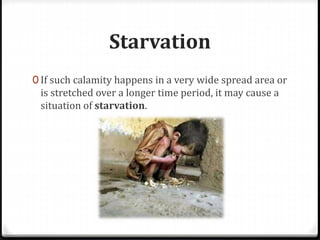
Starvation
0 If such calamity happens in a very wide spread area or
is stretched over a longer time period, it may cause a
situation of starvation.
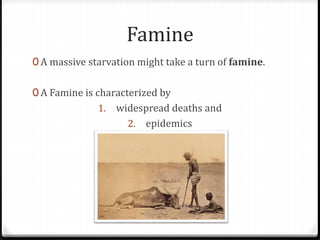
Famine
0 A massive starvation might take a turn of famine.
0 A Famine is characterized by
1. widespread deaths and
2. epidemics
Famines and Starvation Deaths in
India
0 Bengal Famine, 1943
-killed 1.5 million to 3 million
0 The Bihar famine, 1966-7
- 2,353 deaths due to starvation reported
Starvation deaths have also been reported in:
1. Kalahandi and Kashipur in Orissa
2. Baran district of Rajasthan,
3. Palamau district of Jharkhand
and many other remote areas during the recent
years.
Food Insecure Groups
Worst Affected Groups:
0 landless people
0 traditional artisans
0 traditional services providers
0 petty self-employed workers
0 Homeless, beggars etc.
0 Families employed in ill-paid occupations
0 casual labourers (seasonal activities+ very low wages)
0 SCs, STs and some sections of the OBCs (lower castes
among them) –having poor land-base or very low land
productivity
0 Migrants ( as a result of natural disasters )
0 Women and children
States facing problem of food
insecurity
0 Uttar Pradesh (eastern and south-eastern parts),
Bihar,
0 Jharkhand,
0 Orissa,
0 West Bengal,
0 Chattisgarh,
0 parts of Madhya Pradesh and
0 Maharasthra
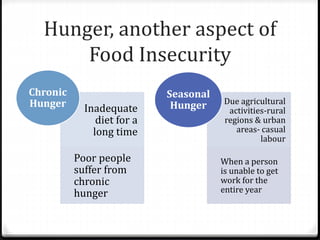
Hunger, another aspect of
Food Insecurity
Inadequate
diet for a
long time
Poor people
suffer from
chronic
hunger
Chronic
Hunger Due agricultural
activities-rural
regions & urban
areas- casual
labour
When a person
is unable to get
work for the
entire year
Seasonal
Hunger
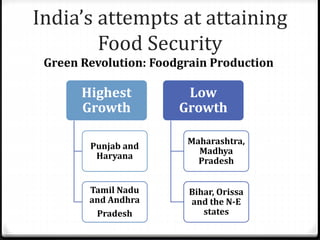
India’s attempts at attaining
Food Security
Highest
Growth
Punjab and
Haryana
Tamil Nadu
and Andhra
Pradesh
Low
Growth
Maharashtra,
Madhya
Pradesh
Bihar, Orissa
and the N-E
states
Green Revolution: Foodgrain Production
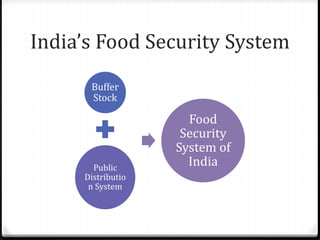
India’s Food Security System
Buffer
Stock
Public
Distributio
n System
Food
Security
System of
India
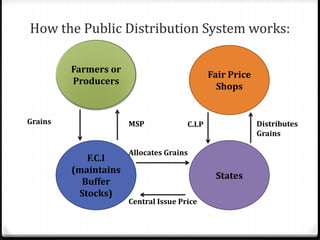
How the Public Distribution System works:
Farmers or
Producers
States
Fair Price
Shops
F.C.I
(maintains
Buffer
Stocks)
Grains MSP
Allocates Grains
Central Issue Price
C.I.P Distributes
Grains
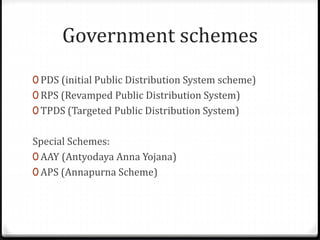
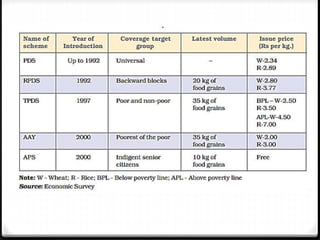
Government schemes
0 PDS (initial Public Distribution System scheme)
0 RPS (Revamped Public Distribution System)
0 TPDS (Targeted Public Distribution System)
Special Schemes:
0 AAY (Antyodaya Anna Yojana)
0 APS (Annapurna Scheme)
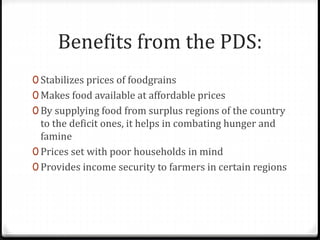
Benefits from the PDS:
0 Stabilizes prices of foodgrains
0 Makes food available at affordable prices
0 By supplying food from surplus regions of the country
to the deficit ones, it helps in combating hunger and
famine
0 Prices set with poor households in mind
0 Provides income security to farmers in certain regions
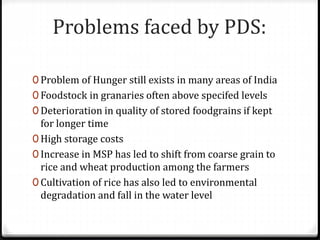
Problems faced by PDS:
0 Problem of Hunger still exists in many areas of India
0 Foodstock in granaries often above specifed levels
0 Deterioration in quality of stored foodgrains if kept
for longer time
0 High storage costs
0 Increase in MSP has led to shift from coarse grain to
rice and wheat production among the farmers
0 Cultivation of rice has also led to environmental
degradation and fall in the water level
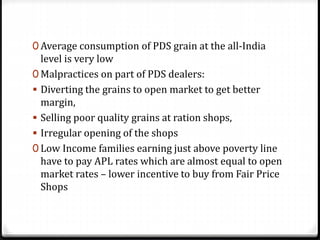
0 Average consumption of PDS grain at the all-India
level is very low
0 Malpractices on part of PDS dealers:
 Diverting the grains to open market to get better
margin,
 Selling poor quality grains at ration shops,
 Irregular opening of the shops
0 Low Income families earning just above poverty line
have to pay APL rates which are almost equal to open
market rates – lower incentive to buy from Fair Price
Shops
Food security

Food security

  • 2.
    Food security means: 0 availability, 0 accessibility and 0 affordability of food to all people at all times.
  • 3.
    Food Security isensured in a country only if 0 Enough food is available for all the persons 0 All persons have the capacity to buy food of acceptable quality and 0 There is no barrier on access to food.
  • 4.
    Need for FoodSecurity: 0 For the poor sections of the society 0 Natural disasters or calamity like earthquake, drought, flood, tsunami, 0 Widespread crop failure due to drought
  • 5.
    How drought affectsfood security Drought takes place Total production of food grains Shortage of food in the affected areas Prices Some people cannot afford to buy food = Food Insecurity
  • 6.
    Starvation 0 If suchcalamity happens in a very wide spread area or is stretched over a longer time period, it may cause a situation of starvation.
  • 7.
    Famine 0 A massivestarvation might take a turn of famine. 0 A Famine is characterized by 1. widespread deaths and 2. epidemics
  • 8.
    Famines and StarvationDeaths in India 0 Bengal Famine, 1943 -killed 1.5 million to 3 million 0 The Bihar famine, 1966-7 - 2,353 deaths due to starvation reported Starvation deaths have also been reported in: 1. Kalahandi and Kashipur in Orissa 2. Baran district of Rajasthan, 3. Palamau district of Jharkhand and many other remote areas during the recent years.
  • 9.
    Food Insecure Groups WorstAffected Groups: 0 landless people 0 traditional artisans 0 traditional services providers 0 petty self-employed workers 0 Homeless, beggars etc. 0 Families employed in ill-paid occupations 0 casual labourers (seasonal activities+ very low wages)
  • 10.
    0 SCs, STsand some sections of the OBCs (lower castes among them) –having poor land-base or very low land productivity 0 Migrants ( as a result of natural disasters ) 0 Women and children
  • 11.
    States facing problemof food insecurity 0 Uttar Pradesh (eastern and south-eastern parts), Bihar, 0 Jharkhand, 0 Orissa, 0 West Bengal, 0 Chattisgarh, 0 parts of Madhya Pradesh and 0 Maharasthra
  • 12.
    Hunger, another aspectof Food Insecurity Inadequate diet for a long time Poor people suffer from chronic hunger Chronic Hunger Due agricultural activities-rural regions & urban areas- casual labour When a person is unable to get work for the entire year Seasonal Hunger
  • 13.
    India’s attempts atattaining Food Security Highest Growth Punjab and Haryana Tamil Nadu and Andhra Pradesh Low Growth Maharashtra, Madhya Pradesh Bihar, Orissa and the N-E states Green Revolution: Foodgrain Production
  • 14.
    India’s Food SecuritySystem Buffer Stock Public Distributio n System Food Security System of India
  • 15.
    How the PublicDistribution System works: Farmers or Producers States Fair Price Shops F.C.I (maintains Buffer Stocks) Grains MSP Allocates Grains Central Issue Price C.I.P Distributes Grains
  • 16.
    Government schemes 0 PDS(initial Public Distribution System scheme) 0 RPS (Revamped Public Distribution System) 0 TPDS (Targeted Public Distribution System) Special Schemes: 0 AAY (Antyodaya Anna Yojana) 0 APS (Annapurna Scheme)
  • 18.
    Benefits from thePDS: 0 Stabilizes prices of foodgrains 0 Makes food available at affordable prices 0 By supplying food from surplus regions of the country to the deficit ones, it helps in combating hunger and famine 0 Prices set with poor households in mind 0 Provides income security to farmers in certain regions
  • 19.
    Problems faced byPDS: 0 Problem of Hunger still exists in many areas of India 0 Foodstock in granaries often above specifed levels 0 Deterioration in quality of stored foodgrains if kept for longer time 0 High storage costs 0 Increase in MSP has led to shift from coarse grain to rice and wheat production among the farmers 0 Cultivation of rice has also led to environmental degradation and fall in the water level
  • 20.
    0 Average consumptionof PDS grain at the all-India level is very low 0 Malpractices on part of PDS dealers:  Diverting the grains to open market to get better margin,  Selling poor quality grains at ration shops,  Irregular opening of the shops 0 Low Income families earning just above poverty line have to pay APL rates which are almost equal to open market rates – lower incentive to buy from Fair Price Shops