ISHAN DEWANGAN
1
FOOD SAFETY MANAGEMENT TOOLS-
BASIC CONCEPT
Food Safety Management System means the
adoption of Good Manufacturing Practices,
Good Hygienic Practices, Sanitation Standard
Operating Procedures, Hazard Analysis, and
Critical Control Points.
Adulteration of foodstuffs may threat to the
consumer.
To safeguard the people from health hazards
posed by contaminants and adulterants, it’s
necessary to have s strict control over quality
of a foods.
It does not harm only to public health but also
have impact over international trade.
PRE-REQUISITER PROGRAMS (PRPs)
Pre-requisite programs (PRPs) are the basic
food safety conditions and activities that are
necessary to maintain a hygienic environment
throughout the food chain suitable for the
production, handling, and provision of safe
ISHAN DEWANGAN
2
products and safe food, for human
consumption.
It includes GMP, GHP, SSOP
GOOD MANUFACTURING PRACTICES (GMP)
The guidance that outlines the aspects of
production and testing that can impact the
quality of a food product are called Good
Manufacturing practices (GMP).
I) Premises: It deals with the building of
an organization, location, of industry.
The neighbouring areas should not
have companies that handle or
produce toxic substances.
There should be enough light for
people to do their job and light
themselves do not cause a hazard.
II) Equipment: Equipment and utensils
used for food preparation should be
preferable of stainless steel, have food
grade/ISI mark, properly fitted with
cover or lid to prevent contamination
ISHAN DEWANGAN
3
and design for easy maintenance and
cleaning.
Also equipment and machinery that
comes in contact with products should
be kept as clean and dry as
practicable.
III) Transport and storage: It deals with
the mode of transport and storage of
food at suitable temperatures and
humidity. A proper transportation
facility should be used to transport the
raw materials as well as the finished
products.
IV) Training of personnel: Employees
should be well trained on personal
hygiene and understand the
implications of their actions on food
safety. Also, the superiors should
conduct checks regularly.
GOOD HYGIENE PRACTICES (GHP)
Good Hygiene Practices means All practices
regarding the conditions and measures.
necessary to ensure the safety and suitability
ISHAN DEWANGAN
4
of food at all stages of the food chain. Its aim
is to produce the food in proper hygienic
conditions with minimum or no contamination.
It can be achieved by following practices:-
1) Personal and body hygiene: it refers to
the practices performed by an individual
to care for ones body health and well
being related to self care of person
working in food industry.
2) Active recordkeeping: A proper record
of hygiene practices adopted especially
during the manufacturing process along
with visitors’ data should be maintained.
3) Policy on visitors: : The food production
house should have a strict policy on
visitors. Either they should not allow or if
allowed they should follow personal
hygiene practices.
SANITATION STANDARDS OPERATING
PROCEDURES (SSOPs)
Sanitation Standard Operating Procedures
(SSOPs) are generally documented steps that
must be followed to ensure adequate cleaning
of product contact and non-contact surfaces
ISHAN DEWANGAN
5
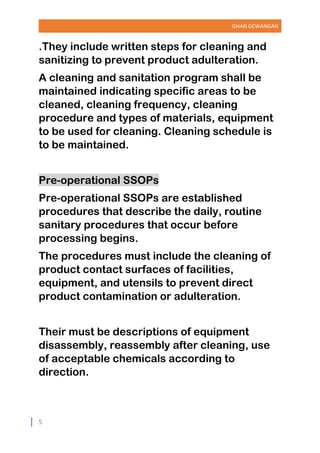
.They include written steps for cleaning and
sanitizing to prevent product adulteration.
A cleaning and sanitation program shall be
maintained indicating specific areas to be
cleaned, cleaning frequency, cleaning
procedure and types of materials, equipment
to be used for cleaning. Cleaning schedule is
to be maintained.
Pre-operational SSOPs
Pre-operational SSOPs are established
procedures that describe the daily, routine
sanitary procedures that occur before
processing begins.
The procedures must include the cleaning of
product contact surfaces of facilities,
equipment, and utensils to prevent direct
product contamination or adulteration.
Their must be descriptions of equipment
disassembly, reassembly after cleaning, use
of acceptable chemicals according to
direction.
ISHAN DEWANGAN
6
Post-operational SSOPs
Post-operational SSOPs are established
procedures that describe the daily, routine
sanitary procedures that will be conducted
during operations to prevent direct product
contamination or adulteration.
These might include:-
1. Equipment and utensil
cleaning/sanitizing/disinfecting during
production, as appropriate, at breaks,
between shifts, and at mid-shift cleanup.
2. Procedures for employee hygiene, such as
the cleanliness of outer garments and gloves,
hair restraints, handwashing, health, etc.
3. Product handling in raw and in the cooked
product areas.
HAZARD ANALYSIS AND CRITICAL CONTROL
POINTS
Hazard analysis critical control point
(HACCP), is a systematic preventive approach
to food safety from biological, chemical, and
physical hazards in production processes that
can cause the finished product to be unsafe
ISHAN DEWANGAN
7
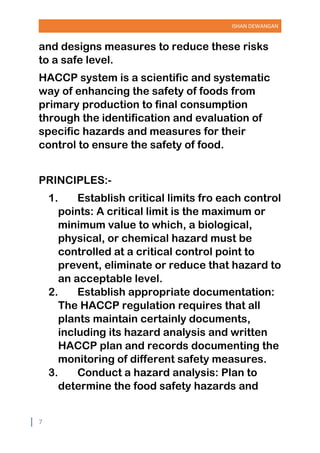
and designs measures to reduce these risks
to a safe level.
HACCP system is a scientific and systematic
way of enhancing the safety of foods from
primary production to final consumption
through the identification and evaluation of
specific hazards and measures for their
control to ensure the safety of food.
PRINCIPLES:-
1. Establish critical limits fro each control
points: A critical limit is the maximum or
minimum value to which, a biological,
physical, or chemical hazard must be
controlled at a critical control point to
prevent, eliminate or reduce that hazard to
an acceptable level.
2. Establish appropriate documentation:
The HACCP regulation requires that all
plants maintain certainly documents,
including its hazard analysis and written
HACCP plan and records documenting the
monitoring of different safety measures.
3. Conduct a hazard analysis: Plan to
determine the food safety hazards and
ISHAN DEWANGAN
8
identify the preventive measures, the plan
can applyto control these hazards.

FOOD SAFETY MANAGEMENT TOOLS- CONCEPT

  • 1.
    ISHAN DEWANGAN 1 FOOD SAFETYMANAGEMENT TOOLS- BASIC CONCEPT Food Safety Management System means the adoption of Good Manufacturing Practices, Good Hygienic Practices, Sanitation Standard Operating Procedures, Hazard Analysis, and Critical Control Points. Adulteration of foodstuffs may threat to the consumer. To safeguard the people from health hazards posed by contaminants and adulterants, it’s necessary to have s strict control over quality of a foods. It does not harm only to public health but also have impact over international trade. PRE-REQUISITER PROGRAMS (PRPs) Pre-requisite programs (PRPs) are the basic food safety conditions and activities that are necessary to maintain a hygienic environment throughout the food chain suitable for the production, handling, and provision of safe
  • 2.
    ISHAN DEWANGAN 2 products andsafe food, for human consumption. It includes GMP, GHP, SSOP GOOD MANUFACTURING PRACTICES (GMP) The guidance that outlines the aspects of production and testing that can impact the quality of a food product are called Good Manufacturing practices (GMP). I) Premises: It deals with the building of an organization, location, of industry. The neighbouring areas should not have companies that handle or produce toxic substances. There should be enough light for people to do their job and light themselves do not cause a hazard. II) Equipment: Equipment and utensils used for food preparation should be preferable of stainless steel, have food grade/ISI mark, properly fitted with cover or lid to prevent contamination
  • 3.
    ISHAN DEWANGAN 3 and designfor easy maintenance and cleaning. Also equipment and machinery that comes in contact with products should be kept as clean and dry as practicable. III) Transport and storage: It deals with the mode of transport and storage of food at suitable temperatures and humidity. A proper transportation facility should be used to transport the raw materials as well as the finished products. IV) Training of personnel: Employees should be well trained on personal hygiene and understand the implications of their actions on food safety. Also, the superiors should conduct checks regularly. GOOD HYGIENE PRACTICES (GHP) Good Hygiene Practices means All practices regarding the conditions and measures. necessary to ensure the safety and suitability
  • 4.
    ISHAN DEWANGAN 4 of foodat all stages of the food chain. Its aim is to produce the food in proper hygienic conditions with minimum or no contamination. It can be achieved by following practices:- 1) Personal and body hygiene: it refers to the practices performed by an individual to care for ones body health and well being related to self care of person working in food industry. 2) Active recordkeeping: A proper record of hygiene practices adopted especially during the manufacturing process along with visitors’ data should be maintained. 3) Policy on visitors: : The food production house should have a strict policy on visitors. Either they should not allow or if allowed they should follow personal hygiene practices. SANITATION STANDARDS OPERATING PROCEDURES (SSOPs) Sanitation Standard Operating Procedures (SSOPs) are generally documented steps that must be followed to ensure adequate cleaning of product contact and non-contact surfaces
  • 5.
    ISHAN DEWANGAN 5 .They includewritten steps for cleaning and sanitizing to prevent product adulteration. A cleaning and sanitation program shall be maintained indicating specific areas to be cleaned, cleaning frequency, cleaning procedure and types of materials, equipment to be used for cleaning. Cleaning schedule is to be maintained. Pre-operational SSOPs Pre-operational SSOPs are established procedures that describe the daily, routine sanitary procedures that occur before processing begins. The procedures must include the cleaning of product contact surfaces of facilities, equipment, and utensils to prevent direct product contamination or adulteration. Their must be descriptions of equipment disassembly, reassembly after cleaning, use of acceptable chemicals according to direction.
  • 6.
    ISHAN DEWANGAN 6 Post-operational SSOPs Post-operationalSSOPs are established procedures that describe the daily, routine sanitary procedures that will be conducted during operations to prevent direct product contamination or adulteration. These might include:- 1. Equipment and utensil cleaning/sanitizing/disinfecting during production, as appropriate, at breaks, between shifts, and at mid-shift cleanup. 2. Procedures for employee hygiene, such as the cleanliness of outer garments and gloves, hair restraints, handwashing, health, etc. 3. Product handling in raw and in the cooked product areas. HAZARD ANALYSIS AND CRITICAL CONTROL POINTS Hazard analysis critical control point (HACCP), is a systematic preventive approach to food safety from biological, chemical, and physical hazards in production processes that can cause the finished product to be unsafe
  • 7.
    ISHAN DEWANGAN 7 and designsmeasures to reduce these risks to a safe level. HACCP system is a scientific and systematic way of enhancing the safety of foods from primary production to final consumption through the identification and evaluation of specific hazards and measures for their control to ensure the safety of food. PRINCIPLES:- 1. Establish critical limits fro each control points: A critical limit is the maximum or minimum value to which, a biological, physical, or chemical hazard must be controlled at a critical control point to prevent, eliminate or reduce that hazard to an acceptable level. 2. Establish appropriate documentation: The HACCP regulation requires that all plants maintain certainly documents, including its hazard analysis and written HACCP plan and records documenting the monitoring of different safety measures. 3. Conduct a hazard analysis: Plan to determine the food safety hazards and
  • 8.
    ISHAN DEWANGAN 8 identify thepreventive measures, the plan can applyto control these hazards.