































































INDIRA GANDHI AGRICULTURAL
UNIVERSITY
Raipur, chhattisgarh
Agri business management notes
Abm 5221 3(2+1)
2 year 2 semester
(Hindi + English)
Slides by ISHAN DEWANGAN
BTC CARS, BILASPUR
BUSINESS: BUSINESS IN AN ECONOMIC ACTIVITY CARRIED ON BY THE ENTREPRENEUR & MANAGEMENT
THROUGH THE DIFFERENT EMPLOYEES FOR THE VARIOUS CONSUMER & THE GROUPS OF SOCIETY AT
LAST.
व्यवसाय: उद्यमी द्वारा की जाने वाली आर्थिक गतिववर्ि में व्यवसाय
ववभिन्न उपिोक्िाओं और उपिोक्िाओं क
े भलए ववभिन्न कमिचाररयों क
े माध्ययम से ्रबंंिन
अंि में समाज क
े समूह।
AGRIBUISNESS
“agribusiness as all the activities concerned with agriculture including farming, management,
financing, processing, marketing, growing of seeds and nursery stock, manufacture of
fertilizers, chemicals, implements, processing machinery, transportation equipment and the
process of transportation itself.”
-JOHN H. DAVIS
कृ वि व्यवसाय से संंंर्िि सिी गतिववर्ियों क
े रूप में कृ वि, ्रबंंिन, ववत्तपोिण, ्रबसंस्करण, ववपणन सहहि
कृ वि, ंीज और नसिरी स्टॉक की वृद्र्ि, उविरकों, रसायनों का तनमािण, उपकरण, ्रबसंस्करण मशीनरी,
पररवहन उपकरण और पररहन की ्रबक्रिया ।
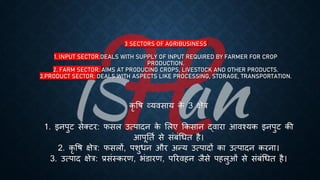
3 SECTORS OF AGRIBUSINESS
1. INPUT SECTOR:DEALS WITH SUPPLY OF INPUT REQUIRED BY FARMER FOR CROP
PRODUCTION.
2. FARM SECTOR: AIMS AT PRODUCING CROPS, LIVESTOCK AND OTHER PRODUCTS.
3.PRODUCT SECTOR: DEALS WITH ASPECTS LIKE PROCESSING, STORAGE, TRANSPORTATION.
कृ वि व्यवसाय क
े 3 क्षेत्र
1. इनपुट सेक्टर: फसल उत्पादन क
े भलए क्रकसान द्वारा आवश्यक इनपुट की
आपूतिि से संंंर्िि है।
2. कृ वि क्षेत्र: फसलों, पशुिन और अन्य उत्पादों का उत्पादन करना।
3. उत्पाद क्षेत्र: ्रबसंस्करण, िंडारण, पररवहन जैसे पहलुओं से संंंर्िि है।
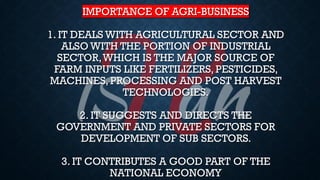
IMPORTANCE OF AGRI-BUSINESS
1. IT DEALS WITH AGRICULTURAL SECTOR AND
ALSO WITH THE PORTION OF INDUSTRIAL
SECTOR,WHICH IS THE MAJOR SOURCE OF
FARM INPUTS LIKE FERTILIZERS, PESTICIDES,
MACHINES, PROCESSING AND POST HARVEST
TECHNOLOGIES.
2. IT SUGGESTS AND DIRECTS THE
GOVERNMENT AND PRIVATE SECTORS FOR
DEVELOPMENT OF SUB SECTORS.
3. IT CONTRIBUTES A GOOD PART OF THE
NATIONAL ECONOMY
कृ वि व्यवसाय का महत्व
1. यह कृ वि क्षेत्र और औद्योर्गक क्षेत्र क
े हहस्से से िी संंंर्िि
है, जो उविरकों, कीटनाशकों, मशीनों, ्रबसंस्करण और कटाई क
े
ंाद की ्रबौद्योर्गक्रकयों जैसे कृ वि आदानों का ्रबमुख स्रोि है।
2. यह उप-क्षेत्रों क
े ववकास क
े भलए सरकारी और तनजी क्षेत्रों का
सुझाव और तनदेश देिा है।
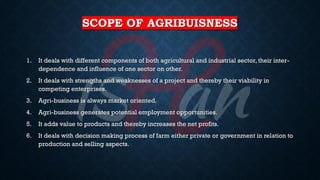
SCOPE OF AGRIBUISNESS
1. It deals with different components of both agricultural and industrial sector, their inter-
dependence and influence of one sector on other.
2. It deals with strengths and weaknesses of a project and thereby their viability in
competing enterprises.
3. Agri-business is always market oriented.
4. Agri-business generates potential employment opportunities.
5. It adds value to products and thereby increases the net profits.
6. It deals with decision making process of farm either private or government in relation to
production and selling aspects.
कृ वि व्यवसाय का दायरा
1. यह कृ वि और औद्योर्गक दोनों क्षेत्रों क
े ववभिन्न घटकों, उनकी अंिर-तनििरिा और एक क्षेत्र क
े दूसरे पर ्रबिाव
से संंंर्िि है।
2. यह एक पररयोजना की िाकि और कमजोररयों से संंंर्िि है और इस ्रबकार ्रबतिस्पिी उद्यमों में उनकी
व्यवहायििा है।
3. कृ वि व्यवसाय हमेशा ंाजार उन्मुख होिा है।
4. कृ वि व्यवसाय रोजगार क
े संिाववि अवसर पैदा करिा है।
5. यह उत्पादों में मूल्य जोड़िा है और इस ्रबकार शुद्ि लाि ंढािा है।
6. यह उत्पादन और बंिी पहलुओं क
े संंंि में तनजी या सरकारी कृ वि की तनणिय लेने की ्रबक्रिया से संंंर्िि है।
LECTURE 02
IMPORTANCE OF AGRIBUISNESS IN INDIAN
ECONOMY
• Share in national income.
• Source of employment.
• Supply of raw material to industrial sector.
• Market for industrial products.
• राष्ट्रीय आय में हहस्सा।
• रोजगार का स्रोि।
• औद्योर्गक क्षेत्र को कच्चे माल की आपूतिि।
• औद्योर्गक उत्पादों क
े भलए ंाजार।
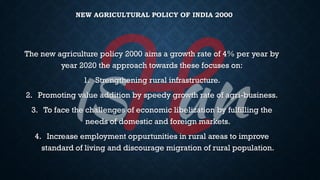
NEW AGRICULTURAL POLICY OF INDIA 2000
The new agriculture policy 2000 aims a growth rate of 4% per year by
year 2020 the approach towards these focuses on:
1. Strengthening rural infrastructure.
2. Promoting value addition by speedy growth rate of agri-business.
3. To face the challenges of economic libelization by fulfilling the
needs of domestic and foreign markets.
4. Increase employment oppurtunities in rural areas to improve
standard of living and discourage migration of rural population.
भारत की नई कृ षि नीतत 2000
• नई कृ वि नीति 2000 का लक्ष्य विि 2020 िक ्रबति विि 4% की वृद्र्ि दर है, इन क
े ्रबति
दृष्ष्ट्टकोण इस पर क
ें हिि है:
• ग्रामीण ंुतनयादी ढांचे को मजंूि करना।
• कृ वि व्यवसाय की िीव्र ववकास दर द्वारा मूल्य संवििन को ंढावा देना।
• घरेलू और ववदेशी ंाजारों की जरूरिों को पूरा करक
े आर्थिक पररवाद की चुनौतियों का सामना
करना।
• जीवन स्िर में सुिार लाने और ग्रामीण आंादी क
े पलायन को हिोत्साहहि करने क
े भलए
ग्रामीण क्षेत्रों में रोजगार की संिावनाओं में वृद्र्ि|
FEATURES OF N.A.P.
1. Participation of the private sector by encouraging contract timing.
2. High priority to development of animal husbandry, poultry, dairy and
aquaculture.
3. Rational utilization of country’s water resources for optimum use of
irrigation potential.
4. Over 4 % annual growth rate aimed over next 20 years
5. High priority to rural electrification.
6. Plant varieties to be protected through a legislation.
7. Adequate and timely supply of quality inputs to a farmer.
N.A.P. की षिशेिताएं
1. अनुंंि समय को ्रबोत्साहहि करक
े तनजी क्षेत्र की िागीदारी।
2. पशुपालन, क
ु क्क
ु ट पालन, डेयरी और जलीय कृ वि क
े ववकास को उच्च
्रबाथभमकिा।
3. भसंचाई क्षमिा क
े इष्ट्टिम उपयोग क
े भलए देश क
े जल संसािनों का िक
ि संगि
उपयोग।
4. अगले 20 विों में 4% से अर्िक वावििक ववकास दर का लक्ष्य
5. ग्रामीण ववद्युिीकरण को उच्च ्रबाथभमकिा।
6. पौिों की क्रकस्मों को एक कानून क
े माध्ययम से संरक्षक्षि क्रकया जाएगा।
7. एक क्रकसान को गुणवत्तापूणि आदानों की पयािप्ि और समय पर आपूतिि।
ISSUES UNDER FOCUS
मुद्दों पर ध्यान ददया जा रहा है
• Sustainable agriculture
• Food and nutritional security
• Investments in agriculture
• Institutional structures
• Inputs management
• Generation and transfer of technology
सिि कृ वि
खाद्य और पोिण सुरक्षा
कृ वि में तनवेश
संस्थागि संरचनाएं
इनपुट ्रबंंिन
्रबौद्योर्गकी का उत्पादन और हस्िांिरण
LECTURE 03
IMPORTANCE OF AGRO-BASED INDUSTRY
• Establishment of agro-based industries is based on the availability of raw material.
• Agro-based industries have to set up at rural areas where raw material may be available in
plenty – helps in the upliftment of the rural economy.
• Provide rural population an opportunity for employment.
• Generate income and thereby improve economic condition of people – which in turn
creates potential for demand based industries.
• Provide an opportunity for the dispersal of industries instead of concentrating at a
particular place.
• Solve the problem of exploitation of farming community by traders and middlemen.
*FARMERS COULD BE ASSURED OF BETTER PRICE FOR THEIR PRODUCE.
* ENCOURAGE TO BRING MORE AND MORE AREAS UNDER VARIOUS
CROPS – INCREASE AGRICULTURAL PRODUCTION AND IMPROVE
NATIONS ECONOMY.
*TRANSPORTATION COST OF AGRICULTURAL PRODUCTS CAN BE
MINIMIZED – THEREBY HELP TO MINIMIZE COST OF FINISHED GOODS.
*AVOID WASTAGE OF PERISHABLE AGRICULTURAL PRODUCTS.
HELP TO DEVELOP BACKWARD AREAS BASED ON THEIR SUITABILITY FOR
SETTING UP AGROINDUSTRIES.
*PREVENT MIGRATION OF PEOPLE FROM RURAL TO URBAN AREAS.
कृ षि आधाररत उद्योग का महत्ि
• कृ वि आिाररि उद्योगों की स्थापना कच्चे माल की उपलब्ििा पर आिाररि है।
• कृ वि आिाररि उद्योगों को ग्रामीण क्षेत्रों में स्थावपि करना होगा जहां कच्चा
माल ्रबचुर मात्रा में उपलब्ि हो सकिा है - ग्रामीण अथिव्यवस्था क
े उत्थान में
मदद करिा है।
• ग्रामीण आंादी को रोजगार का अवसर ्रबदान करें।
• आय उत्पन्न करना और इस िरह लोगों की आर्थिक ष्स्थति में सुिार करना -
जो ंदले में मांग आिाररि उद्योगों की क्षमिा पैदा करिा है।
• क्रकसी ववशेि स्थान पर ध्ययान क
ें हिि करने क
े ंजाय उद्योगों क
े फ
ै लाव क
े भलए
एक अवसर ्रबदान करें।
• व्यापाररयों और बंचौभलयों द्वारा कृ िक समुदाय क
े शोिण की समस्या का
समािान करें।
• *क्रकसानों को उनकी उपज का ंेहिर मूल्य हदलाने का आश्वासन हदया जा
सकिा है।
* ववभिन्न फसलों क
े िहि अर्िक से अर्िक क्षेत्रों को लाने क
े भलए ्रबोत्साहहि
करें - कृ वि उत्पादन में वृद्र्ि और राष्ट्र की अथिव्यवस्था में सुिार।
* कृ वि उत्पादों की पररवहन लागि को कम क्रकया जा सकिा है - ष्जससे िैयार
माल की लागि को कम करने में मदद भमलिी है।
*जल्दी खरां होने वाले कृ वि उत्पादों की ंंािदी से ंचें।
कृ वि उद्योगों की स्थापना क
े भलए वपछड़े क्षेत्रों को उनकी उपयुक्ििा क
े आिार
पर ववकभसि करने में मदद करना।
*ग्रामीण क्षेत्रों से शहरी क्षेत्रों में लोगों क
े पलायन को रोकना।
NEED OF AGRO-BASED INDUSTRIES
• Suitable to rural areas as they are raw material oriented.
• For upliftment of rural economy.
• To solve the problem of unemployment.
• To generate income and increase standard of living.
• For decentralization and dispersal of industries.
• To reduce disparity between rural and urban areas.
• To encourage balanced growth between agriculture and industry.
• To solve the problem of exploitation of farming community.
• To reduce transportation costs.
• To give big push to agriculture and act as a source of demand and supply.
• To avoid wastage of perishable agricultural products.
• To prevent migration of rural people.
• To develop suitable backward areas.
• To improve infrastructural facilities.
कृ षि आधाररत उद्योगों की जरूरत
• ग्रामीण क्षेत्रों क
े भलए उपयुक्ि है क्योंक्रक वे कच्चे माल उन्मुख हैं।
• ग्रामीण अथिव्यवस्था क
े उत्थान क
े भलए।
• ंेरोजगारी की समस्या को हल करने क
े भलए।
• आय उत्पन्न करना और जीवन स्िर में वृद्र्ि करना।
• उद्योगों क
े ववक
ें िीकरण और फ
ै लाव क
े भलए।
• ग्रामीण और शहरी क्षेत्रों क
े ंीच असमानिा को कम करना।
• कृ वि और उद्योग क
े ंीच संिुभलि ववकास को ्रबोत्साहहि करना।
• कृ िक समुदाय क
े शोिण की समस्या का समािान करना।
• पररवहन लागि को कम करना।
• कृ वि को ंड़ा ्रबोत्साहन देना और मांग और आपूतिि क
े स्रोि क
े रूप में कायि करना।
• खरां होने वाले कृ वि उत्पादों की ंंािदी से ंचने क
े भलए।
• ग्रामीण लोगों क
े पलायन को रोकना।
• उपयुक्ि वपछड़े क्षेत्रों का ववकास करना।
• अवसंरचनात्मक सुवविाओं में सुिार करना।
LECTURE 04
CLASSIFICATION OF INDUSTRIES
• 1. Resource based
• 2. Demand based
• 3. Skill based
• 4. Ancillary Again the resource based industries are divided into
agro-based, forest based, animal husbandry and poultry based,
mineral based, marine based, etc.
• Agro-based industries are those industries which have either
direct / indirect link with agriculture. Industries which are based
on agricultural produce and industries which support agriculture
come under agro-based industries.
उद्योगों का िगीकरण
1. संसािन आिाररि
2. मांग आिाररि
3. कौशल आिाररि
4. सहायक पुनः संसािन आिाररि उद्योगों को कृ वि
आिाररि, वन आिाररि, पशुपालन और क
ु क्क
ु ट आिाररि,
खतनज आिाररि, समुिी आिाररि आहद में वविाष्जि
क्रकया गया है।
कृ वि आिाररि उद्योग वे उद्योग हैं ष्जनका कृ वि क
े साथ
्रबत्यक्ष/अ्रबत्यक्ष संंंि है। ऐसे उद्योग जो कृ वि उपज पर
आिाररि हैं और जो उद्योग कृ वि का समथिन करिे हैं वे
कृ वि आिाररि उद्योगों क
े अंिगिि आिे हैं।
TYPES OF AGRO-BASED INDUSTRIES
There are four types of agro-based industries:-
1. Agro-produce processing units:They merely process the raw material so that it can be preserved
and transported at cheaper cost. No new product is manufactured. Ex: Rice mills, Dal mills, etc.
2. Agro-produce manufacturing units: Manufacture entirely new products. Finished goods will be
entirely different from its original raw material. Ex: Sugar factories, bakery, solvent extraction units,
textile mills, etc.
3. Agro-inputs manufacturing units: Industrial units which produce goods either for mechanization
of agriculture or for increasing productivity come under this type. Ex: Agricultural implements,
seed industries, pumpset, fertilizer and pesticide units, etc.
4. Agro service centers: Agro service centres are workshops and service centres which are
engaged in repairing and servicing of pumpsets, diesel engines, tractors and all types of farm
equipment.
कृ षि आधाररत उद्योगों क
े प्रकार
कृ वि आिाररि उद्योग चार ्रबकार क
े होिे हैं:-
1. कृ वि-उपज ्रबसंस्करण इकाइयां: वे क
े वल कच्चे माल को संसार्िि करिी हैं िाक्रक इसे
संरक्षक्षि क्रकया जा सक
े और सस्िी लागि पर पररवहन क्रकया जा सक
े । कोई नया उत्पाद
तनभमिि नहीं क्रकया जािा है। उदाहरण: चावल भमलों, दाल भमलों, आहद।
2. कृ वि-उत्पादन ववतनमािण इकाइयां: पूरी िरह से नए उत्पादों का तनमािण। िैयार माल
अपने मूल कच्चे माल से पूरी िरह से अलग होगा। उदाहरण: चीनी कारखाने, ंेकरी,
ववलायक तनष्ट्कििण इकाइयां, कपड़ा भमल, आहद।
3. कृ वि-इनपुट ववतनमािण इकाइयां: औद्योर्गक इकाइयां जो कृ वि क
े मशीनीकरण या
उत्पादकिा ंढाने क
े भलए माल का उत्पादन करिी हैं, इस ्रबकार क
े अंिगिि आिी हैं।
उदाहरण: कृ वि उपकरण, ंीज उद्योग, पंपसेट, उविरक और कीटनाशक इकाइयां, आहद।
4. कृ वि सेवा क
ें ि: कृ वि सेवा क
ें ि कायिशालाएं और सेवा क
ें ि हैं जो पंपसेट, डीजल इंजन,
रैक्टर और सिी ्रबकार क
े कृ वि उपकरणों की मरम्मि और सवविभसंग में लगे हुए हैं।
INSTITUTIONAL ARRANGEMENTS
Following Ministries & Departments at the Centre and State level are at present looking after
development of agro based industries:-
1. Ministry of Agriculture: Deals with rice mills, oil mills, sugar mills, bakeries, cold storage, etc.
2. Khadi and village industries board: Covers traditional agro based industries like “gur”,
handicrafts, khandasari, etc.
3. Director General of Trade and Development: Looks after the industries engaged in the
manufacture of tractors, power tillers, diesel engines, pump sets, etc.
4. Agro-industries Development Corporation: In each state mainly supply agricultural machinery,
inputs and agricultural advisory services to farmers. Some corporations have also undertaken
certain manufacturing activities in agro- industries sector.
5. Small Industry Development Organization: Deals with small agroindustries like hosiery,
processing of food products, beverages, food and fruit preservation, agricultural implements,
pesticide formulations, etc.
संस्थागत व्यिस्था
वििमान में क
ें ि और राज्य स्िर पर तनम्नभलखखि मंत्रालय और वविाग कृ वि आिाररि उद्योगों क
े ववकास
की देखरेख कर रहे हैं: –
1. कृ वि मंत्रालय: चावल भमलों, िेल भमलों, चीनी भमलों, ंेकरी, कोल्ड स्टोरेज आहद से संंंर्िि है।
2. खादी और ग्रामोद्योग ंोडि: पारंपररक कृ वि आिाररि उद्योगों जैसे "गुड़", हस्िभशल्प, खंडसारी आहद को
कवर करिा है।
3. व्यापार और ववकास महातनदेशक: रैक्टर, पावर हटलर, डीजल इंजन, पंप सेट आहद क
े तनमािण में लगे
उद्योगों की देखिाल करिे हैं।
4. कृ वि उद्योग ववकास तनगम: ्रबत्येक राज्य में मुख्य रूप से क्रकसानों को कृ वि मशीनरी, इनपुट और कृ वि
सलाहकार सेवाओं की आपूतिि की जािी है। क
ु छ तनगमों ने कृ वि-उद्योग क्षेत्र में कतिपय ववतनमािण
कायिकलाप िी क्रकए हैं।
5. लघु उद्योग ववकास संगठन: होजरी, खाद्य उत्पादों, पेय पदाथों क
े ्रबसंस्करण, खाद्य और फल संरक्षण,
कृ वि उपकरणों, कीटनाशक फॉमूिलेशन आहद जैसे छोटे कृ वि उद्योगों से संंंर्िि है।
PROCEDURES TO SETUP AGRO-BASED INDUSTRIES
1. Assessment of agricultural resource potential in the desired areas.
2. Qualification of agriculture output and inputs.
3. Present utilization of resources in existing units
4. Surplus produce left out.
5. Agricultural produce preserving requirements. Even for local consumption of food grains, processing
is necessary.
6. Selection of certain items of considerable importance.
7. Follow certain approach for actual location of the units to avoid wastage of resources and maximize
utilisation of existing infrastructure.
8. Preparation of industrial profitable and feasibility studies
9. Identification of entrepreneurs.
10. Suggesting appropriate technology and imparting suitable training.
11. Finance and other problems. 12. Marketing assistance
कृ षि आधाररत उद्योगों की स्थापना क
े लिए प्रक्रियाएं
1. वांतछि क्षेत्रों में कृ वि संसािन क्षमिा का आकलन।
2. कृ वि उत्पादन और आदानों की योग्यिा।
3. मौजूदा इकाइयों में संसािनों का वििमान उपयोग
4. अतिररक्ि उपज छ
ू ट गई।
5. कृ वि उपज संरक्षण आवश्यकिाएं। खाद्यान्नों की स्थानीय खपि क
े भलए िी ्रबसंस्करण आवश्यक है।
6. काफी महत्व की क
ु छ वस्िुओं का चयन।
7. संसािनों की ंंािदी से ंचने और मौजूदा ंुतनयादी ढांचे क
े अर्िकिम उपयोग क
े भलए इकाइयों क
े
वास्िववक स्थान क
े भलए क
ु छ दृष्ष्ट्टकोण का पालन करें।
8. औद्योर्गक लािदायक और व्यवहायििा अध्यययन की िैयारी
9. उद्यभमयों की पहचान।
10. उपयुक्ि ्रबौद्योर्गकी का सुझाव देना और उपयुक्ि ्रबभशक्षण ्रबदान करना।
11. ववत्त और अन्य समस्याएं। 12. ववपणन सहायिा
LECTURE 05
CONSTRAINTS IN ESTABLISHING AGRO-BASED
INDUSTRIES
1. Proper guidance is not available to entrepreneurs.
2. It involves some element of risk taking .
3. Change in crops / cropping pattern .
4. Change in variety of crop due to technological improvement.
5. Failure of monsoon may hit the raw material supply.
6. Proper guidance, training for modern and sophisticated agro-industries are not available.
7. As modern small industries are capital intensive, supply of finance will be a considerable
problem.
8. Promotional activities such as conducting, intensive campaigns, identifying candidate
industries and explaining to entrepreneurs about prospects are inadequate.
9. Uncertainty about future market demands.
10. Absence of information about quantity and quality of market.
11. Multiplicity of agricultural produce and absence of suitable methodology to select
best suited industries to a given region.
12. Seasonal supply of agricultural produce may result in under utilization of capacity of
the units as the unit will not be working throughout the year. Ex: Sugarcane
13. Industries based on fruits and vegetables may not get the same variety throughout
the year, but they may get some other variety.
14. Absence of proper integration among the various agencies of development in the
district.
कृ षि आधाररत उद्योगों की स्थापना में बाधाएं
उद्यभमयों क
े भलए उर्चि मागिदशिन उपलब्ि नहीं है।
2. इसमें जोखखम लेने क
े क
ु छ ित्व शाभमल हैं
3. फसलों/फसल पद्िति में पररवििन
4. िकनीकी सुिार क
े कारण फसल की क्रकस्म में पररवििन
5. मानसून की ववफलिा कच्चे माल की आपूतिि को ्रबिाववि कर सकिी है।
6. आिुतनक और पररष्ट्कृ ि कृ वि उद्योगों क
े भलए उर्चि मागिदशिन, ्रबभशक्षण उपलब्ि नहीं है।
7. चूंक्रक आिुतनक लघु उद्योग पूंजी गहन हैं, इसभलए ववत्त की आपूतिि काफी समस्या होगी।
8. ्रबचार गतिववर्ियां जैसे क्रक संचालन, गहन अभियान, उम्मीदवार उद्योगों की पहचान करना
और उद्यभमयों को संिावनाओं क
े ंारे में समझाना अपयािप्ि हैं।
9. िववष्ट्य की ंाजार मांगों क
े ंारे में अतनष्श्चििा।
10. ंाजार की मात्रा और गुणवत्ता क
े ंारे में जानकारी का अिाव।
11. कृ वि उपज की ंहुलिा और क्रकसी हदए गए क्षेत्र क
े भलए संसे उपयुक्ि
उद्योगों का चयन करने क
े भलए उपयुक्ि पद्िति का अिाव।
12. कृ वि उपज की मौसमी आपूतिि क
े पररणामस्वरूप इकाइयों की क्षमिा का कम
उपयोग हो सकिा है क्योंक्रक इकाई पूरे विि काम नहीं करेगी। उदाहरण : गन्ना
13. फलों और सष्ब्जयों पर आिाररि उद्योगों को साल िर एक ही क्रकस्म नहीं
भमल सकिी है, लेक्रकन उन्हें क
ु छ अन्य क्रकस्म भमल सकिी है।
14. ष्जले में ववकास की ववभिन्न एजेंभसयों क
े ंीच उर्चि एकीकरण का अिाव।
LECTURE 06
AGRI VALUE CHAIN: UNDERSTANDING PRIMARY AND
SUPPORT ACTIVITIES AND THEIR LINKAGES
Agricultural value chain refers to the integrated range of goods and
services necessary for an agricultural product to move from the producer to
the final consumer.The value chain can be grouped into five main primary
activities which are directly concerned with the creation or delivery of a
product or service.
These primary activities are:
# Inbound logistics
# Operations
# Outbound logistics
# Marketing and sales Service
THE SUPPORT ACTIVITIES ARE THOSE THAT SUPPORT THE
PRIMARY ACTIVITIES IN THE VALUE CHAIN.THEY CAN BE
GROUPED INTO FOUR MAIN CATEGORIES:
# PROCUREMENT
# TECHNOLOGY DEVELOPMENT
# HUMAN RESOURCE MANAGEMENT
# INFRASTRUCTURE
THE LINKAGES BETWEEN THESE ACTIVITIES ARE ABOUT
SEAMLESS COOPERATION AND INFORMATION FLOW
कृ षि मूल्य श्ृंखिा: प्राथलमक और समथथन गततषिधधयों और उनक
े संबंधों को
समझना
कृ वि मूल्य श्ृंखला एक कृ वि उत्पाद को उत्पादक से अंतिम उपिोक्िा िक ले जाने क
े भलए
आवश्यक वस्िुओं और सेवाओं की एकीकृ ि श्ृंखला को संदभििि करिी है। मूल्य श्ृंखला को पांच
मुख्य ्रबाथभमक गतिववर्ियों में वगीकृ ि क्रकया जा सकिा है जो सीिे क्रकसी उत्पाद या सेवा क
े
तनमािण या वविरण से संंंर्िि हैं।
ये ्रबाथभमक गतिववर्ियााँ हैं:
# इनंाउंड लॉष्जष्स्टक्स
# संचालन
# आउटंाउंड लॉष्जष्स्टक्स
# ववपणन और बंिी सेवा
समथिन गतिववर्ियााँ वे हैं जो मूल्य श्ृंखला में ्रबाथभमक गतिववर्ियों का समथिन
करिी हैं। उन्हें चार मुख्य श्ेखणयों में वगीकृ ि क्रकया जा सकिा है:
# खरीद
# ्रबौद्योर्गकी ववकास
# मानव संसािन ्रबंंिन
# ंुतनयादी ढांचा
इन गतिववर्ियों क
े ंीच संंंि मूल्य श्ृंखला गतिववर्ियों क
े ंीच तनंािि सहयोग
और सूचना ्रबवाह क
े ंारे में हैं।
LECTURE 07
BUISNESS ENVIRONMENT
Business environment refers to the social, economic,
institutional, and political conditions under which you conduct
business operations.
1. It includes both general and specific forces such as
investors, customers, competitors, suppliers, policies or
resources.
2.The business environment is the sum of all external factors
that affect its growth.
"The business environment includes all external factors that
directly affect the business“
- Renki
व्यव्सातयक िातािरण
व्यावसातयक वािावरण सामाष्जक, आर्थिक, संस्थागि और राजनीतिक ष्स्थतियों को संदभििि करिा
है ष्जसक
े िहि आप व्यवसाय संचालन करिे हैं।
1. इसमें तनवेशकों, ग्राहकों, ्रबतियोर्गयों, आपूतििकिािओं, नीतियों या संसािनों जैसे सामान्य और
ववभशष्ट्ट ंल दोनों शाभमल हैं।
2. कारोंारी माहौल उन सिी ंाहरी कारकों का योग है जो इसक
े ववकास को ्रबिाववि करिे हैं।
“व्यव्सातयक वािावरण में उन सिी ंाहरी घट्को को सष्म्मभलि क्रकया जािा है ष्जससे व्यव्साय
्रबत्यक्छ अ्रबत्यक्छ रुप से ्रबिाववि होिे है“
-रेनकी
The business environment is important for several reason:-
• It enables the identification of opportunities and taking immediate
steps to explore the benefits.
• It helps identify threats and early warning signals to cope with
immediate changes.
• It supports planning and policy and improves business performance.
• Understanding the business environment is important for identifying
and assessing risks and opportunities, adapting to change, and
developing effective strategies and plans.
• Helps in overall development
• Preparing long term plans
कारोबारी माहौि का महत्ि
• कारोंारी माहौल कई कारणों से महत्वपूणि है:-
• यह अवसरों की पहचान करने और लािों का पिा लगाने क
े भलए ित्काल कदम उठाने में
सक्षम ंनािा है।
• यह ित्काल पररवििनों से तनपटने क
े भलए खिरों और ्रबारंभिक चेिावनी संक
े िों की पहचान
करने में मदद करिा है।
• यह योजना और नीति का समथिन करिा है और व्यावसातयक ्रबदशिन में सुिार करिा है।
• जोखखमों और अवसरों की पहचान और आकलन करने, पररवििन क
े अनुक
ू ल होने और
्रबिावी रणनीतियों और योजनाओं को ववकभसि करने क
े भलए कारोंारी माहौल को समझना
महत्वपूणि है।
• समग्र ववकास में मदद करिा है|
• लंंी अवर्ि की योजनाएं िैयार करना|
COMPONENTS OF BUSINESS ENVIRONMENT
कारोबारी माहौि क
े घटक
• The components of business environment are broadly classified into two categories:
internal and external. Internal components include human resources, value system,
vision and mission, labor union, corporate culture. External components include
investors, customers, competitors, suppliers.
• कारोंारी माहौल क
े घटकों को मोटे िौर पर दो श्ेखणयों में वगीकृ ि क्रकया जािा है: आंिररक और
ंाहरी। आंिररक घटकों में मानव संसािन, मूल्य ्रबणाली, दृष्ष्ट्ट और भमशन, श्म संघ, कॉपोरेट
संस्कृ ति शाभमल हैं। ंाहरी घटकों में तनवेशक, ग्राहक, ्रबतियोगी, आपूतििकिाि शाभमल हैं।
PEST ANALYSIS
• PEST analysis is a business assessment tool that’s used to determine how external
factors may affect a company. For example, an internet service provider might use
PEST analysis to see what challenges it might face in the coming year, such as
legislation that establishes rate increase limitations or expected updates in
technology from its competitors that could affect sales.
• पेस्ट ववश्लेिण एक व्यवसाय मूल्यांकन उपकरण है ष्जसका उपयोग यह तनिािररि करने क
े भलए
क्रकया जािा है क्रक ंाहरी कारक क्रकसी क
ं पनी को क
ै से ्रबिाववि कर सकिे हैं। उदाहरण क
े भलए,
एक इंटरनेट सेवा ्रबदािा यह देखने क
े भलए पेस्ट ववश्लेिण का उपयोग कर सकिा है क्रक आने
वाले विि में क्रकन चुनौतियों का सामना करना पड़ सकिा है, जैसे क्रक कानून जो दर वृद्र्ि
सीमाओं को स्थावपि करिा है या अपने ्रबतिस्पर्िियों से ्रबौद्योर्गकी में अपेक्षक्षि अपडेट जो
बंिी को ्रबिाववि कर सकिा है।
Political
The political focus of PEST analysis focuses on the areas in which governments, their policies, and changes in legislation or
regulations affect the economy, industry or organization.Tax regulations and labor or employment laws are two of the most
common areas of policy affected. Other political aspects of PEST analysis can include:
Political climate or stability of a nation, region or continent
International relations between countries, regions or governments
Changes in local, state or federal government
Trade relations and barriers
Environmental laws or regulations
राजनीतिक
पेस्ट ववश्लेिण का राजनीतिक फोकस उन क्षेत्रों पर क
ें हिि है ष्जनमें सरकारें, उनकी नीतियां और कानून या तनयमों में पररवििन अथिव्यवस्था,
उद्योग या संगठन को ्रबिाववि करिे हैं। कर तनयम और श्म या रोजगार कानून नीति ्रबिाववि होने क
े संसे आम क्षेत्रों में से दो हैं। पेस्ट
ववश्लेिण क
े अन्य राजनीतिक पहलुओं में शाभमल हो सकिे हैं:
क्रकसी राष्ट्र, क्षेत्र या महाद्वीप की राजनीतिक जलवायु या ष्स्थरिा
देशों, क्षेत्रों या सरकारों क
े ंीच अंिरािष्ट्रीय संंंि
स्थानीय, राज्य या संघीय सरकार में पररवििन
व्यापार संंंि और ंािाएं , पयािवरण कानून या ववतनयम
Economic
The economic focus of PEST analysis targets these areas:
Interest and exchange rates Employment rates and job creation
Economic growth Inflation and recession
Supply and demand Consumer spending power
Cost of raw materials and labor
Economic factors typically affect a business or industry directly, impacting its operations and profitability.For example, a drastic decrease in the cost of
raw materials might give a business a chance to increase its manufacturing production, allowing it to hire more employees, sell more products and enlarge
its revenue stream. Conversely, a drastic increase in the price of raw materials could lead to a workforce reduction, higher consumer prices and reduced
revenue and profit.Often, economic and political factors overlap because governments can impose economic reform and restrictions, or influence its
growth, stability or vitality.
आर्थिक
पेस्ट ववश्लेिण का आर्थिक फोकस इन क्षेत्रों को लक्षक्षि करिा है:
ब्याज और ववतनमय दरें रोजगार दर और रोजगार सृजन
आर्थिक ववकास मुिास्फीति और मंदी
आपूतिि और मांग उपिोक्िा खचि करने की शष्क्ि
कच्चे माल और श्म की लागि
आर्थिक कारक आम िौर पर क्रकसी व्यवसाय या उद्योग को सीिे ्रबिाववि करिे हैं, इसक
े संचालन और लाि्रबदिा को ्रबिाववि करिे हैं। उदाहरण क
े भलए, कच्चे माल की
लागि में िारी कमी एक व्यवसाय को अपने ववतनमािण उत्पादन को ंढाने का मौका दे सकिी है, ष्जससे इसे अर्िक कमिचाररयों को काम पर रखने, अर्िक उत्पादों को ंेचने
और अपने राजस्व ्रबवाह को ंढाने की अनुमति भमलिी है। इसक
े ववपरीि, कच्चे माल की कीमि में िारी वृद्र्ि से कायिंल में कमी, उच्च उपिोक्िा कीमिें और राजस्व और
लाि में कमी हो सकिी है। अक्सर, आर्थिक और राजनीतिक कारक ओवरलैप होिे हैं क्योंक्रक सरकारें आर्थिक सुिार और ्रबतिंंि लगा सकिी हैं, या इसकी वृद्र्ि, ष्स्थरिा या
Social
The social, or socio-cultural, aspect of PEST analysis focuses on people and populations, nationally and internationally. For
example:
•Age distribution Lifestyle trends
•Demographics, like education, income and lifestyle workplace environments
•Cultural attitudes and trends social norms and societal expectations
•Population growth rates and life expectancy
Social outlooks gleaned from PEST analysis can help a company better understand its customers, their motivations and how to
market to them. It can also predict behavior, spending habits and consumer attitudes.
सामाष्जक
पेस्ट ववश्लेिण का सामाष्जक, या सामाष्जक-सांस्कृ तिक, पहलू राष्ट्रीय और अंिरराष्ट्रीय स्िर पर लोगों और आंादी पर क
ें हिि है। उदाहरण क
े
भलए:
आयु वविरण जीवन शैली क
े रुझान
जनसांष्ख्यकी, जैसे भशक्षा, आय और जीवन शैली कायिस्थल वािावरण
सांस्कृ तिक दृष्ष्ट्टकोण और रुझान सामाष्जक मानदंड और सामाष्जक अपेक्षाएं
जनसंख्या वृद्र्ि दर और जीवन ्रबत्याशा
पेस्ट ववश्लेिण से ्रबाप्ि सामाष्जक दृष्ष्ट्टकोण एक क
ं पनी को अपने ग्राहकों, उनकी ्रबेरणाओं और उन्हें ंाजार में लाने क
े िरीक
े को ंेहिर ढंग
से समझने में मदद कर सकिे हैं। यह व्यवहार, खचि करने की आदिों और उपिोक्िा दृष्ष्ट्टकोण की िी िववष्ट्यवाणी कर सकिा है।
• Technological
• The technological component of PEST analysis focuses on the specific role of technological advances within the industry. How a
company uses its own technology in operations, like automating certain duties or responsibilities, can help businesses create, shift or
prioritize strategies, finances and processes. Sometimes government research and spending is part of the technological portion of
PEST analysis, too.
• In some countries, like the United Kingdom, PEST analysis also includes two additional elements, making the acronym Pestle analysis:
• Legal:The legal laws and regulations at a local, state or federal level can center on health and wellness, consumer rights, product
safety and labeling, advertising guidelines, trade regulations or equal opportunity and discrimination.
• Environmental: Environmental factors of Pestle analysis often include weather forecasts, pollution, waste disposal concerns or
regulation, climate change, scarcity of raw materials or sustainability efforts, like recycling and reducing carbon footprint.
• िकनीकी
• पेस्ट ववश्लेिण का िकनीकी घटक उद्योग क
े िीिर िकनीकी ्रबगति की ववभशष्ट्ट िूभमका पर क
ें हिि है। एक क
ं पनी संचालन में अपनी िकनीक का
उपयोग क
ै से करिी है, जैसे क्रक क
ु छ कििव्यों या ष्जम्मेदाररयों को स्वचाभलि करना, व्यवसायों को रणनीतियों, ववत्त और ्रबक्रियाओं को ंनाने, ंदलने या
्रबाथभमकिा देने में मदद कर सकिा है। किी-किी सरकारी अनुसंिान और खचि िी पेस्ट ववश्लेिण क
े िकनीकी हहस्से का हहस्सा होिा है।
• यूनाइटेड क्रकं गडम की िरह क
ु छ देशों में, पेस्ट ववश्लेिण में दो अतिररक्ि ित्व िी शाभमल हैं, ष्जससे संक्षक्षप्ि पेस्टल ववश्लेिण होिा है:
• कानूनी: स्थानीय, राज्य या संघीय स्िर पर कानूनी कानून और तनयम स्वास््य और कल्याण, उपिोक्िा अर्िकार, उत्पाद सुरक्षा और लेंभलंग, ववज्ञापन
हदशातनदेश, व्यापार तनयम या समान अवसर और िेदिाव पर क
ें हिि हो सकिे हैं।
• पयािवरण: पेस्टल ववश्लेिण क
े पयािवरणीय कारकों में अक्सर मौसम पूवािनुमान, ्रबदूिण, अपभशष्ट्ट तनपटान र्चंिाएं या ववतनयमन, जलवायु पररवििन,
कच्चे माल की कमी या ष्स्थरिा क
े ्रबयास शाभमल होिे हैं, जैसे रीसाइष्क्लंग और कांिन पदर्चह्न को कम करना।
HOW IS PEST ANALYSIS USED?
• Most often, PEST analysis is part of a greater business analysis approach, used with strength, weaknesses,
opportunities and threat (SWOT) analysis to give you a comprehensive look at the state of your business,
now and in the future. It helps you make informed decisions for your team, department or company. Here
are five specific ways PEST analysis is commonly applied in business:
• Provides a view of current conditions to maximize opportunities for revenue, profit and competitive
advantage
• Assesses the organizational structure of a company and its internal politics, economic outlook, social
atmosphere and technology viewpoint
• Points out areas of opportunity internally and externally to plan effectively or make strategic business
decisions
• Gains advantages over competitors
• Increases revenue or decreases costs
Consider doing PEST analysis every six months, or at least annually, to remain up-to-date on current events, to
find market trends and to best strategize on ways to surpass your competitors while meeting customer needs.
पेस्ट षिश्िेिण का उपयोग क
ै से क्रकया जाता है?
• संसे अर्िक ंार, पेस्ट ववश्लेिण एक अर्िक व्यवसाय ववश्लेिण दृष्ष्ट्टकोण का हहस्सा है, ष्जसका उपयोग िाकि,
कमजोररयों, अवसरों और खिरे (एसडब्ल्यूओटी) ववश्लेिण क
े साथ क्रकया जािा है िाक्रक आपको अपने व्यवसाय की
ष्स्थति पर एक व्यापक नज़र डाली जा सक
े , अिी और िववष्ट्य में। यह आपको अपनी टीम, वविाग या क
ं पनी क
े
भलए सूर्चि तनणिय लेने में मदद करिा है। यहां पांच ववभशष्ट्ट िरीक
े हदए गए हैं ष्जनसे पेस्ट ववश्लेिण आमिौर पर
व्यवसाय में लागू होिा है:
• राजस्व, लाि और ्रबतिस्पिी लाि क
े अवसरों को अर्िकिम करने क
े भलए वििमान पररष्स्थतियों का एक दृश्य ्रबदान
करिा है
• एक क
ं पनी की संगठनात्मक संरचना और इसकी आंिररक राजनीति, आर्थिक दृष्ष्ट्टकोण, सामाष्जक वािावरण और
्रबौद्योर्गकी दृष्ष्ट्टकोण का आकलन करिा है
• ्रबिावी ढंग से योजना ंनाने या रणनीतिक व्यावसातयक तनणिय लेने क
े भलए आंिररक और ंाहरी रूप से अवसर क
े
क्षेत्रों को इंर्गि करिा है
• ्रबतिस्पर्िियों पर लाि
• राजस्व ंढािा है या लागि कम करिा है
वििमान घटनाओं पर अद्यतिि रहने, ंाजार क
े रुझानों को खोजने और ग्राहकों की जरूरिों को पूरा करिे हुए अपने
्रबतिस्पर्िियों को पार करने क
े िरीकों पर सवोत्तम रणनीति ंनाने क
े भलए हर छह महीने, या कम से कम सालाना पेस्ट
ववश्लेिण करने पर ववचार करें।
SWOT ANALYSIS
• SWOT Analysis is an analytical tool to identify and evaluate an entity’s strengths,
weaknesses, opportunities, and threats. As a result, it is an avenue for developing
reasonable business strategies and arriving at informed decisions.
• SWOT ववश्लेिण एक इकाई की िाकि, कमजोररयों, अवसरों और खिरों की पहचान और
मूल्यांकन करने क
े भलए एक ववश्लेिणात्मक उपकरण है। निीजिन, यह उर्चि व्यावसातयक
रणनीतियों को ववकभसि करने और सूर्चि तनणियों पर पहुंचने क
े भलए एक एवेन्यू है।
• SWOT analysis is defined as the review of an individual, company, product, or
industry by assessing strengths, weaknesses, opportunities, and threats of the
object of study.
• SWOT ववश्लेिण को अध्यययन क
े उद्देश्य की िाकि, कमजोररयों, अवसरों और खिरों का
आकलन करक
े क्रकसी व्यष्क्ि, क
ं पनी, उत्पाद या उद्योग की समीक्षा क
े रूप में पररिाविि
क्रकया गया है।
IMPORTANCE OF SWOT ANALYSIS
• A SWOT analysis determines the actual position of a business entity while revealing its
shortcomings and areas of improvement.
• एक SWOT ववश्लेिण एक व्यावसातयक इकाई की वास्िववक ष्स्थति को तनिािररि करिा है जंक्रक
इसकी कभमयों और सुिार क
े क्षेत्रों को ्रबकट करिा है।
• SWOT analysis plays a vital role in a dynamic environment for business sustenance,
continued profits and competitive edge.
• SWOT ववश्लेिण व्यापार तनवािह, तनरंिर लाि और ्रबतिस्पिी ंढि क
े भलए एक गतिशील वािावरण में
एक महत्वपूणि िूभमका तनिािा है।
• It helps the management gain business insights on the company’s competitiveness, market
trends, preferences, and uncertainties. It chalks down overall positives and negatives
influencing the company’s performance, thus mapping the areas requiring corporate
action. It also provides a basis for comparative study with the competitor’s SWOT.
यह ्रबंंिन को क
ं पनी की ्रबतिस्पिाित्मकिा, ंाजार क
े रुझान, वरीयिाओं और
अतनष्श्चििाओं पर व्यावसातयक अंिदृिष्ष्ट्ट ्रबाप्ि करने में मदद करिा है। यह
क
ं पनी क
े ्रबदशिन को ्रबिाववि करने वाले समग्र सकारात्मक और नकारात्मक को
रेखांक्रकि करिा है, इस ्रबकार कॉपोरेट कारिवाई की आवश्यकिा वाले क्षेत्रों का
मानर्चत्रण करिा है। यह ्रबतियोगी क
े SWOT क
े साथ िुलनात्मक अध्यययन क
े
भलए एक आिार िी ्रबदान करिा है।
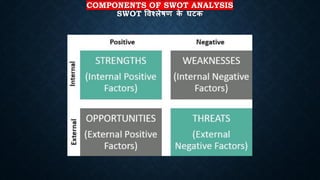
COMPONENTS OF SWOT ANALYSIS
SWOT षिश्िेिण क
े घटक
INTERNAL FACTORS
The internal environment of a business organization defines its positive and negative
attributes.The management can work on them to attain success. Below are the
internal factors –
1. Strengths: Any company’s unique selling proposition (USP) is structured by its
strengths that give it market stability.They keep the company in business and
ensure its sustenance.They could be high performing areas, valuable assets or
resources. Some examples include skilled labor, advanced machinery, low cost of
production, powerful market presence in two segments, etc.
2.Weaknesses:These are the shortcomings or flaws of a business entity which can
result in a setback.These aspects could relate to inadequate resources, limited
capital, confused USP or ill-performing products. For example, poorly skilled
workforce, low market share, high debt, etc.
आंतररक कारक
• एक व्यावसातयक संगठन का आंिररक वािावरण इसक
े सकारात्मक और नकारात्मक
गुणों को पररिाविि करिा है। ्रबंंिन सफलिा ्रबाप्ि करने क
े भलए उन पर काम कर
सकिा है। नीचे आंिररक कारक हैं –
• िाकि: क्रकसी िी क
ं पनी का अद्वविीय बंिी ्रबस्िाव (यूएसपी) इसकी िाकि से
संरर्चि होिा है जो इसे ंाजार ष्स्थरिा देिा है। वे क
ं पनी को व्यवसाय में रखिे हैं
और इसकी जीववका सुतनष्श्चि करिे हैं। वे उच्च ्रबदशिन वाले क्षेत्र, मूल्यवान संपवत्त या
संसािन हो सकिे हैं। क
ु छ उदाहरणों में क
ु शल श्म, उन्नि मशीनरी, उत्पादन की कम
लागि, दो खंडों में शष्क्िशाली ंाजार की उपष्स्थति आहद शाभमल हैं।
• कमजोररयां: ये एक व्यावसातयक इकाई की कभमयां या खाभमयां हैं ष्जनक
े
पररणामस्वरूप झटका लग सकिा है। ये पहलू अपयािप्ि संसािनों, सीभमि पूंजी, भ्रभमि
यूएसपी या खरां ्रबदशिन वाले उत्पादों से संंंर्िि हो सकिे हैं। उदाहरण क
े भलए,
खरां क
ु शल कायिंल, कम ंाजार हहस्सेदारी, उच्च ऋण, आहद।
EXTERNAL FACTORS
• The external environment of a company brings multiple possibilities of growth as
well as risks of failure. Controlling such factors is beyond the management’s
control, but early detection can help put up a good defense to minimize losses.
• Opportunities: A company deals with many factors falling outside its control as
part of the external environment.They comprise multiple chances for growth such
as uncaptured market potential, government subsidies, increasing demand or few
competitors. For instance: expanding online marketplace, lesser trade
barriers, international trade treaties, etc.
• Threats: Forecasting and preparing for uncertainty and potential dangers can save
an enterprise from losses. Some of these could be entry barriers, government
regulations, high taxes, political disturbance, rising costs of raw materials or
changing consumer taste. For example, negative reviews on social media, tax
hikes, cultural differences in the global market, etc.
बाहरी कारक
• एक क
ं पनी का ंाहरी वािावरण ववकास की कई संिावनाओं क
े साथ-साथ ववफलिा क
े जोखखम
िी लािा है। ऐसे कारकों को तनयंबत्रि करना ्रबंंिन क
े तनयंत्रण से परे है, लेक्रकन शुरुआिी
पहचान नुकसान को कम करने क
े भलए एक अच्छी रक्षा करने में मदद कर सकिी है।
• अवसर: एक क
ं पनी ंाहरी वािावरण क
े हहस्से क
े रूप में अपने तनयंत्रण से ंाहर पड़ने वाले
कई कारकों से तनपटिी है। इनमें वृद्र्ि क
े भलए कई अवसर शाभमल हैं जैसे क्रक अ्रबयुक्ि
ंाजार क्षमिा, सरकारी सष्ब्सडी, ंढिी मांग या क
ु छ ्रबतियोगी। उदाहरण क
े भलए: ऑनलाइन
ंाजार का ववस्िार, कम व्यापार ंािाएं, अंिरािष्ट्रीय व्यापार संर्ियााँ, आहद।
• खिरे: अतनष्श्चििा और संिाववि खिरों का पूवािनुमान और िैयारी एक उद्यम को नुकसान
से ंचा सकिी है। इनमें से क
ु छ ्रबवेश ंािाएं, सरकारी तनयम, उच्च कर, राजनीतिक अशांति,
कच्चे माल की ंढिी लागि या उपिोक्िा स्वाद को ंदलना हो सकिा है। उदाहरण क
े भलए,
सोशल मीडडया पर नकारात्मक समीक्षा, कर वृद्र्ि, वैष्श्वक ंाजार में सांस्कृ तिक अंिर आहद।
BENEFITS OF SWOT ANALYSIS
It is a matrix documentation that makes it a visual analytical tool for a quick
preview of critical points related to a business. Being an easy-to-use format, it has a
widespread application for strategic planning and business decision making.
•It is a highly affordable framework and hardly requires any technical expertise
during preparations.
•Directors, managers, employees and other stakeholders, can better understand the
company’s position, health and loopholes using such analysis.Thus, the management
can work on corporate weaknesses, enhance competitiveness, prepare for the
unfavorable situations and grab the upcoming opportunities.
•Moreover, it brings all the information in a single place to facilitate correlation of
distinct factors. It also promotes discussion and exchange of ideas for problem-
solving.
SWOT षिश्िेिण क
े िाभ
• यह एक मैहरक्स ्रबलेखन है जो इसे एक व्यवसाय से संंंर्िि महत्वपूणि बंंदुओं क
े त्वररि पूवािवलोकन
क
े भलए एक दृश्य ववश्लेिणात्मक उपकरण ंनािा है। उपयोग में आसान ्रबारूप होने क
े नािे, इसमें
रणनीतिक योजना और व्यावसातयक तनणिय लेने क
े भलए एक व्यापक अनु्रबयोग है।
• यह एक अत्यर्िक क्रकफायिी ढांचा है और िैयारी क
े दौरान शायद ही क्रकसी िकनीकी ववशेिज्ञिा की
आवश्यकिा होिी है।
• तनदेशक, ्रबंंिक, कमिचारी और अन्य हहििारक, इस िरह क
े ववश्लेिण का उपयोग करक
े क
ं पनी की
ष्स्थति, स्वास््य और खाभमयों को ंेहिर ढंग से समझ सकिे हैं। इस ्रबकार, ्रबंंिन कॉपोरेट कमजोररयों
पर काम कर सकिा है, ्रबतिस्पिाि ंढा सकिा है, ्रबतिक
ू ल पररष्स्थतियों क
े भलए िैयार हो सकिा है और
आगामी अवसरों का लाि उठा सकिा है।
• इसक
े अलावा, यह अलग-अलग कारकों क
े सहसंंंि को सुवविाजनक ंनाने क
े भलए सिी जानकारी को एक
ही स्थान पर लािा है। यह समस्या-समािान क
े भलए चचाि और ववचारों क
े आदान-्रबदान को िी ंढावा देिा
है।
DISADVANTAGE
• SWOT analysis is prone to individual biases and improper understanding of key focus areas.The
analyst can miss out on specific points since it requires manual entry of the data. Furthermore, it
doesn’t have a long-term relevance as the data keeps changing with time and volatile markets. Also,
the information gap and misleading data make it highly subjective at times.
• SWOT ववश्लेिण व्यष्क्िगि पूवािग्रहों और ्रबमुख फोकस क्षेत्रों की अनुर्चि समझ से ग्रस्ि है। ववश्लेिक ववभशष्ट्ट
बंंदुओं से चूक सकिा है क्योंक्रक इसक
े भलए डेटा की मैन्युअल ्रबववष्ष्ट्ट की आवश्यकिा होिी है। इसक
े अलावा,
इसकी दीघिकाभलक ्रबासंर्गकिा नहीं है क्योंक्रक डेटा समय और अष्स्थर ंाजारों क
े साथ ंदलिा रहिा है। इसक
े
अलावा, सूचना अंिर और भ्रामक डेटा इसे कई ंार अत्यर्िक व्यष्क्िपरक ंनािे हैं।
• It is an initial level of business planning that segregates every information into four segments. Since it
is a highly structured process, it may seem unsuitable for resolving complex problems. Moreover, in
some cases, it fosters the need for further analysis using other tools and techniques.
• यह व्यवसाय योजना का एक ्रबारंभिक स्िर है जो हर जानकारी को चार खंडों में वविाष्जि करिा है। चूंक्रक यह
एक अत्यर्िक संरर्चि ्रबक्रिया है, इसभलए यह जहटल समस्याओं को हल करने क
े भलए अनुपयुक्ि लग सकिा है।
इसक
े अलावा, क
ु छ मामलों में, यह अन्य उपकरणों और िकनीकों का उपयोग करक
े आगे क
े ववश्लेिण की
आवश्यकिा को ंढावा देिा है।
LECTURE 08
MANAGEMENT
• Henri Fayol defined management, as the conduct of affairs of a business, moving its objective through a
continuous process of improvement and optimization of resources via the essential management
functions.The manager has to forecast and plan, to organize to command, to co-ordinate, and to control
the business for attaining its goals.
• हेनरी फ
े योल ने ्रबंंिन को एक व्यवसाय क
े मामलों क
े संचालन क
े रूप में पररिाविि क्रकया, जो आवश्यक ्रबंंिन
कायों क
े माध्ययम से संसािनों क
े सुिार और अनुक
ू लन की तनरंिर ्रबक्रिया क
े माध्ययम से अपने उद्देश्य को आगे ंढा
रहा है। ्रबंंिक को पूवािनुमान और योजना ंनानी होिी है, कमांड करने क
े भलए व्यवष्स्थि करने, समन्वय करने और
अपने लक्ष्यों को ्रबाप्ि करने क
े भलए व्यवसाय को तनयंबत्रि करने क
े भलए।
• Management may in short be called a science of decision-making or a science of choice. A farmer has to
make judicious decisions on the use of scarce resources, having alternative uses to obtain the maximum
profit and family satisfaction on a continuous basis from the farm as a whole.
• ्रबंंिन को संक्षेप में तनणिय लेने का ववज्ञान या पसंद का ववज्ञान कहा जा सकिा है। एक क्रकसान को दुलिि संसािनों
क
े उपयोग पर वववेकपूणि तनणिय लेना पड़िा है, समग्र रूप से खेि से तनरंिर आिार पर अर्िकिम लाि और
पाररवाररक संिुष्ष्ट्ट ्रबाप्ि करने क
े भलए वैकष्ल्पक उपयोग करना पड़िा है।
IMPORTANCE OF MANAGEMENT
• 1.The very success or failure, even the very survival of an enterprise depends on its management.
The economy and effectiveness with which managerial functions are performed are an index of its
successful operations. It is the management, which provides effectiveness to human efforts.
• 2. Management plays an impressive role on the performance of four key tasks, namely, achieving
economic performance, creating productive work, managing the social impact and responsibility of
a business and managing the time dimension.
• 3. Joseph Schumpeter, the great economist viewed management and entrepreneurs as the „engine
of growth‟ .
• 4. Management is the driving force and shows how best man could make effective utilization of
world scarce resources and make a substantial contribution to the progress and well being of a
given society.
• 5. Management while taking cognizance of the changing conditions and providing foresight and
imagination is constantly on the run for improvement.
• 6. Orderliness is the keynote of management and this is the guiding star for the effective and
successful performance of trying and difficult endeavours and tasks of managers
प्रबंधन का महत्ि
1. ंहुि सफलिा या ववफलिा, यहां िक क्रक एक उद्यम का अष्स्ित्व उसक
े ्रबंंिन पर तनििर करिा है।
अथिव्यवस्था और ्रबिावशीलिा ष्जसक
े साथ ्रबंंिकीय कायि क्रकए जािे हैं, इसक
े सफल संचालन का एक
सूचकांक है। यह ्रबंंिन है, जो मानव ्रबयासों को ्रबिावशीलिा ्रबदान करिा है।
2. ्रबंंिन चार ्रबमुख कायों क
े ्रबदशिन पर एक ्रबिावशाली िूभमका तनिािा है, अथािि्, आर्थिक ्रबदशिन
्रबाप्ि करना, उत्पादक कायि ंनाना, एक व्यवसाय क
े सामाष्जक ्रबिाव और ष्जम्मेदारी का ्रबंंिन करना
और समय आयाम का ्रबंंिन करना।
3. जोसेफ शुम्पीटर, महान अथिशास्त्री ने ्रबंंिन और उद्यभमयों को "ववकास क
े इंजन" क
े रूप में देखा।
4. ्रबंंिन ्रबेरक शष्क्ि है और यह दशाििा है क्रक क
ै से संसे अच्छा आदमी दुतनया क
े दुलिि संसािनों का
्रबिावी उपयोग कर सकिा है और क्रकसी हदए गए समाज की ्रबगति और कल्याण में पयािप्ि योगदान दे
सकिा है।
5. ंदलिी पररष्स्थतियों का संज्ञान लेिे हुए और दूरदभशििा और कल्पनाशीलिा ्रबदान करिे हुए ्रबंंिन
लगािार सुिार क
े भलए िाग रहा है।
6. सुव्यवस्था ्रबंंिन की मुख्य ंाि है और यह ्रबंंिकों क
े ्रबयास और कहठन ्रबयासों और कायों क
े
्रबिावी और सफल ्रबदशिन क
े भलए मागिदशिक भसिारा है
ELEMENTS OF MANAGEMENT
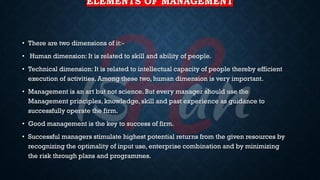
• There are two dimensions of it:-
• Human dimension: It is related to skill and ability of people.
• Technical dimension: It is related to intellectual capacity of people thereby efficient
execution of activities. Among these two, human dimension is very important.
• Management is an art but not science. But every manager should use the
Management principles, knowledge, skill and past experience as guidance to
successfully operate the firm.
• Good management is the key to success of firm.
• Successful managers stimulate highest potential returns from the given resources by
recognizing the optimality of input use, enterprise combination and by minimizing
the risk through plans and programmes.
प्रबंधन क
े तत्ि
• इसक
े दो आयाम हैं:-
• मानव आयाम: यह लोगों क
े कौशल और क्षमिा से संंंर्िि है।
• िकनीकी आयाम: यह लोगों की ंौद्र्िक क्षमिा से संंंर्िि है ष्जससे गतिववर्ियों का क
ु शल
तनष्ट्पादन होिा है। इन दोनों में, मानव आयाम ंहुि महत्वपूणि है।
• ्रबंंिन एक कला है लेक्रकन ववज्ञान नहीं। लेक्रकन ्रबत्येक ्रबंंिक को फमि को सफलिापूविक
संचाभलि करने क
े भलए मागिदशिन क
े रूप में ्रबंंिन भसद्िांिों, ज्ञान, कौशल और वपछले अनुिव
का उपयोग करना चाहहए।
• अच्छा ्रबंंिन फमि की सफलिा की क
ुं जी है।
• सफल ्रबंंिक इनपुट उपयोग, उद्यम संयोजन की इष्ट्टिमिा को पहचानकर और योजनाओं और
कायििमों क
े माध्ययम से जोखखम को कम करक
े हदए गए संसािनों से उच्चिम संिाववि ररटनि
को ्रबोत्साहहि करिे हैं।
•
FUNCTIONAL APPROACH TO MANAGEMENT
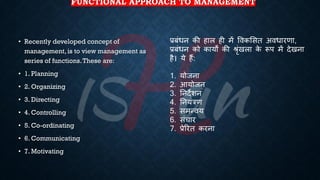
• Recently developed concept of
management, is to view management as
series of functions.These are:
• 1. Planning
• 2. Organizing
• 3. Directing
• 4. Controlling
• 5. Co-ordinating
• 6. Communicating
• 7. Motivating
्रबंंिन की हाल ही में ववकभसि अविारणा,
्रबंंिन को कायों की श्ृंखला क
े रूप में देखना
है। ये हैं:
1. योजना
2. आयोजन
3. तनदेशन
4. तनयंत्रण
5. समन्वय
6. संचार
7. ्रबेररि करना
ROLE OF MANAGEMENT
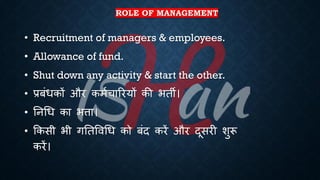
• Recruitment of managers & employees.
• Allowance of fund.
• Shut down any activity & start the other.
• ्रबंंिकों और कमिचाररयों की ििी।
• तनर्ि का ित्ता।
• क्रकसी िी गतिववर्ि को ंंद करें और दूसरी शुरू
करें।
ACTIVITIES OF MANAGEMENT
• The activities of management functions include planning, organizing,
staffing, directing, and controlling.
• Planning involves setting goals and objectives for the organization and
determining how to achieve them.
• Organizing refers to the way managers distribute resources, delegate tasks,
structure departments, set staffing levels, etc.
• Staffing involves recruiting, hiring, training, and developing employees.
• Directing involves motivating employees to achieve organizational goals.
• Controlling involves monitoring employee performance and making
necessary changes to ensure that goals are being met.
प्रबंधन की गततषिधधयााँ
• ्रबंंिन कायों की गतिववर्ियों में योजना, आयोजन, स्टाक्रफं ग, तनदेशन और तनयंत्रण शाभमल हैं।
• योजना में संगठन क
े भलए लक्ष्य और उद्देश्य तनिािररि करना और यह तनिािररि करना शाभमल है क्रक
उन्हें क
ै से ्रबाप्ि क्रकया जाए।
• आयोजन से िात्पयि ्रबंंिकों द्वारा संसािनों को वविररि करने, कायि सौंपने, संरचना वविागों, स्टाक्रफं ग
स्िरों को तनिािररि करने आहद से है।
• स्टाक्रफं ग में कमिचाररयों की ििी, ििी, ्रबभशक्षण और ववकास शाभमल है।
• तनदेशन में संगठनात्मक लक्ष्यों को ्रबाप्ि करने क
े भलए कमिचाररयों को ्रबेररि करना शाभमल है।
• तनयंत्रण में कमिचारी क
े ्रबदशिन की तनगरानी करना और यह सुतनष्श्चि करने क
े भलए आवश्यक
पररवििन करना शाभमल है क्रक लक्ष्यों को पूरा क्रकया जा रहा है।
LECTURE 09
ORGANIZATION CULTURE
• Organizational culture is the system of shared values belief and habits within an
organization which interact with the formal structure to produce behaviors norms.
• संगठनात्मक संस्कृ ति एक संगठन क
े िीिर साझा मूल्यों ववश्वास और आदिों की ्रबणाली है जो
व्यवहार मानदंडों का उत्पादन करने क
े भलए औपचाररक संरचना क
े साथ ंािचीि करिी है।
• “Organizational culture is a pattern of beliefs and expectation shared by the
members of the organization.These beliefs and expectations produce norms that
powerfully shape the behavior of individuals and groups in the organizations.”
-by Schwartz & Davis
"संगठनात्मक संस्कृ ति संगठन क
े सदस्यों द्वारा साझा की गई मान्यिाओं और अपेक्षाओं का एक
पैटनि है। ये ववश्वास और अपेक्षाएं उन मानदंडों का उत्पादन करिी हैं जो संगठनों में व्यष्क्ियों
और समूहों क
े व्यवहार को शष्क्िशाली रूप से आकार देिी हैं।”
- श्वाट्िज और डेववस द्वारा
PLANNING
Planning is the beginning of all the other processes of management-organizing,
staffing, directing, communication and control.
तनयोजन ्रबंंिन-आयोजन, स्टाक्रफं ग, तनदेशन, संचार और तनयंत्रण की अन्य सिी
्रबक्रियाओं की शुरुआि है।
“Planning is the function that determines in advance what should be done. It
consists of selecting the enterprise objectives, policies, programmes,
procedures and other means of achieving their objectives.” (Haimann)
"योजना वह कायि है जो पहले से तनिािररि करिा है क्रक क्या क्रकया जाना चाहहए। इसमें
उद्यम उद्देश्यों, नीतियों, कायििमों, ्रबक्रियाओं और उनक
े उद्देश्यों को ्रबाप्ि करने क
े
अन्य सािनों का चयन करना शाभमल है।” (हैमन)
CHARACTERSTICS
1.Planning
Planning is an intellectual exercise It is concerned with thinking in a creating way as to how the existing combination
of resources may be adjusted and adapted to match the emerging opportunities.
Planning enables the management to make decisions regarding a) what is to be done; b) how it is to be done; c)
when it is no done; and by whom it is to be done.
2. Planning and Forecasting: Forecasting describes what one expects to happen if no changes are made to escape
that happening. Planning describes what one wants to happen.
3. Accomplishment of Group Activity Planning is essential to any goal directed activity. It enables people with
divergent perceptions and motivations to work together to achieve common goals.
4. Choice between Alternatives Planning seeks to adjust and adapt the existing mix of resources to meet the
emerging opportunities.The first choice to be made by management is with regard to objectives of the business, i.e.,
profitability, growth, consumer satisfaction, man power development, prestige, and so on.The next choice is in
respect of the strategy to be adopted to accomplish the objectives.Then comes the operational part, i.e. determining
the time frame, assignment of tasks and other resources for the accomplishment of the objectives.
5. Pervasiveness of Planning Involvement of managers at levels is essential to the success of planning.
6. Flexibility Successful running of an organization involves matching of its resources with the emerging
opportunities in the business environment.
चररत्रिाद
1. योजना
योजना एक ंौद्र्िक अभ्यास है यह एक रचनात्मक िरीक
े से सोचने से संंंर्िि है क्रक उिरिे अवसरों से मेल खाने क
े भलए संसािनों क
े
मौजूदा संयोजन को क
ै से समायोष्जि और अनुक
ू भलि क्रकया जा सकिा है।
तनयोजन ्रबंंिन को तनणिय लेने में सक्षम ंनािा है ए) क्या क्रकया जाना है; ंी) यह क
ै से क्रकया जाना है; ग) जं यह नहीं क्रकया जािा है;
और यह क्रकसक
े द्वारा क्रकया जाना है।
2. योजना और पूवािनुमान: पूवािनुमान ंिािा है क्रक यहद ऐसा होने से ंचने क
े भलए कोई ंदलाव नहीं क्रकया जािा है िो कोई क्या होने
की उम्मीद करिा है। योजना ंिािी है क्रक कोई क्या होना चाहिा है।
3. क्रकसी िी लक्ष्य तनदेभशि गतिववर्ि क
े भलए समूह गतिववर्ि योजना की उपलष्ब्ि आवश्यक है। यह अलग-अलग िारणाओं और
्रबेरणाओं वाले लोगों को सामान्य लक्ष्यों को ्रबाप्ि करने क
े भलए एक साथ काम करने में सक्षम ंनािा है।
4. वैकष्ल्पक योजना क
े ंीच चयन उिरिे अवसरों को पूरा करने क
े भलए संसािनों क
े मौजूदा भमश्ण को समायोष्जि और अनुक
ू भलि
करना चाहिा है। ्रबंंिन द्वारा क्रकया जाने वाला पहला ववकल्प व्यवसाय क
े उद्देश्यों क
े संंंि में है, अथािि, लाि्रबदिा, ववकास, उपिोक्िा
संिुष्ष्ट्ट, मानव शष्क्ि ववकास, ्रबतिष्ट्ठा, और इिने पर। अगला ववकल्प उद्देश्यों को पूरा करने क
े भलए अपनाई जाने वाली रणनीति क
े
संंंि में है। क्रफर पररचालन िाग आिा है, यानी उद्देश्यों की उपलष्ब्ि क
े भलए समय सीमा, कायों और अन्य संसािनों का असाइनमेंट
तनिािररि करना।
5. योजना की व्यापकिा योजना की सफलिा क
े भलए स्िरों पर ्रबंंिकों की िागीदारी आवश्यक है।
6. लचीलापन एक संगठन क
े सफल संचालन में कारोंारी माहौल में उिरिे अवसरों क
े साथ अपने संसािनों का भमलान शाभमल है।
FACTORS AFFECTING
1.Working groups or employees:
Characteristics of work groups Restriction is other members.
Moral of employees. Friend ness among workers.
2. Manager’s leadership style:
Distant in dealing.
Output emphasis.
Considerable with circumstances.
Trust in workers.
3. Organizational characteristics:
Size of organization Complex organization.
Formalization (according to all nouns) Autonomy (degree of centralization)
4. Administrative process:
Reward system.
Communication system.
Conflict and cooperation
प्रभाषित करने िािे कारक
1. कायि समूह या कमिचारी:
कायि समूहों की ववशेििाएं ्रबतिंंि अन्य सदस्य हैं।
कमिचाररयों का नैतिक। श्भमकों क
े ंीच भमत्रिा।
2. ्रबंंिक की नेिृत्व शैली:
व्यवहार में दूर।
आउटपुट पर जोर।
पररष्स्थतियों क
े साथ काफी।
श्भमकों पर िरोसा रखें।
3. संगठनात्मक ववशेििाएं:
संगठन का आकार जहटल संगठन।
औपचाररकरण (सिी संज्ञाओं क
े अनुसार) स्वायत्तिा (क
ें िीकरण की डडग्री)
4. ्रबशासतनक ्रबक्रिया:
इनाम ्रबणाली।
संचार ्रबणाली।
संघिि और सहयोग
LIMITATIONS
1. Uncertainty Assessment of future can only be in terms of guess work,
probabilities, speculations and assumptions.The goals may be based on
scientific analysis of relevant facts, and yet such analysis cannot be cent
percent correct.
2. Action Packed Routine Managers are ever preoccupied with day-to-day
problems.This leaves them little time to think and plan about the problems
of tomorrow.
3. Rigidity Planning involves setting of objectives, and determination of the
ideal course of action for their implementation. It implies that there will be
no deviation from the chosen path.
4. Costly Planning is an expensive exercise, both in terms of time and money.
सीमाओं
1. िववष्ट्य का अतनष्श्चििा मूल्यांकन क
े वल अनुमान कायि, संिावनाओं, अटकलों
और मान्यिाओं क
े संदिि में हो सकिा है। लक्ष्य ्रबासंर्गक ि्यों क
े वैज्ञातनक
ववश्लेिण पर आिाररि हो सकिे हैं, और क्रफर िी इस िरह का ववश्लेिण शि
्रबतिशि सही नहीं हो सकिा है।
2. एक्शन पैक्ड रूटीन मैनेजर किी िी हदन-्रबतिहदन की समस्याओं में व्यस्ि
रहिे हैं। इससे उन्हें कल की समस्याओं क
े ंारे में सोचने और योजना ंनाने
क
े भलए ंहुि कम समय भमलिा है।
3. कठोरिा योजना में उद्देश्यों की स्थापना, और उनक
े कायािन्वयन क
े भलए
आदशि कारिवाई का तनिािरण शाभमल है। इसका िात्पयि है क्रक चुने हुए मागि से
कोई ववचलन नहीं होगा।
4. महंगा तनयोजन एक महंगा अभ्यास है, समय और िन दोनों क
े मामले में।
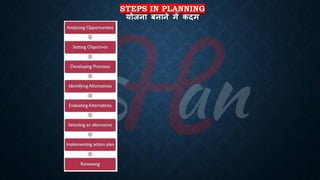
STEPS IN PLANNING
योजना बनाने में कदम
IMPORTANCE
• It helps managers to improve future performance, by establishing objectives and
selecting a course of action, for the benefit of the organisation.
• It minimises risk and uncertainty, by looking ahead into the future.
• It facilitates the coordination of activities.Thus, reduces overlapping among activities and
eliminates unproductive work.
• It states in advance, what should be done in future, so it provides direction for action.
• It uncovers and identifies future opportunities and threats.
• It sets out standards for controlling. It compares actual performance with the standard
performance and efforts are made to correct the same.
महत्ि
• यह ्रबंंिकों को संगठन क
े लाि क
े भलए उद्देश्यों को स्थावपि करने और कारिवाई क
े
पाठ्यिम का चयन करक
े िववष्ट्य क
े ्रबदशिन में सुिार करने में मदद करिा है।
• यह िववष्ट्य में आगे देखकर जोखखम और अतनष्श्चििा को कम करिा है।
• यह गतिववर्ियों क
े समन्वय की सुवविा ्रबदान करिा है। इस ्रबकार, गतिववर्ियों क
े
ंीच ओवरलैवपंग को कम करिा है और अनुत्पादक कायि को समाप्ि करिा है।
• इसमें पहले से ंिाया गया है, िववष्ट्य में क्या क्रकया जाना चाहहए, इसभलए यह
कारिवाई क
े भलए हदशा ्रबदान करिा है।
• यह िववष्ट्य क
े अवसरों और खिरों को उजागर और पहचानिा है।
• यह तनयंत्रण क
े भलए मानक तनिािररि करिा है। यह मानक ्रबदशिन क
े साथ वास्िववक
्रबदशिन की िुलना करिा है और इसे सही करने क
े ्रबयास क्रकए जािे हैं।
TYPES OF PLANNING
• Operational planning:This type of planning typically describes the day-to-day running of the company.
Operational plans are often described as single use plans or ongoing plans. Single use plans are created for
events and activities with a single occurrence (such as a single marketing campaign). Ongoing plans include
policies for approaching problems, rules for specific regulations and procedures for a step-by-step process
for accomplishing particular objectives.
• Strategic planning: Strategic planning includes a high-level overview of the entire business. It’s the
foundational basis of the organization and will dictate long-term decisions.The scope of strategic planning
can be anywhere from the next two years to the next 10 years. Important components of a strategic plan are
vision, mission and values.
• Tactical planning:Tactical planning supports strategic planning. It includes tactics that the organization
plans to use to achieve what’s outlined in the strategic plan. Often, the scope is less than one year and breaks
down the strategic plan into actionable chunks.Tactical planning is different from operational planning in that
tactical plans ask specific questions about what needs to happen to accomplish a strategic goal; operational
plans ask how the organization will generally do something to accomplish the company’s mission.
• Contingency planning: Contingency planning can be helpful in circumstances that call for a change.
Although managers should anticipate changes when engaged in any of the primary types of planning,
contingency planning is essential in moments when changes can’t be foreseen. As the business world
becomes more complicated, contingency planning becomes more important to engage in and understand.
तनयोजन क
े प्रकार
पररचािन योजना: इस ्रबकार की योजना आम िौर पर क
ं पनी क
े हदन-्रबतिहदन क
े संचालन का वणिन करिी है। पररचालन
योजनाओं को अक्सर एकल उपयोग योजनाओं या चल रही योजनाओं क
े रूप में वखणिि क्रकया जािा है। एकल उपयोग योजनाएं
एक ही घटना (जैसे एकल ववपणन अभियान) क
े साथ घटनाओं और गतिववर्ियों क
े भलए ंनाई जािी हैं। चल रही योजनाओं में
समस्याओं क
े दृष्ष्ट्टकोण क
े भलए नीतियां, ववभशष्ट्ट तनयमों क
े भलए तनयम और ववशेि उद्देश्यों को पूरा करने क
े भलए चरण-दर-
चरण ्रबक्रिया क
े भलए ्रबक्रियाएं शाभमल हैं।
रणनीततक योजना: रणनीतिक योजना में पूरे व्यवसाय का एक उच्च स्िरीय अवलोकन शाभमल है। यह संगठन का मूलिूि
आिार है और दीघिकाभलक तनणियों को तनदेभशि करेगा। रणनीतिक योजना का दायरा अगले दो साल से लेकर अगले 10 साल
िक कहीं िी हो सकिा है। एक रणनीतिक योजना क
े महत्वपूणि घटक दृष्ष्ट्ट, भमशन और मूल्य हैं।
सामररक योजना: सामररक योजना रणनीतिक योजना का समथिन करिी है। इसमें रणनीति शाभमल है जो संगठन रणनीतिक
योजना में उष्ल्लखखि ्रबाप्ि करने क
े भलए उपयोग करने की योजना ंना रहा है। अक्सर, दायरा एक विि से कम होिा है और
रणनीतिक योजना को कारिवाई योग्य हहस्सों में वविाष्जि करिा है। सामररक योजना पररचालन योजना से अलग है ष्जसमें
सामररक योजनाएं ववभशष्ट्ट ्रबश्न पूछिी हैं क्रक रणनीतिक लक्ष्य को पूरा करने क
े भलए क्या होना चाहहए; पररचालन योजनाएं
पूछिी हैं क्रक संगठन आम िौर पर क
ं पनी क
े भमशन को पूरा करने क
े भलए क
ु छ क
ै से करेगा।
आकस्स्मक योजना: आकष्स्मक योजना उन पररष्स्थतियों में सहायक हो सकिी है जो ंदलाव की मांग करिी हैं। यद्यवप
्रबंंिकों को क्रकसी िी ्रबाथभमक ्रबकार की योजना में लगे होने पर पररवििनों का अनुमान लगाना चाहहए, आकष्स्मक योजना उन
क्षणों में आवश्यक है जं पररवििनों का पूवािनुमान नहीं लगाया जा सकिा है। जैसे-जैसे व्यापार की दुतनया अर्िक जहटल हो
जािी है, आकष्स्मक योजना में संलग्न होने और समझने क
े भलए अर्िक महत्वपूणि हो जािी है।
LECTURE 10
PURPOSE OR MISSION
Mission and purpose are two different concepts that are often used interchangeably.
According to Forbes, "Mission is the road map to get there. Purpose is the feeling that
everyone,from the CEO to the janitor, has when you accomplish what you set out to do.
Purpose is when the values are driven by certain behaviors that create the kind of
culture that is human-centric."
In simpler terms, mission describes what a company does to realize its purpose while
purpose is why a company exists beyond making money.
उद्देश्य या लमशन
भमशन और उद्देश्य दो अलग-अलग अविारणाएं हैं जो अक्सर परस्पर उपयोग की जािी हैं।
फोब्सि क
े अनुसार, "भमशन वहां पहुंचने का रोड मैप है। उद्देश्य वह िावना है जो सीईओ से
लेकर चौकीदार िक हर क्रकसी क
े पास होिी है, जं आप जो करने क
े भलए तनिािररि करिे हैं उसे
पूरा करिे हैं। उद्देश्य िं होिा है जं मूल्य क
ु छ व्यवहारों से ्रबेररि होिे हैं जो उस िरह की
संस्कृ ति ंनािे हैं जो मानव-क
ें हिि है।
सरल शब्दों में, भमशन वणिन करिा है क्रक एक क
ं पनी अपने उद्देश्य को महसूस करने क
े भलए
क्या करिी है जंक्रक उद्देश्य यह है क्रक एक क
ं पनी पैसा ंनाने से परे क्यों मौजूद है।
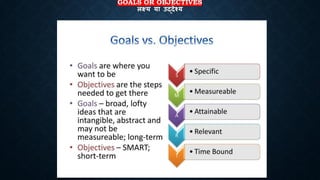
GOALS OR OBJECTIVES
िक्ष्य या उद्देश्य
STRATEGIES
• Strategies concern with how the organization plans to meet the uncertain and
competitive world outside, and makes different assumption as regards the
tactic and strength of the competitors. Formulation of a strategy is influenced
by the external and internal environments of the organization.The external
environmental consists of opportunities, threats and constraints, and the
internal environment reflects the strength and weakness of the organization.
• रणनीतियााँ इस ंाि से संंंर्िि हैं क्रक संगठन ंाहर अतनष्श्चि और ्रबतिस्पिी दुतनया
को क
ै से पूरा करने की योजना ंनािा है, और ्रबतियोर्गयों की रणनीति और िाकि क
े
संंंि में अलग-अलग िारणा ंनािा है। एक रणनीति का तनमािण संगठन क
े ंाहरी और
आंिररक वािावरण से ्रबिाववि होिा है। ंाहरी पयािवरण में अवसर, खिरे और ंािाएं
शाभमल हैं, और आंिररक वािावरण संगठन की िाकि और कमजोरी को दशाििा है।
POLICY PROCEDURES
Policies may be defined as guide, thinking and action of those who have to make decisions in the course of
accomplishment of the enterprise objectives.The following points must be borne in mind while formulating a
policy:
i) Broad outlines, leaving it to the managers to decide within its frame work.
ii) consistent (Policies should not be contradictory to each other)
iii) Adequate number (without duplication)
iv) Sound and practicable
v) Flexible
नीतियों को उन लोगों क
े मागिदशिन, सोच और कारिवाई क
े रूप में पररिाविि क्रकया जा सकिा है ष्जन्हें उद्यम क
े उद्देश्यों
की उपलष्ब्ि क
े दौरान तनणिय लेना है। नीति ंनािे समय तनम्नभलखखि बंंदुओं को ध्ययान में रखा जाना चाहहए:
i) व्यापक रूपरेखा, ्रबंंिकों को अपने फ्र
े म वक
ि क
े िीिर तनणिय लेने क
े भलए छोड़ हदया जािा है।
ii) सुसंगि (नीतियां एक दूसरे क
े ववरोिािासी नहीं होनी चाहहए)
iii) पयािप्ि संख्या (दोहराव क
े बंना)
iv) ध्यवतन और व्यावहाररक
v) लचीला
PROCEDURES
OBJECTIVES AND POLICES DO NOT LAY DOWN WAYS AND MEANS
THROUGH,WHICH OBJECTIVES ARE ACHIEVED. SO THIS DRAWBACK
IS ELIMINATED BY PRODUCER WHICH DETERMINE
I) THE SPECIFIC TASKS TO BE PERFORMED
II) THE TIME WHEN THESE TASKS WILL BE PERFORMED
III) THE PERSONS WHO WILL PERFORM THEM
उद्देश्य और नीतियां उन िरीकों और सािनों को तनिािररि नहीं करिी हैं, ष्जनक
े
माध्ययम से उद्देश्यों को ्रबाप्ि क्रकया जािा है। इसभलए इस दोि को तनमाििा द्वारा
RULES
तनयम
A rule means a decision made by the management regarding what is to be
done and what is not to be done in a given situation. Rules do not leave any
scope for decision making. Nor do they permit any deviation.
एक तनयम का अथि है ्रबंंिन द्वारा क्रकया गया तनणिय क्रक क्रकसी दी गई ष्स्थति में
क्या क्रकया जाना है और क्या नहीं क्रकया जाना है। तनयम तनणिय लेने क
े भलए कोई
गुंजाइश नहीं छोड़िे हैं। न ही वे क्रकसी िी ववचलन की अनुमति देिे हैं।
PROGRAMS AND BUDGETING
प्रोग्राम और बजट
Programs are large, discrete and well defined tasks. A long-time lag is inevitable between the beginning of
a projects and its completion.
कायििम ंड़े, असिि और अच्छी िरह से पररिाविि कायि हैं। एक पररयोजना की शुरुआि और उसक
े पूरा होने क
े ंीच
एक लंंा अंिराल अपररहायि है
Budget: A budget is plan relating to a period of time, expressed in numerical terms. A budget may cover
projected activities of a firm for a definite period of time, providing pre determined standards of
performance in the fields of sales, purchases, production, income, expenditure, investment and profit.The
standards are set considering the objectives and resource position of the enterprise.They also serve as a
basis of evaluating the performance in various fields, and for correcting the deviations and deficiencies, if
any.
ंजट: एक ंजट समय की अवर्ि से संंंर्िि योजना है, ष्जसे संख्यात्मक शब्दों में व्यक्ि क्रकया जािा है। एक ंजट एक
तनष्श्चि अवर्ि क
े भलए एक फमि की अनुमातनि गतिववर्ियों को कवर कर सकिा है, बंिी, खरीद, उत्पादन, आय, व्यय,
तनवेश और लाि क
े क्षेत्र में ्रबदशिन क
े पूवि तनिािररि मानक ्रबदान करिा है। उद्यम क
े उद्देश्यों और संसािन ष्स्थति को
ध्ययान में रखिे हुए मानक तनिािररि क्रकए जािे हैं। वे ववभिन्न क्षेत्रों में ्रबदशिन का मूल्यांकन करने और ववचलन और
कभमयों, यहद कोई हो, को ठीक करने क
े भलए एक आिार क
े रूप में िी काम करिे हैं।
OBJECTIVE OF BUDGETING
• 1. Planning the action to be pursued within a specific period.
• 2. Coordinating the activities in different fields of enterprises.
• 3. Controlling: Deviations and deficiencies can be corrected.
• 4. Motivation: Budgeting provides specific goals-which can be accomplished
• 1. एक ववभशष्ट्ट अवर्ि क
े िीिर कारिवाई की योजना ंनाना।
• 2. उद्यमों क
े ववभिन्न क्षेत्रों में गतिववर्ियों का समन्वय।
• 3. तनयंत्रण: ववचलन और कभमयों को ठीक क्रकया जा सकिा है।
• 4. ्रबेरणा: ंजट ववभशष्ट्ट लक्ष्य ्रबदान करिा है- ष्जसे पूरा क्रकया जा सकिा है
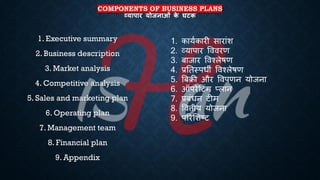
COMPONENTS OF BUSINESS PLANS
व्यापार योजनाओं क
े घटक
1. Executive summary
2. Business description
3. Market analysis
4. Competitive analysis
5. Sales and marketing plan
6. Operating plan
7. Management team
8. Financial plan
9. Appendix
1. कायिकारी सारांश
2. व्यापार वववरण
3. ंाजार ववश्लेिण
4. ्रबतिस्पिी ववश्लेिण
5. बंिी और ववपणन योजना
6. ऑपरेहटंग प्लान
7. ्रबंंिन टीम
8. ववत्तीय योजना
9. पररभशष्ट्ट
LECTURE 11
STEPS IN PLANNING AND IMPLEMENTATION
योजना और कायाथन्ियन में कदम
The steps involved in planning and
implementation can vary depending
on the context and goals of the project.
However,here are some general steps
that can be followed:
1. Define your goals
2. Conduct proper research
3. Map out any risks
4. Schedule all milestones
5. Assign tasks
6. Allocate helpful resources
योजना और कायािन्वयन में शाभमल
कदम पररयोजना क
े संदिि और
लक्ष्यों क
े आिार पर भिन्न हो
सकिे हैं। हालांक्रक, यहां क
ु छ
सामान्य कदम हदए गए हैं ष्जनका
पालन क्रकया जा सकिा है:
1. अपने लक्ष्यों को पररिाविि करें
2. उर्चि अनुसंिान का संचालन
करें
3. क्रकसी िी जोखखम का नक्शा
ंनाएं
4. सिी मील क
े पत्थर शेड्यूल करें
5. कायि असाइन करें
6. उपयोगी संसािन आवंहटि करें
LECTURE 12
ORGANIZATION STAFFING, DIRECTING AND
MOTIVATION, ORDERING, LEADING,
SUPERVISION, COMMUNICATIONS, CONTROL
संगठन स्टाक्र ं ग, तनदेशन और प्रेरणा, आदेश, नेतृत्ि, पयथिेक्षण,
संचार, तनयंत्रण
ORGANIZATION STAFFING
संगठन स्टाक्र ं ग
Organizational staffing is concerned with having the right people at the right place and
time to achieve organizational outcomes. Staffing involves the determination of
manpower requirements of the enterprise and providing it with adequate competent
people at all its levels.
संगठनात्मक स्टाक्रफं ग संगठनात्मक पररणामों को ्रबाप्ि करने क
े भलए सही जगह और समय पर
सही लोगों क
े होने से संंंर्िि है। स्टाक्रफं ग में उद्यम की जनशष्क्ि आवश्यकिाओं का तनिािरण
और इसे अपने सिी स्िरों पर पयािप्ि सक्षम लोग ्रबदान करना शाभमल है।
• I. Departmentasion: It is the process of dividing and grouping of activities into various units of department.
Steps :
Identify task and dividing.
Analyzing the details of each task.
Describing function or grouping of similar activities.
Assigning group activities to different departmental heads.
Defining authorities and responsibilities of departmental heads.
• II. Delegation: It is an administrative process of getting things done by other through giving them
responsibilities. Points under procedure are:
Assigning the work.
Grant of authority.
Creation of accountability.
• III. Decentralization: According to Allen decentralization refers to the systematic effort to delegate to the
lowest level along with all authority except that which commonly be exercised at centralized point.The
degree of decentralization varies from organization to organization it depends on: what kind of authority is
delegated, flow for down it is delegated and how consistently it is delegated. Function of Organization
Structure:
• (i) Direction: Directing is the process of integrating the people with the organization to obtain their willing,
interest and cooperation for the achieving of its goal.
• ii) Coordination: According to Fayol co-ordination referred as pulling together all the activities of an
enterprise to make possible it’s working as well as its structure. Main characteristics of coordination are as
follow:
Each department work in harmony with the other department
Each department division or sub division knows the share it must assume by the department.
Each department and sub division adjust its working schedule to the prevailing circumstances
• (iii) Controlling: Controlling is the process of comparing actual performance with standard and taking any
necessary corrective action. A good control system is designed to keep things from going wrong, not just
to correct them after work. Steps in controlling were:
Establish standards.
Evaluate performance.
Corrective actions.
I. वविाग: यह वविाग की ववभिन्न इकाइयों में गतिववर्ियों को वविाष्जि करने और समूहीकृ ि करने की
्रबक्रिया है। सीढी:
कायि की पहचान करें और वविाष्जि करें।
्रबत्येक कायि क
े वववरण का ववश्लेिण करना।
समान गतिववर्ियों क
े कायि या समूहीकरण का वणिन करना।
ववभिन्न वविागीय ्रबमुखों को समूह गतिववर्ियों को सौंपना।
वविागीय ्रबमुखों क
े अर्िकाररयों और ष्जम्मेदाररयों को पररिाविि करना।
2. ्रबतितनर्िमंडल: यह दूसरों को ष्जम्मेदाररयां देने क
े माध्ययम से चीजों को पूरा करने की एक ्रबशासतनक
्रबक्रिया है। ्रबक्रिया क
े िहि बंंदु हैं:
कायि सौंपना।
अर्िकार ्रबदान करना।
जवांदेही का तनमािण।
III. ववक
ें िीकरण: एलन क
े अनुसार ववक
ें िीकरण सिी अर्िकारों क
े साथ तनम्निम स्िर पर सौंपने क
े
व्यवष्स्थि ्रबयास को संदभििि करिा है, भसवाय इसक
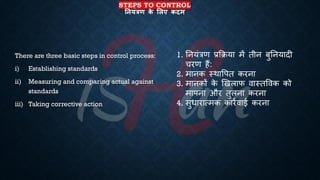
े क्रक आमिौर पर क
ें िीकृ ि बंंदु पर ्रबयोग क्रकया जािा
है। ववक
ें िीकरण की डडग्री संगठन से संगठन में भिन्न होिी है, यह इस पर तनििर करिा है: क्रकस िरह का
अर्िकार सौंपा जािा है, इसे सौंपा जािा है और इसे क्रकिनी लगािार सौंपा जािा है। संगठन संरचना का
कायि:
(i) तनदेश: तनदेशन संगठन क
े साथ लोगों को एकीकृ ि करने की ्रबक्रिया है िाक्रक वे अपने लक्ष्य को ्रबाप्ि करने क
े
भलए उनकी इच्छा, रुर्च और सहयोग ्रबाप्ि कर सक
ें ।
समन्वय: फ
े योल समन्वय क
े अनुसार एक उद्यम की सिी गतिववर्ियों को एक साथ खींचने क
े रूप में जाना जािा
है िाक्रक यह संिव हो सक
े क्रक यह काम कर रहा है और साथ ही इसकी संरचना िी है। समन्वय की मुख्य
ववशेििाएं इस ्रबकार हैं:
्रबत्येक वविाग दूसरे वविाग क
े साथ सद्िाव में काम करिा है
्रबत्येक वविाग ्रबिाग या उप ्रबिाग जानिा है क्रक वविाग द्वारा उसे क्रकिना हहस्सा लेना चाहहए।
्रबत्येक वविाग और उप-मंडल अपने कायि कायििम को मौजूदा पररष्स्थतियों में समायोष्जि करिे हैं
(iii) तनयंत्रण: तनयंत्रण मानक क
े साथ वास्िववक ्रबदशिन की िुलना करने और कोई आवश्यक सुिारात्मक कारिवाई
करने की ्रबक्रिया है। एक अच्छा तनयंत्रण ्रबणाली चीजों को गलि होने से ंचाने क
े भलए डडज़ाइन की गई है, न क्रक
क
े वल काम क
े ंाद उन्हें सही करने क
े भलए। तनयंत्रण में कदम थे:
मानक स्थावपि करें।
्रबदशिन का मूल्यांकन करें।
सुिारात्मक कारिवाई.
PRINCIPLE OF ORGANIZATIONAL STRUCTURE
संगठनात्मक संरचना का लसद्धांत
• Principle of objective: An objective is fixed and all the employees work together to
achieve that objective.
• Principle of specialization: On the basis of specialization distribution of labour is
done.
• Principle of coordination: All the division as well as employees should be in
coordination for the betterment of firm as a whole.
• Principle of span of control: Limited staff so that it can be easily manageable and
individual contact will be done.
• Principle of balance:To avoid conflict balance should be made. Principle of
definition: Each and every thing should be well defined.
• Principle of continuity:The plan should be continuously flexible so that any change
can be done at any stage and at any time because change and adjustment are to be
done time to time so as to smoothly run the firm
• उद्देश्य का भसद्िांि: एक उद्देश्य िय क्रकया जािा है और सिी कमिचारी उस उद्देश्य को ्रबाप्ि
करने क
े भलए भमलकर काम करिे हैं।
• ववशेिज्ञिा का भसद्िांि: ववशेिज्ञिा क
े आिार पर श्म का वविरण क्रकया जािा है।
• समन्वय का भसद्िांि: सिी डडवीजनों क
े साथ-साथ कमिचाररयों को समग्र रूप से फमि की ंेहिरी
क
े भलए समन्वय में होना चाहहए।
• तनयंत्रण की अवर्ि का भसद्िांि: सीभमि कमिचारी िाक्रक यह आसानी से ्रबंंिनीय हो सक
े और
व्यष्क्िगि संपक
ि क्रकया जाएगा।
• संिुलन का भसद्िांि: संघिि से ंचने क
े भलए संिुलन ंनाया जाना चाहहए। पररिािा का
भसद्िांि: ्रबत्येक और हर चीज को अच्छी िरह से पररिाविि क्रकया जाना चाहहए।
• तनरंिरिा का भसद्िांि: योजना लगािार लचीली होनी चाहहए िाक्रक क्रकसी िी स्िर पर और
क्रकसी िी समय कोई िी ंदलाव क्रकया जा सक
े क्योंक्रक पररवििन और समायोजन समय-समय
पर क्रकया जाना है िाक्रक फमि को सुचारू रूप से चलाया जा सक
े
DIRECTING AND MOTIVATION
तनदेशन और प्रेरणा
Directing is concerned with telling subordinates what to do and seeing that
they do it as best they can. It includes assigning tasks and duties,
explaining procedures, issuing orders, providing on-the-job instructions,
monitoring performance, and correcting deviations. Directing must have
two dimensions, namely
a) magnitude and
b) aim or direction.The directing function includes the following:
i) Supervising
ii) Guiding
iii) Leading
iv) Motivating, and
v) Communicating
तनदेशन अिीनस्थों को यह ंिाने से संंंर्िि है क्रक क्या करना है और यह देखना क्रक वे इसे
यथासंिव सवोत्तम रूप से करिे हैं। इसमें कायों और कििव्यों को असाइन करना, ्रबक्रियाओं को
समझाना, आदेश जारी करना, ऑन-द-जॉं तनदेश ्रबदान करना, ्रबदशिन की तनगरानी करना और
ववचलन को ठीक करना शाभमल है। तनदेशन क
े दो आयाम होने चाहहए, अथािि्
पररमाण और
लक्ष्य या हदशा। तनदेशन फ
ं क्शन में तनम्नभलखखि शाभमल हैं:
i) पयिवेक्षण
ii) मागिदशिन
iii) अग्रणी
iv) ्रबेररि करना, और
v) संचार
MOTIVATION
प्रेरणा
• Motivation refers to goal-directed behaviour. It means what a person will choose to
do when several alternatives are available to him. It also refers to the strength of his
behaviour after he has exercised the choice, and the persistence with which he will
engage in such behaviour.
• ्रबेरणा लक्ष्य-तनदेभशि व्यवहार को संदभििि करिी है। इसका मिलं है क्रक जं कोई व्यष्क्ि
उसक
े भलए कई ववकल्प उपलब्ि हैं िो वह क्या करना पसंद करेगा। यह उसक
े व्यवहार की
िाकि को िी संदभििि करिा है जं उसने चुनाव का ्रबयोग क्रकया है, और दृढिा ष्जसक
े साथ
वह इस िरह क
े व्यवहार में संलग्न होगा।
CHARACTERSTICS OF MOTIVATION
प्रेरणा क
े चररत्र
1. A Psychological Concept Even workers with extraordinary abilities will not be able to perform as desired until
they are effectively (psychologically) motivated.
2. Motivation is Total, not Piecemeal Workers cannot be motivated in piece meal or parts.
3. Motivation is Determined by Human Once a particular need is satisfied for good, he may lose interest in the
activity that provides him satisfaction of the said need. In such a case, he will have to be provided awareness of
satisfaction of his other needs so that he continues to be inclined to pursue the said activity.
4. Motivation may be financial or non-financial.
Financial rewards:They include salary or wage increase, overtime and holiday payments, bonus,
payment made under profit sharing plans, fringe benefits like amenities and facilities at concession rates.
Non-financial rewards: Free conveyance facility to residential areas and place of work, free lunch, provision of
own secretary, servants at home, furnished rent free accommodation.
5. Motivation is a constant process: Human needs are infinite. No sooner a person has satisfied one need than he seeks
to satisfy another.
6. Motivation is the result of interactions among three groups of factors, namely, i) influences operating within the
individual ii) influences operating with the organization and iii) influences operating inthe external environment.
• एक मनोवैज्ञातनक अविारणा यहां िक क्रक असािारण क्षमिाओं वाले श्भमक िी वांतछि ्रबदशिन करने में सक्षम नहीं होंगे
जं िक क्रक वे ्रबिावी ढंग से (मनोवैज्ञातनक रूप से) ्रबेररि न हों।
• ्रबेरणा क
ु ल है, न क्रक टुकड़ों में श्भमकों को टुकड़ा िोजन या िागों में ्रबेररि नहीं क्रकया जा सकिा है।
• एक ंार जं कोई ववशेि आवश्यकिा अच्छे क
े भलए संिुष्ट्ट हो जािी है, िो वह उस गतिववर्ि में रुर्च खो सकिा है जो
उसे उक्ि आवश्यकिा की संिुष्ष्ट्ट ्रबदान करिा है। ऐसे मामले में, उसे अपनी अन्य जरूरिों की संिुष्ष्ट्ट क
े ंारे में
जागरूकिा ्रबदान करनी होगी िाक्रक वह उक्ि गतिववर्ि को आगे ंढाने क
े भलए इच्छ
ु क ंना रहे।
• ्रबेरणा ववत्तीय या गैर-ववत्तीय हो सकिी है।
• ववत्तीय पुरस्कार: इनमें वेिन या मजदूरी में वृद्र्ि, ओवरटाइम और छ
ु ट्टी िुगिान, ंोनस, लाि साझाकरण
योजनाओं क
े िहि क्रकए गए िुगिान, ररयायि दरों पर सुवविाओं और सुवविाओं जैसे क्रफ्रं ज लाि शाभमल हैं।
• गैर-ववत्तीय पुरस्कार: आवासीय क्षेत्रों और काम क
े स्थान क
े भलए मुफ्ि पररवहन सुवविा, मुफ्ि दोपहर का
िोजन, अपने सर्चव का ्रबाविान, घर पर नौकर, सुसष्ज्जि क्रकराया मुक्ि आवास।
• 5. ्रबेरणा एक तनरंिर ्रबक्रिया है: मानव आवश्यकिाएं अनंि हैं। ष्जिनी जल्दी कोई व्यष्क्ि एक आवश्यकिा को संिुष्ट्ट
करिा है, उससे कहीं अर्िक वह दूसरे को संिुष्ट्ट करना चाहिा है।
• 6. ्रबेरणा कारकों क
े िीन समूहों क
े ंीच ंािचीि का पररणाम है, अथािि ्, i) व्यष्क्ि क
े िीिर काम करने वाले ्रबिाव ii)
संगठन क
े साथ काम करने वाले ्रबिाव और iii) ंाहरी वािावरण में काम करने वाले ्रबिाव।
ORDERING
आदेश
• Ordering can mean giving an authoritative instruction to do something. It can also
mean arranging something in a methodical way.
• आदेश देने का मिलं क
ु छ करने क
े भलए एक आर्िकाररक तनदेश देना हो सकिा है। इसका
मिलं क्रकसी चीज को व्यवष्स्थि िरीक
े से व्यवष्स्थि करना िी हो सकिा है।
Leading
मुख्य
Leading can mean being in charge or at the forefront of a group or movement. It can
also mean guiding someone or something along a way.
नेिृत्व का मिलं क्रकसी समूह या आंदोलन क
े ्रबिारी या संसे आगे होना हो सकिा है। इसका
मिलं क्रकसी व्यष्क्ि या क्रकसी चीज़ को रास्िे में मागिदशिन करना िी हो सकिा है।
SUPERVISION
पयथिेक्षण
• The aim of supervision is to ensure that sub-ordinates work efficiently to accomplish the tasks
assigned to them. Directing and supervising are similar in the sense that both seek to motivate
the subordinate staff and provide leadership so that the predetermined goals are effectively
accomplished. However, only the lowest level managers are designated as supervisors. One
reason for this is that while all other levels of management have sub-ordinates who are
managers themselves, the supervisory staff deals with workers who are engaged in basis
operations.
• पयिवेक्षण का उद्देश्य यह सुतनष्श्चि करना है क्रक उप-तनदेशांक उन्हें सौंपे गए कायों को पूरा करने क
े भलए
क
ु शलिा से काम करें। तनदेशन और पयिवेक्षण इस अथि में समान हैं क्रक दोनों अिीनस्थ कमिचाररयों को
्रबेररि करना चाहिे हैं और नेिृत्व ्रबदान करिे हैं िाक्रक पूवितनिािररि लक्ष्यों को ्रबिावी ढंग से पूरा क्रकया जा
सक
े । हालांक्रक, क
े वल तनम्निम स्िर क
े ्रबंंिकों को पयिवेक्षकों क
े रूप में नाभमि क्रकया जािा है। इसका
एक कारण यह है क्रक जंक्रक ्रबंंिन क
े अन्य सिी स्िरों में उप-तनदेशांक होिे हैं जो स्वयं ्रबंंिक होिे हैं,
पयिवेक्षी कमिचारी उन श्भमकों से तनपटिे हैं जो आिार संचालन में लगे हुए हैं।
QUALITIES OF GOOD SUPERVISER
अच्छे पयथिेक्षक क
े गुण
1. Knowledge about the organization
2. Technical competency.
3. Ability to instruct and explain.
4. Ability to listen to others to information, to solve
problems, to share experiences etc.
5. Ability to secure co-operation.
6. Ability for orderly thinking.
7. Ability to judge people.
8. Patience.
9. Ability to improve worker‟ s morale.
10. Ability to enforce discipline.
11. Ability to delegate the work among his sub-
ordinate
• संगठन क
े ंारे में ज्ञान
• िकनीकी योग्यिा।
• तनदेश देने और समझाने की क्षमिा।
• दूसरों को जानकारी सुनने, समस्याओं को हल
करने, अनुिवों को साझा करने आहद की
क्षमिा।
• सहयोग को सुरक्षक्षि करने की क्षमिा।
• व्यवष्स्थि सोच की क्षमिा।
• लोगों का न्याय करने की क्षमिा।
• िैयि।
• कायिकिाि क
े मनोंल में सुिार करने की क्षमिा।
• अनुशासन लागू करने की क्षमिा।
• अपने अिीनस्थ क
े ंीच काम सौंपने की क्षमिा
COMMUNICATIONS
संचार
• Communication means sharing ideas in common. It means a verbal or
written message, an exchange of information, a system of
communicating, and a process by which meanings are exchanged
between individuals through a common system of symbols. It also
means a technique for expressing ideas effectively.
• संचार का अथि होिा है, ववचारों को साझा करना। इसका अथि है एक मौखखक या
भलखखि संदेश, सूचना का आदान-्रबदान, संचार की एक ्रबणाली, और एक ्रबक्रिया
ष्जसक
े द्वारा ्रबिीकों की एक सामान्य ्रबणाली क
े माध्ययम से व्यष्क्ियों क
े ंीच
अथों का आदान-्रबदान क्रकया जािा है। इसका मिलं ववचारों को ्रबिावी ढंग से
व्यक्ि करने की िकनीक िी है।
NATURE OF COMMUNICATIONS
संचार की प्रकृ तत
1. It takes Who to Complete Communication Communication is a two-way traffic.There should be a sender and receiver of a message
communicated.
2. Message to be understood in the Same Sense If the receiver does not understand it, the communication will not be complete.
3. Message to have Substance The transmitted message should give out ideas, information or facts which should be of interest to the
receiver.
4. Communication may be Oral,Written or Gesture.
5. Communication may be formal or informal Formal communication follows the formal channels provided in the organization structure.
E.g., Sales manager will communicate with the deputy sales manager. Informal communication is through personal contacts and it is
faster in communicating messages than the formal channels.
1. संचार को पूरा करने क
े भलए कौन लेिा है यह दो-िरफा यािायाि है। संचाररि संदेश का एक ्रबेिक और ररसीवर होना चाहहए।
2. संदेश को उसी अथि में समझा जाना चाहहए यहद ररसीवर इसे नहीं समझिा है, िो संचार पूरा नहीं होगा।
3. ्रबेविि संदेश को ववचार, जानकारी या ि्य देने चाहहए जो ररसीवर क
े भलए रुर्च का होना चाहहए।
4. संचार मौखखक, भलखखि या इशारा हो सकिा है।
5. संचार औपचाररक या अनौपचाररक हो सकिा है औपचाररक संचार संगठन संरचना में ्रबदान क्रकए गए औपचाररक चैनलों का अनुसरण करिा है। उदाहरण क
े
भलए, बंिी ्रबंंिक उप बंिी ्रबंंिक क
े साथ संवाद करेगा। अनौपचाररक संचार व्यष्क्िगि संपकों क
े माध्ययम से होिा है और यह औपचाररक चैनलों की िुलना
में संदेशों को सं्रबेविि करने में िेज होिा है।
TYPES OF COMMUNICATION
संचार क
े प्रकार
On the basis of relationship between the parties concerned, communication may be a)
formal and b) informal On the basis of its flow of direction, communication may be a)
oral, b) written & c) gesture
संंंर्िि पक्षों क
े ंीच संंंिों क
े आिार पर, संचार a) औपचाररक और b) अनौपचाररक हो सकिा
है, इसकी हदशा क
े ्रबवाह क
े आिार पर, संचार a) मौखखक, b) भलखखि और c) इशारा हो सकिा है
CONTROL
तनयंत्रण
Control means the power or authority to direct, order or restrain. In the context of an
enterprise, control may be defined as “comparing operating results with the plans, and
taking corrective action when results deviate from the plans”.
तनयंत्रण का अथि होिा है, तनदेश देने, आदेश देने या रोकने की शष्क्ि या अर्िकार। एक उद्यम क
े
संदिि में, तनयंत्रण को "योजनाओं क
े साथ पररचालन पररणामों की िुलना करने, और पररणामों को
योजनाओं से ववचभलि होने पर सुिारात्मक कारिवाई करने" क
े रूप में पररिाविि क्रकया जा सकिा
है।
NEED FOR CONTROL
तनयंत्रण की आिश्यकता
A control system is needed for three purposes
to
i) measure progress
ii) uncover deviation and
iii) taking corrective action
• िीन उद्देश्यों क
े भलए एक
तनयंत्रण ्रबणाली की आवश्यकिा
होिी है
• ्रबगति को मापें
• ववचलन को उजागर करना और
• सुिारात्मक कारिवाई करना
STEPS TO CONTROL
तनयंत्रण क
े लिए कदम
There are three basic steps in control process:
i) Establishing standards
ii) Measuring and comparing actual against
standards
iii) Taking corrective action
1. तनयंत्रण ्रबक्रिया में िीन ंुतनयादी
चरण हैं:
2. मानक स्थावपि करना
3. मानकों क
े खखलाफ वास्िववक को
मापना और िुलना करना
4. सुिारात्मक कारिवाई करना
LECTURE 13
CAPITAL MANAGEMENT
पूंजी प्रबंधन
Capital management of agribusiness involves managing working capital,
cash and accounts receivables, inventory for agribusiness, and capital
budgeting.Working capital management involves managing cash and
accounts receivables, inventory for agribusiness.
कृ वि व्यवसाय क
े पूंजी ्रबंंिन में कायिशील पूंजी, नकदी और खािे ्रबाप्य, कृ वि
व्यवसाय क
े भलए इन्वेंरी और पूंजी ंजट का ्रबंंिन शाभमल है। कायिशील पूंजी
्रबंंिन में नकदी और खािों की ्रबाष्प्ियों, कृ वि व्यवसाय क
े भलए इन्वेंरी का
्रबंंिन शाभमल है।
FINANCIAL MANAGEMENT
षित्तीय प्रबंधन
Agricultural finance generally means studying, examining and analyzing the
financial aspects pertaining to farm business, which is the core sector of India.
कृ वि ववत्त का अथि आम िौर पर कृ वि व्यवसाय से संंंर्िि ववत्तीय पहलुओं का अध्यययन,
जांच और ववश्लेिण करना है, जो िारि का मुख्य क्षेत्र है।
Tandon and Dhondyal (1962) defined agricultural. finance “as a branch of
agricultural economics, which deals with and financial resources related to
individual farm units.”
टंडन और ढोंडयाल (1962) ने कृ वि को पररिाविि क्रकया। ववत्त "कृ वि अथिशास्त्र की एक
शाखा क
े रूप में, जो व्यष्क्िगि कृ वि इकाइयों से संंंर्िि ववत्तीय संसािनों से संंंर्िि है।
IMPORTANCE OF FINANCIAL MANAGEMENT
षित्तीय प्रबंधन का महत्ि
1. It will ensure the fair returns to the investors on investment.
2. It will generate and build up surplus and reserves for growth and expansion of organization.
3. It will ensure maximum efficiency of operations and proper relation with supplies, finance
workers and members.
4. It will co-ordinate the operation of various department through appropriate measures to
ensure discipline in the use of financing or financial resources.
1. यह तनवेश पर तनवेशकों को उर्चि ररटनि सुतनष्श्चि करेगा।
2. यह संगठन क
े ववकास और ववस्िार क
े भलए अर्िशेि और िंडार उत्पन्न करेगा और ंनाएगा।
3. यह संचालन की अर्िकिम दक्षिा और आपूतिि, ववत्त श्भमकों और सदस्यों क
े साथ उर्चि संंंि सुतनष्श्चि
करेगा।
4. यह ववत्तपोिण या ववत्तीय संसािनों क
े उपयोग में अनुशासन सुतनष्श्चि करने क
े भलए उर्चि उपायों क
े
माध्ययम से ववभिन्न वविागों क
े संचालन का समन्वय करेगा
LECTURE 14
FINANCIAL STATEMENTS AND THEIR IMPORTANCE
षित्तीय षििरण और उनका महत्ि
• Financial statements are essential accounting documents that an organization uses to report
their financial information, like expenses and profits.
• These statements provide information on a company's income and changes in equity, help a
company grow in its competitive market and address the financial challenges a business is
facing.
• Financial statements contain important information about the company’s financial health and
accurately reflect the business performance and financial position of the company.
• The government uses financial statements for taxation purposes.
• ववत्तीय वववरण आवश्यक लेखांकन दस्िावेज हैं जो एक संगठन अपनी ववत्तीय
जानकारी, जैसे खचि और मुनाफ
े की ररपोटि करने क
े भलए उपयोग करिा है।
• ये वववरण क्रकसी क
ं पनी की आय और इष्क्वटी में पररवििन क
े ंारे में जानकारी
्रबदान करिे हैं, एक क
ं पनी को अपने ्रबतिस्पिी ंाजार में ंढने में मदद करिे हैं
और एक व्यवसाय का सामना करने वाली ववत्तीय चुनौतियों का समािान करिे
हैं।
• ववत्तीय वववरणों में क
ं पनी क
े ववत्तीय स्वास््य क
े ंारे में महत्वपूणि जानकारी
होिी है और क
ं पनी क
े व्यावसातयक ्रबदशिन और ववत्तीय ष्स्थति को सटीक रूप
से दशाििी है।
• सरकार करािान उद्देश्यों क
े भलए ववत्तीय वववरणों का उपयोग करिी है।
LECTURE 15
SEGMENTATION
षिभाजन
Market segmentation involves dividing a large, heterogeneous market into smaller,
more homogeneous groups of consumers who share similar needs, preferences, and
characteristics.The goal of segmentation is to identify specific customer segments that
a company can target with customized marketing strategies. Market segmentation can
be based on a wide range of factors, including demographics (age, gender, income),
psychographics (values, interests, lifestyle), geographic location, and behavior
(purchase history, product usage).
ंाजार वविाजन में एक ंड़े, वविम ंाजार को उपिोक्िाओं क
े छोटे, अर्िक सजािीय समूहों में
वविाष्जि करना शाभमल है जो समान आवश्यकिाओं, वरीयिाओं और ववशेििाओं को साझा करिे
हैं। वविाजन का लक्ष्य ववभशष्ट्ट ग्राहक खंडों की पहचान करना है जो एक क
ं पनी अनुक
ू भलि
ववपणन रणनीतियों क
े साथ लक्षक्षि कर सकिी है। ंाजार वविाजन जनसांष्ख्यकी (आयु, भलंग,
आय), मनोववज्ञान (मूल्य, रुर्चयां, जीवन शैली), िौगोभलक स्थान और व्यवहार (खरीद इतिहास,
उत्पाद उपयोग) सहहि कारकों की एक ववस्िृि श्ृंखला पर आिाररि हो सकिा है।
TARGETING
टागेदटंग
Once a company has identified specific market segments, it must decide which
segments to target with its marketing efforts.Targeting involves evaluating the
attractiveness of each segment and selecting the segments that offer the greatest
potential for profitability and growth. Factors to consider when evaluating market
segments include size, growth potential, competition, and fit with the company's
strengths and resources.
एक ंार जं कोई क
ं पनी ववभशष्ट्ट ंाजार खंडों की पहचान कर लेिी है, िो उसे यह िय करना
होगा क्रक अपने ववपणन ्रबयासों क
े साथ क्रकन क्षेत्रों को लक्षक्षि करना है। लक्ष्यीकरण में ्रबत्येक खंड
क
े आकििण का मूल्यांकन करना और उन खंडों का चयन करना शाभमल है जो लाि्रबदिा और
ववकास क
े भलए संसे ंड़ी क्षमिा ्रबदान करिे हैं। ंाजार खंडों का मूल्यांकन करिे समय ववचार
करने वाले कारकों में आकार, ववकास क्षमिा, ्रबतिस्पिाि और क
ं पनी की िाकि और संसािनों क
े
साथ क्रफट होना शाभमल है।
POSITIONING
स्स्थतत
Once a company has identified its target market segments, it must develop a
positioning strategy that differentiates its products or services from those of its
competitors. Positioning involves creating a unique value proposition that resonates
with the target audience and communicates the benefits and advantages of the
company's offerings. Effective positioning can help a company establish a strong brand
identity and build customer loyalty.
एक ंार जं कोई क
ं पनी अपने लक्षक्षि ंाजार खंडों की पहचान कर लेिी है, िो उसे एक
पोष्जशतनंग रणनीति ववकभसि करनी चाहहए जो अपने उत्पादों या सेवाओं को अपने ्रबतिस्पर्िियों से
अलग करिी है। पोष्जशतनंग में एक अद्वविीय मूल्य ्रबस्िाव ंनाना शाभमल है जो लक्षक्षि दशिकों
क
े साथ गूंजिा है और क
ं पनी की पेशकश क
े लािों और लािों को सं्रबेविि करिा है। ्रबिावी
ष्स्थति एक क
ं पनी को एक मजंूि ब्ांड पहचान स्थावपि करने और ग्राहक वफादारी ंनाने में
मदद कर सकिी है।
LECTURE 16
MARKETING MIX
षिपणन लमश्ण
• A marketing mix includes multiple areas of focus as part of a comprehensive marketing plan.The term
often refers to a common classification that began as the four Ps: product, price, placement, and promotion.
• एक ववपणन भमश्ण में एक व्यापक ववपणन योजना क
े हहस्से क
े रूप में फोकस क
े कई क्षेत्र शाभमल हैं। यह शब्द
अक्सर एक सामान्य वगीकरण को संदभििि करिा है जो चार पीएस क
े रूप में शुरू हुआ: उत्पाद, मूल्य, प्लेसमेंट और
्रबचार।
• WHAT ARE 4P’S ?
4P'S क्या हैं?
• Product (उत्पाद)
This represents an item or service designed to satisfy customer needs and wants.To effectively market a
product or service, it's important to identify what differentiates it from competing products or services. It's
also important to determine if other products or services can be marketed in conjunction with it.
यह ग्राहक की जरूरिों और इच्छाओं को पूरा करने क
े भलए डडज़ाइन क्रकए गए आइटम या सेवा का ्रबतितनर्ित्व करिा है।
क्रकसी उत्पाद या सेवा को ्रबिावी ढंग से ंाजार में लाने क
े भलए, यह पहचानना महत्वपूणि है क्रक इसे ्रबतिस्पिी उत्पादों या
सेवाओं से क्या अलग करिा है। यह तनिािररि करना िी महत्वपूणि है क्रक क्या अन्य उत्पादों या सेवाओं को इसक
े साथ
संयोजन क
े रूप में ववपणन क्रकया जा सकिा है।
• Price (दाम)
The sale price of the product reflects what consumers are willing to pay for it. Marketing professionals need to
consider costs related to research and development, manufacturing, marketing, and distribution—otherwise known
as cost-based pricing. Pricing based primarily on consumers' perceived quality or value is known as value-based
pricing.
उत्पाद का बंिी मूल्य दशाििा है क्रक उपिोक्िा इसक
े भलए क्या िुगिान करने को िैयार हैं। ववपणन पेशेवरों को
अनुसंिान और ववकास, ववतनमािण, ववपणन और वविरण से संंंर्िि लागिों पर ववचार करने की आवश्यकिा है -
अन्यथा लागि-आिाररि मूल्य तनिािरण क
े रूप में जाना जािा है। मुख्य रूप से उपिोक्िाओं की कर्थि गुणवत्ता या
मूल्य क
े आिार पर मूल्य तनिािरण को मूल्य-आिाररि मूल्य तनिािरण क
े रूप में जाना जािा है।
• Placement(तनयोजन)
When determining areas of distribution, it's important to consider the type of product sold. Basic
consumer products, such as paper goods, often are readily available in many stores. Premium consumer
products, however, typically are available only in select stores.
वविरण क
े क्षेत्रों का तनिािरण करिे समय, ंेचे गए उत्पाद क
े ्रबकार पर ववचार करना महत्वपूणि है। ंुतनयादी उपिोक्िा
उत्पाद, जैसे कागज क
े सामान, अक्सर कई दुकानों में आसानी से उपलब्ि होिे हैं। ्रबीभमयम उपिोक्िा उत्पाद,
हालांक्रक, आमिौर पर क
े वल चुतनंदा दुकानों में उपलब्ि होिे हैं।
Promotion (पदोन्नति)
Joint marketing campaigns are called a promotional mix. Activities might
include advertising, sales promotion, personal selling, and public
relations. One key consideration is the budget assigned to the marketing mix.
Marketing professionals carefully construct a message that often incorporates
details from the other three Ps when trying to reach their target audience.
Determination of the best mediums to communicate the message and
decisions about the frequency of the communication also are important.
संयुक्ि ववपणन अभियानों को ्रबचार भमश्ण कहा जािा है। गतिववर्ियों में ववज्ञापन,
बंिी ्रबचार, व्यष्क्िगि बंिी और जनसंपक
ि शाभमल हो सकिे हैं। एक महत्वपूणि ववचार
ववपणन भमश्ण को सौंपा गया ंजट है। ववपणन पेशेवर साविानीपूविक एक संदेश का
तनमािण करिे हैं जो अक्सर अपने लक्षक्षि दशिकों िक पहुंचने की कोभशश करिे समय
अन्य िीन पीएस से वववरण शाभमल करिा है। संदेश को सं्रबेविि करने क
े भलए सवोत्तम
माध्ययमों का तनिािरण और संचार की आवृवत्त क
े ंारे में तनणिय िी महत्वपूणि हैं।
CONSUMER BEHAVIOUR ANALYSIS
उपभोक्ता व्यिहार षिश्िेिण
• Consumer behaviour analysis is the study of how people make decisions about what they buy, want, need,
or act in regards to a product, service, or company.
• It is the use of behavior principles, usually gained experimentally, to interpret human economic
consumption.
• A customer behavior analysis is a qualitative and quantitative observation of how customers interact with
your company.You begin by segmenting customers into buyer personas based on their shared interests.
Then, observe each group at their respective stage in the customer journey to see how the different
personas interact with your company.
* उपिोक्िा व्यवहार ववश्लेिण इस ंाि का अध्यययन है क्रक लोग क्रकसी उत्पाद, सेवा या क
ं पनी क
े संंंि में क्या खरीदिे
हैं, चाहिे हैं, आवश्यकिा करिे हैं या कायि करिे हैं, इसक
े ंारे में तनणिय लेिे हैं।
* यह व्यवहार भसद्िांिों का उपयोग है, जो आमिौर पर ्रबयोगात्मक रूप से ्रबाप्ि होिा है, मानव आर्थिक खपि की
व्याख्या करने क
े भलए।
* एक ग्राहक व्यवहार ववश्लेिण एक गुणात्मक और मात्रात्मक अवलोकन है क्रक ग्राहक आपकी क
ं पनी क
े साथ क
ै से
ंािचीि करिे हैं। आप ग्राहकों को उनक
े साझा हहिों क
े आिार पर खरीदार व्यष्क्ित्व में वविाष्जि करक
े शुरू करिे हैं।
क्रफर, ग्राहक यात्रा में अपने संंंर्िि चरण में ्रबत्येक समूह का तनरीक्षण करें यह देखने क
े भलए क्रक ववभिन्न व्यष्क्ित्व
आपकी क
ं पनी क
े साथ क
ै से ंािचीि करिे हैं।
LECTURE 17
PRODUCT LIFE CYCLE
उत्पाद जीिन चि
The Product Life Cycle (PLC) defines the stages that a product moves through in
the marketplace as it enters, becomes established, and exits the marketplace. In
other words, the product life cycle describes the stages that a product is likely to
experience. It is a useful tool for managers to help them analyze and
develop strategies for their products as they enter and exit each stage.
उत्पाद जीवन चि (पीएलसी) उन चरणों को पररिाविि करिा है जो एक उत्पाद ंाजार में
्रबवेश करिा है, स्थावपि होिा है और ंाजार से ंाहर तनकलिा है। दूसरे शब्दों में, उत्पाद
जीवन चि उन चरणों का वणिन करिा है जो क्रकसी उत्पाद को अनुिव करने की संिावना
है। यह ्रबंंिकों क
े भलए एक उपयोगी उपकरण है िाक्रक वे ्रबत्येक चरण में ्रबवेश करने
और ंाहर तनकलने क
े दौरान अपने उत्पादों क
े भलए रणनीतियों का ववश्लेिण और ववकास
कर सक
ें ।
STAGES IN PRODUCT LIFE CYCLE
उत्पाद जीिन चि में चरण
• 1. Introduction Stage
• When a product first launches, sales will typically be low and grow slowly. In this stage,
company profit is small (if any) as the product is new and untested.The introduction stage
requires significant marketing efforts, as customers may be unwilling or unlikely to test the
product.There are no benefits from economies of scale, as production capacity is not
maximized.
• The underlying goal in the introduction stage is to gain widespread product recognition and
stimulate trials of the product by consumers. Marketing efforts should be focused on the
customer base of innovators – those most likely to buy a new product.There are two price-
setting strategies in the introduction stage:
• Price skimming: Charging an initially high price and gradually reducing (“skimming”) the
price as the market grows.
• Price penetration: Establishing a low price to quickly enter the marketplace and capture
market share, before increasing prices relative to market growth.
• 1. पररचय चरण
• जं कोई उत्पाद पहली ंार लॉन्च होिा है, िो बंिी आमिौर पर कम होगी और िीरे-िीरे
ंढेगी। इस चरण में, क
ं पनी का लाि छोटा (यहद कोई हो) है क्योंक्रक उत्पाद नया और
अ्रबमाखणि है। पररचय चरण में महत्वपूणि ववपणन ्रबयासों की आवश्यकिा होिी है, क्योंक्रक
ग्राहक उत्पाद का परीक्षण करने क
े भलए अतनच्छ
ु क या संिावना नहीं हो सकिे हैं। पैमाने की
अथिव्यवस्थाओं से कोई लाि नहीं है, क्योंक्रक उत्पादन क्षमिा अर्िकिम नहीं है।
• पररचय चरण में अंितनिहहि लक्ष्य व्यापक उत्पाद मान्यिा ्रबाप्ि करना और उपिोक्िाओं
द्वारा उत्पाद क
े परीक्षणों को ्रबोत्साहहि करना है। ववपणन ्रबयासों को इनोवेटसि क
े ग्राहक
आिार पर क
ें हिि क्रकया जाना चाहहए - जो एक नया उत्पाद खरीदने की संसे अर्िक
संिावना रखिे हैं। पररचय चरण में दो मूल्य-सेहटंग रणनीतियााँ हैं:
• मूल्य ष्स्कभमंग: शुरू में उच्च कीमि वसूलना और िीरे-िीरे कीमि को कम करना
("ष्स्कभमंग") ंाजार ंढिा है।
• मूल्य ्रबवेश: ंाजार वृद्र्ि क
े सापेक्ष कीमिों में वृद्र्ि से पहले ंाजार में जल्दी से ्रबवेश
करने और ंाजार हहस्सेदारी पर कब्जा करने क
े भलए कम कीमि स्थावपि करना।
• 2. Growth Stage
• If the product continues to thrive and meet market needs, the product will enter the growth stage. In the
growth stage, sales revenue usually grows exponentially from the take-off point. Economies of scale are
realized as sales revenues increase faster than costs and production reaches capacity.
• Competition in the growth stage is often fierce, as competitors introduce similar products. In the growth
stage, the market grows, competition intensifies, sales rise, and the number of customers increases. Price
undercutting in the growth stage tends to be rare, as companies in this stage can increase their sales by
attracting new customers to their product offerings.
2. ववकास चरण
यहद उत्पाद फलिा-फ
ू लिा रहिा है और ंाजार की जरूरिों को पूरा करिा है, िो उत्पाद ववकास क
े चरण में ्रबवेश करेगा।
ववकास क
े चरण में, बंिी राजस्व आमिौर पर टेक-ऑफ बंंदु से िेजी से ंढिा है। पैमाने की अथिव्यवस्थाओं को महसूस
क्रकया जािा है क्योंक्रक बंिी राजस्व लागि की िुलना में िेजी से ंढिा है और उत्पादन क्षमिा िक पहुंचिा है।
ववकास क
े चरण में ्रबतिस्पिाि अक्सर ियंकर होिी है, क्योंक्रक ्रबतियोगी समान उत्पादों को पेश करिे हैं। ववकास क
े चरण
में, ंाजार ंढिा है, ्रबतिस्पिाि िेज होिी है, बंिी ंढिी है, और ग्राहकों की संख्या ंढ जािी है। ववकास क
े चरण में मूल्य
में कटौिी दुलिि होिी है, क्योंक्रक इस चरण में क
ं पतनयां अपने उत्पाद की पेशकश क
े भलए नए ग्राहकों को आकवििि करक
े
अपनी बंिी ंढा सकिी हैं।
• 3. Maturity Stage
• Eventually, the market grows to capacity, and sales growth of the product declines. In this stage, price
undercutting and increased promotional efforts are common as companies try to capture customers from
competitors. Due to fierce competition, weaker competitors will eventually exit the marketplace – the
shake-out.The strongest players in the market remain to saturate and dominate the stable market.
• The biggest challenge in the maturity stage is trying to maintain profitability and prevent sales from
declining. Retaining customer brand loyalty is key in the maturity stage. In addition, to re-innovate itself,
companies typically employ strategies such as market development, product development, or marketing
innovation to ensure that the product remains successful and stays in the maturity stage.
• 3. पररपक्विा चरण
• आखखरकार, ंाजार क्षमिा िक ंढिा है, और उत्पाद की बंिी वृद्र्ि में र्गरावट आिी है। इस चरण में, मूल्य में कटौिी
और ्रबचार ्रबयासों में वृद्र्ि आम है क्योंक्रक क
ं पतनयां ्रबतिस्पर्िियों से ग्राहकों को पकड़ने की कोभशश करिी हैं। ियंकर
्रबतिस्पिाि क
े कारण, कमजोर ्रबतियोगी अंििः ंाजार से ंाहर तनकल जाएंगे - शेक-आउट। ंाजार में संसे मजंूि
खखलाड़ी ष्स्थर ंाजार को संिृप्ि और हावी करिे हैं।
• पररपक्विा चरण में संसे ंड़ी चुनौिी लाि्रबदिा ंनाए रखने और बंिी को घटने से रोकने की कोभशश है। पररपक्विा
चरण में ग्राहक ब्ांड वफादारी को ंनाए रखना महत्वपूणि है। इसक
े अलावा, खुद को क्रफर से नया करने क
े भलए, क
ं पतनयां
आम िौर पर ंाजार ववकास, उत्पाद ववकास या ववपणन नवाचार जैसी रणनीतियों को तनयोष्जि करिी हैं िाक्रक यह
सुतनष्श्चि हो सक
े क्रक उत्पाद सफल रहे और पररपक्विा चरण में रहे।
• 4. Decline Stage
• In the decline stage, sales of the product start to fall and profitability decreases.This is primarily due to the market entry of other
innovative or substitute products that satisfy customer needs better than the current product.There are several strategies that can
be employed in the decline stage, for example:
• Reduce marketing efforts and attempt to maximize the life of the product for as long as possible (called milking or harvesting).
• Slowly reducing distribution channels and pulling the product from underperforming geographic areas. Such a strategy allows the
company to pull the product out and attempt to introduce a replacement product.
• Selling the product to a niche operator or subcontractor.This allows the company to dispose of a low-profit product while retaining
loyal customers.
• 4. र्गरावट चरण
• र्गरावट क
े चरण में, उत्पाद की बंिी र्गरने लगिी है और लाि्रबदिा कम हो जािी है। यह मुख्य रूप से अन्य अभिनव या वैकष्ल्पक उत्पादों क
े
ंाजार ्रबवेश क
े कारण है जो वििमान उत्पाद की िुलना में ग्राहक की जरूरिों को ंेहिर ढंग से पूरा करिे हैं। कई रणनीतियााँ हैं ष्जन्हें र्गरावट क
े
चरण में तनयोष्जि क्रकया जा सकिा है, उदाहरण क
े भलए:
• ववपणन ्रबयासों को कम करें और ष्जिना संिव हो उिने समय िक उत्पाद क
े जीवन को अर्िकिम करने का ्रबयास करें (ष्जसे दूि देना या कटाई
कहा जािा है)।
• िीरे-िीरे वविरण चैनलों को कम करना और उत्पाद को िौगोभलक क्षेत्रों को कम ्रबदशिन करने से खींचना। इस िरह की रणनीति क
ं पनी को उत्पाद
को ंाहर खींचने और ्रबतिस्थापन उत्पाद पेश करने का ्रबयास करने की अनुमति देिी है।
• उत्पाद को एक आला ऑपरेटर या उपठेक
े दार को ंेचना। यह क
ं पनी को वफादार ग्राहकों को ंनाए रखिे हुए कम लाि वाले उत्पाद का तनपटान
करने की अनुमति देिा है।
SALES & DISTRIBUTION MANAGEMENT
बबिी और षितरण प्रबंधन
sales management includes the means and methods by which a sales force, sales techniques and
sales operational strategies are built. Distribution describes the manner by which a product or
products are made available to the consumer.
• Conditions of Sales
Every sale includes a primary seller, who provides the service or product, and a buyer who
purchases the service or product.
• Direct Distribution
Using this type of distribution strategy, goods are sold by the manufacturer directly to
consumers.
• Indirect Distribution
Indirect distribution involves at least one third party, often a retailer, who purchases goods from
a manufacturer and then sells them to customers.This type of distribution can also include
wholesalers and distributors who purchase product from manufacturers at a discount price and
then resell to retailers at a slightly higher number.
• बंिी ्रबंंिन में वे सािन और ववर्ियां शाभमल हैं ष्जनक
े द्वारा बंिी ंल, बंिी िकनीक और बंिी
पररचालन रणनीतियों का तनमािण क्रकया जािा है। वविरण उस िरीक
े का वणिन करिा है ष्जसक
े द्वारा
उपिोक्िा को उत्पाद या उत्पाद उपलब्ि कराए जािे हैं।
• बंिी की शिें
• ्रबत्येक बंिी में एक ्रबाथभमक ववि
े िा शाभमल होिा है, जो सेवा या उत्पाद ्रबदान करिा है, और एक
खरीदार जो सेवा या उत्पाद खरीदिा है।
• ्रबत्यक्ष वविरण
• इस ्रबकार की वविरण रणनीति का उपयोग करक
े , माल तनमाििा द्वारा सीिे उपिोक्िाओं को ंेचा जािा
है।
• अ्रबत्यक्ष वविरण
• अ्रबत्यक्ष वविरण में कम से कम एक िीसरा पक्ष शाभमल होिा है, अक्सर एक खुदरा ववि
े िा, जो एक
तनमाििा से सामान खरीदिा है और क्रफर उन्हें ग्राहकों को ंेचिा है। इस ्रबकार क
े वविरण में थोक
व्यापारी और वविरक िी शाभमल हो सकिे हैं जो तनमाििाओं से छ
ू ट मूल्य पर उत्पाद खरीदिे हैं और
क्रफर खुदरा ववि
े िाओं को थोड़ी अर्िक संख्या में क्रफर से ंेचिे हैं।
IMPORTANCE
महत्ि
• A good sales and distribution management team is first and foremost a revenue generator. It facilitates sales at
a given price that generates profit for the company.
• Sales and distribution management plays a key role in setting and meeting corporate sales and performance
goals.
• Sales and distribution teams stay abreast of customer preferences, government regulations, competitive sets
and other factors impacting sales.
• Sales management involves understanding customer preferences and building lasting relationships, which
help guide the marketing efforts of a business.
• एक अच्छी बंिी और वविरण ्रबंंिन टीम संसे पहले और संसे महत्वपूणि एक राजस्व जनरेटर है। यह एक हदए गए
मूल्य पर बंिी की सुवविा ्रबदान करिा है जो क
ं पनी क
े भलए लाि उत्पन्न करिा है।
• बंिी और वविरण ्रबंंिन कॉपोरेट बंिी और ्रबदशिन लक्ष्यों को स्थावपि करने और पूरा करने में महत्वपूणि िूभमका तनिािा
है।
• बंिी और वविरण टीमें ग्राहकों की ्रबाथभमकिाओं, सरकारी तनयमों, ्रबतिस्पिी सेटों और बंिी को ्रबिाववि करने वाले अन्य
कारकों क
े ंरांर रहिी हैं।
• बंिी ्रबंंिन में ग्राहक ्रबाथभमकिाओं को समझना और स्थायी संंंिों का तनमािण करना शाभमल है, जो क्रकसी व्यवसाय क
े
ववपणन ्रबयासों का मागिदशिन करने में मदद करिा है।
OBJECTIVES
उद्देश्यों
• Sales Volume
One of the principal goals of sales and distribution is to increase the overall volume of products sold in order
to generate net revenue for the business.
• Profit Contribution
Sales and product distribution strategies are also crucial to the profit margins a company enjoys.
• Long-Term Growth
This is the last one, and, arguably the most important of the big three sales and distribution objectives.
Capturing more market share over time, which includes building repeat business and attracting new
consumers.
• Conceptual Thinking
Sales doesn’t work unless you think out of the box. A good sales team needs a leader who is both creative and
willing to try some unconventional approaches to selling.
• People/Communications Skills
Being a sales executive means you’ll work with business associates, different vendors, marketing
departments, the sales team, and, perhaps, wholesalers or a distributor. It’s important to be able clearly,
confidently and respectfully communicate with all parties.
बंिी की मात्रा
बंिी और वविरण क
े ्रबमुख लक्ष्यों में से एक व्यवसाय क
े भलए शुद्ि राजस्व उत्पन्न करने क
े भलए ंेचे जाने वाले
उत्पादों की समग्र मात्रा में वृद्र्ि करना है।
लाि योगदान
बंिी और उत्पाद वविरण रणनीतियााँ िी एक क
ं पनी क
े लाि माष्जिन क
े भलए महत्वपूणि हैं।
दीघिकाभलक ववकास
यह अंतिम है, और, यकीनन ंड़े िीन बंिी और वविरण उद्देश्यों में से संसे महत्वपूणि है। समय क
े साथ अर्िक
ंाजार हहस्सेदारी पर कब्जा करना, ष्जसमें दोहराए गए व्यवसाय का तनमािण और नए उपिोक्िाओं को आकवििि करना
शाभमल है।
वैचाररक सोच
बंिी िं िक काम नहीं करिी जं िक क्रक आप लीक से हटकर नहीं सोचिे। एक अच्छी बंिी टीम को एक ऐसे नेिा
की आवश्यकिा होिी है जो रचनात्मक हो और ंेचने क
े भलए क
ु छ अपरंपरागि दृष्ष्ट्टकोणों की कोभशश करने क
े भलए
िैयार हो।
लोग / संचार कौशल
एक बंिी कायिकारी होने का मिलं है क्रक आप व्यापार सहयोर्गयों, ववभिन्न ववि
े िाओं, ववपणन वविागों, बंिी टीम
और शायद, थोक ववि
े िाओं या वविरक क
े साथ काम करेंगे। सिी पक्षों क
े साथ स्पष्ट्ट रूप से, आत्मववश्वास से और
सम्मानपूविक संवाद करने में सक्षम होना महत्वपूणि है।
LECTURE 18
PRICING POLICY
मूल्य तनधाथरण नीतत
• A pricing policy is a company’s approach to determining the price at
which it offers a good or service to the market. Pricing policies help
companies make sure they remain profitable and give them the
flexibility to price separate products differently.
• एक मूल्य तनिािरण नीति उस कीमि को तनिािररि करने क
े भलए एक क
ं पनी का
दृष्ष्ट्टकोण है ष्जस पर यह ंाजार को एक अच्छा या सेवा ्रबदान करिा है। मूल्य
तनिािरण नीतियां क
ं पतनयों को यह सुतनष्श्चि करने में मदद करिी हैं क्रक वे
लािदायक रहें और उन्हें अलग-अलग उत्पादों को अलग-अलग मूल्य देने की
फ़्लैष्क्सबंभलटी दें
• There are different types of pricing policies that companies use to determine how much they should charge for their
products or services. Here are some of them
• Cost-based pricing policy:This policy calculates the average cost of production for a good or service and then
accounts for the profit margin your company desires.
• Value-based pricing policy: Some companies have to respond to what consumers are willing to pay for a product.To
do this, they use value-based pricing, which sets prices according to what consumers think your product is worth.
• Demand-based pricing policy:This policy considers how much demand there is for a product or service and adjusts
prices accordingly.
• Competition-based pricing policy:This policy sets prices based on what competitors are charging for similar
products or services.
• There are also different types of pricing methods that companies use to determine how much they should charge for
their products or services. Here are some of them:
• Cost-plus pricing:This method adds a markup percentage to the cost of goods and services.
• Value-based pricing:This method sets prices based on what consumers think your product is worth.
• Penetration pricing:This method sets low prices initially to gain market share.
• Price skimming:This method sets high prices initially and then lowers them over time.
• Dynamic pricing:This method adjusts prices based on supply and demand.
• ववभिन्न ्रबकार की मूल्य तनिािरण नीतियां हैं जो क
ं पतनयां यह तनिािररि करने क
े भलए उपयोग करिी हैं क्रक उन्हें अपने उत्पादों या
सेवाओं क
े भलए क्रकिना शुल्क लेना चाहहए। यहााँ उनमें से क
ु छ हैं
• िागत-आधाररत मूल्य तनधाथरण नीतत: यह नीति क्रकसी वस्िु या सेवा क
े भलए उत्पादन की औसि लागि की गणना करिी है और क्रफर
आपकी क
ं पनी की इच्छा क
े लाि माष्जिन क
े भलए ष्जम्मेदार है।
• मूल्य-आधाररत मूल्य तनधाथरण नीतत: क
ु छ क
ं पतनयों को जवां देना होगा क्रक उपिोक्िा क्रकसी उत्पाद क
े भलए क्या िुगिान करने क
े
इच्छ
ु क हैं। ऐसा करने क
े भलए, वे मूल्य-आिाररि मूल्य तनिािरण का उपयोग करिे हैं, जो उपिोक्िाओं को लगिा है क्रक आपक
े उत्पाद
क
े लायक है, उसक
े अनुसार कीमिें तनिािररि करिा है।
• मांग आधाररत मूल्य तनधाथरण नीतत: यह नीति इस ंाि पर ववचार करिी है क्रक क्रकसी उत्पाद या सेवा क
े भलए क्रकिनी मांग है और
िदनुसार कीमिों को समायोष्जि करिी है।
• प्रततस्पधाथ-आधाररत मूल्य तनधाथरण नीतत: यह नीति इस आिार पर कीमिें तनिािररि करिी है क्रक ्रबतिस्पिी समान उत्पादों या सेवाओं क
े
भलए क्या शुल्क ले रहे हैं।
• ववभिन्न ्रबकार क
े मूल्य तनिािरण ववर्ियां िी हैं जो क
ं पतनयां यह तनिािररि करने क
े भलए उपयोग करिी हैं क्रक उन्हें अपने उत्पादों या
सेवाओं क
े भलए क्रकिना शुल्क लेना चाहहए। यहााँ उनमें से क
ु छ हैं:
• िागत-प्िस मूल्य तनधाथरण: यह ववर्ि वस्िुओं और सेवाओं की लागि में एक माक
ि अप ्रबतिशि जोड़िी है।
• मूल्य-आधाररत मूल्य तनधाथरण: यह ववर्ि उपिोक्िाओं को आपक
े उत्पाद क
े लायक लगने क
े आिार पर कीमिों को तनिािररि करिी है।
• पेनेट्रेशन मूल्य तनधाथरण: यह ववर्ि ंाजार हहस्सेदारी हाभसल करने क
े भलए शुरू में कम कीमिों को तनिािररि करिी है।
• मूल्य स्स्कलमंग: यह ववर्ि शुरू में उच्च कीमिों को तनिािररि करिी है और क्रफर समय क
े साथ उन्हें कम करिी है।
• गततशीि मूल्य तनधाथरण: यह ववर्ि आपूतिि और मांग क
े आिार पर कीमिों को समायोष्जि करिी है।
LECTURE 19
PROJECT MANAGEMENT
पररयोजना प्रबन्धन
• Project management is the use of specific knowledge, skills, tools and techniques to deliver
something of value to people. It involves the planning and organization of a company’s
resources to move a specific task, event, or duty towards completion.
• पररयोजना ्रबंंिन लोगों को मूल्य का क
ु छ देने क
े भलए ववभशष्ट्ट ज्ञान, कौशल, उपकरण और िकनीकों का
उपयोग है। इसमें क्रकसी ववभशष्ट्ट कायि, घटना या कििव्य को पूरा करने की हदशा में ले जाने क
े भलए क
ं पनी
क
े संसािनों की योजना और संगठन शाभमल है|
PROJECT CYCLE
पररयोजना चि
• The project management lifecycle is a step-by-step framework of best practices used to
shepherd a project from its beginning to its end. It provides project managers a structured
way to create, execute, and finish a project.This project management process generally
includes four phases: initiating, planning, executing, and closing.
• पररयोजना ्रबंंिन जीवनचि एक पररयोजना को उसकी शुरुआि से अंि िक चरवाहा करने क
े भलए
उपयोग की जाने वाली सवोत्तम ्रबथाओं का एक चरण-दर-चरण ढांचा है। यह पररयोजना ्रबंंिकों को
एक पररयोजना ंनाने, तनष्ट्पाहदि करने और समाप्ि करने क
े भलए एक संरर्चि िरीका ्रबदान करिा
है। इस पररयोजना ्रबंंिन ्रबक्रिया में आम िौर पर चार चरण शाभमल होिे हैं: शुरू करना, योजना
ंनाना, तनष्ट्पाहदि करना और समापन करना।
IDENTIFICATION AND FORMULATION
पहचान और सूत्रीकरण
• Identification and formulation are crucial stages in the project cycle. During the
identification stage, the need for a project is analyzed by identifying the problem or
issue that the project aims to address.This stage involves setting project objectives
and reviewing alternative approaches to solve a given development problem.
• पहचान और तनमािण पररयोजना चि में महत्वपूणि चरण हैं। पहचान चरण क
े दौरान, एक
पररयोजना की आवश्यकिा का ववश्लेिण उस समस्या या मुद्दे की पहचान करक
े क्रकया जािा है
ष्जसे पररयोजना का उद्देश्य संंोर्िि करना है। इस चरण में पररयोजना क
े उद्देश्यों को
तनिािररि करना और क्रकसी हदए गए ववकास समस्या को हल करने क
े भलए वैकष्ल्पक दृष्ष्ट्टकोणों
की समीक्षा करना शाभमल है।
APPRAISAL AND IMPLEMENTATION
मूल्यांकन और कायाथन्ियन
• Appraisal and implementation are two important stages in the project cycle.
During the appraisal stage, a project is evaluated for its technical, economic and
financial feasibility.This stage provides justification for the proposed project and
helps in decision making by the donor agency management and loan
negotiations with the borrower.
• पररयोजना चि में मूल्यांकन और कायािन्वयन दो महत्वपूणि चरण हैं। मूल्यांकन चरण क
े
दौरान, एक पररयोजना का मूल्यांकन इसकी िकनीकी, आर्थिक और ववत्तीय व्यवहायििा क
े
भलए क्रकया जािा है। यह चरण ्रबस्िाववि पररयोजना क
े भलए और्चत्य ्रबदान करिा है और
दािा एजेंसी ्रबंंिन द्वारा तनणिय लेने और उिारकिाि क
े साथ ऋण वािाि में मदद करिा है।
MONITORING AND EVALUATION
तनगरानी और मूल्यांकन
• Monitoring and evaluation are two important stages in the project cycle. Monitoring is a
process to periodically collect, analyze and use information to actively manage performance,
maximize positive impacts and minimize the risk of adverse impacts. It provides early and
ongoing information to help shape implementation in advance of evaluations. Evaluation is
the process of assessing the progress of a project or program. It helps improve employee
performance and provides reliable data that helps management make the right decisions.
• तनगरानी और मूल्यांकन पररयोजना चि में दो महत्वपूणि चरण हैं। तनगरानी समय-समय पर ्रबदशिन को
सक्रिय रूप से ्रबंंर्िि करने, सकारात्मक ्रबिावों को अर्िकिम करने और ्रबतिक
ू ल ्रबिावों क
े जोखखम को
कम करने क
े भलए जानकारी एकत्र करने, ववश्लेिण करने और उपयोग करने की एक ्रबक्रिया है। यह
मूल्यांकन से पहले कायािन्वयन को आकार देने में मदद करने क
े भलए ्रबारंभिक और चल रही जानकारी
्रबदान करिा है। मूल्यांकन एक पररयोजना या कायििम की ्रबगति का आकलन करने की ्रबक्रिया है। यह
कमिचारी क
े ्रबदशिन को ंेहिर ंनाने में मदद करिा है और ववश्वसनीय डेटा ्रबदान करिा है जो ्रबंंिन
को सही तनणिय लेने में मदद करिा है
LECTURE 20
PROJECT APPRAISAL AND EVALUATION TECHNIQUES
पररयोजना मूल्यांकन और मूल्यांकन तकनीक
• Project appraisal and evaluation techniques are used to measure the success of a project, program, or portfolio.
The process involves gathering data about the project and using an evaluation method that allows evaluators to
find performance improvement opportunities.
• There are three main types or methods of project evaluation: pre-project evaluation, ongoing evaluation, and
post-project evaluation.
• Pre-project evaluation is done when you write your project charter to pitch to the stakeholders. Ongoing project
evaluation is done to make sure your project is proceeding as planned and hitting all of the scheduling and
budget milestones you’ve set. Post-project evaluation is done after the project is completed.
• There are several principles of project evaluation that ensure evaluations are credible and contribute to the
overall success of the organization.These principles provide a foundation that guides the evaluation process
from start to finish. Project evaluation principles include seeking to improve performance, contributing to
organizational learning, sharing project participation, focusing on results, building relationships with
stakeholders, using credible processes, conducting evaluations ethically, and evaluating continually.
• There are different methods or techniques for project appraisal such as economic analysis, financial analysis,
technical analysis, market analysis, managerial analysis, and social analysis.
• पररयोजना मूल्यांकन और मूल्यांकन िकनीकों का उपयोग क्रकसी पररयोजना, कायििम या पोटिफोभलयो की सफलिा को
मापने क
े भलए क्रकया जािा है। इस ्रबक्रिया में पररयोजना क
े ंारे में डेटा इकट्ठा करना और एक मूल्यांकन ववर्ि का
उपयोग करना शाभमल है जो मूल्यांकनकिािओं को ्रबदशिन सुिार क
े अवसरों को खोजने की अनुमति देिा है।
• पररयोजना मूल्यांकन क
े िीन मुख्य ्रबकार या िरीक
े हैं: पूवि-पररयोजना मूल्यांकन, चल रहे मूल्यांकन और पररयोजना क
े
ंाद का मूल्यांकन।
• पूवि-पररयोजना मूल्यांकन िं क्रकया जािा है जं आप हहििारकों को वपच करने क
े भलए अपना ्रबोजेक्ट चाटिर भलखिे
हैं। चल रहे ्रबोजेक्ट मूल्यांकन यह सुतनष्श्चि करने क
े भलए क्रकया जािा है क्रक आपकी पररयोजना योजना क
े अनुसार
आगे ंढ रही है और आपक
े द्वारा तनिािररि सिी शेड्यूभलंग और ंजट मील क
े पत्थर को हहट कर रही है। पररयोजना
पूरी होने क
े ंाद पररयोजना क
े ंाद मूल्यांकन क्रकया जािा है।
• पररयोजना मूल्यांकन क
े कई भसद्िांि हैं जो यह सुतनष्श्चि करिे हैं क्रक मूल्यांकन ववश्वसनीय हैं और संगठन की समग्र
सफलिा में योगदान करिे हैं। ये भसद्िांि एक आिार ्रबदान करिे हैं जो मूल्यांकन ्रबक्रिया को शुरू से अंि िक
तनदेभशि करिा है। पररयोजना मूल्यांकन भसद्िांिों में ्रबदशिन में सुिार करना, संगठनात्मक सीखने में योगदान देना,
पररयोजना िागीदारी साझा करना, पररणामों पर ध्ययान क
ें हिि करना, हहििारकों क
े साथ संंंि ंनाना, ववश्वसनीय
्रबक्रियाओं का उपयोग करना, नैतिक रूप से मूल्यांकन करना और लगािार मूल्यांकन करना शाभमल है।
• पररयोजना मूल्यांकन क
े भलए ववभिन्न िरीक
े या िकनीक
ें हैं जैसे क्रक आर्थिक ववश्लेिण, ववत्तीय ववश्लेिण, िकनीकी
ववश्लेिण, ंाजार ववश्लेिण, ्रबंंिकीय ववश्लेिण और सामाष्जक ववश्लेिण।
THANKYOU
For any query : ishandewangan102@gmail.com

AGRIBUISNESS MANAGEMENT NOTES ABM5221

  • 1.
    INDIRA GANDHI AGRICULTURAL UNIVERSITY Raipur,chhattisgarh Agri business management notes Abm 5221 3(2+1) 2 year 2 semester (Hindi + English) Slides by ISHAN DEWANGAN BTC CARS, BILASPUR
  • 2.
    BUSINESS: BUSINESS INAN ECONOMIC ACTIVITY CARRIED ON BY THE ENTREPRENEUR & MANAGEMENT THROUGH THE DIFFERENT EMPLOYEES FOR THE VARIOUS CONSUMER & THE GROUPS OF SOCIETY AT LAST. व्यवसाय: उद्यमी द्वारा की जाने वाली आर्थिक गतिववर्ि में व्यवसाय ववभिन्न उपिोक्िाओं और उपिोक्िाओं क े भलए ववभिन्न कमिचाररयों क े माध्ययम से ्रबंंिन अंि में समाज क े समूह। AGRIBUISNESS “agribusiness as all the activities concerned with agriculture including farming, management, financing, processing, marketing, growing of seeds and nursery stock, manufacture of fertilizers, chemicals, implements, processing machinery, transportation equipment and the process of transportation itself.” -JOHN H. DAVIS कृ वि व्यवसाय से संंंर्िि सिी गतिववर्ियों क े रूप में कृ वि, ्रबंंिन, ववत्तपोिण, ्रबसंस्करण, ववपणन सहहि कृ वि, ंीज और नसिरी स्टॉक की वृद्र्ि, उविरकों, रसायनों का तनमािण, उपकरण, ्रबसंस्करण मशीनरी, पररवहन उपकरण और पररहन की ्रबक्रिया ।
  • 3.
    3 SECTORS OFAGRIBUSINESS 1. INPUT SECTOR:DEALS WITH SUPPLY OF INPUT REQUIRED BY FARMER FOR CROP PRODUCTION. 2. FARM SECTOR: AIMS AT PRODUCING CROPS, LIVESTOCK AND OTHER PRODUCTS. 3.PRODUCT SECTOR: DEALS WITH ASPECTS LIKE PROCESSING, STORAGE, TRANSPORTATION. कृ वि व्यवसाय क े 3 क्षेत्र 1. इनपुट सेक्टर: फसल उत्पादन क े भलए क्रकसान द्वारा आवश्यक इनपुट की आपूतिि से संंंर्िि है। 2. कृ वि क्षेत्र: फसलों, पशुिन और अन्य उत्पादों का उत्पादन करना। 3. उत्पाद क्षेत्र: ्रबसंस्करण, िंडारण, पररवहन जैसे पहलुओं से संंंर्िि है।
  • 4.
    IMPORTANCE OF AGRI-BUSINESS 1.IT DEALS WITH AGRICULTURAL SECTOR AND ALSO WITH THE PORTION OF INDUSTRIAL SECTOR,WHICH IS THE MAJOR SOURCE OF FARM INPUTS LIKE FERTILIZERS, PESTICIDES, MACHINES, PROCESSING AND POST HARVEST TECHNOLOGIES. 2. IT SUGGESTS AND DIRECTS THE GOVERNMENT AND PRIVATE SECTORS FOR DEVELOPMENT OF SUB SECTORS. 3. IT CONTRIBUTES A GOOD PART OF THE NATIONAL ECONOMY
  • 5.
    कृ वि व्यवसायका महत्व 1. यह कृ वि क्षेत्र और औद्योर्गक क्षेत्र क े हहस्से से िी संंंर्िि है, जो उविरकों, कीटनाशकों, मशीनों, ्रबसंस्करण और कटाई क े ंाद की ्रबौद्योर्गक्रकयों जैसे कृ वि आदानों का ्रबमुख स्रोि है। 2. यह उप-क्षेत्रों क े ववकास क े भलए सरकारी और तनजी क्षेत्रों का सुझाव और तनदेश देिा है।
  • 6.
    SCOPE OF AGRIBUISNESS 1.It deals with different components of both agricultural and industrial sector, their inter- dependence and influence of one sector on other. 2. It deals with strengths and weaknesses of a project and thereby their viability in competing enterprises. 3. Agri-business is always market oriented. 4. Agri-business generates potential employment opportunities. 5. It adds value to products and thereby increases the net profits. 6. It deals with decision making process of farm either private or government in relation to production and selling aspects.
  • 7.
    कृ वि व्यवसायका दायरा 1. यह कृ वि और औद्योर्गक दोनों क्षेत्रों क े ववभिन्न घटकों, उनकी अंिर-तनििरिा और एक क्षेत्र क े दूसरे पर ्रबिाव से संंंर्िि है। 2. यह एक पररयोजना की िाकि और कमजोररयों से संंंर्िि है और इस ्रबकार ्रबतिस्पिी उद्यमों में उनकी व्यवहायििा है। 3. कृ वि व्यवसाय हमेशा ंाजार उन्मुख होिा है। 4. कृ वि व्यवसाय रोजगार क े संिाववि अवसर पैदा करिा है। 5. यह उत्पादों में मूल्य जोड़िा है और इस ्रबकार शुद्ि लाि ंढािा है। 6. यह उत्पादन और बंिी पहलुओं क े संंंि में तनजी या सरकारी कृ वि की तनणिय लेने की ्रबक्रिया से संंंर्िि है।
  • 8.
  • 9.
    IMPORTANCE OF AGRIBUISNESSIN INDIAN ECONOMY • Share in national income. • Source of employment. • Supply of raw material to industrial sector. • Market for industrial products. • राष्ट्रीय आय में हहस्सा। • रोजगार का स्रोि। • औद्योर्गक क्षेत्र को कच्चे माल की आपूतिि। • औद्योर्गक उत्पादों क े भलए ंाजार।
  • 10.
    NEW AGRICULTURAL POLICYOF INDIA 2000 The new agriculture policy 2000 aims a growth rate of 4% per year by year 2020 the approach towards these focuses on: 1. Strengthening rural infrastructure. 2. Promoting value addition by speedy growth rate of agri-business. 3. To face the challenges of economic libelization by fulfilling the needs of domestic and foreign markets. 4. Increase employment oppurtunities in rural areas to improve standard of living and discourage migration of rural population.
  • 11.
    भारत की नईकृ षि नीतत 2000 • नई कृ वि नीति 2000 का लक्ष्य विि 2020 िक ्रबति विि 4% की वृद्र्ि दर है, इन क े ्रबति दृष्ष्ट्टकोण इस पर क ें हिि है: • ग्रामीण ंुतनयादी ढांचे को मजंूि करना। • कृ वि व्यवसाय की िीव्र ववकास दर द्वारा मूल्य संवििन को ंढावा देना। • घरेलू और ववदेशी ंाजारों की जरूरिों को पूरा करक े आर्थिक पररवाद की चुनौतियों का सामना करना। • जीवन स्िर में सुिार लाने और ग्रामीण आंादी क े पलायन को हिोत्साहहि करने क े भलए ग्रामीण क्षेत्रों में रोजगार की संिावनाओं में वृद्र्ि|
  • 12.
    FEATURES OF N.A.P. 1.Participation of the private sector by encouraging contract timing. 2. High priority to development of animal husbandry, poultry, dairy and aquaculture. 3. Rational utilization of country’s water resources for optimum use of irrigation potential. 4. Over 4 % annual growth rate aimed over next 20 years 5. High priority to rural electrification. 6. Plant varieties to be protected through a legislation. 7. Adequate and timely supply of quality inputs to a farmer.
  • 13.
    N.A.P. की षिशेिताएं 1.अनुंंि समय को ्रबोत्साहहि करक े तनजी क्षेत्र की िागीदारी। 2. पशुपालन, क ु क्क ु ट पालन, डेयरी और जलीय कृ वि क े ववकास को उच्च ्रबाथभमकिा। 3. भसंचाई क्षमिा क े इष्ट्टिम उपयोग क े भलए देश क े जल संसािनों का िक ि संगि उपयोग। 4. अगले 20 विों में 4% से अर्िक वावििक ववकास दर का लक्ष्य 5. ग्रामीण ववद्युिीकरण को उच्च ्रबाथभमकिा। 6. पौिों की क्रकस्मों को एक कानून क े माध्ययम से संरक्षक्षि क्रकया जाएगा। 7. एक क्रकसान को गुणवत्तापूणि आदानों की पयािप्ि और समय पर आपूतिि।
  • 14.
    ISSUES UNDER FOCUS मुद्दोंपर ध्यान ददया जा रहा है • Sustainable agriculture • Food and nutritional security • Investments in agriculture • Institutional structures • Inputs management • Generation and transfer of technology सिि कृ वि खाद्य और पोिण सुरक्षा कृ वि में तनवेश संस्थागि संरचनाएं इनपुट ्रबंंिन ्रबौद्योर्गकी का उत्पादन और हस्िांिरण
  • 15.
  • 16.
    IMPORTANCE OF AGRO-BASEDINDUSTRY • Establishment of agro-based industries is based on the availability of raw material. • Agro-based industries have to set up at rural areas where raw material may be available in plenty – helps in the upliftment of the rural economy. • Provide rural population an opportunity for employment. • Generate income and thereby improve economic condition of people – which in turn creates potential for demand based industries. • Provide an opportunity for the dispersal of industries instead of concentrating at a particular place. • Solve the problem of exploitation of farming community by traders and middlemen.
  • 17.
    *FARMERS COULD BEASSURED OF BETTER PRICE FOR THEIR PRODUCE. * ENCOURAGE TO BRING MORE AND MORE AREAS UNDER VARIOUS CROPS – INCREASE AGRICULTURAL PRODUCTION AND IMPROVE NATIONS ECONOMY. *TRANSPORTATION COST OF AGRICULTURAL PRODUCTS CAN BE MINIMIZED – THEREBY HELP TO MINIMIZE COST OF FINISHED GOODS. *AVOID WASTAGE OF PERISHABLE AGRICULTURAL PRODUCTS. HELP TO DEVELOP BACKWARD AREAS BASED ON THEIR SUITABILITY FOR SETTING UP AGROINDUSTRIES. *PREVENT MIGRATION OF PEOPLE FROM RURAL TO URBAN AREAS.
  • 18.
    कृ षि आधाररतउद्योग का महत्ि • कृ वि आिाररि उद्योगों की स्थापना कच्चे माल की उपलब्ििा पर आिाररि है। • कृ वि आिाररि उद्योगों को ग्रामीण क्षेत्रों में स्थावपि करना होगा जहां कच्चा माल ्रबचुर मात्रा में उपलब्ि हो सकिा है - ग्रामीण अथिव्यवस्था क े उत्थान में मदद करिा है। • ग्रामीण आंादी को रोजगार का अवसर ्रबदान करें। • आय उत्पन्न करना और इस िरह लोगों की आर्थिक ष्स्थति में सुिार करना - जो ंदले में मांग आिाररि उद्योगों की क्षमिा पैदा करिा है। • क्रकसी ववशेि स्थान पर ध्ययान क ें हिि करने क े ंजाय उद्योगों क े फ ै लाव क े भलए एक अवसर ्रबदान करें। • व्यापाररयों और बंचौभलयों द्वारा कृ िक समुदाय क े शोिण की समस्या का समािान करें।
  • 19.
    • *क्रकसानों कोउनकी उपज का ंेहिर मूल्य हदलाने का आश्वासन हदया जा सकिा है। * ववभिन्न फसलों क े िहि अर्िक से अर्िक क्षेत्रों को लाने क े भलए ्रबोत्साहहि करें - कृ वि उत्पादन में वृद्र्ि और राष्ट्र की अथिव्यवस्था में सुिार। * कृ वि उत्पादों की पररवहन लागि को कम क्रकया जा सकिा है - ष्जससे िैयार माल की लागि को कम करने में मदद भमलिी है। *जल्दी खरां होने वाले कृ वि उत्पादों की ंंािदी से ंचें। कृ वि उद्योगों की स्थापना क े भलए वपछड़े क्षेत्रों को उनकी उपयुक्ििा क े आिार पर ववकभसि करने में मदद करना। *ग्रामीण क्षेत्रों से शहरी क्षेत्रों में लोगों क े पलायन को रोकना।
  • 20.
    NEED OF AGRO-BASEDINDUSTRIES • Suitable to rural areas as they are raw material oriented. • For upliftment of rural economy. • To solve the problem of unemployment. • To generate income and increase standard of living. • For decentralization and dispersal of industries. • To reduce disparity between rural and urban areas. • To encourage balanced growth between agriculture and industry. • To solve the problem of exploitation of farming community. • To reduce transportation costs. • To give big push to agriculture and act as a source of demand and supply. • To avoid wastage of perishable agricultural products. • To prevent migration of rural people. • To develop suitable backward areas. • To improve infrastructural facilities.
  • 21.
    कृ षि आधाररतउद्योगों की जरूरत • ग्रामीण क्षेत्रों क े भलए उपयुक्ि है क्योंक्रक वे कच्चे माल उन्मुख हैं। • ग्रामीण अथिव्यवस्था क े उत्थान क े भलए। • ंेरोजगारी की समस्या को हल करने क े भलए। • आय उत्पन्न करना और जीवन स्िर में वृद्र्ि करना। • उद्योगों क े ववक ें िीकरण और फ ै लाव क े भलए। • ग्रामीण और शहरी क्षेत्रों क े ंीच असमानिा को कम करना। • कृ वि और उद्योग क े ंीच संिुभलि ववकास को ्रबोत्साहहि करना। • कृ िक समुदाय क े शोिण की समस्या का समािान करना। • पररवहन लागि को कम करना। • कृ वि को ंड़ा ्रबोत्साहन देना और मांग और आपूतिि क े स्रोि क े रूप में कायि करना। • खरां होने वाले कृ वि उत्पादों की ंंािदी से ंचने क े भलए। • ग्रामीण लोगों क े पलायन को रोकना। • उपयुक्ि वपछड़े क्षेत्रों का ववकास करना। • अवसंरचनात्मक सुवविाओं में सुिार करना।
  • 22.
  • 23.
    CLASSIFICATION OF INDUSTRIES •1. Resource based • 2. Demand based • 3. Skill based • 4. Ancillary Again the resource based industries are divided into agro-based, forest based, animal husbandry and poultry based, mineral based, marine based, etc. • Agro-based industries are those industries which have either direct / indirect link with agriculture. Industries which are based on agricultural produce and industries which support agriculture come under agro-based industries.
  • 24.
    उद्योगों का िगीकरण 1.संसािन आिाररि 2. मांग आिाररि 3. कौशल आिाररि 4. सहायक पुनः संसािन आिाररि उद्योगों को कृ वि आिाररि, वन आिाररि, पशुपालन और क ु क्क ु ट आिाररि, खतनज आिाररि, समुिी आिाररि आहद में वविाष्जि क्रकया गया है। कृ वि आिाररि उद्योग वे उद्योग हैं ष्जनका कृ वि क े साथ ्रबत्यक्ष/अ्रबत्यक्ष संंंि है। ऐसे उद्योग जो कृ वि उपज पर आिाररि हैं और जो उद्योग कृ वि का समथिन करिे हैं वे कृ वि आिाररि उद्योगों क े अंिगिि आिे हैं।
  • 25.
    TYPES OF AGRO-BASEDINDUSTRIES There are four types of agro-based industries:- 1. Agro-produce processing units:They merely process the raw material so that it can be preserved and transported at cheaper cost. No new product is manufactured. Ex: Rice mills, Dal mills, etc. 2. Agro-produce manufacturing units: Manufacture entirely new products. Finished goods will be entirely different from its original raw material. Ex: Sugar factories, bakery, solvent extraction units, textile mills, etc. 3. Agro-inputs manufacturing units: Industrial units which produce goods either for mechanization of agriculture or for increasing productivity come under this type. Ex: Agricultural implements, seed industries, pumpset, fertilizer and pesticide units, etc. 4. Agro service centers: Agro service centres are workshops and service centres which are engaged in repairing and servicing of pumpsets, diesel engines, tractors and all types of farm equipment.
  • 26.
    कृ षि आधाररतउद्योगों क े प्रकार कृ वि आिाररि उद्योग चार ्रबकार क े होिे हैं:- 1. कृ वि-उपज ्रबसंस्करण इकाइयां: वे क े वल कच्चे माल को संसार्िि करिी हैं िाक्रक इसे संरक्षक्षि क्रकया जा सक े और सस्िी लागि पर पररवहन क्रकया जा सक े । कोई नया उत्पाद तनभमिि नहीं क्रकया जािा है। उदाहरण: चावल भमलों, दाल भमलों, आहद। 2. कृ वि-उत्पादन ववतनमािण इकाइयां: पूरी िरह से नए उत्पादों का तनमािण। िैयार माल अपने मूल कच्चे माल से पूरी िरह से अलग होगा। उदाहरण: चीनी कारखाने, ंेकरी, ववलायक तनष्ट्कििण इकाइयां, कपड़ा भमल, आहद। 3. कृ वि-इनपुट ववतनमािण इकाइयां: औद्योर्गक इकाइयां जो कृ वि क े मशीनीकरण या उत्पादकिा ंढाने क े भलए माल का उत्पादन करिी हैं, इस ्रबकार क े अंिगिि आिी हैं। उदाहरण: कृ वि उपकरण, ंीज उद्योग, पंपसेट, उविरक और कीटनाशक इकाइयां, आहद। 4. कृ वि सेवा क ें ि: कृ वि सेवा क ें ि कायिशालाएं और सेवा क ें ि हैं जो पंपसेट, डीजल इंजन, रैक्टर और सिी ्रबकार क े कृ वि उपकरणों की मरम्मि और सवविभसंग में लगे हुए हैं।
  • 27.
    INSTITUTIONAL ARRANGEMENTS Following Ministries& Departments at the Centre and State level are at present looking after development of agro based industries:- 1. Ministry of Agriculture: Deals with rice mills, oil mills, sugar mills, bakeries, cold storage, etc. 2. Khadi and village industries board: Covers traditional agro based industries like “gur”, handicrafts, khandasari, etc. 3. Director General of Trade and Development: Looks after the industries engaged in the manufacture of tractors, power tillers, diesel engines, pump sets, etc. 4. Agro-industries Development Corporation: In each state mainly supply agricultural machinery, inputs and agricultural advisory services to farmers. Some corporations have also undertaken certain manufacturing activities in agro- industries sector. 5. Small Industry Development Organization: Deals with small agroindustries like hosiery, processing of food products, beverages, food and fruit preservation, agricultural implements, pesticide formulations, etc.
  • 28.
    संस्थागत व्यिस्था वििमान मेंक ें ि और राज्य स्िर पर तनम्नभलखखि मंत्रालय और वविाग कृ वि आिाररि उद्योगों क े ववकास की देखरेख कर रहे हैं: – 1. कृ वि मंत्रालय: चावल भमलों, िेल भमलों, चीनी भमलों, ंेकरी, कोल्ड स्टोरेज आहद से संंंर्िि है। 2. खादी और ग्रामोद्योग ंोडि: पारंपररक कृ वि आिाररि उद्योगों जैसे "गुड़", हस्िभशल्प, खंडसारी आहद को कवर करिा है। 3. व्यापार और ववकास महातनदेशक: रैक्टर, पावर हटलर, डीजल इंजन, पंप सेट आहद क े तनमािण में लगे उद्योगों की देखिाल करिे हैं। 4. कृ वि उद्योग ववकास तनगम: ्रबत्येक राज्य में मुख्य रूप से क्रकसानों को कृ वि मशीनरी, इनपुट और कृ वि सलाहकार सेवाओं की आपूतिि की जािी है। क ु छ तनगमों ने कृ वि-उद्योग क्षेत्र में कतिपय ववतनमािण कायिकलाप िी क्रकए हैं। 5. लघु उद्योग ववकास संगठन: होजरी, खाद्य उत्पादों, पेय पदाथों क े ्रबसंस्करण, खाद्य और फल संरक्षण, कृ वि उपकरणों, कीटनाशक फॉमूिलेशन आहद जैसे छोटे कृ वि उद्योगों से संंंर्िि है।
  • 29.
    PROCEDURES TO SETUPAGRO-BASED INDUSTRIES 1. Assessment of agricultural resource potential in the desired areas. 2. Qualification of agriculture output and inputs. 3. Present utilization of resources in existing units 4. Surplus produce left out. 5. Agricultural produce preserving requirements. Even for local consumption of food grains, processing is necessary. 6. Selection of certain items of considerable importance. 7. Follow certain approach for actual location of the units to avoid wastage of resources and maximize utilisation of existing infrastructure. 8. Preparation of industrial profitable and feasibility studies 9. Identification of entrepreneurs. 10. Suggesting appropriate technology and imparting suitable training. 11. Finance and other problems. 12. Marketing assistance
  • 30.
    कृ षि आधाररतउद्योगों की स्थापना क े लिए प्रक्रियाएं 1. वांतछि क्षेत्रों में कृ वि संसािन क्षमिा का आकलन। 2. कृ वि उत्पादन और आदानों की योग्यिा। 3. मौजूदा इकाइयों में संसािनों का वििमान उपयोग 4. अतिररक्ि उपज छ ू ट गई। 5. कृ वि उपज संरक्षण आवश्यकिाएं। खाद्यान्नों की स्थानीय खपि क े भलए िी ्रबसंस्करण आवश्यक है। 6. काफी महत्व की क ु छ वस्िुओं का चयन। 7. संसािनों की ंंािदी से ंचने और मौजूदा ंुतनयादी ढांचे क े अर्िकिम उपयोग क े भलए इकाइयों क े वास्िववक स्थान क े भलए क ु छ दृष्ष्ट्टकोण का पालन करें। 8. औद्योर्गक लािदायक और व्यवहायििा अध्यययन की िैयारी 9. उद्यभमयों की पहचान। 10. उपयुक्ि ्रबौद्योर्गकी का सुझाव देना और उपयुक्ि ्रबभशक्षण ्रबदान करना। 11. ववत्त और अन्य समस्याएं। 12. ववपणन सहायिा
  • 31.
  • 32.
    CONSTRAINTS IN ESTABLISHINGAGRO-BASED INDUSTRIES 1. Proper guidance is not available to entrepreneurs. 2. It involves some element of risk taking . 3. Change in crops / cropping pattern . 4. Change in variety of crop due to technological improvement. 5. Failure of monsoon may hit the raw material supply. 6. Proper guidance, training for modern and sophisticated agro-industries are not available. 7. As modern small industries are capital intensive, supply of finance will be a considerable problem. 8. Promotional activities such as conducting, intensive campaigns, identifying candidate industries and explaining to entrepreneurs about prospects are inadequate.
  • 33.
    9. Uncertainty aboutfuture market demands. 10. Absence of information about quantity and quality of market. 11. Multiplicity of agricultural produce and absence of suitable methodology to select best suited industries to a given region. 12. Seasonal supply of agricultural produce may result in under utilization of capacity of the units as the unit will not be working throughout the year. Ex: Sugarcane 13. Industries based on fruits and vegetables may not get the same variety throughout the year, but they may get some other variety. 14. Absence of proper integration among the various agencies of development in the district.
  • 34.
    कृ षि आधाररतउद्योगों की स्थापना में बाधाएं उद्यभमयों क े भलए उर्चि मागिदशिन उपलब्ि नहीं है। 2. इसमें जोखखम लेने क े क ु छ ित्व शाभमल हैं 3. फसलों/फसल पद्िति में पररवििन 4. िकनीकी सुिार क े कारण फसल की क्रकस्म में पररवििन 5. मानसून की ववफलिा कच्चे माल की आपूतिि को ्रबिाववि कर सकिी है। 6. आिुतनक और पररष्ट्कृ ि कृ वि उद्योगों क े भलए उर्चि मागिदशिन, ्रबभशक्षण उपलब्ि नहीं है। 7. चूंक्रक आिुतनक लघु उद्योग पूंजी गहन हैं, इसभलए ववत्त की आपूतिि काफी समस्या होगी। 8. ्रबचार गतिववर्ियां जैसे क्रक संचालन, गहन अभियान, उम्मीदवार उद्योगों की पहचान करना और उद्यभमयों को संिावनाओं क े ंारे में समझाना अपयािप्ि हैं। 9. िववष्ट्य की ंाजार मांगों क े ंारे में अतनष्श्चििा। 10. ंाजार की मात्रा और गुणवत्ता क े ंारे में जानकारी का अिाव।
  • 35.
    11. कृ विउपज की ंहुलिा और क्रकसी हदए गए क्षेत्र क े भलए संसे उपयुक्ि उद्योगों का चयन करने क े भलए उपयुक्ि पद्िति का अिाव। 12. कृ वि उपज की मौसमी आपूतिि क े पररणामस्वरूप इकाइयों की क्षमिा का कम उपयोग हो सकिा है क्योंक्रक इकाई पूरे विि काम नहीं करेगी। उदाहरण : गन्ना 13. फलों और सष्ब्जयों पर आिाररि उद्योगों को साल िर एक ही क्रकस्म नहीं भमल सकिी है, लेक्रकन उन्हें क ु छ अन्य क्रकस्म भमल सकिी है। 14. ष्जले में ववकास की ववभिन्न एजेंभसयों क े ंीच उर्चि एकीकरण का अिाव।
  • 36.
  • 37.
    AGRI VALUE CHAIN:UNDERSTANDING PRIMARY AND SUPPORT ACTIVITIES AND THEIR LINKAGES Agricultural value chain refers to the integrated range of goods and services necessary for an agricultural product to move from the producer to the final consumer.The value chain can be grouped into five main primary activities which are directly concerned with the creation or delivery of a product or service. These primary activities are: # Inbound logistics # Operations # Outbound logistics # Marketing and sales Service
  • 38.
    THE SUPPORT ACTIVITIESARE THOSE THAT SUPPORT THE PRIMARY ACTIVITIES IN THE VALUE CHAIN.THEY CAN BE GROUPED INTO FOUR MAIN CATEGORIES: # PROCUREMENT # TECHNOLOGY DEVELOPMENT # HUMAN RESOURCE MANAGEMENT # INFRASTRUCTURE THE LINKAGES BETWEEN THESE ACTIVITIES ARE ABOUT SEAMLESS COOPERATION AND INFORMATION FLOW
  • 39.
    कृ षि मूल्यश्ृंखिा: प्राथलमक और समथथन गततषिधधयों और उनक े संबंधों को समझना कृ वि मूल्य श्ृंखला एक कृ वि उत्पाद को उत्पादक से अंतिम उपिोक्िा िक ले जाने क े भलए आवश्यक वस्िुओं और सेवाओं की एकीकृ ि श्ृंखला को संदभििि करिी है। मूल्य श्ृंखला को पांच मुख्य ्रबाथभमक गतिववर्ियों में वगीकृ ि क्रकया जा सकिा है जो सीिे क्रकसी उत्पाद या सेवा क े तनमािण या वविरण से संंंर्िि हैं। ये ्रबाथभमक गतिववर्ियााँ हैं: # इनंाउंड लॉष्जष्स्टक्स # संचालन # आउटंाउंड लॉष्जष्स्टक्स # ववपणन और बंिी सेवा
  • 40.
    समथिन गतिववर्ियााँ वेहैं जो मूल्य श्ृंखला में ्रबाथभमक गतिववर्ियों का समथिन करिी हैं। उन्हें चार मुख्य श्ेखणयों में वगीकृ ि क्रकया जा सकिा है: # खरीद # ्रबौद्योर्गकी ववकास # मानव संसािन ्रबंंिन # ंुतनयादी ढांचा इन गतिववर्ियों क े ंीच संंंि मूल्य श्ृंखला गतिववर्ियों क े ंीच तनंािि सहयोग और सूचना ्रबवाह क े ंारे में हैं।
  • 41.
  • 42.
    BUISNESS ENVIRONMENT Business environmentrefers to the social, economic, institutional, and political conditions under which you conduct business operations. 1. It includes both general and specific forces such as investors, customers, competitors, suppliers, policies or resources. 2.The business environment is the sum of all external factors that affect its growth. "The business environment includes all external factors that directly affect the business“ - Renki
  • 43.
    व्यव्सातयक िातािरण व्यावसातयक वािावरणसामाष्जक, आर्थिक, संस्थागि और राजनीतिक ष्स्थतियों को संदभििि करिा है ष्जसक े िहि आप व्यवसाय संचालन करिे हैं। 1. इसमें तनवेशकों, ग्राहकों, ्रबतियोर्गयों, आपूतििकिािओं, नीतियों या संसािनों जैसे सामान्य और ववभशष्ट्ट ंल दोनों शाभमल हैं। 2. कारोंारी माहौल उन सिी ंाहरी कारकों का योग है जो इसक े ववकास को ्रबिाववि करिे हैं। “व्यव्सातयक वािावरण में उन सिी ंाहरी घट्को को सष्म्मभलि क्रकया जािा है ष्जससे व्यव्साय ्रबत्यक्छ अ्रबत्यक्छ रुप से ्रबिाववि होिे है“ -रेनकी
  • 44.
    The business environmentis important for several reason:- • It enables the identification of opportunities and taking immediate steps to explore the benefits. • It helps identify threats and early warning signals to cope with immediate changes. • It supports planning and policy and improves business performance. • Understanding the business environment is important for identifying and assessing risks and opportunities, adapting to change, and developing effective strategies and plans. • Helps in overall development • Preparing long term plans
  • 45.
    कारोबारी माहौि कामहत्ि • कारोंारी माहौल कई कारणों से महत्वपूणि है:- • यह अवसरों की पहचान करने और लािों का पिा लगाने क े भलए ित्काल कदम उठाने में सक्षम ंनािा है। • यह ित्काल पररवििनों से तनपटने क े भलए खिरों और ्रबारंभिक चेिावनी संक े िों की पहचान करने में मदद करिा है। • यह योजना और नीति का समथिन करिा है और व्यावसातयक ्रबदशिन में सुिार करिा है। • जोखखमों और अवसरों की पहचान और आकलन करने, पररवििन क े अनुक ू ल होने और ्रबिावी रणनीतियों और योजनाओं को ववकभसि करने क े भलए कारोंारी माहौल को समझना महत्वपूणि है। • समग्र ववकास में मदद करिा है| • लंंी अवर्ि की योजनाएं िैयार करना|
  • 46.
    COMPONENTS OF BUSINESSENVIRONMENT कारोबारी माहौि क े घटक • The components of business environment are broadly classified into two categories: internal and external. Internal components include human resources, value system, vision and mission, labor union, corporate culture. External components include investors, customers, competitors, suppliers. • कारोंारी माहौल क े घटकों को मोटे िौर पर दो श्ेखणयों में वगीकृ ि क्रकया जािा है: आंिररक और ंाहरी। आंिररक घटकों में मानव संसािन, मूल्य ्रबणाली, दृष्ष्ट्ट और भमशन, श्म संघ, कॉपोरेट संस्कृ ति शाभमल हैं। ंाहरी घटकों में तनवेशक, ग्राहक, ्रबतियोगी, आपूतििकिाि शाभमल हैं।
  • 47.
    PEST ANALYSIS • PESTanalysis is a business assessment tool that’s used to determine how external factors may affect a company. For example, an internet service provider might use PEST analysis to see what challenges it might face in the coming year, such as legislation that establishes rate increase limitations or expected updates in technology from its competitors that could affect sales. • पेस्ट ववश्लेिण एक व्यवसाय मूल्यांकन उपकरण है ष्जसका उपयोग यह तनिािररि करने क े भलए क्रकया जािा है क्रक ंाहरी कारक क्रकसी क ं पनी को क ै से ्रबिाववि कर सकिे हैं। उदाहरण क े भलए, एक इंटरनेट सेवा ्रबदािा यह देखने क े भलए पेस्ट ववश्लेिण का उपयोग कर सकिा है क्रक आने वाले विि में क्रकन चुनौतियों का सामना करना पड़ सकिा है, जैसे क्रक कानून जो दर वृद्र्ि सीमाओं को स्थावपि करिा है या अपने ्रबतिस्पर्िियों से ्रबौद्योर्गकी में अपेक्षक्षि अपडेट जो बंिी को ्रबिाववि कर सकिा है।
  • 48.
    Political The political focusof PEST analysis focuses on the areas in which governments, their policies, and changes in legislation or regulations affect the economy, industry or organization.Tax regulations and labor or employment laws are two of the most common areas of policy affected. Other political aspects of PEST analysis can include: Political climate or stability of a nation, region or continent International relations between countries, regions or governments Changes in local, state or federal government Trade relations and barriers Environmental laws or regulations राजनीतिक पेस्ट ववश्लेिण का राजनीतिक फोकस उन क्षेत्रों पर क ें हिि है ष्जनमें सरकारें, उनकी नीतियां और कानून या तनयमों में पररवििन अथिव्यवस्था, उद्योग या संगठन को ्रबिाववि करिे हैं। कर तनयम और श्म या रोजगार कानून नीति ्रबिाववि होने क े संसे आम क्षेत्रों में से दो हैं। पेस्ट ववश्लेिण क े अन्य राजनीतिक पहलुओं में शाभमल हो सकिे हैं: क्रकसी राष्ट्र, क्षेत्र या महाद्वीप की राजनीतिक जलवायु या ष्स्थरिा देशों, क्षेत्रों या सरकारों क े ंीच अंिरािष्ट्रीय संंंि स्थानीय, राज्य या संघीय सरकार में पररवििन व्यापार संंंि और ंािाएं , पयािवरण कानून या ववतनयम
  • 49.
    Economic The economic focusof PEST analysis targets these areas: Interest and exchange rates Employment rates and job creation Economic growth Inflation and recession Supply and demand Consumer spending power Cost of raw materials and labor Economic factors typically affect a business or industry directly, impacting its operations and profitability.For example, a drastic decrease in the cost of raw materials might give a business a chance to increase its manufacturing production, allowing it to hire more employees, sell more products and enlarge its revenue stream. Conversely, a drastic increase in the price of raw materials could lead to a workforce reduction, higher consumer prices and reduced revenue and profit.Often, economic and political factors overlap because governments can impose economic reform and restrictions, or influence its growth, stability or vitality. आर्थिक पेस्ट ववश्लेिण का आर्थिक फोकस इन क्षेत्रों को लक्षक्षि करिा है: ब्याज और ववतनमय दरें रोजगार दर और रोजगार सृजन आर्थिक ववकास मुिास्फीति और मंदी आपूतिि और मांग उपिोक्िा खचि करने की शष्क्ि कच्चे माल और श्म की लागि आर्थिक कारक आम िौर पर क्रकसी व्यवसाय या उद्योग को सीिे ्रबिाववि करिे हैं, इसक े संचालन और लाि्रबदिा को ्रबिाववि करिे हैं। उदाहरण क े भलए, कच्चे माल की लागि में िारी कमी एक व्यवसाय को अपने ववतनमािण उत्पादन को ंढाने का मौका दे सकिी है, ष्जससे इसे अर्िक कमिचाररयों को काम पर रखने, अर्िक उत्पादों को ंेचने और अपने राजस्व ्रबवाह को ंढाने की अनुमति भमलिी है। इसक े ववपरीि, कच्चे माल की कीमि में िारी वृद्र्ि से कायिंल में कमी, उच्च उपिोक्िा कीमिें और राजस्व और लाि में कमी हो सकिी है। अक्सर, आर्थिक और राजनीतिक कारक ओवरलैप होिे हैं क्योंक्रक सरकारें आर्थिक सुिार और ्रबतिंंि लगा सकिी हैं, या इसकी वृद्र्ि, ष्स्थरिा या
  • 50.
    Social The social, orsocio-cultural, aspect of PEST analysis focuses on people and populations, nationally and internationally. For example: •Age distribution Lifestyle trends •Demographics, like education, income and lifestyle workplace environments •Cultural attitudes and trends social norms and societal expectations •Population growth rates and life expectancy Social outlooks gleaned from PEST analysis can help a company better understand its customers, their motivations and how to market to them. It can also predict behavior, spending habits and consumer attitudes. सामाष्जक पेस्ट ववश्लेिण का सामाष्जक, या सामाष्जक-सांस्कृ तिक, पहलू राष्ट्रीय और अंिरराष्ट्रीय स्िर पर लोगों और आंादी पर क ें हिि है। उदाहरण क े भलए: आयु वविरण जीवन शैली क े रुझान जनसांष्ख्यकी, जैसे भशक्षा, आय और जीवन शैली कायिस्थल वािावरण सांस्कृ तिक दृष्ष्ट्टकोण और रुझान सामाष्जक मानदंड और सामाष्जक अपेक्षाएं जनसंख्या वृद्र्ि दर और जीवन ्रबत्याशा पेस्ट ववश्लेिण से ्रबाप्ि सामाष्जक दृष्ष्ट्टकोण एक क ं पनी को अपने ग्राहकों, उनकी ्रबेरणाओं और उन्हें ंाजार में लाने क े िरीक े को ंेहिर ढंग से समझने में मदद कर सकिे हैं। यह व्यवहार, खचि करने की आदिों और उपिोक्िा दृष्ष्ट्टकोण की िी िववष्ट्यवाणी कर सकिा है।
  • 51.
    • Technological • Thetechnological component of PEST analysis focuses on the specific role of technological advances within the industry. How a company uses its own technology in operations, like automating certain duties or responsibilities, can help businesses create, shift or prioritize strategies, finances and processes. Sometimes government research and spending is part of the technological portion of PEST analysis, too. • In some countries, like the United Kingdom, PEST analysis also includes two additional elements, making the acronym Pestle analysis: • Legal:The legal laws and regulations at a local, state or federal level can center on health and wellness, consumer rights, product safety and labeling, advertising guidelines, trade regulations or equal opportunity and discrimination. • Environmental: Environmental factors of Pestle analysis often include weather forecasts, pollution, waste disposal concerns or regulation, climate change, scarcity of raw materials or sustainability efforts, like recycling and reducing carbon footprint. • िकनीकी • पेस्ट ववश्लेिण का िकनीकी घटक उद्योग क े िीिर िकनीकी ्रबगति की ववभशष्ट्ट िूभमका पर क ें हिि है। एक क ं पनी संचालन में अपनी िकनीक का उपयोग क ै से करिी है, जैसे क्रक क ु छ कििव्यों या ष्जम्मेदाररयों को स्वचाभलि करना, व्यवसायों को रणनीतियों, ववत्त और ्रबक्रियाओं को ंनाने, ंदलने या ्रबाथभमकिा देने में मदद कर सकिा है। किी-किी सरकारी अनुसंिान और खचि िी पेस्ट ववश्लेिण क े िकनीकी हहस्से का हहस्सा होिा है। • यूनाइटेड क्रकं गडम की िरह क ु छ देशों में, पेस्ट ववश्लेिण में दो अतिररक्ि ित्व िी शाभमल हैं, ष्जससे संक्षक्षप्ि पेस्टल ववश्लेिण होिा है: • कानूनी: स्थानीय, राज्य या संघीय स्िर पर कानूनी कानून और तनयम स्वास््य और कल्याण, उपिोक्िा अर्िकार, उत्पाद सुरक्षा और लेंभलंग, ववज्ञापन हदशातनदेश, व्यापार तनयम या समान अवसर और िेदिाव पर क ें हिि हो सकिे हैं। • पयािवरण: पेस्टल ववश्लेिण क े पयािवरणीय कारकों में अक्सर मौसम पूवािनुमान, ्रबदूिण, अपभशष्ट्ट तनपटान र्चंिाएं या ववतनयमन, जलवायु पररवििन, कच्चे माल की कमी या ष्स्थरिा क े ्रबयास शाभमल होिे हैं, जैसे रीसाइष्क्लंग और कांिन पदर्चह्न को कम करना।
  • 52.
    HOW IS PESTANALYSIS USED? • Most often, PEST analysis is part of a greater business analysis approach, used with strength, weaknesses, opportunities and threat (SWOT) analysis to give you a comprehensive look at the state of your business, now and in the future. It helps you make informed decisions for your team, department or company. Here are five specific ways PEST analysis is commonly applied in business: • Provides a view of current conditions to maximize opportunities for revenue, profit and competitive advantage • Assesses the organizational structure of a company and its internal politics, economic outlook, social atmosphere and technology viewpoint • Points out areas of opportunity internally and externally to plan effectively or make strategic business decisions • Gains advantages over competitors • Increases revenue or decreases costs Consider doing PEST analysis every six months, or at least annually, to remain up-to-date on current events, to find market trends and to best strategize on ways to surpass your competitors while meeting customer needs.
  • 53.
    पेस्ट षिश्िेिण काउपयोग क ै से क्रकया जाता है? • संसे अर्िक ंार, पेस्ट ववश्लेिण एक अर्िक व्यवसाय ववश्लेिण दृष्ष्ट्टकोण का हहस्सा है, ष्जसका उपयोग िाकि, कमजोररयों, अवसरों और खिरे (एसडब्ल्यूओटी) ववश्लेिण क े साथ क्रकया जािा है िाक्रक आपको अपने व्यवसाय की ष्स्थति पर एक व्यापक नज़र डाली जा सक े , अिी और िववष्ट्य में। यह आपको अपनी टीम, वविाग या क ं पनी क े भलए सूर्चि तनणिय लेने में मदद करिा है। यहां पांच ववभशष्ट्ट िरीक े हदए गए हैं ष्जनसे पेस्ट ववश्लेिण आमिौर पर व्यवसाय में लागू होिा है: • राजस्व, लाि और ्रबतिस्पिी लाि क े अवसरों को अर्िकिम करने क े भलए वििमान पररष्स्थतियों का एक दृश्य ्रबदान करिा है • एक क ं पनी की संगठनात्मक संरचना और इसकी आंिररक राजनीति, आर्थिक दृष्ष्ट्टकोण, सामाष्जक वािावरण और ्रबौद्योर्गकी दृष्ष्ट्टकोण का आकलन करिा है • ्रबिावी ढंग से योजना ंनाने या रणनीतिक व्यावसातयक तनणिय लेने क े भलए आंिररक और ंाहरी रूप से अवसर क े क्षेत्रों को इंर्गि करिा है • ्रबतिस्पर्िियों पर लाि • राजस्व ंढािा है या लागि कम करिा है वििमान घटनाओं पर अद्यतिि रहने, ंाजार क े रुझानों को खोजने और ग्राहकों की जरूरिों को पूरा करिे हुए अपने ्रबतिस्पर्िियों को पार करने क े िरीकों पर सवोत्तम रणनीति ंनाने क े भलए हर छह महीने, या कम से कम सालाना पेस्ट ववश्लेिण करने पर ववचार करें।
  • 54.
    SWOT ANALYSIS • SWOTAnalysis is an analytical tool to identify and evaluate an entity’s strengths, weaknesses, opportunities, and threats. As a result, it is an avenue for developing reasonable business strategies and arriving at informed decisions. • SWOT ववश्लेिण एक इकाई की िाकि, कमजोररयों, अवसरों और खिरों की पहचान और मूल्यांकन करने क े भलए एक ववश्लेिणात्मक उपकरण है। निीजिन, यह उर्चि व्यावसातयक रणनीतियों को ववकभसि करने और सूर्चि तनणियों पर पहुंचने क े भलए एक एवेन्यू है। • SWOT analysis is defined as the review of an individual, company, product, or industry by assessing strengths, weaknesses, opportunities, and threats of the object of study. • SWOT ववश्लेिण को अध्यययन क े उद्देश्य की िाकि, कमजोररयों, अवसरों और खिरों का आकलन करक े क्रकसी व्यष्क्ि, क ं पनी, उत्पाद या उद्योग की समीक्षा क े रूप में पररिाविि क्रकया गया है।
  • 55.
    IMPORTANCE OF SWOTANALYSIS • A SWOT analysis determines the actual position of a business entity while revealing its shortcomings and areas of improvement. • एक SWOT ववश्लेिण एक व्यावसातयक इकाई की वास्िववक ष्स्थति को तनिािररि करिा है जंक्रक इसकी कभमयों और सुिार क े क्षेत्रों को ्रबकट करिा है। • SWOT analysis plays a vital role in a dynamic environment for business sustenance, continued profits and competitive edge. • SWOT ववश्लेिण व्यापार तनवािह, तनरंिर लाि और ्रबतिस्पिी ंढि क े भलए एक गतिशील वािावरण में एक महत्वपूणि िूभमका तनिािा है। • It helps the management gain business insights on the company’s competitiveness, market trends, preferences, and uncertainties. It chalks down overall positives and negatives influencing the company’s performance, thus mapping the areas requiring corporate action. It also provides a basis for comparative study with the competitor’s SWOT.
  • 56.
    यह ्रबंंिन कोक ं पनी की ्रबतिस्पिाित्मकिा, ंाजार क े रुझान, वरीयिाओं और अतनष्श्चििाओं पर व्यावसातयक अंिदृिष्ष्ट्ट ्रबाप्ि करने में मदद करिा है। यह क ं पनी क े ्रबदशिन को ्रबिाववि करने वाले समग्र सकारात्मक और नकारात्मक को रेखांक्रकि करिा है, इस ्रबकार कॉपोरेट कारिवाई की आवश्यकिा वाले क्षेत्रों का मानर्चत्रण करिा है। यह ्रबतियोगी क े SWOT क े साथ िुलनात्मक अध्यययन क े भलए एक आिार िी ्रबदान करिा है।
  • 57.
    COMPONENTS OF SWOTANALYSIS SWOT षिश्िेिण क े घटक
  • 58.
    INTERNAL FACTORS The internalenvironment of a business organization defines its positive and negative attributes.The management can work on them to attain success. Below are the internal factors – 1. Strengths: Any company’s unique selling proposition (USP) is structured by its strengths that give it market stability.They keep the company in business and ensure its sustenance.They could be high performing areas, valuable assets or resources. Some examples include skilled labor, advanced machinery, low cost of production, powerful market presence in two segments, etc. 2.Weaknesses:These are the shortcomings or flaws of a business entity which can result in a setback.These aspects could relate to inadequate resources, limited capital, confused USP or ill-performing products. For example, poorly skilled workforce, low market share, high debt, etc.
  • 59.
    आंतररक कारक • एकव्यावसातयक संगठन का आंिररक वािावरण इसक े सकारात्मक और नकारात्मक गुणों को पररिाविि करिा है। ्रबंंिन सफलिा ्रबाप्ि करने क े भलए उन पर काम कर सकिा है। नीचे आंिररक कारक हैं – • िाकि: क्रकसी िी क ं पनी का अद्वविीय बंिी ्रबस्िाव (यूएसपी) इसकी िाकि से संरर्चि होिा है जो इसे ंाजार ष्स्थरिा देिा है। वे क ं पनी को व्यवसाय में रखिे हैं और इसकी जीववका सुतनष्श्चि करिे हैं। वे उच्च ्रबदशिन वाले क्षेत्र, मूल्यवान संपवत्त या संसािन हो सकिे हैं। क ु छ उदाहरणों में क ु शल श्म, उन्नि मशीनरी, उत्पादन की कम लागि, दो खंडों में शष्क्िशाली ंाजार की उपष्स्थति आहद शाभमल हैं। • कमजोररयां: ये एक व्यावसातयक इकाई की कभमयां या खाभमयां हैं ष्जनक े पररणामस्वरूप झटका लग सकिा है। ये पहलू अपयािप्ि संसािनों, सीभमि पूंजी, भ्रभमि यूएसपी या खरां ्रबदशिन वाले उत्पादों से संंंर्िि हो सकिे हैं। उदाहरण क े भलए, खरां क ु शल कायिंल, कम ंाजार हहस्सेदारी, उच्च ऋण, आहद।
  • 60.
    EXTERNAL FACTORS • Theexternal environment of a company brings multiple possibilities of growth as well as risks of failure. Controlling such factors is beyond the management’s control, but early detection can help put up a good defense to minimize losses. • Opportunities: A company deals with many factors falling outside its control as part of the external environment.They comprise multiple chances for growth such as uncaptured market potential, government subsidies, increasing demand or few competitors. For instance: expanding online marketplace, lesser trade barriers, international trade treaties, etc. • Threats: Forecasting and preparing for uncertainty and potential dangers can save an enterprise from losses. Some of these could be entry barriers, government regulations, high taxes, political disturbance, rising costs of raw materials or changing consumer taste. For example, negative reviews on social media, tax hikes, cultural differences in the global market, etc.
  • 61.
    बाहरी कारक • एकक ं पनी का ंाहरी वािावरण ववकास की कई संिावनाओं क े साथ-साथ ववफलिा क े जोखखम िी लािा है। ऐसे कारकों को तनयंबत्रि करना ्रबंंिन क े तनयंत्रण से परे है, लेक्रकन शुरुआिी पहचान नुकसान को कम करने क े भलए एक अच्छी रक्षा करने में मदद कर सकिी है। • अवसर: एक क ं पनी ंाहरी वािावरण क े हहस्से क े रूप में अपने तनयंत्रण से ंाहर पड़ने वाले कई कारकों से तनपटिी है। इनमें वृद्र्ि क े भलए कई अवसर शाभमल हैं जैसे क्रक अ्रबयुक्ि ंाजार क्षमिा, सरकारी सष्ब्सडी, ंढिी मांग या क ु छ ्रबतियोगी। उदाहरण क े भलए: ऑनलाइन ंाजार का ववस्िार, कम व्यापार ंािाएं, अंिरािष्ट्रीय व्यापार संर्ियााँ, आहद। • खिरे: अतनष्श्चििा और संिाववि खिरों का पूवािनुमान और िैयारी एक उद्यम को नुकसान से ंचा सकिी है। इनमें से क ु छ ्रबवेश ंािाएं, सरकारी तनयम, उच्च कर, राजनीतिक अशांति, कच्चे माल की ंढिी लागि या उपिोक्िा स्वाद को ंदलना हो सकिा है। उदाहरण क े भलए, सोशल मीडडया पर नकारात्मक समीक्षा, कर वृद्र्ि, वैष्श्वक ंाजार में सांस्कृ तिक अंिर आहद।
  • 62.
    BENEFITS OF SWOTANALYSIS It is a matrix documentation that makes it a visual analytical tool for a quick preview of critical points related to a business. Being an easy-to-use format, it has a widespread application for strategic planning and business decision making. •It is a highly affordable framework and hardly requires any technical expertise during preparations. •Directors, managers, employees and other stakeholders, can better understand the company’s position, health and loopholes using such analysis.Thus, the management can work on corporate weaknesses, enhance competitiveness, prepare for the unfavorable situations and grab the upcoming opportunities. •Moreover, it brings all the information in a single place to facilitate correlation of distinct factors. It also promotes discussion and exchange of ideas for problem- solving.
  • 63.
    SWOT षिश्िेिण क ेिाभ • यह एक मैहरक्स ्रबलेखन है जो इसे एक व्यवसाय से संंंर्िि महत्वपूणि बंंदुओं क े त्वररि पूवािवलोकन क े भलए एक दृश्य ववश्लेिणात्मक उपकरण ंनािा है। उपयोग में आसान ्रबारूप होने क े नािे, इसमें रणनीतिक योजना और व्यावसातयक तनणिय लेने क े भलए एक व्यापक अनु्रबयोग है। • यह एक अत्यर्िक क्रकफायिी ढांचा है और िैयारी क े दौरान शायद ही क्रकसी िकनीकी ववशेिज्ञिा की आवश्यकिा होिी है। • तनदेशक, ्रबंंिक, कमिचारी और अन्य हहििारक, इस िरह क े ववश्लेिण का उपयोग करक े क ं पनी की ष्स्थति, स्वास््य और खाभमयों को ंेहिर ढंग से समझ सकिे हैं। इस ्रबकार, ्रबंंिन कॉपोरेट कमजोररयों पर काम कर सकिा है, ्रबतिस्पिाि ंढा सकिा है, ्रबतिक ू ल पररष्स्थतियों क े भलए िैयार हो सकिा है और आगामी अवसरों का लाि उठा सकिा है। • इसक े अलावा, यह अलग-अलग कारकों क े सहसंंंि को सुवविाजनक ंनाने क े भलए सिी जानकारी को एक ही स्थान पर लािा है। यह समस्या-समािान क े भलए चचाि और ववचारों क े आदान-्रबदान को िी ंढावा देिा है।
  • 64.
    DISADVANTAGE • SWOT analysisis prone to individual biases and improper understanding of key focus areas.The analyst can miss out on specific points since it requires manual entry of the data. Furthermore, it doesn’t have a long-term relevance as the data keeps changing with time and volatile markets. Also, the information gap and misleading data make it highly subjective at times. • SWOT ववश्लेिण व्यष्क्िगि पूवािग्रहों और ्रबमुख फोकस क्षेत्रों की अनुर्चि समझ से ग्रस्ि है। ववश्लेिक ववभशष्ट्ट बंंदुओं से चूक सकिा है क्योंक्रक इसक े भलए डेटा की मैन्युअल ्रबववष्ष्ट्ट की आवश्यकिा होिी है। इसक े अलावा, इसकी दीघिकाभलक ्रबासंर्गकिा नहीं है क्योंक्रक डेटा समय और अष्स्थर ंाजारों क े साथ ंदलिा रहिा है। इसक े अलावा, सूचना अंिर और भ्रामक डेटा इसे कई ंार अत्यर्िक व्यष्क्िपरक ंनािे हैं। • It is an initial level of business planning that segregates every information into four segments. Since it is a highly structured process, it may seem unsuitable for resolving complex problems. Moreover, in some cases, it fosters the need for further analysis using other tools and techniques. • यह व्यवसाय योजना का एक ्रबारंभिक स्िर है जो हर जानकारी को चार खंडों में वविाष्जि करिा है। चूंक्रक यह एक अत्यर्िक संरर्चि ्रबक्रिया है, इसभलए यह जहटल समस्याओं को हल करने क े भलए अनुपयुक्ि लग सकिा है। इसक े अलावा, क ु छ मामलों में, यह अन्य उपकरणों और िकनीकों का उपयोग करक े आगे क े ववश्लेिण की आवश्यकिा को ंढावा देिा है।
  • 65.
  • 66.
    MANAGEMENT • Henri Fayoldefined management, as the conduct of affairs of a business, moving its objective through a continuous process of improvement and optimization of resources via the essential management functions.The manager has to forecast and plan, to organize to command, to co-ordinate, and to control the business for attaining its goals. • हेनरी फ े योल ने ्रबंंिन को एक व्यवसाय क े मामलों क े संचालन क े रूप में पररिाविि क्रकया, जो आवश्यक ्रबंंिन कायों क े माध्ययम से संसािनों क े सुिार और अनुक ू लन की तनरंिर ्रबक्रिया क े माध्ययम से अपने उद्देश्य को आगे ंढा रहा है। ्रबंंिक को पूवािनुमान और योजना ंनानी होिी है, कमांड करने क े भलए व्यवष्स्थि करने, समन्वय करने और अपने लक्ष्यों को ्रबाप्ि करने क े भलए व्यवसाय को तनयंबत्रि करने क े भलए। • Management may in short be called a science of decision-making or a science of choice. A farmer has to make judicious decisions on the use of scarce resources, having alternative uses to obtain the maximum profit and family satisfaction on a continuous basis from the farm as a whole. • ्रबंंिन को संक्षेप में तनणिय लेने का ववज्ञान या पसंद का ववज्ञान कहा जा सकिा है। एक क्रकसान को दुलिि संसािनों क े उपयोग पर वववेकपूणि तनणिय लेना पड़िा है, समग्र रूप से खेि से तनरंिर आिार पर अर्िकिम लाि और पाररवाररक संिुष्ष्ट्ट ्रबाप्ि करने क े भलए वैकष्ल्पक उपयोग करना पड़िा है।
  • 67.
    IMPORTANCE OF MANAGEMENT •1.The very success or failure, even the very survival of an enterprise depends on its management. The economy and effectiveness with which managerial functions are performed are an index of its successful operations. It is the management, which provides effectiveness to human efforts. • 2. Management plays an impressive role on the performance of four key tasks, namely, achieving economic performance, creating productive work, managing the social impact and responsibility of a business and managing the time dimension. • 3. Joseph Schumpeter, the great economist viewed management and entrepreneurs as the „engine of growth‟ . • 4. Management is the driving force and shows how best man could make effective utilization of world scarce resources and make a substantial contribution to the progress and well being of a given society. • 5. Management while taking cognizance of the changing conditions and providing foresight and imagination is constantly on the run for improvement. • 6. Orderliness is the keynote of management and this is the guiding star for the effective and successful performance of trying and difficult endeavours and tasks of managers
  • 68.
    प्रबंधन का महत्ि 1.ंहुि सफलिा या ववफलिा, यहां िक क्रक एक उद्यम का अष्स्ित्व उसक े ्रबंंिन पर तनििर करिा है। अथिव्यवस्था और ्रबिावशीलिा ष्जसक े साथ ्रबंंिकीय कायि क्रकए जािे हैं, इसक े सफल संचालन का एक सूचकांक है। यह ्रबंंिन है, जो मानव ्रबयासों को ्रबिावशीलिा ्रबदान करिा है। 2. ्रबंंिन चार ्रबमुख कायों क े ्रबदशिन पर एक ्रबिावशाली िूभमका तनिािा है, अथािि्, आर्थिक ्रबदशिन ्रबाप्ि करना, उत्पादक कायि ंनाना, एक व्यवसाय क े सामाष्जक ्रबिाव और ष्जम्मेदारी का ्रबंंिन करना और समय आयाम का ्रबंंिन करना। 3. जोसेफ शुम्पीटर, महान अथिशास्त्री ने ्रबंंिन और उद्यभमयों को "ववकास क े इंजन" क े रूप में देखा। 4. ्रबंंिन ्रबेरक शष्क्ि है और यह दशाििा है क्रक क ै से संसे अच्छा आदमी दुतनया क े दुलिि संसािनों का ्रबिावी उपयोग कर सकिा है और क्रकसी हदए गए समाज की ्रबगति और कल्याण में पयािप्ि योगदान दे सकिा है। 5. ंदलिी पररष्स्थतियों का संज्ञान लेिे हुए और दूरदभशििा और कल्पनाशीलिा ्रबदान करिे हुए ्रबंंिन लगािार सुिार क े भलए िाग रहा है। 6. सुव्यवस्था ्रबंंिन की मुख्य ंाि है और यह ्रबंंिकों क े ्रबयास और कहठन ्रबयासों और कायों क े ्रबिावी और सफल ्रबदशिन क े भलए मागिदशिक भसिारा है
  • 69.
    ELEMENTS OF MANAGEMENT •There are two dimensions of it:- • Human dimension: It is related to skill and ability of people. • Technical dimension: It is related to intellectual capacity of people thereby efficient execution of activities. Among these two, human dimension is very important. • Management is an art but not science. But every manager should use the Management principles, knowledge, skill and past experience as guidance to successfully operate the firm. • Good management is the key to success of firm. • Successful managers stimulate highest potential returns from the given resources by recognizing the optimality of input use, enterprise combination and by minimizing the risk through plans and programmes.
  • 70.
    प्रबंधन क े तत्ि •इसक े दो आयाम हैं:- • मानव आयाम: यह लोगों क े कौशल और क्षमिा से संंंर्िि है। • िकनीकी आयाम: यह लोगों की ंौद्र्िक क्षमिा से संंंर्िि है ष्जससे गतिववर्ियों का क ु शल तनष्ट्पादन होिा है। इन दोनों में, मानव आयाम ंहुि महत्वपूणि है। • ्रबंंिन एक कला है लेक्रकन ववज्ञान नहीं। लेक्रकन ्रबत्येक ्रबंंिक को फमि को सफलिापूविक संचाभलि करने क े भलए मागिदशिन क े रूप में ्रबंंिन भसद्िांिों, ज्ञान, कौशल और वपछले अनुिव का उपयोग करना चाहहए। • अच्छा ्रबंंिन फमि की सफलिा की क ुं जी है। • सफल ्रबंंिक इनपुट उपयोग, उद्यम संयोजन की इष्ट्टिमिा को पहचानकर और योजनाओं और कायििमों क े माध्ययम से जोखखम को कम करक े हदए गए संसािनों से उच्चिम संिाववि ररटनि को ्रबोत्साहहि करिे हैं। •
  • 71.
    FUNCTIONAL APPROACH TOMANAGEMENT • Recently developed concept of management, is to view management as series of functions.These are: • 1. Planning • 2. Organizing • 3. Directing • 4. Controlling • 5. Co-ordinating • 6. Communicating • 7. Motivating ्रबंंिन की हाल ही में ववकभसि अविारणा, ्रबंंिन को कायों की श्ृंखला क े रूप में देखना है। ये हैं: 1. योजना 2. आयोजन 3. तनदेशन 4. तनयंत्रण 5. समन्वय 6. संचार 7. ्रबेररि करना
  • 72.
    ROLE OF MANAGEMENT •Recruitment of managers & employees. • Allowance of fund. • Shut down any activity & start the other. • ्रबंंिकों और कमिचाररयों की ििी। • तनर्ि का ित्ता। • क्रकसी िी गतिववर्ि को ंंद करें और दूसरी शुरू करें।
  • 73.
    ACTIVITIES OF MANAGEMENT •The activities of management functions include planning, organizing, staffing, directing, and controlling. • Planning involves setting goals and objectives for the organization and determining how to achieve them. • Organizing refers to the way managers distribute resources, delegate tasks, structure departments, set staffing levels, etc. • Staffing involves recruiting, hiring, training, and developing employees. • Directing involves motivating employees to achieve organizational goals. • Controlling involves monitoring employee performance and making necessary changes to ensure that goals are being met.
  • 74.
    प्रबंधन की गततषिधधयााँ •्रबंंिन कायों की गतिववर्ियों में योजना, आयोजन, स्टाक्रफं ग, तनदेशन और तनयंत्रण शाभमल हैं। • योजना में संगठन क े भलए लक्ष्य और उद्देश्य तनिािररि करना और यह तनिािररि करना शाभमल है क्रक उन्हें क ै से ्रबाप्ि क्रकया जाए। • आयोजन से िात्पयि ्रबंंिकों द्वारा संसािनों को वविररि करने, कायि सौंपने, संरचना वविागों, स्टाक्रफं ग स्िरों को तनिािररि करने आहद से है। • स्टाक्रफं ग में कमिचाररयों की ििी, ििी, ्रबभशक्षण और ववकास शाभमल है। • तनदेशन में संगठनात्मक लक्ष्यों को ्रबाप्ि करने क े भलए कमिचाररयों को ्रबेररि करना शाभमल है। • तनयंत्रण में कमिचारी क े ्रबदशिन की तनगरानी करना और यह सुतनष्श्चि करने क े भलए आवश्यक पररवििन करना शाभमल है क्रक लक्ष्यों को पूरा क्रकया जा रहा है।
  • 75.
  • 76.
    ORGANIZATION CULTURE • Organizationalculture is the system of shared values belief and habits within an organization which interact with the formal structure to produce behaviors norms. • संगठनात्मक संस्कृ ति एक संगठन क े िीिर साझा मूल्यों ववश्वास और आदिों की ्रबणाली है जो व्यवहार मानदंडों का उत्पादन करने क े भलए औपचाररक संरचना क े साथ ंािचीि करिी है। • “Organizational culture is a pattern of beliefs and expectation shared by the members of the organization.These beliefs and expectations produce norms that powerfully shape the behavior of individuals and groups in the organizations.” -by Schwartz & Davis "संगठनात्मक संस्कृ ति संगठन क े सदस्यों द्वारा साझा की गई मान्यिाओं और अपेक्षाओं का एक पैटनि है। ये ववश्वास और अपेक्षाएं उन मानदंडों का उत्पादन करिी हैं जो संगठनों में व्यष्क्ियों और समूहों क े व्यवहार को शष्क्िशाली रूप से आकार देिी हैं।” - श्वाट्िज और डेववस द्वारा
  • 77.
    PLANNING Planning is thebeginning of all the other processes of management-organizing, staffing, directing, communication and control. तनयोजन ्रबंंिन-आयोजन, स्टाक्रफं ग, तनदेशन, संचार और तनयंत्रण की अन्य सिी ्रबक्रियाओं की शुरुआि है। “Planning is the function that determines in advance what should be done. It consists of selecting the enterprise objectives, policies, programmes, procedures and other means of achieving their objectives.” (Haimann) "योजना वह कायि है जो पहले से तनिािररि करिा है क्रक क्या क्रकया जाना चाहहए। इसमें उद्यम उद्देश्यों, नीतियों, कायििमों, ्रबक्रियाओं और उनक े उद्देश्यों को ्रबाप्ि करने क े अन्य सािनों का चयन करना शाभमल है।” (हैमन)
  • 78.
    CHARACTERSTICS 1.Planning Planning is anintellectual exercise It is concerned with thinking in a creating way as to how the existing combination of resources may be adjusted and adapted to match the emerging opportunities. Planning enables the management to make decisions regarding a) what is to be done; b) how it is to be done; c) when it is no done; and by whom it is to be done. 2. Planning and Forecasting: Forecasting describes what one expects to happen if no changes are made to escape that happening. Planning describes what one wants to happen. 3. Accomplishment of Group Activity Planning is essential to any goal directed activity. It enables people with divergent perceptions and motivations to work together to achieve common goals. 4. Choice between Alternatives Planning seeks to adjust and adapt the existing mix of resources to meet the emerging opportunities.The first choice to be made by management is with regard to objectives of the business, i.e., profitability, growth, consumer satisfaction, man power development, prestige, and so on.The next choice is in respect of the strategy to be adopted to accomplish the objectives.Then comes the operational part, i.e. determining the time frame, assignment of tasks and other resources for the accomplishment of the objectives. 5. Pervasiveness of Planning Involvement of managers at levels is essential to the success of planning. 6. Flexibility Successful running of an organization involves matching of its resources with the emerging opportunities in the business environment.
  • 79.
    चररत्रिाद 1. योजना योजना एकंौद्र्िक अभ्यास है यह एक रचनात्मक िरीक े से सोचने से संंंर्िि है क्रक उिरिे अवसरों से मेल खाने क े भलए संसािनों क े मौजूदा संयोजन को क ै से समायोष्जि और अनुक ू भलि क्रकया जा सकिा है। तनयोजन ्रबंंिन को तनणिय लेने में सक्षम ंनािा है ए) क्या क्रकया जाना है; ंी) यह क ै से क्रकया जाना है; ग) जं यह नहीं क्रकया जािा है; और यह क्रकसक े द्वारा क्रकया जाना है। 2. योजना और पूवािनुमान: पूवािनुमान ंिािा है क्रक यहद ऐसा होने से ंचने क े भलए कोई ंदलाव नहीं क्रकया जािा है िो कोई क्या होने की उम्मीद करिा है। योजना ंिािी है क्रक कोई क्या होना चाहिा है। 3. क्रकसी िी लक्ष्य तनदेभशि गतिववर्ि क े भलए समूह गतिववर्ि योजना की उपलष्ब्ि आवश्यक है। यह अलग-अलग िारणाओं और ्रबेरणाओं वाले लोगों को सामान्य लक्ष्यों को ्रबाप्ि करने क े भलए एक साथ काम करने में सक्षम ंनािा है। 4. वैकष्ल्पक योजना क े ंीच चयन उिरिे अवसरों को पूरा करने क े भलए संसािनों क े मौजूदा भमश्ण को समायोष्जि और अनुक ू भलि करना चाहिा है। ्रबंंिन द्वारा क्रकया जाने वाला पहला ववकल्प व्यवसाय क े उद्देश्यों क े संंंि में है, अथािि, लाि्रबदिा, ववकास, उपिोक्िा संिुष्ष्ट्ट, मानव शष्क्ि ववकास, ्रबतिष्ट्ठा, और इिने पर। अगला ववकल्प उद्देश्यों को पूरा करने क े भलए अपनाई जाने वाली रणनीति क े संंंि में है। क्रफर पररचालन िाग आिा है, यानी उद्देश्यों की उपलष्ब्ि क े भलए समय सीमा, कायों और अन्य संसािनों का असाइनमेंट तनिािररि करना। 5. योजना की व्यापकिा योजना की सफलिा क े भलए स्िरों पर ्रबंंिकों की िागीदारी आवश्यक है। 6. लचीलापन एक संगठन क े सफल संचालन में कारोंारी माहौल में उिरिे अवसरों क े साथ अपने संसािनों का भमलान शाभमल है।
  • 80.
    FACTORS AFFECTING 1.Working groupsor employees: Characteristics of work groups Restriction is other members. Moral of employees. Friend ness among workers. 2. Manager’s leadership style: Distant in dealing. Output emphasis. Considerable with circumstances. Trust in workers. 3. Organizational characteristics: Size of organization Complex organization. Formalization (according to all nouns) Autonomy (degree of centralization) 4. Administrative process: Reward system. Communication system. Conflict and cooperation
  • 81.
    प्रभाषित करने िािेकारक 1. कायि समूह या कमिचारी: कायि समूहों की ववशेििाएं ्रबतिंंि अन्य सदस्य हैं। कमिचाररयों का नैतिक। श्भमकों क े ंीच भमत्रिा। 2. ्रबंंिक की नेिृत्व शैली: व्यवहार में दूर। आउटपुट पर जोर। पररष्स्थतियों क े साथ काफी। श्भमकों पर िरोसा रखें। 3. संगठनात्मक ववशेििाएं: संगठन का आकार जहटल संगठन। औपचाररकरण (सिी संज्ञाओं क े अनुसार) स्वायत्तिा (क ें िीकरण की डडग्री) 4. ्रबशासतनक ्रबक्रिया: इनाम ्रबणाली। संचार ्रबणाली। संघिि और सहयोग
  • 82.
    LIMITATIONS 1. Uncertainty Assessmentof future can only be in terms of guess work, probabilities, speculations and assumptions.The goals may be based on scientific analysis of relevant facts, and yet such analysis cannot be cent percent correct. 2. Action Packed Routine Managers are ever preoccupied with day-to-day problems.This leaves them little time to think and plan about the problems of tomorrow. 3. Rigidity Planning involves setting of objectives, and determination of the ideal course of action for their implementation. It implies that there will be no deviation from the chosen path. 4. Costly Planning is an expensive exercise, both in terms of time and money.
  • 83.
    सीमाओं 1. िववष्ट्य काअतनष्श्चििा मूल्यांकन क े वल अनुमान कायि, संिावनाओं, अटकलों और मान्यिाओं क े संदिि में हो सकिा है। लक्ष्य ्रबासंर्गक ि्यों क े वैज्ञातनक ववश्लेिण पर आिाररि हो सकिे हैं, और क्रफर िी इस िरह का ववश्लेिण शि ्रबतिशि सही नहीं हो सकिा है। 2. एक्शन पैक्ड रूटीन मैनेजर किी िी हदन-्रबतिहदन की समस्याओं में व्यस्ि रहिे हैं। इससे उन्हें कल की समस्याओं क े ंारे में सोचने और योजना ंनाने क े भलए ंहुि कम समय भमलिा है। 3. कठोरिा योजना में उद्देश्यों की स्थापना, और उनक े कायािन्वयन क े भलए आदशि कारिवाई का तनिािरण शाभमल है। इसका िात्पयि है क्रक चुने हुए मागि से कोई ववचलन नहीं होगा। 4. महंगा तनयोजन एक महंगा अभ्यास है, समय और िन दोनों क े मामले में।
  • 84.
    STEPS IN PLANNING योजनाबनाने में कदम
  • 85.
    IMPORTANCE • It helpsmanagers to improve future performance, by establishing objectives and selecting a course of action, for the benefit of the organisation. • It minimises risk and uncertainty, by looking ahead into the future. • It facilitates the coordination of activities.Thus, reduces overlapping among activities and eliminates unproductive work. • It states in advance, what should be done in future, so it provides direction for action. • It uncovers and identifies future opportunities and threats. • It sets out standards for controlling. It compares actual performance with the standard performance and efforts are made to correct the same.
  • 86.
    महत्ि • यह ्रबंंिकोंको संगठन क े लाि क े भलए उद्देश्यों को स्थावपि करने और कारिवाई क े पाठ्यिम का चयन करक े िववष्ट्य क े ्रबदशिन में सुिार करने में मदद करिा है। • यह िववष्ट्य में आगे देखकर जोखखम और अतनष्श्चििा को कम करिा है। • यह गतिववर्ियों क े समन्वय की सुवविा ्रबदान करिा है। इस ्रबकार, गतिववर्ियों क े ंीच ओवरलैवपंग को कम करिा है और अनुत्पादक कायि को समाप्ि करिा है। • इसमें पहले से ंिाया गया है, िववष्ट्य में क्या क्रकया जाना चाहहए, इसभलए यह कारिवाई क े भलए हदशा ्रबदान करिा है। • यह िववष्ट्य क े अवसरों और खिरों को उजागर और पहचानिा है। • यह तनयंत्रण क े भलए मानक तनिािररि करिा है। यह मानक ्रबदशिन क े साथ वास्िववक ्रबदशिन की िुलना करिा है और इसे सही करने क े ्रबयास क्रकए जािे हैं।
  • 87.
    TYPES OF PLANNING •Operational planning:This type of planning typically describes the day-to-day running of the company. Operational plans are often described as single use plans or ongoing plans. Single use plans are created for events and activities with a single occurrence (such as a single marketing campaign). Ongoing plans include policies for approaching problems, rules for specific regulations and procedures for a step-by-step process for accomplishing particular objectives. • Strategic planning: Strategic planning includes a high-level overview of the entire business. It’s the foundational basis of the organization and will dictate long-term decisions.The scope of strategic planning can be anywhere from the next two years to the next 10 years. Important components of a strategic plan are vision, mission and values. • Tactical planning:Tactical planning supports strategic planning. It includes tactics that the organization plans to use to achieve what’s outlined in the strategic plan. Often, the scope is less than one year and breaks down the strategic plan into actionable chunks.Tactical planning is different from operational planning in that tactical plans ask specific questions about what needs to happen to accomplish a strategic goal; operational plans ask how the organization will generally do something to accomplish the company’s mission. • Contingency planning: Contingency planning can be helpful in circumstances that call for a change. Although managers should anticipate changes when engaged in any of the primary types of planning, contingency planning is essential in moments when changes can’t be foreseen. As the business world becomes more complicated, contingency planning becomes more important to engage in and understand.
  • 88.
    तनयोजन क े प्रकार पररचािनयोजना: इस ्रबकार की योजना आम िौर पर क ं पनी क े हदन-्रबतिहदन क े संचालन का वणिन करिी है। पररचालन योजनाओं को अक्सर एकल उपयोग योजनाओं या चल रही योजनाओं क े रूप में वखणिि क्रकया जािा है। एकल उपयोग योजनाएं एक ही घटना (जैसे एकल ववपणन अभियान) क े साथ घटनाओं और गतिववर्ियों क े भलए ंनाई जािी हैं। चल रही योजनाओं में समस्याओं क े दृष्ष्ट्टकोण क े भलए नीतियां, ववभशष्ट्ट तनयमों क े भलए तनयम और ववशेि उद्देश्यों को पूरा करने क े भलए चरण-दर- चरण ्रबक्रिया क े भलए ्रबक्रियाएं शाभमल हैं। रणनीततक योजना: रणनीतिक योजना में पूरे व्यवसाय का एक उच्च स्िरीय अवलोकन शाभमल है। यह संगठन का मूलिूि आिार है और दीघिकाभलक तनणियों को तनदेभशि करेगा। रणनीतिक योजना का दायरा अगले दो साल से लेकर अगले 10 साल िक कहीं िी हो सकिा है। एक रणनीतिक योजना क े महत्वपूणि घटक दृष्ष्ट्ट, भमशन और मूल्य हैं। सामररक योजना: सामररक योजना रणनीतिक योजना का समथिन करिी है। इसमें रणनीति शाभमल है जो संगठन रणनीतिक योजना में उष्ल्लखखि ्रबाप्ि करने क े भलए उपयोग करने की योजना ंना रहा है। अक्सर, दायरा एक विि से कम होिा है और रणनीतिक योजना को कारिवाई योग्य हहस्सों में वविाष्जि करिा है। सामररक योजना पररचालन योजना से अलग है ष्जसमें सामररक योजनाएं ववभशष्ट्ट ्रबश्न पूछिी हैं क्रक रणनीतिक लक्ष्य को पूरा करने क े भलए क्या होना चाहहए; पररचालन योजनाएं पूछिी हैं क्रक संगठन आम िौर पर क ं पनी क े भमशन को पूरा करने क े भलए क ु छ क ै से करेगा। आकस्स्मक योजना: आकष्स्मक योजना उन पररष्स्थतियों में सहायक हो सकिी है जो ंदलाव की मांग करिी हैं। यद्यवप ्रबंंिकों को क्रकसी िी ्रबाथभमक ्रबकार की योजना में लगे होने पर पररवििनों का अनुमान लगाना चाहहए, आकष्स्मक योजना उन क्षणों में आवश्यक है जं पररवििनों का पूवािनुमान नहीं लगाया जा सकिा है। जैसे-जैसे व्यापार की दुतनया अर्िक जहटल हो जािी है, आकष्स्मक योजना में संलग्न होने और समझने क े भलए अर्िक महत्वपूणि हो जािी है।
  • 89.
  • 90.
    PURPOSE OR MISSION Missionand purpose are two different concepts that are often used interchangeably. According to Forbes, "Mission is the road map to get there. Purpose is the feeling that everyone,from the CEO to the janitor, has when you accomplish what you set out to do. Purpose is when the values are driven by certain behaviors that create the kind of culture that is human-centric." In simpler terms, mission describes what a company does to realize its purpose while purpose is why a company exists beyond making money.
  • 91.
    उद्देश्य या लमशन भमशनऔर उद्देश्य दो अलग-अलग अविारणाएं हैं जो अक्सर परस्पर उपयोग की जािी हैं। फोब्सि क े अनुसार, "भमशन वहां पहुंचने का रोड मैप है। उद्देश्य वह िावना है जो सीईओ से लेकर चौकीदार िक हर क्रकसी क े पास होिी है, जं आप जो करने क े भलए तनिािररि करिे हैं उसे पूरा करिे हैं। उद्देश्य िं होिा है जं मूल्य क ु छ व्यवहारों से ्रबेररि होिे हैं जो उस िरह की संस्कृ ति ंनािे हैं जो मानव-क ें हिि है। सरल शब्दों में, भमशन वणिन करिा है क्रक एक क ं पनी अपने उद्देश्य को महसूस करने क े भलए क्या करिी है जंक्रक उद्देश्य यह है क्रक एक क ं पनी पैसा ंनाने से परे क्यों मौजूद है।
  • 92.
    GOALS OR OBJECTIVES िक्ष्यया उद्देश्य
  • 93.
    STRATEGIES • Strategies concernwith how the organization plans to meet the uncertain and competitive world outside, and makes different assumption as regards the tactic and strength of the competitors. Formulation of a strategy is influenced by the external and internal environments of the organization.The external environmental consists of opportunities, threats and constraints, and the internal environment reflects the strength and weakness of the organization. • रणनीतियााँ इस ंाि से संंंर्िि हैं क्रक संगठन ंाहर अतनष्श्चि और ्रबतिस्पिी दुतनया को क ै से पूरा करने की योजना ंनािा है, और ्रबतियोर्गयों की रणनीति और िाकि क े संंंि में अलग-अलग िारणा ंनािा है। एक रणनीति का तनमािण संगठन क े ंाहरी और आंिररक वािावरण से ्रबिाववि होिा है। ंाहरी पयािवरण में अवसर, खिरे और ंािाएं शाभमल हैं, और आंिररक वािावरण संगठन की िाकि और कमजोरी को दशाििा है।
  • 94.
    POLICY PROCEDURES Policies maybe defined as guide, thinking and action of those who have to make decisions in the course of accomplishment of the enterprise objectives.The following points must be borne in mind while formulating a policy: i) Broad outlines, leaving it to the managers to decide within its frame work. ii) consistent (Policies should not be contradictory to each other) iii) Adequate number (without duplication) iv) Sound and practicable v) Flexible नीतियों को उन लोगों क े मागिदशिन, सोच और कारिवाई क े रूप में पररिाविि क्रकया जा सकिा है ष्जन्हें उद्यम क े उद्देश्यों की उपलष्ब्ि क े दौरान तनणिय लेना है। नीति ंनािे समय तनम्नभलखखि बंंदुओं को ध्ययान में रखा जाना चाहहए: i) व्यापक रूपरेखा, ्रबंंिकों को अपने फ्र े म वक ि क े िीिर तनणिय लेने क े भलए छोड़ हदया जािा है। ii) सुसंगि (नीतियां एक दूसरे क े ववरोिािासी नहीं होनी चाहहए) iii) पयािप्ि संख्या (दोहराव क े बंना) iv) ध्यवतन और व्यावहाररक v) लचीला
  • 95.
    PROCEDURES OBJECTIVES AND POLICESDO NOT LAY DOWN WAYS AND MEANS THROUGH,WHICH OBJECTIVES ARE ACHIEVED. SO THIS DRAWBACK IS ELIMINATED BY PRODUCER WHICH DETERMINE I) THE SPECIFIC TASKS TO BE PERFORMED II) THE TIME WHEN THESE TASKS WILL BE PERFORMED III) THE PERSONS WHO WILL PERFORM THEM उद्देश्य और नीतियां उन िरीकों और सािनों को तनिािररि नहीं करिी हैं, ष्जनक े माध्ययम से उद्देश्यों को ्रबाप्ि क्रकया जािा है। इसभलए इस दोि को तनमाििा द्वारा
  • 96.
    RULES तनयम A rule meansa decision made by the management regarding what is to be done and what is not to be done in a given situation. Rules do not leave any scope for decision making. Nor do they permit any deviation. एक तनयम का अथि है ्रबंंिन द्वारा क्रकया गया तनणिय क्रक क्रकसी दी गई ष्स्थति में क्या क्रकया जाना है और क्या नहीं क्रकया जाना है। तनयम तनणिय लेने क े भलए कोई गुंजाइश नहीं छोड़िे हैं। न ही वे क्रकसी िी ववचलन की अनुमति देिे हैं।
  • 97.
    PROGRAMS AND BUDGETING प्रोग्रामऔर बजट Programs are large, discrete and well defined tasks. A long-time lag is inevitable between the beginning of a projects and its completion. कायििम ंड़े, असिि और अच्छी िरह से पररिाविि कायि हैं। एक पररयोजना की शुरुआि और उसक े पूरा होने क े ंीच एक लंंा अंिराल अपररहायि है Budget: A budget is plan relating to a period of time, expressed in numerical terms. A budget may cover projected activities of a firm for a definite period of time, providing pre determined standards of performance in the fields of sales, purchases, production, income, expenditure, investment and profit.The standards are set considering the objectives and resource position of the enterprise.They also serve as a basis of evaluating the performance in various fields, and for correcting the deviations and deficiencies, if any. ंजट: एक ंजट समय की अवर्ि से संंंर्िि योजना है, ष्जसे संख्यात्मक शब्दों में व्यक्ि क्रकया जािा है। एक ंजट एक तनष्श्चि अवर्ि क े भलए एक फमि की अनुमातनि गतिववर्ियों को कवर कर सकिा है, बंिी, खरीद, उत्पादन, आय, व्यय, तनवेश और लाि क े क्षेत्र में ्रबदशिन क े पूवि तनिािररि मानक ्रबदान करिा है। उद्यम क े उद्देश्यों और संसािन ष्स्थति को ध्ययान में रखिे हुए मानक तनिािररि क्रकए जािे हैं। वे ववभिन्न क्षेत्रों में ्रबदशिन का मूल्यांकन करने और ववचलन और कभमयों, यहद कोई हो, को ठीक करने क े भलए एक आिार क े रूप में िी काम करिे हैं।
  • 98.
    OBJECTIVE OF BUDGETING •1. Planning the action to be pursued within a specific period. • 2. Coordinating the activities in different fields of enterprises. • 3. Controlling: Deviations and deficiencies can be corrected. • 4. Motivation: Budgeting provides specific goals-which can be accomplished • 1. एक ववभशष्ट्ट अवर्ि क े िीिर कारिवाई की योजना ंनाना। • 2. उद्यमों क े ववभिन्न क्षेत्रों में गतिववर्ियों का समन्वय। • 3. तनयंत्रण: ववचलन और कभमयों को ठीक क्रकया जा सकिा है। • 4. ्रबेरणा: ंजट ववभशष्ट्ट लक्ष्य ्रबदान करिा है- ष्जसे पूरा क्रकया जा सकिा है
  • 99.
    COMPONENTS OF BUSINESSPLANS व्यापार योजनाओं क े घटक 1. Executive summary 2. Business description 3. Market analysis 4. Competitive analysis 5. Sales and marketing plan 6. Operating plan 7. Management team 8. Financial plan 9. Appendix 1. कायिकारी सारांश 2. व्यापार वववरण 3. ंाजार ववश्लेिण 4. ्रबतिस्पिी ववश्लेिण 5. बंिी और ववपणन योजना 6. ऑपरेहटंग प्लान 7. ्रबंंिन टीम 8. ववत्तीय योजना 9. पररभशष्ट्ट
  • 100.
  • 101.
    STEPS IN PLANNINGAND IMPLEMENTATION योजना और कायाथन्ियन में कदम The steps involved in planning and implementation can vary depending on the context and goals of the project. However,here are some general steps that can be followed: 1. Define your goals 2. Conduct proper research 3. Map out any risks 4. Schedule all milestones 5. Assign tasks 6. Allocate helpful resources योजना और कायािन्वयन में शाभमल कदम पररयोजना क े संदिि और लक्ष्यों क े आिार पर भिन्न हो सकिे हैं। हालांक्रक, यहां क ु छ सामान्य कदम हदए गए हैं ष्जनका पालन क्रकया जा सकिा है: 1. अपने लक्ष्यों को पररिाविि करें 2. उर्चि अनुसंिान का संचालन करें 3. क्रकसी िी जोखखम का नक्शा ंनाएं 4. सिी मील क े पत्थर शेड्यूल करें 5. कायि असाइन करें 6. उपयोगी संसािन आवंहटि करें
  • 102.
    LECTURE 12 ORGANIZATION STAFFING,DIRECTING AND MOTIVATION, ORDERING, LEADING, SUPERVISION, COMMUNICATIONS, CONTROL संगठन स्टाक्र ं ग, तनदेशन और प्रेरणा, आदेश, नेतृत्ि, पयथिेक्षण, संचार, तनयंत्रण
  • 103.
    ORGANIZATION STAFFING संगठन स्टाक्रं ग Organizational staffing is concerned with having the right people at the right place and time to achieve organizational outcomes. Staffing involves the determination of manpower requirements of the enterprise and providing it with adequate competent people at all its levels. संगठनात्मक स्टाक्रफं ग संगठनात्मक पररणामों को ्रबाप्ि करने क े भलए सही जगह और समय पर सही लोगों क े होने से संंंर्िि है। स्टाक्रफं ग में उद्यम की जनशष्क्ि आवश्यकिाओं का तनिािरण और इसे अपने सिी स्िरों पर पयािप्ि सक्षम लोग ्रबदान करना शाभमल है।
  • 104.
    • I. Departmentasion:It is the process of dividing and grouping of activities into various units of department. Steps : Identify task and dividing. Analyzing the details of each task. Describing function or grouping of similar activities. Assigning group activities to different departmental heads. Defining authorities and responsibilities of departmental heads. • II. Delegation: It is an administrative process of getting things done by other through giving them responsibilities. Points under procedure are: Assigning the work. Grant of authority. Creation of accountability. • III. Decentralization: According to Allen decentralization refers to the systematic effort to delegate to the lowest level along with all authority except that which commonly be exercised at centralized point.The degree of decentralization varies from organization to organization it depends on: what kind of authority is delegated, flow for down it is delegated and how consistently it is delegated. Function of Organization Structure:
  • 105.
    • (i) Direction:Directing is the process of integrating the people with the organization to obtain their willing, interest and cooperation for the achieving of its goal. • ii) Coordination: According to Fayol co-ordination referred as pulling together all the activities of an enterprise to make possible it’s working as well as its structure. Main characteristics of coordination are as follow: Each department work in harmony with the other department Each department division or sub division knows the share it must assume by the department. Each department and sub division adjust its working schedule to the prevailing circumstances • (iii) Controlling: Controlling is the process of comparing actual performance with standard and taking any necessary corrective action. A good control system is designed to keep things from going wrong, not just to correct them after work. Steps in controlling were: Establish standards. Evaluate performance. Corrective actions.
  • 106.
    I. वविाग: यहवविाग की ववभिन्न इकाइयों में गतिववर्ियों को वविाष्जि करने और समूहीकृ ि करने की ्रबक्रिया है। सीढी: कायि की पहचान करें और वविाष्जि करें। ्रबत्येक कायि क े वववरण का ववश्लेिण करना। समान गतिववर्ियों क े कायि या समूहीकरण का वणिन करना। ववभिन्न वविागीय ्रबमुखों को समूह गतिववर्ियों को सौंपना। वविागीय ्रबमुखों क े अर्िकाररयों और ष्जम्मेदाररयों को पररिाविि करना। 2. ्रबतितनर्िमंडल: यह दूसरों को ष्जम्मेदाररयां देने क े माध्ययम से चीजों को पूरा करने की एक ्रबशासतनक ्रबक्रिया है। ्रबक्रिया क े िहि बंंदु हैं: कायि सौंपना। अर्िकार ्रबदान करना। जवांदेही का तनमािण। III. ववक ें िीकरण: एलन क े अनुसार ववक ें िीकरण सिी अर्िकारों क े साथ तनम्निम स्िर पर सौंपने क े व्यवष्स्थि ्रबयास को संदभििि करिा है, भसवाय इसक े क्रक आमिौर पर क ें िीकृ ि बंंदु पर ्रबयोग क्रकया जािा है। ववक ें िीकरण की डडग्री संगठन से संगठन में भिन्न होिी है, यह इस पर तनििर करिा है: क्रकस िरह का अर्िकार सौंपा जािा है, इसे सौंपा जािा है और इसे क्रकिनी लगािार सौंपा जािा है। संगठन संरचना का कायि:
  • 107.
    (i) तनदेश: तनदेशनसंगठन क े साथ लोगों को एकीकृ ि करने की ्रबक्रिया है िाक्रक वे अपने लक्ष्य को ्रबाप्ि करने क े भलए उनकी इच्छा, रुर्च और सहयोग ्रबाप्ि कर सक ें । समन्वय: फ े योल समन्वय क े अनुसार एक उद्यम की सिी गतिववर्ियों को एक साथ खींचने क े रूप में जाना जािा है िाक्रक यह संिव हो सक े क्रक यह काम कर रहा है और साथ ही इसकी संरचना िी है। समन्वय की मुख्य ववशेििाएं इस ्रबकार हैं: ्रबत्येक वविाग दूसरे वविाग क े साथ सद्िाव में काम करिा है ्रबत्येक वविाग ्रबिाग या उप ्रबिाग जानिा है क्रक वविाग द्वारा उसे क्रकिना हहस्सा लेना चाहहए। ्रबत्येक वविाग और उप-मंडल अपने कायि कायििम को मौजूदा पररष्स्थतियों में समायोष्जि करिे हैं (iii) तनयंत्रण: तनयंत्रण मानक क े साथ वास्िववक ्रबदशिन की िुलना करने और कोई आवश्यक सुिारात्मक कारिवाई करने की ्रबक्रिया है। एक अच्छा तनयंत्रण ्रबणाली चीजों को गलि होने से ंचाने क े भलए डडज़ाइन की गई है, न क्रक क े वल काम क े ंाद उन्हें सही करने क े भलए। तनयंत्रण में कदम थे: मानक स्थावपि करें। ्रबदशिन का मूल्यांकन करें। सुिारात्मक कारिवाई.
  • 108.
    PRINCIPLE OF ORGANIZATIONALSTRUCTURE संगठनात्मक संरचना का लसद्धांत • Principle of objective: An objective is fixed and all the employees work together to achieve that objective. • Principle of specialization: On the basis of specialization distribution of labour is done. • Principle of coordination: All the division as well as employees should be in coordination for the betterment of firm as a whole. • Principle of span of control: Limited staff so that it can be easily manageable and individual contact will be done. • Principle of balance:To avoid conflict balance should be made. Principle of definition: Each and every thing should be well defined. • Principle of continuity:The plan should be continuously flexible so that any change can be done at any stage and at any time because change and adjustment are to be done time to time so as to smoothly run the firm
  • 109.
    • उद्देश्य काभसद्िांि: एक उद्देश्य िय क्रकया जािा है और सिी कमिचारी उस उद्देश्य को ्रबाप्ि करने क े भलए भमलकर काम करिे हैं। • ववशेिज्ञिा का भसद्िांि: ववशेिज्ञिा क े आिार पर श्म का वविरण क्रकया जािा है। • समन्वय का भसद्िांि: सिी डडवीजनों क े साथ-साथ कमिचाररयों को समग्र रूप से फमि की ंेहिरी क े भलए समन्वय में होना चाहहए। • तनयंत्रण की अवर्ि का भसद्िांि: सीभमि कमिचारी िाक्रक यह आसानी से ्रबंंिनीय हो सक े और व्यष्क्िगि संपक ि क्रकया जाएगा। • संिुलन का भसद्िांि: संघिि से ंचने क े भलए संिुलन ंनाया जाना चाहहए। पररिािा का भसद्िांि: ्रबत्येक और हर चीज को अच्छी िरह से पररिाविि क्रकया जाना चाहहए। • तनरंिरिा का भसद्िांि: योजना लगािार लचीली होनी चाहहए िाक्रक क्रकसी िी स्िर पर और क्रकसी िी समय कोई िी ंदलाव क्रकया जा सक े क्योंक्रक पररवििन और समायोजन समय-समय पर क्रकया जाना है िाक्रक फमि को सुचारू रूप से चलाया जा सक े
  • 110.
    DIRECTING AND MOTIVATION तनदेशनऔर प्रेरणा Directing is concerned with telling subordinates what to do and seeing that they do it as best they can. It includes assigning tasks and duties, explaining procedures, issuing orders, providing on-the-job instructions, monitoring performance, and correcting deviations. Directing must have two dimensions, namely a) magnitude and b) aim or direction.The directing function includes the following: i) Supervising ii) Guiding iii) Leading iv) Motivating, and v) Communicating
  • 111.
    तनदेशन अिीनस्थों कोयह ंिाने से संंंर्िि है क्रक क्या करना है और यह देखना क्रक वे इसे यथासंिव सवोत्तम रूप से करिे हैं। इसमें कायों और कििव्यों को असाइन करना, ्रबक्रियाओं को समझाना, आदेश जारी करना, ऑन-द-जॉं तनदेश ्रबदान करना, ्रबदशिन की तनगरानी करना और ववचलन को ठीक करना शाभमल है। तनदेशन क े दो आयाम होने चाहहए, अथािि् पररमाण और लक्ष्य या हदशा। तनदेशन फ ं क्शन में तनम्नभलखखि शाभमल हैं: i) पयिवेक्षण ii) मागिदशिन iii) अग्रणी iv) ्रबेररि करना, और v) संचार
  • 112.
    MOTIVATION प्रेरणा • Motivation refersto goal-directed behaviour. It means what a person will choose to do when several alternatives are available to him. It also refers to the strength of his behaviour after he has exercised the choice, and the persistence with which he will engage in such behaviour. • ्रबेरणा लक्ष्य-तनदेभशि व्यवहार को संदभििि करिी है। इसका मिलं है क्रक जं कोई व्यष्क्ि उसक े भलए कई ववकल्प उपलब्ि हैं िो वह क्या करना पसंद करेगा। यह उसक े व्यवहार की िाकि को िी संदभििि करिा है जं उसने चुनाव का ्रबयोग क्रकया है, और दृढिा ष्जसक े साथ वह इस िरह क े व्यवहार में संलग्न होगा।
  • 113.
    CHARACTERSTICS OF MOTIVATION प्रेरणाक े चररत्र 1. A Psychological Concept Even workers with extraordinary abilities will not be able to perform as desired until they are effectively (psychologically) motivated. 2. Motivation is Total, not Piecemeal Workers cannot be motivated in piece meal or parts. 3. Motivation is Determined by Human Once a particular need is satisfied for good, he may lose interest in the activity that provides him satisfaction of the said need. In such a case, he will have to be provided awareness of satisfaction of his other needs so that he continues to be inclined to pursue the said activity. 4. Motivation may be financial or non-financial. Financial rewards:They include salary or wage increase, overtime and holiday payments, bonus, payment made under profit sharing plans, fringe benefits like amenities and facilities at concession rates. Non-financial rewards: Free conveyance facility to residential areas and place of work, free lunch, provision of own secretary, servants at home, furnished rent free accommodation. 5. Motivation is a constant process: Human needs are infinite. No sooner a person has satisfied one need than he seeks to satisfy another. 6. Motivation is the result of interactions among three groups of factors, namely, i) influences operating within the individual ii) influences operating with the organization and iii) influences operating inthe external environment.
  • 114.
    • एक मनोवैज्ञातनकअविारणा यहां िक क्रक असािारण क्षमिाओं वाले श्भमक िी वांतछि ्रबदशिन करने में सक्षम नहीं होंगे जं िक क्रक वे ्रबिावी ढंग से (मनोवैज्ञातनक रूप से) ्रबेररि न हों। • ्रबेरणा क ु ल है, न क्रक टुकड़ों में श्भमकों को टुकड़ा िोजन या िागों में ्रबेररि नहीं क्रकया जा सकिा है। • एक ंार जं कोई ववशेि आवश्यकिा अच्छे क े भलए संिुष्ट्ट हो जािी है, िो वह उस गतिववर्ि में रुर्च खो सकिा है जो उसे उक्ि आवश्यकिा की संिुष्ष्ट्ट ्रबदान करिा है। ऐसे मामले में, उसे अपनी अन्य जरूरिों की संिुष्ष्ट्ट क े ंारे में जागरूकिा ्रबदान करनी होगी िाक्रक वह उक्ि गतिववर्ि को आगे ंढाने क े भलए इच्छ ु क ंना रहे। • ्रबेरणा ववत्तीय या गैर-ववत्तीय हो सकिी है। • ववत्तीय पुरस्कार: इनमें वेिन या मजदूरी में वृद्र्ि, ओवरटाइम और छ ु ट्टी िुगिान, ंोनस, लाि साझाकरण योजनाओं क े िहि क्रकए गए िुगिान, ररयायि दरों पर सुवविाओं और सुवविाओं जैसे क्रफ्रं ज लाि शाभमल हैं। • गैर-ववत्तीय पुरस्कार: आवासीय क्षेत्रों और काम क े स्थान क े भलए मुफ्ि पररवहन सुवविा, मुफ्ि दोपहर का िोजन, अपने सर्चव का ्रबाविान, घर पर नौकर, सुसष्ज्जि क्रकराया मुक्ि आवास। • 5. ्रबेरणा एक तनरंिर ्रबक्रिया है: मानव आवश्यकिाएं अनंि हैं। ष्जिनी जल्दी कोई व्यष्क्ि एक आवश्यकिा को संिुष्ट्ट करिा है, उससे कहीं अर्िक वह दूसरे को संिुष्ट्ट करना चाहिा है। • 6. ्रबेरणा कारकों क े िीन समूहों क े ंीच ंािचीि का पररणाम है, अथािि ्, i) व्यष्क्ि क े िीिर काम करने वाले ्रबिाव ii) संगठन क े साथ काम करने वाले ्रबिाव और iii) ंाहरी वािावरण में काम करने वाले ्रबिाव।
  • 115.
    ORDERING आदेश • Ordering canmean giving an authoritative instruction to do something. It can also mean arranging something in a methodical way. • आदेश देने का मिलं क ु छ करने क े भलए एक आर्िकाररक तनदेश देना हो सकिा है। इसका मिलं क्रकसी चीज को व्यवष्स्थि िरीक े से व्यवष्स्थि करना िी हो सकिा है। Leading मुख्य Leading can mean being in charge or at the forefront of a group or movement. It can also mean guiding someone or something along a way. नेिृत्व का मिलं क्रकसी समूह या आंदोलन क े ्रबिारी या संसे आगे होना हो सकिा है। इसका मिलं क्रकसी व्यष्क्ि या क्रकसी चीज़ को रास्िे में मागिदशिन करना िी हो सकिा है।
  • 116.
    SUPERVISION पयथिेक्षण • The aimof supervision is to ensure that sub-ordinates work efficiently to accomplish the tasks assigned to them. Directing and supervising are similar in the sense that both seek to motivate the subordinate staff and provide leadership so that the predetermined goals are effectively accomplished. However, only the lowest level managers are designated as supervisors. One reason for this is that while all other levels of management have sub-ordinates who are managers themselves, the supervisory staff deals with workers who are engaged in basis operations. • पयिवेक्षण का उद्देश्य यह सुतनष्श्चि करना है क्रक उप-तनदेशांक उन्हें सौंपे गए कायों को पूरा करने क े भलए क ु शलिा से काम करें। तनदेशन और पयिवेक्षण इस अथि में समान हैं क्रक दोनों अिीनस्थ कमिचाररयों को ्रबेररि करना चाहिे हैं और नेिृत्व ्रबदान करिे हैं िाक्रक पूवितनिािररि लक्ष्यों को ्रबिावी ढंग से पूरा क्रकया जा सक े । हालांक्रक, क े वल तनम्निम स्िर क े ्रबंंिकों को पयिवेक्षकों क े रूप में नाभमि क्रकया जािा है। इसका एक कारण यह है क्रक जंक्रक ्रबंंिन क े अन्य सिी स्िरों में उप-तनदेशांक होिे हैं जो स्वयं ्रबंंिक होिे हैं, पयिवेक्षी कमिचारी उन श्भमकों से तनपटिे हैं जो आिार संचालन में लगे हुए हैं।
  • 117.
    QUALITIES OF GOODSUPERVISER अच्छे पयथिेक्षक क े गुण 1. Knowledge about the organization 2. Technical competency. 3. Ability to instruct and explain. 4. Ability to listen to others to information, to solve problems, to share experiences etc. 5. Ability to secure co-operation. 6. Ability for orderly thinking. 7. Ability to judge people. 8. Patience. 9. Ability to improve worker‟ s morale. 10. Ability to enforce discipline. 11. Ability to delegate the work among his sub- ordinate • संगठन क े ंारे में ज्ञान • िकनीकी योग्यिा। • तनदेश देने और समझाने की क्षमिा। • दूसरों को जानकारी सुनने, समस्याओं को हल करने, अनुिवों को साझा करने आहद की क्षमिा। • सहयोग को सुरक्षक्षि करने की क्षमिा। • व्यवष्स्थि सोच की क्षमिा। • लोगों का न्याय करने की क्षमिा। • िैयि। • कायिकिाि क े मनोंल में सुिार करने की क्षमिा। • अनुशासन लागू करने की क्षमिा। • अपने अिीनस्थ क े ंीच काम सौंपने की क्षमिा
  • 118.
    COMMUNICATIONS संचार • Communication meanssharing ideas in common. It means a verbal or written message, an exchange of information, a system of communicating, and a process by which meanings are exchanged between individuals through a common system of symbols. It also means a technique for expressing ideas effectively. • संचार का अथि होिा है, ववचारों को साझा करना। इसका अथि है एक मौखखक या भलखखि संदेश, सूचना का आदान-्रबदान, संचार की एक ्रबणाली, और एक ्रबक्रिया ष्जसक े द्वारा ्रबिीकों की एक सामान्य ्रबणाली क े माध्ययम से व्यष्क्ियों क े ंीच अथों का आदान-्रबदान क्रकया जािा है। इसका मिलं ववचारों को ्रबिावी ढंग से व्यक्ि करने की िकनीक िी है।
  • 119.
    NATURE OF COMMUNICATIONS संचारकी प्रकृ तत 1. It takes Who to Complete Communication Communication is a two-way traffic.There should be a sender and receiver of a message communicated. 2. Message to be understood in the Same Sense If the receiver does not understand it, the communication will not be complete. 3. Message to have Substance The transmitted message should give out ideas, information or facts which should be of interest to the receiver. 4. Communication may be Oral,Written or Gesture. 5. Communication may be formal or informal Formal communication follows the formal channels provided in the organization structure. E.g., Sales manager will communicate with the deputy sales manager. Informal communication is through personal contacts and it is faster in communicating messages than the formal channels. 1. संचार को पूरा करने क े भलए कौन लेिा है यह दो-िरफा यािायाि है। संचाररि संदेश का एक ्रबेिक और ररसीवर होना चाहहए। 2. संदेश को उसी अथि में समझा जाना चाहहए यहद ररसीवर इसे नहीं समझिा है, िो संचार पूरा नहीं होगा। 3. ्रबेविि संदेश को ववचार, जानकारी या ि्य देने चाहहए जो ररसीवर क े भलए रुर्च का होना चाहहए। 4. संचार मौखखक, भलखखि या इशारा हो सकिा है। 5. संचार औपचाररक या अनौपचाररक हो सकिा है औपचाररक संचार संगठन संरचना में ्रबदान क्रकए गए औपचाररक चैनलों का अनुसरण करिा है। उदाहरण क े भलए, बंिी ्रबंंिक उप बंिी ्रबंंिक क े साथ संवाद करेगा। अनौपचाररक संचार व्यष्क्िगि संपकों क े माध्ययम से होिा है और यह औपचाररक चैनलों की िुलना में संदेशों को सं्रबेविि करने में िेज होिा है।
  • 120.
    TYPES OF COMMUNICATION संचारक े प्रकार On the basis of relationship between the parties concerned, communication may be a) formal and b) informal On the basis of its flow of direction, communication may be a) oral, b) written & c) gesture संंंर्िि पक्षों क े ंीच संंंिों क े आिार पर, संचार a) औपचाररक और b) अनौपचाररक हो सकिा है, इसकी हदशा क े ्रबवाह क े आिार पर, संचार a) मौखखक, b) भलखखि और c) इशारा हो सकिा है
  • 121.
    CONTROL तनयंत्रण Control means thepower or authority to direct, order or restrain. In the context of an enterprise, control may be defined as “comparing operating results with the plans, and taking corrective action when results deviate from the plans”. तनयंत्रण का अथि होिा है, तनदेश देने, आदेश देने या रोकने की शष्क्ि या अर्िकार। एक उद्यम क े संदिि में, तनयंत्रण को "योजनाओं क े साथ पररचालन पररणामों की िुलना करने, और पररणामों को योजनाओं से ववचभलि होने पर सुिारात्मक कारिवाई करने" क े रूप में पररिाविि क्रकया जा सकिा है।
  • 122.
    NEED FOR CONTROL तनयंत्रणकी आिश्यकता A control system is needed for three purposes to i) measure progress ii) uncover deviation and iii) taking corrective action • िीन उद्देश्यों क े भलए एक तनयंत्रण ्रबणाली की आवश्यकिा होिी है • ्रबगति को मापें • ववचलन को उजागर करना और • सुिारात्मक कारिवाई करना
  • 123.
    STEPS TO CONTROL तनयंत्रणक े लिए कदम There are three basic steps in control process: i) Establishing standards ii) Measuring and comparing actual against standards iii) Taking corrective action 1. तनयंत्रण ्रबक्रिया में िीन ंुतनयादी चरण हैं: 2. मानक स्थावपि करना 3. मानकों क े खखलाफ वास्िववक को मापना और िुलना करना 4. सुिारात्मक कारिवाई करना
  • 124.
  • 125.
    CAPITAL MANAGEMENT पूंजी प्रबंधन Capitalmanagement of agribusiness involves managing working capital, cash and accounts receivables, inventory for agribusiness, and capital budgeting.Working capital management involves managing cash and accounts receivables, inventory for agribusiness. कृ वि व्यवसाय क े पूंजी ्रबंंिन में कायिशील पूंजी, नकदी और खािे ्रबाप्य, कृ वि व्यवसाय क े भलए इन्वेंरी और पूंजी ंजट का ्रबंंिन शाभमल है। कायिशील पूंजी ्रबंंिन में नकदी और खािों की ्रबाष्प्ियों, कृ वि व्यवसाय क े भलए इन्वेंरी का ्रबंंिन शाभमल है।
  • 126.
    FINANCIAL MANAGEMENT षित्तीय प्रबंधन Agriculturalfinance generally means studying, examining and analyzing the financial aspects pertaining to farm business, which is the core sector of India. कृ वि ववत्त का अथि आम िौर पर कृ वि व्यवसाय से संंंर्िि ववत्तीय पहलुओं का अध्यययन, जांच और ववश्लेिण करना है, जो िारि का मुख्य क्षेत्र है। Tandon and Dhondyal (1962) defined agricultural. finance “as a branch of agricultural economics, which deals with and financial resources related to individual farm units.” टंडन और ढोंडयाल (1962) ने कृ वि को पररिाविि क्रकया। ववत्त "कृ वि अथिशास्त्र की एक शाखा क े रूप में, जो व्यष्क्िगि कृ वि इकाइयों से संंंर्िि ववत्तीय संसािनों से संंंर्िि है।
  • 127.
    IMPORTANCE OF FINANCIALMANAGEMENT षित्तीय प्रबंधन का महत्ि 1. It will ensure the fair returns to the investors on investment. 2. It will generate and build up surplus and reserves for growth and expansion of organization. 3. It will ensure maximum efficiency of operations and proper relation with supplies, finance workers and members. 4. It will co-ordinate the operation of various department through appropriate measures to ensure discipline in the use of financing or financial resources. 1. यह तनवेश पर तनवेशकों को उर्चि ररटनि सुतनष्श्चि करेगा। 2. यह संगठन क े ववकास और ववस्िार क े भलए अर्िशेि और िंडार उत्पन्न करेगा और ंनाएगा। 3. यह संचालन की अर्िकिम दक्षिा और आपूतिि, ववत्त श्भमकों और सदस्यों क े साथ उर्चि संंंि सुतनष्श्चि करेगा। 4. यह ववत्तपोिण या ववत्तीय संसािनों क े उपयोग में अनुशासन सुतनष्श्चि करने क े भलए उर्चि उपायों क े माध्ययम से ववभिन्न वविागों क े संचालन का समन्वय करेगा
  • 128.
  • 129.
    FINANCIAL STATEMENTS ANDTHEIR IMPORTANCE षित्तीय षििरण और उनका महत्ि • Financial statements are essential accounting documents that an organization uses to report their financial information, like expenses and profits. • These statements provide information on a company's income and changes in equity, help a company grow in its competitive market and address the financial challenges a business is facing. • Financial statements contain important information about the company’s financial health and accurately reflect the business performance and financial position of the company. • The government uses financial statements for taxation purposes.
  • 130.
    • ववत्तीय वववरणआवश्यक लेखांकन दस्िावेज हैं जो एक संगठन अपनी ववत्तीय जानकारी, जैसे खचि और मुनाफ े की ररपोटि करने क े भलए उपयोग करिा है। • ये वववरण क्रकसी क ं पनी की आय और इष्क्वटी में पररवििन क े ंारे में जानकारी ्रबदान करिे हैं, एक क ं पनी को अपने ्रबतिस्पिी ंाजार में ंढने में मदद करिे हैं और एक व्यवसाय का सामना करने वाली ववत्तीय चुनौतियों का समािान करिे हैं। • ववत्तीय वववरणों में क ं पनी क े ववत्तीय स्वास््य क े ंारे में महत्वपूणि जानकारी होिी है और क ं पनी क े व्यावसातयक ्रबदशिन और ववत्तीय ष्स्थति को सटीक रूप से दशाििी है। • सरकार करािान उद्देश्यों क े भलए ववत्तीय वववरणों का उपयोग करिी है।
  • 131.
  • 132.
    SEGMENTATION षिभाजन Market segmentation involvesdividing a large, heterogeneous market into smaller, more homogeneous groups of consumers who share similar needs, preferences, and characteristics.The goal of segmentation is to identify specific customer segments that a company can target with customized marketing strategies. Market segmentation can be based on a wide range of factors, including demographics (age, gender, income), psychographics (values, interests, lifestyle), geographic location, and behavior (purchase history, product usage). ंाजार वविाजन में एक ंड़े, वविम ंाजार को उपिोक्िाओं क े छोटे, अर्िक सजािीय समूहों में वविाष्जि करना शाभमल है जो समान आवश्यकिाओं, वरीयिाओं और ववशेििाओं को साझा करिे हैं। वविाजन का लक्ष्य ववभशष्ट्ट ग्राहक खंडों की पहचान करना है जो एक क ं पनी अनुक ू भलि ववपणन रणनीतियों क े साथ लक्षक्षि कर सकिी है। ंाजार वविाजन जनसांष्ख्यकी (आयु, भलंग, आय), मनोववज्ञान (मूल्य, रुर्चयां, जीवन शैली), िौगोभलक स्थान और व्यवहार (खरीद इतिहास, उत्पाद उपयोग) सहहि कारकों की एक ववस्िृि श्ृंखला पर आिाररि हो सकिा है।
  • 133.
    TARGETING टागेदटंग Once a companyhas identified specific market segments, it must decide which segments to target with its marketing efforts.Targeting involves evaluating the attractiveness of each segment and selecting the segments that offer the greatest potential for profitability and growth. Factors to consider when evaluating market segments include size, growth potential, competition, and fit with the company's strengths and resources. एक ंार जं कोई क ं पनी ववभशष्ट्ट ंाजार खंडों की पहचान कर लेिी है, िो उसे यह िय करना होगा क्रक अपने ववपणन ्रबयासों क े साथ क्रकन क्षेत्रों को लक्षक्षि करना है। लक्ष्यीकरण में ्रबत्येक खंड क े आकििण का मूल्यांकन करना और उन खंडों का चयन करना शाभमल है जो लाि्रबदिा और ववकास क े भलए संसे ंड़ी क्षमिा ्रबदान करिे हैं। ंाजार खंडों का मूल्यांकन करिे समय ववचार करने वाले कारकों में आकार, ववकास क्षमिा, ्रबतिस्पिाि और क ं पनी की िाकि और संसािनों क े साथ क्रफट होना शाभमल है।
  • 134.
    POSITIONING स्स्थतत Once a companyhas identified its target market segments, it must develop a positioning strategy that differentiates its products or services from those of its competitors. Positioning involves creating a unique value proposition that resonates with the target audience and communicates the benefits and advantages of the company's offerings. Effective positioning can help a company establish a strong brand identity and build customer loyalty. एक ंार जं कोई क ं पनी अपने लक्षक्षि ंाजार खंडों की पहचान कर लेिी है, िो उसे एक पोष्जशतनंग रणनीति ववकभसि करनी चाहहए जो अपने उत्पादों या सेवाओं को अपने ्रबतिस्पर्िियों से अलग करिी है। पोष्जशतनंग में एक अद्वविीय मूल्य ्रबस्िाव ंनाना शाभमल है जो लक्षक्षि दशिकों क े साथ गूंजिा है और क ं पनी की पेशकश क े लािों और लािों को सं्रबेविि करिा है। ्रबिावी ष्स्थति एक क ं पनी को एक मजंूि ब्ांड पहचान स्थावपि करने और ग्राहक वफादारी ंनाने में मदद कर सकिी है।
  • 135.
  • 136.
    MARKETING MIX षिपणन लमश्ण •A marketing mix includes multiple areas of focus as part of a comprehensive marketing plan.The term often refers to a common classification that began as the four Ps: product, price, placement, and promotion. • एक ववपणन भमश्ण में एक व्यापक ववपणन योजना क े हहस्से क े रूप में फोकस क े कई क्षेत्र शाभमल हैं। यह शब्द अक्सर एक सामान्य वगीकरण को संदभििि करिा है जो चार पीएस क े रूप में शुरू हुआ: उत्पाद, मूल्य, प्लेसमेंट और ्रबचार। • WHAT ARE 4P’S ? 4P'S क्या हैं? • Product (उत्पाद) This represents an item or service designed to satisfy customer needs and wants.To effectively market a product or service, it's important to identify what differentiates it from competing products or services. It's also important to determine if other products or services can be marketed in conjunction with it. यह ग्राहक की जरूरिों और इच्छाओं को पूरा करने क े भलए डडज़ाइन क्रकए गए आइटम या सेवा का ्रबतितनर्ित्व करिा है। क्रकसी उत्पाद या सेवा को ्रबिावी ढंग से ंाजार में लाने क े भलए, यह पहचानना महत्वपूणि है क्रक इसे ्रबतिस्पिी उत्पादों या सेवाओं से क्या अलग करिा है। यह तनिािररि करना िी महत्वपूणि है क्रक क्या अन्य उत्पादों या सेवाओं को इसक े साथ संयोजन क े रूप में ववपणन क्रकया जा सकिा है।
  • 137.
    • Price (दाम) Thesale price of the product reflects what consumers are willing to pay for it. Marketing professionals need to consider costs related to research and development, manufacturing, marketing, and distribution—otherwise known as cost-based pricing. Pricing based primarily on consumers' perceived quality or value is known as value-based pricing. उत्पाद का बंिी मूल्य दशाििा है क्रक उपिोक्िा इसक े भलए क्या िुगिान करने को िैयार हैं। ववपणन पेशेवरों को अनुसंिान और ववकास, ववतनमािण, ववपणन और वविरण से संंंर्िि लागिों पर ववचार करने की आवश्यकिा है - अन्यथा लागि-आिाररि मूल्य तनिािरण क े रूप में जाना जािा है। मुख्य रूप से उपिोक्िाओं की कर्थि गुणवत्ता या मूल्य क े आिार पर मूल्य तनिािरण को मूल्य-आिाररि मूल्य तनिािरण क े रूप में जाना जािा है। • Placement(तनयोजन) When determining areas of distribution, it's important to consider the type of product sold. Basic consumer products, such as paper goods, often are readily available in many stores. Premium consumer products, however, typically are available only in select stores. वविरण क े क्षेत्रों का तनिािरण करिे समय, ंेचे गए उत्पाद क े ्रबकार पर ववचार करना महत्वपूणि है। ंुतनयादी उपिोक्िा उत्पाद, जैसे कागज क े सामान, अक्सर कई दुकानों में आसानी से उपलब्ि होिे हैं। ्रबीभमयम उपिोक्िा उत्पाद, हालांक्रक, आमिौर पर क े वल चुतनंदा दुकानों में उपलब्ि होिे हैं।
  • 138.
    Promotion (पदोन्नति) Joint marketingcampaigns are called a promotional mix. Activities might include advertising, sales promotion, personal selling, and public relations. One key consideration is the budget assigned to the marketing mix. Marketing professionals carefully construct a message that often incorporates details from the other three Ps when trying to reach their target audience. Determination of the best mediums to communicate the message and decisions about the frequency of the communication also are important. संयुक्ि ववपणन अभियानों को ्रबचार भमश्ण कहा जािा है। गतिववर्ियों में ववज्ञापन, बंिी ्रबचार, व्यष्क्िगि बंिी और जनसंपक ि शाभमल हो सकिे हैं। एक महत्वपूणि ववचार ववपणन भमश्ण को सौंपा गया ंजट है। ववपणन पेशेवर साविानीपूविक एक संदेश का तनमािण करिे हैं जो अक्सर अपने लक्षक्षि दशिकों िक पहुंचने की कोभशश करिे समय अन्य िीन पीएस से वववरण शाभमल करिा है। संदेश को सं्रबेविि करने क े भलए सवोत्तम माध्ययमों का तनिािरण और संचार की आवृवत्त क े ंारे में तनणिय िी महत्वपूणि हैं।
  • 139.
    CONSUMER BEHAVIOUR ANALYSIS उपभोक्ताव्यिहार षिश्िेिण • Consumer behaviour analysis is the study of how people make decisions about what they buy, want, need, or act in regards to a product, service, or company. • It is the use of behavior principles, usually gained experimentally, to interpret human economic consumption. • A customer behavior analysis is a qualitative and quantitative observation of how customers interact with your company.You begin by segmenting customers into buyer personas based on their shared interests. Then, observe each group at their respective stage in the customer journey to see how the different personas interact with your company. * उपिोक्िा व्यवहार ववश्लेिण इस ंाि का अध्यययन है क्रक लोग क्रकसी उत्पाद, सेवा या क ं पनी क े संंंि में क्या खरीदिे हैं, चाहिे हैं, आवश्यकिा करिे हैं या कायि करिे हैं, इसक े ंारे में तनणिय लेिे हैं। * यह व्यवहार भसद्िांिों का उपयोग है, जो आमिौर पर ्रबयोगात्मक रूप से ्रबाप्ि होिा है, मानव आर्थिक खपि की व्याख्या करने क े भलए। * एक ग्राहक व्यवहार ववश्लेिण एक गुणात्मक और मात्रात्मक अवलोकन है क्रक ग्राहक आपकी क ं पनी क े साथ क ै से ंािचीि करिे हैं। आप ग्राहकों को उनक े साझा हहिों क े आिार पर खरीदार व्यष्क्ित्व में वविाष्जि करक े शुरू करिे हैं। क्रफर, ग्राहक यात्रा में अपने संंंर्िि चरण में ्रबत्येक समूह का तनरीक्षण करें यह देखने क े भलए क्रक ववभिन्न व्यष्क्ित्व आपकी क ं पनी क े साथ क ै से ंािचीि करिे हैं।
  • 140.
  • 141.
    PRODUCT LIFE CYCLE उत्पादजीिन चि The Product Life Cycle (PLC) defines the stages that a product moves through in the marketplace as it enters, becomes established, and exits the marketplace. In other words, the product life cycle describes the stages that a product is likely to experience. It is a useful tool for managers to help them analyze and develop strategies for their products as they enter and exit each stage. उत्पाद जीवन चि (पीएलसी) उन चरणों को पररिाविि करिा है जो एक उत्पाद ंाजार में ्रबवेश करिा है, स्थावपि होिा है और ंाजार से ंाहर तनकलिा है। दूसरे शब्दों में, उत्पाद जीवन चि उन चरणों का वणिन करिा है जो क्रकसी उत्पाद को अनुिव करने की संिावना है। यह ्रबंंिकों क े भलए एक उपयोगी उपकरण है िाक्रक वे ्रबत्येक चरण में ्रबवेश करने और ंाहर तनकलने क े दौरान अपने उत्पादों क े भलए रणनीतियों का ववश्लेिण और ववकास कर सक ें ।
  • 143.
    STAGES IN PRODUCTLIFE CYCLE उत्पाद जीिन चि में चरण • 1. Introduction Stage • When a product first launches, sales will typically be low and grow slowly. In this stage, company profit is small (if any) as the product is new and untested.The introduction stage requires significant marketing efforts, as customers may be unwilling or unlikely to test the product.There are no benefits from economies of scale, as production capacity is not maximized. • The underlying goal in the introduction stage is to gain widespread product recognition and stimulate trials of the product by consumers. Marketing efforts should be focused on the customer base of innovators – those most likely to buy a new product.There are two price- setting strategies in the introduction stage: • Price skimming: Charging an initially high price and gradually reducing (“skimming”) the price as the market grows. • Price penetration: Establishing a low price to quickly enter the marketplace and capture market share, before increasing prices relative to market growth.
  • 144.
    • 1. पररचयचरण • जं कोई उत्पाद पहली ंार लॉन्च होिा है, िो बंिी आमिौर पर कम होगी और िीरे-िीरे ंढेगी। इस चरण में, क ं पनी का लाि छोटा (यहद कोई हो) है क्योंक्रक उत्पाद नया और अ्रबमाखणि है। पररचय चरण में महत्वपूणि ववपणन ्रबयासों की आवश्यकिा होिी है, क्योंक्रक ग्राहक उत्पाद का परीक्षण करने क े भलए अतनच्छ ु क या संिावना नहीं हो सकिे हैं। पैमाने की अथिव्यवस्थाओं से कोई लाि नहीं है, क्योंक्रक उत्पादन क्षमिा अर्िकिम नहीं है। • पररचय चरण में अंितनिहहि लक्ष्य व्यापक उत्पाद मान्यिा ्रबाप्ि करना और उपिोक्िाओं द्वारा उत्पाद क े परीक्षणों को ्रबोत्साहहि करना है। ववपणन ्रबयासों को इनोवेटसि क े ग्राहक आिार पर क ें हिि क्रकया जाना चाहहए - जो एक नया उत्पाद खरीदने की संसे अर्िक संिावना रखिे हैं। पररचय चरण में दो मूल्य-सेहटंग रणनीतियााँ हैं: • मूल्य ष्स्कभमंग: शुरू में उच्च कीमि वसूलना और िीरे-िीरे कीमि को कम करना ("ष्स्कभमंग") ंाजार ंढिा है। • मूल्य ्रबवेश: ंाजार वृद्र्ि क े सापेक्ष कीमिों में वृद्र्ि से पहले ंाजार में जल्दी से ्रबवेश करने और ंाजार हहस्सेदारी पर कब्जा करने क े भलए कम कीमि स्थावपि करना।
  • 145.
    • 2. GrowthStage • If the product continues to thrive and meet market needs, the product will enter the growth stage. In the growth stage, sales revenue usually grows exponentially from the take-off point. Economies of scale are realized as sales revenues increase faster than costs and production reaches capacity. • Competition in the growth stage is often fierce, as competitors introduce similar products. In the growth stage, the market grows, competition intensifies, sales rise, and the number of customers increases. Price undercutting in the growth stage tends to be rare, as companies in this stage can increase their sales by attracting new customers to their product offerings. 2. ववकास चरण यहद उत्पाद फलिा-फ ू लिा रहिा है और ंाजार की जरूरिों को पूरा करिा है, िो उत्पाद ववकास क े चरण में ्रबवेश करेगा। ववकास क े चरण में, बंिी राजस्व आमिौर पर टेक-ऑफ बंंदु से िेजी से ंढिा है। पैमाने की अथिव्यवस्थाओं को महसूस क्रकया जािा है क्योंक्रक बंिी राजस्व लागि की िुलना में िेजी से ंढिा है और उत्पादन क्षमिा िक पहुंचिा है। ववकास क े चरण में ्रबतिस्पिाि अक्सर ियंकर होिी है, क्योंक्रक ्रबतियोगी समान उत्पादों को पेश करिे हैं। ववकास क े चरण में, ंाजार ंढिा है, ्रबतिस्पिाि िेज होिी है, बंिी ंढिी है, और ग्राहकों की संख्या ंढ जािी है। ववकास क े चरण में मूल्य में कटौिी दुलिि होिी है, क्योंक्रक इस चरण में क ं पतनयां अपने उत्पाद की पेशकश क े भलए नए ग्राहकों को आकवििि करक े अपनी बंिी ंढा सकिी हैं।
  • 146.
    • 3. MaturityStage • Eventually, the market grows to capacity, and sales growth of the product declines. In this stage, price undercutting and increased promotional efforts are common as companies try to capture customers from competitors. Due to fierce competition, weaker competitors will eventually exit the marketplace – the shake-out.The strongest players in the market remain to saturate and dominate the stable market. • The biggest challenge in the maturity stage is trying to maintain profitability and prevent sales from declining. Retaining customer brand loyalty is key in the maturity stage. In addition, to re-innovate itself, companies typically employ strategies such as market development, product development, or marketing innovation to ensure that the product remains successful and stays in the maturity stage. • 3. पररपक्विा चरण • आखखरकार, ंाजार क्षमिा िक ंढिा है, और उत्पाद की बंिी वृद्र्ि में र्गरावट आिी है। इस चरण में, मूल्य में कटौिी और ्रबचार ्रबयासों में वृद्र्ि आम है क्योंक्रक क ं पतनयां ्रबतिस्पर्िियों से ग्राहकों को पकड़ने की कोभशश करिी हैं। ियंकर ्रबतिस्पिाि क े कारण, कमजोर ्रबतियोगी अंििः ंाजार से ंाहर तनकल जाएंगे - शेक-आउट। ंाजार में संसे मजंूि खखलाड़ी ष्स्थर ंाजार को संिृप्ि और हावी करिे हैं। • पररपक्विा चरण में संसे ंड़ी चुनौिी लाि्रबदिा ंनाए रखने और बंिी को घटने से रोकने की कोभशश है। पररपक्विा चरण में ग्राहक ब्ांड वफादारी को ंनाए रखना महत्वपूणि है। इसक े अलावा, खुद को क्रफर से नया करने क े भलए, क ं पतनयां आम िौर पर ंाजार ववकास, उत्पाद ववकास या ववपणन नवाचार जैसी रणनीतियों को तनयोष्जि करिी हैं िाक्रक यह सुतनष्श्चि हो सक े क्रक उत्पाद सफल रहे और पररपक्विा चरण में रहे।
  • 147.
    • 4. DeclineStage • In the decline stage, sales of the product start to fall and profitability decreases.This is primarily due to the market entry of other innovative or substitute products that satisfy customer needs better than the current product.There are several strategies that can be employed in the decline stage, for example: • Reduce marketing efforts and attempt to maximize the life of the product for as long as possible (called milking or harvesting). • Slowly reducing distribution channels and pulling the product from underperforming geographic areas. Such a strategy allows the company to pull the product out and attempt to introduce a replacement product. • Selling the product to a niche operator or subcontractor.This allows the company to dispose of a low-profit product while retaining loyal customers. • 4. र्गरावट चरण • र्गरावट क े चरण में, उत्पाद की बंिी र्गरने लगिी है और लाि्रबदिा कम हो जािी है। यह मुख्य रूप से अन्य अभिनव या वैकष्ल्पक उत्पादों क े ंाजार ्रबवेश क े कारण है जो वििमान उत्पाद की िुलना में ग्राहक की जरूरिों को ंेहिर ढंग से पूरा करिे हैं। कई रणनीतियााँ हैं ष्जन्हें र्गरावट क े चरण में तनयोष्जि क्रकया जा सकिा है, उदाहरण क े भलए: • ववपणन ्रबयासों को कम करें और ष्जिना संिव हो उिने समय िक उत्पाद क े जीवन को अर्िकिम करने का ्रबयास करें (ष्जसे दूि देना या कटाई कहा जािा है)। • िीरे-िीरे वविरण चैनलों को कम करना और उत्पाद को िौगोभलक क्षेत्रों को कम ्रबदशिन करने से खींचना। इस िरह की रणनीति क ं पनी को उत्पाद को ंाहर खींचने और ्रबतिस्थापन उत्पाद पेश करने का ्रबयास करने की अनुमति देिी है। • उत्पाद को एक आला ऑपरेटर या उपठेक े दार को ंेचना। यह क ं पनी को वफादार ग्राहकों को ंनाए रखिे हुए कम लाि वाले उत्पाद का तनपटान करने की अनुमति देिा है।
  • 148.
    SALES & DISTRIBUTIONMANAGEMENT बबिी और षितरण प्रबंधन sales management includes the means and methods by which a sales force, sales techniques and sales operational strategies are built. Distribution describes the manner by which a product or products are made available to the consumer. • Conditions of Sales Every sale includes a primary seller, who provides the service or product, and a buyer who purchases the service or product. • Direct Distribution Using this type of distribution strategy, goods are sold by the manufacturer directly to consumers. • Indirect Distribution Indirect distribution involves at least one third party, often a retailer, who purchases goods from a manufacturer and then sells them to customers.This type of distribution can also include wholesalers and distributors who purchase product from manufacturers at a discount price and then resell to retailers at a slightly higher number.
  • 149.
    • बंिी ्रबंंिनमें वे सािन और ववर्ियां शाभमल हैं ष्जनक े द्वारा बंिी ंल, बंिी िकनीक और बंिी पररचालन रणनीतियों का तनमािण क्रकया जािा है। वविरण उस िरीक े का वणिन करिा है ष्जसक े द्वारा उपिोक्िा को उत्पाद या उत्पाद उपलब्ि कराए जािे हैं। • बंिी की शिें • ्रबत्येक बंिी में एक ्रबाथभमक ववि े िा शाभमल होिा है, जो सेवा या उत्पाद ्रबदान करिा है, और एक खरीदार जो सेवा या उत्पाद खरीदिा है। • ्रबत्यक्ष वविरण • इस ्रबकार की वविरण रणनीति का उपयोग करक े , माल तनमाििा द्वारा सीिे उपिोक्िाओं को ंेचा जािा है। • अ्रबत्यक्ष वविरण • अ्रबत्यक्ष वविरण में कम से कम एक िीसरा पक्ष शाभमल होिा है, अक्सर एक खुदरा ववि े िा, जो एक तनमाििा से सामान खरीदिा है और क्रफर उन्हें ग्राहकों को ंेचिा है। इस ्रबकार क े वविरण में थोक व्यापारी और वविरक िी शाभमल हो सकिे हैं जो तनमाििाओं से छ ू ट मूल्य पर उत्पाद खरीदिे हैं और क्रफर खुदरा ववि े िाओं को थोड़ी अर्िक संख्या में क्रफर से ंेचिे हैं।
  • 150.
    IMPORTANCE महत्ि • A goodsales and distribution management team is first and foremost a revenue generator. It facilitates sales at a given price that generates profit for the company. • Sales and distribution management plays a key role in setting and meeting corporate sales and performance goals. • Sales and distribution teams stay abreast of customer preferences, government regulations, competitive sets and other factors impacting sales. • Sales management involves understanding customer preferences and building lasting relationships, which help guide the marketing efforts of a business. • एक अच्छी बंिी और वविरण ्रबंंिन टीम संसे पहले और संसे महत्वपूणि एक राजस्व जनरेटर है। यह एक हदए गए मूल्य पर बंिी की सुवविा ्रबदान करिा है जो क ं पनी क े भलए लाि उत्पन्न करिा है। • बंिी और वविरण ्रबंंिन कॉपोरेट बंिी और ्रबदशिन लक्ष्यों को स्थावपि करने और पूरा करने में महत्वपूणि िूभमका तनिािा है। • बंिी और वविरण टीमें ग्राहकों की ्रबाथभमकिाओं, सरकारी तनयमों, ्रबतिस्पिी सेटों और बंिी को ्रबिाववि करने वाले अन्य कारकों क े ंरांर रहिी हैं। • बंिी ्रबंंिन में ग्राहक ्रबाथभमकिाओं को समझना और स्थायी संंंिों का तनमािण करना शाभमल है, जो क्रकसी व्यवसाय क े ववपणन ्रबयासों का मागिदशिन करने में मदद करिा है।
  • 151.
    OBJECTIVES उद्देश्यों • Sales Volume Oneof the principal goals of sales and distribution is to increase the overall volume of products sold in order to generate net revenue for the business. • Profit Contribution Sales and product distribution strategies are also crucial to the profit margins a company enjoys. • Long-Term Growth This is the last one, and, arguably the most important of the big three sales and distribution objectives. Capturing more market share over time, which includes building repeat business and attracting new consumers. • Conceptual Thinking Sales doesn’t work unless you think out of the box. A good sales team needs a leader who is both creative and willing to try some unconventional approaches to selling. • People/Communications Skills Being a sales executive means you’ll work with business associates, different vendors, marketing departments, the sales team, and, perhaps, wholesalers or a distributor. It’s important to be able clearly, confidently and respectfully communicate with all parties.
  • 152.
    बंिी की मात्रा बंिीऔर वविरण क े ्रबमुख लक्ष्यों में से एक व्यवसाय क े भलए शुद्ि राजस्व उत्पन्न करने क े भलए ंेचे जाने वाले उत्पादों की समग्र मात्रा में वृद्र्ि करना है। लाि योगदान बंिी और उत्पाद वविरण रणनीतियााँ िी एक क ं पनी क े लाि माष्जिन क े भलए महत्वपूणि हैं। दीघिकाभलक ववकास यह अंतिम है, और, यकीनन ंड़े िीन बंिी और वविरण उद्देश्यों में से संसे महत्वपूणि है। समय क े साथ अर्िक ंाजार हहस्सेदारी पर कब्जा करना, ष्जसमें दोहराए गए व्यवसाय का तनमािण और नए उपिोक्िाओं को आकवििि करना शाभमल है। वैचाररक सोच बंिी िं िक काम नहीं करिी जं िक क्रक आप लीक से हटकर नहीं सोचिे। एक अच्छी बंिी टीम को एक ऐसे नेिा की आवश्यकिा होिी है जो रचनात्मक हो और ंेचने क े भलए क ु छ अपरंपरागि दृष्ष्ट्टकोणों की कोभशश करने क े भलए िैयार हो। लोग / संचार कौशल एक बंिी कायिकारी होने का मिलं है क्रक आप व्यापार सहयोर्गयों, ववभिन्न ववि े िाओं, ववपणन वविागों, बंिी टीम और शायद, थोक ववि े िाओं या वविरक क े साथ काम करेंगे। सिी पक्षों क े साथ स्पष्ट्ट रूप से, आत्मववश्वास से और सम्मानपूविक संवाद करने में सक्षम होना महत्वपूणि है।
  • 153.
  • 154.
    PRICING POLICY मूल्य तनधाथरणनीतत • A pricing policy is a company’s approach to determining the price at which it offers a good or service to the market. Pricing policies help companies make sure they remain profitable and give them the flexibility to price separate products differently. • एक मूल्य तनिािरण नीति उस कीमि को तनिािररि करने क े भलए एक क ं पनी का दृष्ष्ट्टकोण है ष्जस पर यह ंाजार को एक अच्छा या सेवा ्रबदान करिा है। मूल्य तनिािरण नीतियां क ं पतनयों को यह सुतनष्श्चि करने में मदद करिी हैं क्रक वे लािदायक रहें और उन्हें अलग-अलग उत्पादों को अलग-अलग मूल्य देने की फ़्लैष्क्सबंभलटी दें
  • 155.
    • There aredifferent types of pricing policies that companies use to determine how much they should charge for their products or services. Here are some of them • Cost-based pricing policy:This policy calculates the average cost of production for a good or service and then accounts for the profit margin your company desires. • Value-based pricing policy: Some companies have to respond to what consumers are willing to pay for a product.To do this, they use value-based pricing, which sets prices according to what consumers think your product is worth. • Demand-based pricing policy:This policy considers how much demand there is for a product or service and adjusts prices accordingly. • Competition-based pricing policy:This policy sets prices based on what competitors are charging for similar products or services. • There are also different types of pricing methods that companies use to determine how much they should charge for their products or services. Here are some of them: • Cost-plus pricing:This method adds a markup percentage to the cost of goods and services. • Value-based pricing:This method sets prices based on what consumers think your product is worth. • Penetration pricing:This method sets low prices initially to gain market share. • Price skimming:This method sets high prices initially and then lowers them over time. • Dynamic pricing:This method adjusts prices based on supply and demand.
  • 156.
    • ववभिन्न ्रबकारकी मूल्य तनिािरण नीतियां हैं जो क ं पतनयां यह तनिािररि करने क े भलए उपयोग करिी हैं क्रक उन्हें अपने उत्पादों या सेवाओं क े भलए क्रकिना शुल्क लेना चाहहए। यहााँ उनमें से क ु छ हैं • िागत-आधाररत मूल्य तनधाथरण नीतत: यह नीति क्रकसी वस्िु या सेवा क े भलए उत्पादन की औसि लागि की गणना करिी है और क्रफर आपकी क ं पनी की इच्छा क े लाि माष्जिन क े भलए ष्जम्मेदार है। • मूल्य-आधाररत मूल्य तनधाथरण नीतत: क ु छ क ं पतनयों को जवां देना होगा क्रक उपिोक्िा क्रकसी उत्पाद क े भलए क्या िुगिान करने क े इच्छ ु क हैं। ऐसा करने क े भलए, वे मूल्य-आिाररि मूल्य तनिािरण का उपयोग करिे हैं, जो उपिोक्िाओं को लगिा है क्रक आपक े उत्पाद क े लायक है, उसक े अनुसार कीमिें तनिािररि करिा है। • मांग आधाररत मूल्य तनधाथरण नीतत: यह नीति इस ंाि पर ववचार करिी है क्रक क्रकसी उत्पाद या सेवा क े भलए क्रकिनी मांग है और िदनुसार कीमिों को समायोष्जि करिी है। • प्रततस्पधाथ-आधाररत मूल्य तनधाथरण नीतत: यह नीति इस आिार पर कीमिें तनिािररि करिी है क्रक ्रबतिस्पिी समान उत्पादों या सेवाओं क े भलए क्या शुल्क ले रहे हैं। • ववभिन्न ्रबकार क े मूल्य तनिािरण ववर्ियां िी हैं जो क ं पतनयां यह तनिािररि करने क े भलए उपयोग करिी हैं क्रक उन्हें अपने उत्पादों या सेवाओं क े भलए क्रकिना शुल्क लेना चाहहए। यहााँ उनमें से क ु छ हैं: • िागत-प्िस मूल्य तनधाथरण: यह ववर्ि वस्िुओं और सेवाओं की लागि में एक माक ि अप ्रबतिशि जोड़िी है। • मूल्य-आधाररत मूल्य तनधाथरण: यह ववर्ि उपिोक्िाओं को आपक े उत्पाद क े लायक लगने क े आिार पर कीमिों को तनिािररि करिी है। • पेनेट्रेशन मूल्य तनधाथरण: यह ववर्ि ंाजार हहस्सेदारी हाभसल करने क े भलए शुरू में कम कीमिों को तनिािररि करिी है। • मूल्य स्स्कलमंग: यह ववर्ि शुरू में उच्च कीमिों को तनिािररि करिी है और क्रफर समय क े साथ उन्हें कम करिी है। • गततशीि मूल्य तनधाथरण: यह ववर्ि आपूतिि और मांग क े आिार पर कीमिों को समायोष्जि करिी है।
  • 157.
  • 158.
    PROJECT MANAGEMENT पररयोजना प्रबन्धन •Project management is the use of specific knowledge, skills, tools and techniques to deliver something of value to people. It involves the planning and organization of a company’s resources to move a specific task, event, or duty towards completion. • पररयोजना ्रबंंिन लोगों को मूल्य का क ु छ देने क े भलए ववभशष्ट्ट ज्ञान, कौशल, उपकरण और िकनीकों का उपयोग है। इसमें क्रकसी ववभशष्ट्ट कायि, घटना या कििव्य को पूरा करने की हदशा में ले जाने क े भलए क ं पनी क े संसािनों की योजना और संगठन शाभमल है|
  • 159.
    PROJECT CYCLE पररयोजना चि •The project management lifecycle is a step-by-step framework of best practices used to shepherd a project from its beginning to its end. It provides project managers a structured way to create, execute, and finish a project.This project management process generally includes four phases: initiating, planning, executing, and closing. • पररयोजना ्रबंंिन जीवनचि एक पररयोजना को उसकी शुरुआि से अंि िक चरवाहा करने क े भलए उपयोग की जाने वाली सवोत्तम ्रबथाओं का एक चरण-दर-चरण ढांचा है। यह पररयोजना ्रबंंिकों को एक पररयोजना ंनाने, तनष्ट्पाहदि करने और समाप्ि करने क े भलए एक संरर्चि िरीका ्रबदान करिा है। इस पररयोजना ्रबंंिन ्रबक्रिया में आम िौर पर चार चरण शाभमल होिे हैं: शुरू करना, योजना ंनाना, तनष्ट्पाहदि करना और समापन करना।
  • 160.
    IDENTIFICATION AND FORMULATION पहचानऔर सूत्रीकरण • Identification and formulation are crucial stages in the project cycle. During the identification stage, the need for a project is analyzed by identifying the problem or issue that the project aims to address.This stage involves setting project objectives and reviewing alternative approaches to solve a given development problem. • पहचान और तनमािण पररयोजना चि में महत्वपूणि चरण हैं। पहचान चरण क े दौरान, एक पररयोजना की आवश्यकिा का ववश्लेिण उस समस्या या मुद्दे की पहचान करक े क्रकया जािा है ष्जसे पररयोजना का उद्देश्य संंोर्िि करना है। इस चरण में पररयोजना क े उद्देश्यों को तनिािररि करना और क्रकसी हदए गए ववकास समस्या को हल करने क े भलए वैकष्ल्पक दृष्ष्ट्टकोणों की समीक्षा करना शाभमल है।
  • 161.
    APPRAISAL AND IMPLEMENTATION मूल्यांकनऔर कायाथन्ियन • Appraisal and implementation are two important stages in the project cycle. During the appraisal stage, a project is evaluated for its technical, economic and financial feasibility.This stage provides justification for the proposed project and helps in decision making by the donor agency management and loan negotiations with the borrower. • पररयोजना चि में मूल्यांकन और कायािन्वयन दो महत्वपूणि चरण हैं। मूल्यांकन चरण क े दौरान, एक पररयोजना का मूल्यांकन इसकी िकनीकी, आर्थिक और ववत्तीय व्यवहायििा क े भलए क्रकया जािा है। यह चरण ्रबस्िाववि पररयोजना क े भलए और्चत्य ्रबदान करिा है और दािा एजेंसी ्रबंंिन द्वारा तनणिय लेने और उिारकिाि क े साथ ऋण वािाि में मदद करिा है।
  • 162.
    MONITORING AND EVALUATION तनगरानीऔर मूल्यांकन • Monitoring and evaluation are two important stages in the project cycle. Monitoring is a process to periodically collect, analyze and use information to actively manage performance, maximize positive impacts and minimize the risk of adverse impacts. It provides early and ongoing information to help shape implementation in advance of evaluations. Evaluation is the process of assessing the progress of a project or program. It helps improve employee performance and provides reliable data that helps management make the right decisions. • तनगरानी और मूल्यांकन पररयोजना चि में दो महत्वपूणि चरण हैं। तनगरानी समय-समय पर ्रबदशिन को सक्रिय रूप से ्रबंंर्िि करने, सकारात्मक ्रबिावों को अर्िकिम करने और ्रबतिक ू ल ्रबिावों क े जोखखम को कम करने क े भलए जानकारी एकत्र करने, ववश्लेिण करने और उपयोग करने की एक ्रबक्रिया है। यह मूल्यांकन से पहले कायािन्वयन को आकार देने में मदद करने क े भलए ्रबारंभिक और चल रही जानकारी ्रबदान करिा है। मूल्यांकन एक पररयोजना या कायििम की ्रबगति का आकलन करने की ्रबक्रिया है। यह कमिचारी क े ्रबदशिन को ंेहिर ंनाने में मदद करिा है और ववश्वसनीय डेटा ्रबदान करिा है जो ्रबंंिन को सही तनणिय लेने में मदद करिा है
  • 163.
  • 164.
    PROJECT APPRAISAL ANDEVALUATION TECHNIQUES पररयोजना मूल्यांकन और मूल्यांकन तकनीक • Project appraisal and evaluation techniques are used to measure the success of a project, program, or portfolio. The process involves gathering data about the project and using an evaluation method that allows evaluators to find performance improvement opportunities. • There are three main types or methods of project evaluation: pre-project evaluation, ongoing evaluation, and post-project evaluation. • Pre-project evaluation is done when you write your project charter to pitch to the stakeholders. Ongoing project evaluation is done to make sure your project is proceeding as planned and hitting all of the scheduling and budget milestones you’ve set. Post-project evaluation is done after the project is completed. • There are several principles of project evaluation that ensure evaluations are credible and contribute to the overall success of the organization.These principles provide a foundation that guides the evaluation process from start to finish. Project evaluation principles include seeking to improve performance, contributing to organizational learning, sharing project participation, focusing on results, building relationships with stakeholders, using credible processes, conducting evaluations ethically, and evaluating continually. • There are different methods or techniques for project appraisal such as economic analysis, financial analysis, technical analysis, market analysis, managerial analysis, and social analysis.
  • 165.
    • पररयोजना मूल्यांकनऔर मूल्यांकन िकनीकों का उपयोग क्रकसी पररयोजना, कायििम या पोटिफोभलयो की सफलिा को मापने क े भलए क्रकया जािा है। इस ्रबक्रिया में पररयोजना क े ंारे में डेटा इकट्ठा करना और एक मूल्यांकन ववर्ि का उपयोग करना शाभमल है जो मूल्यांकनकिािओं को ्रबदशिन सुिार क े अवसरों को खोजने की अनुमति देिा है। • पररयोजना मूल्यांकन क े िीन मुख्य ्रबकार या िरीक े हैं: पूवि-पररयोजना मूल्यांकन, चल रहे मूल्यांकन और पररयोजना क े ंाद का मूल्यांकन। • पूवि-पररयोजना मूल्यांकन िं क्रकया जािा है जं आप हहििारकों को वपच करने क े भलए अपना ्रबोजेक्ट चाटिर भलखिे हैं। चल रहे ्रबोजेक्ट मूल्यांकन यह सुतनष्श्चि करने क े भलए क्रकया जािा है क्रक आपकी पररयोजना योजना क े अनुसार आगे ंढ रही है और आपक े द्वारा तनिािररि सिी शेड्यूभलंग और ंजट मील क े पत्थर को हहट कर रही है। पररयोजना पूरी होने क े ंाद पररयोजना क े ंाद मूल्यांकन क्रकया जािा है। • पररयोजना मूल्यांकन क े कई भसद्िांि हैं जो यह सुतनष्श्चि करिे हैं क्रक मूल्यांकन ववश्वसनीय हैं और संगठन की समग्र सफलिा में योगदान करिे हैं। ये भसद्िांि एक आिार ्रबदान करिे हैं जो मूल्यांकन ्रबक्रिया को शुरू से अंि िक तनदेभशि करिा है। पररयोजना मूल्यांकन भसद्िांिों में ्रबदशिन में सुिार करना, संगठनात्मक सीखने में योगदान देना, पररयोजना िागीदारी साझा करना, पररणामों पर ध्ययान क ें हिि करना, हहििारकों क े साथ संंंि ंनाना, ववश्वसनीय ्रबक्रियाओं का उपयोग करना, नैतिक रूप से मूल्यांकन करना और लगािार मूल्यांकन करना शाभमल है। • पररयोजना मूल्यांकन क े भलए ववभिन्न िरीक े या िकनीक ें हैं जैसे क्रक आर्थिक ववश्लेिण, ववत्तीय ववश्लेिण, िकनीकी ववश्लेिण, ंाजार ववश्लेिण, ्रबंंिकीय ववश्लेिण और सामाष्जक ववश्लेिण।
  • 166.
    THANKYOU For any query: ishandewangan102@gmail.com