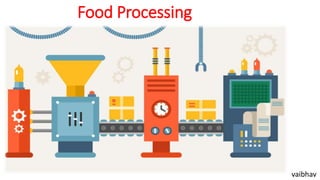
Food Processing
vaibhav
What is Food Processing
• Food Processing includes process under which any raw product
of agriculture, dairy, animal husbandry, meat, poultry or fishing
is transformed through a process (involving employees, power,
machines or money) in such a way that its original physical
properties undergo a change and the transformed product has
commercial value and is suitable for human and animal
consumption.
• It also includes the process of value addition to produce products
through methods such as preservation, addition of food
additives, drying etc. with a view to preserve food substances in
an effective manner, enhance their shelf life and quality.
Significance
The Food Processing Industry (FPI) is of enormous significance as it provides vital linkages
and synergies that it promotes between the two pillars of the economy, i.e. agriculture and
industry.
1. Employment Generation
2. Doubling of farmers’ income
3. Reduce malnutrition
4. Reduce food wastage
5. Boosts Trade and Earns Foreign exchange
6. Curbing Migration
7. Curbing Food Inflation
8. Crop-diversification
9. Preserve the nutritive quality of food and prolongs the shelf life
10. Enhances the quality and taste of food
11. Enhances consumer choices
Status of Food Processing In India
• India is the world's second largest producer of fruits & vegetables after China but hardly 2% of
the produce is processed.
• In spite of a large production base, the level of processing is low (less than 10%). Approximately
2% of fruits and vegetables, 8% marine, 35% milk, 6% poultry are processed. Lack of adequate
processable varieties continues to pose a significant challenge to this sector.
• India's livestock population is largest in the world with 50% of the world's buffaloes and 20% of
cattle, but only about 1% of total meat production is converted to value added products.
• More than 75% of the industry is in unorganized sector.
• Processing can be delineated into primary and secondary processing. Rice, sugar, edible oil and
flour mills are examples of primary processing. Secondary processing includes the processing of
fruits and vegetables, dairy, bakery, chocolates and other items.
• Most processing in India can be classified as primary processing, which has lower value-
addition compared to secondary processing. There is a need to move up the value chain in
processed food products to boost farmer incomes. For instance, horticulture products, such as
fruits and vegetables, carry the potential for higher value-addition when compared to cereal
crops.
• At present, India’s agricultural exports predominantly consist of raw materials, which are then
processed in other countries, again indicating the space to move up the value chain.
Food processing industry in India can be segmented as follows
• Cereal/ pulse milling
• Fruit & vegetable processing
• Milk & milk products
• Beverages like coffee, tea & cocoa
• Fish, poultry, eggs & products
• Meat & meat products
• Aerated waters/soft drinks
• Beer/alcoholic beverages
• Bread, biscuits & other bakery products
• Edible oil/fats.
• Confectioneries
• Breakfast cereals, malt protein, weaning, extruded food products
Problems in Food Processing Industries
Farm level problems
•Poor yield of farm produce and therefore low returns.
•Lack of material resources necessary for development.
•Primitive methods of farming.
•No control on the quality of inputs and lack of finance
to manage.
•Vagaries of weather.
•Unavailability of reliable handling and transportation
system.
•Lack of storage facilities at farm.
Distributors’ problems
• Lack of modern transportation facilities and high cost
• Inadequate cold storage faculties
• Irregular quality and quantity of farm produce
Processing industries problem
• Financing
• Higher import duties
• Higher cost of raw material and packaging
• Inadequate transport and cold storage facilities
• Infrequent availability of refrigerated containers
• Staggering advertising costs
• Limited domestic market
Draft National Food Processing Policy
• Key objectives :
• (i) reducing wastage at the farmer level to increase their incomes,
• (ii) supporting the food processing industry to create employment opportunities,
• (iii) ensuring a higher deployment of credit in the sector,
• (iv) enhancing the availability of safer, affordable, and higher quality food products for
consumer, and
• (v) infrastructure and skill building to meet the demands of the sector.
• Infrastructure development: The draft policy seeks to incentivise the
creation of supply chain infrastructure for the food processing sector. Some
of the proposed measures include:
• (i) identifying, developing and promoting new agriculture processing and production
clusters, and
• (ii) supporting the development of logistics infrastructure such as cleaning and
packing facilities.
Reasons for slow growth of processed foods in India
• Majority of the population has low-income levels and cannot afford processed foods.
• The high cost of packaging pushes up the cost of the processed items and thereby makes them
out of reach of the common man.
• Indians traditionally prefer fresh foods that are cooked rather than use preserved foods.
• There is also no national character for food habits and these keep changing from region to
region.
• However, the scenario is changing with some foods, especially fast food, acquiring the national
character. Also some foods such as idli, dosa, some Punjabi foods like chhole, alu mutter etc.,
some Chinese foods and now the western foods like burgers and pizza are fast gaining national
popularity.
• Transport (both road and railways) and communication are poor.
• There are no reliable cold chains, which are necessary for temperature sensitive foods like fruits
& vegetables, ice creams etc.
• Modernization is unaffordable for small-scale manufacturer but the large companies do not find
investment justifiable due to small size of the market.
• Supermarkets are not yet popular although a few are making an appearance.
Challenges
•Extensive use of fertilizers, pesticides
•Care should be taken as processed foods may not be
nutritionally balanced
•Low value-added in processing
•Limited ability to control quality and safety
•Low consumer awareness
Government’s Initiative
• PMKSY (Pradhan Mantri Kisan SAMPADA Yojana)
• Mega Food Parks.
• Integrated Cold Chain, Value Addition and Preservation Infrastructure.
• Creation/Expansion of Food Processing/Preservation Capacities.
• Infrastructure for Agro Processing Clusters.
• Scheme for Creation of Backward and Forward Linkages.
• Food Safety & Quality Assurance Infrastructure.
• Human Resources and Institutions
• Foreign Direct Investment (FDI) policy
•Agricultural and Processed Food Products Export
Development Authority (APEDA)
Suggestions
• Storage capacities and infrastructure should be increased.
• Develop the agricultural facility with good agricultural practice which leads to the transition from staple
food crops to diversification of crops.
• Backward linkages to farmers need to be made more robust. Contract farming can be promoted.
According to the Model Contract Farming Act, 2018, the contract will specify the quantity, quality and
price of produce being supplied. This would shield farmers from price volatility, subject to quality
commitments.
• Skilling is required at two levels. First at the farm gate in promoting agricultural best practices and in
processing activities.
• Public investment and connectivity should be increased.
• Slaughter animal rules should be framed in a comprehensive policy framework.
• Farm pattern diversification which leads to a production of variety of crops other than constant set of
crops which creates lot of job opportunities.
• Second Green Revolution should be updated with the diversified technologies.
• We have to encourage the domestic startups and industry than the international companies.
• There should be a Centre of Excellence between centre and state.
• Should have more training institutes for upcoming entrepreneurs and it should be in all states.
Scholarship should be given to the upcoming entrepreneurs.
• New technology should be updated in the training institutes and skill development should be given the
top most priority.

Food processing

  • 1.
  • 2.
    What is FoodProcessing • Food Processing includes process under which any raw product of agriculture, dairy, animal husbandry, meat, poultry or fishing is transformed through a process (involving employees, power, machines or money) in such a way that its original physical properties undergo a change and the transformed product has commercial value and is suitable for human and animal consumption. • It also includes the process of value addition to produce products through methods such as preservation, addition of food additives, drying etc. with a view to preserve food substances in an effective manner, enhance their shelf life and quality.
  • 3.
    Significance The Food ProcessingIndustry (FPI) is of enormous significance as it provides vital linkages and synergies that it promotes between the two pillars of the economy, i.e. agriculture and industry. 1. Employment Generation 2. Doubling of farmers’ income 3. Reduce malnutrition 4. Reduce food wastage 5. Boosts Trade and Earns Foreign exchange 6. Curbing Migration 7. Curbing Food Inflation 8. Crop-diversification 9. Preserve the nutritive quality of food and prolongs the shelf life 10. Enhances the quality and taste of food 11. Enhances consumer choices
  • 4.
    Status of FoodProcessing In India • India is the world's second largest producer of fruits & vegetables after China but hardly 2% of the produce is processed. • In spite of a large production base, the level of processing is low (less than 10%). Approximately 2% of fruits and vegetables, 8% marine, 35% milk, 6% poultry are processed. Lack of adequate processable varieties continues to pose a significant challenge to this sector. • India's livestock population is largest in the world with 50% of the world's buffaloes and 20% of cattle, but only about 1% of total meat production is converted to value added products. • More than 75% of the industry is in unorganized sector. • Processing can be delineated into primary and secondary processing. Rice, sugar, edible oil and flour mills are examples of primary processing. Secondary processing includes the processing of fruits and vegetables, dairy, bakery, chocolates and other items. • Most processing in India can be classified as primary processing, which has lower value- addition compared to secondary processing. There is a need to move up the value chain in processed food products to boost farmer incomes. For instance, horticulture products, such as fruits and vegetables, carry the potential for higher value-addition when compared to cereal crops. • At present, India’s agricultural exports predominantly consist of raw materials, which are then processed in other countries, again indicating the space to move up the value chain.
  • 5.
    Food processing industryin India can be segmented as follows • Cereal/ pulse milling • Fruit & vegetable processing • Milk & milk products • Beverages like coffee, tea & cocoa • Fish, poultry, eggs & products • Meat & meat products • Aerated waters/soft drinks • Beer/alcoholic beverages • Bread, biscuits & other bakery products • Edible oil/fats. • Confectioneries • Breakfast cereals, malt protein, weaning, extruded food products
  • 6.
    Problems in FoodProcessing Industries Farm level problems •Poor yield of farm produce and therefore low returns. •Lack of material resources necessary for development. •Primitive methods of farming. •No control on the quality of inputs and lack of finance to manage. •Vagaries of weather. •Unavailability of reliable handling and transportation system. •Lack of storage facilities at farm.
  • 7.
    Distributors’ problems • Lackof modern transportation facilities and high cost • Inadequate cold storage faculties • Irregular quality and quantity of farm produce Processing industries problem • Financing • Higher import duties • Higher cost of raw material and packaging • Inadequate transport and cold storage facilities • Infrequent availability of refrigerated containers • Staggering advertising costs • Limited domestic market
  • 8.
    Draft National FoodProcessing Policy • Key objectives : • (i) reducing wastage at the farmer level to increase their incomes, • (ii) supporting the food processing industry to create employment opportunities, • (iii) ensuring a higher deployment of credit in the sector, • (iv) enhancing the availability of safer, affordable, and higher quality food products for consumer, and • (v) infrastructure and skill building to meet the demands of the sector. • Infrastructure development: The draft policy seeks to incentivise the creation of supply chain infrastructure for the food processing sector. Some of the proposed measures include: • (i) identifying, developing and promoting new agriculture processing and production clusters, and • (ii) supporting the development of logistics infrastructure such as cleaning and packing facilities.
  • 9.
    Reasons for slowgrowth of processed foods in India • Majority of the population has low-income levels and cannot afford processed foods. • The high cost of packaging pushes up the cost of the processed items and thereby makes them out of reach of the common man. • Indians traditionally prefer fresh foods that are cooked rather than use preserved foods. • There is also no national character for food habits and these keep changing from region to region. • However, the scenario is changing with some foods, especially fast food, acquiring the national character. Also some foods such as idli, dosa, some Punjabi foods like chhole, alu mutter etc., some Chinese foods and now the western foods like burgers and pizza are fast gaining national popularity. • Transport (both road and railways) and communication are poor. • There are no reliable cold chains, which are necessary for temperature sensitive foods like fruits & vegetables, ice creams etc. • Modernization is unaffordable for small-scale manufacturer but the large companies do not find investment justifiable due to small size of the market. • Supermarkets are not yet popular although a few are making an appearance.
  • 10.
    Challenges •Extensive use offertilizers, pesticides •Care should be taken as processed foods may not be nutritionally balanced •Low value-added in processing •Limited ability to control quality and safety •Low consumer awareness
  • 11.
    Government’s Initiative • PMKSY(Pradhan Mantri Kisan SAMPADA Yojana) • Mega Food Parks. • Integrated Cold Chain, Value Addition and Preservation Infrastructure. • Creation/Expansion of Food Processing/Preservation Capacities. • Infrastructure for Agro Processing Clusters. • Scheme for Creation of Backward and Forward Linkages. • Food Safety & Quality Assurance Infrastructure. • Human Resources and Institutions • Foreign Direct Investment (FDI) policy •Agricultural and Processed Food Products Export Development Authority (APEDA)
  • 12.
    Suggestions • Storage capacitiesand infrastructure should be increased. • Develop the agricultural facility with good agricultural practice which leads to the transition from staple food crops to diversification of crops. • Backward linkages to farmers need to be made more robust. Contract farming can be promoted. According to the Model Contract Farming Act, 2018, the contract will specify the quantity, quality and price of produce being supplied. This would shield farmers from price volatility, subject to quality commitments. • Skilling is required at two levels. First at the farm gate in promoting agricultural best practices and in processing activities. • Public investment and connectivity should be increased. • Slaughter animal rules should be framed in a comprehensive policy framework. • Farm pattern diversification which leads to a production of variety of crops other than constant set of crops which creates lot of job opportunities. • Second Green Revolution should be updated with the diversified technologies. • We have to encourage the domestic startups and industry than the international companies. • There should be a Centre of Excellence between centre and state. • Should have more training institutes for upcoming entrepreneurs and it should be in all states. Scholarship should be given to the upcoming entrepreneurs. • New technology should be updated in the training institutes and skill development should be given the top most priority.