 It is a “Degree of excellence.” which a thing possess.
 Food quality is a complex concept measured using objective indices related to
the nutritional, microbiological or physiochemical characteristics of the food.
 Definition from a USDA Marketing workshop report by Gould (1977). It reads “a
combination of attributes or characteristics of a product that have a significance
in determining the degree of acceptability of a product to a user.
WHAT IS QUALITY?
 To develop new products-the food industry depends on evaluation in
developing new products and maintaining quality in existing products.
 To observe consumer reactions- how the consumer reacts to particular
food dictates the quality of the product.
 To collect information of food acceptability.
 To assist in determining the shelf life of a product.
 To understand how the product competes in the market.
 To determine whether or not consumers can detect differences
between product due to recipe modification.
Objective of quality food
Direct ratings of aspects of product quality by ‘annoyance’
1. Food quality instructs the consumers to rate the degree to which
they would be annoyed were the product to lack some specific
characteristics. (Moskowitz, 1985).
2. The researcher presents the panelist with a variety of potential
product defects, ranging from general to specific.
3. The order of these defects is randomized in the questionnaire.
The rating of annoyance on a O-100 scale is presumed to reflect
relative importance.
4. when a product is described as being of low quality, the
annoyance rating is high, no matter what the category. This
means that when the researcher describes the product as being
of ‘low quality’, the consumer states that he would be annoyed
had he purchased a product with this defect of ‘low quality’
ATTITUDINAL QUALITY FROM THE CONSUMER'S
POINT OF VIEW
Improving consumer acceptance -the ‘upside’ of quality
Manufacturers always search for ways to improve product quality
in order to insure ongoing consumer acceptance, and therefore to
remain in business.
The key word is acceptance. Product quality is assumed to be
identical to overall liking, so the objective is to increase overall
liking, while maintaining cost.
PRODUCT QUALITY IN A COMPETITIVE
ECONOMIC ENVIRONMENT
 In many companies, both in the US, and elsewhere, product
researchers measure product overall liking in an ongoing fashion by
means of competitive audits in a category.
 This is a common practice that allows the manufacturer to
understand how well their product(s) does vs the full range of
competitor products currently available to the consumer.
Consumers assess the different products, both on a blind
(disguised) basis, and on a branded (identified) basis (Moskowitz,
1985, 1994).
 Consumers rate those products on overall liking, sensory attribute
liking, and sensory attribute ratings.
 As noted above, when the consumers rate ‘quality’ for these
products, there is an exceptionally high positive correlation
between ‘overall product quality’ and ‘overall liking’
.
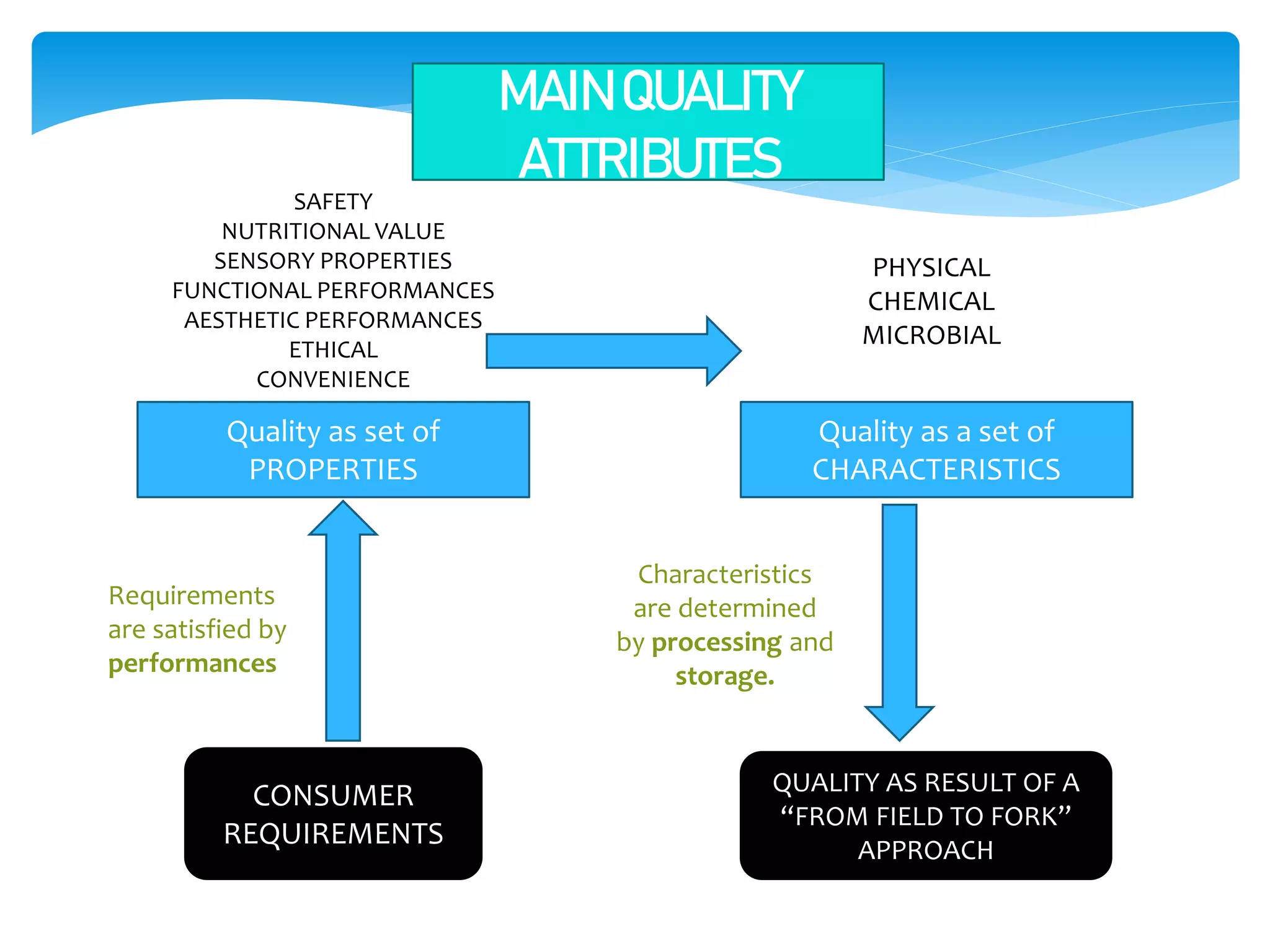
Quality as set of
PROPERTIES
Quality as a set of
CHARACTERISTICS
SAFETY
NUTRITIONAL VALUE
SENSORY PROPERTIES
FUNCTIONAL PERFORMANCES
AESTHETIC PERFORMANCES
ETHICAL
CONVENIENCE
PHYSICAL
CHEMICAL
MICROBIAL
CONSUMER
REQUIREMENTS
QUALITY AS RESULT OF A
“FROM FIELD TO FORK”
APPROACH
Characteristics
are determined
by processing and
storage.
Requirements
are satisfied by
performances
MAIN QUALITY
ATTRIBUTES
 PROCESSED FOODS:
1. Composition, physical and structural properties.
2. Type of Processing technique applied.
3. Storage and packaging conditions. (time, temperature, relative
humidity).
WHERE QUALITY ATTRIBUTES CAN BE LOST/REDUCE
1. Selection, production, picking up, storage raw material.
2. Formulation of the recipe.
3. Processing and manufacturing technologies.
4. Packaging
5. Storage condition, transport, distribution.
6. Domestic management and use( storage, transport, preparation)
FACTORS THAT AFFFECT FOOD QUALITY
Due to-
Three major hazards may contaminate food and lead to a breach of food
quality:
 Physical Hazard: Presence of dirt, dust, metal, hair, etc. that contaminate
food
 Chemical Hazard: Presence of pesticides, heavy metals, and allergens, etc.
 Biological Hazard: Presence of microorganisms (mainly)
Risks
 Food poisoning and infections.(microbial)
 Carcinogenesis, mutagenicity. (Chemical)
 Parasitic traumatic injuries. (microbial)
 Toxic substances and dangerous components. (lead, mercury etc)
Quality attribute associated to the acceptable
risks
 PROPERTY ASSOCIATED TO THE PRESENCE AND
CONTENT OF:
Macronutrients Micro-nutrients
1. Proteins 1. Vitamins
2. Lipids 2. Minerals
3. Carbohydrates (sugars, starch)
THESE COMPONENTS POSITIVELY CONTRIBUTE TO HEALTH STATUS OF
CONSUMERS.
 Absence of anti-nutritional components.
 Absence of components that may cause allergies and intolerance.
 Presence and availability of components (bio actives) able to exert
positive effects on human health.
BIOACTIVES phytochemicals, phenolic compounds, carotenoids, essential oils,
antioxidants.
Nutritive value
The four principal quality factors in food are the following:
 Appearance: comprising color, shape, size, gloss, etc. is based on optical
properties and visual manifestation of size and shape.
 Flavor: comprising taste (perceived on tongue) and odor (perceived in the
olfactory Centre in the nose), is the response of receptor in the oral cavity to
chemical stimuli.
 Texture, is the response of the tactile senses to physical stimuli that result from
contact between some part of the body and the food..
Of the above listed the first three are termed as “sensory acceptable factors”
because they are perceived by the senses directly.
 Nutrition Cost, convenience and packaging are also important but not considered
quality factors.
Nutrition is a quality factor that is not an acceptability factor as it is not perceived by
the senses.
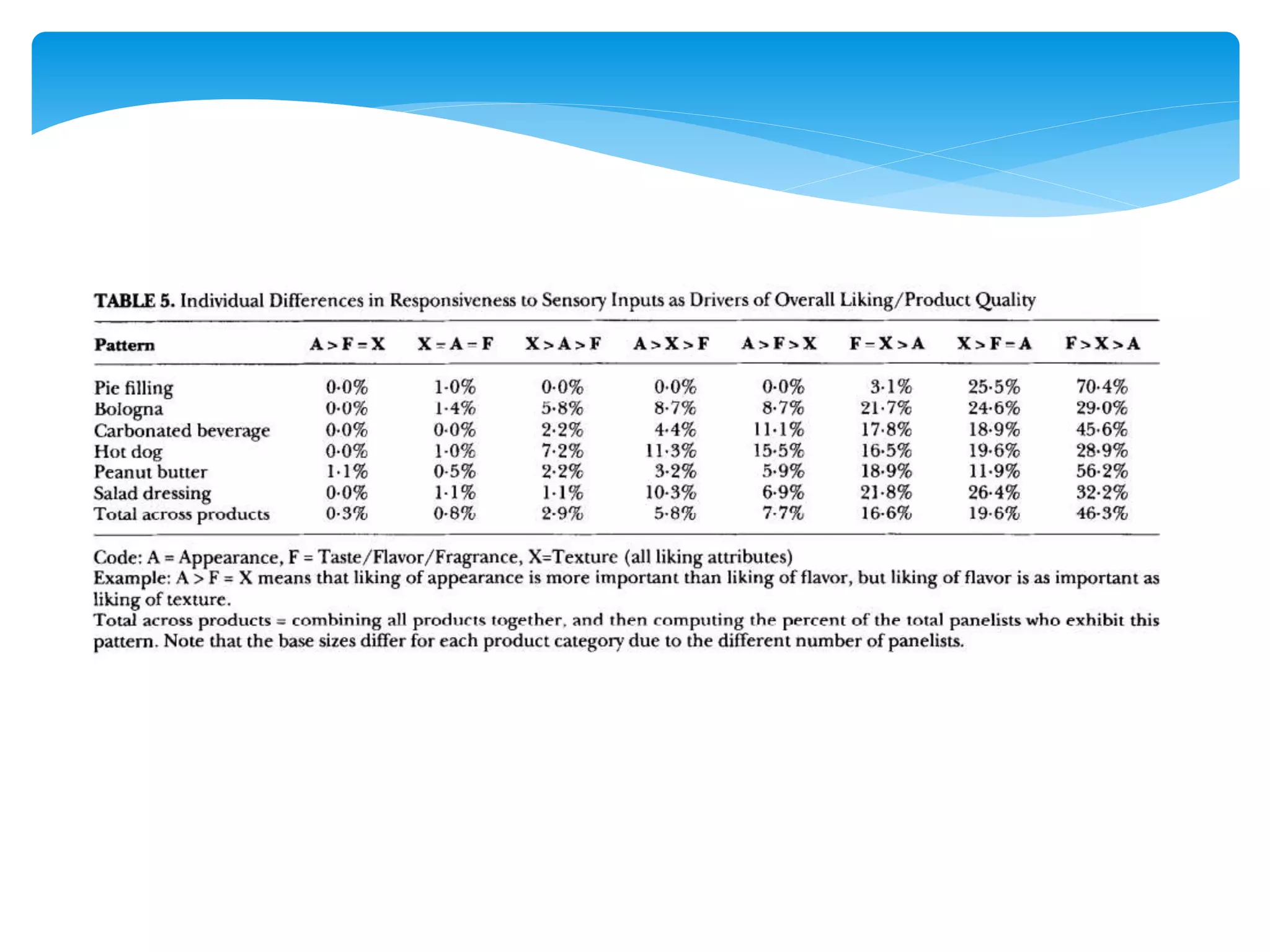
Sensory attributes in evaluating food
quality
Sensory attributes in evaluating food quality
 Referred to religious, political, ideological issues.
Ethical requirements include:
 Organic agriculture and farming products.
 Environment protection/sustainability.
 “Kosher” o “Halal” products.
 Vegetarian, vegan products.
 “GMO-free”.
and related certification requirements.
Ethical requirements
 It depends on the ability to resist to the evolution of the reactions and
processes that cause food degradation over storage time or the expected
shelf life.
(Sale-ability/Consumption/Usable time)
1. Microbial growth
2. Chemical and enzymatic/biochemical reactions
3. Physical processes.
 Aim of Food processing :
 Slow down/inhibit the reactions and processes causing food degradation.
 Destroy microorganisms (both pathogenic and alterative) and degradative
enzymes.
Stability and shelf life
Expected stability/shelf-life –
 Fresh product
(fresh vegetables, milk, meat, fish) few hours/days
 Processed product:
It depends on the product, from days to years.
In processed products, type and intensity of processing along with
packaging significantly affect they stability during storage, distribution
and transportation.
Continue……
1. Raw materials and ingredients :
 Proper choice depending on the desired final quality, safety and stability.
 High microbial quality and low chemical and environmental contaminants
2.Processing Improving control of the process parameter:
 Optimization of the process parameters to maximize the desired effects and
minimize the process damages.
 Adoption of new processing and preservation technologies.
3. Adoption of prevention strategies
HACCP (Hazard Analysis Critical Control Point), GMP (Good Manufacturing
Practices), TQM (Total Quality Management), etc.
How to improve the quality of food
The four common standards:
1. LEGAL STANDARDS (FSSAI )
 Mandatory and set up by law or through regulations.
 Legal standards are generally concerned with the lack of adulteration due to - insects, molds,
yeasts and pesticides-
 maximum limits of additives permitted.
 established specific processing conditions so that extraneous materials do not contaminate
food.
2. Company or Voluntary Label Standards : (AGMARK)
 Represents a consumer image and may become a trademark or symbol of product quality.
 Used by private companies or supermarkets and tend to vary depending upon the particular
requirements of a given label.
 AGMARK: (agri-produce) 3 Grades, depending on the quality.
Grades help farmers to get prices for agricultural commodities as per the quality produced by
them and consumers get the desired quality.
Food Quality standards
3. Industry Standards.(BIS MARK)
 Voluntary standard used to establish given quality limits for a given commodity.
 Industry standards are implemented due to the pressure from marketing organizations or
by specific commodity groups where legal standards are not involved.
EG: packaged drinking water. (now BIS is mandatory for packaged water)
4. Consumer or grade standards. These represent the consumers’ requirements for a product.
CONSUMER PROTECTION ACT (1986)
 Under minister of consumer affairs
 The main objective of this Act is to provide better protection for the consumer in terms of
quality of the product he buys.
 The provisions of this Act are compensatory in nature.
This Act is intended to provide simple, speedy and inexpensive redressal to the consumer's
grievance and relief of specific nature.
Continue…
Consumers have a right to expect that the foods they purchase and
consume will be safe and of high quality. They have a right to voice
their opinions about the food control procedures, standards and
activities that governments and industry use to ascertain that the
food supply has these characteristics. While consumers,
governments and others play an important part in ensuring food
safety and quality. A number of food control issues are currently
being debated at the national and international levels, regarding
for example pathogenic microorganisms, allergens, genetically
modified foods, contaminants (including pesticides), irradiation
and nutrition labelling. These are important and complicated
matters that require attention.
CONCLUSIONS
The control issues are at various stages of resolution and considerable
effort will be required to resolve them in a scientific, practical and
uniform manner. Industry recognizes that consumers play an active,
important role in the food control process through their participation
in the standard-setting process and discussions on scientific and
technical issues. The mutual goal should be to resolve these questions
in a way that takes into account the needs of governments, consumers
and industry. For governments, there is the need for enforceable
standards that are convincing to both consumers and industry. For
consumers, food control systems must provide meaningful protection
against real and important hazards. Finally, industry needs standards
that permit flexibility and efficiency in producing and marketing foods
that will serve their customers - the world's consumers.
QUALITY standard logos
.
 Elsevier journal: FOOD QUALlTY RELATIVITY,CONTEXTANDCONSUMER
EXPECTATIONS.
 Atkins, Peter & Bowler, Ian. (2001). Food quality.
 Peri C..The universe of food quality. Food Quality and Preference 17 (2006) 3–8.
 van Boekel M. A.J.S. Kinetic Modeling of Food Quality: A Critical Review.
Comprehensive Reviews in Food Science and Food Safety, 7 (2008), 144-158
 Barrett, D. M., Beaulieu, J.C. and Shewfelt, R. (2010). Color, Flavor, Texture, and
Nutritional Quality of Fresh-Cut Fruits and Vegetables: Desirable Levels,
Instrumental and Sensory Measurement, and the Effects of Processing, Critical
Reviews in Food Science and Nutrition, 50: 5, 369-389.
 Grunert, Klaus G. "Food quality and safety: consumer perception and
demand." European review of agricultural economics 32.3 (2005): 369-391.
 Cardello, Armand V. "Food quality: relativity, context and consumer
expectations." Food quality and preference 6.3 (1995): 163-170.
 LOGOS- google search
REFERENCES
concept of food quality

concept of food quality

  • 2.
     It isa “Degree of excellence.” which a thing possess.  Food quality is a complex concept measured using objective indices related to the nutritional, microbiological or physiochemical characteristics of the food.  Definition from a USDA Marketing workshop report by Gould (1977). It reads “a combination of attributes or characteristics of a product that have a significance in determining the degree of acceptability of a product to a user. WHAT IS QUALITY?
  • 3.
     To developnew products-the food industry depends on evaluation in developing new products and maintaining quality in existing products.  To observe consumer reactions- how the consumer reacts to particular food dictates the quality of the product.  To collect information of food acceptability.  To assist in determining the shelf life of a product.  To understand how the product competes in the market.  To determine whether or not consumers can detect differences between product due to recipe modification. Objective of quality food
  • 4.
    Direct ratings ofaspects of product quality by ‘annoyance’ 1. Food quality instructs the consumers to rate the degree to which they would be annoyed were the product to lack some specific characteristics. (Moskowitz, 1985). 2. The researcher presents the panelist with a variety of potential product defects, ranging from general to specific. 3. The order of these defects is randomized in the questionnaire. The rating of annoyance on a O-100 scale is presumed to reflect relative importance. 4. when a product is described as being of low quality, the annoyance rating is high, no matter what the category. This means that when the researcher describes the product as being of ‘low quality’, the consumer states that he would be annoyed had he purchased a product with this defect of ‘low quality’ ATTITUDINAL QUALITY FROM THE CONSUMER'S POINT OF VIEW
  • 6.
    Improving consumer acceptance-the ‘upside’ of quality Manufacturers always search for ways to improve product quality in order to insure ongoing consumer acceptance, and therefore to remain in business. The key word is acceptance. Product quality is assumed to be identical to overall liking, so the objective is to increase overall liking, while maintaining cost. PRODUCT QUALITY IN A COMPETITIVE ECONOMIC ENVIRONMENT
  • 7.
     In manycompanies, both in the US, and elsewhere, product researchers measure product overall liking in an ongoing fashion by means of competitive audits in a category.  This is a common practice that allows the manufacturer to understand how well their product(s) does vs the full range of competitor products currently available to the consumer. Consumers assess the different products, both on a blind (disguised) basis, and on a branded (identified) basis (Moskowitz, 1985, 1994).  Consumers rate those products on overall liking, sensory attribute liking, and sensory attribute ratings.  As noted above, when the consumers rate ‘quality’ for these products, there is an exceptionally high positive correlation between ‘overall product quality’ and ‘overall liking’ .
  • 9.
    Quality as setof PROPERTIES Quality as a set of CHARACTERISTICS SAFETY NUTRITIONAL VALUE SENSORY PROPERTIES FUNCTIONAL PERFORMANCES AESTHETIC PERFORMANCES ETHICAL CONVENIENCE PHYSICAL CHEMICAL MICROBIAL CONSUMER REQUIREMENTS QUALITY AS RESULT OF A “FROM FIELD TO FORK” APPROACH Characteristics are determined by processing and storage. Requirements are satisfied by performances MAIN QUALITY ATTRIBUTES
  • 10.
     PROCESSED FOODS: 1.Composition, physical and structural properties. 2. Type of Processing technique applied. 3. Storage and packaging conditions. (time, temperature, relative humidity). WHERE QUALITY ATTRIBUTES CAN BE LOST/REDUCE 1. Selection, production, picking up, storage raw material. 2. Formulation of the recipe. 3. Processing and manufacturing technologies. 4. Packaging 5. Storage condition, transport, distribution. 6. Domestic management and use( storage, transport, preparation) FACTORS THAT AFFFECT FOOD QUALITY
  • 11.
    Due to- Three majorhazards may contaminate food and lead to a breach of food quality:  Physical Hazard: Presence of dirt, dust, metal, hair, etc. that contaminate food  Chemical Hazard: Presence of pesticides, heavy metals, and allergens, etc.  Biological Hazard: Presence of microorganisms (mainly) Risks  Food poisoning and infections.(microbial)  Carcinogenesis, mutagenicity. (Chemical)  Parasitic traumatic injuries. (microbial)  Toxic substances and dangerous components. (lead, mercury etc) Quality attribute associated to the acceptable risks
  • 12.
     PROPERTY ASSOCIATEDTO THE PRESENCE AND CONTENT OF: Macronutrients Micro-nutrients 1. Proteins 1. Vitamins 2. Lipids 2. Minerals 3. Carbohydrates (sugars, starch) THESE COMPONENTS POSITIVELY CONTRIBUTE TO HEALTH STATUS OF CONSUMERS.  Absence of anti-nutritional components.  Absence of components that may cause allergies and intolerance.  Presence and availability of components (bio actives) able to exert positive effects on human health. BIOACTIVES phytochemicals, phenolic compounds, carotenoids, essential oils, antioxidants. Nutritive value
  • 13.
    The four principalquality factors in food are the following:  Appearance: comprising color, shape, size, gloss, etc. is based on optical properties and visual manifestation of size and shape.  Flavor: comprising taste (perceived on tongue) and odor (perceived in the olfactory Centre in the nose), is the response of receptor in the oral cavity to chemical stimuli.  Texture, is the response of the tactile senses to physical stimuli that result from contact between some part of the body and the food.. Of the above listed the first three are termed as “sensory acceptable factors” because they are perceived by the senses directly.  Nutrition Cost, convenience and packaging are also important but not considered quality factors. Nutrition is a quality factor that is not an acceptability factor as it is not perceived by the senses. Sensory attributes in evaluating food quality
  • 14.
    Sensory attributes inevaluating food quality
  • 15.
     Referred toreligious, political, ideological issues. Ethical requirements include:  Organic agriculture and farming products.  Environment protection/sustainability.  “Kosher” o “Halal” products.  Vegetarian, vegan products.  “GMO-free”. and related certification requirements. Ethical requirements
  • 16.
     It dependson the ability to resist to the evolution of the reactions and processes that cause food degradation over storage time or the expected shelf life. (Sale-ability/Consumption/Usable time) 1. Microbial growth 2. Chemical and enzymatic/biochemical reactions 3. Physical processes.  Aim of Food processing :  Slow down/inhibit the reactions and processes causing food degradation.  Destroy microorganisms (both pathogenic and alterative) and degradative enzymes. Stability and shelf life
  • 17.
    Expected stability/shelf-life – Fresh product (fresh vegetables, milk, meat, fish) few hours/days  Processed product: It depends on the product, from days to years. In processed products, type and intensity of processing along with packaging significantly affect they stability during storage, distribution and transportation. Continue……
  • 18.
    1. Raw materialsand ingredients :  Proper choice depending on the desired final quality, safety and stability.  High microbial quality and low chemical and environmental contaminants 2.Processing Improving control of the process parameter:  Optimization of the process parameters to maximize the desired effects and minimize the process damages.  Adoption of new processing and preservation technologies. 3. Adoption of prevention strategies HACCP (Hazard Analysis Critical Control Point), GMP (Good Manufacturing Practices), TQM (Total Quality Management), etc. How to improve the quality of food
  • 19.
    The four commonstandards: 1. LEGAL STANDARDS (FSSAI )  Mandatory and set up by law or through regulations.  Legal standards are generally concerned with the lack of adulteration due to - insects, molds, yeasts and pesticides-  maximum limits of additives permitted.  established specific processing conditions so that extraneous materials do not contaminate food. 2. Company or Voluntary Label Standards : (AGMARK)  Represents a consumer image and may become a trademark or symbol of product quality.  Used by private companies or supermarkets and tend to vary depending upon the particular requirements of a given label.  AGMARK: (agri-produce) 3 Grades, depending on the quality. Grades help farmers to get prices for agricultural commodities as per the quality produced by them and consumers get the desired quality. Food Quality standards
  • 20.
    3. Industry Standards.(BISMARK)  Voluntary standard used to establish given quality limits for a given commodity.  Industry standards are implemented due to the pressure from marketing organizations or by specific commodity groups where legal standards are not involved. EG: packaged drinking water. (now BIS is mandatory for packaged water) 4. Consumer or grade standards. These represent the consumers’ requirements for a product. CONSUMER PROTECTION ACT (1986)  Under minister of consumer affairs  The main objective of this Act is to provide better protection for the consumer in terms of quality of the product he buys.  The provisions of this Act are compensatory in nature. This Act is intended to provide simple, speedy and inexpensive redressal to the consumer's grievance and relief of specific nature. Continue…
  • 21.
    Consumers have aright to expect that the foods they purchase and consume will be safe and of high quality. They have a right to voice their opinions about the food control procedures, standards and activities that governments and industry use to ascertain that the food supply has these characteristics. While consumers, governments and others play an important part in ensuring food safety and quality. A number of food control issues are currently being debated at the national and international levels, regarding for example pathogenic microorganisms, allergens, genetically modified foods, contaminants (including pesticides), irradiation and nutrition labelling. These are important and complicated matters that require attention. CONCLUSIONS
  • 22.
    The control issuesare at various stages of resolution and considerable effort will be required to resolve them in a scientific, practical and uniform manner. Industry recognizes that consumers play an active, important role in the food control process through their participation in the standard-setting process and discussions on scientific and technical issues. The mutual goal should be to resolve these questions in a way that takes into account the needs of governments, consumers and industry. For governments, there is the need for enforceable standards that are convincing to both consumers and industry. For consumers, food control systems must provide meaningful protection against real and important hazards. Finally, industry needs standards that permit flexibility and efficiency in producing and marketing foods that will serve their customers - the world's consumers.
  • 23.
  • 24.
     Elsevier journal:FOOD QUALlTY RELATIVITY,CONTEXTANDCONSUMER EXPECTATIONS.  Atkins, Peter & Bowler, Ian. (2001). Food quality.  Peri C..The universe of food quality. Food Quality and Preference 17 (2006) 3–8.  van Boekel M. A.J.S. Kinetic Modeling of Food Quality: A Critical Review. Comprehensive Reviews in Food Science and Food Safety, 7 (2008), 144-158  Barrett, D. M., Beaulieu, J.C. and Shewfelt, R. (2010). Color, Flavor, Texture, and Nutritional Quality of Fresh-Cut Fruits and Vegetables: Desirable Levels, Instrumental and Sensory Measurement, and the Effects of Processing, Critical Reviews in Food Science and Nutrition, 50: 5, 369-389.  Grunert, Klaus G. "Food quality and safety: consumer perception and demand." European review of agricultural economics 32.3 (2005): 369-391.  Cardello, Armand V. "Food quality: relativity, context and consumer expectations." Food quality and preference 6.3 (1995): 163-170.  LOGOS- google search REFERENCES