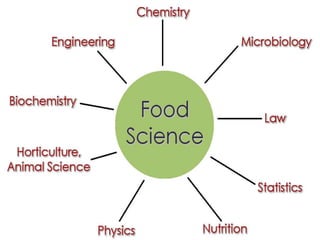
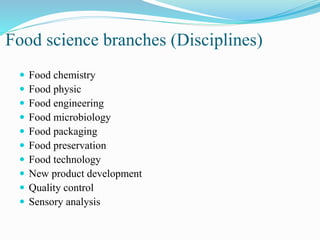
Food can be classified in many ways such as by source, safety, composition, and stability during storage. Food science is the study of food substances and involves disciplines like food chemistry, engineering, microbiology and technology. It is important to study food science to develop new processing methods, preserve foods, and discover new food sources. Over time, food technology and processing has advanced from hunter-gatherers and early farmers to modern practices using electricity, transportation, mechanization and scientific understanding. Food can now be classified, preserved, and distributed through various modern formats to make it available to consumers.
Discussion on food definitions, classifications (solid, semi-solid, etc.), and nutrition types (macronutrients and micronutrients). Key terms: Energy, Carbohydrates, Proteins.
Introduction to food science, its importance, and the role of food scientists in processing, preservation, and finding new food sources.
Overview of food technology, historical shifts from hunter-gatherers to farmers, and domestication practices for food production.
How different civilizations introduced unique food processing and preservation techniques, leading to modern practices.
Objectives of food technology, factors influencing food processes, and importance of food processing for safety and nutrition.
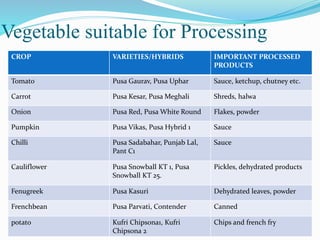
Stages of food processing (primary, secondary, tertiary) and common crops suitable for processing, highlighting product types.Description of the food value chain and distribution formats for food products across traditional and modern retail setups.
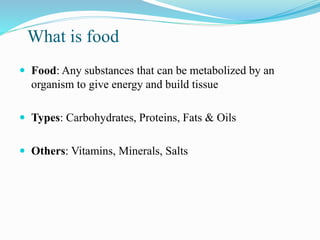
What is food
Food: Any substances that can be metabolized by an
organism to give energy and build tissue
Types: Carbohydrates, Proteins, Fats & Oils
Others: Vitamins, Minerals, Salts
3.
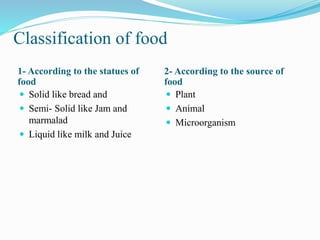
Classification of food
1-According to the statues of
food
2- According to the source of
food
Solid like bread and
Semi- Solid like Jam and
marmalad
Liquid like milk and Juice
Plant
Animal
Microorganism
4.
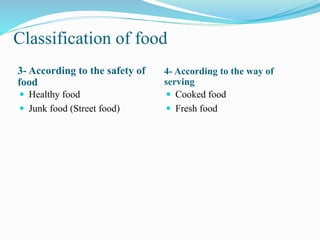
Classification of food
3-According to the safety of
food
4- According to the way of
serving
Healthy food
Junk food (Street food)
Cooked food
Fresh food
5.
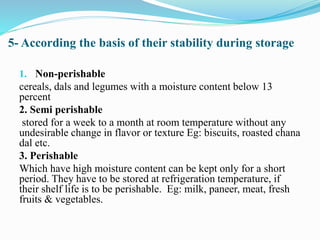
5- According thebasis of their stability during storage
1. Non-perishable
cereals, dals and legumes with a moisture content below 13
percent
2. Semi perishable
stored for a week to a month at room temperature without any
undesirable change in flavor or texture Eg: biscuits, roasted chana
dal etc.
3. Perishable
Which have high moisture content can be kept only for a short
period. They have to be stored at refrigeration temperature, if
their shelf life is to be perishable. Eg: milk, paneer, meat, fresh
fruits & vegetables.
6.
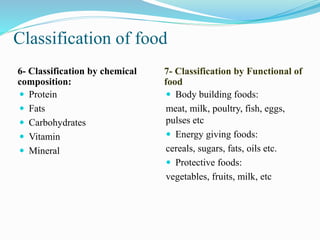
Classification of food
6-Classification by chemical
composition:
7- Classification by Functional of
food
Protein
Fats
Carbohydrates
Vitamin
Mineral
Body building foods:
meat, milk, poultry, fish, eggs,
pulses etc
Energy giving foods:
cereals, sugars, fats, oils etc.
Protective foods:
vegetables, fruits, milk, etc
7.
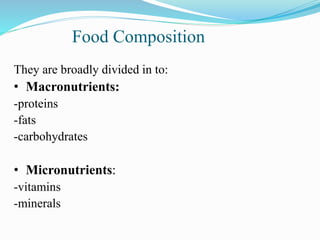
They are broadlydivided in to:
• Macronutrients:
-proteins
-fats
-carbohydrates
• Micronutrients:
-vitamins
-minerals
Food Composition
8.
What is foodscience?
Food science is the study of the substances we eat.
Food science is applied science "the discipline in which
the engineering, biological, and physical sciences are used
to study the nature of foods.
Why is itimportant to study food
science?
Food scientists search new
processing methods for foods.
These methods deal with
slowing the breakdown of
foods (extend shelf life).
12.
Why is itimportant to study food
science?
Food scientists experiment with new uses for
existing foods.
Food scientists also work to discover plants
and animals as food sources.
13.
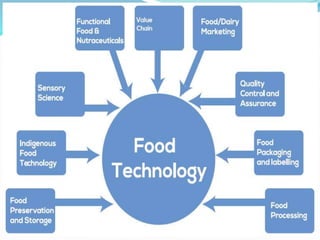
Food Technology
Foodtechnology is a branch of food science that deals with
the production processes that make foods.
Food technology concentrated on food preservation
Hunter-gatherers
Throughout theages, people have hunted animals and
gathered plants to use as food.
In pre-historic times people would have eaten a wide
variety of fruit, nuts, meat and roots, which they would
have obtained from local surroundings.
16.
Hunter-gatherers
All the animalsand plants would have been wild.
The diet consisted of what was growing locally and
animals which were easy to catch.
The discovery of fire led to the realisation that it could be
used to cook animals and plants to make them easier to
eat, and tastier.
17.
Hunter-gatherers
The weather andthe seasons would have affected the food
supply available. In spring and summer, there would have
been a glut of food. However, in the winter months, food
would have been less.
Methods of preserving foods, such as sun drying, salting,
fermenting and smoking were used to help keep the food
fit to eat longer. Modern preservation methods today still
follow similar principles.
18.
Farmers
The progress fromhunting to farming took place
gradually. Keeping animals and plants for food probably
started around 12,000 BC. However, not all animals and
plants that had been eaten previously could be produced
on farms.
By observing the usefulness and yield of different
varieties, a small proportion of plants were selected for
cultivation.
19.
Cultivation
The first plantsto be cultivated were the wild grasses
which were developed into wheat, barley, oats and millet.
A few species of animals, such as goat, pig, sheep, were
kept to produce food, i.e. meat and milk.
20.
Cultivation
Early farming beganto reduce the time needed for
hunting, and people began to move into settlements.
Farming and trapping became full time activities.
The settlements were vey basic, yet housed many people
and their animals.
The cultivated fields, which were worked by the people
who lived nearby. This gradually led to the development
of villages.
21.
Domestication
During this periodof early farming, domestication began
to rise and spread. Domestication refers to the selection
process of plants and animals to better suit the needs of
human beings. There were also many technological
developments in agriculture and animal husbandry.
Stone polishing led to the making of new tools and
utensils, such as hoes and ploughs. polished stone made it
possible to grind grains into flour.
22.
Varieties of foodsources
Through the centuries the process of producing new or
improved strains of plants and animals has continued.
From the vast array of crops used as food by the hunter-
gatherers, people now use only 14 major cereal crops to
provide food for the world.
Rather than eating many different crops, a range of
different food products is now made from a small number
of staple foods, for example potatoes may still be
manufactured into – crisps, extruded snacks, gnocchi,
soup, chips, waffles, potato starch (used in instant
desserts).
23.
Crops
The most importantstaples in the world today are: Wheat,
Maize, Rice, Potato, Oats, Sweet potato and Milet.
24.
Civilisations
Throughout history civilisationsaround the world have
introduced specific cooking, preserving and farming
methods.
Ancient Egypt showed aspects of:
• butchery;
• bakery, e.g. bread, rough cakes and porridge;
• fermentation, e.g. beer, yogurt and cheese;
• drying, e.g. fruit and vegetables.
25.
Civilisations
China and Japanshowed aspects of:
• fermentation, e.g. soy sauce and tofu;
• rice production around 5000BC;
• freezing around 1800 BC.
The Roman empire showed aspects of:
• transport, e.g. road system;
• farming on large scale;
• preservation, e.g. bottling
26.
The goal offood Technology .
To make food more suitable in taste or nutritional value.
To remove some harmful compound from food (Toxin
removal)
To make food available longer for consumption. (extend Shelf
life)
To make food available in lean season
Easy transportation of perishable foods.
28.
Factors affecting foodtechnology
Today, factors affecting food technology include:
domestication of animals and crops
preservation methods
development of villages and towns
changes of land ownership
transport and travel (national, European, worldwide & space)
war
religion and culture
famine
flood, disease
mechanisation.
29.
Factors affecting foodtechnology
Electricity
Discovery and use of raw materials
Understanding of scientific principles
Research and development of food ingredients
Increasing technological capabilities
Economic understanding and trade
Changes in society, e.g. the changing role of women;
30.
Food processing
Itis branch of food technology
The main objective of processing is to supply
wholesome, safe, nutritious and acceptable food to
consumers throughout the year.
Due to insufficient demand, poor transportation and
perishable nature of the crops we need food processing.
31.
Reasons for Processing
Diversification of the economy, in order to reduce present
dependence on one export commodity;
Reduction of imports and meeting export demands;
Generate both rural and urban employment;
Reduce food losses;
Improve farmers' nutrition by allowing them to consume
their own processed fruit and vegetables during the off-
season.
Generate new sources of income for farmers.
Develop new value-added products.
32.
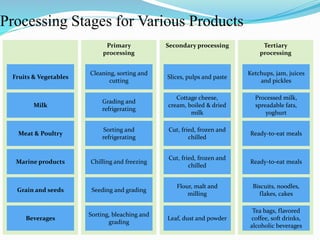
Processing Stages forVarious Products
Primary
processing
Secondary processing Tertiary
processing
Fruits & Vegetables
Milk
Meat & Poultry
Marine products
Grain and seeds
Beverages
Cleaning, sorting and
cutting
Grading and
refrigerating
Sorting and
refrigerating
Chilling and freezing
Seeding and grading
Sorting, bleaching and
grading
Slices, pulps and paste
Cottage cheese,
cream, boiled & dried
milk
Cut, fried, frozen and
chilled
Cut, fried, frozen and
chilled
Flour, malt and
milling
Leaf, dust and powder
Ketchups, jam, juices
and pickles
Processed milk,
spreadable fats,
yoghurt
Ready-to-eat meals
Ready-to-eat meals
Biscuits, noodles,
flakes, cakes
Tea bags, flavored
coffee, soft drinks,
alcoholic beverages
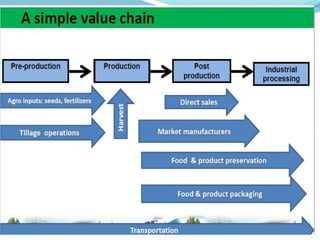
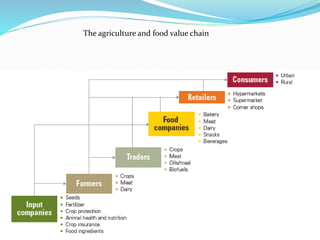
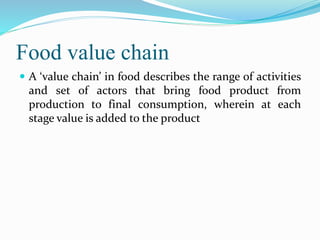
Food value chain
A ‘value chain’ in food describes the range of activities
and set of actors that bring food product from
production to final consumption, wherein at each
stage value is added to the product
37
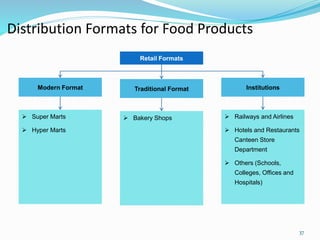
Distribution Formats forFood Products
Traditional FormatModern Format
Super Marts
Hyper Marts
Bakery Shops
Institutions
Railways and Airlines
Hotels and Restaurants
Canteen Store
Department
Others (Schools,
Colleges, Offices and
Hospitals)
Retail Formats