FOOD PREPARATION:
4 Basic Cuts for Carrots
slice, batonnet, julienne,
and brunoise
Why is it important to know these
basic cuts in cooking
preparation?
How can we apply this to our
life?
Five Senses Fun!
• Use your five senses to describe how carrots look, feel, taste, sound, and
smell.
FAST FACTS
 Carrots are a root vegetable, which means they grow underground
 Orange carrots are the most recognized, however, carrots can also
be red, purple, white, or yellow in color
 Carrots are typically planted in the spring and may take anywhere
from 2 to 4 months to mature
 Carrots are usually harvested when the roots are at least 1/2 inch
in diameter
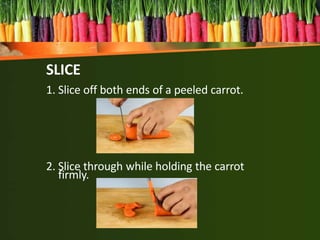
SLICE
1. Slice off both ends of a peeled carrot.
2. Slice through while holding the carrot
firmly.
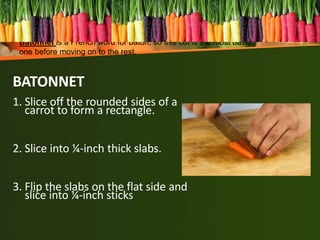
BATONNET
1. Slice off the rounded sides of a
carrot to form a rectangle.
2. Slice into ¼-inch thick slabs.
3. Flip the slabs on the flat side and
slice into ¼-inch sticks
Batonnet is a French word for baton, so this cut is the most basic
one before moving on to the rest.
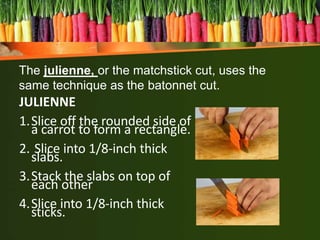
JULIENNE
1.Slice off the rounded side of
a carrot to form a rectangle.
2. Slice into 1/8-inch thick
slabs.
3.Stack the slabs on top of
each other
4.Slice into 1/8-inch thick
sticks.
The julienne, or the matchstick cut, uses the
same technique as the batonnet cut.
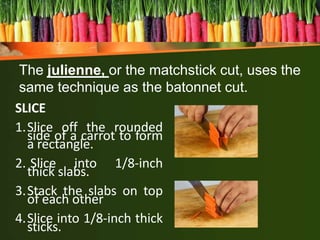
SLICE
1.Slice off the rounded
side of a carrot to form
a rectangle.
2. Slice into 1/8-inch
thick slabs.
3.Stack the slabs on top
of each other
4.Slice into 1/8-inch thick
sticks.
The julienne, or the matchstick cut, uses the
same technique as the batonnet cut.
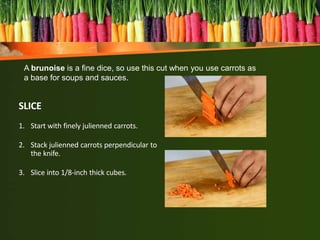
SLICE
1. Start with finely julienned carrots.
2. Stack julienned carrots perpendicular to
the knife.
3. Slice into 1/8-inch thick cubes.
A brunoise is a fine dice, so use this cut when you use carrots as
a base for soups and sauces.
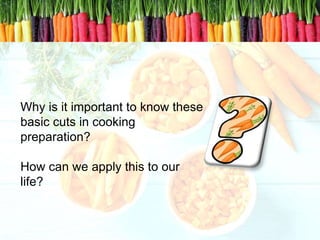
Why is it important to know these
basic cuts in cooking
preparation?
How can we apply this to our
life?
Why is it important to know these
basic cuts in cooking
preparation?
How can we apply this to our
life?

Food preparation

  • 1.
    FOOD PREPARATION: 4 BasicCuts for Carrots slice, batonnet, julienne, and brunoise
  • 2.
    Why is itimportant to know these basic cuts in cooking preparation? How can we apply this to our life?
  • 3.
    Five Senses Fun! •Use your five senses to describe how carrots look, feel, taste, sound, and smell. FAST FACTS  Carrots are a root vegetable, which means they grow underground  Orange carrots are the most recognized, however, carrots can also be red, purple, white, or yellow in color  Carrots are typically planted in the spring and may take anywhere from 2 to 4 months to mature  Carrots are usually harvested when the roots are at least 1/2 inch in diameter
  • 4.
    SLICE 1. Slice offboth ends of a peeled carrot. 2. Slice through while holding the carrot firmly.
  • 5.
    BATONNET 1. Slice offthe rounded sides of a carrot to form a rectangle. 2. Slice into ¼-inch thick slabs. 3. Flip the slabs on the flat side and slice into ¼-inch sticks Batonnet is a French word for baton, so this cut is the most basic one before moving on to the rest.
  • 6.
    JULIENNE 1.Slice off therounded side of a carrot to form a rectangle. 2. Slice into 1/8-inch thick slabs. 3.Stack the slabs on top of each other 4.Slice into 1/8-inch thick sticks. The julienne, or the matchstick cut, uses the same technique as the batonnet cut.
  • 7.
    SLICE 1.Slice off therounded side of a carrot to form a rectangle. 2. Slice into 1/8-inch thick slabs. 3.Stack the slabs on top of each other 4.Slice into 1/8-inch thick sticks. The julienne, or the matchstick cut, uses the same technique as the batonnet cut.
  • 8.
    SLICE 1. Start withfinely julienned carrots. 2. Stack julienned carrots perpendicular to the knife. 3. Slice into 1/8-inch thick cubes. A brunoise is a fine dice, so use this cut when you use carrots as a base for soups and sauces.
  • 9.
    Why is itimportant to know these basic cuts in cooking preparation? How can we apply this to our life?
  • 10.
    Why is itimportant to know these basic cuts in cooking preparation? How can we apply this to our life?