BASIC KNIFE SKILLS AND
CUTTING TECHNIQUES
TOPICS
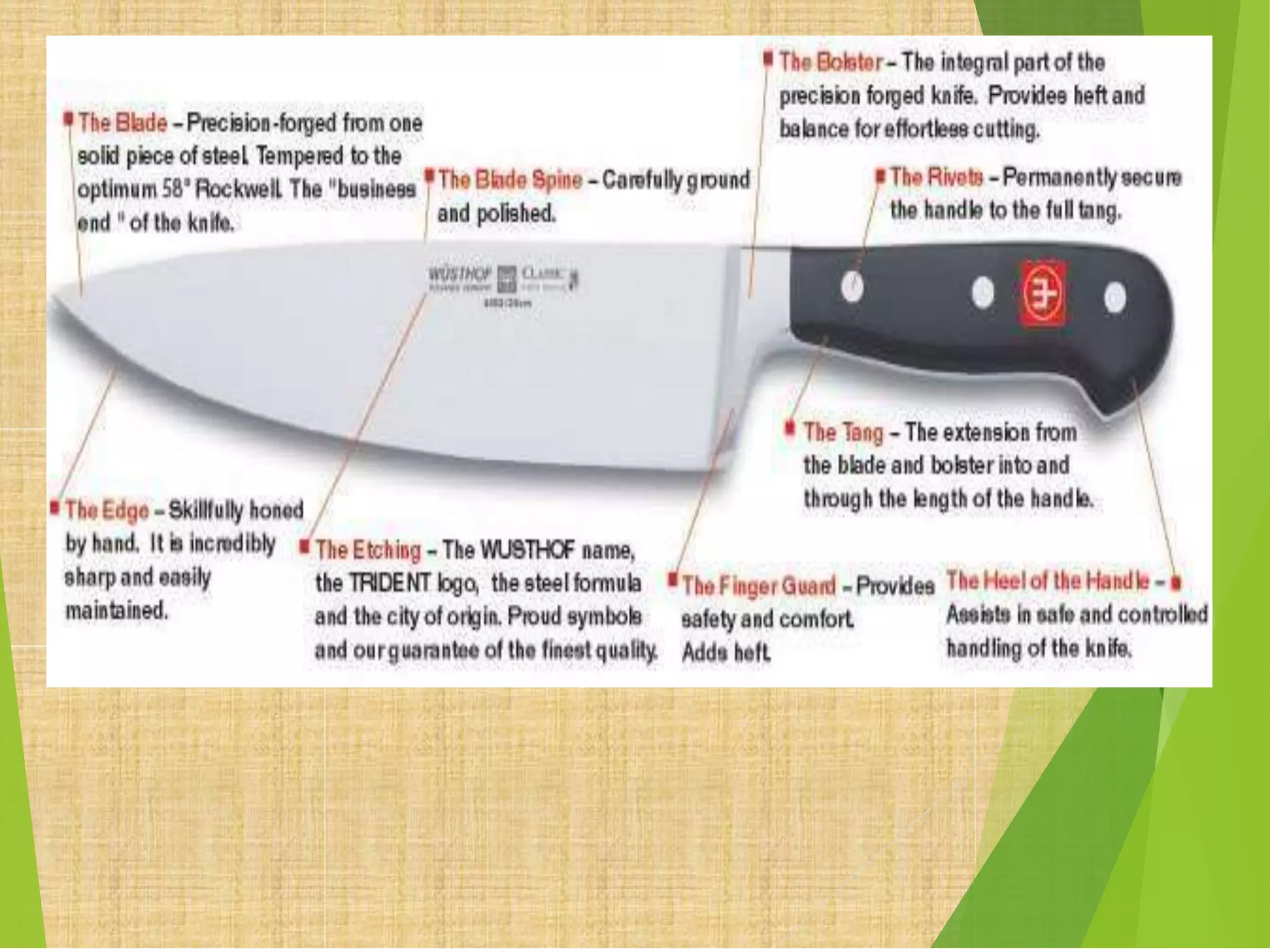
1) Parts of knife
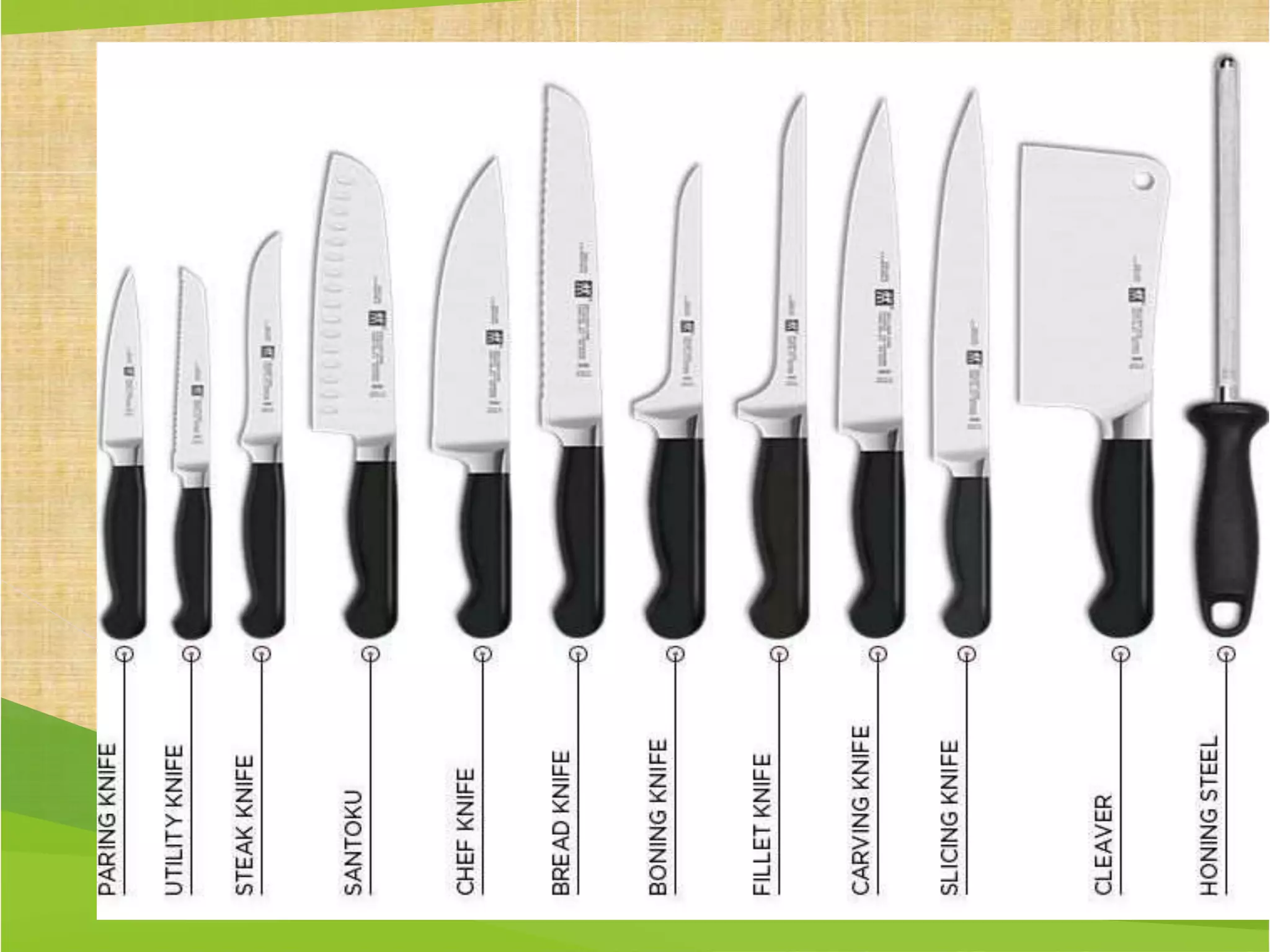
2) Different types of Knives
3) Holding knife and hand posture
4) Why different types of knives are needed
5) Knife safety
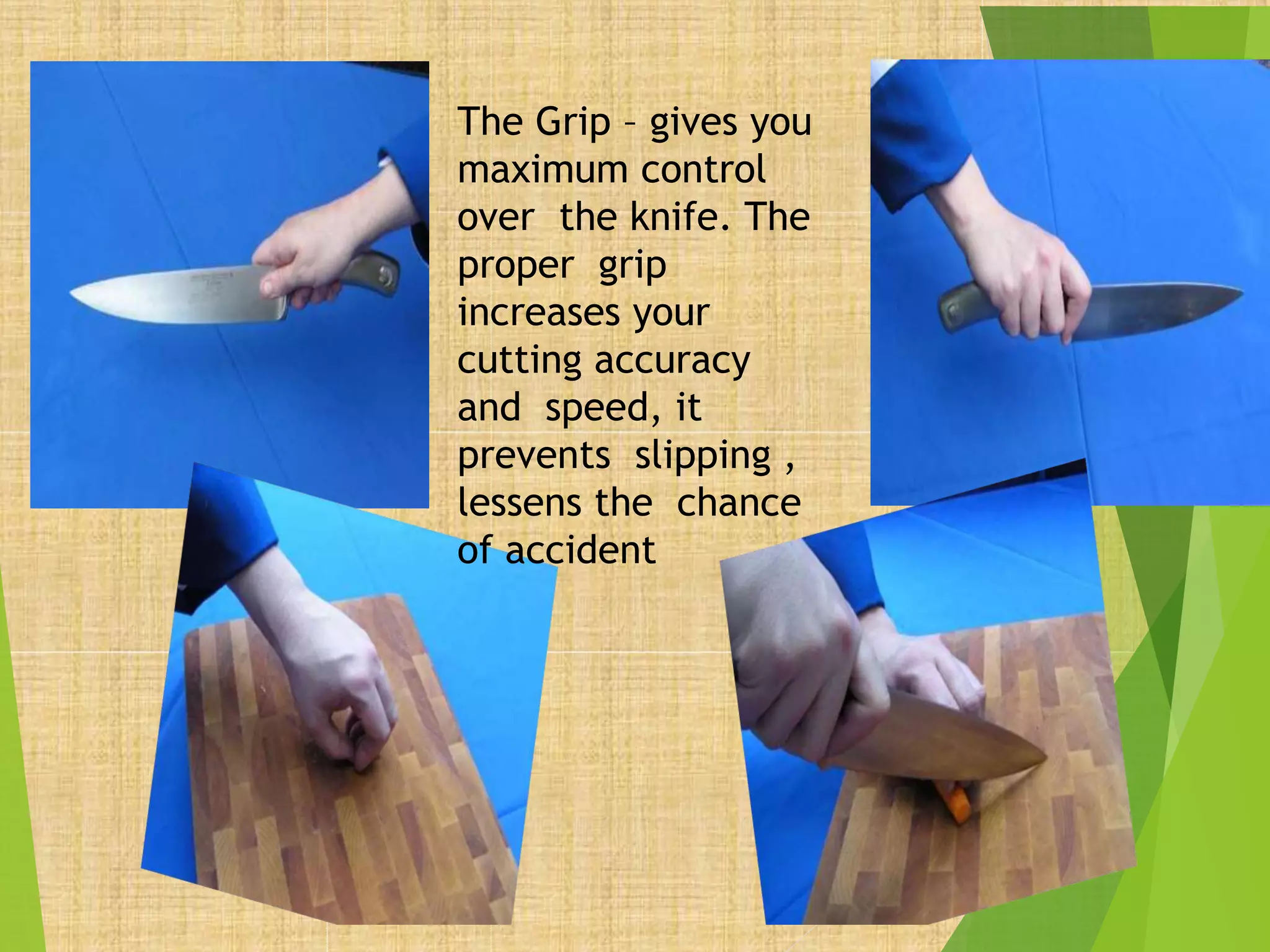
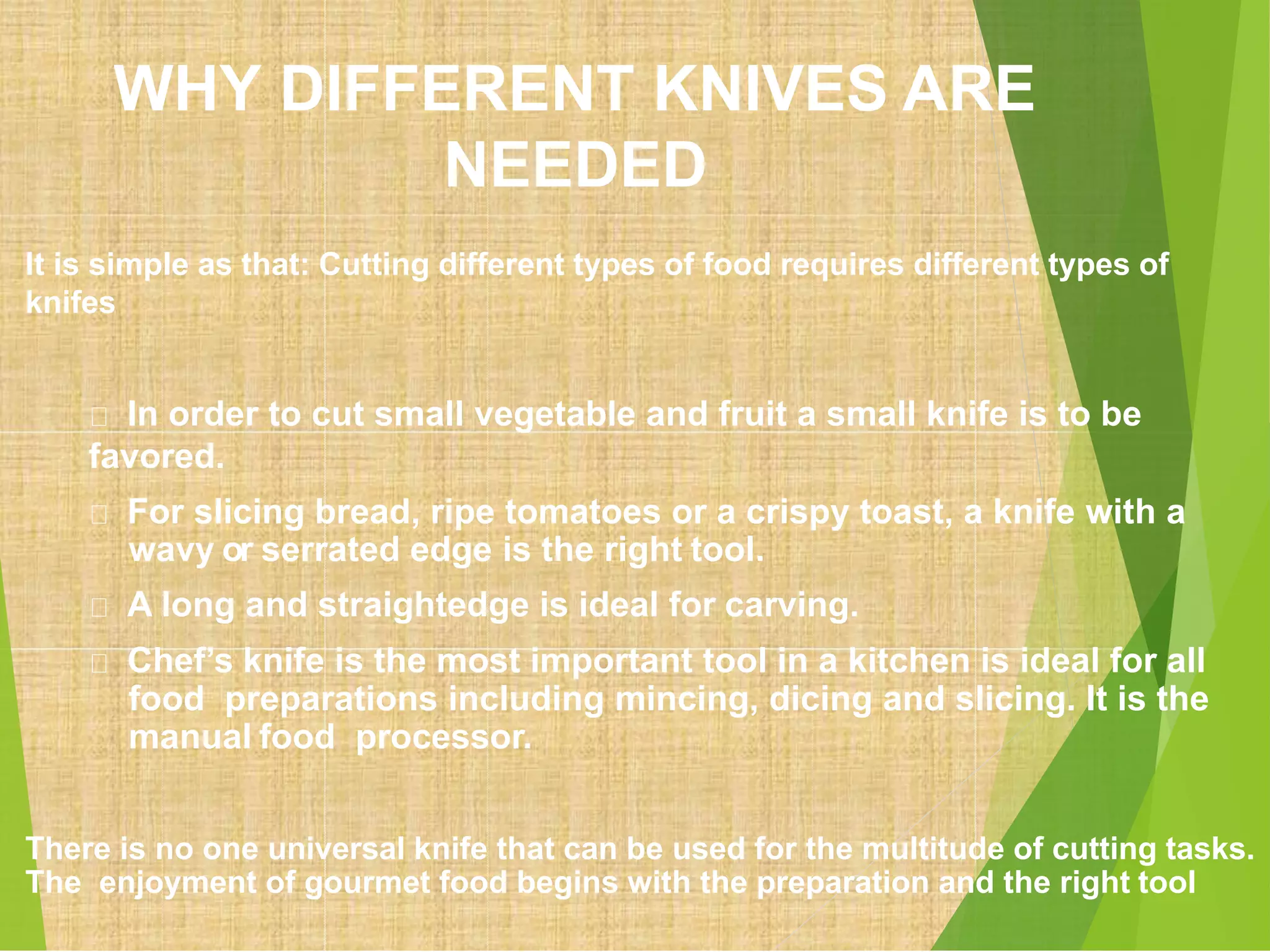
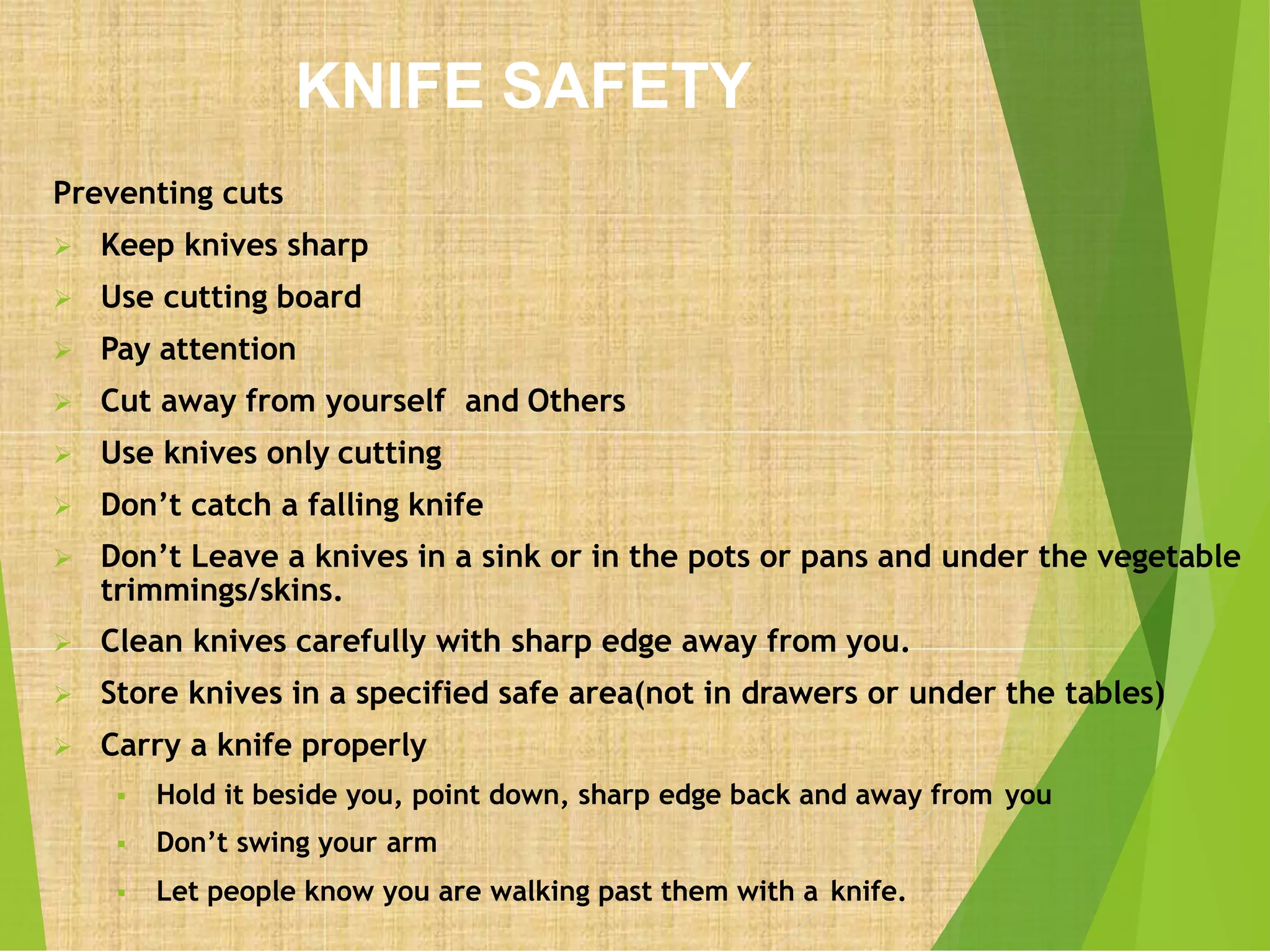
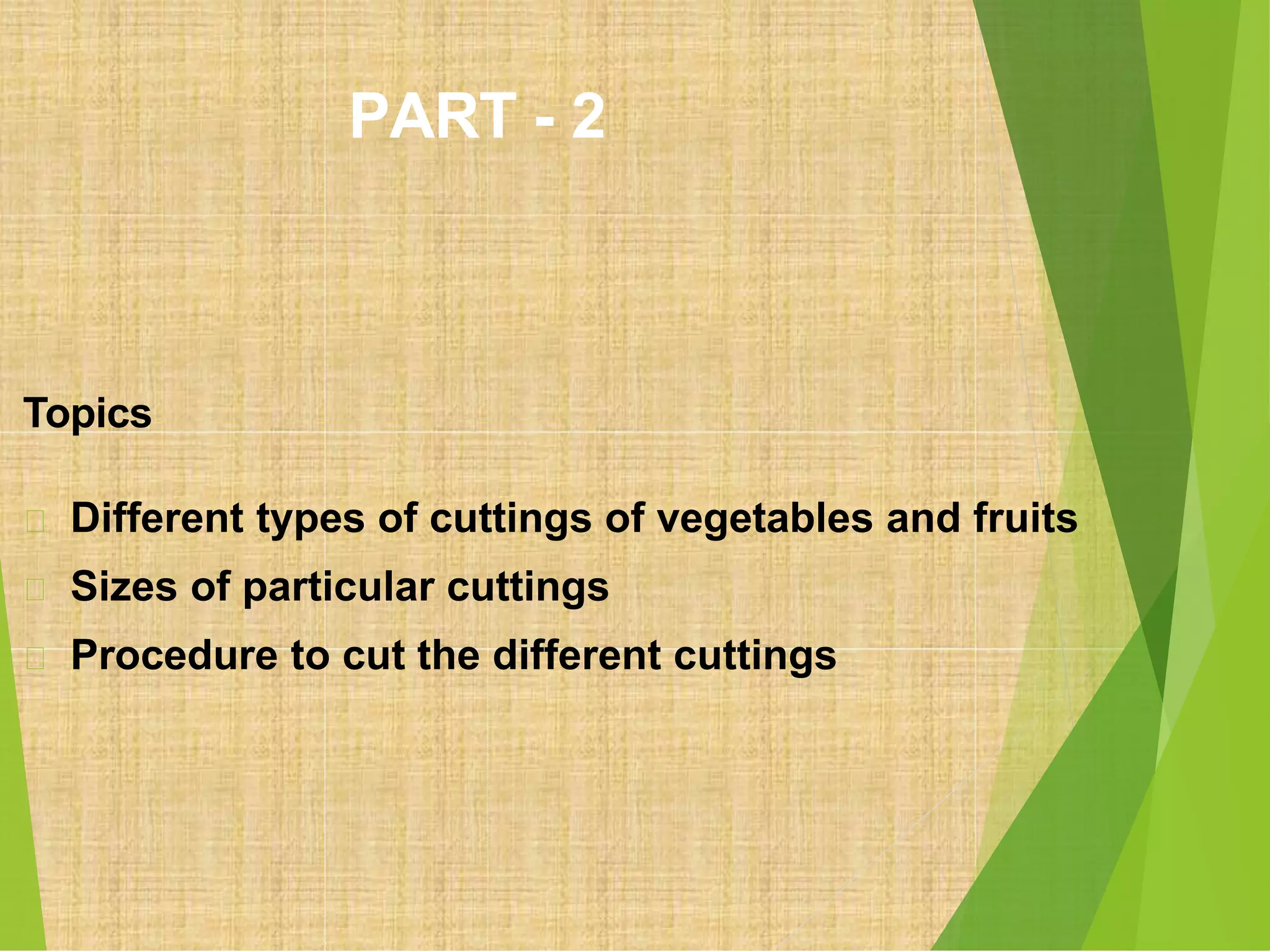
The Grip – gives you
maximum control
over the knife. The
proper grip
increases your
cutting accuracy
and speed, it
prevents slipping ,
lessens the chance
of accident
WHY DIFFERENT KNIVES ARE
NEEDED
It is simple as that: Cutting different types of food requires different types of
knifes
In order to cut small vegetable and fruit a small knife is to be
favored.
For slicing bread, ripe tomatoes or a crispy toast, a knife with a
wavy or serrated edge is the right tool.
A long and straightedge is ideal for carving.
Chef’s knife is the most important tool in a kitchen is ideal for all
food preparations including mincing, dicing and slicing. It is the
manual food processor.
There is no one universal knife that can be used for the multitude of cutting tasks.
The enjoyment of gourmet food begins with the preparation and the right tool
KNIFE SAFETY
Preventing cuts
 Keep knives sharp
 Use cutting board
 Pay attention
 Cut away from yourself and Others
 Use knives only cutting
 Don’t catch a falling knife
 Don’t Leave a knives in a sink or in the pots or pans and under the vegetable
trimmings/skins.
 Clean knives carefully with sharp edge away from you.
 Store knives in a specified safe area(not in drawers or under the tables)
 Carry a knife properly
 Hold it beside you, point down, sharp edge back and away from you
 Don’t swing your arm
 Let people know you are walking past them with a knife.
PART - 2
Topics
Different types of cuttings of vegetables and fruits
Sizes of particular cuttings
Procedure to cut the different cuttings
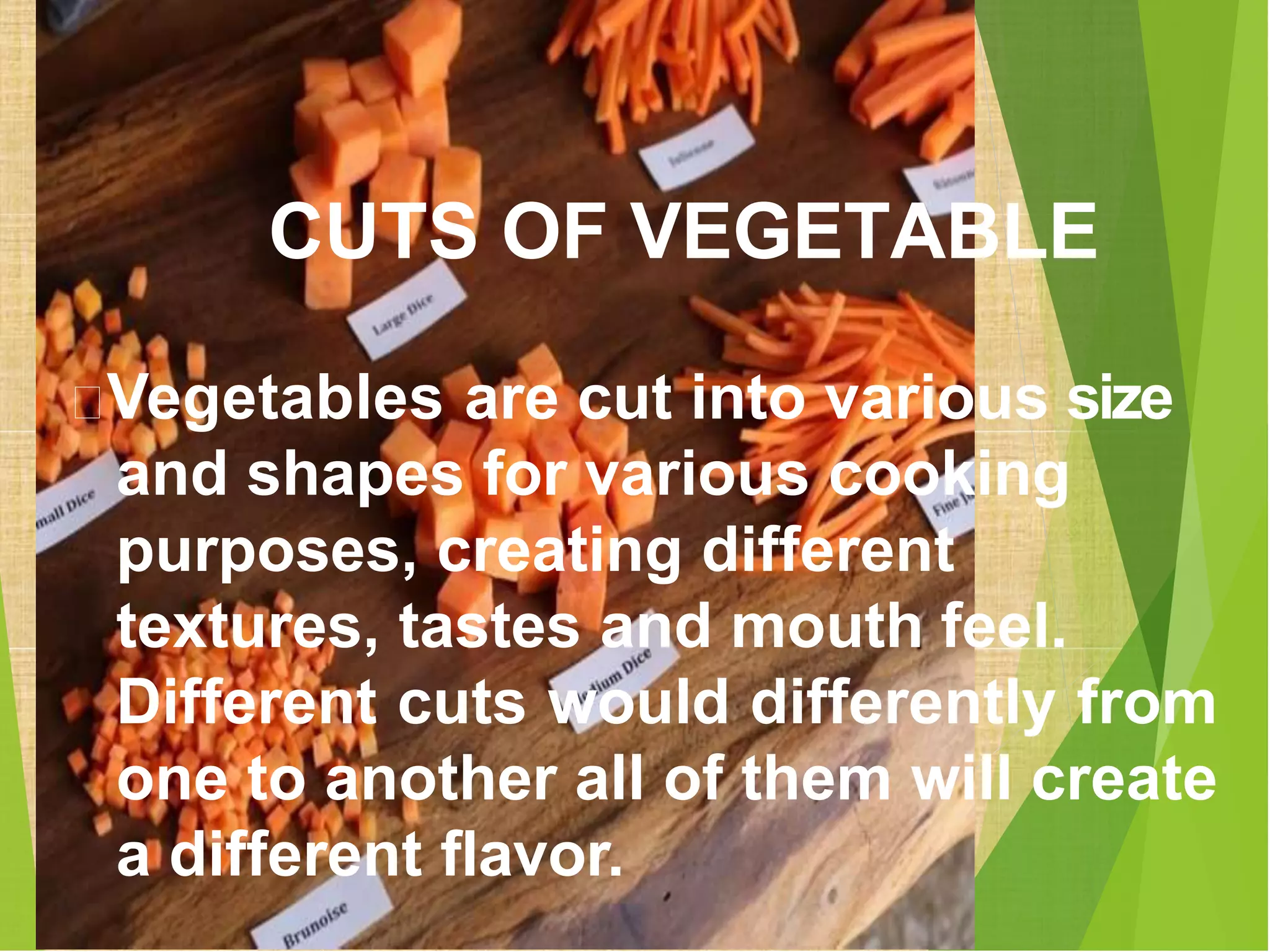
Vegetables are cut into various size
and shapes for various cooking
purposes, creating different
textures, tastes and mouth feel.
Different cuts would differently from
one to another all of them will create
a different flavor.
CUTS OF VEGETABLE
CUTS OF VEGETABLE
Dice
Batonnet
Julienne
Jardinière
Macedoine
Brunoise
Lozenge / Diamond
Slicing or Roundelle
Paring
Chiffonade
Paysanne
Allumette
Wedges
Mirepoix
Tourne
Fluting
Mincing
Chopping
Parisienne
Segment
Fermiere
Florets
SLICING / ROUNDELLE
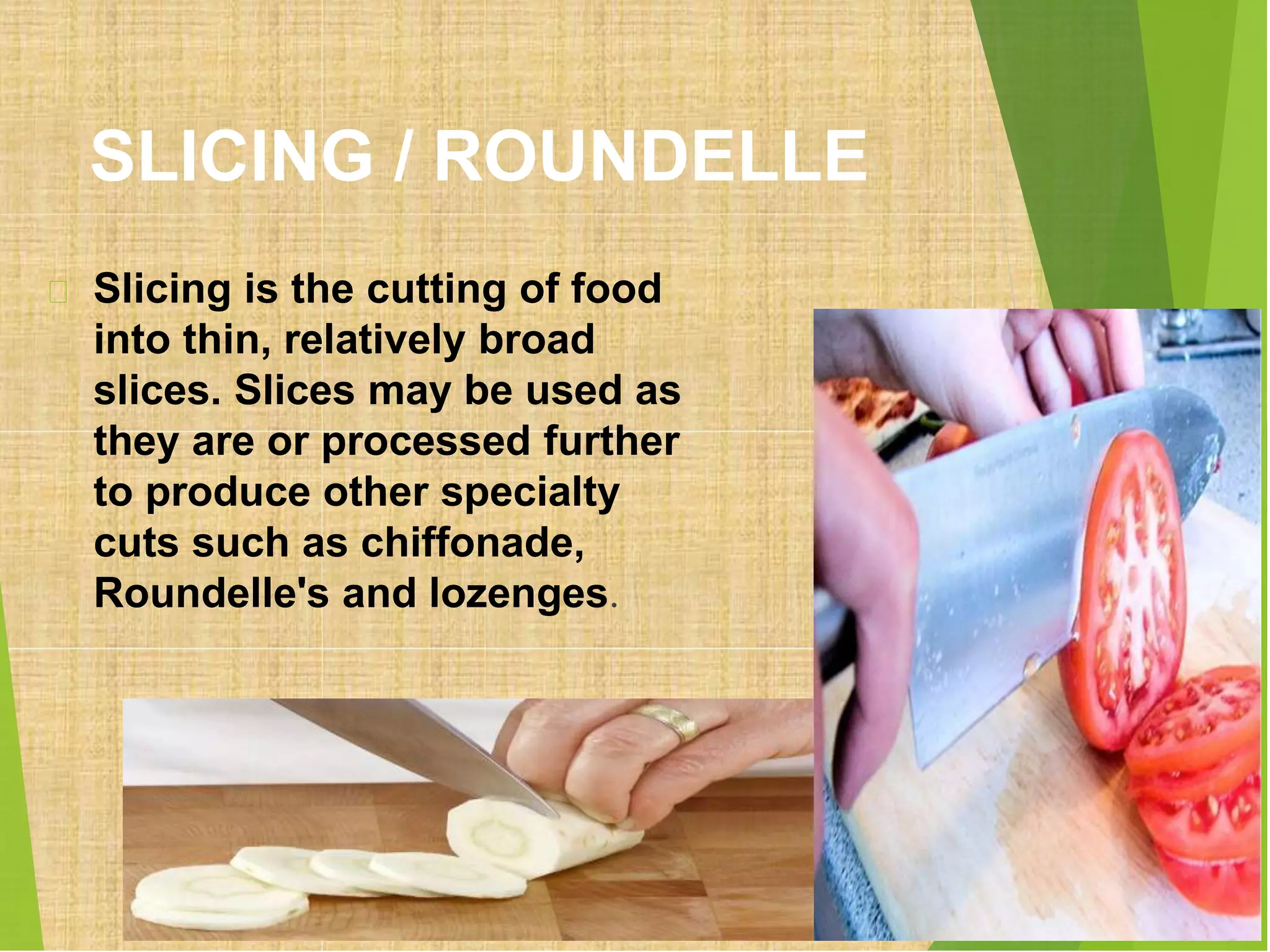
Slicing is the cutting of food
into thin, relatively broad
slices. Slices may be used as
they are or processed further
to produce other specialty
cuts such as chiffonade,
Roundelle's and lozenges.
BATONNET
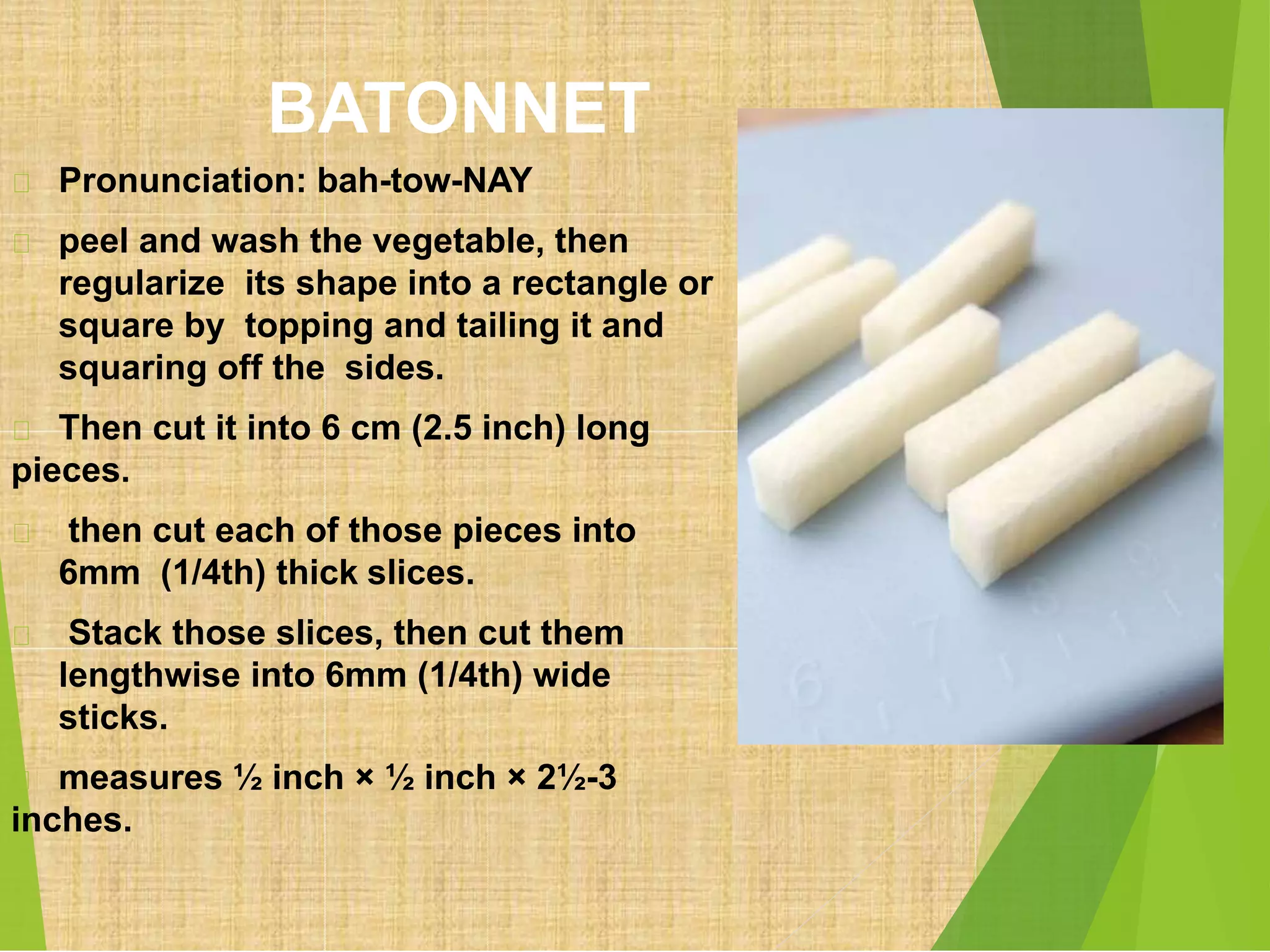
Pronunciation: bah-tow-NAY
peel and wash the vegetable, then
regularize its shape into a rectangle or
square by topping and tailing it and
squaring off the sides.
Then cut it into 6 cm (2.5 inch) long
pieces.
then cut each of those pieces into
6mm (1/4th) thick slices.
Stack those slices, then cut them
lengthwise into 6mm (1/4th) wide
sticks.
measures ½ inch × ½ inch × 2½-3
inches.
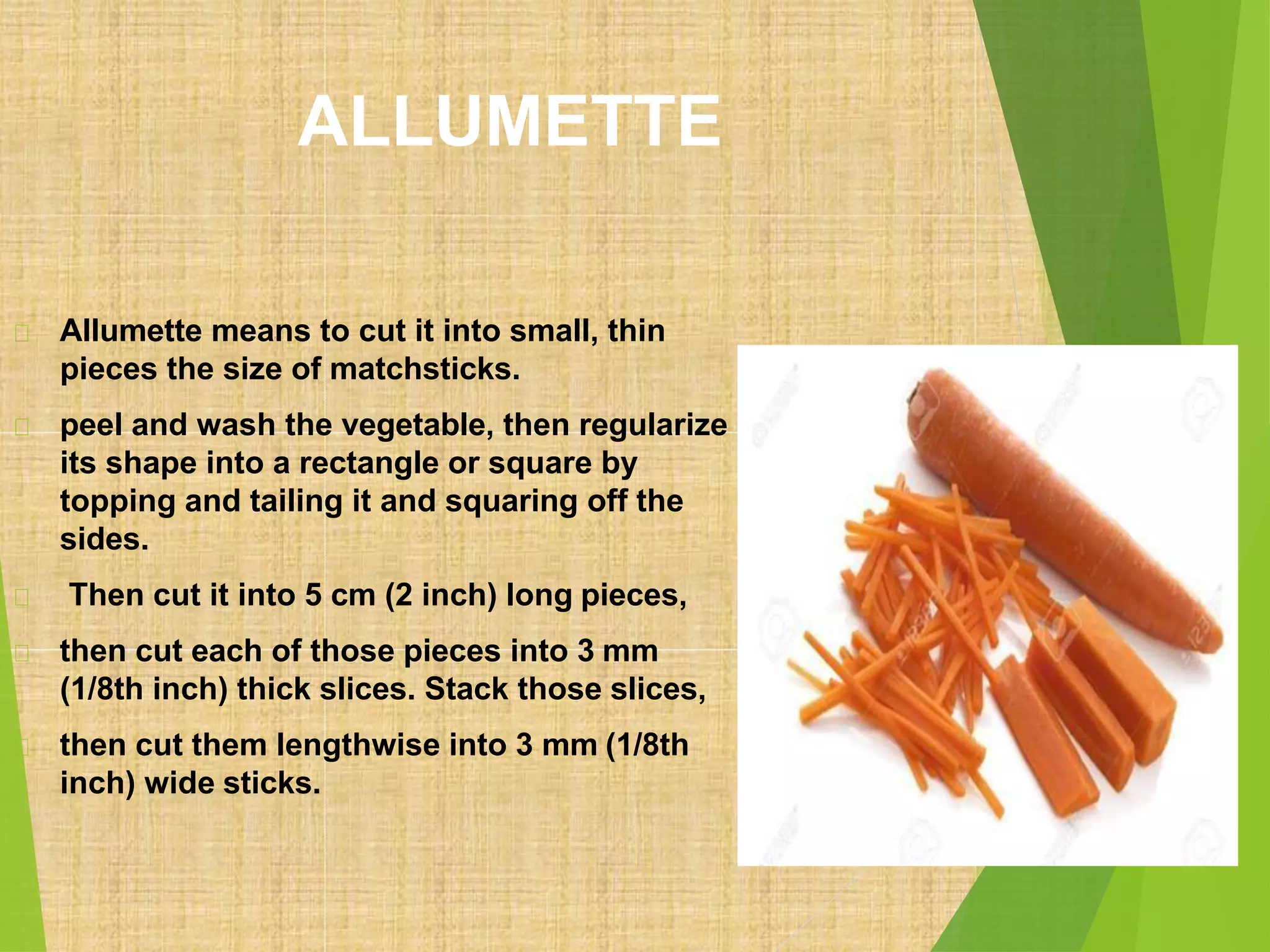
ALLUMETTE
Allumette means to cut it into small, thin
pieces the size of matchsticks.
peel and wash the vegetable, then regularize
its shape into a rectangle or square by
topping and tailing it and squaring off the
sides.
Then cut it into 5 cm (2 inch) long pieces,
then cut each of those pieces into 3 mm
(1/8th inch) thick slices. Stack those slices,
then cut them lengthwise into 3 mm (1/8th
inch) wide sticks.
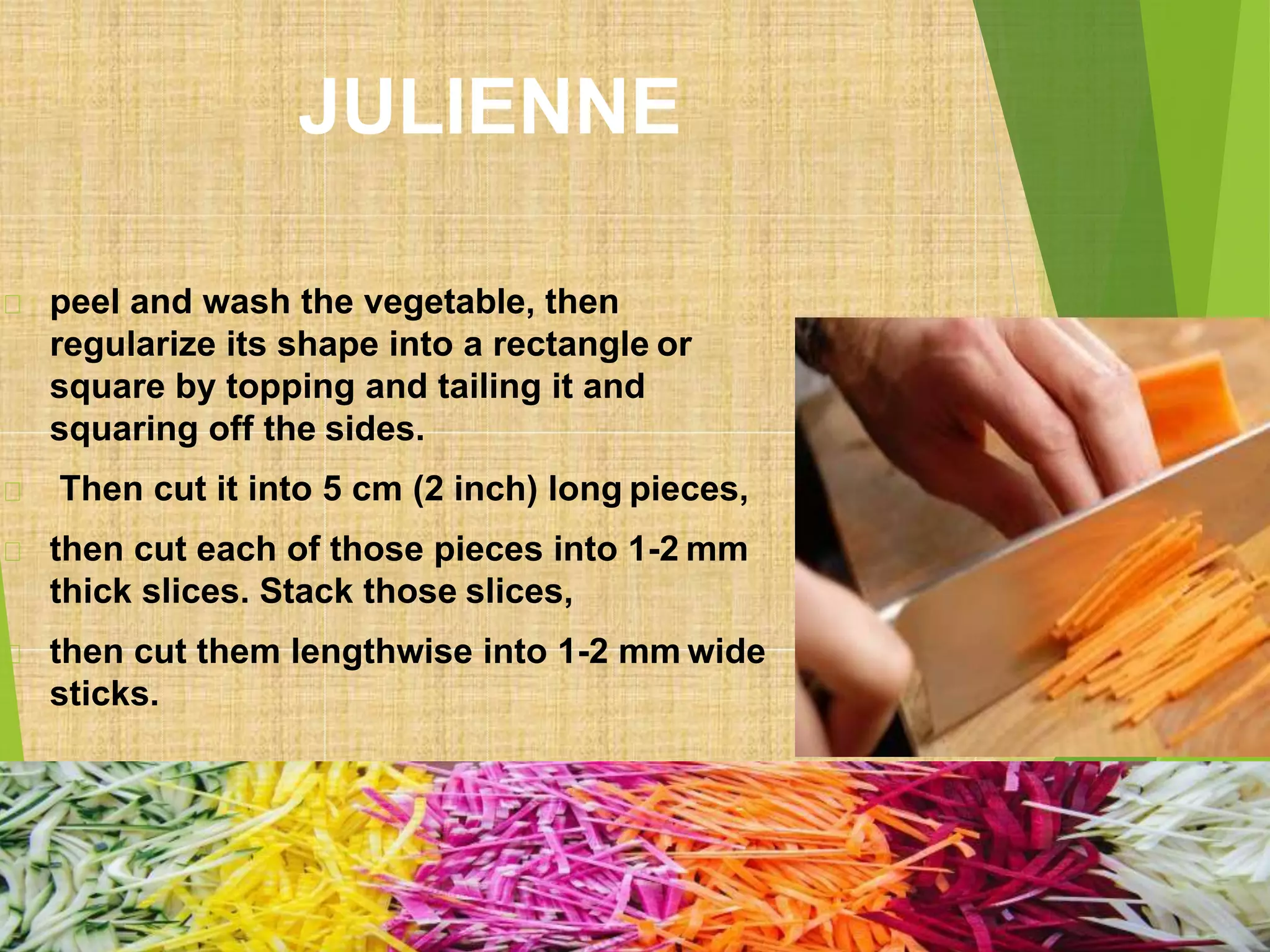
JULIENNE
peel and wash the vegetable, then
regularize its shape into a rectangle or
square by topping and tailing it and
squaring off the sides.
Then cut it into 5 cm (2 inch) long pieces,
then cut each of those pieces into 1-2 mm
thick slices. Stack those slices,
then cut them lengthwise into 1-2 mm wide
sticks.
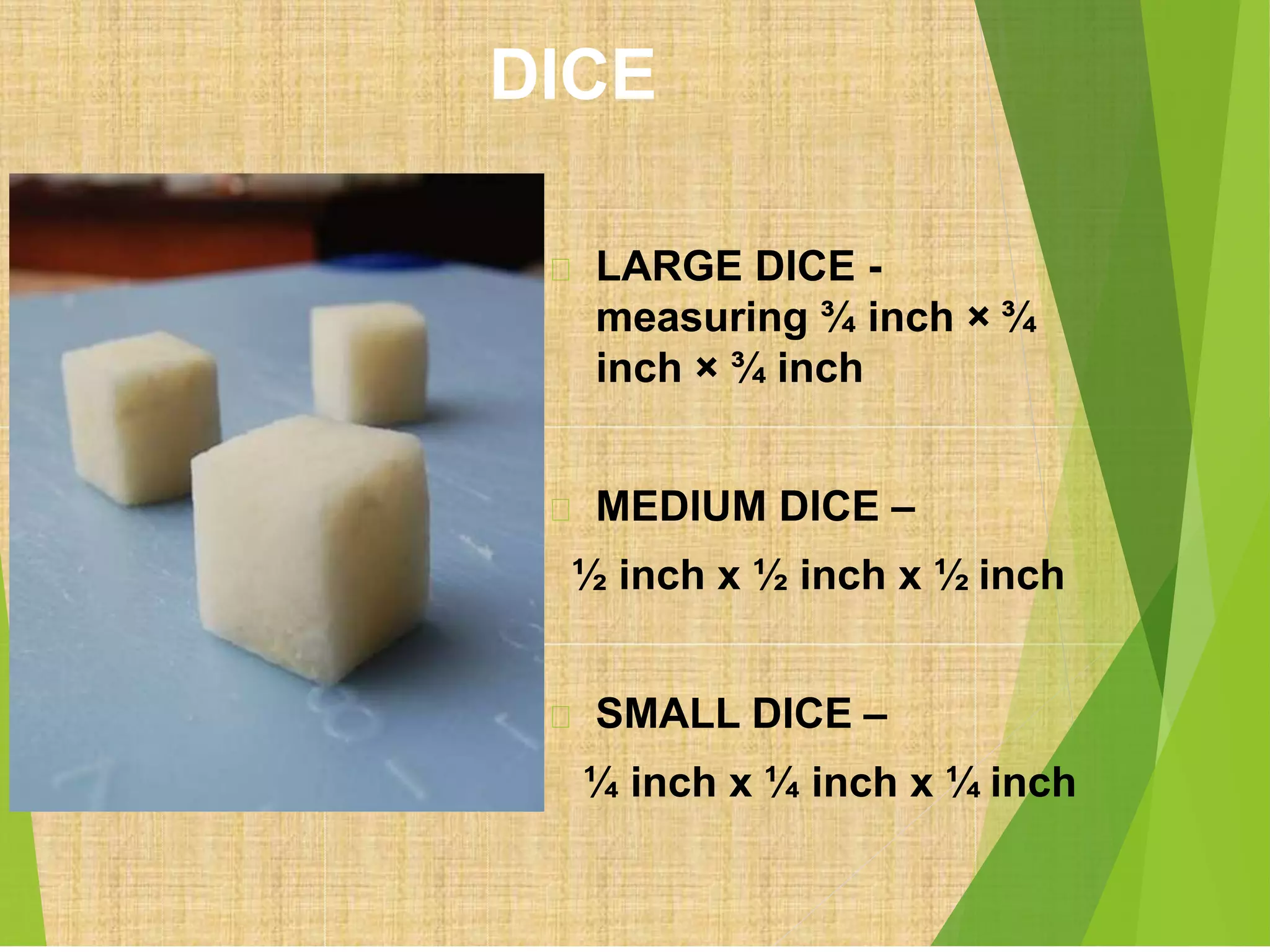
DICE
LARGE DICE -
measuring ¾ inch × ¾
inch × ¾ inch
MEDIUM DICE –
½ inch x ½ inch x ½ inch
SMALL DICE –
¼ inch x ¼ inch x ¼ inch
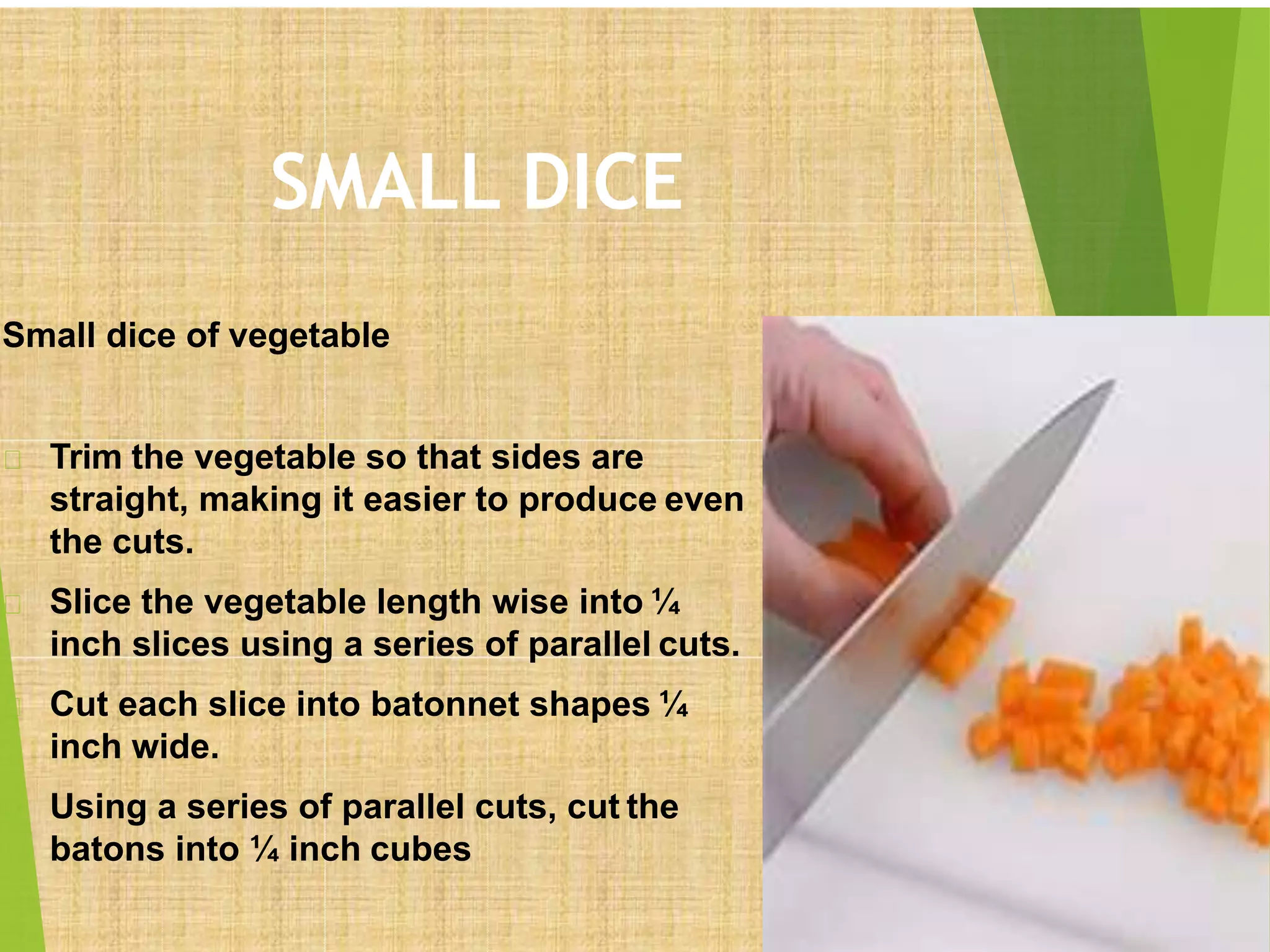
SMALL DICE
Small dice of vegetable
Trim the vegetable so that sides are
straight, making it easier to produce even
the cuts.
Slice the vegetable length wise into ¼
inch slices using a series of parallel cuts.
Cut each slice into batonnet shapes ¼
inch wide.
Using a series of parallel cuts, cut the
batons into ¼ inch cubes
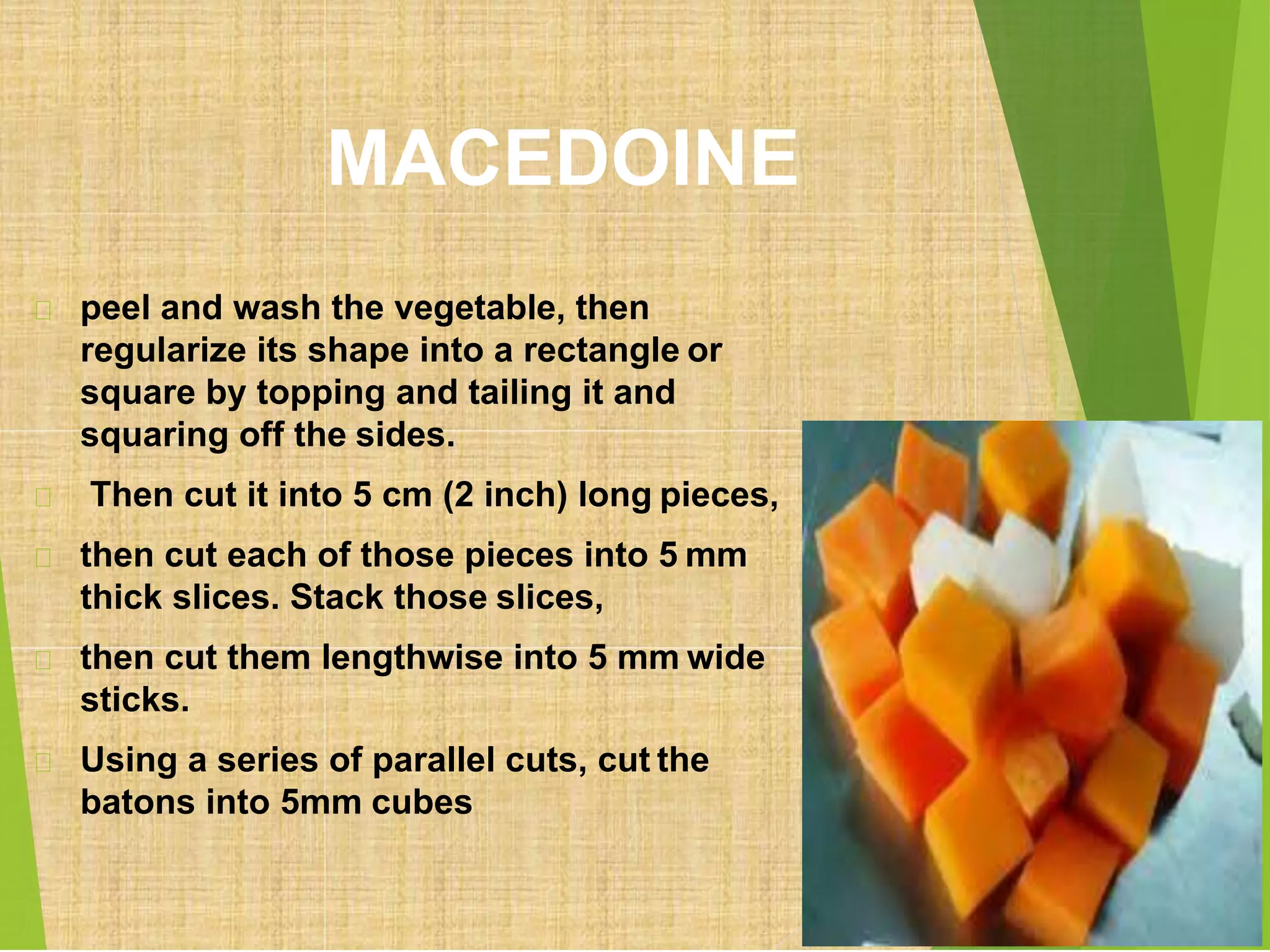
MACEDOINE
peel and wash the vegetable, then
regularize its shape into a rectangle or
square by topping and tailing it and
squaring off the sides.
Then cut it into 5 cm (2 inch) long pieces,
then cut each of those pieces into 5 mm
thick slices. Stack those slices,
then cut them lengthwise into 5 mm wide
sticks.
Using a series of parallel cuts, cut the
batons into 5mm cubes
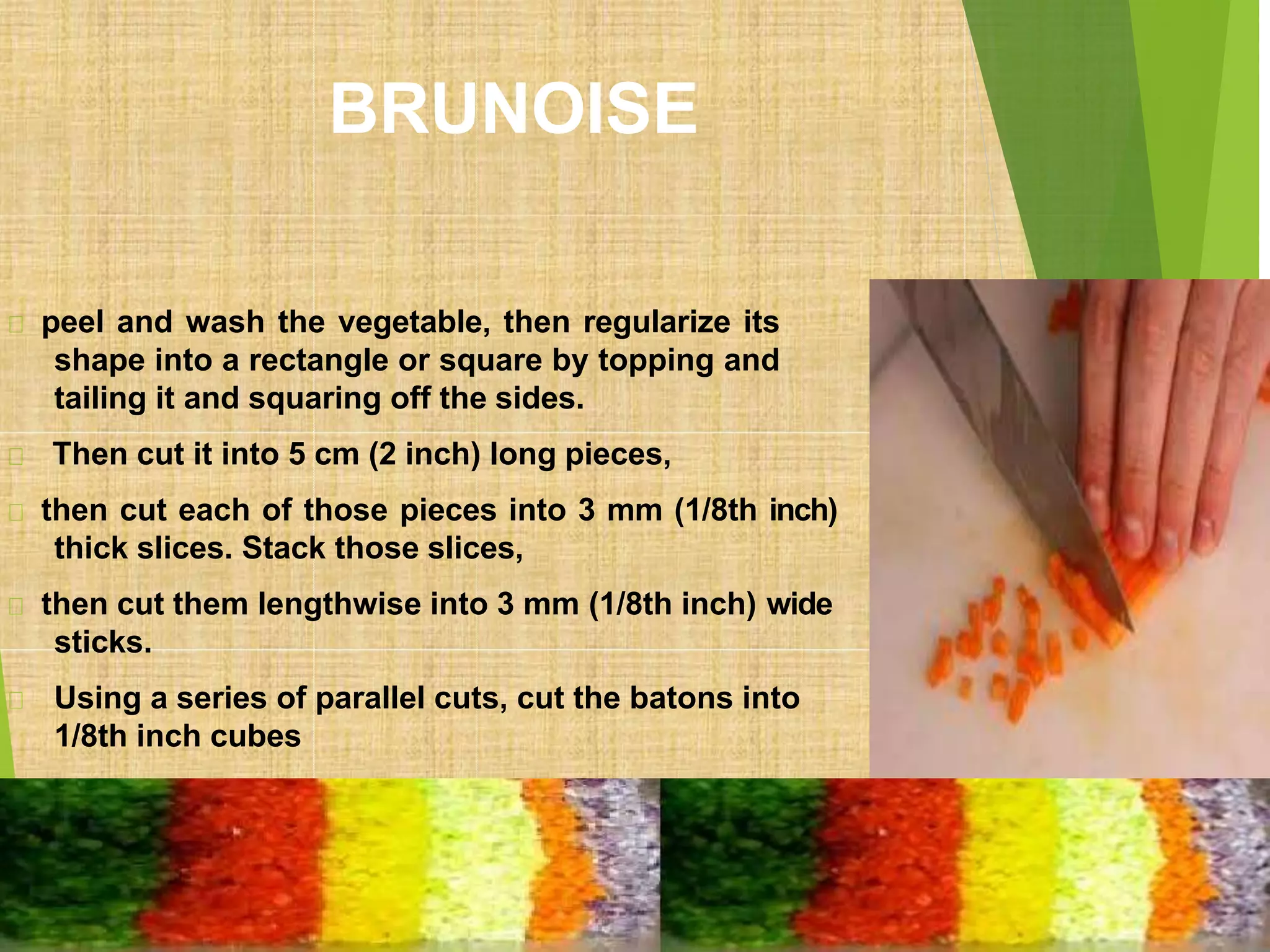
BRUNOISE
peel and wash the vegetable, then regularize its
shape into a rectangle or square by topping and
tailing it and squaring off the sides.
Then cut it into 5 cm (2 inch) long pieces,
then cut each of those pieces into 3 mm (1/8th inch)
thick slices. Stack those slices,
then cut them lengthwise into 3 mm (1/8th inch) wide
sticks.
Using a series of parallel cuts, cut the batons into
1/8th inch cubes
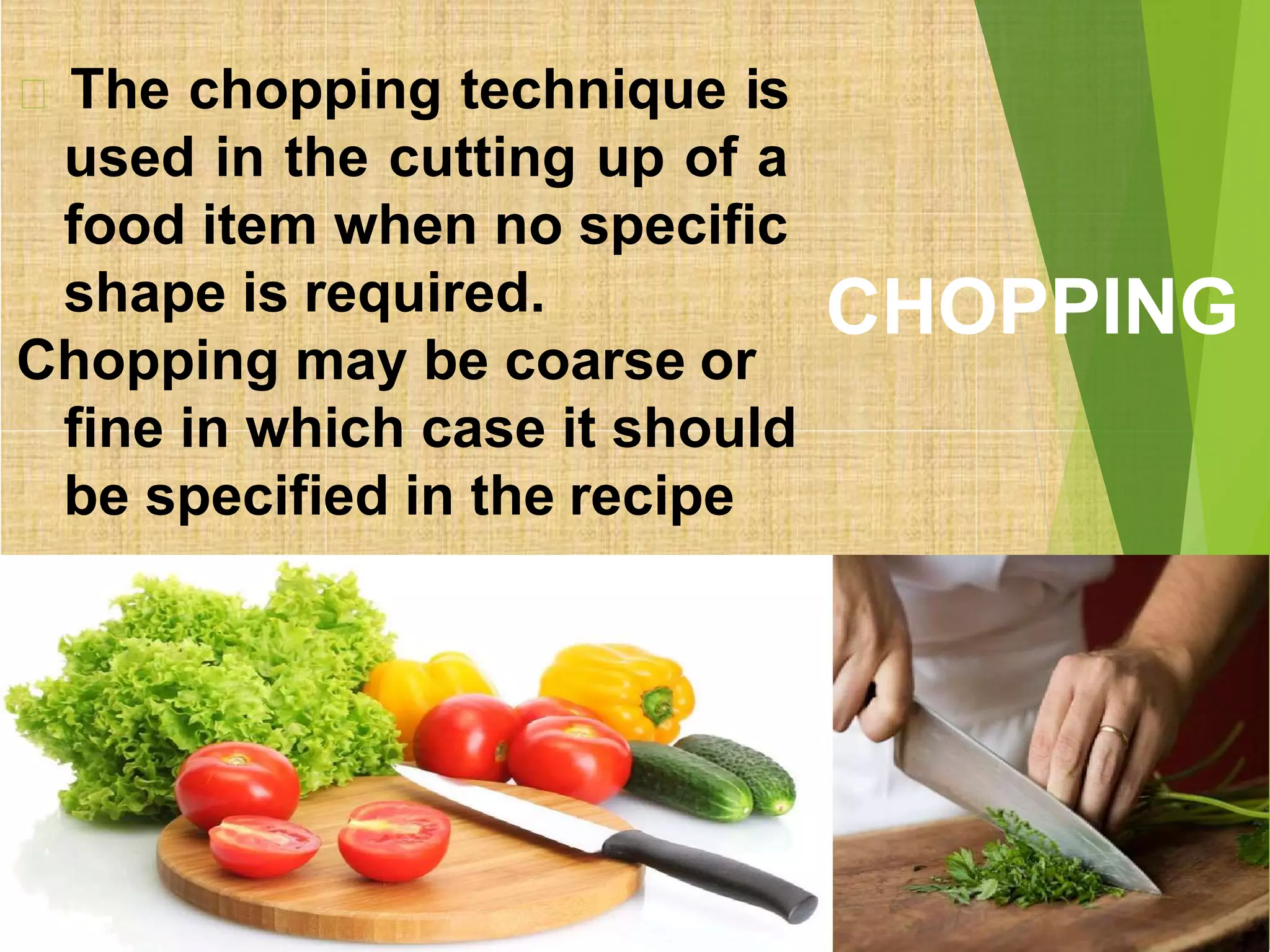
CHOPPING
The chopping technique is
used in the cutting up of a
food item when no specific
shape is required.
Chopping may be coarse or
fine in which case it should
be specified in the recipe
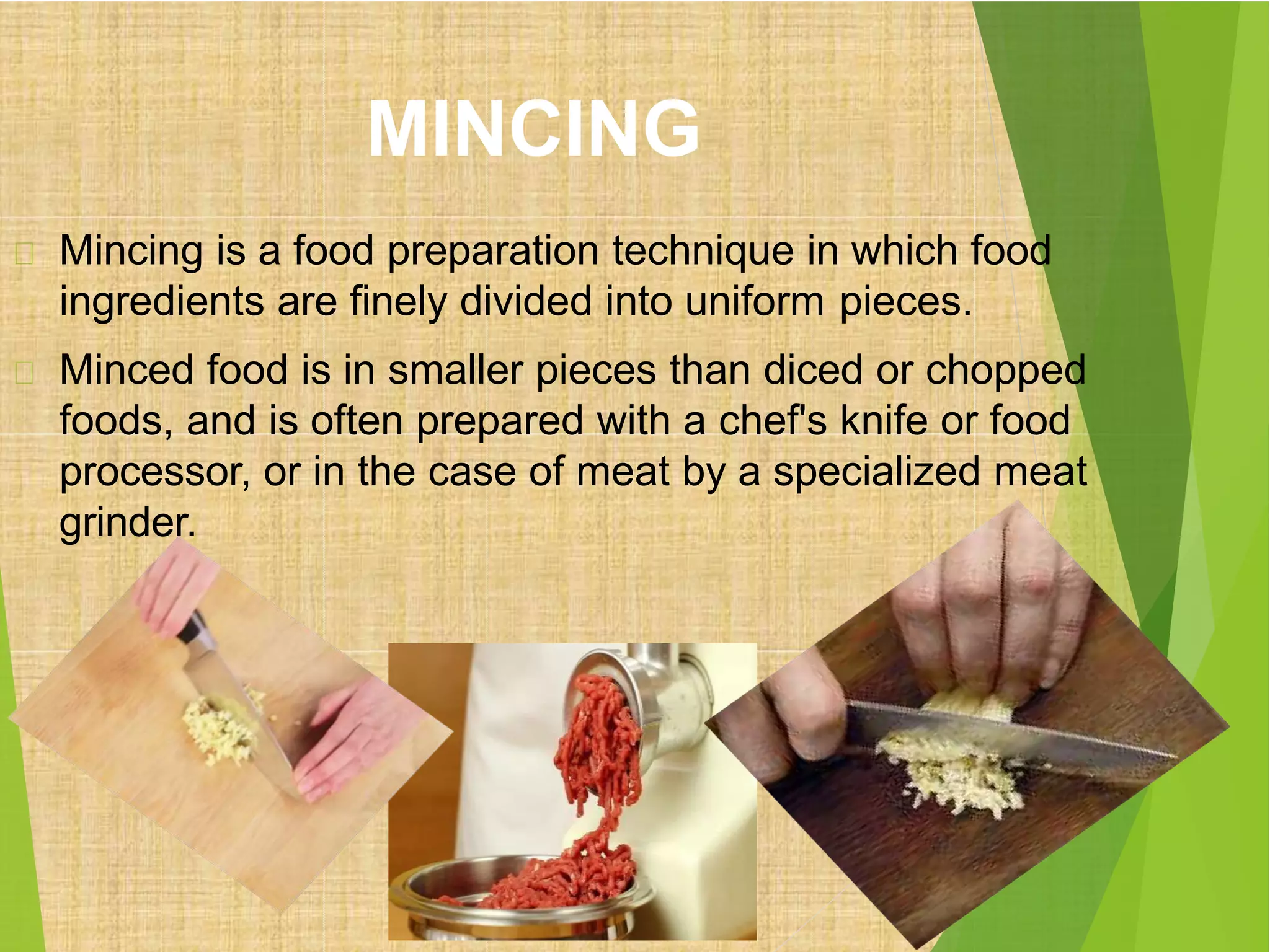
MINCING
Mincing is a food preparation technique in which food
ingredients are finely divided into uniform pieces.
Minced food is in smaller pieces than diced or chopped
foods, and is often prepared with a chef's knife or food
processor, or in the case of meat by a specialized meat
grinder.
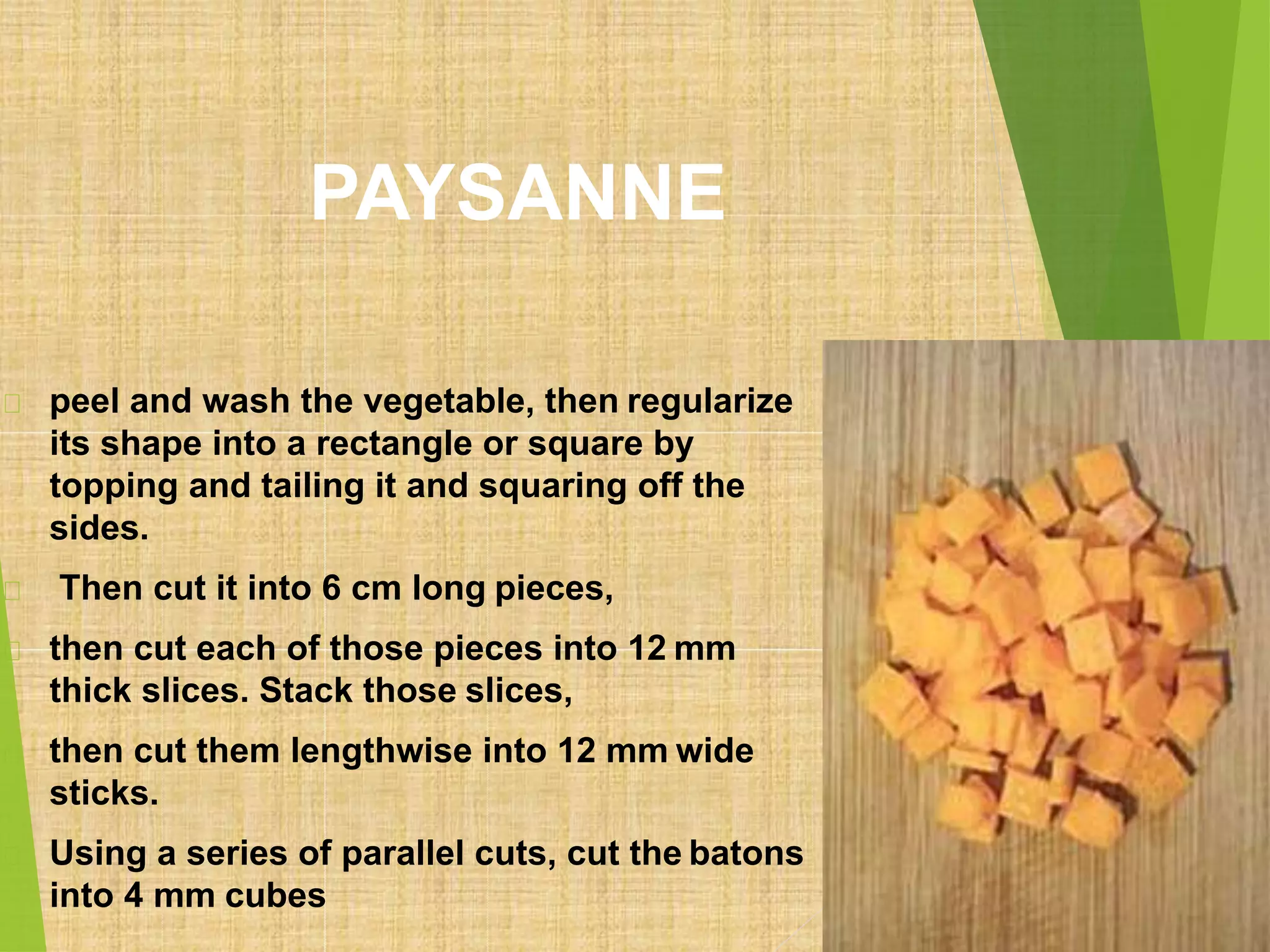
PAYSANNE
peel and wash the vegetable, then regularize
its shape into a rectangle or square by
topping and tailing it and squaring off the
sides.
Then cut it into 6 cm long pieces,
then cut each of those pieces into 12 mm
thick slices. Stack those slices,
then cut them lengthwise into 12 mm wide
sticks.
Using a series of parallel cuts, cut the batons
into 4 mm cubes
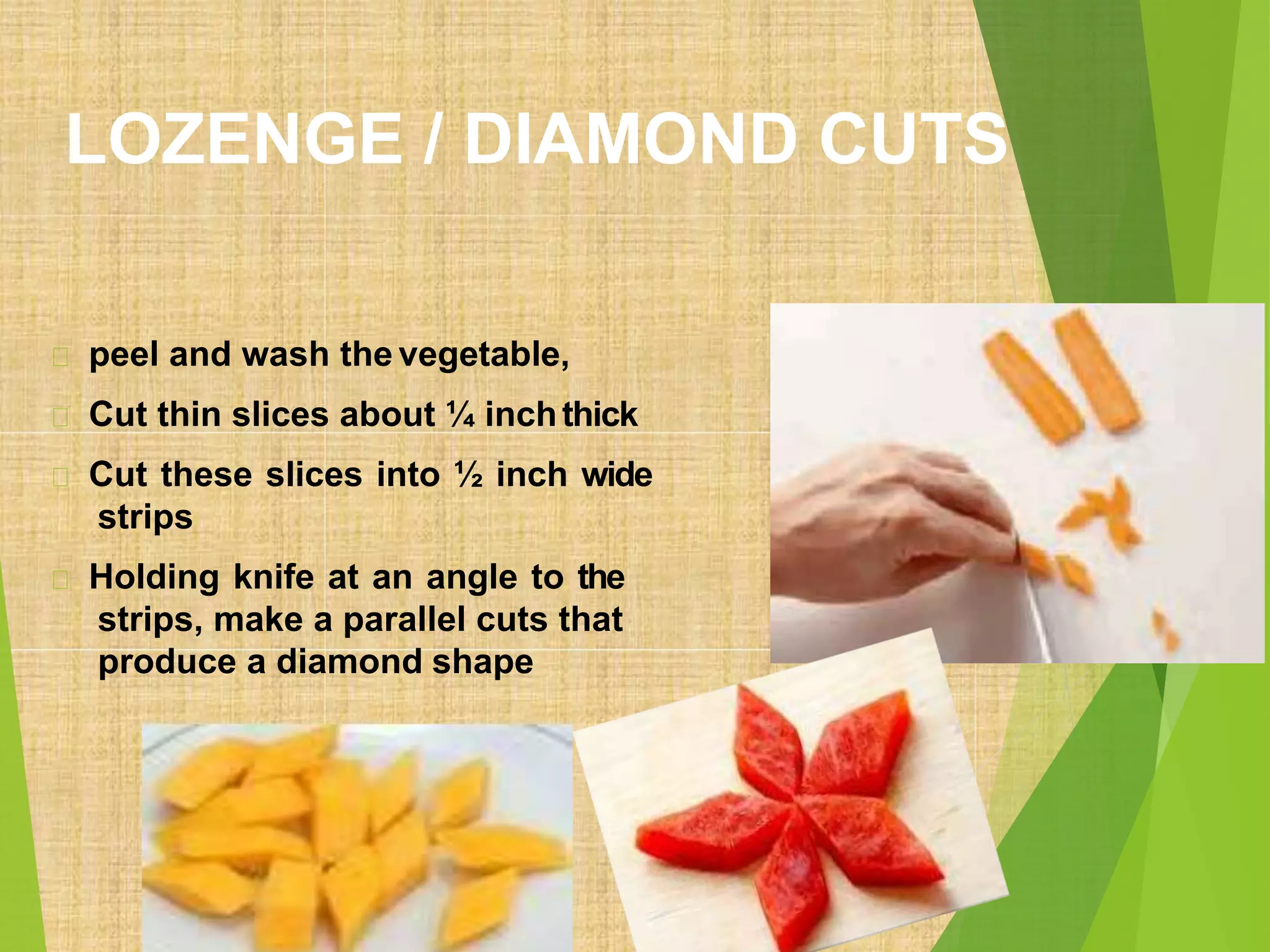
LOZENGE / DIAMOND CUTS
peel and wash the vegetable,
Cut thin slices about ¼ inchthick
Cut these slices into ½ inch wide
strips
Holding knife at an angle to the
strips, make a parallel cuts that
produce a diamond shape
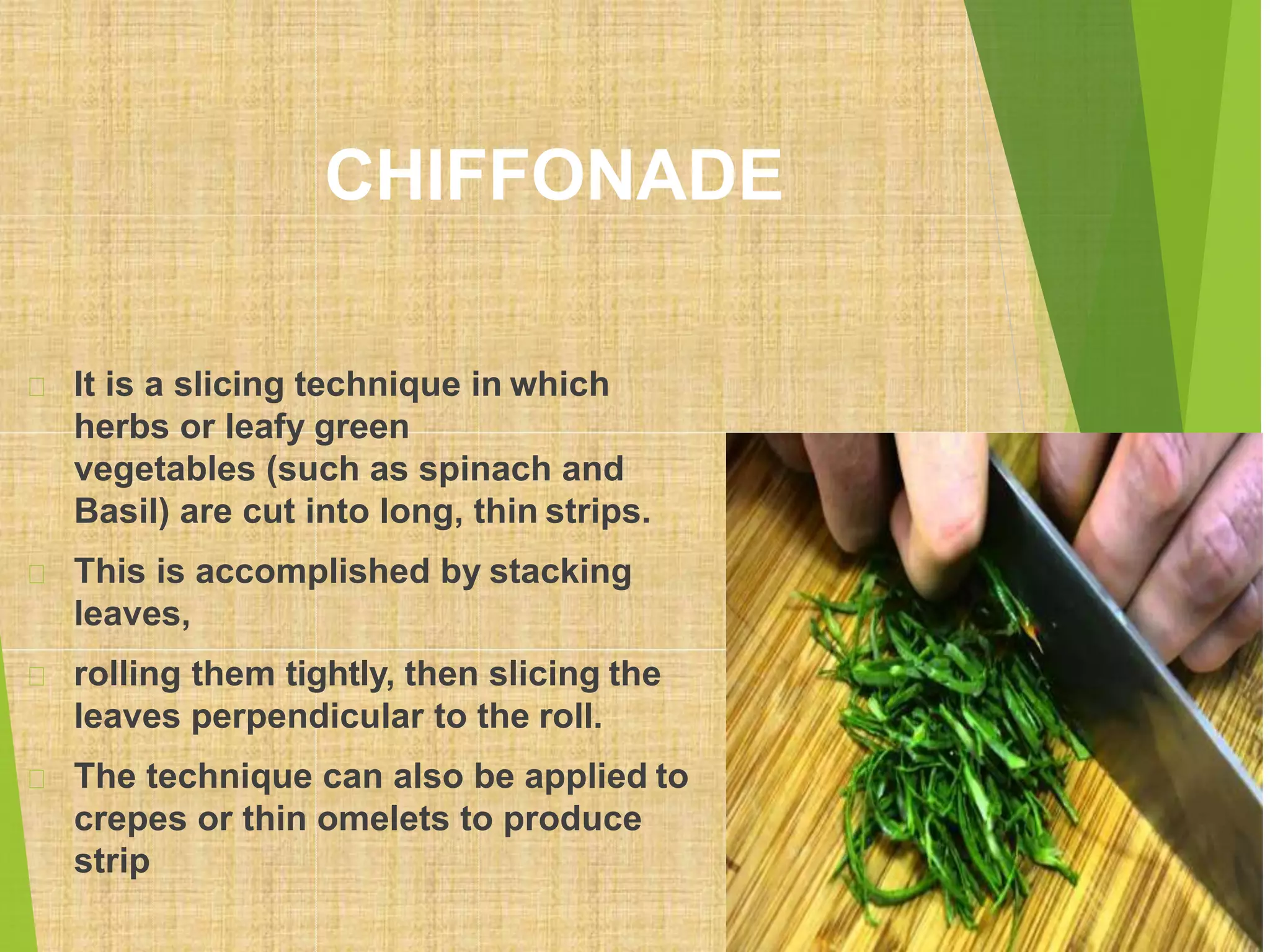
CHIFFONADE
It is a slicing technique in which
herbs or leafy green
vegetables (such as spinach and
Basil) are cut into long, thin strips.
This is accomplished by stacking
leaves,
rolling them tightly, then slicing the
leaves perpendicular to the roll.
The technique can also be applied to
crepes or thin omelets to produce
strip
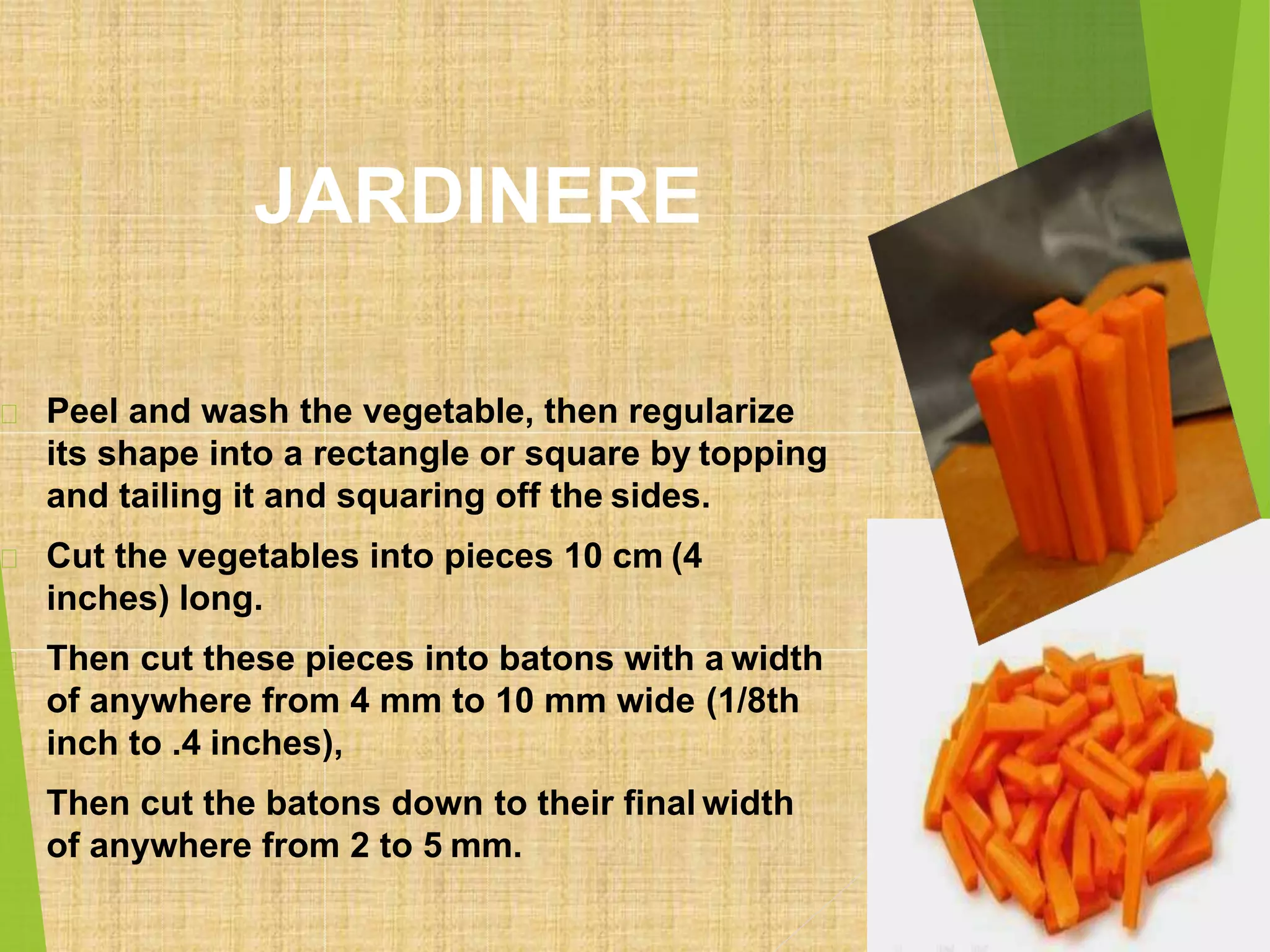
JARDINERE
Peel and wash the vegetable, then regularize
its shape into a rectangle or square by topping
and tailing it and squaring off the sides.
Cut the vegetables into pieces 10 cm (4
inches) long.
Then cut these pieces into batons with a width
of anywhere from 4 mm to 10 mm wide (1/8th
inch to .4 inches),
Then cut the batons down to their final width
of anywhere from 2 to 5 mm.
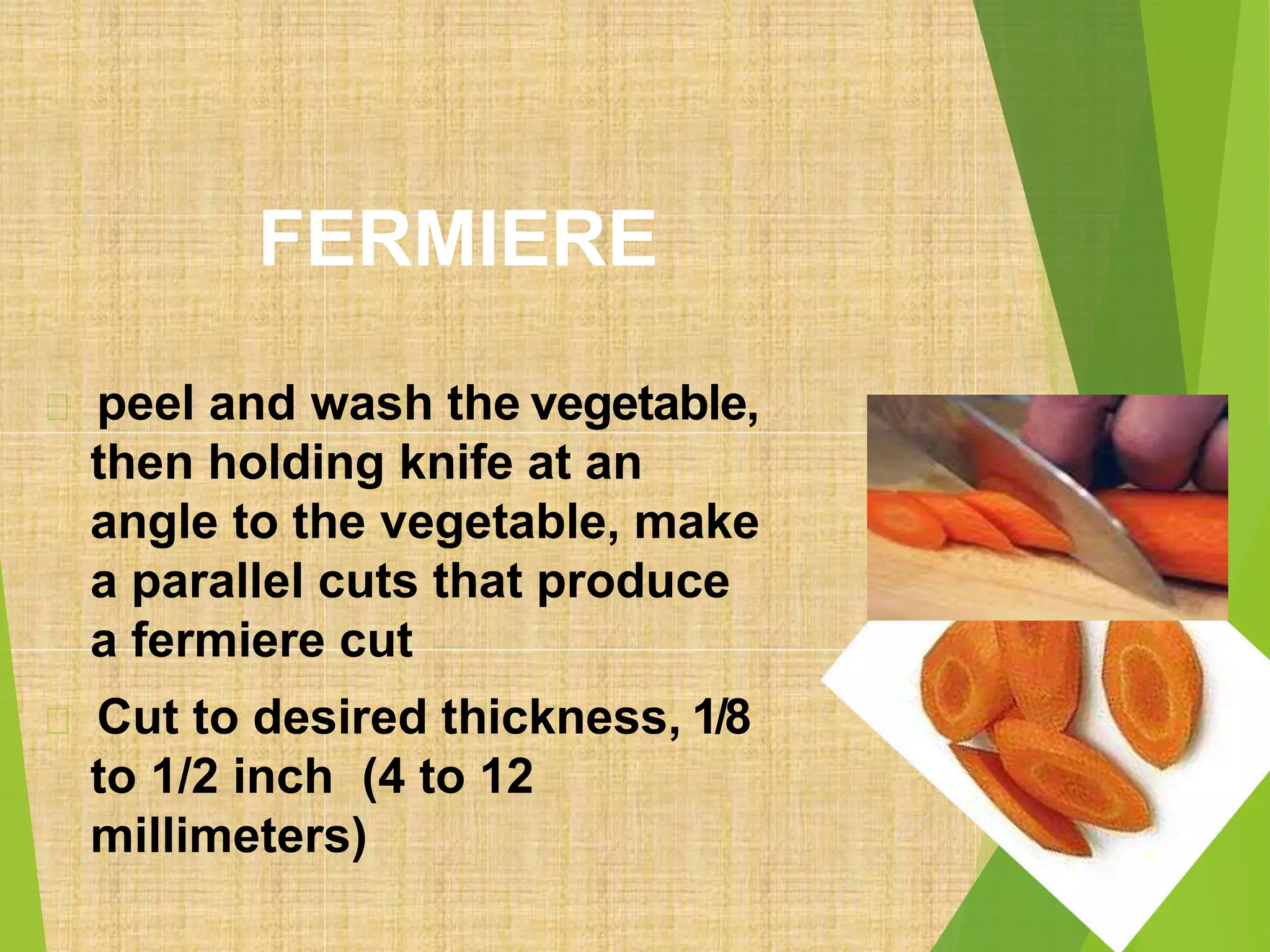
FERMIERE
peel and wash the vegetable,
then holding knife at an
angle to the vegetable, make
a parallel cuts that produce
a fermiere cut
Cut to desired thickness, 1/8
to 1/2 inch (4 to 12
millimeters)
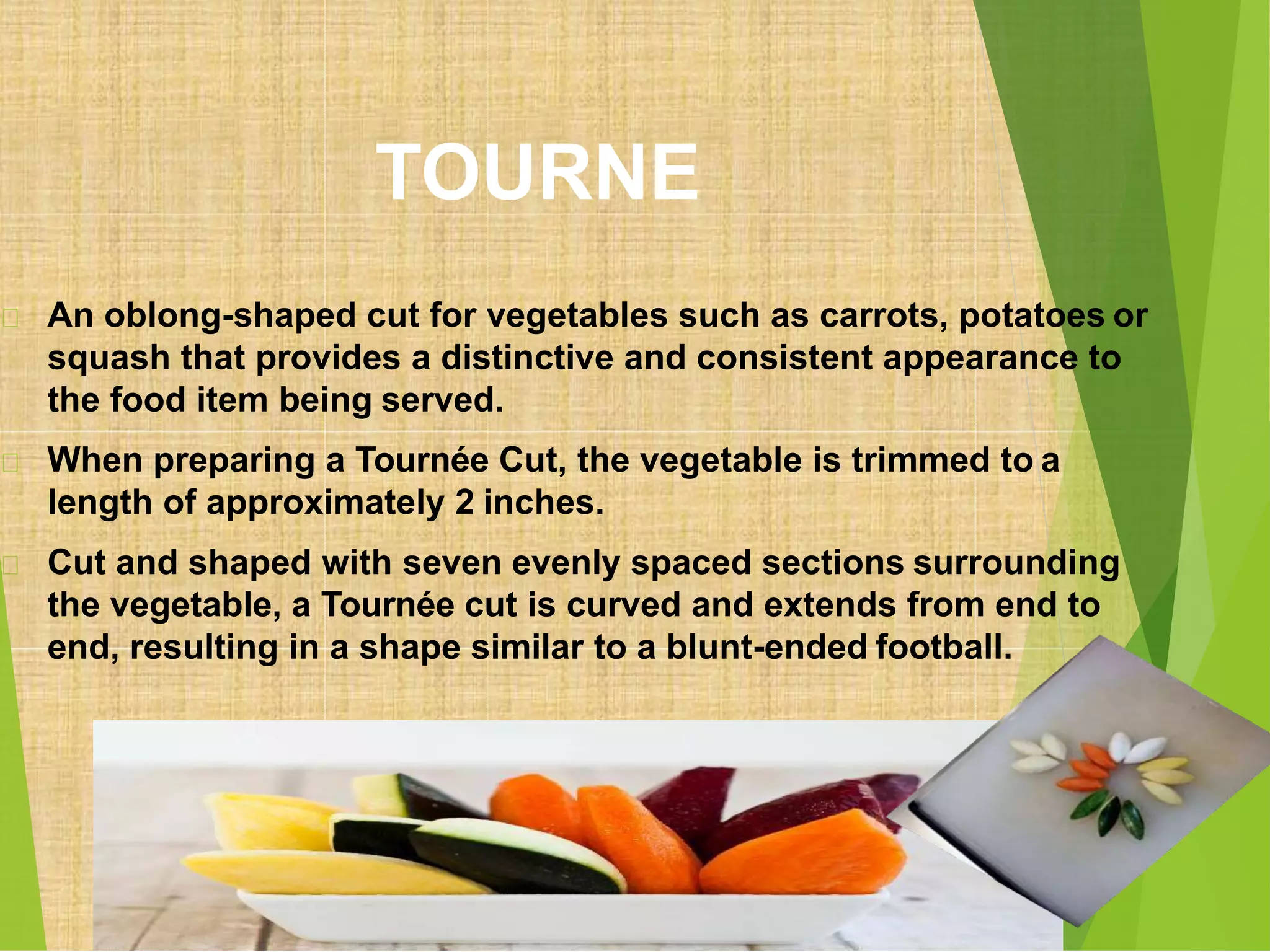
TOURNE
An oblong-shaped cut for vegetables such as carrots, potatoes or
squash that provides a distinctive and consistent appearance to
the food item being served.
When preparing a Tournée Cut, the vegetable is trimmed to a
length of approximately 2 inches.
Cut and shaped with seven evenly spaced sections surrounding
the vegetable, a Tournée cut is curved and extends from end to
end, resulting in a shape similar to a blunt-ended football.
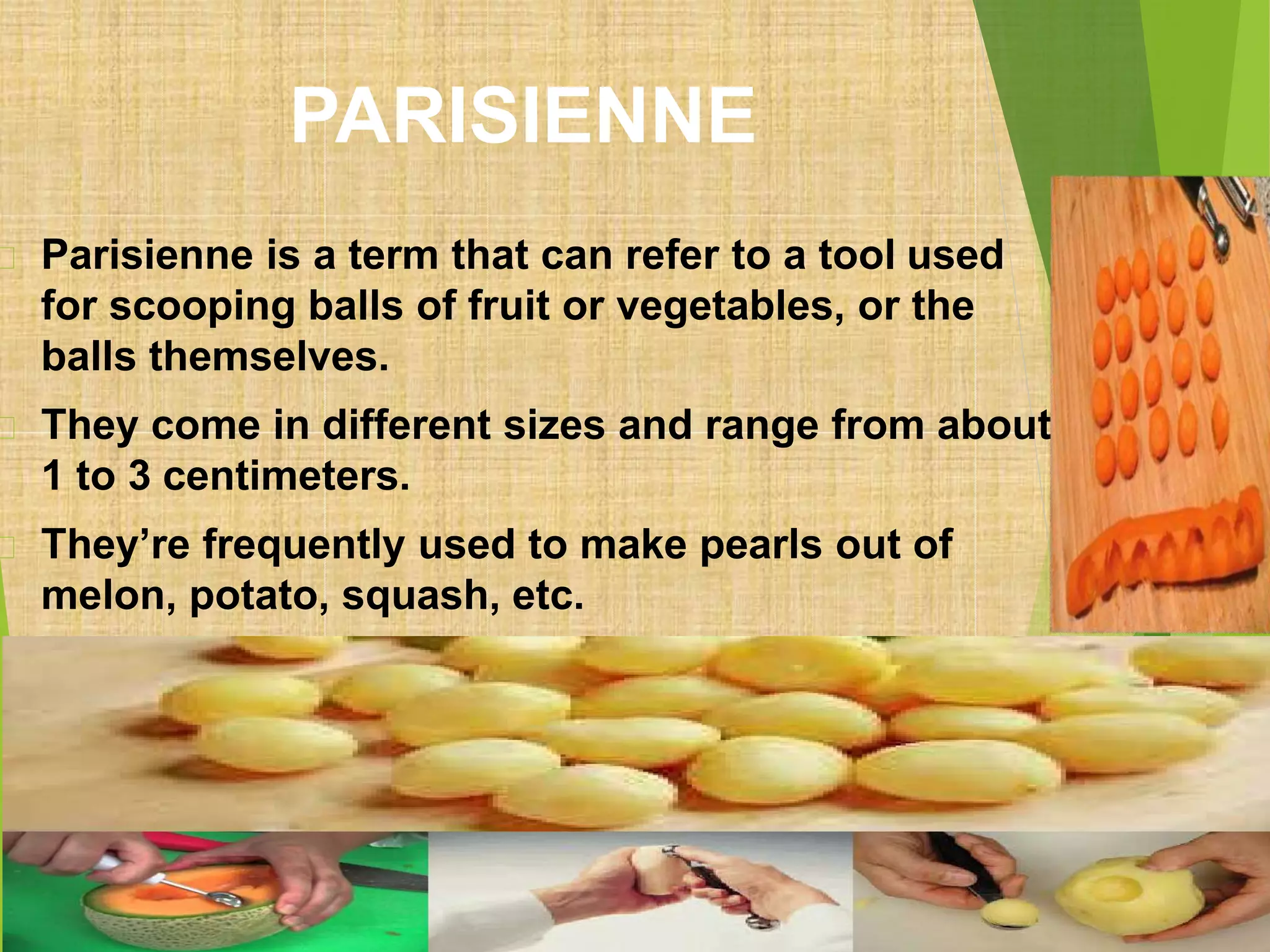
PARISIENNE
Parisienne is a term that can refer to a tool used
for scooping balls of fruit or vegetables, or the
balls themselves.
They come in different sizes and range from about
1 to 3 centimeters.
They’re frequently used to make pearls out of
melon, potato, squash, etc.
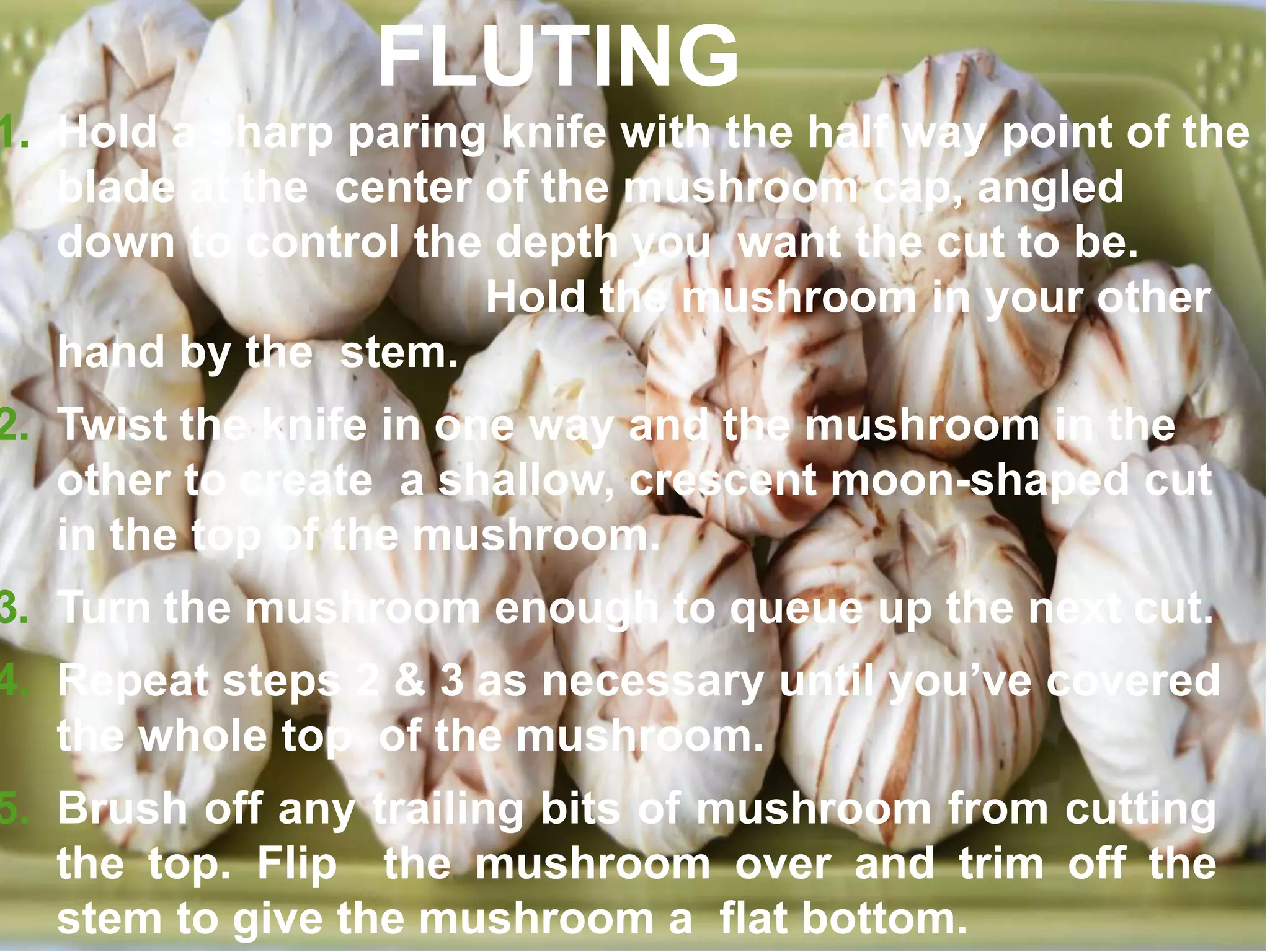
1. Hold a sharp paring knife with the half way point of the
blade at the center of the mushroom cap, angled
down to control the depth you want the cut to be.
Hold the mushroom in your other
hand by the stem.
2. Twist the knife in one way and the mushroom in the
other to create a shallow, crescent moon-shaped cut
in the top of the mushroom.
3. Turn the mushroom enough to queue up the next cut.
4. Repeat steps 2 & 3 as necessary until you’ve covered
the whole top of the mushroom.
5. Brush off any trailing bits of mushroom from cutting
the top. Flip the mushroom over and trim off the
stem to give the mushroom a flat bottom.
FLUTING
WEDGES
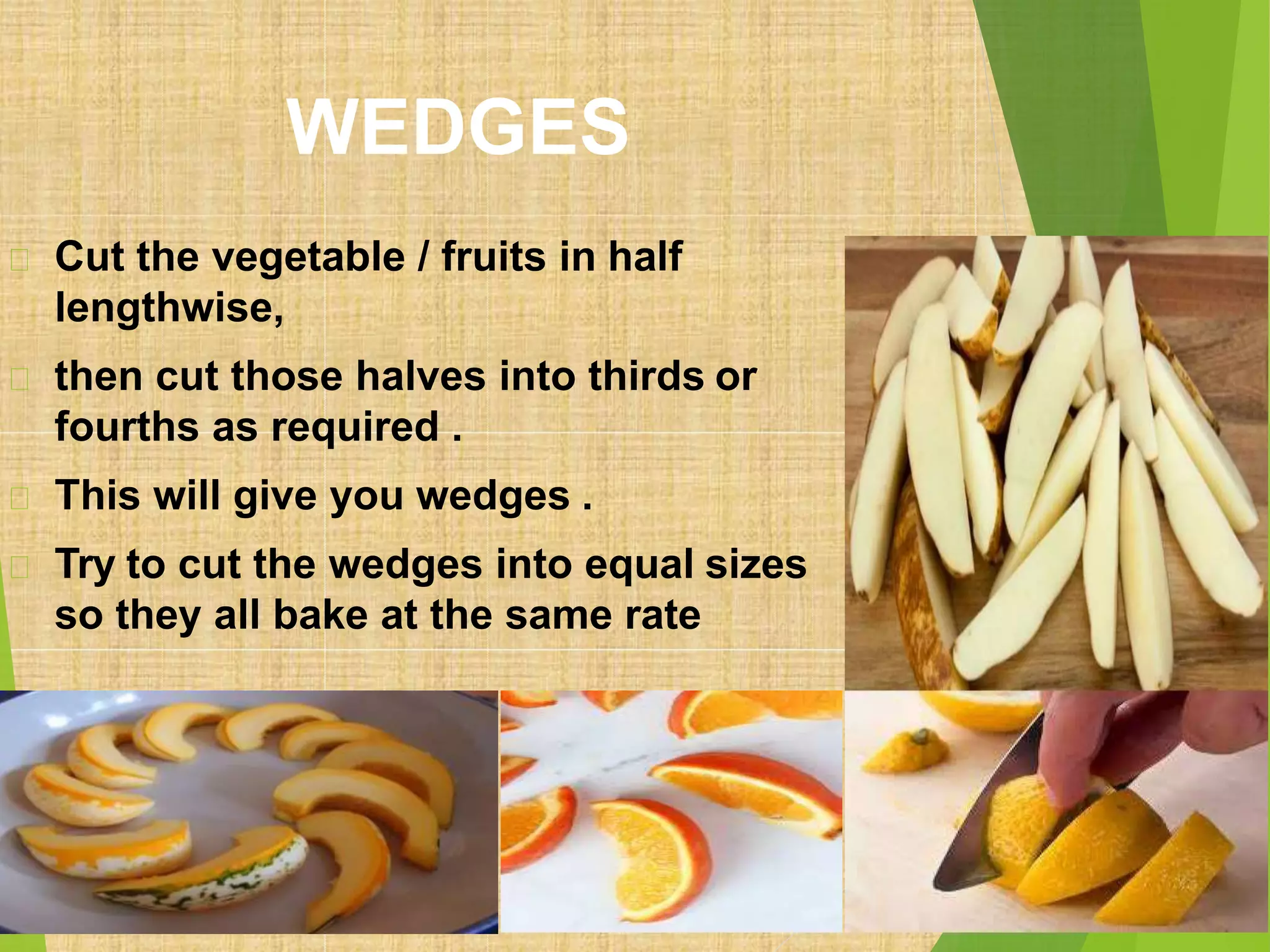
Cut the vegetable / fruits in half
lengthwise,
then cut those halves into thirds or
fourths as required .
This will give you wedges .
Try to cut the wedges into equal sizes
so they all bake at the same rate
SEGMENT
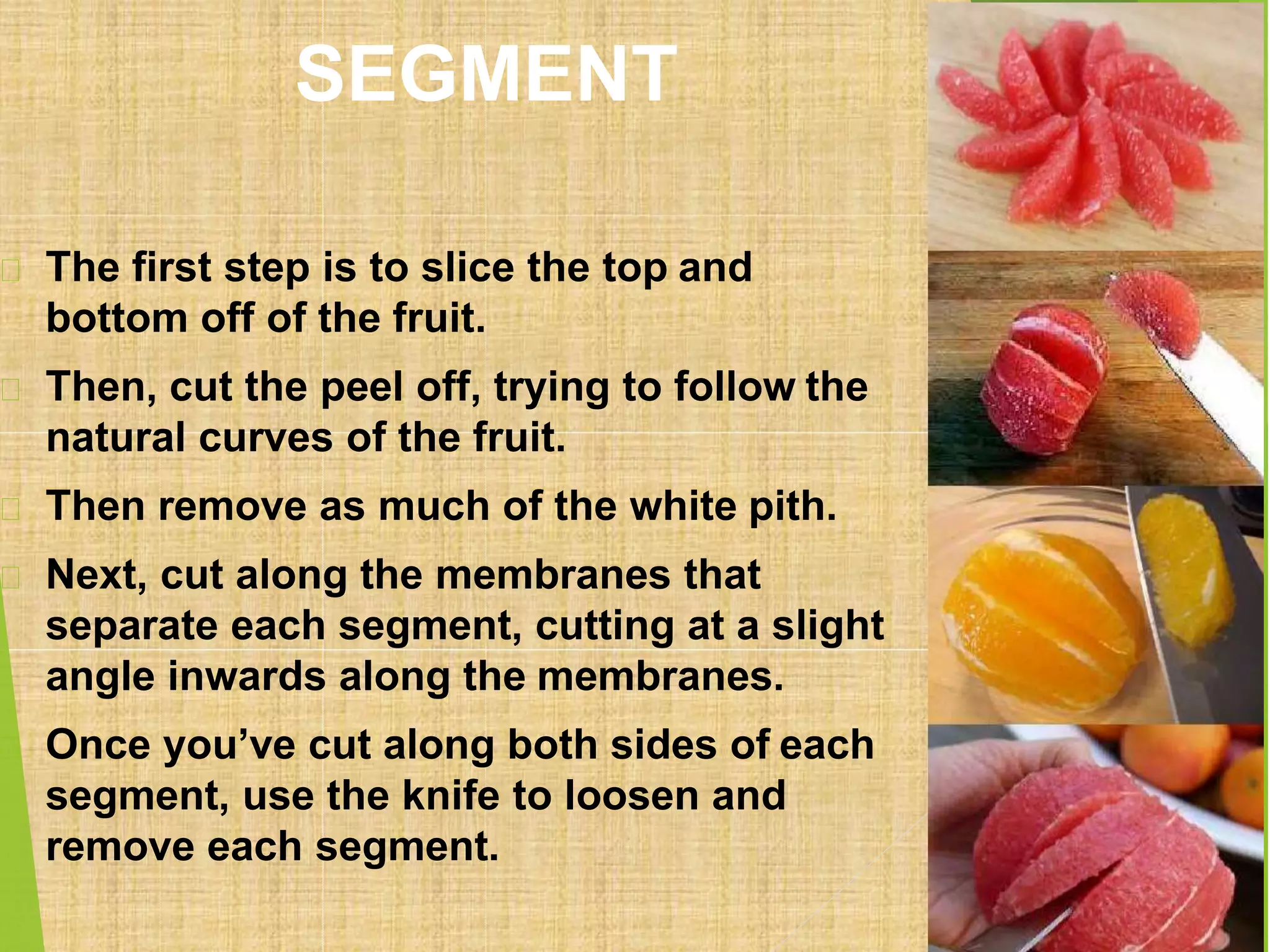
The first step is to slice the top and
bottom off of the fruit.
Then, cut the peel off, trying to follow the
natural curves of the fruit.
Then remove as much of the white pith.
Next, cut along the membranes that
separate each segment, cutting at a slight
angle inwards along the membranes.
Once you’ve cut along both sides of each
segment, use the knife to loosen and
remove each segment.
FLORETS
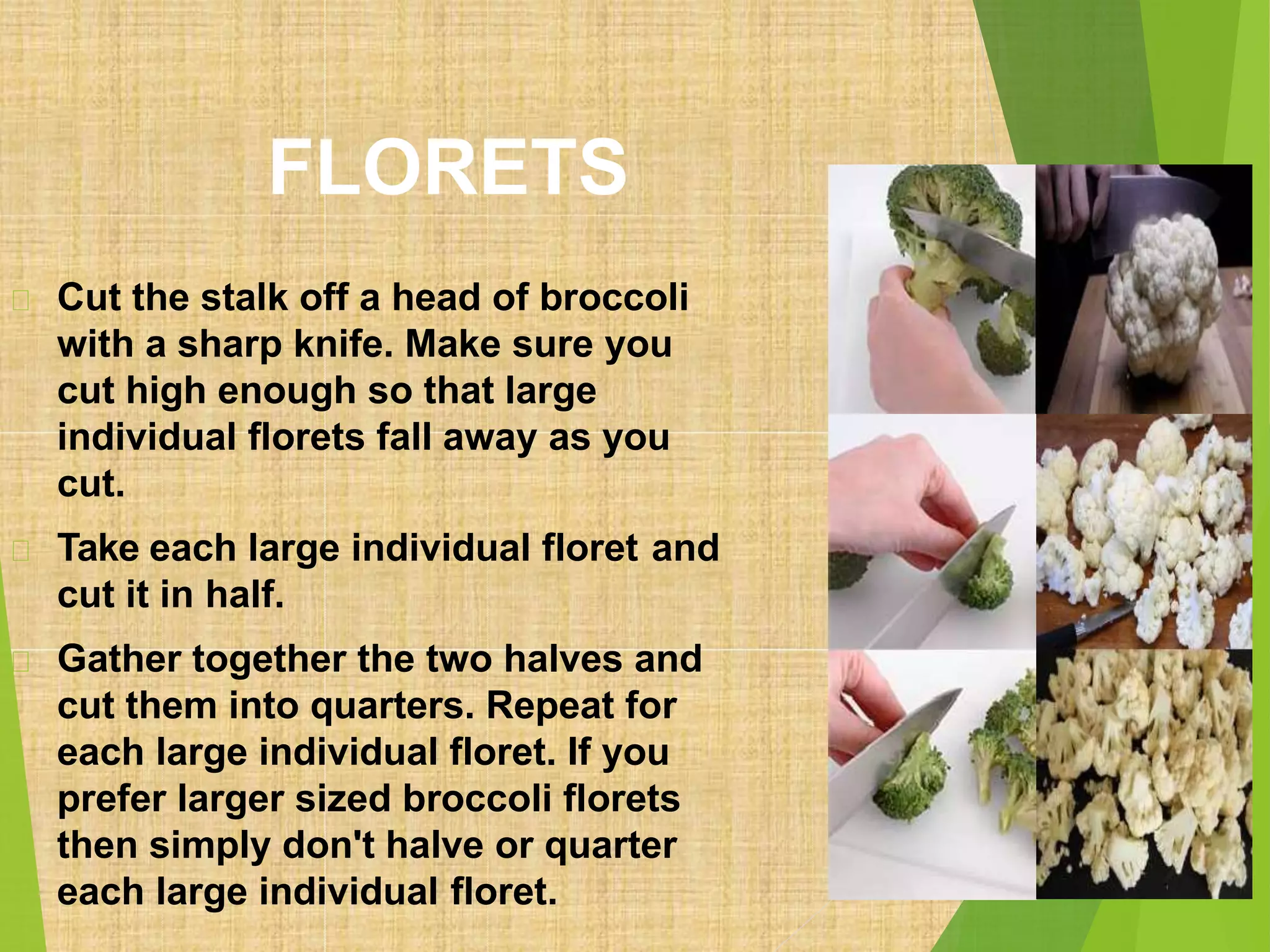
Cut the stalk off a head of broccoli
with a sharp knife. Make sure you
cut high enough so that large
individual florets fall away as you
cut.
Take each large individual floret and
cut it in half.
Gather together the two halves and
cut them into quarters. Repeat for
each large individual floret. If you
prefer larger sized broccoli florets
then simply don't halve or quarter
each large individual floret.
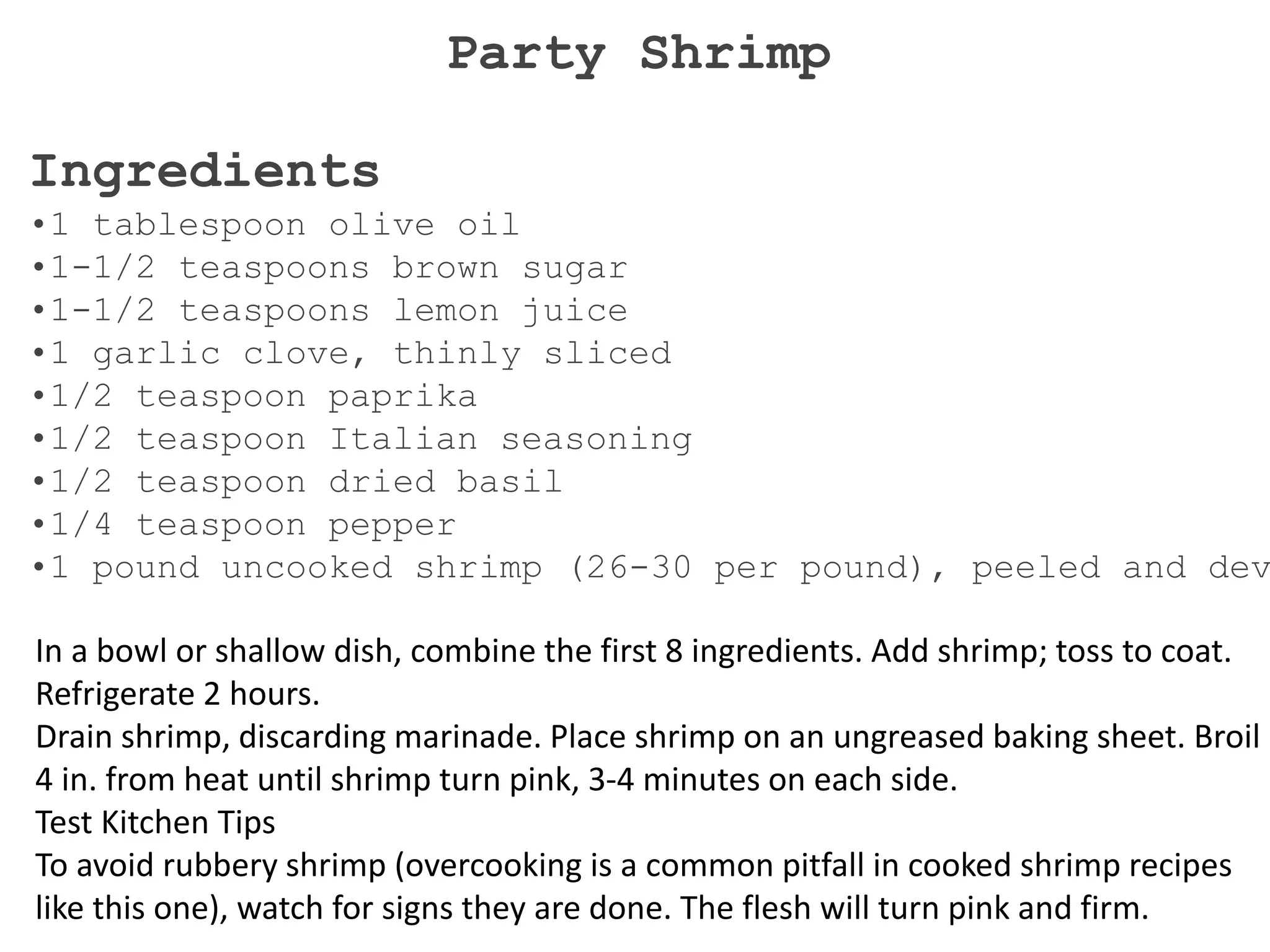
Ingredients
•1 tablespoon olive oil
•1-1/2 teaspoons brown sugar
•1-1/2 teaspoons lemon juice
•1 garlic clove, thinly sliced
•1/2 teaspoon paprika
•1/2 teaspoon Italian seasoning
•1/2 teaspoon dried basil
•1/4 teaspoon pepper
•1 pound uncooked shrimp (26-30 per pound), peeled and dev
In a bowl or shallow dish, combine the first 8 ingredients. Add shrimp; toss to coat.
Refrigerate 2 hours.
Drain shrimp, discarding marinade. Place shrimp on an ungreased baking sheet. Broil
4 in. from heat until shrimp turn pink, 3-4 minutes on each side.
Test Kitchen Tips
To avoid rubbery shrimp (overcooking is a common pitfall in cooked shrimp recipes
like this one), watch for signs they are done. The flesh will turn pink and firm.
Party Shrimp
Ingredients
•1-2/3 cups evaporated milk, divided
•2/3 cup chopped onion
•1/4 cup fine dry bread crumbs
•1/2 teaspoon salt
•1/2 teaspoon allspice
•Dash pepper
•1 pound lean ground beef (90% lean)
•2 teaspoons butter
•2 teaspoons beef bouillon granules
•1 cup boiling water
•1/2 cup cold water
•2 tablespoons all-purpose flour
•1 tablespoon lemon juice
Classic Swedish Meatballs
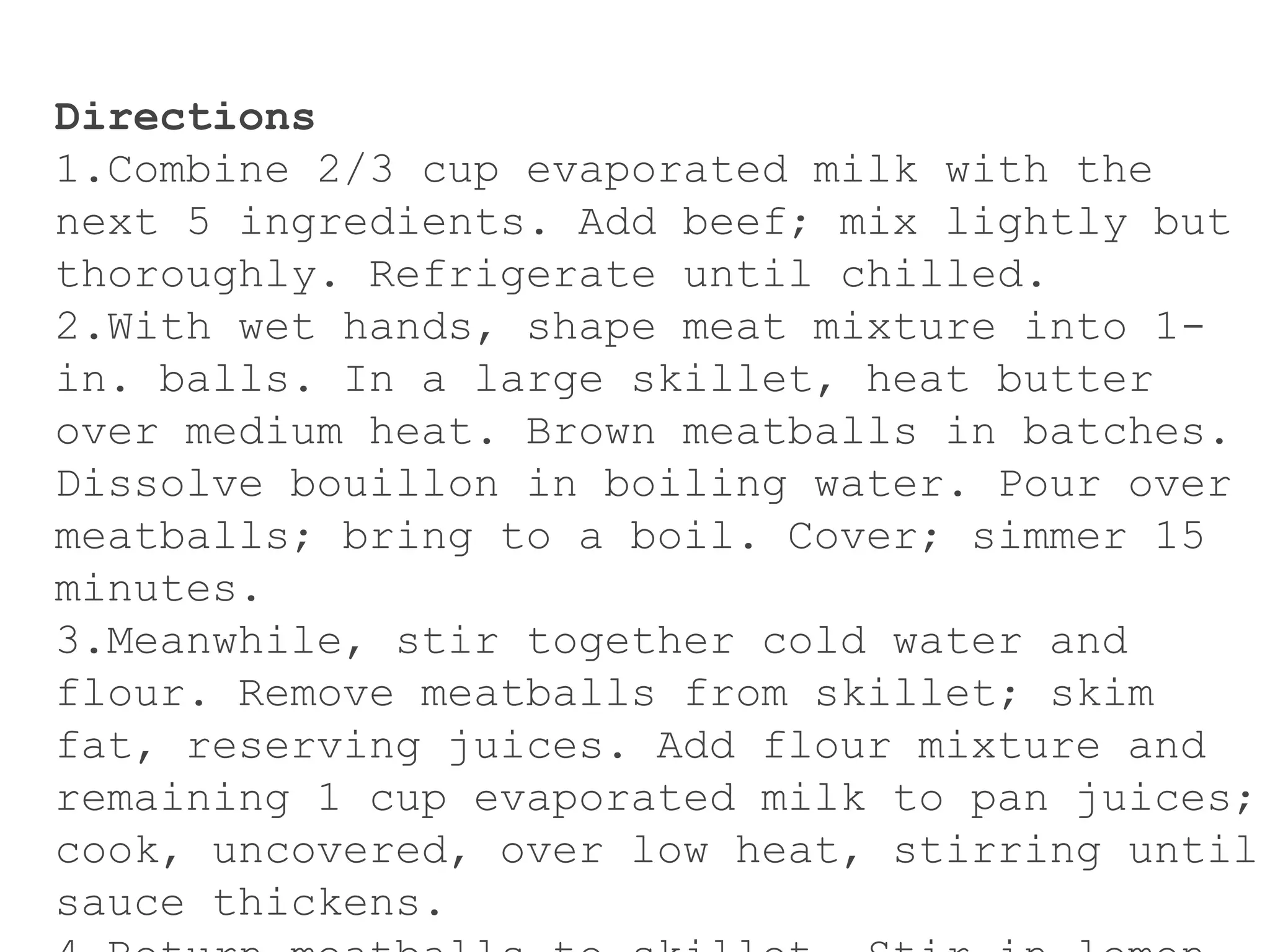
Directions
1.Combine 2/3 cup evaporated milk with the
next 5 ingredients. Add beef; mix lightly but
thoroughly. Refrigerate until chilled.
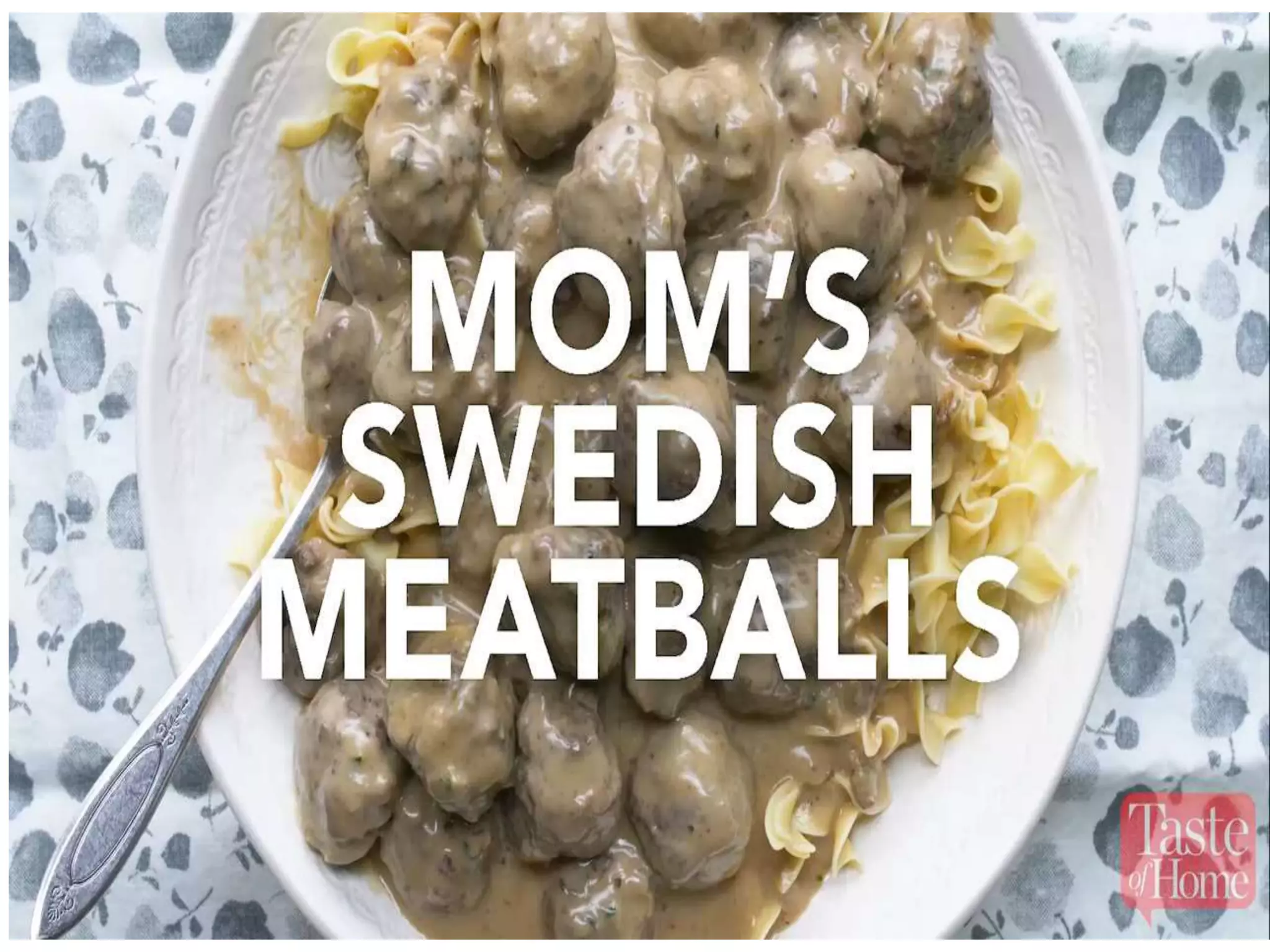
2.With wet hands, shape meat mixture into 1-
in. balls. In a large skillet, heat butter
over medium heat. Brown meatballs in batches.
Dissolve bouillon in boiling water. Pour over
meatballs; bring to a boil. Cover; simmer 15
minutes.
3.Meanwhile, stir together cold water and
flour. Remove meatballs from skillet; skim
fat, reserving juices. Add flour mixture and
remaining 1 cup evaporated milk to pan juices;
cook, uncovered, over low heat, stirring until
sauce thickens.
CUTTING PROCESS.pptx

CUTTING PROCESS.pptx

  • 1.
    BASIC KNIFE SKILLSAND CUTTING TECHNIQUES
  • 2.
    TOPICS 1) Parts ofknife 2) Different types of Knives 3) Holding knife and hand posture 4) Why different types of knives are needed 5) Knife safety
  • 5.
    The Grip –gives you maximum control over the knife. The proper grip increases your cutting accuracy and speed, it prevents slipping , lessens the chance of accident
  • 6.
    WHY DIFFERENT KNIVESARE NEEDED It is simple as that: Cutting different types of food requires different types of knifes In order to cut small vegetable and fruit a small knife is to be favored. For slicing bread, ripe tomatoes or a crispy toast, a knife with a wavy or serrated edge is the right tool. A long and straightedge is ideal for carving. Chef’s knife is the most important tool in a kitchen is ideal for all food preparations including mincing, dicing and slicing. It is the manual food processor. There is no one universal knife that can be used for the multitude of cutting tasks. The enjoyment of gourmet food begins with the preparation and the right tool
  • 7.
    KNIFE SAFETY Preventing cuts Keep knives sharp  Use cutting board  Pay attention  Cut away from yourself and Others  Use knives only cutting  Don’t catch a falling knife  Don’t Leave a knives in a sink or in the pots or pans and under the vegetable trimmings/skins.  Clean knives carefully with sharp edge away from you.  Store knives in a specified safe area(not in drawers or under the tables)  Carry a knife properly  Hold it beside you, point down, sharp edge back and away from you  Don’t swing your arm  Let people know you are walking past them with a knife.
  • 8.
    PART - 2 Topics Differenttypes of cuttings of vegetables and fruits Sizes of particular cuttings Procedure to cut the different cuttings
  • 9.
    Vegetables are cutinto various size and shapes for various cooking purposes, creating different textures, tastes and mouth feel. Different cuts would differently from one to another all of them will create a different flavor. CUTS OF VEGETABLE
  • 10.
    CUTS OF VEGETABLE Dice Batonnet Julienne Jardinière Macedoine Brunoise Lozenge/ Diamond Slicing or Roundelle Paring Chiffonade Paysanne Allumette Wedges Mirepoix Tourne Fluting Mincing Chopping Parisienne Segment Fermiere Florets
  • 11.
    SLICING / ROUNDELLE Slicingis the cutting of food into thin, relatively broad slices. Slices may be used as they are or processed further to produce other specialty cuts such as chiffonade, Roundelle's and lozenges.
  • 12.
    BATONNET Pronunciation: bah-tow-NAY peel andwash the vegetable, then regularize its shape into a rectangle or square by topping and tailing it and squaring off the sides. Then cut it into 6 cm (2.5 inch) long pieces. then cut each of those pieces into 6mm (1/4th) thick slices. Stack those slices, then cut them lengthwise into 6mm (1/4th) wide sticks. measures ½ inch × ½ inch × 2½-3 inches.
  • 13.
    ALLUMETTE Allumette means tocut it into small, thin pieces the size of matchsticks. peel and wash the vegetable, then regularize its shape into a rectangle or square by topping and tailing it and squaring off the sides. Then cut it into 5 cm (2 inch) long pieces, then cut each of those pieces into 3 mm (1/8th inch) thick slices. Stack those slices, then cut them lengthwise into 3 mm (1/8th inch) wide sticks.
  • 14.
    JULIENNE peel and washthe vegetable, then regularize its shape into a rectangle or square by topping and tailing it and squaring off the sides. Then cut it into 5 cm (2 inch) long pieces, then cut each of those pieces into 1-2 mm thick slices. Stack those slices, then cut them lengthwise into 1-2 mm wide sticks.
  • 15.
    DICE LARGE DICE - measuring¾ inch × ¾ inch × ¾ inch MEDIUM DICE – ½ inch x ½ inch x ½ inch SMALL DICE – ¼ inch x ¼ inch x ¼ inch
  • 16.
    SMALL DICE Small diceof vegetable Trim the vegetable so that sides are straight, making it easier to produce even the cuts. Slice the vegetable length wise into ¼ inch slices using a series of parallel cuts. Cut each slice into batonnet shapes ¼ inch wide. Using a series of parallel cuts, cut the batons into ¼ inch cubes
  • 17.
    MACEDOINE peel and washthe vegetable, then regularize its shape into a rectangle or square by topping and tailing it and squaring off the sides. Then cut it into 5 cm (2 inch) long pieces, then cut each of those pieces into 5 mm thick slices. Stack those slices, then cut them lengthwise into 5 mm wide sticks. Using a series of parallel cuts, cut the batons into 5mm cubes
  • 18.
    BRUNOISE peel and washthe vegetable, then regularize its shape into a rectangle or square by topping and tailing it and squaring off the sides. Then cut it into 5 cm (2 inch) long pieces, then cut each of those pieces into 3 mm (1/8th inch) thick slices. Stack those slices, then cut them lengthwise into 3 mm (1/8th inch) wide sticks. Using a series of parallel cuts, cut the batons into 1/8th inch cubes
  • 19.
    CHOPPING The chopping techniqueis used in the cutting up of a food item when no specific shape is required. Chopping may be coarse or fine in which case it should be specified in the recipe
  • 20.
    MINCING Mincing is afood preparation technique in which food ingredients are finely divided into uniform pieces. Minced food is in smaller pieces than diced or chopped foods, and is often prepared with a chef's knife or food processor, or in the case of meat by a specialized meat grinder.
  • 21.
    PAYSANNE peel and washthe vegetable, then regularize its shape into a rectangle or square by topping and tailing it and squaring off the sides. Then cut it into 6 cm long pieces, then cut each of those pieces into 12 mm thick slices. Stack those slices, then cut them lengthwise into 12 mm wide sticks. Using a series of parallel cuts, cut the batons into 4 mm cubes
  • 22.
    LOZENGE / DIAMONDCUTS peel and wash the vegetable, Cut thin slices about ¼ inchthick Cut these slices into ½ inch wide strips Holding knife at an angle to the strips, make a parallel cuts that produce a diamond shape
  • 23.
    CHIFFONADE It is aslicing technique in which herbs or leafy green vegetables (such as spinach and Basil) are cut into long, thin strips. This is accomplished by stacking leaves, rolling them tightly, then slicing the leaves perpendicular to the roll. The technique can also be applied to crepes or thin omelets to produce strip
  • 24.
    JARDINERE Peel and washthe vegetable, then regularize its shape into a rectangle or square by topping and tailing it and squaring off the sides. Cut the vegetables into pieces 10 cm (4 inches) long. Then cut these pieces into batons with a width of anywhere from 4 mm to 10 mm wide (1/8th inch to .4 inches), Then cut the batons down to their final width of anywhere from 2 to 5 mm.
  • 25.
    FERMIERE peel and washthe vegetable, then holding knife at an angle to the vegetable, make a parallel cuts that produce a fermiere cut Cut to desired thickness, 1/8 to 1/2 inch (4 to 12 millimeters)
  • 26.
    TOURNE An oblong-shaped cutfor vegetables such as carrots, potatoes or squash that provides a distinctive and consistent appearance to the food item being served. When preparing a Tournée Cut, the vegetable is trimmed to a length of approximately 2 inches. Cut and shaped with seven evenly spaced sections surrounding the vegetable, a Tournée cut is curved and extends from end to end, resulting in a shape similar to a blunt-ended football.
  • 27.
    PARISIENNE Parisienne is aterm that can refer to a tool used for scooping balls of fruit or vegetables, or the balls themselves. They come in different sizes and range from about 1 to 3 centimeters. They’re frequently used to make pearls out of melon, potato, squash, etc.
  • 28.
    1. Hold asharp paring knife with the half way point of the blade at the center of the mushroom cap, angled down to control the depth you want the cut to be. Hold the mushroom in your other hand by the stem. 2. Twist the knife in one way and the mushroom in the other to create a shallow, crescent moon-shaped cut in the top of the mushroom. 3. Turn the mushroom enough to queue up the next cut. 4. Repeat steps 2 & 3 as necessary until you’ve covered the whole top of the mushroom. 5. Brush off any trailing bits of mushroom from cutting the top. Flip the mushroom over and trim off the stem to give the mushroom a flat bottom. FLUTING
  • 29.
    WEDGES Cut the vegetable/ fruits in half lengthwise, then cut those halves into thirds or fourths as required . This will give you wedges . Try to cut the wedges into equal sizes so they all bake at the same rate
  • 30.
    SEGMENT The first stepis to slice the top and bottom off of the fruit. Then, cut the peel off, trying to follow the natural curves of the fruit. Then remove as much of the white pith. Next, cut along the membranes that separate each segment, cutting at a slight angle inwards along the membranes. Once you’ve cut along both sides of each segment, use the knife to loosen and remove each segment.
  • 31.
    FLORETS Cut the stalkoff a head of broccoli with a sharp knife. Make sure you cut high enough so that large individual florets fall away as you cut. Take each large individual floret and cut it in half. Gather together the two halves and cut them into quarters. Repeat for each large individual floret. If you prefer larger sized broccoli florets then simply don't halve or quarter each large individual floret.
  • 33.
    Ingredients •1 tablespoon oliveoil •1-1/2 teaspoons brown sugar •1-1/2 teaspoons lemon juice •1 garlic clove, thinly sliced •1/2 teaspoon paprika •1/2 teaspoon Italian seasoning •1/2 teaspoon dried basil •1/4 teaspoon pepper •1 pound uncooked shrimp (26-30 per pound), peeled and dev In a bowl or shallow dish, combine the first 8 ingredients. Add shrimp; toss to coat. Refrigerate 2 hours. Drain shrimp, discarding marinade. Place shrimp on an ungreased baking sheet. Broil 4 in. from heat until shrimp turn pink, 3-4 minutes on each side. Test Kitchen Tips To avoid rubbery shrimp (overcooking is a common pitfall in cooked shrimp recipes like this one), watch for signs they are done. The flesh will turn pink and firm. Party Shrimp
  • 35.
    Ingredients •1-2/3 cups evaporatedmilk, divided •2/3 cup chopped onion •1/4 cup fine dry bread crumbs •1/2 teaspoon salt •1/2 teaspoon allspice •Dash pepper •1 pound lean ground beef (90% lean) •2 teaspoons butter •2 teaspoons beef bouillon granules •1 cup boiling water •1/2 cup cold water •2 tablespoons all-purpose flour •1 tablespoon lemon juice Classic Swedish Meatballs
  • 36.
    Directions 1.Combine 2/3 cupevaporated milk with the next 5 ingredients. Add beef; mix lightly but thoroughly. Refrigerate until chilled. 2.With wet hands, shape meat mixture into 1- in. balls. In a large skillet, heat butter over medium heat. Brown meatballs in batches. Dissolve bouillon in boiling water. Pour over meatballs; bring to a boil. Cover; simmer 15 minutes. 3.Meanwhile, stir together cold water and flour. Remove meatballs from skillet; skim fat, reserving juices. Add flour mixture and remaining 1 cup evaporated milk to pan juices; cook, uncovered, over low heat, stirring until sauce thickens.