Food
seasoning
condiments
additives
BEVERAGES
food
seasoning
• Defined as an item added to
enhance the natural flavor of a food
without changing its flavor dramatically.
• Add zest to our food
types of
seasoning
1. Those that have flavor of their own
2. Those that enhance flavor (thus called flavor enhancers)
3. Different Parts of Plant Used as Seasoning:
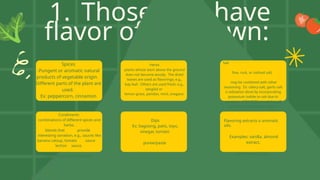
1. Those that have
flavor of their own:
Spices
-Pungent or aromatic natural
products of vegetable origin.
Different parts of the plant are
used.
Ex: peppercorn, cinnamon
Herbs
plants whose stem above the ground
does not become woody. The dried
leaves are used as flavorings; e.g.,
bay leaf. Others are used fresh; e.g.,
tanglad or
lemon grass, pandan, mint, oregano
Salt
fine, rock, or iodized salt;
may be combined with other
seasoning. Ex: celery-salt, garlic-salt
o iodization done by incorporating
potassium iodide to salt due to
provision of RA 8172 mandating all
salt to be fortified with iodine.
Condiments
combinations of different spices and
herbs.
blends that provide
interesting variation, e.g., sauces like
banana catsup, tomato sauce
lechon sauce,
Worceshire sauce, Tabasco
Dips
Ex: bagoong, patis, toyo,
vinegar, tomato
puree/paste
Flavoring extracts o aromatic
oils.
Examples: vanilla, almond
extract,
lemon extract,etc.
2. Those that enhance
flavor (thus called
flavor enhancers)
Monosodium glutamate o
popularly called vetsin
- used for
meats, seafood and vegetables
Nucleotides o used of soups, sauces,
gravies used
for soups, sauces, gravies
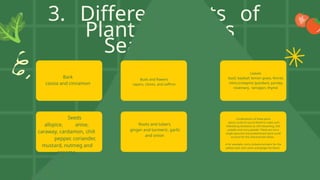
3. Different Parts of
Plant Used as
Seasoning:
Bark
cassia and cinnamon
Buds and flowers
capers, cloves, and saffron
Leaves
basil, bayleaf, lemon grass, fennel,
mint,screwpine (pandan), parsley,
rosemary, tarragon, thyme
Seeds
allspice, anise,
caraway, cardamon, chili
pepper, coriander,
mustard, nutmeg and
sesame.
Roots and tubers
ginger and turmeric, garlic
and onion
Combinations of these parts
spices could of course blend to make such
interesting variations as chili seasoning, chili
powder and curry powder. These are not a
single spice but one predominant spice could
account for the characteristic flavor.
o For example, curry contains turmeric for the
yellow color and cumin and ginger for flavor.
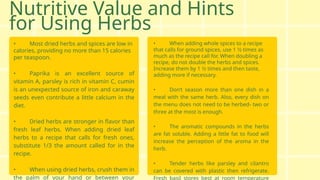
Nutritive Value and Hints
for Using Herbs
• Most dried herbs and spices are low in
calories, providing no more than 15 calories
per teaspoon.
• Paprika is an excellent source of
vitamin A, parsley is rich in vitamin C, cumin
is an unexpected source of iron and caraway
seeds even contribute a little calcium in the
diet.
• Dried herbs are stronger in flavor than
fresh leaf herbs. When adding dried leaf
herbs to a recipe that calls for fresh ones,
substitute 1/3 the amount called for in the
recipe.
• When using dried herbs, crush them in
the palm of your hand or between your
• When adding whole spices to a recipe
that calls for ground spices, use 1 1⁄2 times as
much as the recipe call for. When doubling a
recipe, do not double the herbs and spices.
Increase them by 1 1⁄2 times and then taste,
adding more if necessary.
• Don’t season more than one dish in a
meal with the same herb. Also, every dish on
the menu does not need to be herbed- two or
three at the most is enough.
• The aromatic compounds in the herbs
are fat soluble. Adding a little fat to food will
increase the perception of the aroma in the
herb.
• Tender herbs like parsley and cilantro
can be covered with plastic then refrigerate.
Fresh basil stores best at room temperature
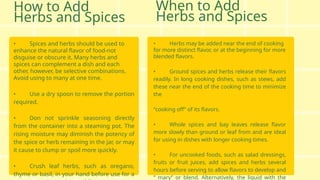
How to Add
Herbs and Spices
• Spices and herbs should be used to
enhance the natural flavor of food-not
disguise or obscure it. Many herbs and
spices can complement a dish and each
other, however, be selective combinations.
Avoid using to many at one time.
• Use a dry spoon to remove the portion
required.
• Don not sprinkle seasoning directly
from the container into a steaming pot. The
rising moisture may diminish the potency of
the spice or herb remaining in the jar, or may
it cause to clump or spoil more quickly.
• Crush leaf herbs, such as oregano,
thyme or basil, in your hand before use for a
• Herbs may be added near the end of cooking
for more distinct flavor, or at the beginning for more
blended flavors.
• Ground spices and herbs release their flavors
readily. In long cooking dishes, such as stews, add
these near the end of the cooking time to minimize
the
“cooking off” of its flavors.
• Whole spices and bay leaves release flavor
more slowly than ground or leaf from and are ideal
for using in dishes with longer cooking times.
• For uncooked foods, such as salad dressings,
fruits or fruit juices, add spices and herbs several
hours before serving to allow flavors to develop and
“ mary” or blend. Alternatively, the liquid with the
When to Add
Herbs and Spices
Condiments
• Derived from the French words
condire, which means to pickle, and
condere, which means to build or store up.
• Flavorful and savory preparation
added to food to enhance flavor or appetite
such as a relish, sauce, mixture of spices
and so on.
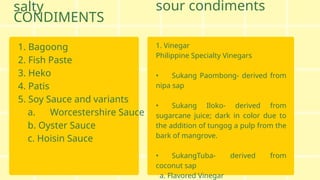
salty
CONDIMENTS
1. Bagoong
2. Fish Paste
3. Heko
4. Patis
5. Soy Sauce and variants
a. Worcestershire Sauce
b. Oyster Sauce
c. Hoisin Sauce
1. Vinegar
Philippine Specialty Vinegars
• Sukang Paombong- derived from
nipa sap
• Sukang Iloko- derived from
sugarcane juice; dark in color due to
the addition of tungog a pulp from the
bark of mangrove.
• SukangTuba- derived from
coconut sap
a. Flavored Vinegar
sour condiments
sauce
1. Catsup/Ketchup
2. Banana
Catsup/Banana Sauce
3. Squash Catsup/
Sauce
4. Chutney
5. Pickles and Pickle
Relish
1. Lechon Sauce
2. Barbecue sauce
3. Steak Sauce
4. Kare-kare Sauce Mix
5. Marinade Mixes
6. Gravy Mixes
other specialty
sauces
food additive
sbtances added to food for specific functions
such as coloring, flavoring, modification of
texture, improving shelf life and preventing
microbial growth. Not intended to salvage spoiled
raw materials nor is it intended to take the place
of
sanitation and good kitchen practices
Approval of
Additive Use in
Foods
• Food and Drug Administration (FDA) has the
primary legal responsibility for determining their use
safe use.
• To market a new food or color additive, a
manufacturer or other sponsor must first petition for
its approval
• A food additive is given a GRAS (generally
recognized as safe) status when it has a history of
safe use in foods qualified by scientific procedures.
Food additives can be
divided into six major
categories namely:
1. Preservatives
• include the antimicrobials, antioxidants and anti-
browning agents.
2. Nutritional additives
• include vitamin, minerals, amino and fatty acids.
3. Flavoring agents
• subdivided into natural and synthetic flavors, flavor
enhancers and sweeteners.
4. Texturing agents
Food Colors
• classified into natural
and artificial food colors
Natural colorants
• An extract from a
natural source is also
classified as a natural
color. Example of this is
achuete (annatto).
Color additive
• any dye, pigment or
substance which when added
or applied to a food, drug or
cosmetic, or to the human
body, is capable (alone or
through reactions with other
subatances) of imparting color.
Certified colors
• are synthetically
produced (or human made)
and used widely because they
impart an intense, uniform
color, are less expensive, and
blend more easily to create a
variety hues.
Natural colors
Natural colors can be divided into the following
groups (Deman, 1990):
• Tetrapyrole compounds- are
chlorophylls found in green vegetables and
leaves and hemes present in meat and fish
• Isoprenoid derivatives- are
carotenoids which are widely distributed both
in animals and plants
• Benzopyran derivatives- are
anthocyanins and flavonoids which are
responsible for the red, blue and violet colors of
beverages
• Refers to any drink, water being the main
natural form
• Any liquid that is swallowed to quench thirst
for nourishment or enjoyment
types of
beverages
• Non- alcoholic o “non-stimulating” o Milk,
coffee, tea, chocolate, synthetic drinks
• Alcoholic o “stimulating” o Beer, malt liquors,
wine
tea
Kinds of Tea
1. Black – leaves are fermented
2. Green – leaves are steamed before
drying to destroy enzymes; from fermented
leaves
3. Oolong – semi-fermented leaves
4. Instant – vaccum-dried
5. Scented or spiced tea/Tisanes – made
from dried herbs & flower blossoms
• Objective in preparing tea is to extract the maximum
amount of flavoring substances but the minimum amount of
disagreeably
flavored tannin the same as in coffee
• Prepared from the leaves of Camelia sinensis
• Contain natural oils, caffeine & theine as stimulants & tannin
for color & pungency
market form of
coffee
• Roasted Whole
Coffee
• Ground Coffee
• Soluble or Instant
Coffee
• 3-in-1 Coffee
• Espresso
• Caffe Latte
• Cappuccino
• Iced Coffee
• Flavored Coffee
speciality of coffee
cocoa and
chocolate
• Main stimulant is threobromine
• Flavor component: caffeine, tannins
• Fat Content:
o Cocoa – 18% fat o Chocolate – 50% fat
• Starch content:
o Cocoa – 11% starch
o Chocolate – 8% starch
Kinds:
• Cocoa – powdered chocolate- with 50% cocoa butter
Energy, Sports and Health
Drinks
• Contain electrolytes-the substances that control osmosis in the body and help
maintain the acid-base balance required for normal
cellular activities
3 Popular Types of Sports Drinks
1. Isotonic - quickly replaces fluids lost by sweating and supplies a boost of
carbohydrates; made for the average athlete
2 Hypotonic - quickly replaces fluid lost, and is best for low-respiration athletes such
as jockey and gymnasts
3. Hypertonic - supplements daily carbohydrate intake normally after exercise to top
glycogen stores. Used primarily for athletes such as long-distance runners
Fruit Juice, Nectar and Fruit
Drinks
• Fruit juice is legally defined as the juicy extract from fruits, when water is
added the product becomes a fruit drink.
• Nectar may be used when sugar is added.
• A concentrate is a product made when water is removed from a fruit juice,
thus when water from pineapple is removed the resulting product is a pineapple
concentrate.
Standards of Quality for Fruit Juices
• Appearance
• Flavor
alcohol and
drinks
1. Fermented beverages
a. Brews - Beer, Cider and Perry
b. Wines - Natural/Still (Red, Rose/Blush, White), Sparkling (Champagne and Others), Fortified
(Sherry, Port, Madeira, Marsala,
Malaga), Aromatized (Vermouth and others)
2. Distilled beverages
a. Brandy
b. Rum
c. Tequila and Mezcal
d. Vodka
e. Whisky/Whiskey
3. Compounded spirits
Wine
• Produced only from grapes but today
the term wine is extended to alcoholic
drinks from any fruit, which contains
sufficient fermentable carbohydrate.
• Made on a limited commercial scale
from fruits such as strawberry , gooseberry,
and peach.
• Can also be produced from mango,
santol, tamarind, bignay, and others
• Alcoholic content of 10-18 percent
Malt Liquor
• produced by fermentation of cereal
like barley malt or from a mixture of malt
and rye.
• Malt beverage can be classified as the
Beer light colored brew that is fermented
from cereals and malt and flavored with
hops. Some common types of beer are:
1. Pale/Pilsen/Pilsner
• pale gold colored beer which has a
slightly bitter taste
2. Lager
• made by bottom yeast fermentation
of the above strain of Saccharomyces
carlsbergensis, lower alcoholic content
than ale
3. Cervesa negra
Among the distilled liquors are:
1. Brandy
• spirit distilled from the fermented juice of grapes or
sometimes of apples, peaches, or plums. Contains 30-50 %
alcohol.
2. Cognac
• a brandy distilled from wine. It derived its name from
Cognac, a district in France where it is made.
3. Armagnac
• a brandy is produced from continuous operations of
the original and redistillation systems in contrast with the
separate batch operations of Cognac.
4. Gin
• colorless beverage containing 40-50 % alcohol which
derives its flavors from added essential oils rather than from
product of fermentation.
5. Rum
• distillate from fermented sugarcane juice, syrup or
molasses
Philippine Alcoholic beverages
• Basi – fermented sugarcane
• Tuba – fresh palm extract
• Lambanog – distilled fermented tuba
• Tapuy – fermented rice
coconut as beverage non-
alcoholic
1. Coconut water
• Formed during the 3rd month of the coconut to its maximum at the 8th month
2. Buko juice
• Drinks made from 7 month old coconuts (buko) value for its therapeutic properties especially for those with kidney trouble and
high blood pressure Alcoholic:
1. Toddy (Tuba)
• Sweet fermented coconut sap which is milky in appearance obtained by tapping the young, flowering spathe of the coconut
palm
• Has a short shelf life unless added with bark to increase its alcohol content
2. Lambanog
• Obtained from distillation of tuba fermented in an earthen jar or plastic container.

Spices and Condiments and Beverages.pptx

  • 1.
  • 2.
    food seasoning • Defined asan item added to enhance the natural flavor of a food without changing its flavor dramatically. • Add zest to our food
  • 3.
    types of seasoning 1. Thosethat have flavor of their own 2. Those that enhance flavor (thus called flavor enhancers) 3. Different Parts of Plant Used as Seasoning:
  • 4.
    1. Those thathave flavor of their own: Spices -Pungent or aromatic natural products of vegetable origin. Different parts of the plant are used. Ex: peppercorn, cinnamon Herbs plants whose stem above the ground does not become woody. The dried leaves are used as flavorings; e.g., bay leaf. Others are used fresh; e.g., tanglad or lemon grass, pandan, mint, oregano Salt fine, rock, or iodized salt; may be combined with other seasoning. Ex: celery-salt, garlic-salt o iodization done by incorporating potassium iodide to salt due to provision of RA 8172 mandating all salt to be fortified with iodine. Condiments combinations of different spices and herbs. blends that provide interesting variation, e.g., sauces like banana catsup, tomato sauce lechon sauce, Worceshire sauce, Tabasco Dips Ex: bagoong, patis, toyo, vinegar, tomato puree/paste Flavoring extracts o aromatic oils. Examples: vanilla, almond extract, lemon extract,etc.
  • 5.
    2. Those thatenhance flavor (thus called flavor enhancers) Monosodium glutamate o popularly called vetsin - used for meats, seafood and vegetables Nucleotides o used of soups, sauces, gravies used for soups, sauces, gravies
  • 6.
    3. Different Partsof Plant Used as Seasoning: Bark cassia and cinnamon Buds and flowers capers, cloves, and saffron Leaves basil, bayleaf, lemon grass, fennel, mint,screwpine (pandan), parsley, rosemary, tarragon, thyme Seeds allspice, anise, caraway, cardamon, chili pepper, coriander, mustard, nutmeg and sesame. Roots and tubers ginger and turmeric, garlic and onion Combinations of these parts spices could of course blend to make such interesting variations as chili seasoning, chili powder and curry powder. These are not a single spice but one predominant spice could account for the characteristic flavor. o For example, curry contains turmeric for the yellow color and cumin and ginger for flavor.
  • 7.
    Nutritive Value andHints for Using Herbs • Most dried herbs and spices are low in calories, providing no more than 15 calories per teaspoon. • Paprika is an excellent source of vitamin A, parsley is rich in vitamin C, cumin is an unexpected source of iron and caraway seeds even contribute a little calcium in the diet. • Dried herbs are stronger in flavor than fresh leaf herbs. When adding dried leaf herbs to a recipe that calls for fresh ones, substitute 1/3 the amount called for in the recipe. • When using dried herbs, crush them in the palm of your hand or between your • When adding whole spices to a recipe that calls for ground spices, use 1 1⁄2 times as much as the recipe call for. When doubling a recipe, do not double the herbs and spices. Increase them by 1 1⁄2 times and then taste, adding more if necessary. • Don’t season more than one dish in a meal with the same herb. Also, every dish on the menu does not need to be herbed- two or three at the most is enough. • The aromatic compounds in the herbs are fat soluble. Adding a little fat to food will increase the perception of the aroma in the herb. • Tender herbs like parsley and cilantro can be covered with plastic then refrigerate. Fresh basil stores best at room temperature
  • 8.
    How to Add Herbsand Spices • Spices and herbs should be used to enhance the natural flavor of food-not disguise or obscure it. Many herbs and spices can complement a dish and each other, however, be selective combinations. Avoid using to many at one time. • Use a dry spoon to remove the portion required. • Don not sprinkle seasoning directly from the container into a steaming pot. The rising moisture may diminish the potency of the spice or herb remaining in the jar, or may it cause to clump or spoil more quickly. • Crush leaf herbs, such as oregano, thyme or basil, in your hand before use for a • Herbs may be added near the end of cooking for more distinct flavor, or at the beginning for more blended flavors. • Ground spices and herbs release their flavors readily. In long cooking dishes, such as stews, add these near the end of the cooking time to minimize the “cooking off” of its flavors. • Whole spices and bay leaves release flavor more slowly than ground or leaf from and are ideal for using in dishes with longer cooking times. • For uncooked foods, such as salad dressings, fruits or fruit juices, add spices and herbs several hours before serving to allow flavors to develop and “ mary” or blend. Alternatively, the liquid with the When to Add Herbs and Spices
  • 9.
    Condiments • Derived fromthe French words condire, which means to pickle, and condere, which means to build or store up. • Flavorful and savory preparation added to food to enhance flavor or appetite such as a relish, sauce, mixture of spices and so on.
  • 10.
    salty CONDIMENTS 1. Bagoong 2. FishPaste 3. Heko 4. Patis 5. Soy Sauce and variants a. Worcestershire Sauce b. Oyster Sauce c. Hoisin Sauce 1. Vinegar Philippine Specialty Vinegars • Sukang Paombong- derived from nipa sap • Sukang Iloko- derived from sugarcane juice; dark in color due to the addition of tungog a pulp from the bark of mangrove. • SukangTuba- derived from coconut sap a. Flavored Vinegar sour condiments
  • 11.
    sauce 1. Catsup/Ketchup 2. Banana Catsup/BananaSauce 3. Squash Catsup/ Sauce 4. Chutney 5. Pickles and Pickle Relish 1. Lechon Sauce 2. Barbecue sauce 3. Steak Sauce 4. Kare-kare Sauce Mix 5. Marinade Mixes 6. Gravy Mixes other specialty sauces
  • 12.
    food additive sbtances addedto food for specific functions such as coloring, flavoring, modification of texture, improving shelf life and preventing microbial growth. Not intended to salvage spoiled raw materials nor is it intended to take the place of sanitation and good kitchen practices
  • 13.
    Approval of Additive Usein Foods • Food and Drug Administration (FDA) has the primary legal responsibility for determining their use safe use. • To market a new food or color additive, a manufacturer or other sponsor must first petition for its approval • A food additive is given a GRAS (generally recognized as safe) status when it has a history of safe use in foods qualified by scientific procedures.
  • 14.
    Food additives canbe divided into six major categories namely: 1. Preservatives • include the antimicrobials, antioxidants and anti- browning agents. 2. Nutritional additives • include vitamin, minerals, amino and fatty acids. 3. Flavoring agents • subdivided into natural and synthetic flavors, flavor enhancers and sweeteners. 4. Texturing agents
  • 15.
    Food Colors • classifiedinto natural and artificial food colors Natural colorants • An extract from a natural source is also classified as a natural color. Example of this is achuete (annatto). Color additive • any dye, pigment or substance which when added or applied to a food, drug or cosmetic, or to the human body, is capable (alone or through reactions with other subatances) of imparting color. Certified colors • are synthetically produced (or human made) and used widely because they impart an intense, uniform color, are less expensive, and blend more easily to create a variety hues. Natural colors Natural colors can be divided into the following groups (Deman, 1990): • Tetrapyrole compounds- are chlorophylls found in green vegetables and leaves and hemes present in meat and fish • Isoprenoid derivatives- are carotenoids which are widely distributed both in animals and plants • Benzopyran derivatives- are anthocyanins and flavonoids which are responsible for the red, blue and violet colors of
  • 16.
    beverages • Refers toany drink, water being the main natural form • Any liquid that is swallowed to quench thirst for nourishment or enjoyment
  • 17.
    types of beverages • Non-alcoholic o “non-stimulating” o Milk, coffee, tea, chocolate, synthetic drinks • Alcoholic o “stimulating” o Beer, malt liquors, wine
  • 18.
    tea Kinds of Tea 1.Black – leaves are fermented 2. Green – leaves are steamed before drying to destroy enzymes; from fermented leaves 3. Oolong – semi-fermented leaves 4. Instant – vaccum-dried 5. Scented or spiced tea/Tisanes – made from dried herbs & flower blossoms • Objective in preparing tea is to extract the maximum amount of flavoring substances but the minimum amount of disagreeably flavored tannin the same as in coffee • Prepared from the leaves of Camelia sinensis • Contain natural oils, caffeine & theine as stimulants & tannin for color & pungency
  • 19.
    market form of coffee •Roasted Whole Coffee • Ground Coffee • Soluble or Instant Coffee • 3-in-1 Coffee • Espresso • Caffe Latte • Cappuccino • Iced Coffee • Flavored Coffee speciality of coffee
  • 20.
    cocoa and chocolate • Mainstimulant is threobromine • Flavor component: caffeine, tannins • Fat Content: o Cocoa – 18% fat o Chocolate – 50% fat • Starch content: o Cocoa – 11% starch o Chocolate – 8% starch Kinds: • Cocoa – powdered chocolate- with 50% cocoa butter
  • 21.
    Energy, Sports andHealth Drinks • Contain electrolytes-the substances that control osmosis in the body and help maintain the acid-base balance required for normal cellular activities 3 Popular Types of Sports Drinks 1. Isotonic - quickly replaces fluids lost by sweating and supplies a boost of carbohydrates; made for the average athlete 2 Hypotonic - quickly replaces fluid lost, and is best for low-respiration athletes such as jockey and gymnasts 3. Hypertonic - supplements daily carbohydrate intake normally after exercise to top glycogen stores. Used primarily for athletes such as long-distance runners
  • 22.
    Fruit Juice, Nectarand Fruit Drinks • Fruit juice is legally defined as the juicy extract from fruits, when water is added the product becomes a fruit drink. • Nectar may be used when sugar is added. • A concentrate is a product made when water is removed from a fruit juice, thus when water from pineapple is removed the resulting product is a pineapple concentrate. Standards of Quality for Fruit Juices • Appearance • Flavor
  • 23.
    alcohol and drinks 1. Fermentedbeverages a. Brews - Beer, Cider and Perry b. Wines - Natural/Still (Red, Rose/Blush, White), Sparkling (Champagne and Others), Fortified (Sherry, Port, Madeira, Marsala, Malaga), Aromatized (Vermouth and others) 2. Distilled beverages a. Brandy b. Rum c. Tequila and Mezcal d. Vodka e. Whisky/Whiskey 3. Compounded spirits
  • 24.
    Wine • Produced onlyfrom grapes but today the term wine is extended to alcoholic drinks from any fruit, which contains sufficient fermentable carbohydrate. • Made on a limited commercial scale from fruits such as strawberry , gooseberry, and peach. • Can also be produced from mango, santol, tamarind, bignay, and others • Alcoholic content of 10-18 percent Malt Liquor • produced by fermentation of cereal like barley malt or from a mixture of malt and rye. • Malt beverage can be classified as the Beer light colored brew that is fermented from cereals and malt and flavored with hops. Some common types of beer are: 1. Pale/Pilsen/Pilsner • pale gold colored beer which has a slightly bitter taste 2. Lager • made by bottom yeast fermentation of the above strain of Saccharomyces carlsbergensis, lower alcoholic content than ale 3. Cervesa negra
  • 25.
    Among the distilledliquors are: 1. Brandy • spirit distilled from the fermented juice of grapes or sometimes of apples, peaches, or plums. Contains 30-50 % alcohol. 2. Cognac • a brandy distilled from wine. It derived its name from Cognac, a district in France where it is made. 3. Armagnac • a brandy is produced from continuous operations of the original and redistillation systems in contrast with the separate batch operations of Cognac. 4. Gin • colorless beverage containing 40-50 % alcohol which derives its flavors from added essential oils rather than from product of fermentation. 5. Rum • distillate from fermented sugarcane juice, syrup or molasses Philippine Alcoholic beverages • Basi – fermented sugarcane • Tuba – fresh palm extract • Lambanog – distilled fermented tuba • Tapuy – fermented rice
  • 26.
    coconut as beveragenon- alcoholic 1. Coconut water • Formed during the 3rd month of the coconut to its maximum at the 8th month 2. Buko juice • Drinks made from 7 month old coconuts (buko) value for its therapeutic properties especially for those with kidney trouble and high blood pressure Alcoholic: 1. Toddy (Tuba) • Sweet fermented coconut sap which is milky in appearance obtained by tapping the young, flowering spathe of the coconut palm • Has a short shelf life unless added with bark to increase its alcohol content 2. Lambanog • Obtained from distillation of tuba fermented in an earthen jar or plastic container.