Food Coloring
Food Chemistry II
Ilyana Causing
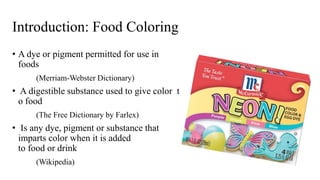
Introduction: Food Coloring
• A dye or pigment permitted for use in
foods
(Merriam-Webster Dictionary)
• A digestible substance used to give color t
o food
(The Free Dictionary by Farlex)
• Is any dye, pigment or substance that
imparts color when it is added
to food or drink
(Wikipedia)
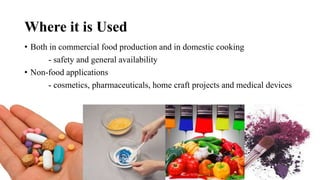
Where it is Used
• Both in commercial food production and in domestic cooking
- safety and general availability
• Non-food applications
- cosmetics, pharmaceuticals, home craft projects and medical devices
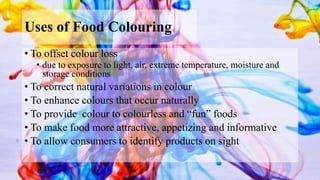
Uses of Food Colouring
• To offset colour loss
• due to exposure to light, air, extreme temperature, moisture and
storage conditions
• To correct natural variations in colour
• To enhance colours that occur naturally
• To provide colour to colourless and “fun” foods
• To make food more attractive, appetizing and informative
• To allow consumers to identify products on sight
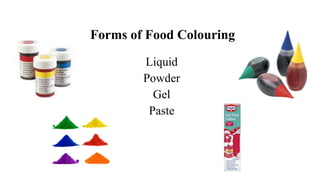
Liquid
Powder
Gel
Paste
Forms of Food Colouring
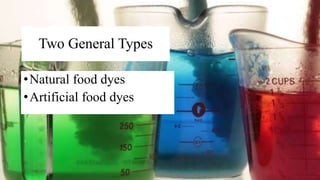
Two General Types
•Natural food dyes
•Artificial food dyes
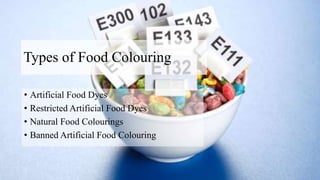
Types of Food Colouring
• Artificial Food Dyes
• Restricted Artificial Food Dyes
• Natural Food Colourings
• Banned Artificial Food Colouring
Artificial Food Dyes
• These are food dyes approved for use in food by the United States
Food and Drug Administration (FDA)
• There technically 7 Artificial Food Dyes
• Brilliant Blue FCF
• Indigotine – dark blue
• Fast Green FCF – blueish green
• Allura Red AC
• Erythrosine – pink
• Tartrazine – yellow
• Sunset Yellow FCF - orange
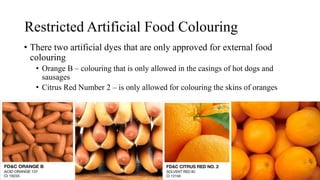
Restricted Artificial Food Colouring
• There two artificial dyes that are only approved for external food
colouring
• Orange B – colouring that is only allowed in the casings of hot dogs and
sausages
• Citrus Red Number 2 – is only allowed for colouring the skins of oranges
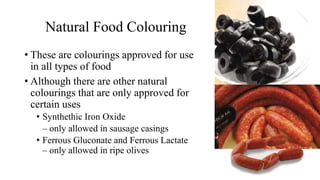
Natural Food Colouring
• These are colourings approved for use
in all types of food
• Although there are other natural
colourings that are only approved for
certain uses
• Synthethic Iron Oxide
– only allowed in sausage casings
• Ferrous Gluconate and Ferrous Lactate
– only allowed in ripe olives
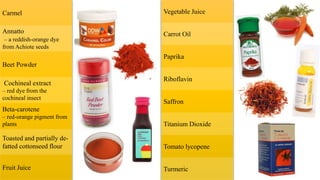
Carmel
Annatto
– a reddish-orange dye
from Achiote seeds
Beet Powder
Cochineal extract
– red dye from the
cochineal insect
Beta-carotene
– red-orange pigment from
plants
Toasted and partially de-
fatted cottonseed flour
Fruit Juice
Vegetable Juice
Carrot Oil
Paprika
Riboflavin
Saffron
Titanium Dioxide
Tomato lycopene
Turmeric
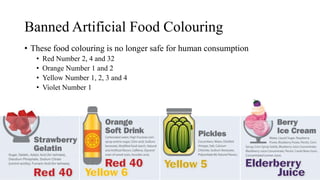
Banned Artificial Food Colouring
• These food colouring is no longer safe for human consumption
• Red Number 2, 4 and 32
• Orange Number 1 and 2
• Yellow Number 1, 2, 3 and 4
• Violet Number 1
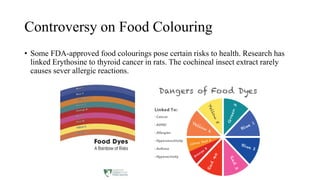
Controversy on Food Colouring
• Some FDA-approved food colourings pose certain risks to health. Research has
linked Erythosine to thyroid cancer in rats. The cochineal insect extract rarely
causes sever allergic reactions.
Possible Health Benefits
• Brilliant Blue FCF could help in the healing of spinal injuries.
Researchers have found that injecting the dye into rats who have just
suffered spinal injuries reduces the chances of paralysis. It prevents the
body from sending a chemical to the site of the injury which is know
for causing further damage to nerve tissue.

Food Coloring

  • 1.
  • 2.
    Introduction: Food Coloring •A dye or pigment permitted for use in foods (Merriam-Webster Dictionary) • A digestible substance used to give color t o food (The Free Dictionary by Farlex) • Is any dye, pigment or substance that imparts color when it is added to food or drink (Wikipedia)
  • 3.
    Where it isUsed • Both in commercial food production and in domestic cooking - safety and general availability • Non-food applications - cosmetics, pharmaceuticals, home craft projects and medical devices
  • 4.
    Uses of FoodColouring • To offset colour loss • due to exposure to light, air, extreme temperature, moisture and storage conditions • To correct natural variations in colour • To enhance colours that occur naturally • To provide colour to colourless and “fun” foods • To make food more attractive, appetizing and informative • To allow consumers to identify products on sight
  • 6.
  • 7.
    Two General Types •Naturalfood dyes •Artificial food dyes
  • 8.
    Types of FoodColouring • Artificial Food Dyes • Restricted Artificial Food Dyes • Natural Food Colourings • Banned Artificial Food Colouring
  • 9.
    Artificial Food Dyes •These are food dyes approved for use in food by the United States Food and Drug Administration (FDA) • There technically 7 Artificial Food Dyes • Brilliant Blue FCF • Indigotine – dark blue • Fast Green FCF – blueish green • Allura Red AC • Erythrosine – pink • Tartrazine – yellow • Sunset Yellow FCF - orange
  • 10.
    Restricted Artificial FoodColouring • There two artificial dyes that are only approved for external food colouring • Orange B – colouring that is only allowed in the casings of hot dogs and sausages • Citrus Red Number 2 – is only allowed for colouring the skins of oranges
  • 11.
    Natural Food Colouring •These are colourings approved for use in all types of food • Although there are other natural colourings that are only approved for certain uses • Synthethic Iron Oxide – only allowed in sausage casings • Ferrous Gluconate and Ferrous Lactate – only allowed in ripe olives
  • 12.
    Carmel Annatto – a reddish-orangedye from Achiote seeds Beet Powder Cochineal extract – red dye from the cochineal insect Beta-carotene – red-orange pigment from plants Toasted and partially de- fatted cottonseed flour Fruit Juice Vegetable Juice Carrot Oil Paprika Riboflavin Saffron Titanium Dioxide Tomato lycopene Turmeric
  • 13.
    Banned Artificial FoodColouring • These food colouring is no longer safe for human consumption • Red Number 2, 4 and 32 • Orange Number 1 and 2 • Yellow Number 1, 2, 3 and 4 • Violet Number 1
  • 14.
    Controversy on FoodColouring • Some FDA-approved food colourings pose certain risks to health. Research has linked Erythosine to thyroid cancer in rats. The cochineal insect extract rarely causes sever allergic reactions.
  • 15.
    Possible Health Benefits •Brilliant Blue FCF could help in the healing of spinal injuries. Researchers have found that injecting the dye into rats who have just suffered spinal injuries reduces the chances of paralysis. It prevents the body from sending a chemical to the site of the injury which is know for causing further damage to nerve tissue.