COLOURS
By
P.Hema Prabha
Dept. of Food Processing and Preservation
Technology
Faculty of Engineering
Avinashilingam Institute for Home Science and
Higher Education for Women
Coimbatore,Tamilnadu
COLOURING AGENT
 A colour is a dye, pigment or substance that
can impart colour, alone or through reaction
with other substances when added or applied
to food.
 They are contained in many
foods including snack foods,
margarine, cheese, jams and
jellies, and desserts, drinks etc.
REASONS
 Offsetting colour loss due to light air, extreme of
temperature, moisture and storage condition.
 Enhancing naturally occurring colour
 Providing identity to food
 Increase appetite appeal
 To mask defects and less desirable food more
desirable
 Protecting flavour and vitamins from damage by
light
 Decorative or artistic purposes
 May keep certain food tasting fresher for long time
DYES AND LAKES
DYES:
 Dyes dissolve in water and are manufactured as
powders, granules, liquids or other special-purpose
form.
 They are used in beverages, dry mixes, baked goods,
confections, dairy products etc
LAKES:
 Lakes are water insoluble form of the dye.
 These are more stable and are ideal for colouring
products with fat and oil or items lacking surface
moisture to dissolve dyes.
 Used in cakes and doughnut mixes, candies and
chewing gums.
CLASSIFICATION
NATURAL FOODS
 Natural food colour is any dye, pigment or any other substance
obtained from vegetable, animal, mineral that is capable of
colouring foods or drugs.
 Colours come from variety of sources like seeds, fruits, vegetables,
algae and insect. Grass, beet root, and turmeric are some of the
natural sources from which colours are extracted.
 Red, blue and violet: Derived from anthocyanins found in
beetroots, raspberries and red cabbages.
 Green: Derived from chlorophylls, the green pigment found in all
leaves and stems.
 Yellow, Orange, Red: Derived from carotenoids found in apricots,
carrots and tomatoes.
SYNTHETIC FOODS
 They are also called artificial colours.
 These are manufactured by chemical reaction and
are commonly used in food and pharmaceutical
industries.
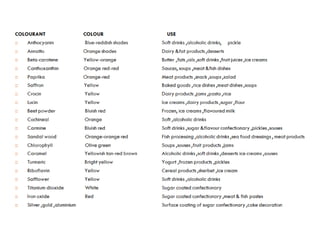
 Some of the common food colours are tartrazine,
sunset yellow, amaranth, allura red, quinoline
yellow, brilliant blue and indigo carmine.
 Theses are less costly and less prone to microbial
contamination
 These are highly stable to light, oxygen and pH.
NON-CERTIFIED COLOURS:
 These are colours that do not need certificate to
sell or use
 Derived from plants, animals, minerals , other
than coal & phenol
 These are mainly foods and /or food ingredients
rather than food additives
CERTIFIED COLOURS:
 Those colour that are subjected to FDA’s
certification process are called certified colours.
 The synthetic colours fall under this category
FLAVOURS
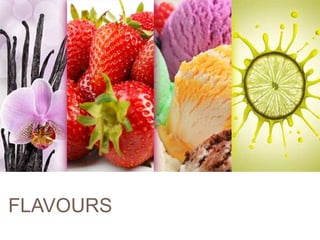
 Flavouring is any of the liquid extracts, essences
that are added to foods to enhance their taste and
aroma.
 Flavouring agents are edible chemicals and
extracts that alter the flavour of food and products
through the sense of smell
 Smell is the most determinant of a food flavour
i.e., a food flavour can be easily altered by altering
the smell.
 Seasoning is an item added to enhance the
natural flavour of the food (eg, salt) whereas
flavouring is an item added to alter the natural
flavour of the food (eg, herbs and spices)
CLASSIFICATION
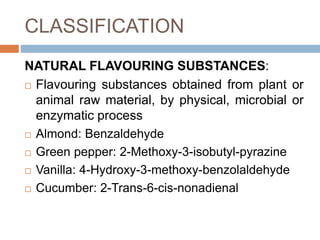
NATURAL FLAVOURING SUBSTANCES:
 Flavouring substances obtained from plant or
animal raw material, by physical, microbial or
enzymatic process
 Almond: Benzaldehyde
 Green pepper: 2-Methoxy-3-isobutyl-pyrazine
 Vanilla: 4-Hydroxy-3-methoxy-benzolaldehyde
 Cucumber: 2-Trans-6-cis-nonadienal
ARTIFICIAL FLAVOURING AGENTS
 Flavouring agents that are produced artificially
by fractional distillation and additional
chemical manipulation of naturally.
 Although they are chemically different, sensory
characteristics are the same as natural ones.
 These are specific and often complex mixture
of singular naturally occurring flavour
compounds combined together to either
initiate or enhance a natural flavour.
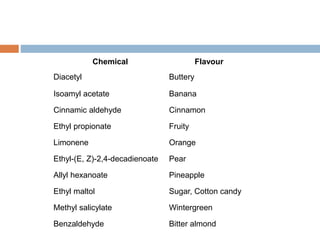
Chemical Flavour
Diacetyl Buttery
Isoamyl acetate Banana
Cinnamic aldehyde Cinnamon
Ethyl propionate Fruity
Limonene Orange
Ethyl-(E, Z)-2,4-decadienoate Pear
Allyl hexanoate Pineapple
Ethyl maltol Sugar, Cotton candy
Methyl salicylate Wintergreen
Benzaldehyde Bitter almond
REASONS
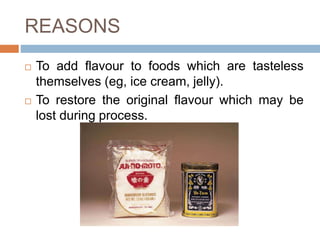
 To add flavour to foods which are tasteless
themselves (eg, ice cream, jelly).
 To restore the original flavour which may be
lost during process.
FLAVORING GUIDELINES
 Flavorings should not hide the taste or
aroma of the primary ingredient
 Flavorings should be combined in
balance, so as not to overwhelm the
palate
 Flavorings should not be used to disguise
poor quality or poorly prepared products
 Flavorings should be added sparingly
when foods are being cooked over a long
period of time
 Taste and season foods frequently during
cooking
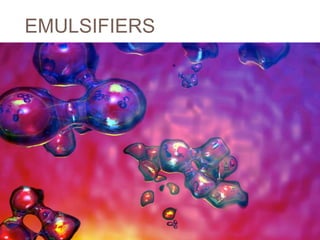
EMULSIFIERS
EMULSIFERS
 When oil and water is together shaken together then left
to stand, tiny droplets of oil float upwards – they join
together until eventually the oil is floating on the water
again
 This is not a useful property when concerned with foods
which often contain both oil and water (such as salad
cream) – without a binder to hold the two together they
would keep separating.
 The binder added to bind them together is called and
emulsifier and the mixture is called an emulsion.
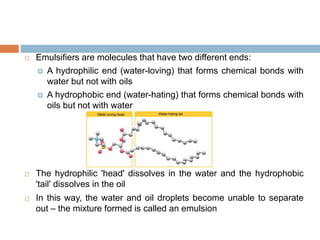
 Emulsifiers are molecules that have two different ends:
 A hydrophilic end (water-loving) that forms chemical bonds with
water but not with oils
 A hydrophobic end (water-hating) that forms chemical bonds with
oils but not with water
 The hydrophilic 'head' dissolves in the water and the hydrophobic
'tail' dissolves in the oil
 In this way, the water and oil droplets become unable to separate
out – the mixture formed is called an emulsion
Example
LECITHINS(E-322) are mixture of phospholipids such
as phosphatidyl, choline and
phosphatidylethanolamine and are usually extracted
from natural sources such as egg yoke and soybeans.
Uses: salad dressings, baked goods and chocolate.
ESTERS OF MONOGLYCERIDES OF FATTY ACIDS
(E472a-f) are made from natural fatty acids(from
vegetable or animal source),glycerol and an organic
acid. Uses: ice cream, cakes and crisps.
MONO AND DIGLYCERIDES OF FATTY
ACIDS(E471) are semi synthetic emulsifiers made
from glycerol and natural fatty acids(plant or animal
sources). Uses: breads, cakes and margarines.
E - number
 E numbers are code numbers used to identity
food additives that have been shown to be safe
and officially approved for use in food across the
EU(European Union).
 They are commonly found on food labels
throughout the European Union.
 Safety assessment and approval are the
responsibility of the European Food Safety
Authority.
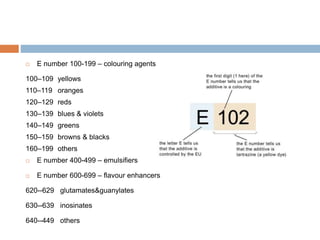
 E number 100-199 – colouring agents
100–109 yellows
110–119 oranges
120–129 reds
130–139 blues & violets
140–149 greens
150–159 browns & blacks
160–199 others
 E number 400-499 – emulsifiers
 E number 600-699 – flavour enhancers
620--629 glutamates&guanylates
630--639 inosinates
640--449 others

Colours

  • 1.
    COLOURS By P.Hema Prabha Dept. ofFood Processing and Preservation Technology Faculty of Engineering Avinashilingam Institute for Home Science and Higher Education for Women Coimbatore,Tamilnadu
  • 2.
    COLOURING AGENT  Acolour is a dye, pigment or substance that can impart colour, alone or through reaction with other substances when added or applied to food.  They are contained in many foods including snack foods, margarine, cheese, jams and jellies, and desserts, drinks etc.
  • 3.
    REASONS  Offsetting colourloss due to light air, extreme of temperature, moisture and storage condition.  Enhancing naturally occurring colour  Providing identity to food  Increase appetite appeal  To mask defects and less desirable food more desirable  Protecting flavour and vitamins from damage by light  Decorative or artistic purposes  May keep certain food tasting fresher for long time
  • 4.
    DYES AND LAKES DYES: Dyes dissolve in water and are manufactured as powders, granules, liquids or other special-purpose form.  They are used in beverages, dry mixes, baked goods, confections, dairy products etc LAKES:  Lakes are water insoluble form of the dye.  These are more stable and are ideal for colouring products with fat and oil or items lacking surface moisture to dissolve dyes.  Used in cakes and doughnut mixes, candies and chewing gums.
  • 5.
    CLASSIFICATION NATURAL FOODS  Naturalfood colour is any dye, pigment or any other substance obtained from vegetable, animal, mineral that is capable of colouring foods or drugs.  Colours come from variety of sources like seeds, fruits, vegetables, algae and insect. Grass, beet root, and turmeric are some of the natural sources from which colours are extracted.  Red, blue and violet: Derived from anthocyanins found in beetroots, raspberries and red cabbages.  Green: Derived from chlorophylls, the green pigment found in all leaves and stems.  Yellow, Orange, Red: Derived from carotenoids found in apricots, carrots and tomatoes.
  • 6.
    SYNTHETIC FOODS  Theyare also called artificial colours.  These are manufactured by chemical reaction and are commonly used in food and pharmaceutical industries.  Some of the common food colours are tartrazine, sunset yellow, amaranth, allura red, quinoline yellow, brilliant blue and indigo carmine.  Theses are less costly and less prone to microbial contamination  These are highly stable to light, oxygen and pH.
  • 8.
    NON-CERTIFIED COLOURS:  Theseare colours that do not need certificate to sell or use  Derived from plants, animals, minerals , other than coal & phenol  These are mainly foods and /or food ingredients rather than food additives CERTIFIED COLOURS:  Those colour that are subjected to FDA’s certification process are called certified colours.  The synthetic colours fall under this category
  • 9.
  • 10.
     Flavouring isany of the liquid extracts, essences that are added to foods to enhance their taste and aroma.  Flavouring agents are edible chemicals and extracts that alter the flavour of food and products through the sense of smell  Smell is the most determinant of a food flavour i.e., a food flavour can be easily altered by altering the smell.  Seasoning is an item added to enhance the natural flavour of the food (eg, salt) whereas flavouring is an item added to alter the natural flavour of the food (eg, herbs and spices)
  • 11.
    CLASSIFICATION NATURAL FLAVOURING SUBSTANCES: Flavouring substances obtained from plant or animal raw material, by physical, microbial or enzymatic process  Almond: Benzaldehyde  Green pepper: 2-Methoxy-3-isobutyl-pyrazine  Vanilla: 4-Hydroxy-3-methoxy-benzolaldehyde  Cucumber: 2-Trans-6-cis-nonadienal
  • 12.
    ARTIFICIAL FLAVOURING AGENTS Flavouring agents that are produced artificially by fractional distillation and additional chemical manipulation of naturally.  Although they are chemically different, sensory characteristics are the same as natural ones.  These are specific and often complex mixture of singular naturally occurring flavour compounds combined together to either initiate or enhance a natural flavour.
  • 13.
    Chemical Flavour Diacetyl Buttery Isoamylacetate Banana Cinnamic aldehyde Cinnamon Ethyl propionate Fruity Limonene Orange Ethyl-(E, Z)-2,4-decadienoate Pear Allyl hexanoate Pineapple Ethyl maltol Sugar, Cotton candy Methyl salicylate Wintergreen Benzaldehyde Bitter almond
  • 14.
    REASONS  To addflavour to foods which are tasteless themselves (eg, ice cream, jelly).  To restore the original flavour which may be lost during process.
  • 15.
    FLAVORING GUIDELINES  Flavoringsshould not hide the taste or aroma of the primary ingredient  Flavorings should be combined in balance, so as not to overwhelm the palate  Flavorings should not be used to disguise poor quality or poorly prepared products  Flavorings should be added sparingly when foods are being cooked over a long period of time  Taste and season foods frequently during cooking
  • 16.
  • 17.
    EMULSIFERS  When oiland water is together shaken together then left to stand, tiny droplets of oil float upwards – they join together until eventually the oil is floating on the water again  This is not a useful property when concerned with foods which often contain both oil and water (such as salad cream) – without a binder to hold the two together they would keep separating.  The binder added to bind them together is called and emulsifier and the mixture is called an emulsion.
  • 18.
     Emulsifiers aremolecules that have two different ends:  A hydrophilic end (water-loving) that forms chemical bonds with water but not with oils  A hydrophobic end (water-hating) that forms chemical bonds with oils but not with water  The hydrophilic 'head' dissolves in the water and the hydrophobic 'tail' dissolves in the oil  In this way, the water and oil droplets become unable to separate out – the mixture formed is called an emulsion
  • 19.
    Example LECITHINS(E-322) are mixtureof phospholipids such as phosphatidyl, choline and phosphatidylethanolamine and are usually extracted from natural sources such as egg yoke and soybeans. Uses: salad dressings, baked goods and chocolate. ESTERS OF MONOGLYCERIDES OF FATTY ACIDS (E472a-f) are made from natural fatty acids(from vegetable or animal source),glycerol and an organic acid. Uses: ice cream, cakes and crisps. MONO AND DIGLYCERIDES OF FATTY ACIDS(E471) are semi synthetic emulsifiers made from glycerol and natural fatty acids(plant or animal sources). Uses: breads, cakes and margarines.
  • 20.
    E - number E numbers are code numbers used to identity food additives that have been shown to be safe and officially approved for use in food across the EU(European Union).  They are commonly found on food labels throughout the European Union.  Safety assessment and approval are the responsibility of the European Food Safety Authority.
  • 21.
     E number100-199 – colouring agents 100–109 yellows 110–119 oranges 120–129 reds 130–139 blues & violets 140–149 greens 150–159 browns & blacks 160–199 others  E number 400-499 – emulsifiers  E number 600-699 – flavour enhancers 620--629 glutamates&guanylates 630--639 inosinates 640--449 others