Microbial metabolites as
flavouring agents
Lasina .J
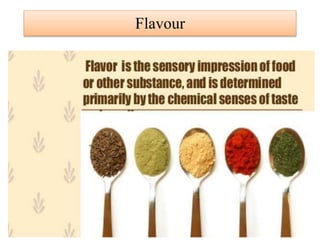
Flavour
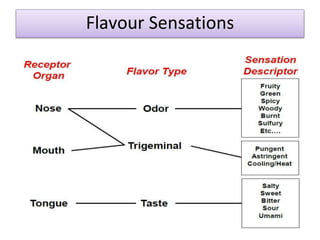
Flavour Sensations
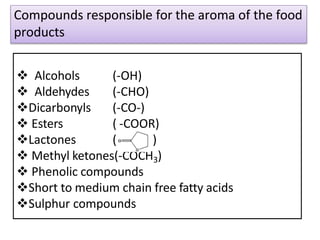
(-OH)
(-CHO)
(-CO-)
( -COOR)
 Alcohols
 Aldehydes
Dicarbonyls
 Esters
Lactones ( )
 Methyl ketones(-COCH3)
 Phenolic compounds
Short to medium chain free fatty acids
Sulphur compounds
Compounds responsible for the aroma of the food
products
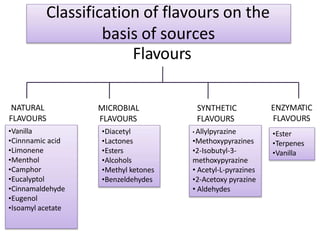
Classification of flavours on the
basis of sources
NATURAL
FLAVOURS
MICROBIAL
FLAVOURS
SYNTHETIC
FLAVOURS
ENZYMATIC
FLAVOURS
•Vanilla
•Cinnnamic acid
•Limonene
•Menthol
•Camphor
•Eucalyptol
•Cinnamaldehyde
•Eugenol
•Isoamyl acetate
Flavours
•Diacetyl
•Lactones
•Esters
•Alcohols
•Methyl ketones
•Benzeldehydes
•Ester
•Terpenes
•Vanilla
• Allylpyrazine
•Methoxypyrazines
•2-Isobutyl-3-
methoxypyrazine
• Acetyl-L-pyrazines
•2-Acetoxy pyrazine
• Aldehydes
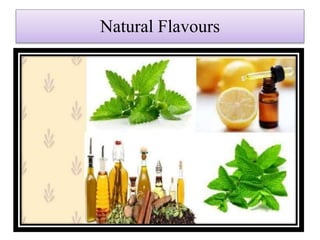
Natural Flavours
I. Natural flavours
• Natural flavors contains the flavoring constituents derived from aspice,
fruits, vegetables, similar plant material, edible yeast, meat, seafood,
poultry, eggs, dairy products.
(i) In plants-
• Plants can synthesize, accumulate and emit volatiles that act as aroma and
flavor molecules due to interactions with human receptors.
• Natural flavours present in different parts of plants-
i. Bark- Cinnamon,
ii. Bud- Onion, garlic,
iii. Root-Carrot,
iv. Leaf - Coriander, Curry leaf
• They are commercially important for the food, pharmaceutical, agricultural
and chemical industries as flavorants, drugs, pesticides and industrial
feedstocks.
ii. Animal based flavours- such as meat
• Raw meat - salty, metallic with slightly sweet
aroma
• Cooked meat- meaty flavor notes due to bis-(2-
methyl-3-furan) disulfide, formed by interactions
between Maillard reaction products and lipid
oxidation products
Plant species Compounds Products
Oryza sativa (Rice) 2-acetyl -1-pyruvate Basmati flavour
Allium sativum (Garlic) Thiols Garlic
Allium cepa (Onion) Phenolics Onion
Vanilla planifolia
(Vanilla beans)
Vanilla(4-Hydroxy-3-
methoxybenzaldehyde)
Vanillin
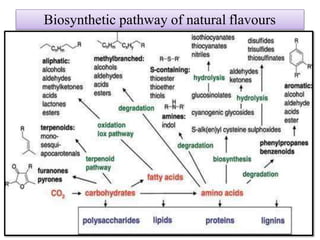
Biosynthetic pathway of natural flavours
Limitations of natural flavours
• Low abundance of the volatiles
• Flavours are affected by plant type, geographical
location, seasonal restriction
• High cost
Synthetic flavours
• Synthetic (or artificial) flavors are complex mixtures of naturally occurring
flavor compounds to either imitate or enhance a natural flavor.
• In the 1800s, a German chemist was the first to develop synthetic aromatic
chemicals of fruity odour.
• In 1858, Vanillin was first crystallized from an alcoholic extract ofvanilla
beans by Gobley
• By the end of the 19th century, production of synthetic flavors shares a
global market.
• These mixtures are formulated by flavorists to give a food product a unique
flavor and to maintain flavor consistency between different product
batches.
• Produced by fractional distillation and additional chemical manipulation of
naturally sourced chemicals, crude oil or coal.
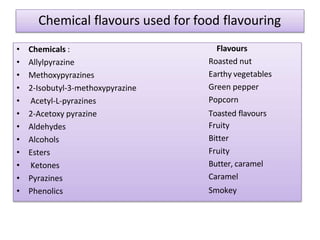
Chemical flavours used for food flavouring
• Chemicals :
• Allylpyrazine
• Methoxypyrazines
• 2-Isobutyl-3-methoxypyrazine
• Acetyl-L-pyrazines
• 2-Acetoxy pyrazine
• Aldehydes
• Alcohols
• Esters
• Ketones
• Pyrazines
• Phenolics
Flavours
Roasted nut
Earthy vegetables
Green pepper
Popcorn
Toasted flavours
Fruity
Bitter
Fruity
Butter, caramel
Caramel
Smokey
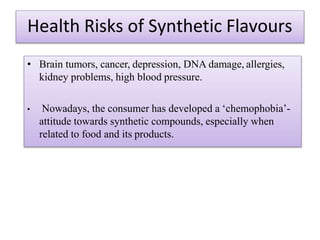
Health Risks of Synthetic Flavours
• Brain tumors, cancer, depression, DNA damage, allergies,
kidney problems, high blood pressure.
• Nowadays, the consumer has developed a ‘chemophobia’-
attitude towards synthetic compounds, especially when
related to food and its products.
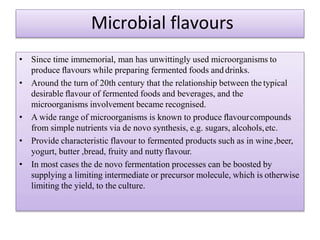
• Since time immemorial, man has unwittingly used microorganisms to
produce flavours while preparing fermented foods and drinks.
• Around the turn of 20th century that the relationship between the typical
desirable flavour of fermented foods and beverages, and the
microorganisms involvement became recognised.
• A wide range of microorganisms is known to produce flavourcompounds
from simple nutrients via de novo synthesis, e.g. sugars, alcohols,etc.
• Provide characteristic flavour to fermented products such as in wine,beer,
yogurt, butter ,bread, fruity and nutty flavour.
• In most cases the de novo fermentation processes can be boosted by
supplying a limiting intermediate or precursor molecule, which is otherwise
limiting the yield, to the culture.
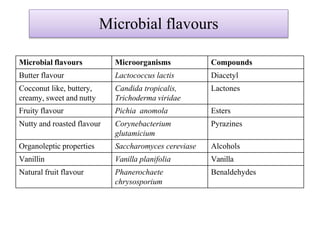
Microbial flavours
Microbial flavours Microorganisms Compounds
Butter flavour Lactococcus lactis Diacetyl
Cocconut like, buttery,
creamy, sweet and nutty
Candida tropicalis,
Trichoderma viridae
Lactones
Fruity flavour Pichia anomola Esters
Nutty and roasted flavour Corynebacterium
glutamicium
Pyrazines
Organoleptic properties Saccharomyces cereviase Alcohols
Vanillin Vanilla planifolia Vanilla
Natural fruit flavour Phanerochaete
chrysosporium
Benaldehydes
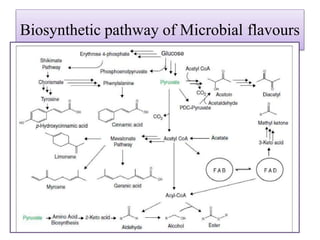
Microbial flavours
Biosynthetic pathway of Microbial flavours
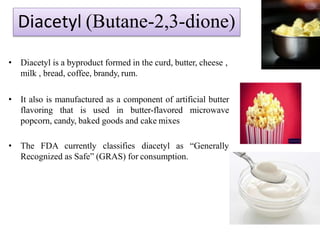
Diacetyl (Butane-2,3-dione)
• Diacetyl is a byproduct formed in the curd, butter, cheese ,
milk , bread, coffee, brandy, rum.
• It also is manufactured as a component of artificial butter
flavoring that is used in butter-flavored microwave
popcorn, candy, baked goods and cake mixes
• The FDA currently classifies diacetyl as “Generally
Recognized as Safe” (GRAS) for consumption.
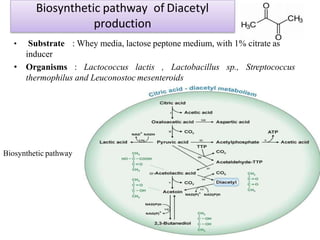
Biosynthetic pathway of Diacetyl
production
• Substrate : Whey media, lactose peptone medium, with 1% citrate as
inducer
• Organisms : Lactococcus lactis , Lactobacillus sp., Streptococcus
thermophilus and Leuconostoc mesenteroids
Biosynthetic pathway
Lactones( D-glucono-1,5-lactone lactonohydrolase )
• The microbial bioprocess of lactone synthesis was first established
in the early 1980s.
• Microbial lactones are produced by the β-oxidation of hydroxy fatty
acids.
• They contribute to the aroma of butter, cheese and various foods and
fruits.
e.g.- i. Cyclopentadecanolide is responsible for the musk like odor of
angelica root oil.
ii. Phthalides are responsible for the odors of celery and lovage oils.
iii. Raw milk does not contain free lactones, appear after heating.
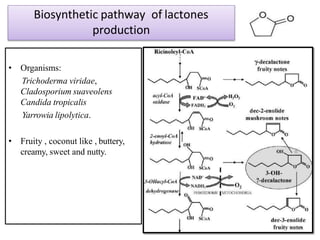
Biosynthetic pathway of lactones
production
• Organisms:
Trichoderma viridae,
Cladosporium suaveolens
Candida tropicalis
Yarrowia lipolytica.
• Fruity , coconut like , buttery,
creamy, sweet and nutty.
ESTERS (-COOR)
iii.
• Volatile esters are responsible for the fruity character of fermented beverages
and constitute a vital group of aromatic compounds in beer and wine.
• Maarse and Visscher (1989) listed 94 esters formed in beer during primary
fermentation.
• A study conducted by Saerens et al. (2007) to evaluate the fermentation
parameters with ethyl ester production using yeast strain.
• Observations-
i. Higher level of unsaturated fatty acids - decrease in ethyl ester production
ii. Higher carbon or nitrogen content - moderate levels in ethyl ester
production.
Limited level of medium chain fatty acids – leads to increase in ethyl ester
production
Conclusion-
The precursor availability is the major limiting factor in ethyl ester
production. So, the expression level and activity of the fatty acid
biosynthetic enzymes therefore appear to be prime targets for flavour
modification by alteration of process parameters
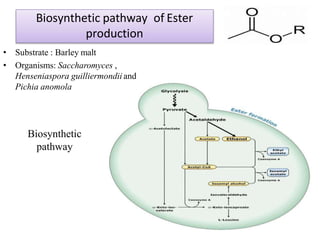
Biosynthetic pathway of Ester
production
• Substrate : Barley malt
• Organisms: Saccharomyces ,
Henseniaspora guilliermondii and
Pichia anomola
Biosynthetic
pathway
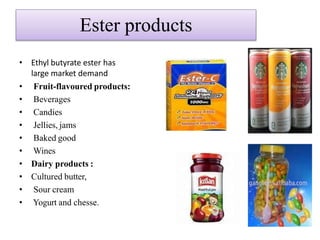
Ester products
• Ethyl butyrate ester has
large market demand
• Fruit-flavoured products:
• Beverages
• Candies
• Jellies, jams
• Baked good
• Wines
• Dairy products :
• Cultured butter,
• Sour cream
• Yogurt and chesse.
Pyrazine((7R)-7-methyl-6,7-dihydro-5H-
cyclopenta)
• Constituents of peas, coffee, c apsicum peppers and wines at concentration as low
as 0.00001 ppm.
• The synthesis of pyrazine was first recorded by Laurent in 1844, the compound was
proved to be tetraphenylpyrazine
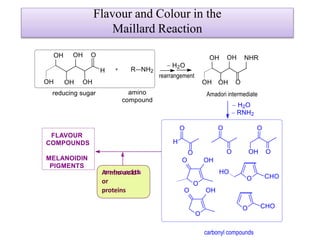
• In 1912 – 1916 Louis-Camille Maillard observe the colour changes on mixing
amino acids and sugars
• Pyrazines is a heterocyclic, N2 containing compound formed during roasting of
food through Maillard reaction.
• Modern cooking do not favour pyrazine formation, so need to supply natural
pyrazine with roastyflavour
• Has interesting anticancer as well as antituberculosis activities.
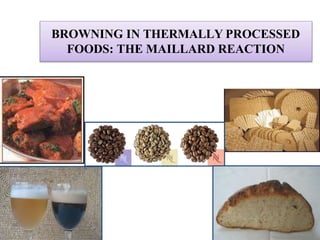
BROWNING IN THERMALLY PROCESSED
FOODS: THE MAILLARD REACTION
Flavour and Colour in the
Maillard Reaction
 H2O
rearrangement
H
OH OH NHR
OH OH O
Amadori intermediate
carbonyl compounds
 H2O
 RNH2
O
O
H
O
O
CHO
HO
O
O OH
O
O
O CHO
O OH
OH O
O
FLAVOUR
COMPOUNDS
MELANOIDIN
PIGMENTS
H
OH OH O
R NH2+
OH OH OH
reducing sugar amino
compound
Aammiinnooaacciidds
or
proteins
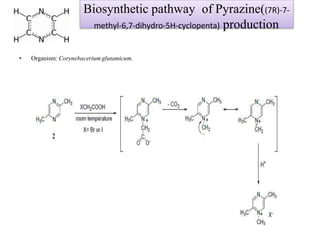
Biosynthetic pathway of Pyrazine((7R)-7-
methyl-6,7-dihydro-5H-cyclopenta) production
• Organism: Corynebacerium glutamicum.
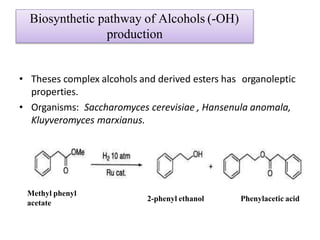
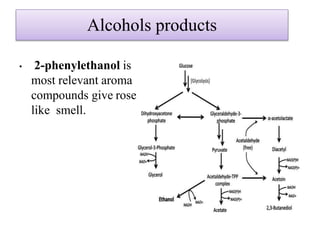
Biosynthetic pathway of Alcohols (-OH)
production
• Theses complex alcohols and derived esters has organoleptic
properties.
• Organisms: Saccharomyces cerevisiae , Hansenula anomala,
Kluyveromyces marxianus.
Methyl phenyl
acetate
2-phenyl ethanol Phenylacetic acid
Alcohols products
• 2-phenylethanol is
most relevant aroma
compounds give rose
like smell.
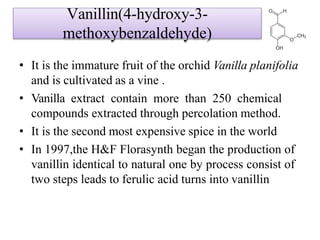
Vanillin(4-hydroxy-3-
methoxybenzaldehyde)
• It is the immature fruit of the orchid Vanilla planifolia
and is cultivated as a vine .
• Vanilla extract contain more than 250 chemical
compounds extracted through percolation method.
• It is the second most expensive spice in the world
• In 1997,the H&F Florasynth began the production of
vanillin identical to natural one by process consist of
two steps leads to ferulic acid turns into vanillin
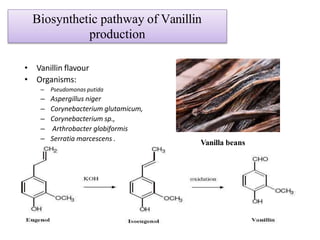
Biosynthetic pathway of Vanillin
production
• Vanillin flavour
• Organisms:
– Pseudomonas putida
– Aspergillus niger
– Corynebacterium glutamicum,
– Corynebacterium sp.,
– Arthrobacter globiformis
– Serratia marcescens .
Vanilla beans
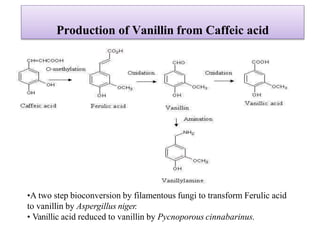
Production of Vanillin from Caffeic acid
•A two step bioconversion by filamentous fungi to transform Ferulic acid
to vanillin by Aspergillus niger.
• Vanillic acid reduced to vanillin by Pycnoporous cinnabarinus.
Applications
• Febrifuge: Vanilla essential oil an effectively reduce
fevers by fighting infections
• Anti-carcinogenic: The anticarcinogenic property of
vanilla oil comes from its antioxidant properties.
• Antioxidant: This property of vanilla essential oil
solve many problems
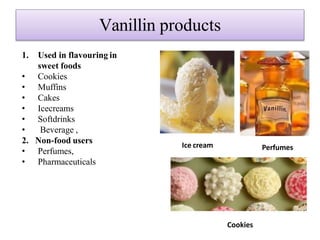
Vanillin products
Ice cream Perfumes
Cookies
1. Used in flavouring in
sweet foods
• Cookies
• Muffins
• Cakes
• Icecreams
• Softdrinks
• Beverage ,
2. Non-food users
• Perfumes,
• Pharmaceuticals
Benzaldehyde
• Benzaldehyde is the second most important Flavour molecule after vanillin.
• Benzaldehyde was first extracted from bitter almonds in 1803 bythe
French pharmacist Martres.
• In 1832 German chemists Friedrich Wohler and Justus von Liebigfirst
synthesized benzaldehyde
• It is mainly in the form of glycosides in cherry, laurel, peach contain
significant amount of amygdalin.
• Occur naturally in bitter almond oil.
• Used as a flavoring and fragrance in food, cosmetics, pharmaceuticals, and
soap and is "generally regarded as safe" (GRAS) by the US FDA.
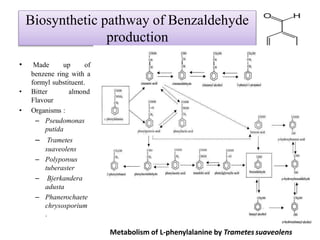
Biosynthetic pathway of Benzaldehyde
production
• Made up of
benzene ring with a
formyl substituent.
almond• Bitter
Flavour
• Organisms :
– Pseudomonas
putida
– Trametes
suaveolens
– Polyporous
tuberaster
– Bjerkandera
adusta
– Phanerochaete
chrysosporium
.
Metabolism of L-phenylalanine by Trametes suaveolens
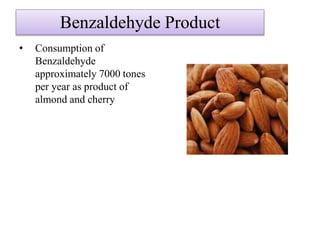
Benzaldehyde Product
• Consumption of
Benzaldehyde
approximately 7000 tones
per year as product of
almond and cherry
Methyl ketones
• Methyl ketones are important flavor components, especially
of blue cheeses
• Penicillium roqueforti produces 2-pentanone, 2-heptanone
and 2-nonanone
• Contributing to the flavor of fresh butter.
• They also have applications as biofuels, owing to their
reduced, aliphatic carbon chains
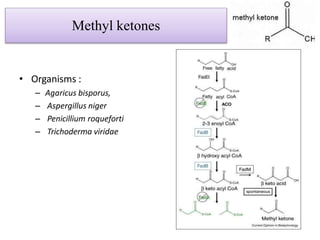
• Methyl ketones can be produced from the fatty acid β-
oxidation pathway
Methyl ketones
• Organisms :
– Agaricus bisporus,
– Aspergillus niger
– Penicillium roqueforti
– Trichoderma viridae
Methyl ketone products
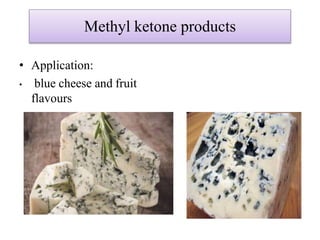
• Application:
• blue cheese and fruit
flavours
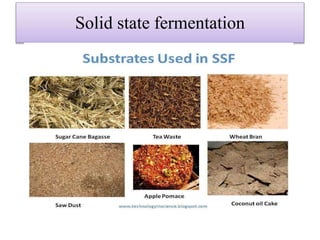
Solid state fermentation
• Solid state fermentation process occuring in
the absence or near-absence of free water.
• SSF employ natural raw material as carbon
source such as cassava,barley,wheat bran, rice
bran,sugarcane bagasse, various oil cakes,fruit
pulp,corn cobs,seeds, coffee husk,
Solid state fermentation
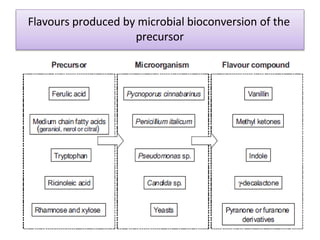
Flavours produced by microbial bioconversion of the
precursor
Advantages of SSF
•Process is simple
•Cost effective
•Less Effluent release,reduce pollution
•Aeration process is easy
•Easier downstream processing

Microbial flavours

  • 1.
  • 2.
  • 3.
  • 4.
    (-OH) (-CHO) (-CO-) ( -COOR)  Alcohols Aldehydes Dicarbonyls  Esters Lactones ( )  Methyl ketones(-COCH3)  Phenolic compounds Short to medium chain free fatty acids Sulphur compounds Compounds responsible for the aroma of the food products
  • 5.
    Classification of flavourson the basis of sources NATURAL FLAVOURS MICROBIAL FLAVOURS SYNTHETIC FLAVOURS ENZYMATIC FLAVOURS •Vanilla •Cinnnamic acid •Limonene •Menthol •Camphor •Eucalyptol •Cinnamaldehyde •Eugenol •Isoamyl acetate Flavours •Diacetyl •Lactones •Esters •Alcohols •Methyl ketones •Benzeldehydes •Ester •Terpenes •Vanilla • Allylpyrazine •Methoxypyrazines •2-Isobutyl-3- methoxypyrazine • Acetyl-L-pyrazines •2-Acetoxy pyrazine • Aldehydes
  • 6.
  • 7.
    I. Natural flavours •Natural flavors contains the flavoring constituents derived from aspice, fruits, vegetables, similar plant material, edible yeast, meat, seafood, poultry, eggs, dairy products. (i) In plants- • Plants can synthesize, accumulate and emit volatiles that act as aroma and flavor molecules due to interactions with human receptors. • Natural flavours present in different parts of plants- i. Bark- Cinnamon, ii. Bud- Onion, garlic, iii. Root-Carrot, iv. Leaf - Coriander, Curry leaf • They are commercially important for the food, pharmaceutical, agricultural and chemical industries as flavorants, drugs, pesticides and industrial feedstocks.
  • 8.
    ii. Animal basedflavours- such as meat • Raw meat - salty, metallic with slightly sweet aroma • Cooked meat- meaty flavor notes due to bis-(2- methyl-3-furan) disulfide, formed by interactions between Maillard reaction products and lipid oxidation products Plant species Compounds Products Oryza sativa (Rice) 2-acetyl -1-pyruvate Basmati flavour Allium sativum (Garlic) Thiols Garlic Allium cepa (Onion) Phenolics Onion Vanilla planifolia (Vanilla beans) Vanilla(4-Hydroxy-3- methoxybenzaldehyde) Vanillin
  • 9.
    Biosynthetic pathway ofnatural flavours
  • 10.
    Limitations of naturalflavours • Low abundance of the volatiles • Flavours are affected by plant type, geographical location, seasonal restriction • High cost
  • 11.
    Synthetic flavours • Synthetic(or artificial) flavors are complex mixtures of naturally occurring flavor compounds to either imitate or enhance a natural flavor. • In the 1800s, a German chemist was the first to develop synthetic aromatic chemicals of fruity odour. • In 1858, Vanillin was first crystallized from an alcoholic extract ofvanilla beans by Gobley • By the end of the 19th century, production of synthetic flavors shares a global market. • These mixtures are formulated by flavorists to give a food product a unique flavor and to maintain flavor consistency between different product batches. • Produced by fractional distillation and additional chemical manipulation of naturally sourced chemicals, crude oil or coal.
  • 12.
    Chemical flavours usedfor food flavouring • Chemicals : • Allylpyrazine • Methoxypyrazines • 2-Isobutyl-3-methoxypyrazine • Acetyl-L-pyrazines • 2-Acetoxy pyrazine • Aldehydes • Alcohols • Esters • Ketones • Pyrazines • Phenolics Flavours Roasted nut Earthy vegetables Green pepper Popcorn Toasted flavours Fruity Bitter Fruity Butter, caramel Caramel Smokey
  • 13.
    Health Risks ofSynthetic Flavours • Brain tumors, cancer, depression, DNA damage, allergies, kidney problems, high blood pressure. • Nowadays, the consumer has developed a ‘chemophobia’- attitude towards synthetic compounds, especially when related to food and its products.
  • 14.
    • Since timeimmemorial, man has unwittingly used microorganisms to produce flavours while preparing fermented foods and drinks. • Around the turn of 20th century that the relationship between the typical desirable flavour of fermented foods and beverages, and the microorganisms involvement became recognised. • A wide range of microorganisms is known to produce flavourcompounds from simple nutrients via de novo synthesis, e.g. sugars, alcohols,etc. • Provide characteristic flavour to fermented products such as in wine,beer, yogurt, butter ,bread, fruity and nutty flavour. • In most cases the de novo fermentation processes can be boosted by supplying a limiting intermediate or precursor molecule, which is otherwise limiting the yield, to the culture. Microbial flavours
  • 15.
    Microbial flavours MicroorganismsCompounds Butter flavour Lactococcus lactis Diacetyl Cocconut like, buttery, creamy, sweet and nutty Candida tropicalis, Trichoderma viridae Lactones Fruity flavour Pichia anomola Esters Nutty and roasted flavour Corynebacterium glutamicium Pyrazines Organoleptic properties Saccharomyces cereviase Alcohols Vanillin Vanilla planifolia Vanilla Natural fruit flavour Phanerochaete chrysosporium Benaldehydes Microbial flavours
  • 16.
    Biosynthetic pathway ofMicrobial flavours
  • 17.
    Diacetyl (Butane-2,3-dione) • Diacetylis a byproduct formed in the curd, butter, cheese , milk , bread, coffee, brandy, rum. • It also is manufactured as a component of artificial butter flavoring that is used in butter-flavored microwave popcorn, candy, baked goods and cake mixes • The FDA currently classifies diacetyl as “Generally Recognized as Safe” (GRAS) for consumption.
  • 18.
    Biosynthetic pathway ofDiacetyl production • Substrate : Whey media, lactose peptone medium, with 1% citrate as inducer • Organisms : Lactococcus lactis , Lactobacillus sp., Streptococcus thermophilus and Leuconostoc mesenteroids Biosynthetic pathway
  • 19.
    Lactones( D-glucono-1,5-lactone lactonohydrolase) • The microbial bioprocess of lactone synthesis was first established in the early 1980s. • Microbial lactones are produced by the β-oxidation of hydroxy fatty acids. • They contribute to the aroma of butter, cheese and various foods and fruits. e.g.- i. Cyclopentadecanolide is responsible for the musk like odor of angelica root oil. ii. Phthalides are responsible for the odors of celery and lovage oils. iii. Raw milk does not contain free lactones, appear after heating.
  • 20.
    Biosynthetic pathway oflactones production • Organisms: Trichoderma viridae, Cladosporium suaveolens Candida tropicalis Yarrowia lipolytica. • Fruity , coconut like , buttery, creamy, sweet and nutty.
  • 21.
    ESTERS (-COOR) iii. • Volatileesters are responsible for the fruity character of fermented beverages and constitute a vital group of aromatic compounds in beer and wine. • Maarse and Visscher (1989) listed 94 esters formed in beer during primary fermentation. • A study conducted by Saerens et al. (2007) to evaluate the fermentation parameters with ethyl ester production using yeast strain. • Observations- i. Higher level of unsaturated fatty acids - decrease in ethyl ester production ii. Higher carbon or nitrogen content - moderate levels in ethyl ester production. Limited level of medium chain fatty acids – leads to increase in ethyl ester production Conclusion- The precursor availability is the major limiting factor in ethyl ester production. So, the expression level and activity of the fatty acid biosynthetic enzymes therefore appear to be prime targets for flavour modification by alteration of process parameters
  • 22.
    Biosynthetic pathway ofEster production • Substrate : Barley malt • Organisms: Saccharomyces , Henseniaspora guilliermondii and Pichia anomola Biosynthetic pathway
  • 23.
    Ester products • Ethylbutyrate ester has large market demand • Fruit-flavoured products: • Beverages • Candies • Jellies, jams • Baked good • Wines • Dairy products : • Cultured butter, • Sour cream • Yogurt and chesse.
  • 24.
    Pyrazine((7R)-7-methyl-6,7-dihydro-5H- cyclopenta) • Constituents ofpeas, coffee, c apsicum peppers and wines at concentration as low as 0.00001 ppm. • The synthesis of pyrazine was first recorded by Laurent in 1844, the compound was proved to be tetraphenylpyrazine • In 1912 – 1916 Louis-Camille Maillard observe the colour changes on mixing amino acids and sugars • Pyrazines is a heterocyclic, N2 containing compound formed during roasting of food through Maillard reaction. • Modern cooking do not favour pyrazine formation, so need to supply natural pyrazine with roastyflavour • Has interesting anticancer as well as antituberculosis activities.
  • 25.
    BROWNING IN THERMALLYPROCESSED FOODS: THE MAILLARD REACTION
  • 26.
    Flavour and Colourin the Maillard Reaction  H2O rearrangement H OH OH NHR OH OH O Amadori intermediate carbonyl compounds  H2O  RNH2 O O H O O CHO HO O O OH O O O CHO O OH OH O O FLAVOUR COMPOUNDS MELANOIDIN PIGMENTS H OH OH O R NH2+ OH OH OH reducing sugar amino compound Aammiinnooaacciidds or proteins
  • 27.
    Biosynthetic pathway ofPyrazine((7R)-7- methyl-6,7-dihydro-5H-cyclopenta) production • Organism: Corynebacerium glutamicum.
  • 28.
    Biosynthetic pathway ofAlcohols (-OH) production • Theses complex alcohols and derived esters has organoleptic properties. • Organisms: Saccharomyces cerevisiae , Hansenula anomala, Kluyveromyces marxianus. Methyl phenyl acetate 2-phenyl ethanol Phenylacetic acid
  • 29.
    Alcohols products • 2-phenylethanolis most relevant aroma compounds give rose like smell.
  • 30.
    Vanillin(4-hydroxy-3- methoxybenzaldehyde) • It isthe immature fruit of the orchid Vanilla planifolia and is cultivated as a vine . • Vanilla extract contain more than 250 chemical compounds extracted through percolation method. • It is the second most expensive spice in the world • In 1997,the H&F Florasynth began the production of vanillin identical to natural one by process consist of two steps leads to ferulic acid turns into vanillin
  • 31.
    Biosynthetic pathway ofVanillin production • Vanillin flavour • Organisms: – Pseudomonas putida – Aspergillus niger – Corynebacterium glutamicum, – Corynebacterium sp., – Arthrobacter globiformis – Serratia marcescens . Vanilla beans
  • 32.
    Production of Vanillinfrom Caffeic acid •A two step bioconversion by filamentous fungi to transform Ferulic acid to vanillin by Aspergillus niger. • Vanillic acid reduced to vanillin by Pycnoporous cinnabarinus.
  • 33.
    Applications • Febrifuge: Vanillaessential oil an effectively reduce fevers by fighting infections • Anti-carcinogenic: The anticarcinogenic property of vanilla oil comes from its antioxidant properties. • Antioxidant: This property of vanilla essential oil solve many problems
  • 34.
    Vanillin products Ice creamPerfumes Cookies 1. Used in flavouring in sweet foods • Cookies • Muffins • Cakes • Icecreams • Softdrinks • Beverage , 2. Non-food users • Perfumes, • Pharmaceuticals
  • 35.
    Benzaldehyde • Benzaldehyde isthe second most important Flavour molecule after vanillin. • Benzaldehyde was first extracted from bitter almonds in 1803 bythe French pharmacist Martres. • In 1832 German chemists Friedrich Wohler and Justus von Liebigfirst synthesized benzaldehyde • It is mainly in the form of glycosides in cherry, laurel, peach contain significant amount of amygdalin. • Occur naturally in bitter almond oil. • Used as a flavoring and fragrance in food, cosmetics, pharmaceuticals, and soap and is "generally regarded as safe" (GRAS) by the US FDA.
  • 36.
    Biosynthetic pathway ofBenzaldehyde production • Made up of benzene ring with a formyl substituent. almond• Bitter Flavour • Organisms : – Pseudomonas putida – Trametes suaveolens – Polyporous tuberaster – Bjerkandera adusta – Phanerochaete chrysosporium . Metabolism of L-phenylalanine by Trametes suaveolens
  • 37.
    Benzaldehyde Product • Consumptionof Benzaldehyde approximately 7000 tones per year as product of almond and cherry
  • 38.
    Methyl ketones • Methylketones are important flavor components, especially of blue cheeses • Penicillium roqueforti produces 2-pentanone, 2-heptanone and 2-nonanone • Contributing to the flavor of fresh butter. • They also have applications as biofuels, owing to their reduced, aliphatic carbon chains • Methyl ketones can be produced from the fatty acid β- oxidation pathway
  • 39.
    Methyl ketones • Organisms: – Agaricus bisporus, – Aspergillus niger – Penicillium roqueforti – Trichoderma viridae
  • 40.
    Methyl ketone products •Application: • blue cheese and fruit flavours
  • 41.
    Solid state fermentation •Solid state fermentation process occuring in the absence or near-absence of free water. • SSF employ natural raw material as carbon source such as cassava,barley,wheat bran, rice bran,sugarcane bagasse, various oil cakes,fruit pulp,corn cobs,seeds, coffee husk,
  • 42.
  • 43.
    Flavours produced bymicrobial bioconversion of the precursor
  • 44.
    Advantages of SSF •Processis simple •Cost effective •Less Effluent release,reduce pollution •Aeration process is easy •Easier downstream processing