FOOD CROPS :-
Wheat Chick pea
Contents
• Introduction
• Origin ,morphology ,cultivation and uses of
following crops :-
• Wheat
• Chick pea
INTRODUCTION
FOOD :-
 Food is necessary for the existence of all living
things.
 It is the basic requirements of life to survive.
 It is the building up of bodily structure ,or as a
source of energy.
 It is made of various kind of energy rich substances
like carbohydrates ,proteins ,fats ,vitamins ,and
minerals which are known as nutrients.
Cont…
FUNCTIONS OF FOOD :-
 Food provide energy for various metabolic activities.
 It help in growth and development of body.
 It help in replacement of worn out tisues ,repair of
damaged cells and healing of wounds.
 It provide protection against diseases.
SOURCES OF FOOD :-
 Cereals (wheat)
 Pulses(chick pea)
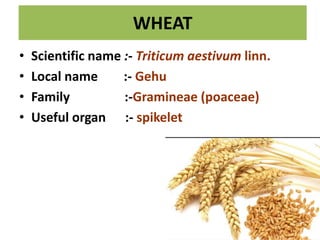
WHEAT
• Scientific name :- Triticum aestivum linn.
• Local name :- Gehu
• Family :-Gramineae (poaceae)
• Useful organ :- spikelet
ORIGIN
• Wheat is originated in southwestern Asia.
• Primitive relatives of present day wheat have been
discovered in some of the oldest excavations of the
world in eastern Iraq ,which date back 9000years.
• Wheat was first grown in the united states in 1602 on
an island of the massachusetts coast.
• Other archelogical findings show that bread wheat was
grown in the nile valley about 5000as well as in india
,china and england at about same time.
Morphology
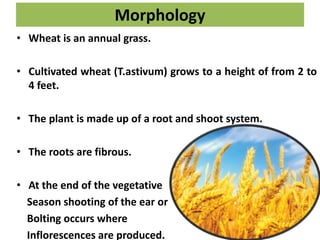
• Wheat is an annual grass.
• Cultivated wheat (T.astivum) grows to a height of from 2 to
4 feet.
• The plant is made up of a root and shoot system.
• The roots are fibrous.
• At the end of the vegetative
Season shooting of the ear or
Bolting occurs where
Inflorescences are produced.
Cont…
• The inflorescence is a spike , consisting of 15-20
spikelet’s borne alternately on the rachis thus giving a
zigzag appearance.
• A spikelet consists of 1-5 flowers enclosed by pair of
glumes.
• The individual spikelet’s are sessile and solitary and
consist of from one to five flowers each.
• The mature grain consists of the embryo (6%),a starchy
endosperm (82 to 86%),the nitrogenous aleurone layer
(3 to 4%) ,and the husk (8 to 9%).
• This last structure is composed of the remains of the
nucellus ,the integuments of the seed coat,and the
ovary walls or pericarp.
Cultivation
• Wheat is grown in the warm temperate regions.
• Cool water relatively dry and warm summer and
average annual rainfall of 30-90 mm are suitable for
the crop.
• Loams are most suitable soul for its cultivation.
• It is sown from early October to late November.
• The requirement of seeds are 25-30 per hectare.
• Wheat is usually grow in row ,with row to row
distance of 20-22.5 cm.
• 120 kg nitrogen,40-60 kg phosphorus and 60-65 kg
potash per hectare is required for high yield.
Cont…
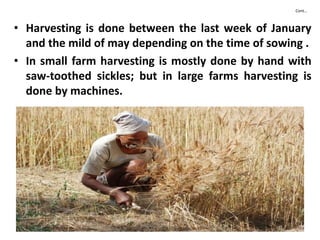
• Harvesting is done between the last week of January
and the mild of may depending on the time of sowing .
• In small farm harvesting is mostly done by hand with
saw-toothed sickles; but in large farms harvesting is
done by machines.
USES
• There are three main kinds of flour-suji ,maida ,aata
which are marking from the wheat.
• The flour is used for making biscuits ,cakes ,pastry
and similar articles.
• Wheat flakes are used a breakfast food.
• Wheat is also used in the manufacture of beer and
other alcoholic drink.
• Wheat straw is used for seating chairs ,stuffing
mattresses ,etc. it makes a good food for livestock.
It is also used as fodder.
Cont…
• The straw is used as bedding for cattle; it is also
used for padding ,many other purposes.
• Straw pulp is utilized for the manufacture of paper,
straw board and building board.
• Low graded flour are utilized in the preparation of
pastes for wall papering and ply-wood adhesive and
in iron foundries as a core binder.
• Wheat starch is used in cosmetic and
pharmaceutical industry.
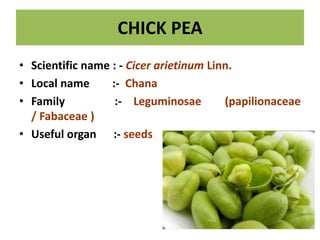
CHICK PEA
• Scientific name : - Cicer arietinum Linn.
• Local name :- Chana
• Family :- Leguminosae (papilionaceae
/ Fabaceae )
• Useful organ :- seeds
ORIGIN
• Ladizinkly (1975) reported the centre of origin to be
southeastern turkey.
• Botanical and archeological evidence show that
chickpeas were first domesticated in the middle east
and widely cultivated in India ; Mediterranean area.
• Wild species are most abundant in turkey ,Iran
,Afghanistan and central Asia.
• Wild Cicer reticulatum is interfertile with the
cultivated pulse and morphologically closely look
like Cicer arietinum .
Morphology
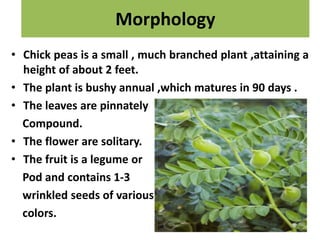
• Chick peas is a small , much branched plant ,attaining a
height of about 2 feet.
• The plant is bushy annual ,which matures in 90 days .
• The leaves are pinnately
Compound.
• The flower are solitary.
• The fruit is a legume or
Pod and contains 1-3
wrinkled seeds of various
colors.
CULTIVATION
• It is well adapted to arid and semi regions with low to
moderate rainfall and a cool and dry climate .
• The crop thrives best in deep alluvial clay and cannot
tolerate frost at any stage of growth.
• Since nitrogen fixing bacteria occur in its root nodules
,so the nitrogen fertilizer are not required to the crop
.The crop is shown in October- november and is ready
for harvest in february.
• The seeds are threshed by trampling and splitting the
small or medium size.
USES
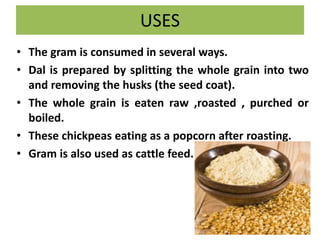
• The gram is consumed in several ways.
• Dal is prepared by splitting the whole grain into two
and removing the husks (the seed coat).
• The whole grain is eaten raw ,roasted , purched or
boiled.
• These chickpeas eating as a popcorn after roasting.
• Gram is also used as cattle feed.
Cont…
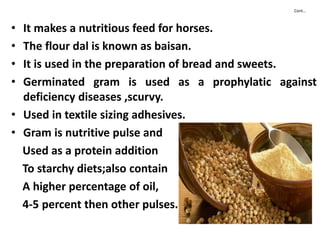
• It makes a nutritious feed for horses.
• The flour dal is known as baisan.
• It is used in the preparation of bread and sweets.
• Germinated gram is used as a prophylatic against
deficiency diseases ,scurvy.
• Used in textile sizing adhesives.
• Gram is nutritive pulse and
Used as a protein addition
To starchy diets;also contain
A higher percentage of oil,
4-5 percent then other pulses.
REFERENCES
• Economic botany by – B.P.Pandey
• Economic botany by-Pooja
• www.wikepedia.com
• www.slideshare.com
Food crops (wheat ,chick pea)

Food crops (wheat ,chick pea)

  • 1.
  • 2.
    Contents • Introduction • Origin,morphology ,cultivation and uses of following crops :- • Wheat • Chick pea
  • 3.
    INTRODUCTION FOOD :-  Foodis necessary for the existence of all living things.  It is the basic requirements of life to survive.  It is the building up of bodily structure ,or as a source of energy.  It is made of various kind of energy rich substances like carbohydrates ,proteins ,fats ,vitamins ,and minerals which are known as nutrients.
  • 4.
    Cont… FUNCTIONS OF FOOD:-  Food provide energy for various metabolic activities.  It help in growth and development of body.  It help in replacement of worn out tisues ,repair of damaged cells and healing of wounds.  It provide protection against diseases. SOURCES OF FOOD :-  Cereals (wheat)  Pulses(chick pea)
  • 5.
    WHEAT • Scientific name:- Triticum aestivum linn. • Local name :- Gehu • Family :-Gramineae (poaceae) • Useful organ :- spikelet
  • 6.
    ORIGIN • Wheat isoriginated in southwestern Asia. • Primitive relatives of present day wheat have been discovered in some of the oldest excavations of the world in eastern Iraq ,which date back 9000years. • Wheat was first grown in the united states in 1602 on an island of the massachusetts coast. • Other archelogical findings show that bread wheat was grown in the nile valley about 5000as well as in india ,china and england at about same time.
  • 7.
    Morphology • Wheat isan annual grass. • Cultivated wheat (T.astivum) grows to a height of from 2 to 4 feet. • The plant is made up of a root and shoot system. • The roots are fibrous. • At the end of the vegetative Season shooting of the ear or Bolting occurs where Inflorescences are produced.
  • 8.
    Cont… • The inflorescenceis a spike , consisting of 15-20 spikelet’s borne alternately on the rachis thus giving a zigzag appearance. • A spikelet consists of 1-5 flowers enclosed by pair of glumes. • The individual spikelet’s are sessile and solitary and consist of from one to five flowers each. • The mature grain consists of the embryo (6%),a starchy endosperm (82 to 86%),the nitrogenous aleurone layer (3 to 4%) ,and the husk (8 to 9%). • This last structure is composed of the remains of the nucellus ,the integuments of the seed coat,and the ovary walls or pericarp.
  • 9.
    Cultivation • Wheat isgrown in the warm temperate regions. • Cool water relatively dry and warm summer and average annual rainfall of 30-90 mm are suitable for the crop. • Loams are most suitable soul for its cultivation. • It is sown from early October to late November. • The requirement of seeds are 25-30 per hectare. • Wheat is usually grow in row ,with row to row distance of 20-22.5 cm. • 120 kg nitrogen,40-60 kg phosphorus and 60-65 kg potash per hectare is required for high yield.
  • 10.
    Cont… • Harvesting isdone between the last week of January and the mild of may depending on the time of sowing . • In small farm harvesting is mostly done by hand with saw-toothed sickles; but in large farms harvesting is done by machines.
  • 11.
    USES • There arethree main kinds of flour-suji ,maida ,aata which are marking from the wheat. • The flour is used for making biscuits ,cakes ,pastry and similar articles. • Wheat flakes are used a breakfast food. • Wheat is also used in the manufacture of beer and other alcoholic drink. • Wheat straw is used for seating chairs ,stuffing mattresses ,etc. it makes a good food for livestock. It is also used as fodder.
  • 12.
    Cont… • The strawis used as bedding for cattle; it is also used for padding ,many other purposes. • Straw pulp is utilized for the manufacture of paper, straw board and building board. • Low graded flour are utilized in the preparation of pastes for wall papering and ply-wood adhesive and in iron foundries as a core binder. • Wheat starch is used in cosmetic and pharmaceutical industry.
  • 13.
    CHICK PEA • Scientificname : - Cicer arietinum Linn. • Local name :- Chana • Family :- Leguminosae (papilionaceae / Fabaceae ) • Useful organ :- seeds
  • 14.
    ORIGIN • Ladizinkly (1975)reported the centre of origin to be southeastern turkey. • Botanical and archeological evidence show that chickpeas were first domesticated in the middle east and widely cultivated in India ; Mediterranean area. • Wild species are most abundant in turkey ,Iran ,Afghanistan and central Asia. • Wild Cicer reticulatum is interfertile with the cultivated pulse and morphologically closely look like Cicer arietinum .
  • 15.
    Morphology • Chick peasis a small , much branched plant ,attaining a height of about 2 feet. • The plant is bushy annual ,which matures in 90 days . • The leaves are pinnately Compound. • The flower are solitary. • The fruit is a legume or Pod and contains 1-3 wrinkled seeds of various colors.
  • 16.
    CULTIVATION • It iswell adapted to arid and semi regions with low to moderate rainfall and a cool and dry climate . • The crop thrives best in deep alluvial clay and cannot tolerate frost at any stage of growth. • Since nitrogen fixing bacteria occur in its root nodules ,so the nitrogen fertilizer are not required to the crop .The crop is shown in October- november and is ready for harvest in february. • The seeds are threshed by trampling and splitting the small or medium size.
  • 17.
    USES • The gramis consumed in several ways. • Dal is prepared by splitting the whole grain into two and removing the husks (the seed coat). • The whole grain is eaten raw ,roasted , purched or boiled. • These chickpeas eating as a popcorn after roasting. • Gram is also used as cattle feed.
  • 18.
    Cont… • It makesa nutritious feed for horses. • The flour dal is known as baisan. • It is used in the preparation of bread and sweets. • Germinated gram is used as a prophylatic against deficiency diseases ,scurvy. • Used in textile sizing adhesives. • Gram is nutritive pulse and Used as a protein addition To starchy diets;also contain A higher percentage of oil, 4-5 percent then other pulses.
  • 19.
    REFERENCES • Economic botanyby – B.P.Pandey • Economic botany by-Pooja • www.wikepedia.com • www.slideshare.com