TEAK
Botanical name: Tectona grandis
Family: Verbenaceae
Part used: Wood (Secondary xylem)
By: Dr. Anuprabha
Department of Botany
Goswami Ganesh Dutta Sanatan Dharma College,
Chandigarh
Teak is a large, deciduous tree up to 40 m (131 ft) tall with gray
to grayish brown branches.
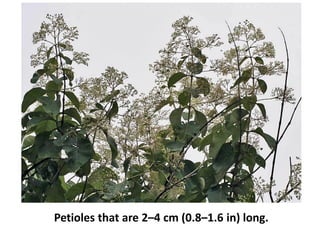
Petioles that are 2–4 cm (0.8–1.6 in) long.
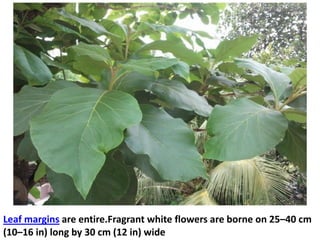
Leaf margins are entire.Fragrant white flowers are borne on 25–40 cm
(10–16 in) long by 30 cm (12 in) wide
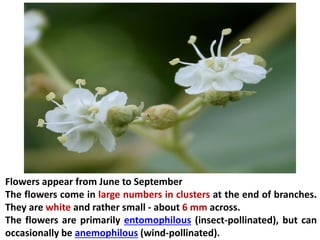
Flowers appear from June to September
The flowers come in large numbers in clusters at the end of branches.
They are white and rather small - about 6 mm across.
The flowers are primarily entomophilous (insect-pollinated), but can
occasionally be anemophilous (wind-pollinated).
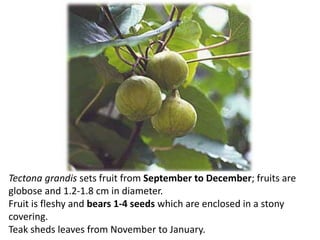
Tectona grandis sets fruit from September to December; fruits are
globose and 1.2-1.8 cm in diameter.
Fruit is fleshy and bears 1-4 seeds which are enclosed in a stony
covering.
Teak sheds leaves from November to January.
ECONOMIC
IMPORTANCE
Teak is recognized as the best
timber for the manufacture of
door, window frames and
shutters, wagon and carriage,
furniture, cabinets, ships,
agricultural implements,
decorative flooring and wall
panelling because of its
moderate weight, appropriate
strength, dimensional stability
and durability, easy workability
and finishing qualities and most
appealing grain, texture, colour
and figure.
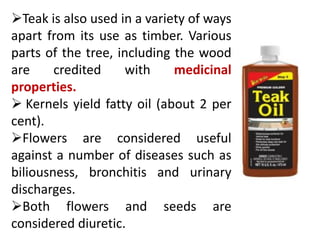
➢Teak is also used in a variety of ways
apart from its use as timber. Various
parts of the tree, including the wood
are credited with medicinal
properties.
➢ Kernels yield fatty oil (about 2 per
cent).
➢Flowers are considered useful
against a number of diseases such as
biliousness, bronchitis and urinary
discharges.
➢Both flowers and seeds are
considered diuretic.
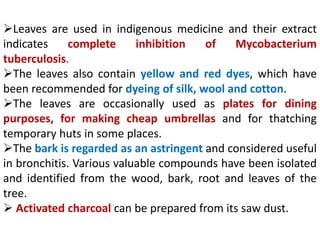
➢Leaves are used in indigenous medicine and their extract
indicates complete inhibition of Mycobacterium
tuberculosis.
➢The leaves also contain yellow and red dyes, which have
been recommended for dyeing of silk, wool and cotton.
➢The leaves are occasionally used as plates for dining
purposes, for making cheap umbrellas and for thatching
temporary huts in some places.
➢The bark is regarded as an astringent and considered useful
in bronchitis. Various valuable compounds have been isolated
and identified from the wood, bark, root and leaves of the
tree.
➢ Activated charcoal can be prepared from its saw dust.

Teak morphology and economic importance

  • 1.
    TEAK Botanical name: Tectonagrandis Family: Verbenaceae Part used: Wood (Secondary xylem) By: Dr. Anuprabha Department of Botany Goswami Ganesh Dutta Sanatan Dharma College, Chandigarh
  • 2.
    Teak is alarge, deciduous tree up to 40 m (131 ft) tall with gray to grayish brown branches.
  • 3.
    Petioles that are2–4 cm (0.8–1.6 in) long.
  • 4.
    Leaf margins areentire.Fragrant white flowers are borne on 25–40 cm (10–16 in) long by 30 cm (12 in) wide
  • 5.
    Flowers appear fromJune to September The flowers come in large numbers in clusters at the end of branches. They are white and rather small - about 6 mm across. The flowers are primarily entomophilous (insect-pollinated), but can occasionally be anemophilous (wind-pollinated).
  • 6.
    Tectona grandis setsfruit from September to December; fruits are globose and 1.2-1.8 cm in diameter. Fruit is fleshy and bears 1-4 seeds which are enclosed in a stony covering. Teak sheds leaves from November to January.
  • 7.
    ECONOMIC IMPORTANCE Teak is recognizedas the best timber for the manufacture of door, window frames and shutters, wagon and carriage, furniture, cabinets, ships, agricultural implements, decorative flooring and wall panelling because of its moderate weight, appropriate strength, dimensional stability and durability, easy workability and finishing qualities and most appealing grain, texture, colour and figure.
  • 8.
    ➢Teak is alsoused in a variety of ways apart from its use as timber. Various parts of the tree, including the wood are credited with medicinal properties. ➢ Kernels yield fatty oil (about 2 per cent). ➢Flowers are considered useful against a number of diseases such as biliousness, bronchitis and urinary discharges. ➢Both flowers and seeds are considered diuretic.
  • 9.
    ➢Leaves are usedin indigenous medicine and their extract indicates complete inhibition of Mycobacterium tuberculosis. ➢The leaves also contain yellow and red dyes, which have been recommended for dyeing of silk, wool and cotton. ➢The leaves are occasionally used as plates for dining purposes, for making cheap umbrellas and for thatching temporary huts in some places. ➢The bark is regarded as an astringent and considered useful in bronchitis. Various valuable compounds have been isolated and identified from the wood, bark, root and leaves of the tree. ➢ Activated charcoal can be prepared from its saw dust.