Focus Groups
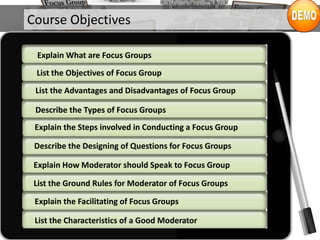
Course Objectives
List the Objectives of Focus Group
Explain What are Focus Groups
List the Advantages and Disadvantages of Focus Group
Describe the Types of Focus Groups
Describe the Designing of Questions for Focus Groups
Explain the Steps involved in Conducting a Focus Group
Explain How Moderator should Speak to Focus Group
List the Ground Rules for Moderator of Focus Groups
List the Characteristics of a Good Moderator
Explain the Facilitating of Focus Groups
Introduction
Introduction
Introduction
Introduction
Introduction
Introduction
Introduction
Introduction
Introduction
Introduction
Introduction
What are Focus Groups?
• ‘Focus Groups’ are also known as ‘Group Interviews’ or
‘Group Discussions’.
• They are used to understand the attitude or behavior of the
audience.
• Six to twelve individuals are selected and either one or two
moderators are selected.
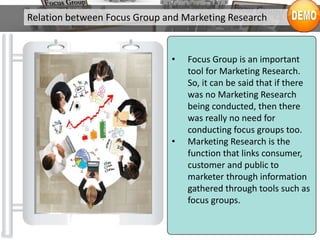
Relation between Focus Group and Marketing Research
• Focus Group is an important
tool for Marketing Research.
So, it can be said that if there
was no Marketing Research
being conducted, then there
was really no need for
conducting focus groups too.
• Marketing Research is the
function that links consumer,
customer and public to
marketer through information
gathered through tools such as
focus groups.
There may be certain members in a focus
group who may play ‘Blocking Roles’.
‘Blocking Roles’ are those activities that
disrupt the group.
Some blocking roles may be in the form of
dominating discussions, verbally attacking
other focus group members, and distracting
the focus group with petty information or
unnecessary humor.
Did You Know?
Exploratory Focus Groups
• Exploratory Focus Groups:
o Such focus groups mainly explore
how a group perceives a problem
o They use the power of group thinking
to brainstorm potential solutions
o Such focus groups also try to identify
the areas of further investigation or
action
o They help design surveys for wide
distribution
o They help understand unclear or
contradictory survey responses
o Such focus groups tend to use open-
ended questions to evoke
participation
Select a Sample
• Select a Sample
o The second step for conducting a focus group is to determine
and select a sample.
o Here, the sample is a list of people that are selected and chosen
from a group from whom the information is needed.
2
Designing Questions for Focus Groups
• Properly arrange the questions: To determine the order of the
question, take decisions on aspects like opening questions
(simple, interesting questions should be used as opening
questions to gain co-operation and confidence of respondents),
type of information (Basic information relates to the research
issue, classification information relates to social and
demographic characteristics, and identification information
relates to personal information such as name, address, contact
number of respondents), difficult questions (complex,
embarrassing, dull and sensitive questions could be difficult),
effect on subsequent questions, logical sequence, etc.
Real Life Example
Percy & Grimm is a
leading manufacturer
of oral health care
products such as
toothpaste,
mouthwash,
toothbrush, dental
whitening creams,
dental floss etc.
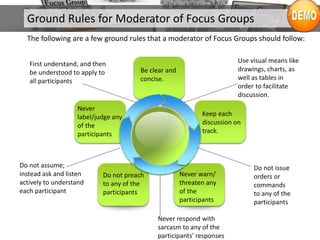
Ground Rules for Moderator of Focus Groups
Do not assume;
instead ask and listen
actively to understand
each participant
Do not issue
orders or
commands
to any of the
participants
First understand, and then
be understood to apply to
all participants
Use visual means like
drawings, charts, as
well as tables in
order to facilitate
discussion.
Never respond with
sarcasm to any of the
participants’ responses
Be clear and
concise.
Keep each
discussion on
track.
Never
label/judge any
of the
participants
Never warn/
threaten any
of the
participants
Do not preach
to any of the
participants
The following are a few ground rules that a moderator of Focus Groups should follow:
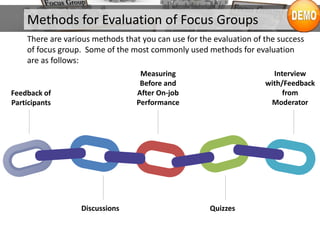
Methods for Evaluation of Focus Groups
There are various methods that you can use for the evaluation of the success
of focus group. Some of the most commonly used methods for evaluation
are as follows:
Feedback of
Participants
Discussions
Measuring
Before and
After On-job
Performance
Quizzes
Interview
with/Feedback
from
Moderator
This is a DEMO Course On – Focus Groups.
Become a Member and Get Access to Complete Powerpoint
Presentations for more than 140 Subjects.
What Do you Get:
1. View All Courses Online.
2. Download Powerpoint Presentation for Each Course.
3. Do the Knowledge Checks for Each Course.
ManagementStudyGuide.com

Focus groups-Lesson

  • 1.
  • 2.
    Course Objectives List theObjectives of Focus Group Explain What are Focus Groups List the Advantages and Disadvantages of Focus Group Describe the Types of Focus Groups Describe the Designing of Questions for Focus Groups Explain the Steps involved in Conducting a Focus Group Explain How Moderator should Speak to Focus Group List the Ground Rules for Moderator of Focus Groups List the Characteristics of a Good Moderator Explain the Facilitating of Focus Groups
  • 3.
  • 4.
  • 5.
  • 6.
  • 7.
  • 8.
  • 9.
  • 10.
  • 11.
  • 12.
  • 13.
  • 14.
    What are FocusGroups? • ‘Focus Groups’ are also known as ‘Group Interviews’ or ‘Group Discussions’. • They are used to understand the attitude or behavior of the audience. • Six to twelve individuals are selected and either one or two moderators are selected.
  • 15.
    Relation between FocusGroup and Marketing Research • Focus Group is an important tool for Marketing Research. So, it can be said that if there was no Marketing Research being conducted, then there was really no need for conducting focus groups too. • Marketing Research is the function that links consumer, customer and public to marketer through information gathered through tools such as focus groups.
  • 16.
    There may becertain members in a focus group who may play ‘Blocking Roles’. ‘Blocking Roles’ are those activities that disrupt the group. Some blocking roles may be in the form of dominating discussions, verbally attacking other focus group members, and distracting the focus group with petty information or unnecessary humor. Did You Know?
  • 17.
    Exploratory Focus Groups •Exploratory Focus Groups: o Such focus groups mainly explore how a group perceives a problem o They use the power of group thinking to brainstorm potential solutions o Such focus groups also try to identify the areas of further investigation or action o They help design surveys for wide distribution o They help understand unclear or contradictory survey responses o Such focus groups tend to use open- ended questions to evoke participation
  • 18.
    Select a Sample •Select a Sample o The second step for conducting a focus group is to determine and select a sample. o Here, the sample is a list of people that are selected and chosen from a group from whom the information is needed. 2
  • 19.
    Designing Questions forFocus Groups • Properly arrange the questions: To determine the order of the question, take decisions on aspects like opening questions (simple, interesting questions should be used as opening questions to gain co-operation and confidence of respondents), type of information (Basic information relates to the research issue, classification information relates to social and demographic characteristics, and identification information relates to personal information such as name, address, contact number of respondents), difficult questions (complex, embarrassing, dull and sensitive questions could be difficult), effect on subsequent questions, logical sequence, etc.
  • 20.
    Real Life Example Percy& Grimm is a leading manufacturer of oral health care products such as toothpaste, mouthwash, toothbrush, dental whitening creams, dental floss etc.
  • 21.
    Ground Rules forModerator of Focus Groups Do not assume; instead ask and listen actively to understand each participant Do not issue orders or commands to any of the participants First understand, and then be understood to apply to all participants Use visual means like drawings, charts, as well as tables in order to facilitate discussion. Never respond with sarcasm to any of the participants’ responses Be clear and concise. Keep each discussion on track. Never label/judge any of the participants Never warn/ threaten any of the participants Do not preach to any of the participants The following are a few ground rules that a moderator of Focus Groups should follow:
  • 22.
    Methods for Evaluationof Focus Groups There are various methods that you can use for the evaluation of the success of focus group. Some of the most commonly used methods for evaluation are as follows: Feedback of Participants Discussions Measuring Before and After On-job Performance Quizzes Interview with/Feedback from Moderator
  • 23.
    This is aDEMO Course On – Focus Groups. Become a Member and Get Access to Complete Powerpoint Presentations for more than 140 Subjects. What Do you Get: 1. View All Courses Online. 2. Download Powerpoint Presentation for Each Course. 3. Do the Knowledge Checks for Each Course. ManagementStudyGuide.com