Jennifer Evans
Assistant Director ELA
St. Clair County RESA
Evans.jennifer@sccresa.org
http://www.protopage.com/evans.jennifer
 In order to create a literacy environment
within your classroom, what things must be
considered?
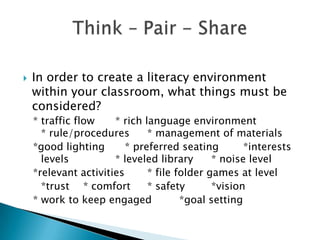
 In order to create a literacy environment
within your classroom, what things must be
considered?
* traffic flow * rich language environment
* rule/procedures * management of materials
*good lighting * preferred seating *interests
levels * leveled library * noise level
*relevant activities * file folder games at level
*trust * comfort * safety *vision
* work to keep engaged *goal setting
 In order for a guided reading group to be
successful, the rest of the students in the
class need to be involved in meaningful
literacy activities.
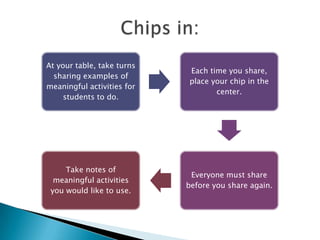
At your table, take turns
sharing examples of
meaningful activities for
students to do.
Each time you share,
place your chip in the
center.
Everyone must share
before you share again.
Take notes of
meaningful activities
you would like to use.
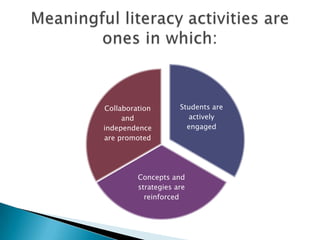
Students are
actively
engaged
Concepts and
strategies are
reinforced
Collaboration
and
independence
are promoted
Literacy develops
best through social
interaction and
dialogue with others.
Guided reading is
essentially a carefully
managed “social
occurrence”.
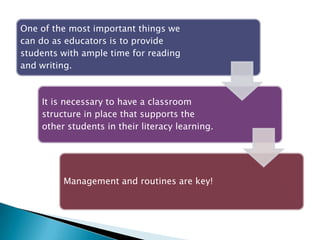
One of the most important things we
can do as educators is to provide
students with ample time for reading
and writing.
It is necessary to have a classroom
structure in place that supports the
other students in their literacy learning.
Management and routines are key!
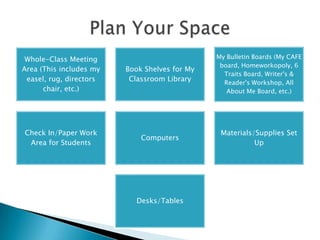
Whole-Class Meeting
Area (This includes my
easel, rug, directors
chair, etc.)
Book Shelves for My
Classroom Library
My Bulletin Boards (My CAFE
board, Homeworkopoly, 6
Traits Board, Writer's &
Reader's Workshop, All
About Me Board, etc.)
Check In/Paper Work
Area for Students
Computers
Materials/Supplies Set
Up
Desks/Tables
 The sisters – setting up your classroom:
http://www.choiceliteracy.com/books-dvds-
detail.php?id=57
 Classroom set-up:
http://workshopteaching.weebly.com/classroo
m-set-up.html
 The Reading Workshop Resource page:
http://www.busyteacherscafe.com/literacy/reading
_workshop.html
 What effective classroom libraries look like:
http://teacher.scholastic.com/products/classroo
mbooks/pdfs/research/What_Effective_Libraries.
pdf
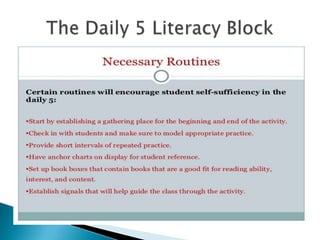
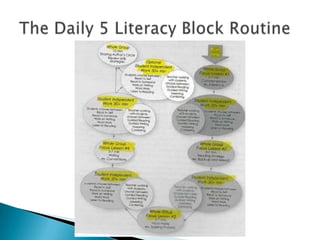
 Daily 5 Literacy Block:
http://pinterest.com/megandm/daily-5-literacy-
block/
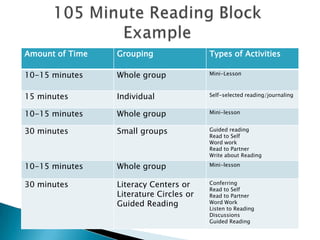
Amount of Time Grouping Types of Activities
10-15 minutes Whole group Mini-Lesson
15 minutes Individual Self-selected reading/journaling
10-15 minutes Whole group Mini-lesson
30 minutes Small groups Guided reading
Read to Self
Word work
Read to Partner
Write about Reading
10-15 minutes Whole group Mini-lesson
30 minutes Literacy Centers or
Literature Circles or
Guided Reading
Conferring
Read to Self
Read to Partner
Word Work
Listen to Reading
Discussions
Guided Reading
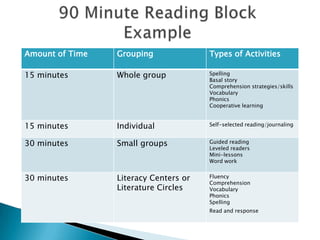
Amount of Time Grouping Types of Activities
15 minutes Whole group Spelling
Basal story
Comprehension strategies/skills
Vocabulary
Phonics
Cooperative learning
15 minutes Individual Self-selected reading/journaling
30 minutes Small groups Guided reading
Leveled readers
Mini-lessons
Word work
30 minutes Literacy Centers or
Literature Circles
Fluency
Comprehension
Vocabulary
Phonics
Spelling
Read and response
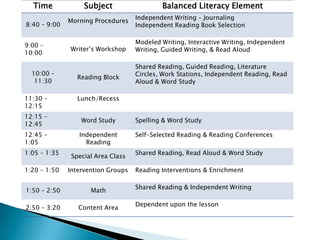
Time Subject Balanced Literacy Element
8:40 – 9:00
Morning Procedures
Independent Writing – Journaling
Independent Reading Book Selection
9:00 –
10:00
Writer’s Workshop
Modeled Writing, Interactive Writing, Independent
Writing, Guided Writing, & Read Aloud
10:00 –
11:30
Reading Block
Shared Reading, Guided Reading, Literature
Circles, Work Stations, Independent Reading, Read
Aloud & Word Study
11:30 –
12:15
Lunch/Recess
12:15 –
12:45
Word Study Spelling & Word Study
12:45 –
1:05
Independent
Reading
Self-Selected Reading & Reading Conferences
1:05 – 1:35
Special Area Class
Shared Reading, Read Aloud & Word Study
1:20 – 1:50 Intervention Groups Reading Interventions & Enrichment
1:50 – 2:50 Math
Shared Reading & Independent Writing
2:50 – 3:20 Content Area
Dependent upon the lesson
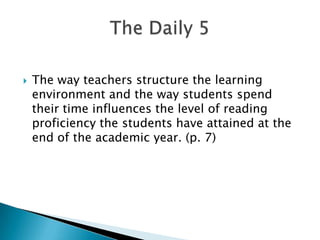
 The way teachers structure the learning
environment and the way students spend
their time influences the level of reading
proficiency the students have attained at the
end of the academic year. (p. 7)
We wanted to change the atmosphere in our
classroom to create routines and procedures
that fostered independent literacy behaviors
that were ingrained to the point of being habits.
Our goal was for all students to have
internalized these expectations and shared
experiences in a way that allowed for every child
to become engrossed in their reading. (p. 9)
 When trust is combined with explicit instruction,
our students acquire the skills necessary to
become independent learners. Students will
continue their learning even when they are not
being “managed” by the teacher. (p. 18)
 Providing choice
 Establish routines
 Explicitly explain why
 Build Stamina
 Good-fit books
 Anchor Charts
 Correct Modeling
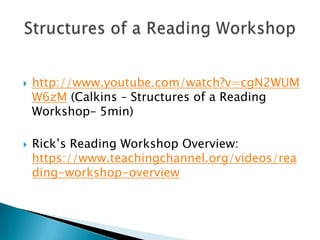
 http://www.youtube.com/watch?v=cgN2WUM
W6zM (Calkins – Structures of a Reading
Workshop– 5min)
 Rick’s Reading Workshop Overview:
https://www.teachingchannel.org/videos/rea
ding-workshop-overview
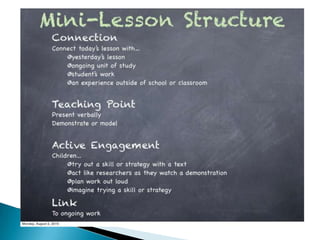
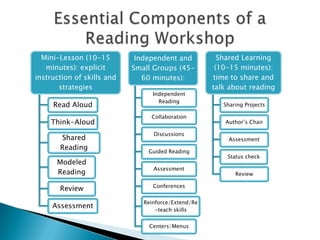
Mini-Lesson (10-15
minutes): explicit
instruction of skills and
strategies
Read Aloud
Think-Aloud
Shared
Reading
Modeled
Reading
Review
Assessment
Independent and
Small Groups (45-
60 minutes):
Independent
Reading
Collaboration
Discussions
Guided Reading
Assessment
Conferences
Reinforce/Extend/Re
-teach skills
Centers/Menus
Shared Learning
(10-15 minutes):
time to share and
talk about reading
Sharing Projects
Author’s Chair
Assessment
Status check
Review
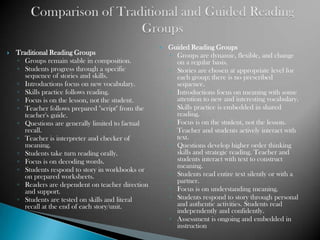
 Traditional Reading Groups
◦ Groups remain stable in composition.
◦ Students progress through a specific
sequence of stories and skills.
◦ Introductions focus on new vocabulary.
◦ Skills practice follows reading.
◦ Focus is on the lesson, not the student.
◦ Teacher follows prepared "script" from the
teacher's guide.
◦ Questions are generally limited to factual
recall.
◦ Teacher is interpreter and checker of
meaning.
◦ Students take turn reading orally.
◦ Focus is on decoding words.
◦ Students respond to story in workbooks or
on prepared worksheets.
◦ Readers are dependent on teacher direction
and support.
◦ Students are tested on skills and literal
recall at the end of each story/unit.
 Guided Reading Groups
◦ Groups are dynamic, flexible, and change
on a regular basis.
◦ Stories are chosen at appropriate level for
each group; there is no prescribed
sequence.
◦ Introductions focus on meaning with some
attention to new and interesting vocabulary.
◦ Skills practice is embedded in shared
reading.
◦ Focus is on the student, not the lesson.
◦ Teacher and students actively interact with
text.
◦ Questions develop higher order thinking
skills and strategic reading. Teacher and
students interact with text to construct
meaning.
◦ Students read entire text silently or with a
partner.
◦ Focus is on understanding meaning.
◦ Students respond to story through personal
and authentic activities. Students read
independently and confidently.
◦ Assessment is ongoing and embedded in
instruction
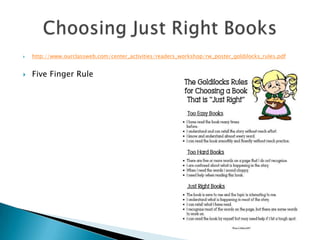
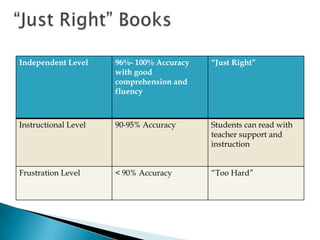
 http://www.ourclassweb.com/center_activities/readers_workshop/rw_poster_goldilocks_rules.pdf
 Five Finger Rule
Independent Level 96%- 100% Accuracy
with good
comprehension and
fluency
“Just Right”
Instructional Level 90-95% Accuracy Students can read with
teacher support and
instruction
Frustration Level < 90% Accuracy “Too Hard”
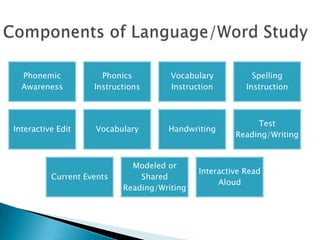
Phonemic
Awareness
Phonics
Instructions
Vocabulary
Instruction
Spelling
Instruction
Interactive Edit Vocabulary Handwriting
Test
Reading/Writing
Current Events
Modeled or
Shared
Reading/Writing
Interactive Read
Aloud
 http://insideteaching.org/quest/collections/s
ites/myers_jennifer/workshopapproach.htm
1. Plan and
Organize Your
Classroom
2. Develop Your
Schedule
3. Establish
Clear Routines
and Expectations
6. Prepare
Relevant
Activities at Level
4. Use Data to
Group Students
5. Determine
Instruction
7. Progress
Monitor
8. Readjust and
Plan Instruction
1. What your
classroom will look
like (sketch it out)
2. What your
schedule will look
like (write it out)
3. List your
routines and
procedures to
explicitly teach
Work by yourself or with a partner to develop:

Reading workshop structure

  • 1.
    Jennifer Evans Assistant DirectorELA St. Clair County RESA Evans.jennifer@sccresa.org http://www.protopage.com/evans.jennifer
  • 2.
     In orderto create a literacy environment within your classroom, what things must be considered?
  • 3.
     In orderto create a literacy environment within your classroom, what things must be considered? * traffic flow * rich language environment * rule/procedures * management of materials *good lighting * preferred seating *interests levels * leveled library * noise level *relevant activities * file folder games at level *trust * comfort * safety *vision * work to keep engaged *goal setting
  • 4.
     In orderfor a guided reading group to be successful, the rest of the students in the class need to be involved in meaningful literacy activities.
  • 5.
    At your table,take turns sharing examples of meaningful activities for students to do. Each time you share, place your chip in the center. Everyone must share before you share again. Take notes of meaningful activities you would like to use.
  • 6.
    Students are actively engaged Concepts and strategiesare reinforced Collaboration and independence are promoted
  • 7.
    Literacy develops best throughsocial interaction and dialogue with others. Guided reading is essentially a carefully managed “social occurrence”.
  • 8.
    One of themost important things we can do as educators is to provide students with ample time for reading and writing. It is necessary to have a classroom structure in place that supports the other students in their literacy learning. Management and routines are key!
  • 9.
    Whole-Class Meeting Area (Thisincludes my easel, rug, directors chair, etc.) Book Shelves for My Classroom Library My Bulletin Boards (My CAFE board, Homeworkopoly, 6 Traits Board, Writer's & Reader's Workshop, All About Me Board, etc.) Check In/Paper Work Area for Students Computers Materials/Supplies Set Up Desks/Tables
  • 10.
     The sisters– setting up your classroom: http://www.choiceliteracy.com/books-dvds- detail.php?id=57  Classroom set-up: http://workshopteaching.weebly.com/classroo m-set-up.html
  • 11.
     The ReadingWorkshop Resource page: http://www.busyteacherscafe.com/literacy/reading _workshop.html  What effective classroom libraries look like: http://teacher.scholastic.com/products/classroo mbooks/pdfs/research/What_Effective_Libraries. pdf  Daily 5 Literacy Block: http://pinterest.com/megandm/daily-5-literacy- block/
  • 12.
    Amount of TimeGrouping Types of Activities 10-15 minutes Whole group Mini-Lesson 15 minutes Individual Self-selected reading/journaling 10-15 minutes Whole group Mini-lesson 30 minutes Small groups Guided reading Read to Self Word work Read to Partner Write about Reading 10-15 minutes Whole group Mini-lesson 30 minutes Literacy Centers or Literature Circles or Guided Reading Conferring Read to Self Read to Partner Word Work Listen to Reading Discussions Guided Reading
  • 13.
    Amount of TimeGrouping Types of Activities 15 minutes Whole group Spelling Basal story Comprehension strategies/skills Vocabulary Phonics Cooperative learning 15 minutes Individual Self-selected reading/journaling 30 minutes Small groups Guided reading Leveled readers Mini-lessons Word work 30 minutes Literacy Centers or Literature Circles Fluency Comprehension Vocabulary Phonics Spelling Read and response
  • 14.
    Time Subject BalancedLiteracy Element 8:40 – 9:00 Morning Procedures Independent Writing – Journaling Independent Reading Book Selection 9:00 – 10:00 Writer’s Workshop Modeled Writing, Interactive Writing, Independent Writing, Guided Writing, & Read Aloud 10:00 – 11:30 Reading Block Shared Reading, Guided Reading, Literature Circles, Work Stations, Independent Reading, Read Aloud & Word Study 11:30 – 12:15 Lunch/Recess 12:15 – 12:45 Word Study Spelling & Word Study 12:45 – 1:05 Independent Reading Self-Selected Reading & Reading Conferences 1:05 – 1:35 Special Area Class Shared Reading, Read Aloud & Word Study 1:20 – 1:50 Intervention Groups Reading Interventions & Enrichment 1:50 – 2:50 Math Shared Reading & Independent Writing 2:50 – 3:20 Content Area Dependent upon the lesson
  • 15.
     The wayteachers structure the learning environment and the way students spend their time influences the level of reading proficiency the students have attained at the end of the academic year. (p. 7)
  • 16.
    We wanted tochange the atmosphere in our classroom to create routines and procedures that fostered independent literacy behaviors that were ingrained to the point of being habits. Our goal was for all students to have internalized these expectations and shared experiences in a way that allowed for every child to become engrossed in their reading. (p. 9)
  • 19.
     When trustis combined with explicit instruction, our students acquire the skills necessary to become independent learners. Students will continue their learning even when they are not being “managed” by the teacher. (p. 18)  Providing choice  Establish routines  Explicitly explain why  Build Stamina  Good-fit books  Anchor Charts  Correct Modeling
  • 20.
     http://www.youtube.com/watch?v=cgN2WUM W6zM (Calkins– Structures of a Reading Workshop– 5min)  Rick’s Reading Workshop Overview: https://www.teachingchannel.org/videos/rea ding-workshop-overview
  • 21.
    Mini-Lesson (10-15 minutes): explicit instructionof skills and strategies Read Aloud Think-Aloud Shared Reading Modeled Reading Review Assessment Independent and Small Groups (45- 60 minutes): Independent Reading Collaboration Discussions Guided Reading Assessment Conferences Reinforce/Extend/Re -teach skills Centers/Menus Shared Learning (10-15 minutes): time to share and talk about reading Sharing Projects Author’s Chair Assessment Status check Review
  • 24.
     Traditional ReadingGroups ◦ Groups remain stable in composition. ◦ Students progress through a specific sequence of stories and skills. ◦ Introductions focus on new vocabulary. ◦ Skills practice follows reading. ◦ Focus is on the lesson, not the student. ◦ Teacher follows prepared "script" from the teacher's guide. ◦ Questions are generally limited to factual recall. ◦ Teacher is interpreter and checker of meaning. ◦ Students take turn reading orally. ◦ Focus is on decoding words. ◦ Students respond to story in workbooks or on prepared worksheets. ◦ Readers are dependent on teacher direction and support. ◦ Students are tested on skills and literal recall at the end of each story/unit.  Guided Reading Groups ◦ Groups are dynamic, flexible, and change on a regular basis. ◦ Stories are chosen at appropriate level for each group; there is no prescribed sequence. ◦ Introductions focus on meaning with some attention to new and interesting vocabulary. ◦ Skills practice is embedded in shared reading. ◦ Focus is on the student, not the lesson. ◦ Teacher and students actively interact with text. ◦ Questions develop higher order thinking skills and strategic reading. Teacher and students interact with text to construct meaning. ◦ Students read entire text silently or with a partner. ◦ Focus is on understanding meaning. ◦ Students respond to story through personal and authentic activities. Students read independently and confidently. ◦ Assessment is ongoing and embedded in instruction
  • 25.
  • 26.
    Independent Level 96%-100% Accuracy with good comprehension and fluency “Just Right” Instructional Level 90-95% Accuracy Students can read with teacher support and instruction Frustration Level < 90% Accuracy “Too Hard”
  • 27.
    Phonemic Awareness Phonics Instructions Vocabulary Instruction Spelling Instruction Interactive Edit VocabularyHandwriting Test Reading/Writing Current Events Modeled or Shared Reading/Writing Interactive Read Aloud
  • 28.
  • 30.
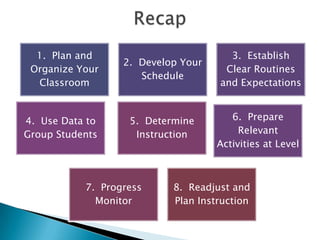
    1. Plan and OrganizeYour Classroom 2. Develop Your Schedule 3. Establish Clear Routines and Expectations 6. Prepare Relevant Activities at Level 4. Use Data to Group Students 5. Determine Instruction 7. Progress Monitor 8. Readjust and Plan Instruction
  • 31.
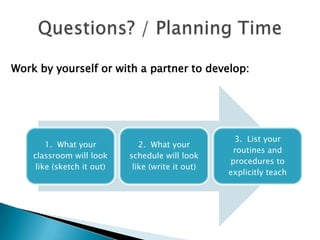
    1. What your classroomwill look like (sketch it out) 2. What your schedule will look like (write it out) 3. List your routines and procedures to explicitly teach Work by yourself or with a partner to develop:

Editor's Notes

  • #3 Traffic flow, rich language environment, rule/procedures, management of materials, good lighting, preferred seating, interests levels, leveled library, have at least 7 books per child, noise level, relevant activities, file folder games at their level, trust, comfort, safety, vision, work to keep engaged, goal setting
  • #4 Traffic flow, rich language environment, rule/procedures, management of materials, good lighting, preferred seating, interests levels, leveled library, have at least 7 books per child, noise level, relevant activities, file folder games at their level, trust, comfort, safety, vision, work to keep engaged, goal setting
  • #13 This is just a model of what a normal day may look like. However, when doing a class novel, the timing may change.
  • #14 This is just a model of what a normal day may look like. However, when doing a class novel, the timing may change.
  • #15  Literacy development consumes a large portion of the school day. In order for students to grow into real readers and writers, they need to be provided with ample time to hone their skills. Reading and writing elements are employed in every subject area throughout the day. For example, while the students are in gym class, they may read the rules to a new game or match terms to the correct lines on the basketball court (Free Throw Line card would be placed on the actual free throw line).