10/16/2014 
1 
FLUXES FOR WELDING 
BY 
JABIN MATHEW BENJAMIN 
13MY04 
DEPT. OF METALLURGICAL ENGINEERING
NEED FOR FLUXES 
10/16/2014 
2 
 Oxide Formation 
 Sources of O2 
 Oxide fluxes 
 Atmosphere air 
 Slag-metal reactions 
 Effects 
 Reduces hardenability of weld 
 Promotes porosity 
 Produces inclusions
NEED FOR FLUXES 
10/16/2014 
3 
 Inclusion Formation. 
 Sources of inclusions 
 Mechanical entrapment of nonmetallic slag 
 Reactions between metallic alloy elements and nonmetallic 
tramp elements 
 Types 
 Oxides 
 Sulfides 
 Nitrides 
 Carbides
FLUXES 
10/16/2014 
4 
 Added to the welding environment to improve arc stability 
 The flux, by providing easily ionized atoms, plays an important 
role in welding by improving arc stability. 
 To provide a slag and with low density 
 Covers the hot weld metal and protects it from the atmosphere. 
 To add alloying elements 
 To improve weld metal properties 
 Refine the weld pool (deoxidation and desulfurization) 
 To avoid formation to oxide and sulphide inclusions
Types Of Fluxes 
10/16/2014 
5 
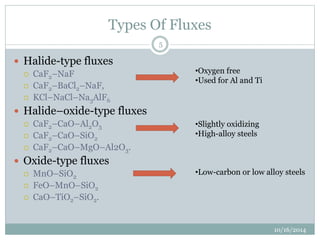
 Halide-type fluxes 
 CaF2–NaF 
 CaF2–BaCl2–NaF, 
 KCl–NaCl–Na3AlF6 
 Halide–oxide-type fluxes 
 CaF2–CaO–Al2O3 
 CaF2–CaO–SiO2 
 CaF2–CaO–MgO–Al2O3. 
 Oxide-type fluxes 
 MnO–SiO2 
 FeO–MnO–SiO2 
 CaO–TiO2–SiO2. 
•Oxygen free 
•Used for Al and Ti 
•Slightly oxidizing 
•High-alloy steels 
•Low-carbon or low alloy steels
Basicity Index 
10/16/2014 
6 
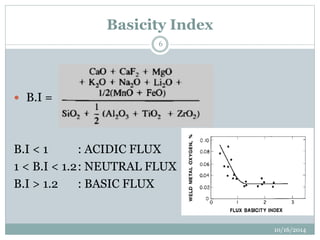
 B.I = 
B.I < 1 : ACIDIC FLUX 
1 < B.I < 1.2: NEUTRAL FLUX 
B.I > 1.2 : BASIC FLUX
Oxide Fluxes 
10/16/2014 
7 
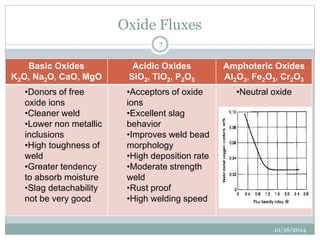
Basic Oxides 
K2O, Na2O, CaO, MgO 
Acidic Oxides 
SiO2, TiO2, P2O5 
Amphoteric Oxides 
Al2O3, Fe2O3, Cr2O3 
•Donors of free 
oxide ions 
•Cleaner weld 
•Lower non metallic 
inclusions 
•High toughness of 
weld 
•Greater tendency 
to absorb moisture 
•Slag detachability 
not be very good 
•Acceptors of oxide 
ions 
•Excellent slag 
behavior 
•Improves weld bead 
morphology 
•High deposition rate 
•Moderate strength 
weld 
•Rust proof 
•High welding speed 
•Neutral oxide
Functions of flux components 
10/16/2014 
8 
 CaO 
 Strong desulfurizer 
 MnO 
 Increased penetration 
 SiO2 
 Lower content increases the width to depth ratio.
Slag Formation 
10/16/2014 
9 
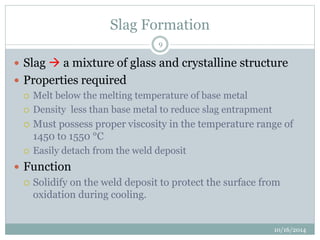
 Slag  a mixture of glass and crystalline structure 
 Properties required 
 Melt below the melting temperature of base metal 
 Density less than base metal to reduce slag entrapment 
 Must possess proper viscosity in the temperature range of 
1450 to 1550 °C 
 Easily detach from the weld deposit 
 Function 
 Solidify on the weld deposit to protect the surface from 
oxidation during cooling.
Shielded Metal Arc Welding 
10/16/2014 
10 
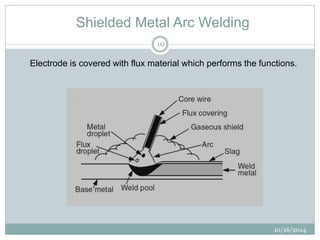
Electrode is covered with flux material which performs the functions.
10/16/2014 
Flux-cored Arc Welding (FCAW) 
11 
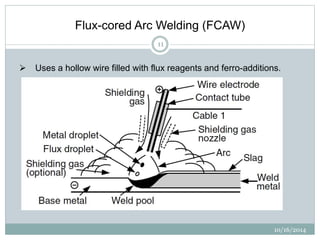
 Uses a hollow wire filled with flux reagents and ferro-additions.
FCAW Fluxes 
10/16/2014 
12 
 Carbon-dioxide-shielded FCAW 
 Titania 
 Lime 
 High CO2 content as carbonates 
 Self-shielded FCAW 
 Fluorspar-aluminum 
 Fluorspar-titania 
 Low CO2 content
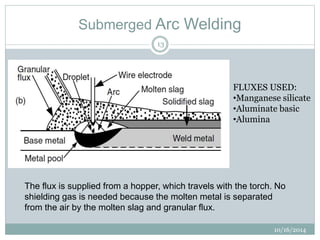
Submerged Arc Welding 
FLUXES USED: 
•Manganese silicate 
•Aluminate basic 
•Alumina 
10/16/2014 
13 
The flux is supplied from a hopper, which travels with the torch. No 
shielding gas is needed because the molten metal is separated 
from the air by the molten slag and granular flux.
10/16/2014 
14 
 Bonded fluxes 
 Non metallic and ferro additions with low temperature 
binders 
 Agglomerated fluxes 
 Similar to bonded but used with ceramic glass binder 
cured at high temperature 
 Fused fluxes 
 Homogeneous glass mixture of proper flux mixture into 
water
Fluxes and Weld Penetration 
10/16/2014 
15 
 High viscosity 
 Confine the molten weld pool 
 Increases the heat input for a given area 
 Deeper penetration. 
 Flux composition 
 Affects arc stability 
 More ionized particles more stable arc 
 A more stable arc will produce deeper penetration 
 Surface tension 
 Increases weld penetration.
Finally a welding flux must also.. 
10/16/2014 
16 
 Stabilize arc and control arc resistivity 
 Permit use of different types of current and polarity 
 Promote slag detachability 
 Produce smooth weld contour 
 Reduce spatter and fume
Reference 
10/16/2014 
17 
 Jackson, C. E., "Fluxes and Slags in Welding," W. R. C Bulletin, 190, 
(1977). 
 Janzen, H. E„ "An Investigation of the SiO-MnO-CaO/CaF2 Welding 
Flux System, "Thesis, Colorado School of Mines,T-1970, (1977). 
 ASM handbook, Vol. 6.
THANKYOU 
10/16/2014 
18

Fluxes in welding

  • 1.
    10/16/2014 1 FLUXESFOR WELDING BY JABIN MATHEW BENJAMIN 13MY04 DEPT. OF METALLURGICAL ENGINEERING
  • 2.
    NEED FOR FLUXES 10/16/2014 2  Oxide Formation  Sources of O2  Oxide fluxes  Atmosphere air  Slag-metal reactions  Effects  Reduces hardenability of weld  Promotes porosity  Produces inclusions
  • 3.
    NEED FOR FLUXES 10/16/2014 3  Inclusion Formation.  Sources of inclusions  Mechanical entrapment of nonmetallic slag  Reactions between metallic alloy elements and nonmetallic tramp elements  Types  Oxides  Sulfides  Nitrides  Carbides
  • 4.
    FLUXES 10/16/2014 4  Added to the welding environment to improve arc stability  The flux, by providing easily ionized atoms, plays an important role in welding by improving arc stability.  To provide a slag and with low density  Covers the hot weld metal and protects it from the atmosphere.  To add alloying elements  To improve weld metal properties  Refine the weld pool (deoxidation and desulfurization)  To avoid formation to oxide and sulphide inclusions
  • 5.
    Types Of Fluxes 10/16/2014 5  Halide-type fluxes  CaF2–NaF  CaF2–BaCl2–NaF,  KCl–NaCl–Na3AlF6  Halide–oxide-type fluxes  CaF2–CaO–Al2O3  CaF2–CaO–SiO2  CaF2–CaO–MgO–Al2O3.  Oxide-type fluxes  MnO–SiO2  FeO–MnO–SiO2  CaO–TiO2–SiO2. •Oxygen free •Used for Al and Ti •Slightly oxidizing •High-alloy steels •Low-carbon or low alloy steels
  • 6.
    Basicity Index 10/16/2014 6  B.I = B.I < 1 : ACIDIC FLUX 1 < B.I < 1.2: NEUTRAL FLUX B.I > 1.2 : BASIC FLUX
  • 7.
    Oxide Fluxes 10/16/2014 7 Basic Oxides K2O, Na2O, CaO, MgO Acidic Oxides SiO2, TiO2, P2O5 Amphoteric Oxides Al2O3, Fe2O3, Cr2O3 •Donors of free oxide ions •Cleaner weld •Lower non metallic inclusions •High toughness of weld •Greater tendency to absorb moisture •Slag detachability not be very good •Acceptors of oxide ions •Excellent slag behavior •Improves weld bead morphology •High deposition rate •Moderate strength weld •Rust proof •High welding speed •Neutral oxide
  • 8.
    Functions of fluxcomponents 10/16/2014 8  CaO  Strong desulfurizer  MnO  Increased penetration  SiO2  Lower content increases the width to depth ratio.
  • 9.
    Slag Formation 10/16/2014 9  Slag  a mixture of glass and crystalline structure  Properties required  Melt below the melting temperature of base metal  Density less than base metal to reduce slag entrapment  Must possess proper viscosity in the temperature range of 1450 to 1550 °C  Easily detach from the weld deposit  Function  Solidify on the weld deposit to protect the surface from oxidation during cooling.
  • 10.
    Shielded Metal ArcWelding 10/16/2014 10 Electrode is covered with flux material which performs the functions.
  • 11.
    10/16/2014 Flux-cored ArcWelding (FCAW) 11  Uses a hollow wire filled with flux reagents and ferro-additions.
  • 12.
    FCAW Fluxes 10/16/2014 12  Carbon-dioxide-shielded FCAW  Titania  Lime  High CO2 content as carbonates  Self-shielded FCAW  Fluorspar-aluminum  Fluorspar-titania  Low CO2 content
  • 13.
    Submerged Arc Welding FLUXES USED: •Manganese silicate •Aluminate basic •Alumina 10/16/2014 13 The flux is supplied from a hopper, which travels with the torch. No shielding gas is needed because the molten metal is separated from the air by the molten slag and granular flux.
  • 14.
    10/16/2014 14 Bonded fluxes  Non metallic and ferro additions with low temperature binders  Agglomerated fluxes  Similar to bonded but used with ceramic glass binder cured at high temperature  Fused fluxes  Homogeneous glass mixture of proper flux mixture into water
  • 15.
    Fluxes and WeldPenetration 10/16/2014 15  High viscosity  Confine the molten weld pool  Increases the heat input for a given area  Deeper penetration.  Flux composition  Affects arc stability  More ionized particles more stable arc  A more stable arc will produce deeper penetration  Surface tension  Increases weld penetration.
  • 16.
    Finally a weldingflux must also.. 10/16/2014 16  Stabilize arc and control arc resistivity  Permit use of different types of current and polarity  Promote slag detachability  Produce smooth weld contour  Reduce spatter and fume
  • 17.
    Reference 10/16/2014 17  Jackson, C. E., "Fluxes and Slags in Welding," W. R. C Bulletin, 190, (1977).  Janzen, H. E„ "An Investigation of the SiO-MnO-CaO/CaF2 Welding Flux System, "Thesis, Colorado School of Mines,T-1970, (1977).  ASM handbook, Vol. 6.
  • 18.