CEE 205
Fluid Mechanics
Fluid Statics
Fluid Statics
 At rest
 No relative motion
 Moving with same velocity
In statics the particles of fluid is at rest or there is no
relative motion between adjacent layers.
Hydrostatics
Aerostatics
Stress Acting in Fluid Statics
 No Shear stress
 Only normal stress
 Significant in gravity fields only
Pascal’s Law
Pascal's law states that pressure at any point is the same in all
directions and hence it is a scalar quantity in fluid statics.
Pascal's law states that any two points at same elevation in a
continuous mass of static fluid will be at the same pressure.
Pascal's law or the principle of transmission of fluid-pressure is a
principle in fluid mechanics that states that pressure exerted
anywhere in a confined incompressible fluid is transmitted
equally in all directions throughout the fluid such that the
pressure variations (initial differences) remain the same.
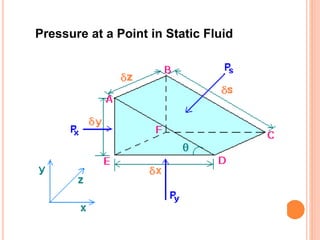
Pressure at a Point in Static Fluid
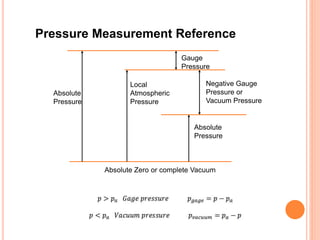
Pressure Measurement Reference
Absolute Zero or complete Vacuum
Absolute
Pressure
Local
Atmospheric
Pressure
Absolute
Pressure
Gauge
Pressure
Negative Gauge
Pressure or
Vacuum Pressure
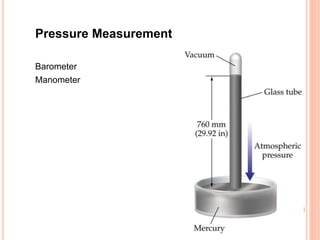
Pressure Measurement
Barometer
Manometer
Pressure Measurement: Manometer
Piezometer
U tube manometer
Differential manometer
Multiple tube manometer
Multiple liquid manometer
Inclined tube manometer
Inverted U tube manometer
Manometer with enlarged ends
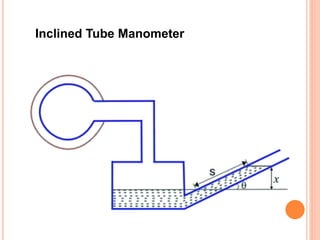
Inclined Tube Manometer
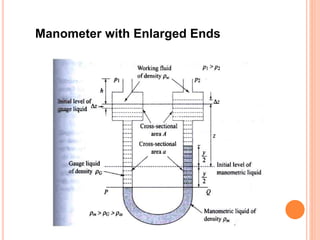
Manometer with Enlarged Ends
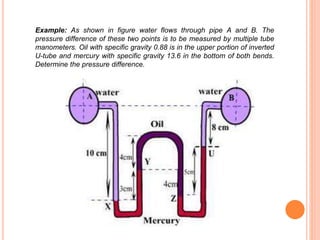
Example: As shown in figure water flows through pipe A and B. The
pressure difference of these two points is to be measured by multiple tube
manometers. Oil with specific gravity 0.88 is in the upper portion of inverted
U-tube and mercury with specific gravity 13.6 in the bottom of both bends.
Determine the pressure difference.
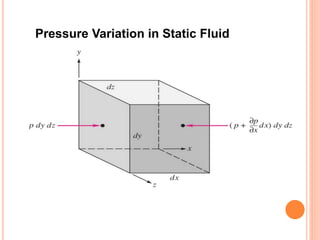
Pressure Variation in Static Fluid
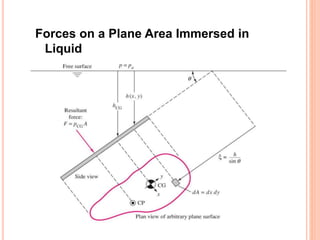
Forces on a Plane Area Immersed in
Liquid
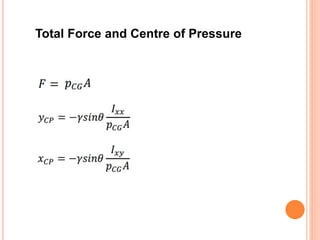
Total Force and Centre of Pressure
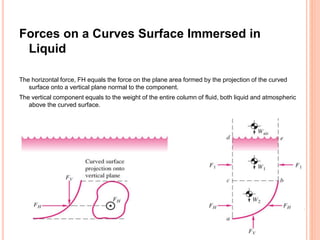
Forces on a Curves Surface Immersed in
Liquid
The horizontal force, FH equals the force on the plane area formed by the projection of the curved
surface onto a vertical plane normal to the component.
The vertical component equals to the weight of the entire column of fluid, both liquid and atmospheric
above the curved surface.
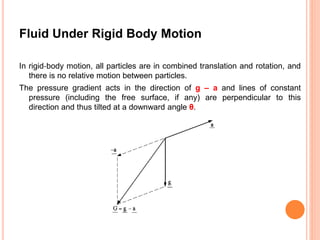
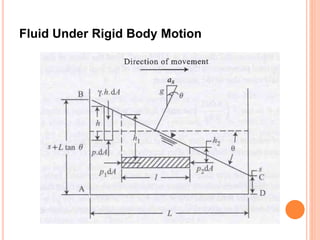
Fluid Under Rigid Body Motion
In rigid‐body motion, all particles are in combined translation and rotation, and
there is no relative motion between particles.
The pressure gradient acts in the direction of g – a and lines of constant
pressure (including the free surface, if any) are perpendicular to this
direction and thus tilted at a downward angle θ.
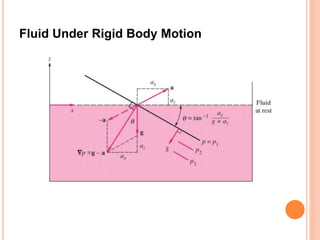
Fluid Under Rigid Body Motion
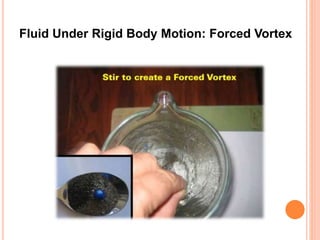
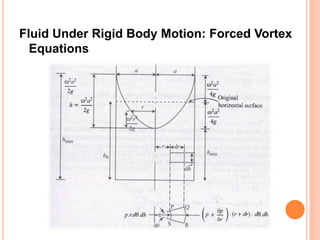
Fluid Under Rigid Body Motion: Forced Vortex
Equations
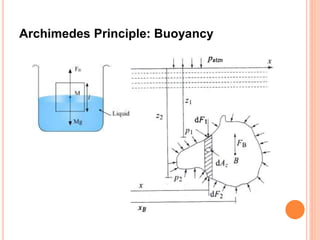
Archimedes Principle: Buoyancy
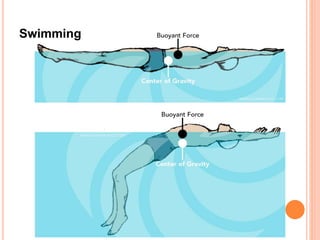
Swimming
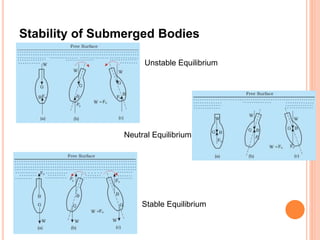
Stability of Submerged Bodies
Unstable Equilibrium
Stable Equilibrium
Neutral Equilibrium
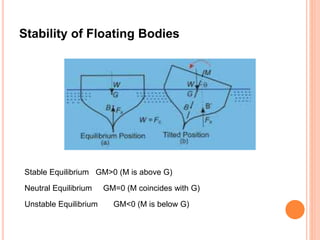
Stability of Floating Bodies
Stable Equilibrium GM>0 (M is above G)
Unstable Equilibrium GM<0 (M is below G)
Neutral Equilibrium GM=0 (M coincides with G)
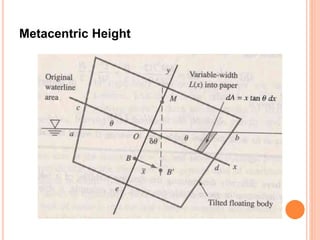
Metacentric Height

Fluid_Statics.pptx

  • 1.
  • 2.
    Fluid Statics  Atrest  No relative motion  Moving with same velocity In statics the particles of fluid is at rest or there is no relative motion between adjacent layers. Hydrostatics Aerostatics
  • 3.
    Stress Acting inFluid Statics  No Shear stress  Only normal stress  Significant in gravity fields only
  • 4.
    Pascal’s Law Pascal's lawstates that pressure at any point is the same in all directions and hence it is a scalar quantity in fluid statics. Pascal's law states that any two points at same elevation in a continuous mass of static fluid will be at the same pressure. Pascal's law or the principle of transmission of fluid-pressure is a principle in fluid mechanics that states that pressure exerted anywhere in a confined incompressible fluid is transmitted equally in all directions throughout the fluid such that the pressure variations (initial differences) remain the same.
  • 5.
    Pressure at aPoint in Static Fluid
  • 6.
    Pressure Measurement Reference AbsoluteZero or complete Vacuum Absolute Pressure Local Atmospheric Pressure Absolute Pressure Gauge Pressure Negative Gauge Pressure or Vacuum Pressure
  • 7.
  • 8.
    Pressure Measurement: Manometer Piezometer Utube manometer Differential manometer Multiple tube manometer Multiple liquid manometer Inclined tube manometer Inverted U tube manometer Manometer with enlarged ends
  • 9.
  • 10.
  • 11.
    Example: As shownin figure water flows through pipe A and B. The pressure difference of these two points is to be measured by multiple tube manometers. Oil with specific gravity 0.88 is in the upper portion of inverted U-tube and mercury with specific gravity 13.6 in the bottom of both bends. Determine the pressure difference.
  • 12.
  • 13.
    Forces on aPlane Area Immersed in Liquid
  • 14.
    Total Force andCentre of Pressure
  • 15.
    Forces on aCurves Surface Immersed in Liquid The horizontal force, FH equals the force on the plane area formed by the projection of the curved surface onto a vertical plane normal to the component. The vertical component equals to the weight of the entire column of fluid, both liquid and atmospheric above the curved surface.
  • 16.
    Fluid Under RigidBody Motion In rigid‐body motion, all particles are in combined translation and rotation, and there is no relative motion between particles. The pressure gradient acts in the direction of g – a and lines of constant pressure (including the free surface, if any) are perpendicular to this direction and thus tilted at a downward angle θ.
  • 17.
    Fluid Under RigidBody Motion
  • 18.
    Fluid Under RigidBody Motion
  • 19.
    Fluid Under RigidBody Motion: Forced Vortex
  • 20.
    Fluid Under RigidBody Motion: Forced Vortex Equations
  • 21.
  • 22.
  • 23.
    Stability of SubmergedBodies Unstable Equilibrium Stable Equilibrium Neutral Equilibrium
  • 24.
    Stability of FloatingBodies Stable Equilibrium GM>0 (M is above G) Unstable Equilibrium GM<0 (M is below G) Neutral Equilibrium GM=0 (M coincides with G)
  • 25.