Chapter 2
Fluid Statics
Lecture Topics on 14-09-2022
Chapter 2 Fluid Statics
Learning Objectives
2.1 Pressure at a Point
ME F212 Fluid Mechanics
Learning Objectives
After completing this chapter, you should be able to:
• Determine the pressure at various locations in a
fluid at rest
• Explain the concept of manometers and apply
appropriate equations to determine pressure
• Calculate the hydrostatic pressure force on a plan
or curved submerged surface
• Calculate the buoyant force and discuss the
stability of floating or submerged objects
ME F212 Fluid Mechanics
Pressure at a Point
How does the pressure at a point vary with
orientation of the plane passing through the
point?
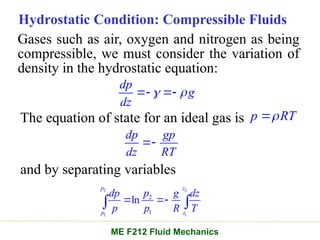
The term pressure is used to indicate the normal
force per unit area at a given point acting on a given
plane within the fluid mass of interest.
ME F212 Fluid Mechanics
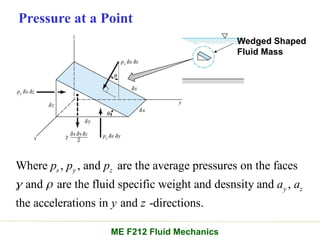
To answer this question, consider the free body
diagram, that was obtained by removing a small
triangular wedge of fluid from some arbitrary
location within a fluid mass.
Wedged Shaped
Fluid Mass
Pressure at a Point
Where , , and are the average pressures on the faces
and are the fluid specific weight and desnsity and ,
the accelerations in and -directions.
s y z
y z
p p p
a a
y z
 
ME F212 Fluid Mechanics
Pressure at a Point: Analysis
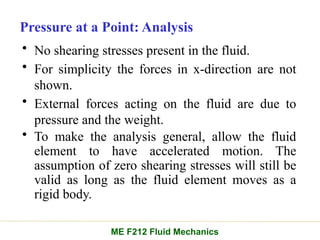
• No shearing stresses present in the fluid.
• For simplicity the forces in x-direction are not
shown.
• External forces acting on the fluid are due to
pressure and the weight.
• To make the analysis general, allow the fluid
element to have accelerated motion. The
assumption of zero shearing stresses will still be
valid as long as the fluid element moves as a
rigid body.
ME F212 Fluid Mechanics
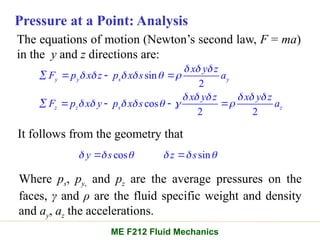
The equations of motion (Newton’s second law, F = ma)
in the y and z directions are:
Pressure at a Point: Analysis
sin
2
cos
2 2
y y s y
z z s z
x y z
F p x z p x s a
x y z x y z
F p x y p x s a
  
     
     
      
   
    
It follows from the geometry that
cos sin
y s z s
     
 
Where ps, py, and pz are the average pressures on the
faces, γ and ρ are the fluid specific weight and density
and ay, az the accelerations.
ME F212 Fluid Mechanics
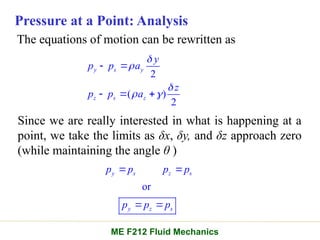
The equations of motion can be rewritten as
Pressure at a Point: Analysis
2
( )
2
y s y
z s z
y
p p a
z
p p a



 
 
  
Since we are really interested in what is happening at a
point, we take the limits as δx, δy, and δz approach zero
(while maintaining the angle θ )
or
y s z s
y z s
p p p p
p p p
 
 
ME F212 Fluid Mechanics
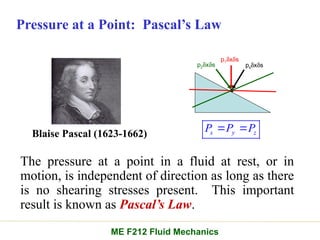
Pressure at a Point: Pascal’s Law
psdxds
p1dxds
p2dxds
The pressure at a point in a fluid at rest, or in
motion, is independent of direction as long as there
is no shearing stresses present. This important
result is known as Pascal’s Law.
Blaise Pascal (1623-1662) s y z
P P P
 
ME F212 Fluid Mechanics
2.3 Pressure Variation in a Fluid at Rest
2.4 Standard Atmosphere
ME F212 Fluid Mechanics
Lecture Topics on 16-09-2022
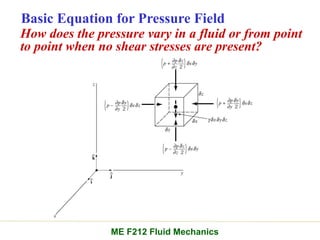
Basic Equation for Pressure Field
How does the pressure vary in a fluid or from point
to point when no shear stresses are present?
ME F212 Fluid Mechanics
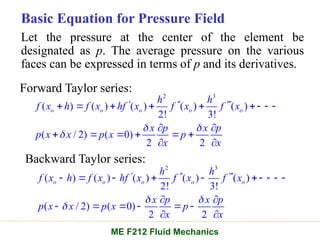
Basic Equation for Pressure Field
Let the pressure at the center of the element be
designated as p. The average pressure on the various
faces can be expressed in terms of p and its derivatives.
ME F212 Fluid Mechanics
Forward Taylor series: 2 3
( ) ( ) ( ) ( ) ( )
2! 3!
( / 2) ( 0)
2 2
o o o o o
h h
f x h f x hf x f x f x
x p x p
p x x p x p
x x
 

 
 


        
 
     
 
Backward Taylor series:
2 3
( ) ( ) ( ) ( ) ( )
2! 3!
( / 2) ( 0)
2 2
o o o o o
h h
f x h f x hf x f x f x
x p x p
p x x p x p
x x
 

 
 


        
 
     
 
Pressure Field Equation
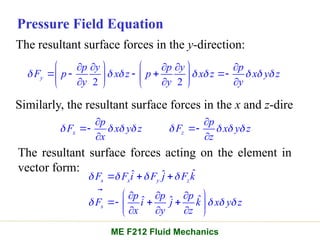
The resultant surface forces in the y-direction:
Similarly, the resultant surface forces in the x and z-dire
The resultant surface forces acting on the element in
vector form:
2 2
y
p y p y p
F p x z p x z x y z
y y y
       
   
    
    
   
  
   
x z
p p
F x y z F x y z
x z
       
 
 
 
ˆ
ˆ ˆ
ˆ
ˆ ˆ
s x y z
s
F F i F j F k
p p p
F i j k x y z
x y z
   
   
  
 
  
  
 
  
 


ME F212 Fluid Mechanics
Pressure Field Equation
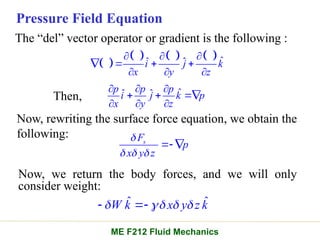
The “del” vector operator or gradient is the following :
Then,
Now, rewriting the surface force equation, we obtain the
following:
Now, we return the body forces, and we will only
consider weight:
ˆ
ˆ ˆ
p p p
i j k p
x y z
  
  
  
 
      ˆ
ˆ ˆ
i j k
x y z
  
   
  
s
F
p
x y z

  
 

ˆ ˆ
W k x y z k
   
 
ME F212 Fluid Mechanics
Pressure Field Equations
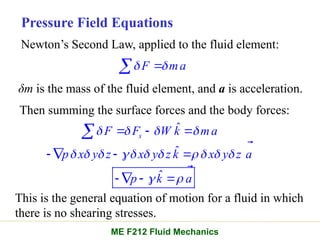
Newton’s Second Law, applied to the fluid element:
δm is the mass of the fluid element, and a is acceleration.
Then summing the surface forces and the body forces:
F ma
 


 
ˆ
ˆ
ˆ
s
F F W k ma
p x y z x y z k x y z a
p k a
   
         
 
  
   
   

  


This is the general equation of motion for a fluid in which
there is no shearing stresses.
ME F212 Fluid Mechanics
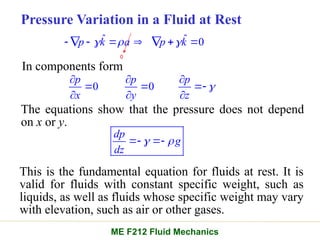
Pressure Variation in a Fluid at Rest
0
In components form
The equations show that the pressure does not depend
on x or y.
This is the fundamental equation for fluids at rest. It is
valid for fluids with constant specific weight, such as
liquids, as well as fluids whose specific weight may vary
with elevation, such as air or other gases.
ˆ ˆ 0
p k a p k
  
       
0 0
p p p
x y z

  
  
  
dp
g
dz
 
 
ME F212 Fluid Mechanics
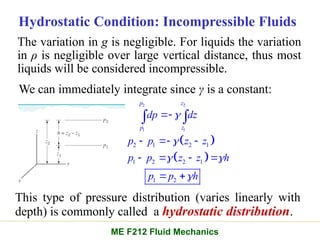
Hydrostatic Condition: Incompressible Fluids
The variation in g is negligible. For liquids the variation
in ρ is negligible over large vertical distance, thus most
liquids will be considered incompressible.
We can immediately integrate since γ is a constant:
This type of pressure distribution (varies linearly with
depth) is commonly called a hydrostatic distribution.
 
 
2 2
1 1
2 1 2 1
1 2 2 1
1 2
p z
p z
dp dz
p p z z
p p z z h
p p h


 


  
   
 
 
ME F212 Fluid Mechanics
Hydrostatic Condition: Incompressible Fluids
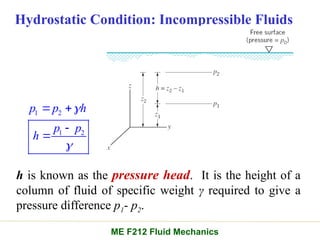
h is known as the pressure head. It is the height of a
column of fluid of specific weight γ required to give a
pressure difference p1- p2.
1 2
1 2
p p h
p p
h


 


ME F212 Fluid Mechanics
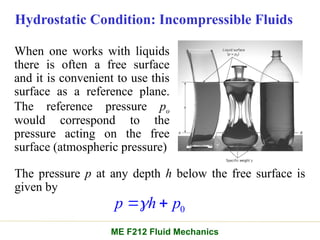
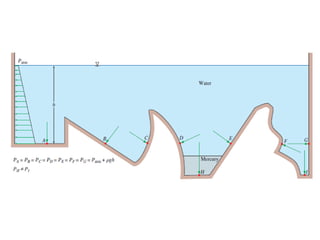
When one works with liquids
there is often a free surface
and it is convenient to use this
surface as a reference plane.
The reference pressure po
would correspond to the
pressure acting on the free
surface (atmospheric pressure)
Hydrostatic Condition: Incompressible Fluids
0
p h p

 
The pressure p at any depth h below the free surface is
given by
ME F212 Fluid Mechanics
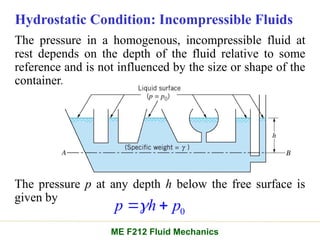
The pressure in a homogenous, incompressible fluid at
rest depends on the depth of the fluid relative to some
reference and is not influenced by the size or shape of the
container.
Hydrostatic Condition: Incompressible Fluids
0
p h p

 
The pressure p at any depth h below the free surface is
given by
ME F212 Fluid Mechanics
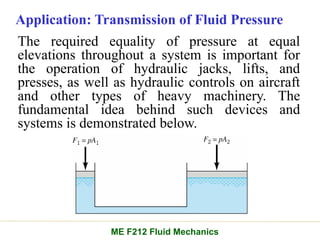
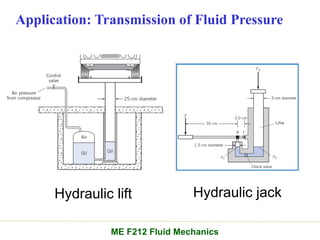
Application: Transmission of Fluid Pressure
The required equality of pressure at equal
elevations throughout a system is important for
the operation of hydraulic jacks, lifts, and
presses, as well as hydraulic controls on aircraft
and other types of heavy machinery. The
fundamental idea behind such devices and
systems is demonstrated below.
ME F212 Fluid Mechanics
Application: Transmission of Fluid Pressure
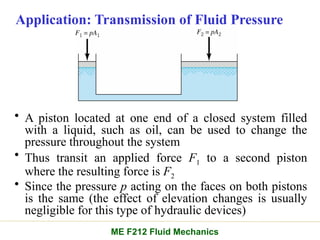
• A piston located at one end of a closed system filled
with a liquid, such as oil, can be used to change the
pressure throughout the system
• Thus transit an applied force F1 to a second piston
where the resulting force is F2
• Since the pressure p acting on the faces on both pistons
is the same (the effect of elevation changes is usually
negligible for this type of hydraulic devices)
ME F212 Fluid Mechanics
Application: Transmission of Fluid Pressure
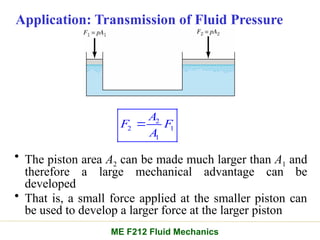
• The piston area A2 can be made much larger than A1 and
therefore a large mechanical advantage can be
developed
• That is, a small force applied at the smaller piston can
be used to develop a larger force at the larger piston
2
2 1
1
A
F F
A

ME F212 Fluid Mechanics
Application: Transmission of Fluid Pressure
Hydraulic lift Hydraulic jack
ME F212 Fluid Mechanics
Hydrostatic Condition: Compressible Fluids
Gases such as air, oxygen and nitrogen as being
compressible, we must consider the variation of
density in the hydrostatic equation:
dp
g
dz
 
 
The equation of state for an ideal gas is p RT


dp gp
dz RT

and by separating variables
2 2
1 1
2
1
ln
p z
p z
p
dp g dz
p p R T
 
 
ME F212 Fluid Mechanics
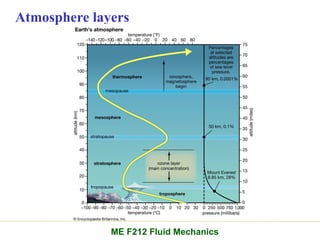
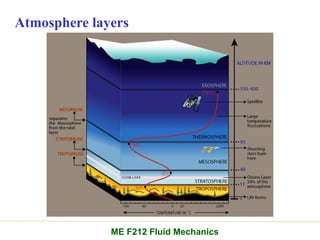
Atmosphere layers
ME F212 Fluid Mechanics
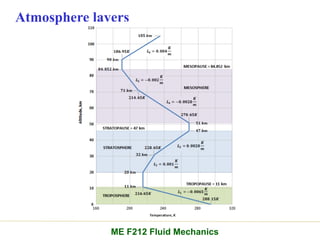
Atmosphere layers
ME F212 Fluid Mechanics
Atmosphere layers
ME F212 Fluid Mechanics
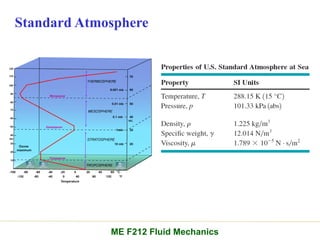
Standard Atmosphere
• One would like to have measurements of pressure
versus altitude over the specific range for the specific
conditions (temperature, reference pressure).
• This type of information is usually not available. Thus
a standard atmosphere has been determined.
• The concept of standard atmosphere was developed in
the 1920s.
• The currently accepted standard atmosphere is based
on a report published in 1962 and updated in 1976.
• The U.S. standard atmosphere is an idealized
representation of middle-latitude, year-round mean
conditions of the earth’s atmosphere.
ME F212 Fluid Mechanics
Standard Atmosphere
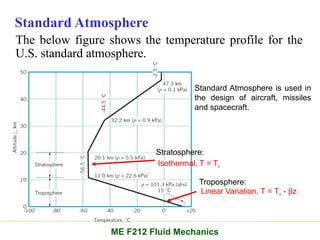
The below figure shows the temperature profile for the
U.S. standard atmosphere.
Linear Variation, T = Ta - bz
Isothermal, T = To
Standard Atmosphere is used in
the design of aircraft, missiles
and spacecraft.
Stratosphere:
Troposphere:
ME F212 Fluid Mechanics
Standard Atmosphere
ME F212 Fluid Mechanics
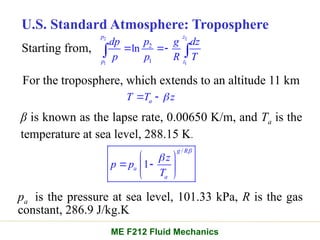
U.S. Standard Atmosphere: Troposphere
Starting from,
For the troposphere, which extends to an altitude 11 km
β is known as the lapse rate, 0.00650 K/m, and Ta is the
temperature at sea level, 288.15 K.
pa is the pressure at sea level, 101.33 kPa, R is the gas
constant, 286.9 J/kg.K
2 2
1 1
2
1
ln
p z
p z
p
dp g dz
p p R T
 
 
a
T T z

 
/
1
g R
a
a
z
p p
T


 
 
 
 
ME F212 Fluid Mechanics
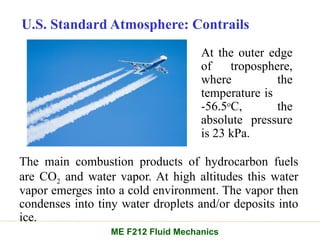
U.S. Standard Atmosphere: Contrails
The main combustion products of hydrocarbon fuels
are CO2 and water vapor. At high altitudes this water
vapor emerges into a cold environment. The vapor then
condenses into tiny water droplets and/or deposits into
ice.
ME F212 Fluid Mechanics
At the outer edge
of troposphere,
where the
temperature is
-56.5o
C, the
absolute pressure
is 23 kPa.
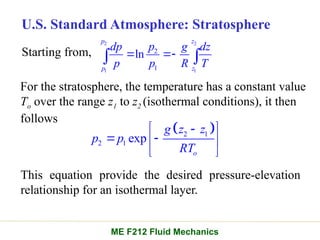
U.S. Standard Atmosphere: Stratosphere
Starting from,
2 2
1 1
2
1
ln
p z
p z
p
dp g dz
p p R T
 
 
For the stratosphere, the temperature has a constant value
To over the range z1 to z2 (isothermal conditions), it then
follows
 
2 1
2 1 exp
o
g z z
p p
RT

 
 
 
 
This equation provide the desired pressure-elevation
relationship for an isothermal layer.
ME F212 Fluid Mechanics
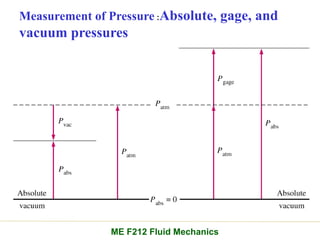
Measurement of Pressure
Absolute Pressure: Pressure measured relative to a
perfect vacuum (absolute zero pressure). or
Gage Pressure: Pressure measured relative to
local atmospheric pressure.
• A gage pressure of zero corresponds to a
pressure that is at local atmospheric pressure.
• Absolute pressure is always positive.
• Gage pressure can be either negative or positive.
• Negative gage pressure is known as a vacuum or
suction.
The pressure at a point is designated as either an
ME F212 Fluid Mechanics
Measurement of Pressure :Absolute, gage, and
vacuum pressures
ME F212 Fluid Mechanics
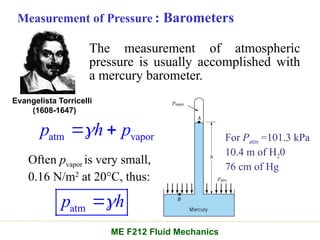
Measurement of Pressure : Barometers
Evangelista Torricelli
(1608-1647)
The measurement of atmospheric
pressure is usually accomplished with
a mercury barometer.
Often pvapor is very small,
0.16 N/m2
at 20°C, thus:
atm vapor
p h p

 
atm
p h


For Patm =101.3 kPa
10.4 m of H20
76 cm of Hg
ME F212 Fluid Mechanics
Measurement of Pressure: Manometry
A standard technique for measuring pressure
involves use of liquid columns in vertical or
inclined tubes are called Manometry. Pressure
measuring devices based on this technique are
called manometers.
The three common types of manometers are
1. The Piezometer Tube
2. The U-Tube Manometer
3. The Inclined Tube Manometer
The fundamental equation for manometers is
0
p h p

 
since they involve columns of fluid at rest.
ME F212 Fluid Mechanics
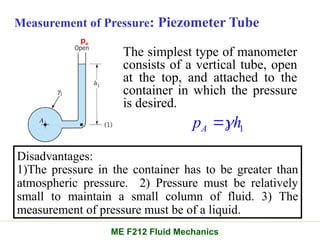
Measurement of Pressure: Piezometer Tube
po
The simplest type of manometer
consists of a vertical tube, open
at the top, and attached to the
container in which the pressure
is desired.
Disadvantages:
1)The pressure in the container has to be greater than
atmospheric pressure. 2) Pressure must be relatively
small to maintain a small column of fluid. 3) The
measurement of pressure must be of a liquid.
1
A
p h


ME F212 Fluid Mechanics
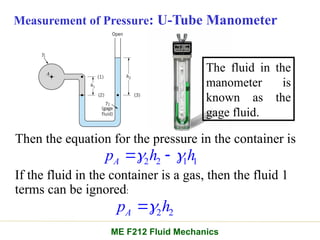
Measurement of Pressure: U-Tube Manometer
Then the equation for the pressure in the container is
If the fluid in the container is a gas, then the fluid 1
terms can be ignored:
The fluid in the
manometer is
known as the
gage fluid.
2 2 1 1
A
p h h
 
 
2 2
A
p h


ME F212 Fluid Mechanics
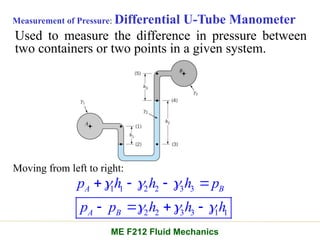
Measurement of Pressure: Differential U-Tube Manometer
Used to measure the difference in pressure between
two containers or two points in a given system.
Moving from left to right:
1 1 2 2 3 3
2 2 3 3 1 1
A B
A B
p h h h p
p p h h h
  
  
   
   
ME F212 Fluid Mechanics
Differential U-Tube Manometer
Final notes:
• Capillarity due to surface tension at the various fluid
interfaces are not considered.
• Capillarity can play a role, but in many cases each
meniscus will cancel (ex: simple U-tube manometer).
• Making the Capillary rise negligible by using relative
large bore tubes.
• Temperature must be considered in very accurate
measurements, as the gage fluid properties can change.
• Common gage fluids are Hg and Water, some oils, and
must be immiscible.
ME F212 Fluid Mechanics
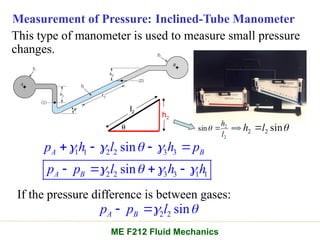
Measurement of Pressure: Inclined-Tube Manometer
This type of manometer is used to measure small pressure
changes.
q
h2
l2
2
2
sin
l
h

 
sin
2
2 l
h 
If the pressure difference is between gases:
1 1 2 2 3 3
2 2 3 3 1 1
sin
sin
A B
A B
p h l h p
p p l h h
   
   
   
   
2 2 sin
A B
p p l
 
 
ME F212 Fluid Mechanics
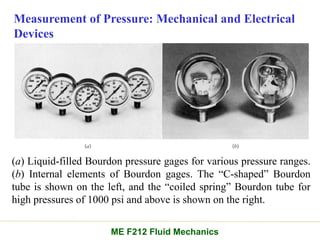
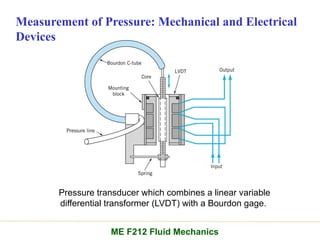
Measurement of Pressure: Mechanical and Electrical
Devices
(a) Liquid-filled Bourdon pressure gages for various pressure ranges.
(b) Internal elements of Bourdon gages. The “C-shaped” Bourdon
tube is shown on the left, and the “coiled spring” Bourdon tube for
high pressures of 1000 psi and above is shown on the right.
ME F212 Fluid Mechanics
Measurement of Pressure: Mechanical and Electrical
Devices
Pressure transducer which combines a linear variable
differential transformer (LVDT) with a Bourdon gage.
ME F212 Fluid Mechanics
Measurement of Pressure: Mechanical and Electrical
Devices
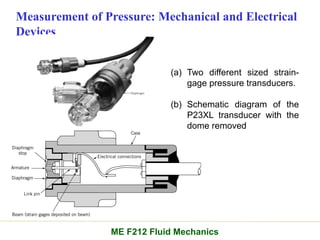
(a) Two different sized strain-
gage pressure transducers.
(b) Schematic diagram of the
P23XL transducer with the
dome removed
ME F212 Fluid Mechanics
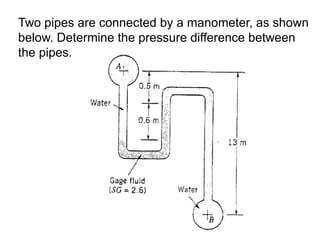
Two pipes are connected by a manometer, as shown
below. Determine the pressure difference between
the pipes.
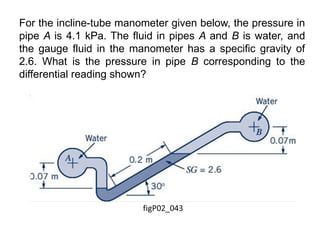
For the incline-tube manometer given below, the pressure in
pipe A is 4.1 kPa. The fluid in pipes A and B is water, and
the gauge fluid in the manometer has a specific gravity of
2.6. What is the pressure in pipe B corresponding to the
differential reading shown?
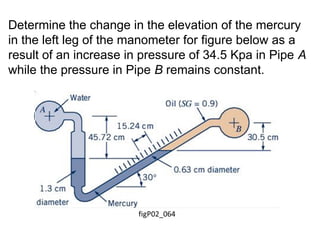
Determine the change in the elevation of the mercury
in the left leg of the manometer for figure below as a
result of an increase in pressure of 34.5 Kpa in Pipe A
while the pressure in Pipe B remains constant.
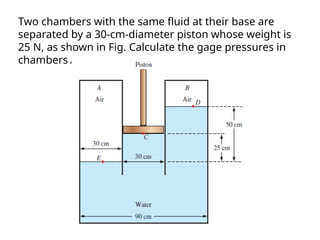
Two chambers with the same fluid at their base are
separated by a 30-cm-diameter piston whose weight is
25 N, as shown in Fig. Calculate the gage pressures in
chambers A and B.
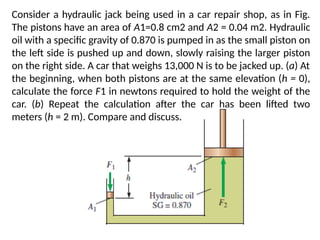
Consider a hydraulic jack being used in a car repair shop, as in Fig.
The pistons have an area of A1=0.8 cm2 and A2 = 0.04 m2. Hydraulic
oil with a specific gravity of 0.870 is pumped in as the small piston on
the left side is pushed up and down, slowly raising the larger piston
on the right side. A car that weighs 13,000 N is to be jacked up. (a) At
the beginning, when both pistons are at the same elevation (h = 0),
calculate the force F1 in newtons required to hold the weight of the
car. (b) Repeat the calculation after the car has been lifted two
meters (h = 2 m). Compare and discuss.

This PowerPoint presentation explains the basics abt presseure

  • 1.
  • 2.
    Lecture Topics on14-09-2022 Chapter 2 Fluid Statics Learning Objectives 2.1 Pressure at a Point ME F212 Fluid Mechanics
  • 3.
    Learning Objectives After completingthis chapter, you should be able to: • Determine the pressure at various locations in a fluid at rest • Explain the concept of manometers and apply appropriate equations to determine pressure • Calculate the hydrostatic pressure force on a plan or curved submerged surface • Calculate the buoyant force and discuss the stability of floating or submerged objects ME F212 Fluid Mechanics
  • 4.
    Pressure at aPoint How does the pressure at a point vary with orientation of the plane passing through the point? The term pressure is used to indicate the normal force per unit area at a given point acting on a given plane within the fluid mass of interest. ME F212 Fluid Mechanics To answer this question, consider the free body diagram, that was obtained by removing a small triangular wedge of fluid from some arbitrary location within a fluid mass.
  • 5.
    Wedged Shaped Fluid Mass Pressureat a Point Where , , and are the average pressures on the faces and are the fluid specific weight and desnsity and , the accelerations in and -directions. s y z y z p p p a a y z   ME F212 Fluid Mechanics
  • 6.
    Pressure at aPoint: Analysis • No shearing stresses present in the fluid. • For simplicity the forces in x-direction are not shown. • External forces acting on the fluid are due to pressure and the weight. • To make the analysis general, allow the fluid element to have accelerated motion. The assumption of zero shearing stresses will still be valid as long as the fluid element moves as a rigid body. ME F212 Fluid Mechanics
  • 7.
    The equations ofmotion (Newton’s second law, F = ma) in the y and z directions are: Pressure at a Point: Analysis sin 2 cos 2 2 y y s y z z s z x y z F p x z p x s a x y z x y z F p x y p x s a                                It follows from the geometry that cos sin y s z s         Where ps, py, and pz are the average pressures on the faces, γ and ρ are the fluid specific weight and density and ay, az the accelerations. ME F212 Fluid Mechanics
  • 8.
    The equations ofmotion can be rewritten as Pressure at a Point: Analysis 2 ( ) 2 y s y z s z y p p a z p p a           Since we are really interested in what is happening at a point, we take the limits as δx, δy, and δz approach zero (while maintaining the angle θ ) or y s z s y z s p p p p p p p     ME F212 Fluid Mechanics
  • 9.
    Pressure at aPoint: Pascal’s Law psdxds p1dxds p2dxds The pressure at a point in a fluid at rest, or in motion, is independent of direction as long as there is no shearing stresses present. This important result is known as Pascal’s Law. Blaise Pascal (1623-1662) s y z P P P   ME F212 Fluid Mechanics
  • 10.
    2.3 Pressure Variationin a Fluid at Rest 2.4 Standard Atmosphere ME F212 Fluid Mechanics Lecture Topics on 16-09-2022
  • 11.
    Basic Equation forPressure Field How does the pressure vary in a fluid or from point to point when no shear stresses are present? ME F212 Fluid Mechanics
  • 12.
    Basic Equation forPressure Field Let the pressure at the center of the element be designated as p. The average pressure on the various faces can be expressed in terms of p and its derivatives. ME F212 Fluid Mechanics Forward Taylor series: 2 3 ( ) ( ) ( ) ( ) ( ) 2! 3! ( / 2) ( 0) 2 2 o o o o o h h f x h f x hf x f x f x x p x p p x x p x p x x                             Backward Taylor series: 2 3 ( ) ( ) ( ) ( ) ( ) 2! 3! ( / 2) ( 0) 2 2 o o o o o h h f x h f x hf x f x f x x p x p p x x p x p x x                            
  • 13.
    Pressure Field Equation Theresultant surface forces in the y-direction: Similarly, the resultant surface forces in the x and z-dire The resultant surface forces acting on the element in vector form: 2 2 y p y p y p F p x z p x z x y z y y y                                  x z p p F x y z F x y z x z               ˆ ˆ ˆ ˆ ˆ ˆ s x y z s F F i F j F k p p p F i j k x y z x y z                             ME F212 Fluid Mechanics
  • 14.
    Pressure Field Equation The“del” vector operator or gradient is the following : Then, Now, rewriting the surface force equation, we obtain the following: Now, we return the body forces, and we will only consider weight: ˆ ˆ ˆ p p p i j k p x y z                  ˆ ˆ ˆ i j k x y z           s F p x y z        ˆ ˆ W k x y z k       ME F212 Fluid Mechanics
  • 15.
    Pressure Field Equations Newton’sSecond Law, applied to the fluid element: δm is the mass of the fluid element, and a is acceleration. Then summing the surface forces and the body forces: F ma       ˆ ˆ ˆ s F F W k ma p x y z x y z k x y z a p k a                                  This is the general equation of motion for a fluid in which there is no shearing stresses. ME F212 Fluid Mechanics
  • 16.
    Pressure Variation ina Fluid at Rest 0 In components form The equations show that the pressure does not depend on x or y. This is the fundamental equation for fluids at rest. It is valid for fluids with constant specific weight, such as liquids, as well as fluids whose specific weight may vary with elevation, such as air or other gases. ˆ ˆ 0 p k a p k            0 0 p p p x y z           dp g dz     ME F212 Fluid Mechanics
  • 17.
    Hydrostatic Condition: IncompressibleFluids The variation in g is negligible. For liquids the variation in ρ is negligible over large vertical distance, thus most liquids will be considered incompressible. We can immediately integrate since γ is a constant: This type of pressure distribution (varies linearly with depth) is commonly called a hydrostatic distribution.     2 2 1 1 2 1 2 1 1 2 2 1 1 2 p z p z dp dz p p z z p p z z h p p h                  ME F212 Fluid Mechanics
  • 18.
    Hydrostatic Condition: IncompressibleFluids h is known as the pressure head. It is the height of a column of fluid of specific weight γ required to give a pressure difference p1- p2. 1 2 1 2 p p h p p h       ME F212 Fluid Mechanics
  • 19.
    When one workswith liquids there is often a free surface and it is convenient to use this surface as a reference plane. The reference pressure po would correspond to the pressure acting on the free surface (atmospheric pressure) Hydrostatic Condition: Incompressible Fluids 0 p h p    The pressure p at any depth h below the free surface is given by ME F212 Fluid Mechanics
  • 20.
    The pressure ina homogenous, incompressible fluid at rest depends on the depth of the fluid relative to some reference and is not influenced by the size or shape of the container. Hydrostatic Condition: Incompressible Fluids 0 p h p    The pressure p at any depth h below the free surface is given by ME F212 Fluid Mechanics
  • 22.
    Application: Transmission ofFluid Pressure The required equality of pressure at equal elevations throughout a system is important for the operation of hydraulic jacks, lifts, and presses, as well as hydraulic controls on aircraft and other types of heavy machinery. The fundamental idea behind such devices and systems is demonstrated below. ME F212 Fluid Mechanics
  • 23.
    Application: Transmission ofFluid Pressure • A piston located at one end of a closed system filled with a liquid, such as oil, can be used to change the pressure throughout the system • Thus transit an applied force F1 to a second piston where the resulting force is F2 • Since the pressure p acting on the faces on both pistons is the same (the effect of elevation changes is usually negligible for this type of hydraulic devices) ME F212 Fluid Mechanics
  • 24.
    Application: Transmission ofFluid Pressure • The piston area A2 can be made much larger than A1 and therefore a large mechanical advantage can be developed • That is, a small force applied at the smaller piston can be used to develop a larger force at the larger piston 2 2 1 1 A F F A  ME F212 Fluid Mechanics
  • 25.
    Application: Transmission ofFluid Pressure Hydraulic lift Hydraulic jack ME F212 Fluid Mechanics
  • 26.
    Hydrostatic Condition: CompressibleFluids Gases such as air, oxygen and nitrogen as being compressible, we must consider the variation of density in the hydrostatic equation: dp g dz     The equation of state for an ideal gas is p RT   dp gp dz RT  and by separating variables 2 2 1 1 2 1 ln p z p z p dp g dz p p R T     ME F212 Fluid Mechanics
  • 27.
  • 28.
  • 29.
  • 30.
    Standard Atmosphere • Onewould like to have measurements of pressure versus altitude over the specific range for the specific conditions (temperature, reference pressure). • This type of information is usually not available. Thus a standard atmosphere has been determined. • The concept of standard atmosphere was developed in the 1920s. • The currently accepted standard atmosphere is based on a report published in 1962 and updated in 1976. • The U.S. standard atmosphere is an idealized representation of middle-latitude, year-round mean conditions of the earth’s atmosphere. ME F212 Fluid Mechanics
  • 31.
    Standard Atmosphere The belowfigure shows the temperature profile for the U.S. standard atmosphere. Linear Variation, T = Ta - bz Isothermal, T = To Standard Atmosphere is used in the design of aircraft, missiles and spacecraft. Stratosphere: Troposphere: ME F212 Fluid Mechanics
  • 32.
  • 33.
    U.S. Standard Atmosphere:Troposphere Starting from, For the troposphere, which extends to an altitude 11 km β is known as the lapse rate, 0.00650 K/m, and Ta is the temperature at sea level, 288.15 K. pa is the pressure at sea level, 101.33 kPa, R is the gas constant, 286.9 J/kg.K 2 2 1 1 2 1 ln p z p z p dp g dz p p R T     a T T z    / 1 g R a a z p p T           ME F212 Fluid Mechanics
  • 34.
    U.S. Standard Atmosphere:Contrails The main combustion products of hydrocarbon fuels are CO2 and water vapor. At high altitudes this water vapor emerges into a cold environment. The vapor then condenses into tiny water droplets and/or deposits into ice. ME F212 Fluid Mechanics At the outer edge of troposphere, where the temperature is -56.5o C, the absolute pressure is 23 kPa.
  • 35.
    U.S. Standard Atmosphere:Stratosphere Starting from, 2 2 1 1 2 1 ln p z p z p dp g dz p p R T     For the stratosphere, the temperature has a constant value To over the range z1 to z2 (isothermal conditions), it then follows   2 1 2 1 exp o g z z p p RT          This equation provide the desired pressure-elevation relationship for an isothermal layer. ME F212 Fluid Mechanics
  • 36.
    Measurement of Pressure AbsolutePressure: Pressure measured relative to a perfect vacuum (absolute zero pressure). or Gage Pressure: Pressure measured relative to local atmospheric pressure. • A gage pressure of zero corresponds to a pressure that is at local atmospheric pressure. • Absolute pressure is always positive. • Gage pressure can be either negative or positive. • Negative gage pressure is known as a vacuum or suction. The pressure at a point is designated as either an ME F212 Fluid Mechanics
  • 37.
    Measurement of Pressure:Absolute, gage, and vacuum pressures ME F212 Fluid Mechanics
  • 38.
    Measurement of Pressure: Barometers Evangelista Torricelli (1608-1647) The measurement of atmospheric pressure is usually accomplished with a mercury barometer. Often pvapor is very small, 0.16 N/m2 at 20°C, thus: atm vapor p h p    atm p h   For Patm =101.3 kPa 10.4 m of H20 76 cm of Hg ME F212 Fluid Mechanics
  • 39.
    Measurement of Pressure:Manometry A standard technique for measuring pressure involves use of liquid columns in vertical or inclined tubes are called Manometry. Pressure measuring devices based on this technique are called manometers. The three common types of manometers are 1. The Piezometer Tube 2. The U-Tube Manometer 3. The Inclined Tube Manometer The fundamental equation for manometers is 0 p h p    since they involve columns of fluid at rest. ME F212 Fluid Mechanics
  • 40.
    Measurement of Pressure:Piezometer Tube po The simplest type of manometer consists of a vertical tube, open at the top, and attached to the container in which the pressure is desired. Disadvantages: 1)The pressure in the container has to be greater than atmospheric pressure. 2) Pressure must be relatively small to maintain a small column of fluid. 3) The measurement of pressure must be of a liquid. 1 A p h   ME F212 Fluid Mechanics
  • 41.
    Measurement of Pressure:U-Tube Manometer Then the equation for the pressure in the container is If the fluid in the container is a gas, then the fluid 1 terms can be ignored: The fluid in the manometer is known as the gage fluid. 2 2 1 1 A p h h     2 2 A p h   ME F212 Fluid Mechanics
  • 42.
    Measurement of Pressure:Differential U-Tube Manometer Used to measure the difference in pressure between two containers or two points in a given system. Moving from left to right: 1 1 2 2 3 3 2 2 3 3 1 1 A B A B p h h h p p p h h h               ME F212 Fluid Mechanics
  • 43.
    Differential U-Tube Manometer Finalnotes: • Capillarity due to surface tension at the various fluid interfaces are not considered. • Capillarity can play a role, but in many cases each meniscus will cancel (ex: simple U-tube manometer). • Making the Capillary rise negligible by using relative large bore tubes. • Temperature must be considered in very accurate measurements, as the gage fluid properties can change. • Common gage fluids are Hg and Water, some oils, and must be immiscible. ME F212 Fluid Mechanics
  • 44.
    Measurement of Pressure:Inclined-Tube Manometer This type of manometer is used to measure small pressure changes. q h2 l2 2 2 sin l h    sin 2 2 l h  If the pressure difference is between gases: 1 1 2 2 3 3 2 2 3 3 1 1 sin sin A B A B p h l h p p p l h h                 2 2 sin A B p p l     ME F212 Fluid Mechanics
  • 45.
    Measurement of Pressure:Mechanical and Electrical Devices (a) Liquid-filled Bourdon pressure gages for various pressure ranges. (b) Internal elements of Bourdon gages. The “C-shaped” Bourdon tube is shown on the left, and the “coiled spring” Bourdon tube for high pressures of 1000 psi and above is shown on the right. ME F212 Fluid Mechanics
  • 46.
    Measurement of Pressure:Mechanical and Electrical Devices Pressure transducer which combines a linear variable differential transformer (LVDT) with a Bourdon gage. ME F212 Fluid Mechanics
  • 47.
    Measurement of Pressure:Mechanical and Electrical Devices (a) Two different sized strain- gage pressure transducers. (b) Schematic diagram of the P23XL transducer with the dome removed ME F212 Fluid Mechanics
  • 49.
    Two pipes areconnected by a manometer, as shown below. Determine the pressure difference between the pipes.
  • 50.
    For the incline-tubemanometer given below, the pressure in pipe A is 4.1 kPa. The fluid in pipes A and B is water, and the gauge fluid in the manometer has a specific gravity of 2.6. What is the pressure in pipe B corresponding to the differential reading shown?
  • 51.
    Determine the changein the elevation of the mercury in the left leg of the manometer for figure below as a result of an increase in pressure of 34.5 Kpa in Pipe A while the pressure in Pipe B remains constant.
  • 52.
    Two chambers withthe same fluid at their base are separated by a 30-cm-diameter piston whose weight is 25 N, as shown in Fig. Calculate the gage pressures in chambers A and B.
  • 53.
    Consider a hydraulicjack being used in a car repair shop, as in Fig. The pistons have an area of A1=0.8 cm2 and A2 = 0.04 m2. Hydraulic oil with a specific gravity of 0.870 is pumped in as the small piston on the left side is pushed up and down, slowly raising the larger piston on the right side. A car that weighs 13,000 N is to be jacked up. (a) At the beginning, when both pistons are at the same elevation (h = 0), calculate the force F1 in newtons required to hold the weight of the car. (b) Repeat the calculation after the car has been lifted two meters (h = 2 m). Compare and discuss.