FURTHER APPLICATIONS
OF INTEGRATION
8
8.3
Applications to
Physics and Engineering
In this section, we will learn about:
The applications of integral calculus to
force due to water pressure and centers of mass.
FURTHER APPLICATIONS OF INTEGRATION
As with our previous applications to geometry
(areas, volumes, and lengths) and to work,
our strategy is:
 Break up the physical quantity into small parts.
 Approximate each small part.
 Add the results.
 Take the limit.
 Then, evaluate the resulting integral.
APPLICATIONS TO PHYSICS AND ENGINEERING
Deep-sea divers realize that water
pressure increases as they dive deeper.
 This is because the weight of the water
above them increases.
HYDROSTATIC FORCE AND PRESSURE
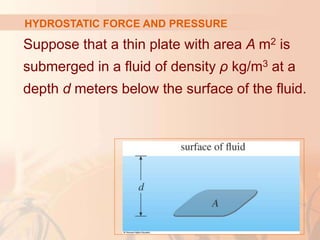
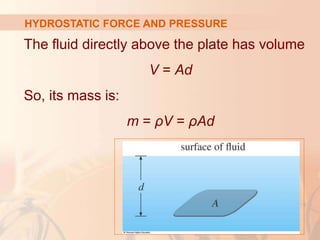
Suppose that a thin plate with area A m2 is
submerged in a fluid of density ρ kg/m3 at a
depth d meters below the surface of the fluid.
HYDROSTATIC FORCE AND PRESSURE
The fluid directly above the plate has volume
V = Ad
So, its mass is:
m = ρV = ρAd
HYDROSTATIC FORCE AND PRESSURE
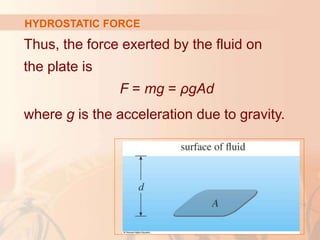
Thus, the force exerted by the fluid on
the plate is
F = mg = ρgAd
where g is the acceleration due to gravity.
HYDROSTATIC FORCE
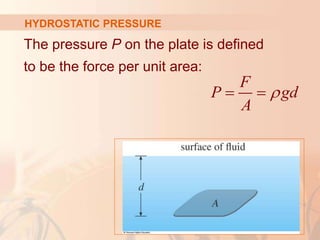
The pressure P on the plate is defined
to be the force per unit area:
HYDROSTATIC PRESSURE
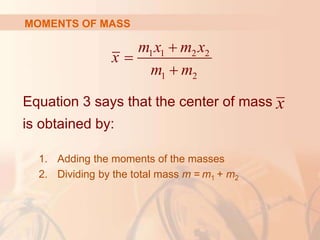
F
P gd
A
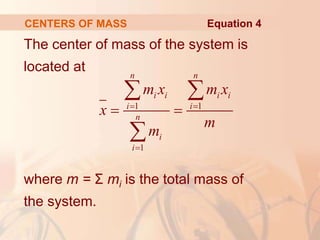

 
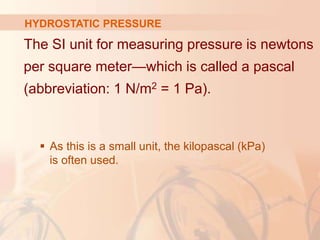
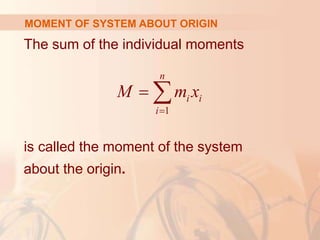
The SI unit for measuring pressure is newtons
per square meter—which is called a pascal
(abbreviation: 1 N/m2 = 1 Pa).
 As this is a small unit, the kilopascal (kPa)
is often used.
HYDROSTATIC PRESSURE
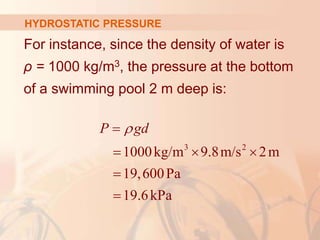
For instance, since the density of water is
ρ = 1000 kg/m3, the pressure at the bottom
of a swimming pool 2 m deep is:
HYDROSTATIC PRESSURE
3 2
1000kg/m 9.8m/s 2m
19,600Pa
19.6kPa
P gd


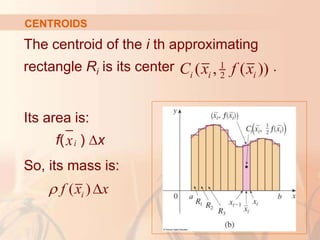
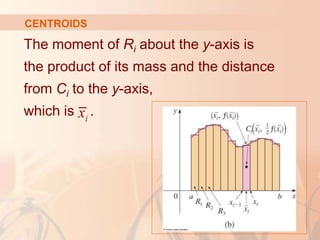
  


An important principle of fluid pressure is
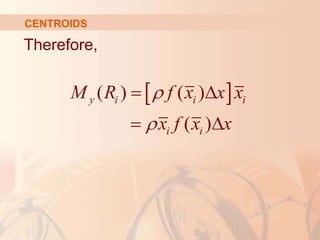
the experimentally verified fact that, at any
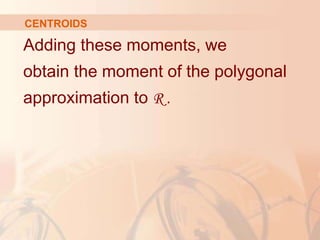
point in a liquid, the pressure is the same in
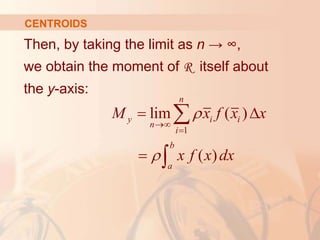
all directions.
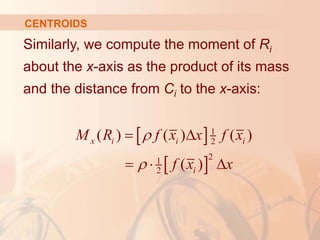
 This is why a diver feels the same pressure
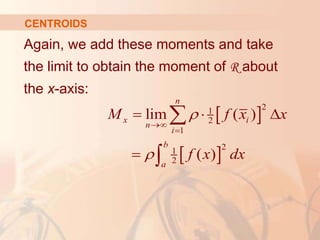
on nose and both ears.
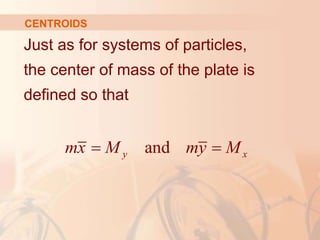
HYDROSTATIC PRESSURE
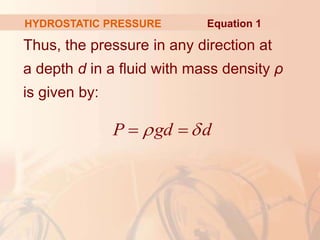
Thus, the pressure in any direction at
a depth d in a fluid with mass density ρ
is given by:
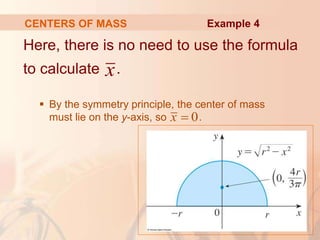
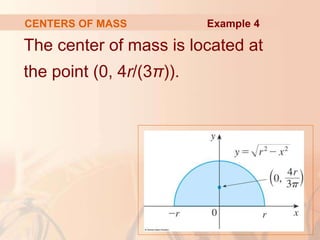
HYDROSTATIC PRESSURE
P gd d
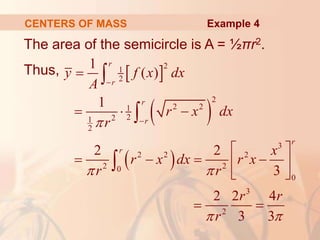
 
 
Equation 1
This helps us determine the hydrostatic
force against a vertical plate or wall or dam
in a fluid.
 This is not a straightforward problem.
 The pressure is not constant, but increases
as the depth increases.
HYDROSTATIC FORCE AND PRESSURE
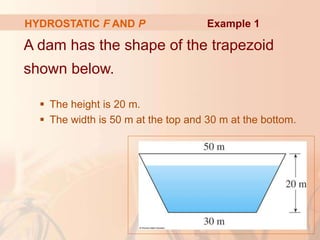
A dam has the shape of the trapezoid
shown below.
 The height is 20 m.
 The width is 50 m at the top and 30 m at the bottom.
HYDROSTATIC F AND P Example 1
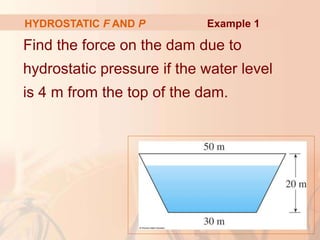
Find the force on the dam due to
hydrostatic pressure if the water level
is 4 m from the top of the dam.
HYDROSTATIC F AND P Example 1
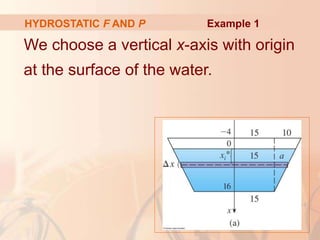
We choose a vertical x-axis with origin
at the surface of the water.
HYDROSTATIC F AND P Example 1
The depth of the water is 16 m.
 So, we divide the interval [0, 16] into subintervals
of equal length with endpoints xi.
 We choose
xi* [xi–1, xi].
HYDROSTATIC F AND P Example 1

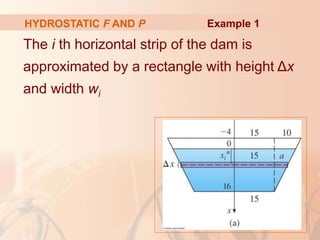
The i th horizontal strip of the dam is
approximated by a rectangle with height Δx
and width wi
HYDROSTATIC F AND P Example 1
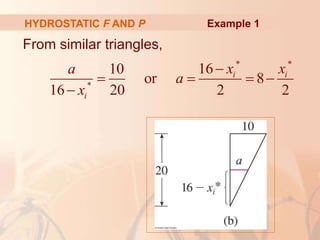
From similar triangles,
HYDROSTATIC F AND P
* *
*
16
10
or 8
16 20 2 2
i i
i
x x
a
a
x

   

Example 1
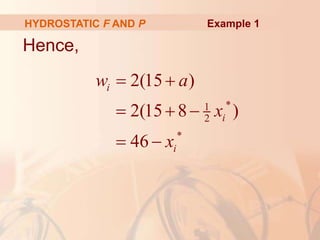
Hence,
*
1
2
*
2(15 )
2(15 8 )
46
i
i
i
w a
x
x
 
  
 
HYDROSTATIC F AND P Example 1
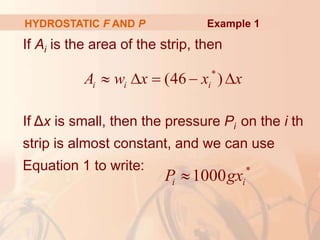
If Ai is the area of the strip, then
If Δx is small, then the pressure Pi on the i th
strip is almost constant, and we can use
Equation 1 to write:
HYDROSTATIC F AND P
*
(46 )
i i i
A w x x x
    
*
1000
i i
P gx

Example 1
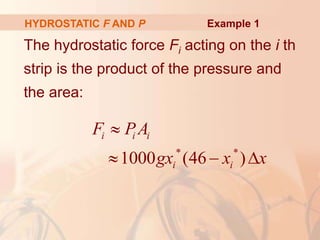
The hydrostatic force Fi acting on the i th
strip is the product of the pressure and
the area:
HYDROSTATIC F AND P
* *
1000 (46 )
i i i
i i
F PA
gx x x

  
Example 1
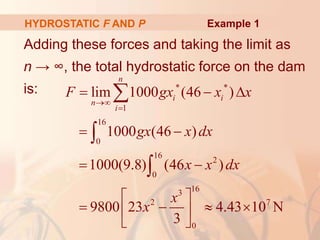
Adding these forces and taking the limit as
n → ∞, the total hydrostatic force on the dam
is:
HYDROSTATIC F AND P
* *
1
16
0
16
2
0
16
3
2 7
0
lim 1000 (46 )
1000 (46 )
1000(9.8) (46 )
9800 23 4.43 10 N
3
n
i i
n
i
F gx x x
gx x dx
x x dx
x
x


  
 
 
 
   
 
 



Example 1
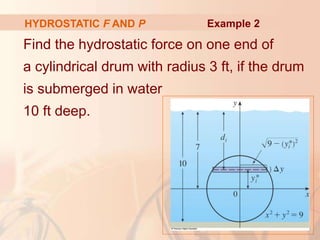
Find the hydrostatic force on one end of
a cylindrical drum with radius 3 ft, if the drum
is submerged in water
10 ft deep.
HYDROSTATIC F AND P Example 2
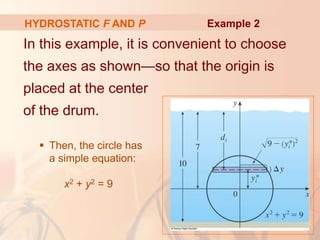
In this example, it is convenient to choose
the axes as shown—so that the origin is
placed at the center
of the drum.
 Then, the circle has
a simple equation:
x2 + y2 = 9
HYDROSTATIC F AND P Example 2
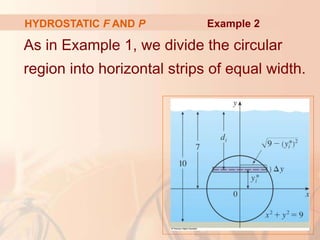
As in Example 1, we divide the circular
region into horizontal strips of equal width.
HYDROSTATIC F AND P Example 2
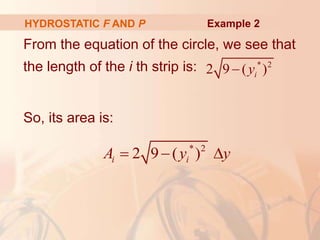
From the equation of the circle, we see that
the length of the i th strip is:
So, its area is:
HYDROSTATIC F AND P
* 2
2 9 ( )
i
y

* 2
2 9 ( )
i i
A y y
  
Example 2
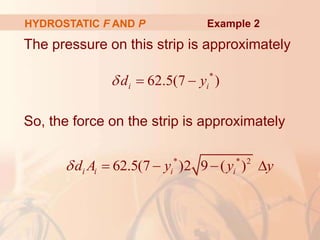
The pressure on this strip is approximately
So, the force on the strip is approximately
HYDROSTATIC F AND P
* * 2
62.5(7 )2 9 ( )
i i i i
d A y y y
    
*
62.5(7 )
i i
d y
  
Example 2
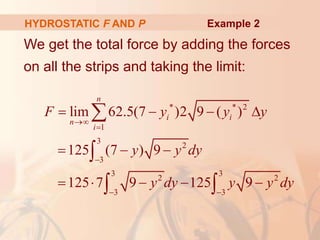
We get the total force by adding the forces
on all the strips and taking the limit:
HYDROSTATIC F AND P
* * 2
1
3
2
3
3 3
2 2
3 3
lim 62.5(7 )2 9 ( )
125 (7 ) 9
125 7 9 125 9
n
i i
n
i
F y y y
y y dy
y dy y y dy



 
   
  
    


 
Example 2
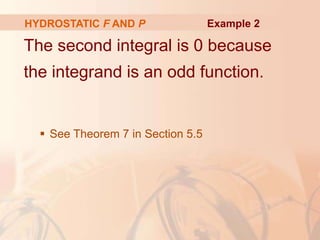
The second integral is 0 because
the integrand is an odd function.
 See Theorem 7 in Section 5.5
HYDROSTATIC F AND P Example 2
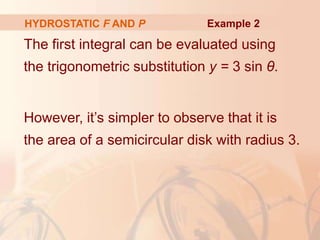
The first integral can be evaluated using
the trigonometric substitution y = 3 sin θ.
However, it’s simpler to observe that it is
the area of a semicircular disk with radius 3.
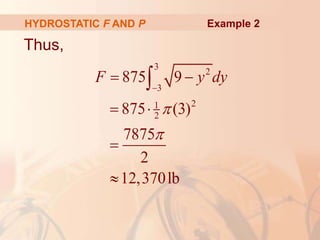
HYDROSTATIC F AND P Example 2
Thus,
HYDROSTATIC F AND P
3
2
3
2
1
2
875 9
875 (3)
7875
2
12,370lb
F y dy



 
 



Example 2
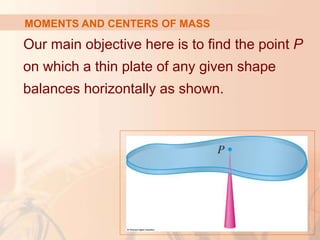
Our main objective here is to find the point P
on which a thin plate of any given shape
balances horizontally as shown.
MOMENTS AND CENTERS OF MASS
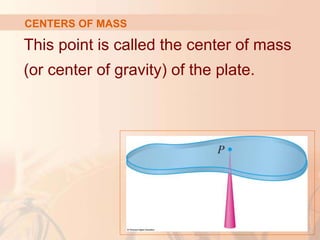
This point is called the center of mass
(or center of gravity) of the plate.
CENTERS OF MASS
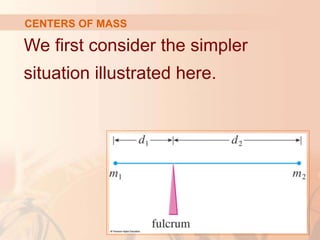
We first consider the simpler
situation illustrated here.
CENTERS OF MASS
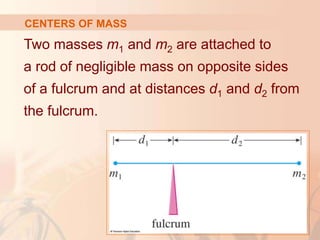
Two masses m1 and m2 are attached to
a rod of negligible mass on opposite sides
of a fulcrum and at distances d1 and d2 from
the fulcrum.
CENTERS OF MASS
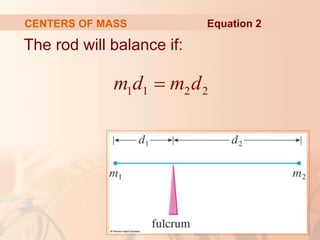
The rod will balance if:
CENTERS OF MASS
1 1 2 2
m d m d

Equation 2
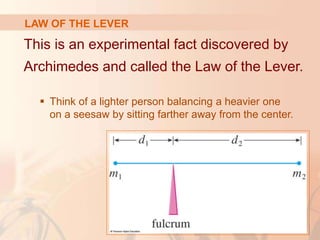
This is an experimental fact discovered by
Archimedes and called the Law of the Lever.
 Think of a lighter person balancing a heavier one
on a seesaw by sitting farther away from the center.
LAW OF THE LEVER
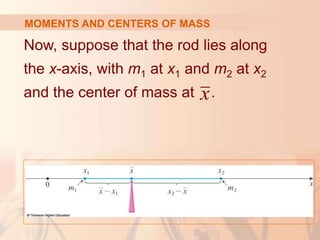
Now, suppose that the rod lies along
the x-axis, with m1 at x1 and m2 at x2
and the center of mass at .
MOMENTS AND CENTERS OF MASS
x
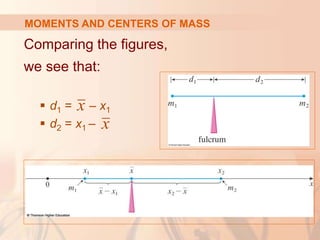
Comparing the figures,
we see that:
 d1 = – x1
 d2 = x1 –
x
MOMENTS AND CENTERS OF MASS
x
CENTERS OF MASS
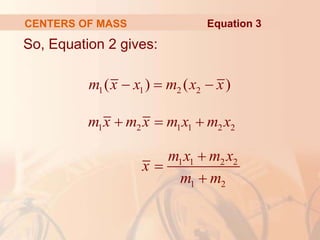
So, Equation 2 gives:
1 1 2 2
( ) ( )
m x x m x x
  
1 2 1 1 2 2
m x m x m x m x
  
1 1 2 2
1 2
m x m x
x
m m



Equation 3
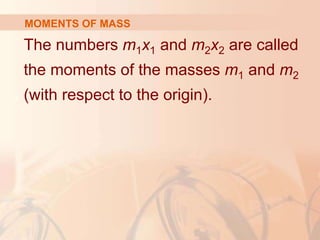
The numbers m1x1 and m2x2 are called
the moments of the masses m1 and m2
(with respect to the origin).
MOMENTS OF MASS
Equation 3 says that the center of mass
is obtained by:
1. Adding the moments of the masses
2. Dividing by the total mass m = m1 + m2
MOMENTS OF MASS
x
1 1 2 2
1 2
m x m x
x
m m



In general, suppose we have a system of n
particles with masses m1, m2, . . . , mn located
at the points x1, x2, . . . , xn on the x-axis.
Then, we can show where the center of mass
of the system is located—as follows.
CENTERS OF MASS Equation 4
The center of mass of the system is
located at
where m = Σ mi is the total mass of
the system.
CENTERS OF MASS
1 1
1
n n
i i i i
i i
n
i
i
m x m x
x
m
m
 

 
 

Equation 4
The sum of the individual moments
is called the moment of the system
about the origin.
MOMENT OF SYSTEM ABOUT ORIGIN
1
n
i i
i
M m x

 
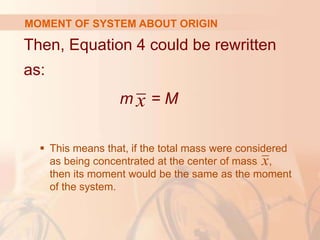
Then, Equation 4 could be rewritten
as:
m = M
 This means that, if the total mass were considered
as being concentrated at the center of mass ,
then its moment would be the same as the moment
of the system.
MOMENT OF SYSTEM ABOUT ORIGIN
x
x
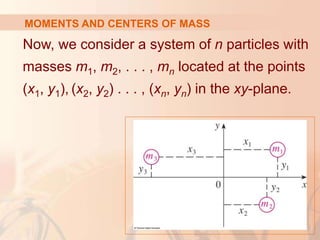
Now, we consider a system of n particles with
masses m1, m2, . . . , mn located at the points
(x1, y1), (x2, y2) . . . , (xn, yn) in the xy-plane.
MOMENTS AND CENTERS OF MASS
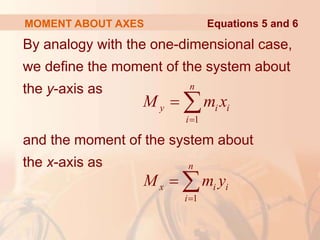
By analogy with the one-dimensional case,
we define the moment of the system about
the y-axis as
and the moment of the system about
the x-axis as
MOMENT ABOUT AXES
1
n
y i i
i
M m x

 
Equations 5 and 6
1
n
x i i
i
M m y

 
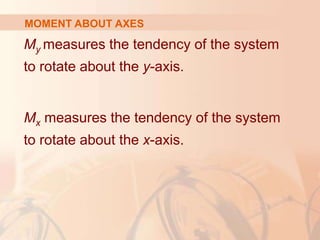
My measures the tendency of the system
to rotate about the y-axis.
Mx measures the tendency of the system
to rotate about the x-axis.
MOMENT ABOUT AXES
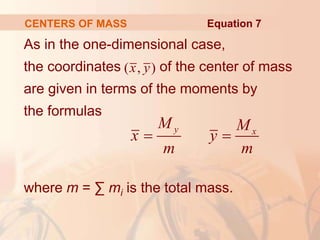
As in the one-dimensional case,
the coordinates of the center of mass
are given in terms of the moments by
the formulas
where m = ∑ mi is the total mass.
CENTERS OF MASS
( , )
x y
y x
M M
x y
m m
 
Equation 7
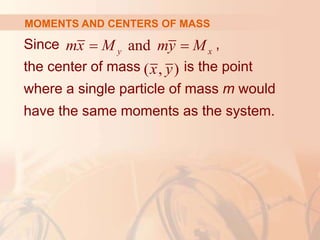
Since ,
the center of mass is the point
where a single particle of mass m would
have the same moments as the system.
MOMENTS AND CENTERS OF MASS
and
y x
mx M my M
 
( , )
x y
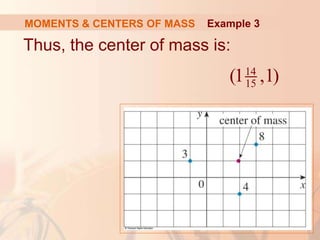
Find the moments and center of mass
of the system of objects that have masses
3, 4, and 8 at the points (–1, 1), (2, –1) and
(3, 2) respectively.
MOMENTS & CENTERS OF MASS Example 3
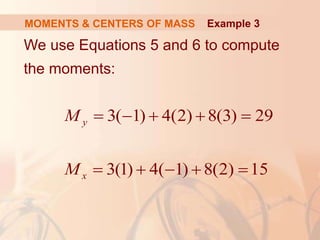
We use Equations 5 and 6 to compute
the moments:
MOMENTS & CENTERS OF MASS
3( 1) 4(2) 8(3) 29
3(1) 4( 1) 8(2) 15
y
x
M
M
    
    
Example 3
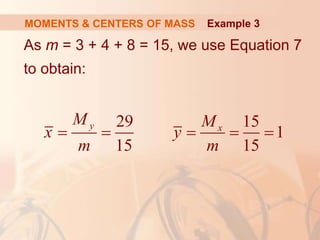
As m = 3 + 4 + 8 = 15, we use Equation 7
to obtain:
MOMENTS & CENTERS OF MASS Example 3
29 15
1
15 15
y x
M M
x y
m m
    
Thus, the center of mass is:
MOMENTS & CENTERS OF MASS
14
15
(1 ,1)
Example 3
Next, we consider a flat plate, called
a lamina, with uniform density ρ that
occupies a region R of the plane.
 We wish to locate the center of mass of the plate,
which is called the centroid of R .
CENTROIDS
In doing so, we use
the following physical
principles.
CENTROIDS
The symmetry principle says that, if R is
symmetric about a line l, then the centroid
of R lies on l.
 If R is reflected about l, then R remains the same
so its centroid remains fixed.
 However, the only fixed points lie on l.
 Thus, the centroid of a rectangle is its center.
CENTROIDS
Moments should be defined so that, if
the entire mass of a region is concentrated
at the center of mass, then its moments
remain unchanged.
CENTROIDS
Also, the moment of the union of two
non-overlapping regions should be
the sum of the moments of the individual
regions.
CENTROIDS
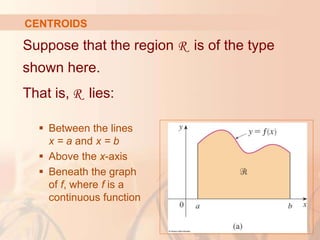
Suppose that the region R is of the type
shown here.
That is, R lies:
 Between the lines
x = a and x = b
 Above the x-axis
 Beneath the graph
of f, where f is a
continuous function
CENTROIDS
We divide the interval [a, b] into n subintervals
with endpoints x0, x1, . . . , xn and equal width
∆x.
 We choose the
sample point xi
* to
be the midpoint
of the i th
subinterval.
 That is,
= (xi–1 + xi)/2
CENTROIDS
i
x
i
x
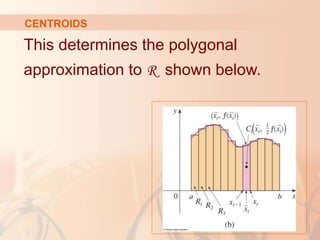
This determines the polygonal
approximation to R shown below.
CENTROIDS
The centroid of the i th approximating
rectangle Ri is its center .
Its area is:
f( ) ∆x
So, its mass is:
CENTROIDS
1
2
( , ( ))
i i i
C x f x
( )
i
f x x
 
i
x
The moment of Ri about the y-axis is
the product of its mass and the distance
from Ci to the y-axis,
which is .
CENTROIDS
i
x
Therefore,
CENTROIDS
 
( ) ( )
( )
y i i i
i i
M R f x x x
x f x x


 
 
Adding these moments, we
obtain the moment of the polygonal
approximation to R .
CENTROIDS
Then, by taking the limit as n → ∞,
we obtain the moment of R itself about
the y-axis:
CENTROIDS
1
lim ( )
( )
n
y i i
n
i
b
a
M x f x x
x f x dx




 



Similarly, we compute the moment of Ri
about the x-axis as the product of its mass
and the distance from Ci to the x-axis:
CENTROIDS
 
 
1
2
2
1
2
( ) ( ) ( )
( )
x i i i
i
M R f x x f x
f x x


 
  
Again, we add these moments and take
the limit to obtain the moment of R about
the x-axis:
CENTROIDS
 
 
2
1
2
1
2
1
2
lim ( )
( )
n
x i
n
i
b
a
M f x x
f x dx




  



Just as for systems of particles,
the center of mass of the plate is
defined so that
CENTROIDS
and
y x
mx M my M
 
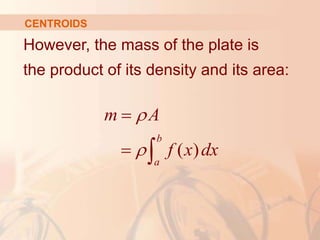
However, the mass of the plate is
the product of its density and its area:
CENTROIDS
( )
b
a
m A
f x dx



 
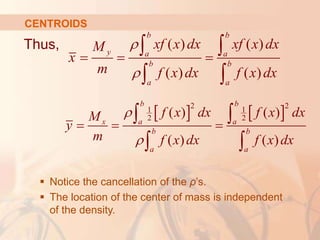
Thus,
 Notice the cancellation of the ρ’s.
 The location of the center of mass is independent
of the density.
CENTROIDS
( ) ( )
( ) ( )
b b
y a a
b b
a a
xf x dx xf x dx
M
x
m f x dx f x dx


  
 
 
   
2 2
1 1
2 2
( ) ( )
( ) ( )
b b
x a a
b b
a a
f x dx f x dx
M
y
m f x dx f x dx


  
 
 
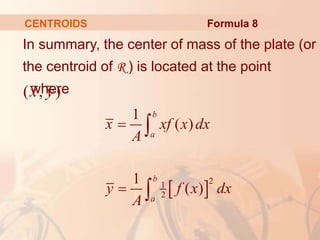
In summary, the center of mass of the plate (or
the centroid of R ) is located at the point
, where
CENTROIDS
( , )
x y
 
2
1
2
1
( )
1
( )
b
a
b
a
x xf x dx
A
y f x dx
A




Formula 8
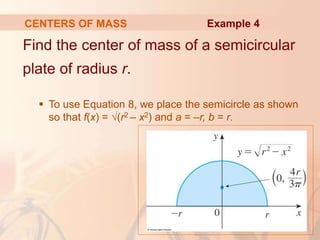
Find the center of mass of a semicircular
plate of radius r.
 To use Equation 8, we place the semicircle as shown
so that f(x) = √(r2 – x2) and a = –r, b = r.
CENTERS OF MASS Example 4
Here, there is no need to use the formula
to calculate .
 By the symmetry principle, the center of mass
must lie on the y-axis, so .
CENTERS OF MASS
x
0
x 
Example 4
The area of the semicircle is A = ½πr2.
Thus,
CENTERS OF MASS
 
 
 
2
1
2
2
2 2
1
2
2
1
2
3
2 2 2
2 2
0
0
3
2
1
( )
1
2 2
3
2 2 4
3 3
r
r
r
r
r
r
y f x dx
A
r x dx
r
x
r x dx r x
r r
r r
r

 
 



  
 
   
 
 
 



Example 4
The center of mass is located at
the point (0, 4r/(3π)).
CENTERS OF MASS Example 4
Find the centroid of the region bounded
by the curves
y = cos x, y = 0, x = 0, x = π/2
CENTERS OF MASS Example 5
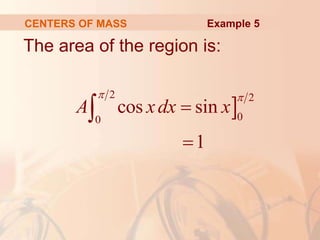
The area of the region is:
CENTERS OF MASS

2 2
0
0
cos sin
1
A xdx x
 



Example 5
CENTROIDS
 
 
 
/ 2 2
1
2
/ 2
2
1
2
/ 2
1
4
/ 2
1 1
4 2 0
1
( )
cos
1 cos2
sin 2
8
a
a
a
y f x dx
A
xdx
x dx
x x







 
 




Example 5

/2
/2
0
2
0
2
0
1
( )
cos
sin
sin
1
2
a
x xf x dx
A
x xdx
x x
xdx









 



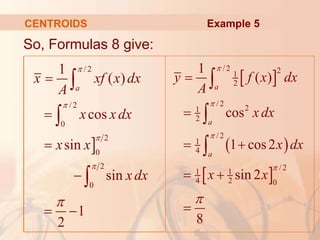
So, Formulas 8 give:
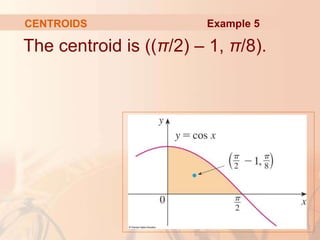
The centroid is ((π/2) – 1, π/8).
CENTROIDS Example 5
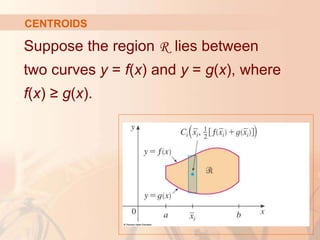
Suppose the region R lies between
two curves y = f(x) and y = g(x), where
f(x) ≥ g(x).
CENTROIDS
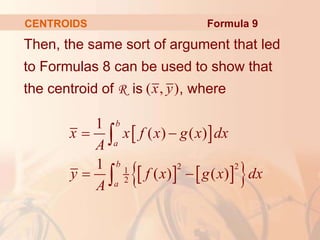
Then, the same sort of argument that led
to Formulas 8 can be used to show that
the centroid of R is , where
CENTROIDS
( , )
x y
 
   
 
2 2
1
2
1
( ) ( )
1
( ) ( )
b
a
b
a
x x f x g x dx
A
y f x g x dx
A
 
 


Formula 9
Find the centroid of the region
bounded by the line x = y and
the parabola y = x2.
CENTROIDS Example 6
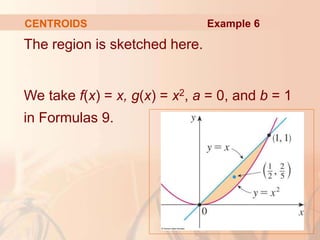
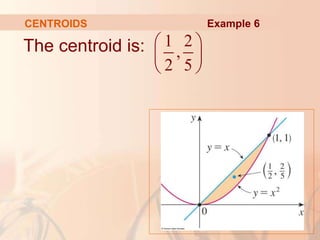
The region is sketched here.
We take f(x) = x, g(x) = x2, a = 0, and b = 1
in Formulas 9.
CENTROIDS Example 6
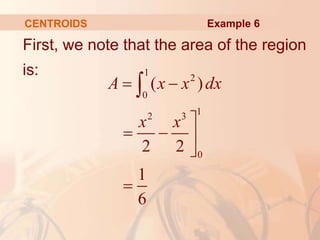
First, we note that the area of the region
is:
CENTROIDS
1
2
0
1
2 3
0
( )
2 2
1
6
A x x dx
x x
 

  



Example 6
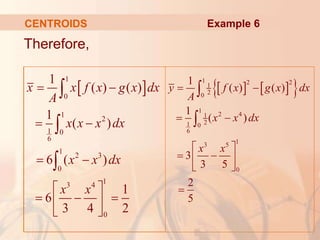
Therefore,
CENTROIDS
 
1
0
1
2
1 0
6
1
2 3
0
1
3 4
0
1
( ) ( )
1
( )
6 ( )
1
6
3 4 2
 
 
 
 
  
 
 



x x f x g x dx
A
x x x dx
x x dx
x x
Example 6
   
 
1 2 2
1
2
0
1
2 4
1
2
1 0
6
1
3 5
0
1
( ) ( )
1
( )
3
3 5
2
5
y f x g x dx
A
x x dx
x x
 
 
 
 
 
 



The centroid is:
CENTROIDS
1 2
,
2 5
 
 
 
Example 6
We end this section by showing
a surprising connection between
centroids and volumes of revolution.
CENTROIDS
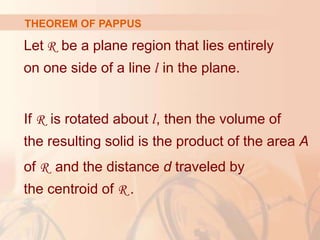
Let R be a plane region that lies entirely
on one side of a line l in the plane.
If R is rotated about l, then the volume of
the resulting solid is the product of the area A
of R and the distance d traveled by
the centroid of R .
THEOREM OF PAPPUS
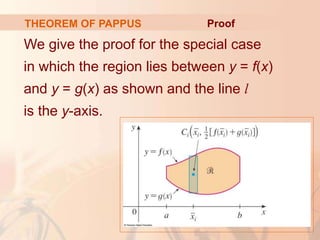
We give the proof for the special case
in which the region lies between y = f(x)
and y = g(x) as shown and the line l
is the y-axis.
THEOREM OF PAPPUS Proof
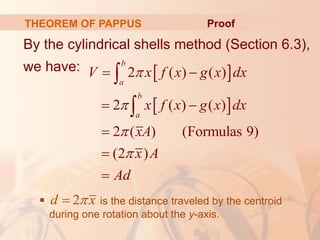
By the cylindrical shells method (Section 6.3),
we have:
 is the distance traveled by the centroid
during one rotation about the y-axis.
THEOREM OF PAPPUS
 
 
2 ( ) ( )
2 ( ) ( )
2 ( ) (Formulas 9)
(2 )
b
a
b
a
V x f x g x dx
x f x g x dx
xA
x A
Ad




 
 





Proof
2
d x


A torus is formed by rotating a circle of
radius r about a line in the plane of the circle
that is a distance R(> r) from the center of
the circle.
Find the volume of the torus.
THEOREM OF PAPPUS Example 7
The circle has area A = πr2.
By the symmetry principle, its centroid is
its center.
 So, the distance traveled by the centroid during
a rotation is d = 2πR.
THEOREM OF PAPPUS Example 7
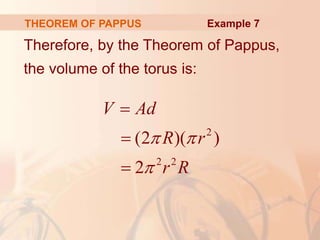
Therefore, by the Theorem of Pappus,
the volume of the torus is:
THEOREM OF PAPPUS
2
2 2
(2 )( )
2
V Ad
R r
r R
 




Example 7
Compare the method of
Example 7 with that of Exercise 63
in Section 6.2
THEOREM OF PAPPUS

Chap8_Sec3.ppt

  • 1.
  • 2.
    8.3 Applications to Physics andEngineering In this section, we will learn about: The applications of integral calculus to force due to water pressure and centers of mass. FURTHER APPLICATIONS OF INTEGRATION
  • 3.
    As with ourprevious applications to geometry (areas, volumes, and lengths) and to work, our strategy is:  Break up the physical quantity into small parts.  Approximate each small part.  Add the results.  Take the limit.  Then, evaluate the resulting integral. APPLICATIONS TO PHYSICS AND ENGINEERING
  • 4.
    Deep-sea divers realizethat water pressure increases as they dive deeper.  This is because the weight of the water above them increases. HYDROSTATIC FORCE AND PRESSURE
  • 5.
    Suppose that athin plate with area A m2 is submerged in a fluid of density ρ kg/m3 at a depth d meters below the surface of the fluid. HYDROSTATIC FORCE AND PRESSURE
  • 6.
    The fluid directlyabove the plate has volume V = Ad So, its mass is: m = ρV = ρAd HYDROSTATIC FORCE AND PRESSURE
  • 7.
    Thus, the forceexerted by the fluid on the plate is F = mg = ρgAd where g is the acceleration due to gravity. HYDROSTATIC FORCE
  • 8.
    The pressure Pon the plate is defined to be the force per unit area: HYDROSTATIC PRESSURE F P gd A   
  • 9.
    The SI unitfor measuring pressure is newtons per square meter—which is called a pascal (abbreviation: 1 N/m2 = 1 Pa).  As this is a small unit, the kilopascal (kPa) is often used. HYDROSTATIC PRESSURE
  • 10.
    For instance, sincethe density of water is ρ = 1000 kg/m3, the pressure at the bottom of a swimming pool 2 m deep is: HYDROSTATIC PRESSURE 3 2 1000kg/m 9.8m/s 2m 19,600Pa 19.6kPa P gd       
  • 11.
    An important principleof fluid pressure is the experimentally verified fact that, at any point in a liquid, the pressure is the same in all directions.  This is why a diver feels the same pressure on nose and both ears. HYDROSTATIC PRESSURE
  • 12.
    Thus, the pressurein any direction at a depth d in a fluid with mass density ρ is given by: HYDROSTATIC PRESSURE P gd d     Equation 1
  • 13.
    This helps usdetermine the hydrostatic force against a vertical plate or wall or dam in a fluid.  This is not a straightforward problem.  The pressure is not constant, but increases as the depth increases. HYDROSTATIC FORCE AND PRESSURE
  • 14.
    A dam hasthe shape of the trapezoid shown below.  The height is 20 m.  The width is 50 m at the top and 30 m at the bottom. HYDROSTATIC F AND P Example 1
  • 15.
    Find the forceon the dam due to hydrostatic pressure if the water level is 4 m from the top of the dam. HYDROSTATIC F AND P Example 1
  • 16.
    We choose avertical x-axis with origin at the surface of the water. HYDROSTATIC F AND P Example 1
  • 17.
    The depth ofthe water is 16 m.  So, we divide the interval [0, 16] into subintervals of equal length with endpoints xi.  We choose xi* [xi–1, xi]. HYDROSTATIC F AND P Example 1 
  • 18.
    The i thhorizontal strip of the dam is approximated by a rectangle with height Δx and width wi HYDROSTATIC F AND P Example 1
  • 19.
    From similar triangles, HYDROSTATICF AND P * * * 16 10 or 8 16 20 2 2 i i i x x a a x       Example 1
  • 20.
    Hence, * 1 2 * 2(15 ) 2(15 8) 46 i i i w a x x        HYDROSTATIC F AND P Example 1
  • 21.
    If Ai isthe area of the strip, then If Δx is small, then the pressure Pi on the i th strip is almost constant, and we can use Equation 1 to write: HYDROSTATIC F AND P * (46 ) i i i A w x x x      * 1000 i i P gx  Example 1
  • 22.
    The hydrostatic forceFi acting on the i th strip is the product of the pressure and the area: HYDROSTATIC F AND P * * 1000 (46 ) i i i i i F PA gx x x     Example 1
  • 23.
    Adding these forcesand taking the limit as n → ∞, the total hydrostatic force on the dam is: HYDROSTATIC F AND P * * 1 16 0 16 2 0 16 3 2 7 0 lim 1000 (46 ) 1000 (46 ) 1000(9.8) (46 ) 9800 23 4.43 10 N 3 n i i n i F gx x x gx x dx x x dx x x                       Example 1
  • 24.
    Find the hydrostaticforce on one end of a cylindrical drum with radius 3 ft, if the drum is submerged in water 10 ft deep. HYDROSTATIC F AND P Example 2
  • 25.
    In this example,it is convenient to choose the axes as shown—so that the origin is placed at the center of the drum.  Then, the circle has a simple equation: x2 + y2 = 9 HYDROSTATIC F AND P Example 2
  • 26.
    As in Example1, we divide the circular region into horizontal strips of equal width. HYDROSTATIC F AND P Example 2
  • 27.
    From the equationof the circle, we see that the length of the i th strip is: So, its area is: HYDROSTATIC F AND P * 2 2 9 ( ) i y  * 2 2 9 ( ) i i A y y    Example 2
  • 28.
    The pressure onthis strip is approximately So, the force on the strip is approximately HYDROSTATIC F AND P * * 2 62.5(7 )2 9 ( ) i i i i d A y y y      * 62.5(7 ) i i d y    Example 2
  • 29.
    We get thetotal force by adding the forces on all the strips and taking the limit: HYDROSTATIC F AND P * * 2 1 3 2 3 3 3 2 2 3 3 lim 62.5(7 )2 9 ( ) 125 (7 ) 9 125 7 9 125 9 n i i n i F y y y y y dy y dy y y dy                      Example 2
  • 30.
    The second integralis 0 because the integrand is an odd function.  See Theorem 7 in Section 5.5 HYDROSTATIC F AND P Example 2
  • 31.
    The first integralcan be evaluated using the trigonometric substitution y = 3 sin θ. However, it’s simpler to observe that it is the area of a semicircular disk with radius 3. HYDROSTATIC F AND P Example 2
  • 32.
    Thus, HYDROSTATIC F ANDP 3 2 3 2 1 2 875 9 875 (3) 7875 2 12,370lb F y dy           Example 2
  • 33.
    Our main objectivehere is to find the point P on which a thin plate of any given shape balances horizontally as shown. MOMENTS AND CENTERS OF MASS
  • 34.
    This point iscalled the center of mass (or center of gravity) of the plate. CENTERS OF MASS
  • 35.
    We first considerthe simpler situation illustrated here. CENTERS OF MASS
  • 36.
    Two masses m1and m2 are attached to a rod of negligible mass on opposite sides of a fulcrum and at distances d1 and d2 from the fulcrum. CENTERS OF MASS
  • 37.
    The rod willbalance if: CENTERS OF MASS 1 1 2 2 m d m d  Equation 2
  • 38.
    This is anexperimental fact discovered by Archimedes and called the Law of the Lever.  Think of a lighter person balancing a heavier one on a seesaw by sitting farther away from the center. LAW OF THE LEVER
  • 39.
    Now, suppose thatthe rod lies along the x-axis, with m1 at x1 and m2 at x2 and the center of mass at . MOMENTS AND CENTERS OF MASS x
  • 40.
    Comparing the figures, wesee that:  d1 = – x1  d2 = x1 – x MOMENTS AND CENTERS OF MASS x
  • 41.
    CENTERS OF MASS So,Equation 2 gives: 1 1 2 2 ( ) ( ) m x x m x x    1 2 1 1 2 2 m x m x m x m x    1 1 2 2 1 2 m x m x x m m    Equation 3
  • 42.
    The numbers m1x1and m2x2 are called the moments of the masses m1 and m2 (with respect to the origin). MOMENTS OF MASS
  • 43.
    Equation 3 saysthat the center of mass is obtained by: 1. Adding the moments of the masses 2. Dividing by the total mass m = m1 + m2 MOMENTS OF MASS x 1 1 2 2 1 2 m x m x x m m   
  • 44.
    In general, supposewe have a system of n particles with masses m1, m2, . . . , mn located at the points x1, x2, . . . , xn on the x-axis. Then, we can show where the center of mass of the system is located—as follows. CENTERS OF MASS Equation 4
  • 45.
    The center ofmass of the system is located at where m = Σ mi is the total mass of the system. CENTERS OF MASS 1 1 1 n n i i i i i i n i i m x m x x m m         Equation 4
  • 46.
    The sum ofthe individual moments is called the moment of the system about the origin. MOMENT OF SYSTEM ABOUT ORIGIN 1 n i i i M m x   
  • 47.
    Then, Equation 4could be rewritten as: m = M  This means that, if the total mass were considered as being concentrated at the center of mass , then its moment would be the same as the moment of the system. MOMENT OF SYSTEM ABOUT ORIGIN x x
  • 48.
    Now, we considera system of n particles with masses m1, m2, . . . , mn located at the points (x1, y1), (x2, y2) . . . , (xn, yn) in the xy-plane. MOMENTS AND CENTERS OF MASS
  • 49.
    By analogy withthe one-dimensional case, we define the moment of the system about the y-axis as and the moment of the system about the x-axis as MOMENT ABOUT AXES 1 n y i i i M m x    Equations 5 and 6 1 n x i i i M m y   
  • 50.
    My measures thetendency of the system to rotate about the y-axis. Mx measures the tendency of the system to rotate about the x-axis. MOMENT ABOUT AXES
  • 51.
    As in theone-dimensional case, the coordinates of the center of mass are given in terms of the moments by the formulas where m = ∑ mi is the total mass. CENTERS OF MASS ( , ) x y y x M M x y m m   Equation 7
  • 52.
    Since , the centerof mass is the point where a single particle of mass m would have the same moments as the system. MOMENTS AND CENTERS OF MASS and y x mx M my M   ( , ) x y
  • 53.
    Find the momentsand center of mass of the system of objects that have masses 3, 4, and 8 at the points (–1, 1), (2, –1) and (3, 2) respectively. MOMENTS & CENTERS OF MASS Example 3
  • 54.
    We use Equations5 and 6 to compute the moments: MOMENTS & CENTERS OF MASS 3( 1) 4(2) 8(3) 29 3(1) 4( 1) 8(2) 15 y x M M           Example 3
  • 55.
    As m =3 + 4 + 8 = 15, we use Equation 7 to obtain: MOMENTS & CENTERS OF MASS Example 3 29 15 1 15 15 y x M M x y m m     
  • 56.
    Thus, the centerof mass is: MOMENTS & CENTERS OF MASS 14 15 (1 ,1) Example 3
  • 57.
    Next, we considera flat plate, called a lamina, with uniform density ρ that occupies a region R of the plane.  We wish to locate the center of mass of the plate, which is called the centroid of R . CENTROIDS
  • 58.
    In doing so,we use the following physical principles. CENTROIDS
  • 59.
    The symmetry principlesays that, if R is symmetric about a line l, then the centroid of R lies on l.  If R is reflected about l, then R remains the same so its centroid remains fixed.  However, the only fixed points lie on l.  Thus, the centroid of a rectangle is its center. CENTROIDS
  • 60.
    Moments should bedefined so that, if the entire mass of a region is concentrated at the center of mass, then its moments remain unchanged. CENTROIDS
  • 61.
    Also, the momentof the union of two non-overlapping regions should be the sum of the moments of the individual regions. CENTROIDS
  • 62.
    Suppose that theregion R is of the type shown here. That is, R lies:  Between the lines x = a and x = b  Above the x-axis  Beneath the graph of f, where f is a continuous function CENTROIDS
  • 63.
    We divide theinterval [a, b] into n subintervals with endpoints x0, x1, . . . , xn and equal width ∆x.  We choose the sample point xi * to be the midpoint of the i th subinterval.  That is, = (xi–1 + xi)/2 CENTROIDS i x i x
  • 64.
    This determines thepolygonal approximation to R shown below. CENTROIDS
  • 65.
    The centroid ofthe i th approximating rectangle Ri is its center . Its area is: f( ) ∆x So, its mass is: CENTROIDS 1 2 ( , ( )) i i i C x f x ( ) i f x x   i x
  • 66.
    The moment ofRi about the y-axis is the product of its mass and the distance from Ci to the y-axis, which is . CENTROIDS i x
  • 67.
    Therefore, CENTROIDS   ( )( ) ( ) y i i i i i M R f x x x x f x x      
  • 68.
    Adding these moments,we obtain the moment of the polygonal approximation to R . CENTROIDS
  • 69.
    Then, by takingthe limit as n → ∞, we obtain the moment of R itself about the y-axis: CENTROIDS 1 lim ( ) ( ) n y i i n i b a M x f x x x f x dx         
  • 70.
    Similarly, we computethe moment of Ri about the x-axis as the product of its mass and the distance from Ci to the x-axis: CENTROIDS     1 2 2 1 2 ( ) ( ) ( ) ( ) x i i i i M R f x x f x f x x       
  • 71.
    Again, we addthese moments and take the limit to obtain the moment of R about the x-axis: CENTROIDS     2 1 2 1 2 1 2 lim ( ) ( ) n x i n i b a M f x x f x dx          
  • 72.
    Just as forsystems of particles, the center of mass of the plate is defined so that CENTROIDS and y x mx M my M  
  • 73.
    However, the massof the plate is the product of its density and its area: CENTROIDS ( ) b a m A f x dx     
  • 74.
    Thus,  Notice thecancellation of the ρ’s.  The location of the center of mass is independent of the density. CENTROIDS ( ) ( ) ( ) ( ) b b y a a b b a a xf x dx xf x dx M x m f x dx f x dx              2 2 1 1 2 2 ( ) ( ) ( ) ( ) b b x a a b b a a f x dx f x dx M y m f x dx f x dx         
  • 75.
    In summary, thecenter of mass of the plate (or the centroid of R ) is located at the point , where CENTROIDS ( , ) x y   2 1 2 1 ( ) 1 ( ) b a b a x xf x dx A y f x dx A     Formula 8
  • 76.
    Find the centerof mass of a semicircular plate of radius r.  To use Equation 8, we place the semicircle as shown so that f(x) = √(r2 – x2) and a = –r, b = r. CENTERS OF MASS Example 4
  • 77.
    Here, there isno need to use the formula to calculate .  By the symmetry principle, the center of mass must lie on the y-axis, so . CENTERS OF MASS x 0 x  Example 4
  • 78.
    The area ofthe semicircle is A = ½πr2. Thus, CENTERS OF MASS       2 1 2 2 2 2 1 2 2 1 2 3 2 2 2 2 2 0 0 3 2 1 ( ) 1 2 2 3 2 2 4 3 3 r r r r r r y f x dx A r x dx r x r x dx r x r r r r r                           Example 4
  • 79.
    The center ofmass is located at the point (0, 4r/(3π)). CENTERS OF MASS Example 4
  • 80.
    Find the centroidof the region bounded by the curves y = cos x, y = 0, x = 0, x = π/2 CENTERS OF MASS Example 5
  • 81.
    The area ofthe region is: CENTERS OF MASS  2 2 0 0 cos sin 1 A xdx x      Example 5
  • 82.
    CENTROIDS      / 2 2 1 2 / 2 2 1 2 / 2 1 4 / 2 1 1 4 2 0 1 ( ) cos 1 cos2 sin 2 8 a a a y f x dx A xdx x dx x x                Example 5  /2 /2 0 2 0 2 0 1 ( ) cos sin sin 1 2 a x xf x dx A x xdx x x xdx               So, Formulas 8 give:
  • 83.
    The centroid is((π/2) – 1, π/8). CENTROIDS Example 5
  • 84.
    Suppose the regionR lies between two curves y = f(x) and y = g(x), where f(x) ≥ g(x). CENTROIDS
  • 85.
    Then, the samesort of argument that led to Formulas 8 can be used to show that the centroid of R is , where CENTROIDS ( , ) x y         2 2 1 2 1 ( ) ( ) 1 ( ) ( ) b a b a x x f x g x dx A y f x g x dx A       Formula 9
  • 86.
    Find the centroidof the region bounded by the line x = y and the parabola y = x2. CENTROIDS Example 6
  • 87.
    The region issketched here. We take f(x) = x, g(x) = x2, a = 0, and b = 1 in Formulas 9. CENTROIDS Example 6
  • 88.
    First, we notethat the area of the region is: CENTROIDS 1 2 0 1 2 3 0 ( ) 2 2 1 6 A x x dx x x          Example 6
  • 89.
    Therefore, CENTROIDS   1 0 1 2 1 0 6 1 23 0 1 3 4 0 1 ( ) ( ) 1 ( ) 6 ( ) 1 6 3 4 2                   x x f x g x dx A x x x dx x x dx x x Example 6       1 2 2 1 2 0 1 2 4 1 2 1 0 6 1 3 5 0 1 ( ) ( ) 1 ( ) 3 3 5 2 5 y f x g x dx A x x dx x x               
  • 90.
    The centroid is: CENTROIDS 12 , 2 5       Example 6
  • 91.
    We end thissection by showing a surprising connection between centroids and volumes of revolution. CENTROIDS
  • 92.
    Let R bea plane region that lies entirely on one side of a line l in the plane. If R is rotated about l, then the volume of the resulting solid is the product of the area A of R and the distance d traveled by the centroid of R . THEOREM OF PAPPUS
  • 93.
    We give theproof for the special case in which the region lies between y = f(x) and y = g(x) as shown and the line l is the y-axis. THEOREM OF PAPPUS Proof
  • 94.
    By the cylindricalshells method (Section 6.3), we have:  is the distance traveled by the centroid during one rotation about the y-axis. THEOREM OF PAPPUS     2 ( ) ( ) 2 ( ) ( ) 2 ( ) (Formulas 9) (2 ) b a b a V x f x g x dx x f x g x dx xA x A Ad              Proof 2 d x  
  • 95.
    A torus isformed by rotating a circle of radius r about a line in the plane of the circle that is a distance R(> r) from the center of the circle. Find the volume of the torus. THEOREM OF PAPPUS Example 7
  • 96.
    The circle hasarea A = πr2. By the symmetry principle, its centroid is its center.  So, the distance traveled by the centroid during a rotation is d = 2πR. THEOREM OF PAPPUS Example 7
  • 97.
    Therefore, by theTheorem of Pappus, the volume of the torus is: THEOREM OF PAPPUS 2 2 2 (2 )( ) 2 V Ad R r r R       Example 7
  • 98.
    Compare the methodof Example 7 with that of Exercise 63 in Section 6.2 THEOREM OF PAPPUS