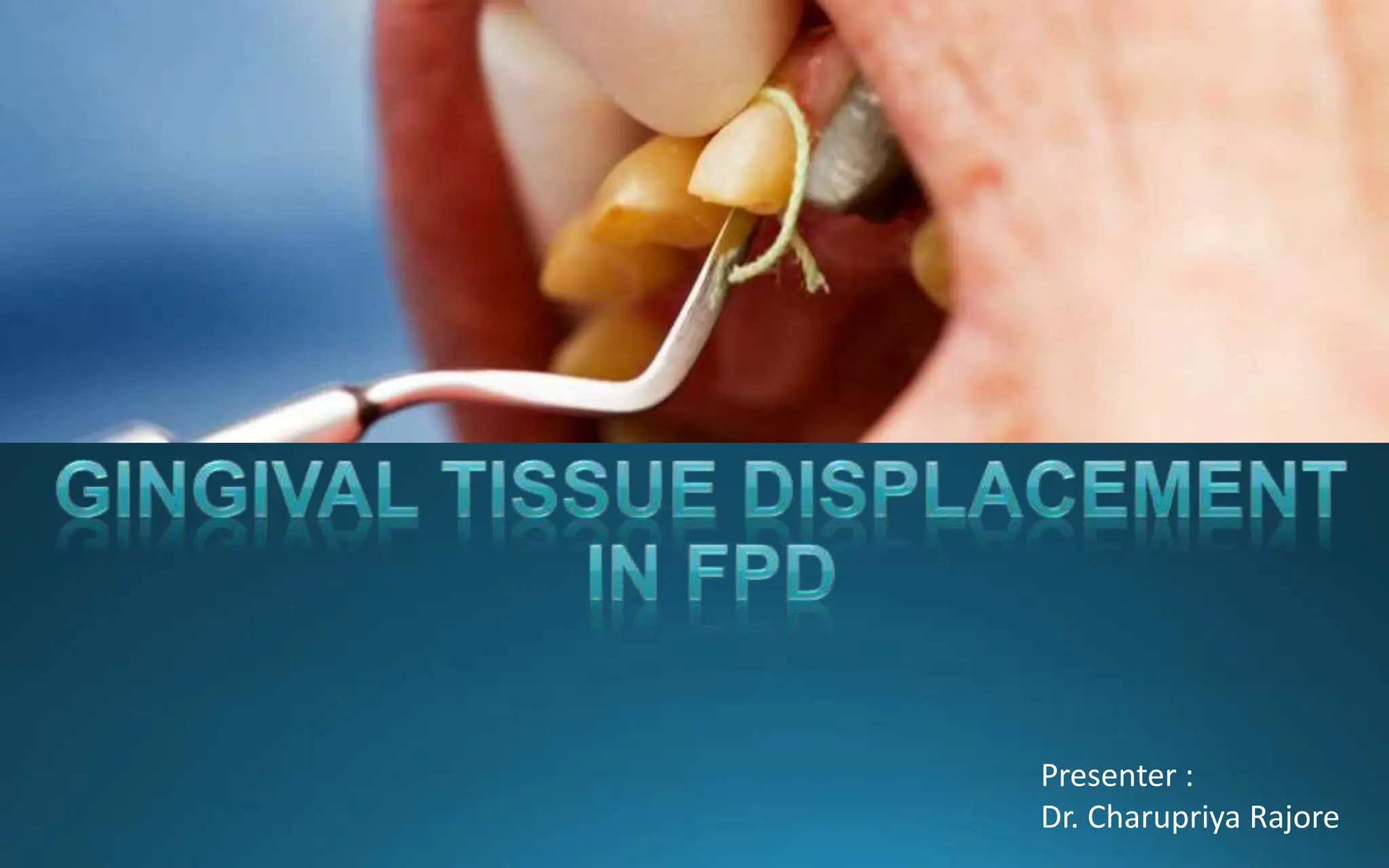
Presenter :
Dr. Charupriya Rajore
1. Introduction
7. Gingival tissue displacement around implant
INTRODUCTION
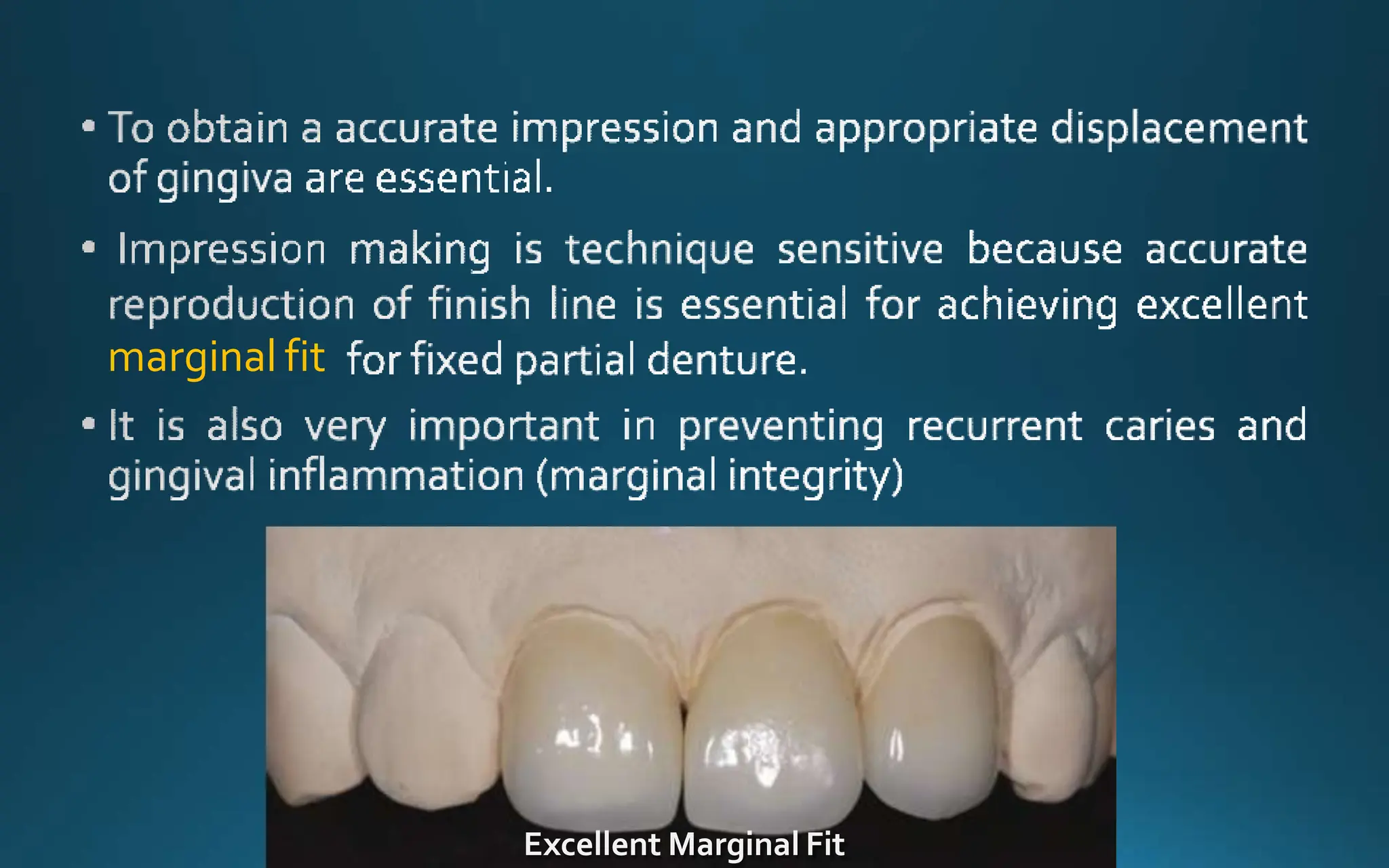
Supra-gingival margins
marginal fit
Excellent Marginal Fit
Gingival retraction
NeedAnd ImportanceOf Gingival Displacement
exposure of
finish line
impression
material and fluid control.
esthetics prevention
of periodontal disease
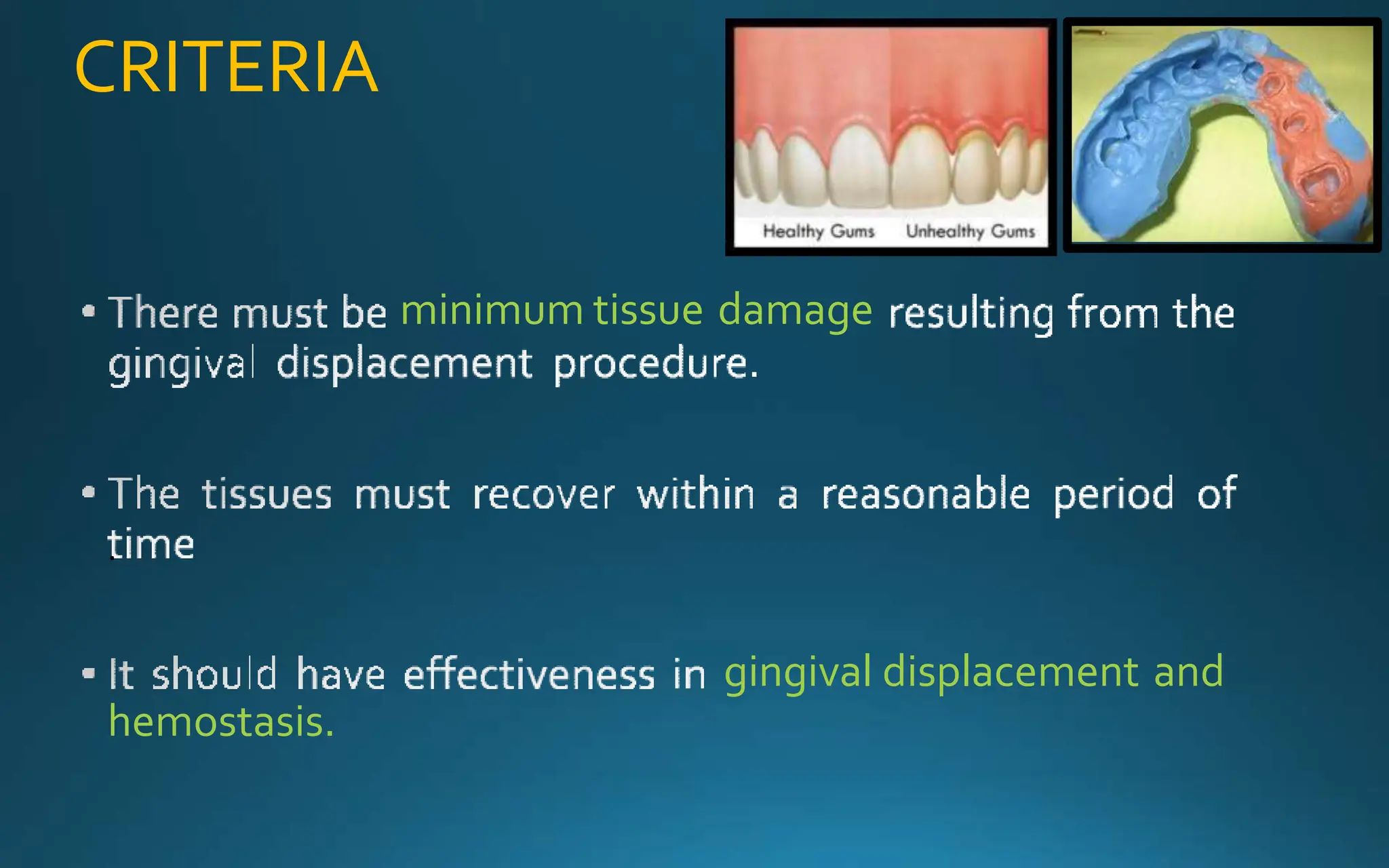
CRITERIA
minimum tissue damage
.
gingival displacement and
hemostasis.
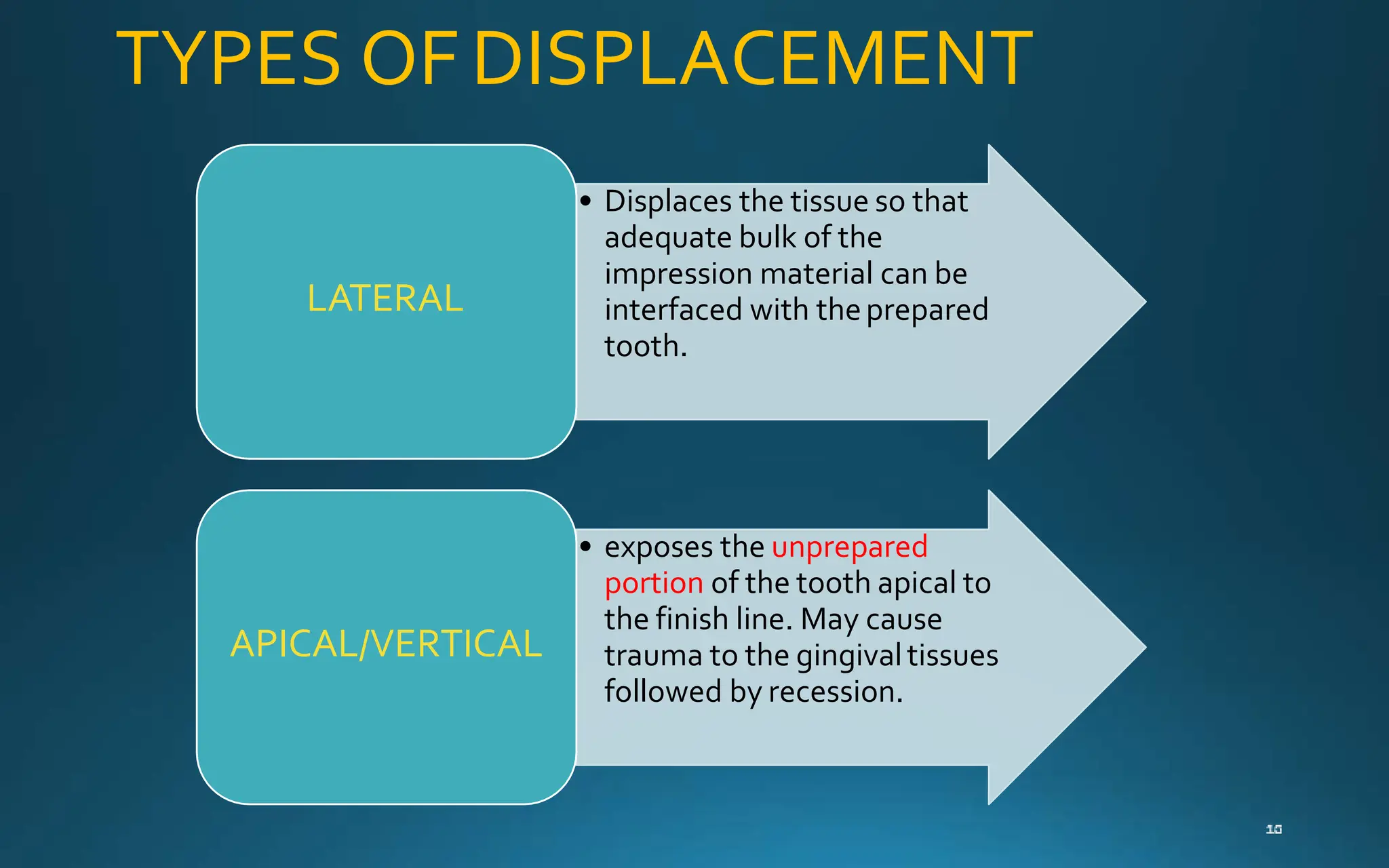
TYPES OFDISPLACEMENT
• Displaces the tissue so that
adequate bulk of the
impression material can be
interfaced with theprepared
tooth.
LATERAL
• exposes the unprepared
portion of the tooth apical to
the finish line. May cause
trauma to the gingivaltissues
followed by recession.
APICAL/VERTICAL
COMBINATION
OF DIFFERENT
TECHNIQUES
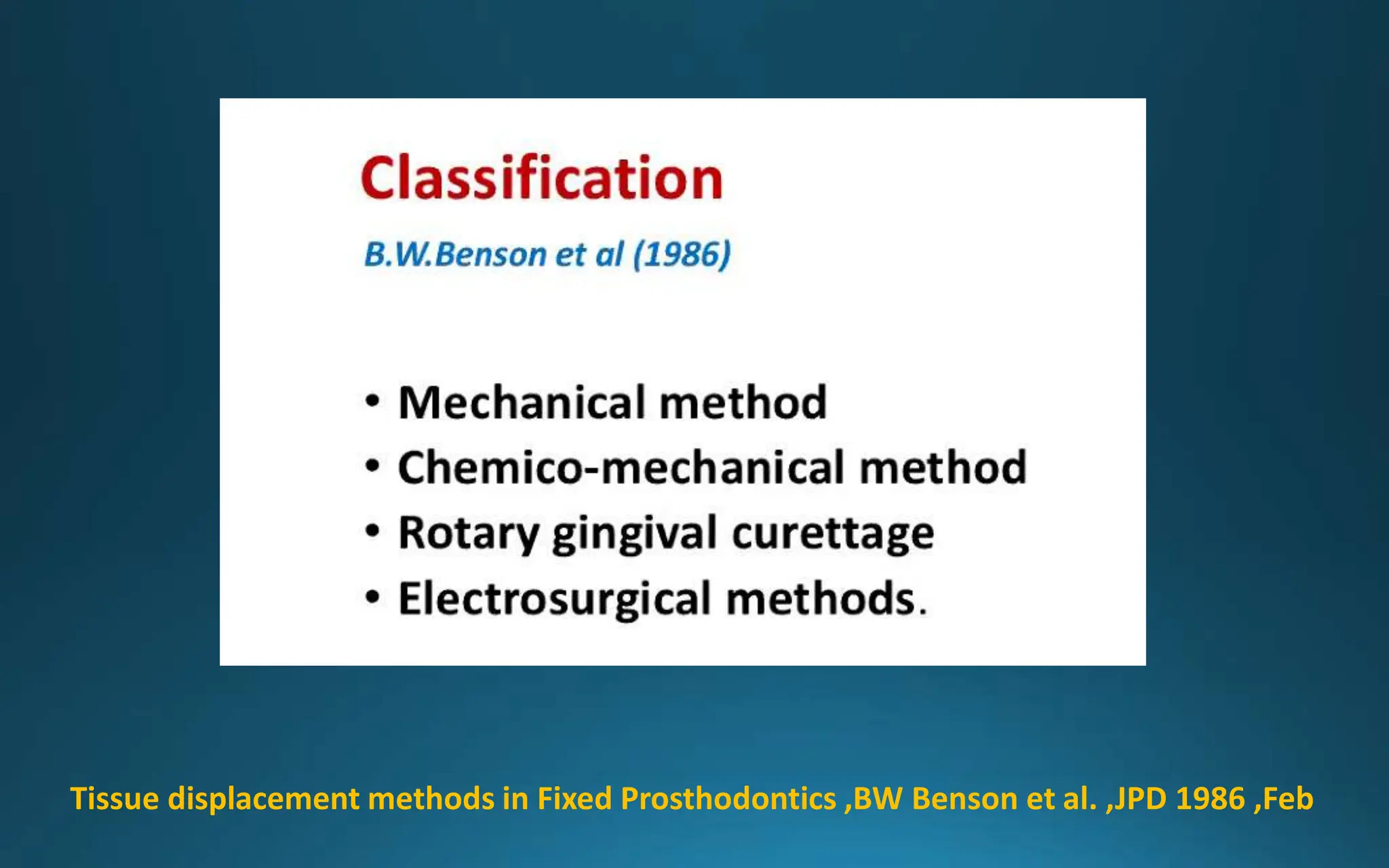
Tissue displacement methods in Fixed Prosthodontics ,BW Benson et al. ,JPD 1986 ,Feb
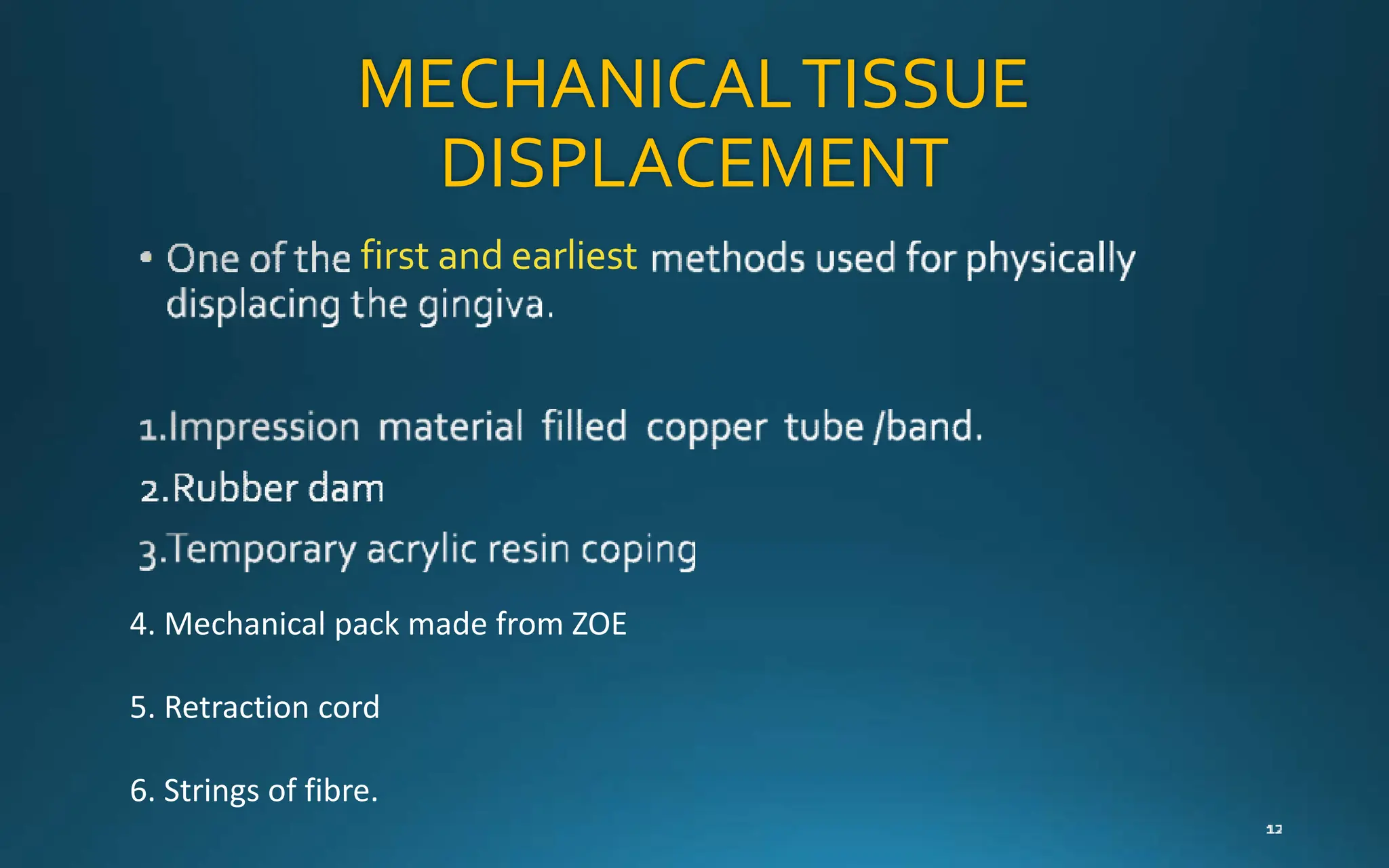
MECHANICALTISSUE
DISPLACEMENT
first and earliest
4. Mechanical pack made from ZOE
5. Retraction cord
6. Strings of fibre.
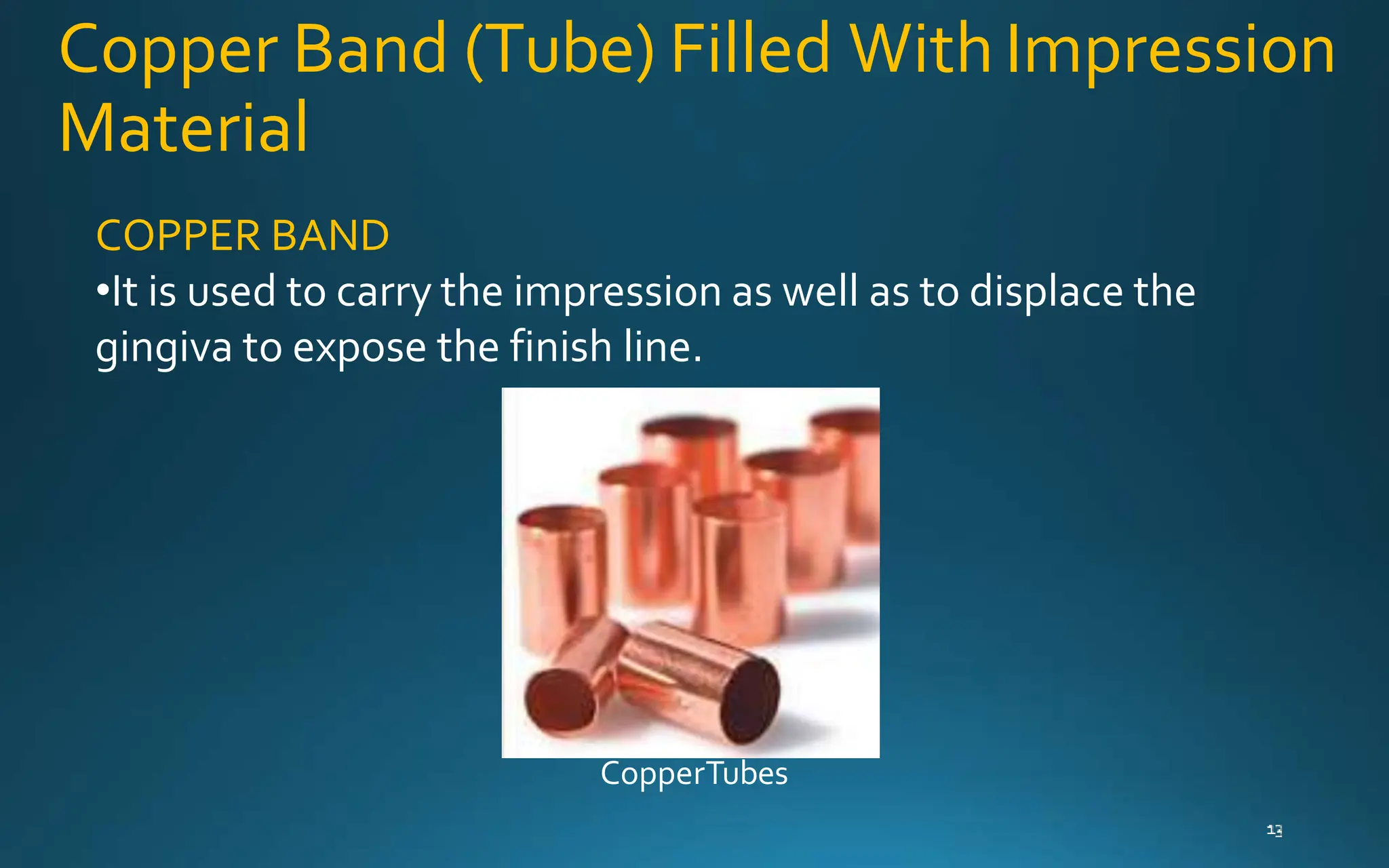
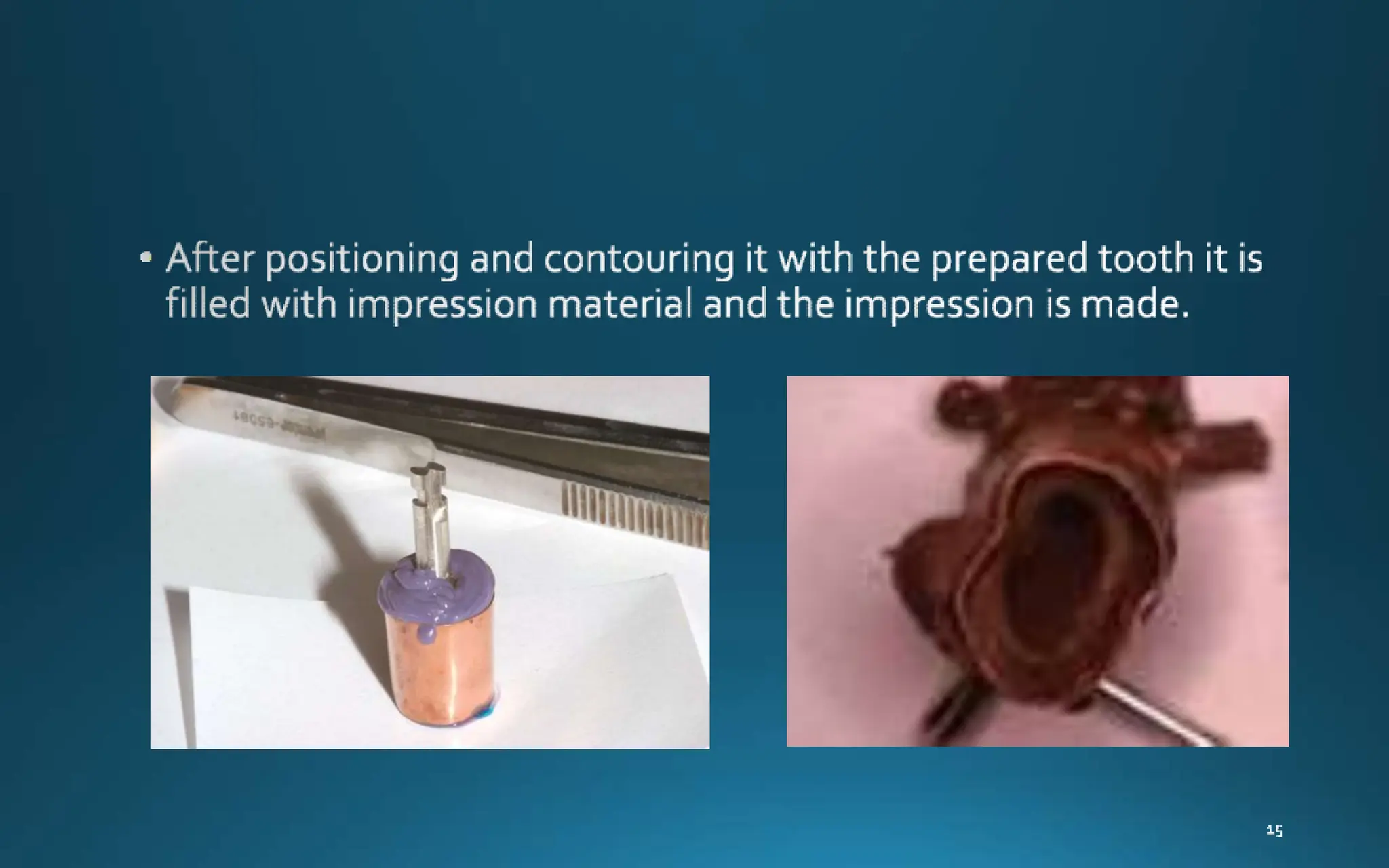
Copper Band (Tube) Filled WithImpression
Material
COPPER BAND
•It is used to carry the impression as well as to displace the
gingiva to expose the finish line.
CopperTubes
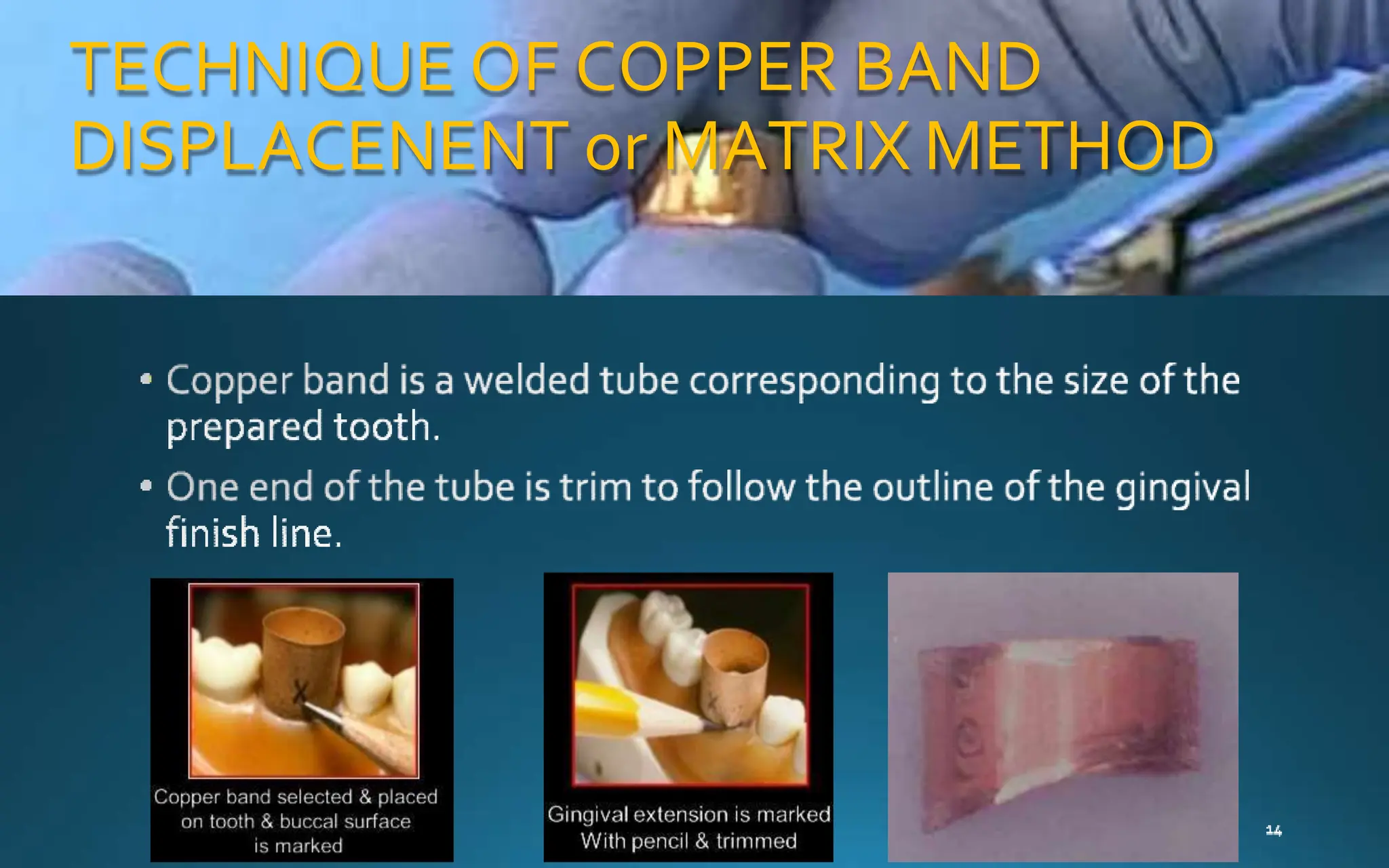
TECHNIQUE OF COPPER BAND
DISPLACENENT or MATRIX METHOD
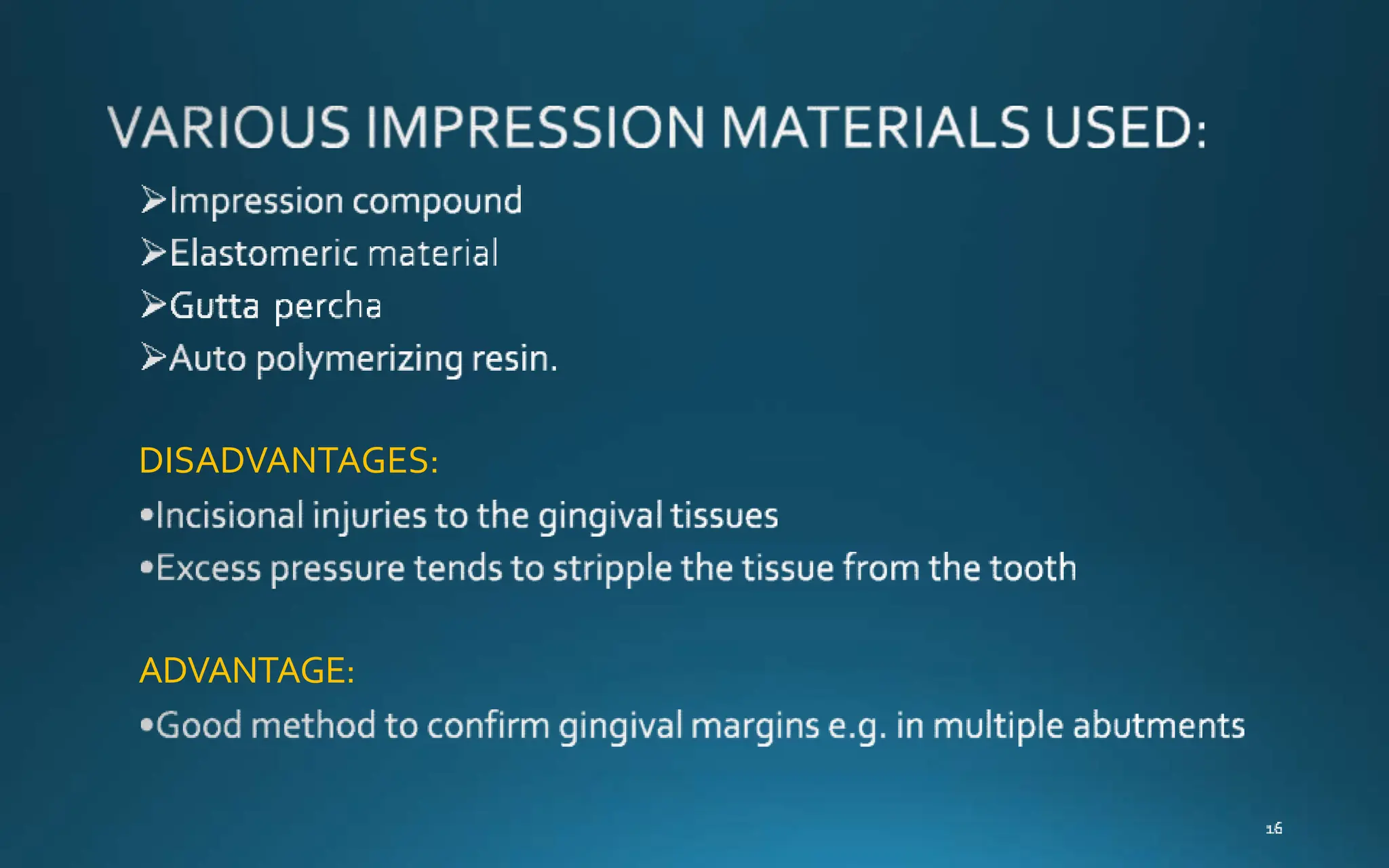
DISADVANTAGES:
ADVANTAGE:
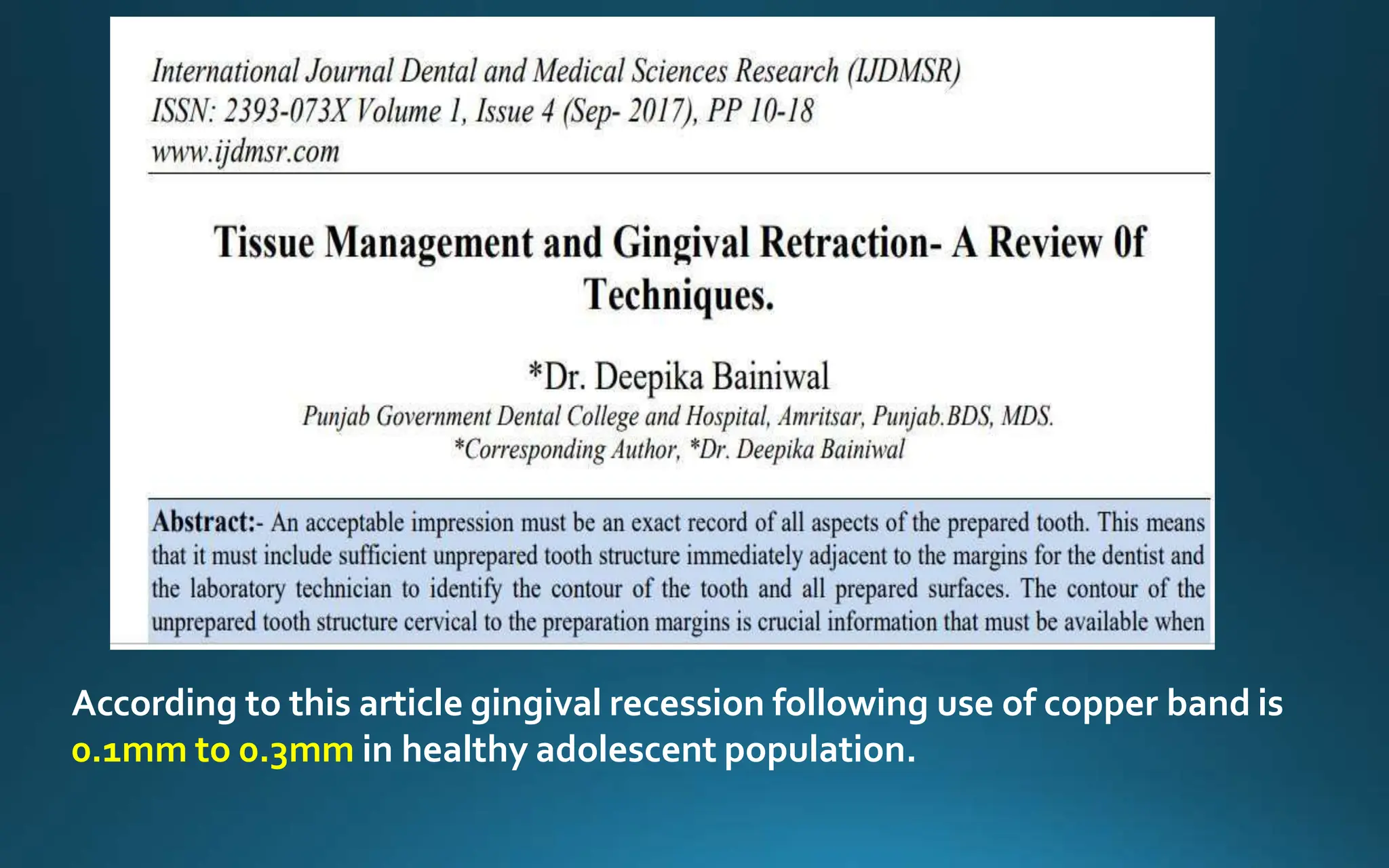
According to this article gingival recession following use of copper band is
0.1mm to 0.3mm in healthy adolescent population.
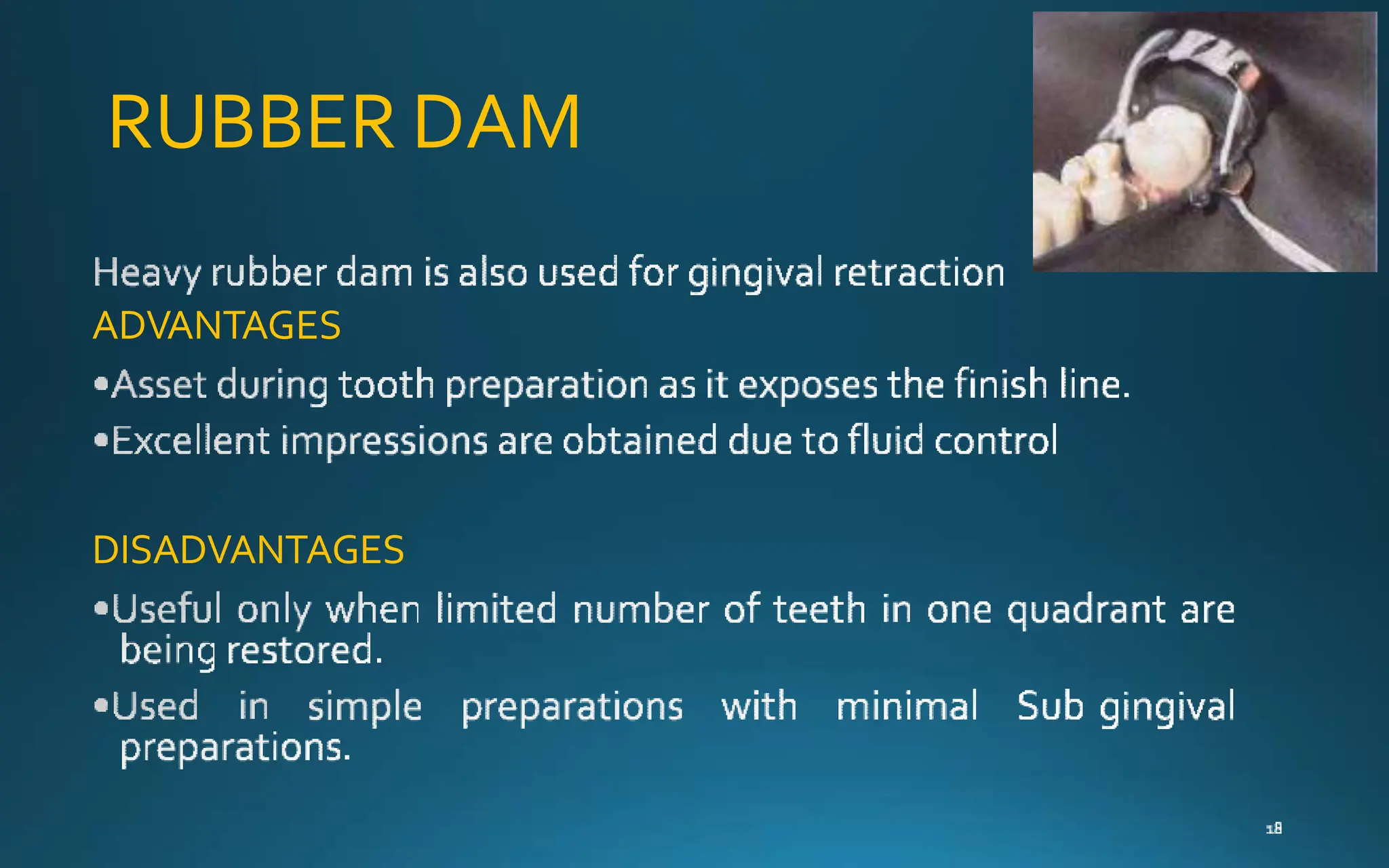
RUBBER DAM
ADVANTAGES
DISADVANTAGES
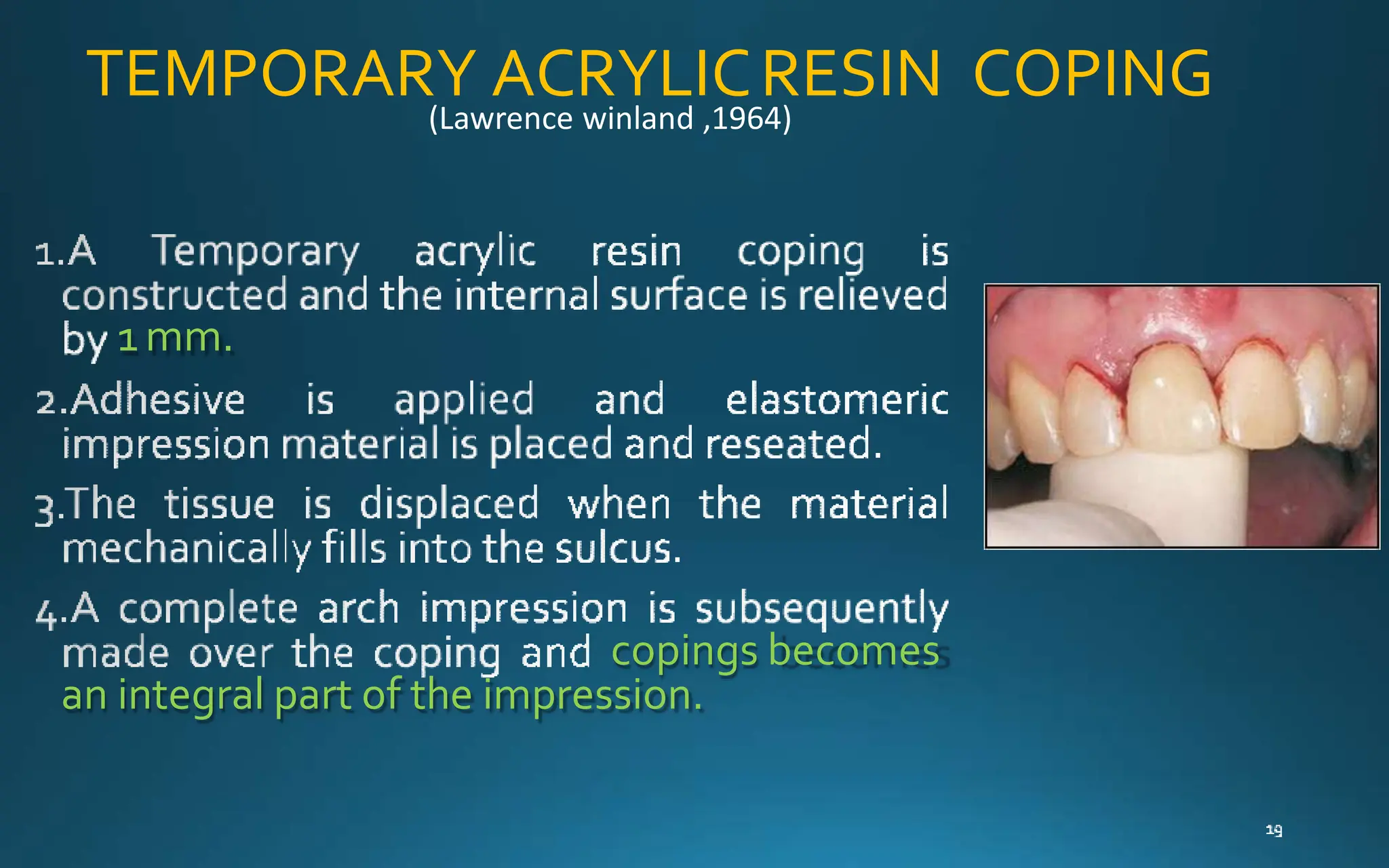
TEMPORARY ACRYLICRESIN COPING
1 mm.
copings becomes
an integral part of the impression.
(Lawrence winland ,1964)
TEMPORARY METAL CROWN FILLEDWITH
THERMO-PLASTIC STOPPING MATERIAL
prolonged or lasting recession
sensitive
susceptible to caries
same appointment
GINGIVALTISSUE RETRACTION-AREVIEW:
Syed Shujaulla, SyedaTawkhiraTabasum, Sunil Kumar MVJIDENT ISSUE 1VOLUME 1 OCTOBER 2012
Chemicomechanical Displacement
Methods
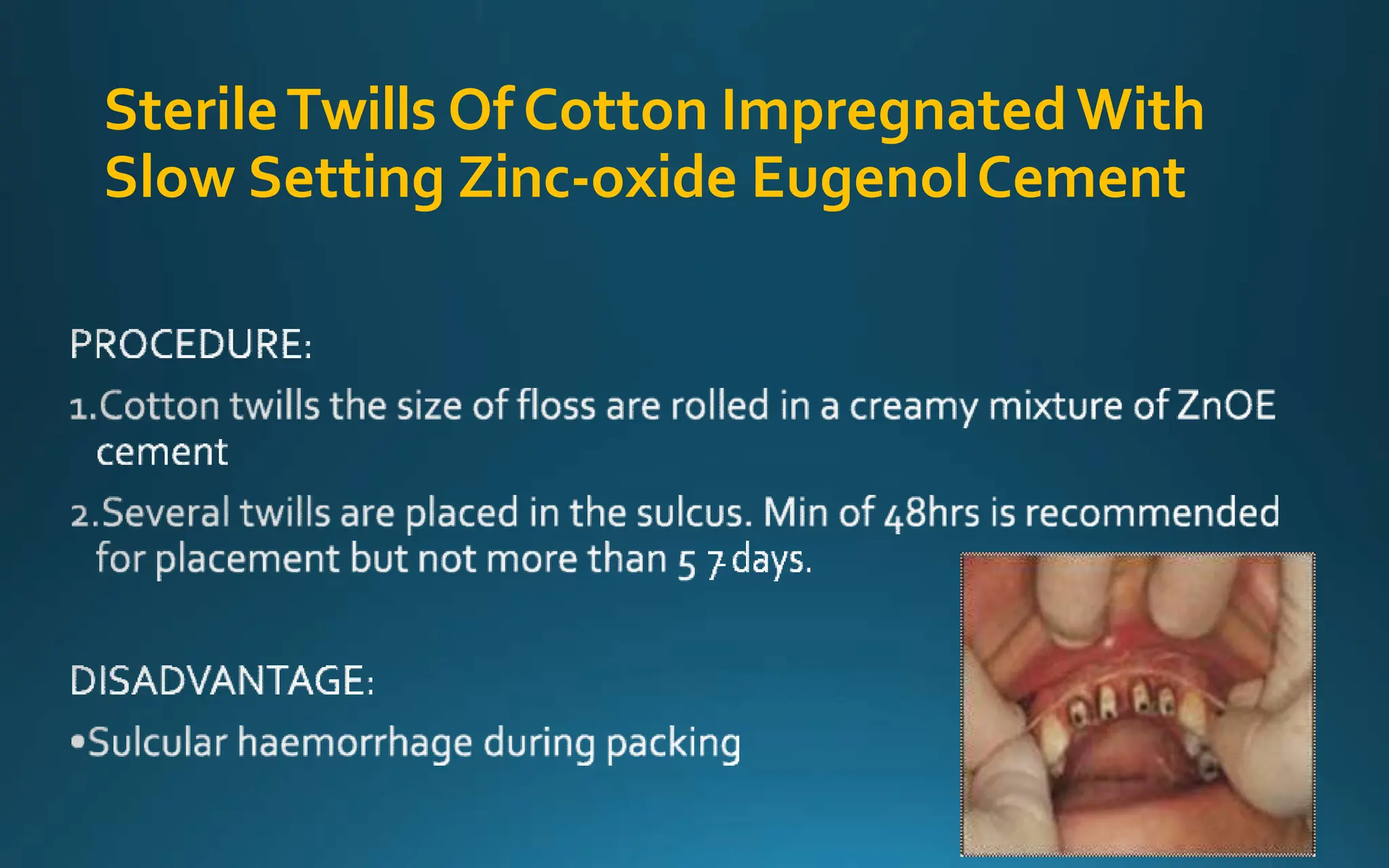
SterileTwills Of Cotton ImpregnatedWith
Slow Setting Zinc-oxide EugenolCement
-
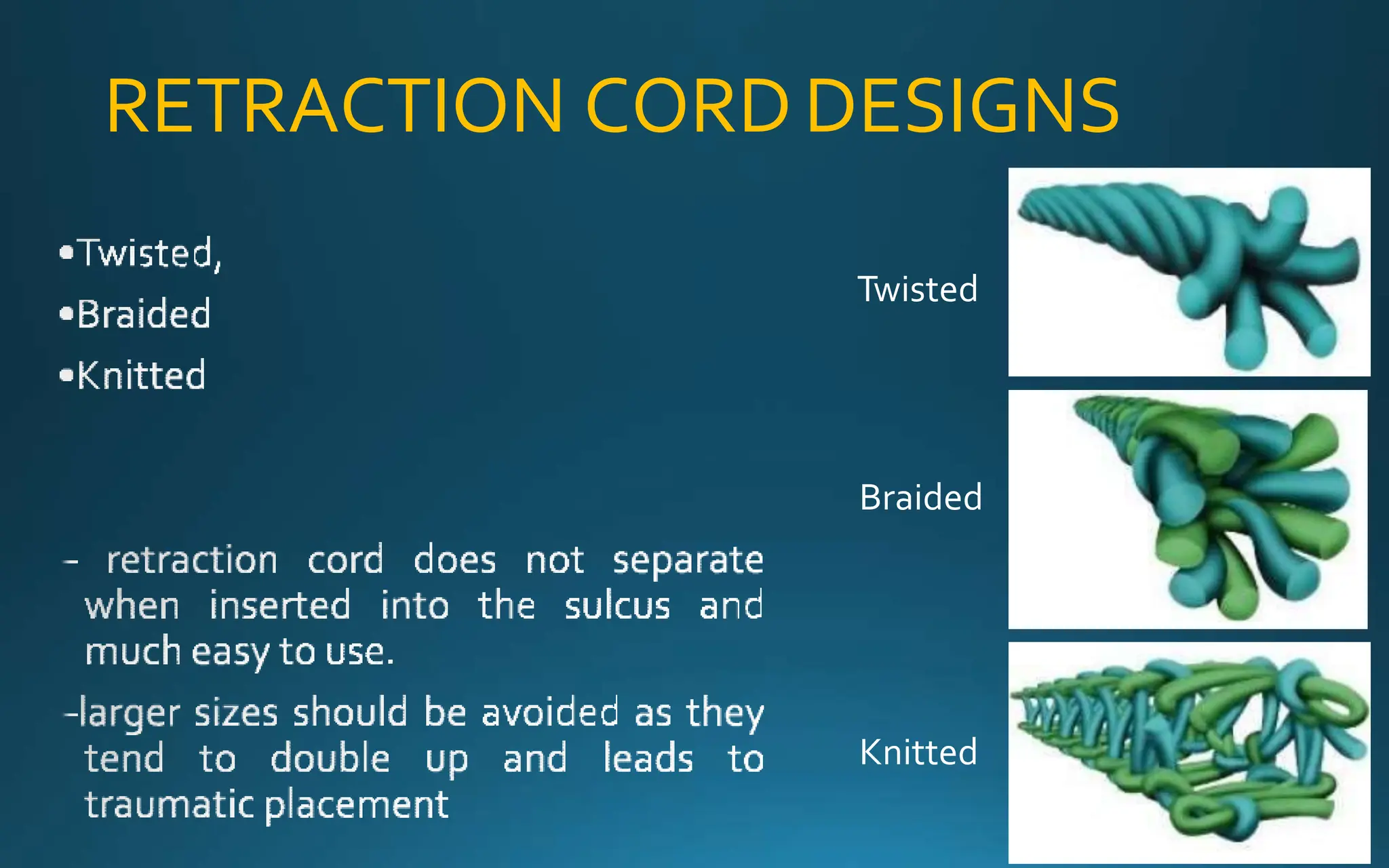
RETRACTION CORDDESIGNS
Twisted
Braided
Knitted
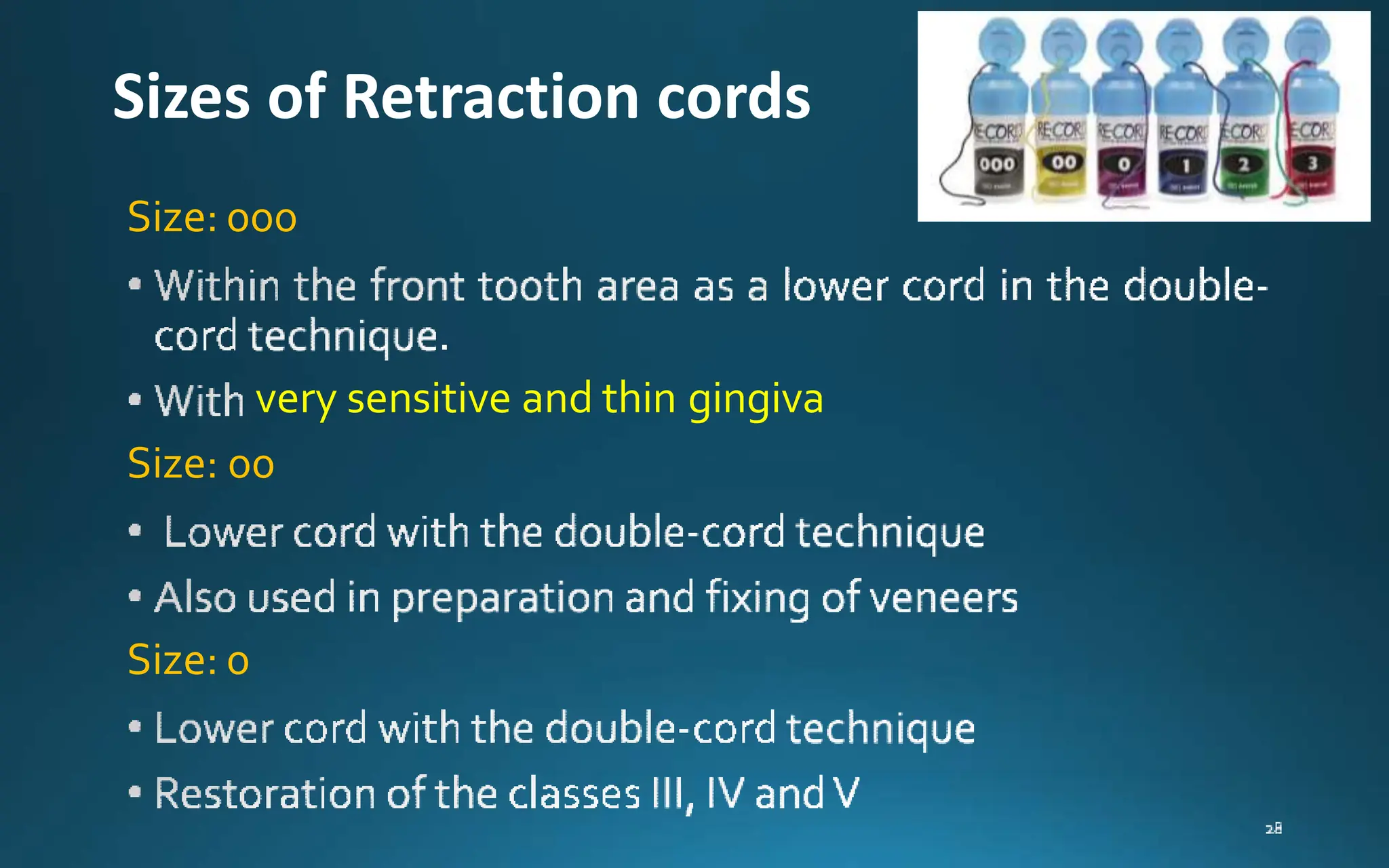
Size: 000
very sensitive and thin gingiva
Size: 00
Size: 0
Sizes of Retraction cords
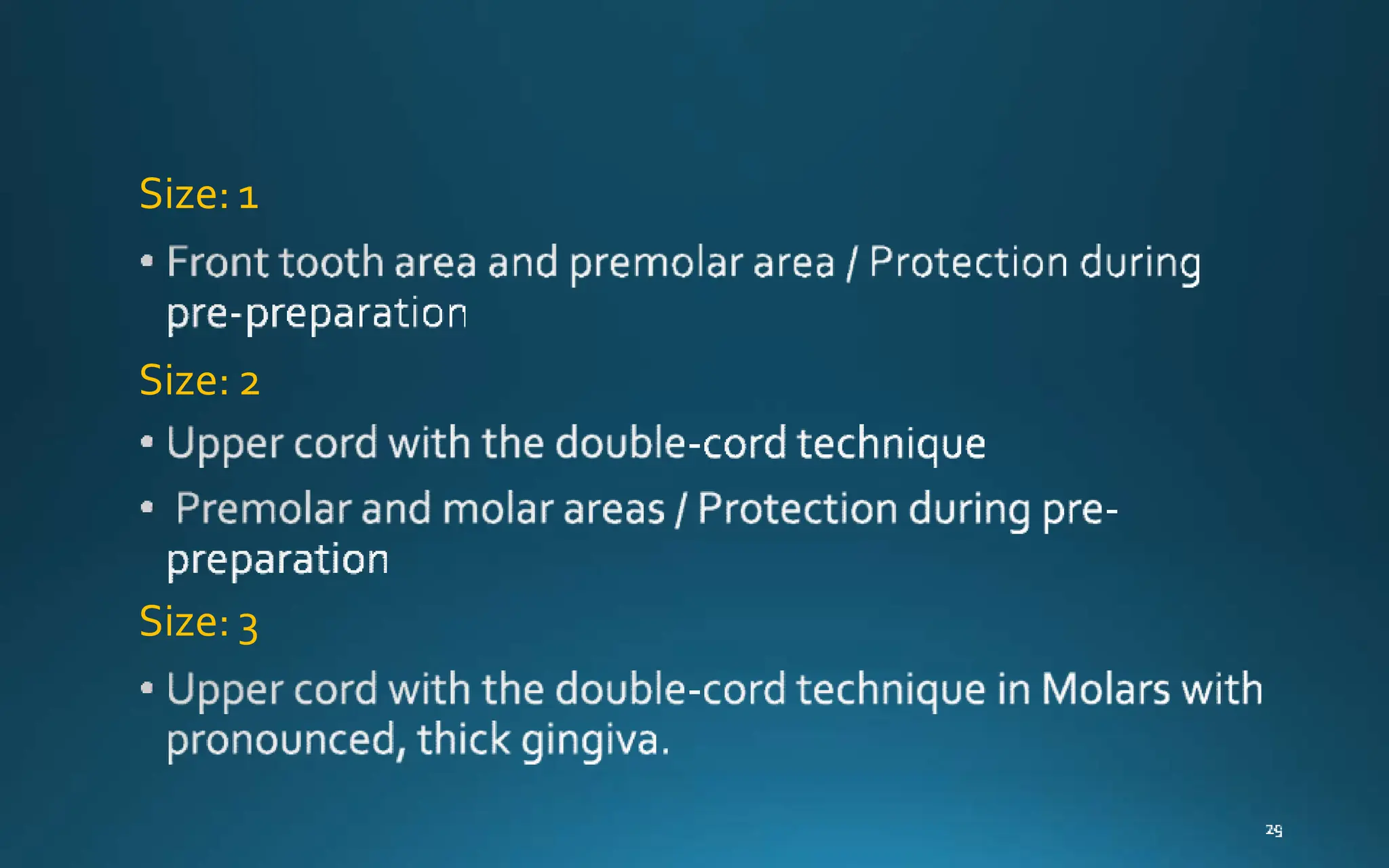
Size: 1
Size: 2
Size: 3
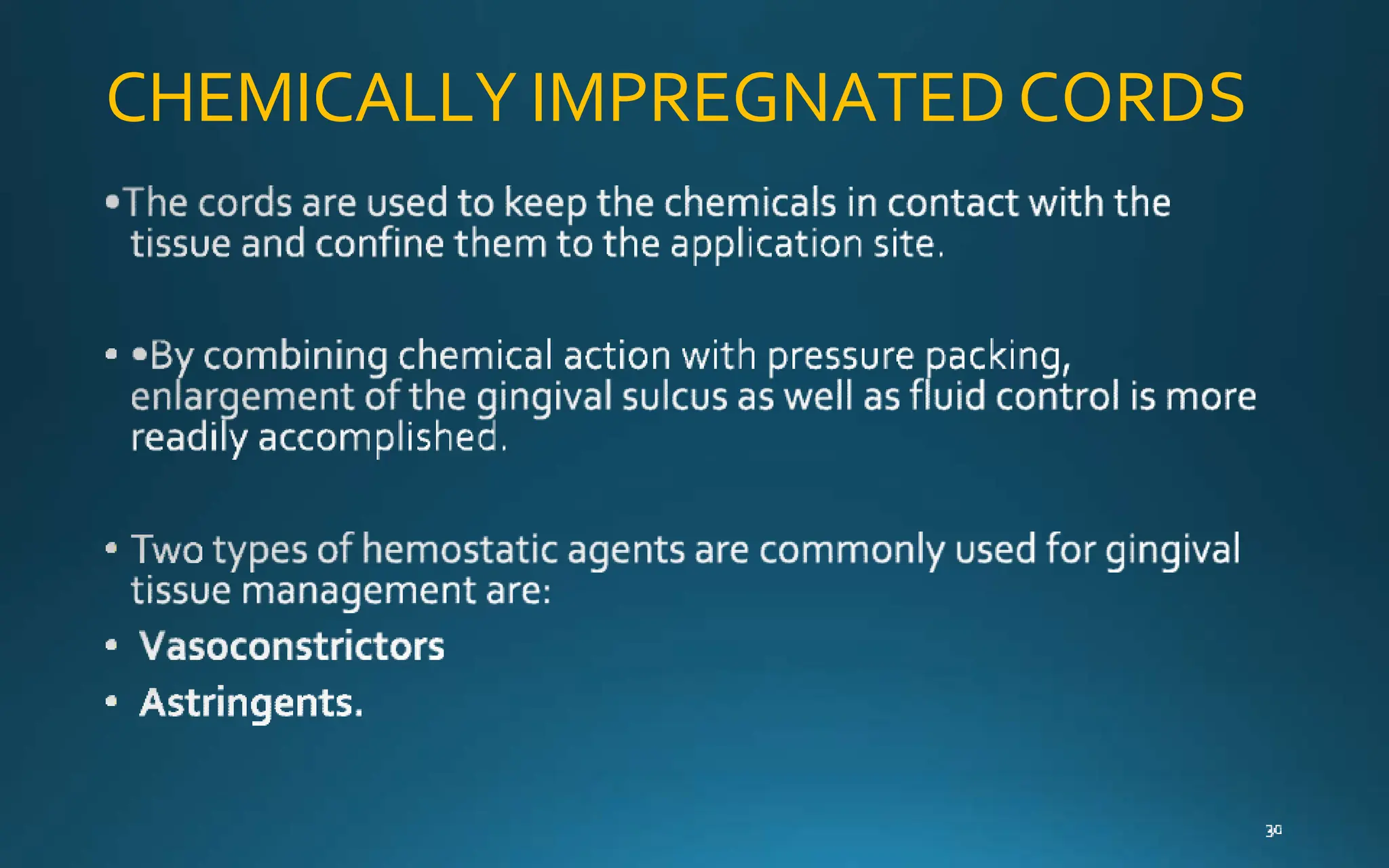
CHEMICALLY IMPREGNATEDCORDS
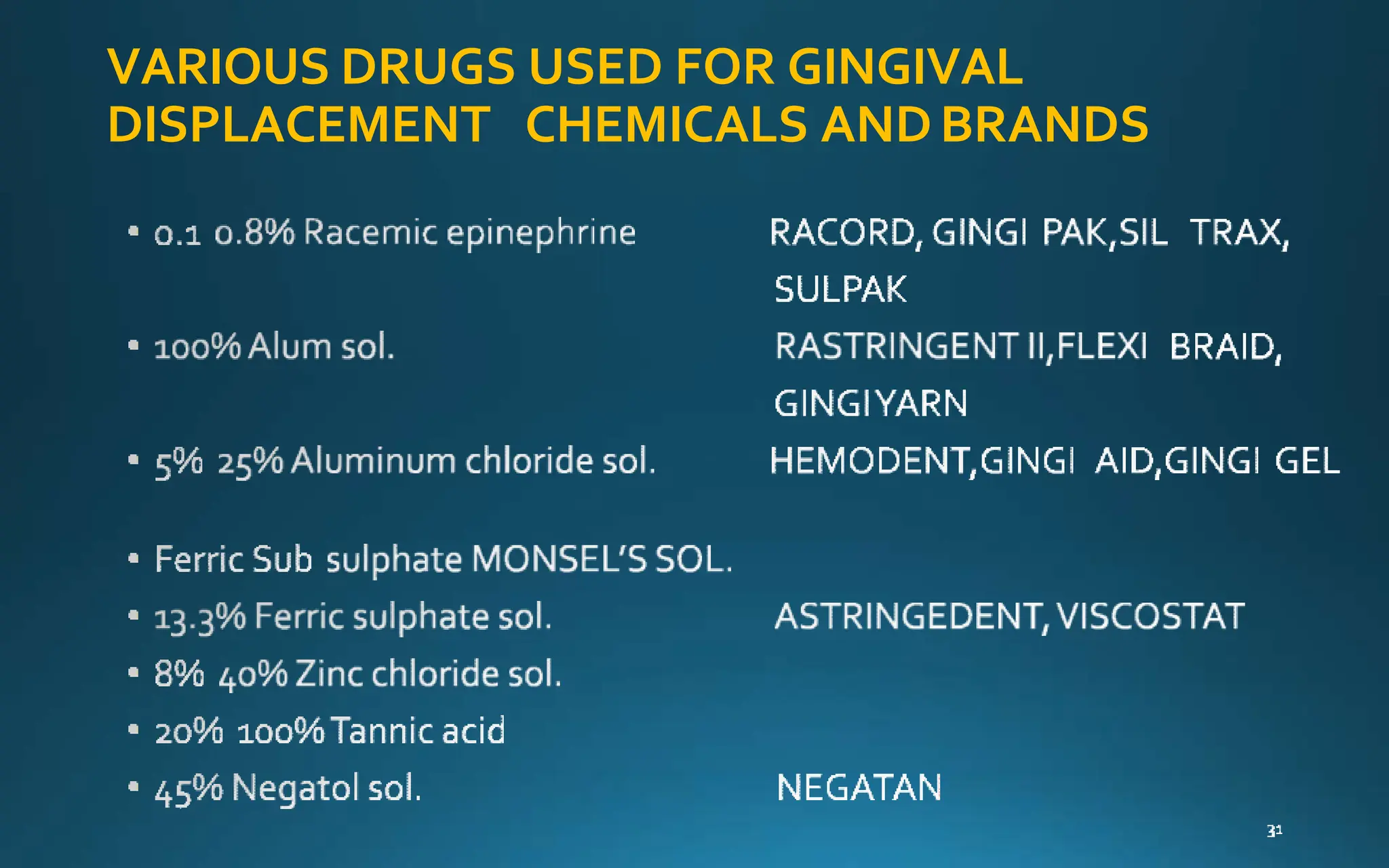
VARIOUS DRUGS USED FOR GINGIVAL
DISPLACEMENT CHEMICALS ANDBRANDS
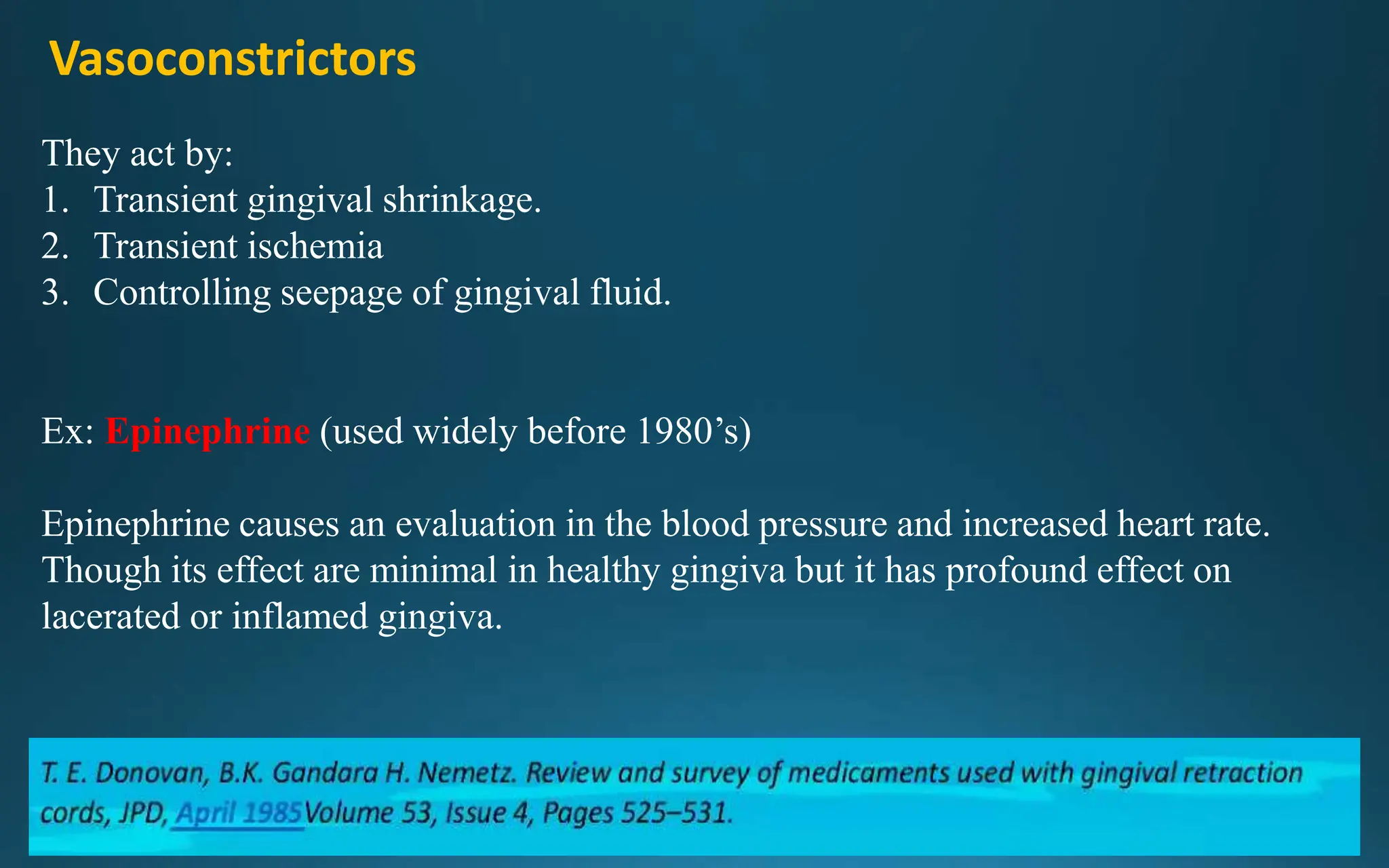
Vasoconstrictors
They act by:
1. Transient gingival shrinkage.
2. Transient ischemia
3. Controlling seepage of gingival fluid.
Ex: Epinephrine (used widely before 1980’s)
Epinephrine causes an evaluation in the blood pressure and increased heart rate.
Though its effect are minimal in healthy gingiva but it has profound effect on
lacerated or inflamed gingiva.
EPINEPHRINECONTRAINDICATIONS:
Baba NZ,GoodacreCJ , Jekki R,Won J.GingivalDisplacement for Impression Making in Fixed ProsthodonticsContemporary
Principles,Materials,andTechniques. DentClin NAm 58 (2014) 45–68
.
PhataleS,Marawar, P.P,Kalburge,JV.Effect of Retraction materials on Gingival Health : A Histopathological study.J Indian Soc
Periodontol 2010; Jan- Mar; 14(1): pp 35-39.
BIOLOGIC FLUID COAGULANTS
• Astringent agents such as alum, aluminum chloride and zinc chloride
are metal salts that inhibit plasma proteins’ inter-capillary immigration,
decrease cell permeability, control the moisture in the peripheral tissues
through protein precipitation on the superficial layer, and increase the
mechanical strength of the mucosa. Thus, protein precipitation has
hemostatic effects under physiological condition.
• Very safe agent as they induce minimal systemic effects.
• Eg. 100% Alum
• 15-25% AlSO4
• 15- 20% Fe2 SO4
• 25% AlSO4
ALUM (POTASSIUMALUMINUMSULFATE)
transientischemia
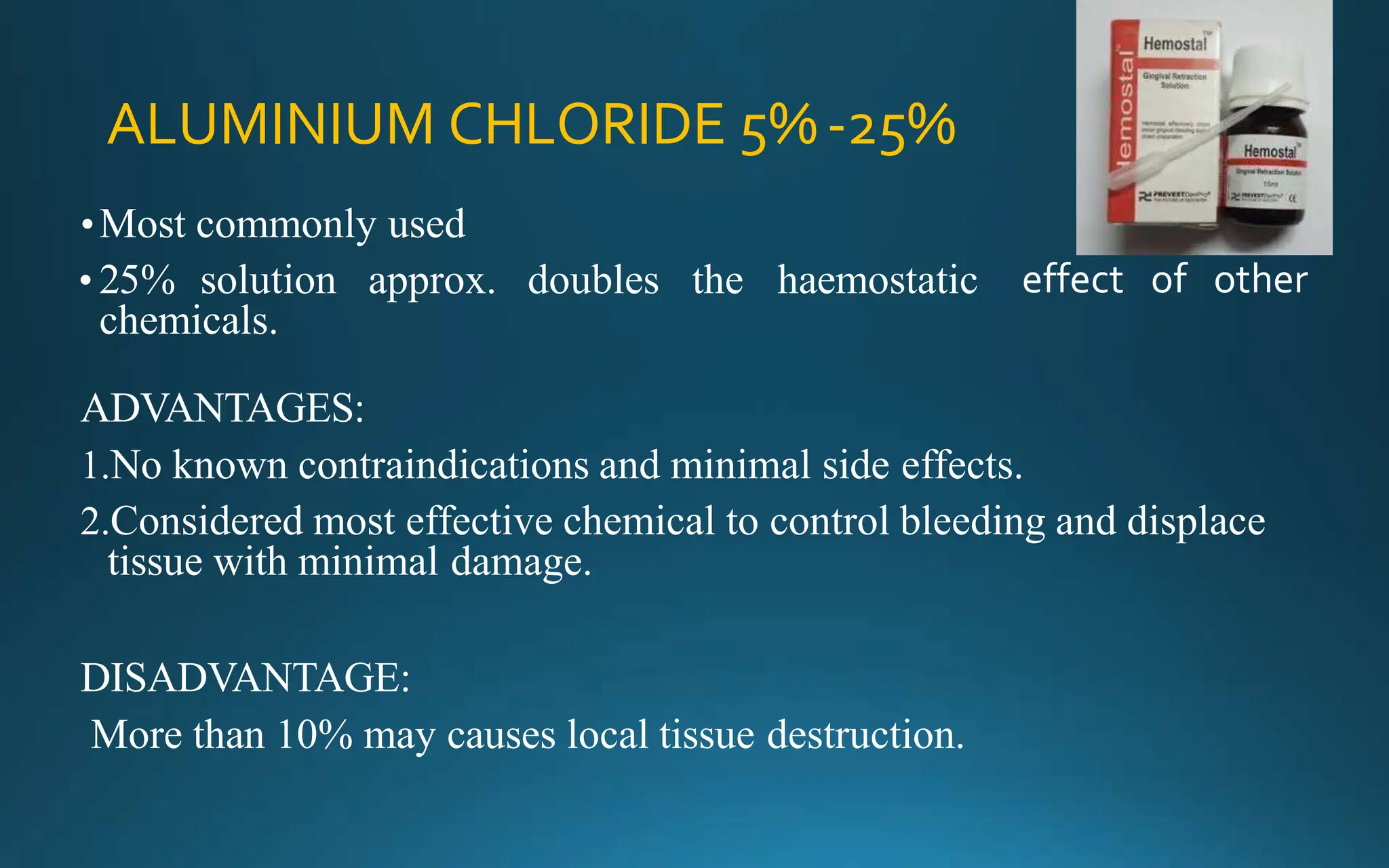
ALUMINIUM CHLORIDE 5%-25%
effect of other
•Most commonly used
• 25% solution approx. doubles the haemostatic
chemicals.
ADVANTAGES:
1.No known contraindications and minimal side effects.
2.Considered most effective chemical to control bleeding and displace
tissue with minimal damage.
DISADVANTAGE:
More than 10% may causes local tissue destruction.
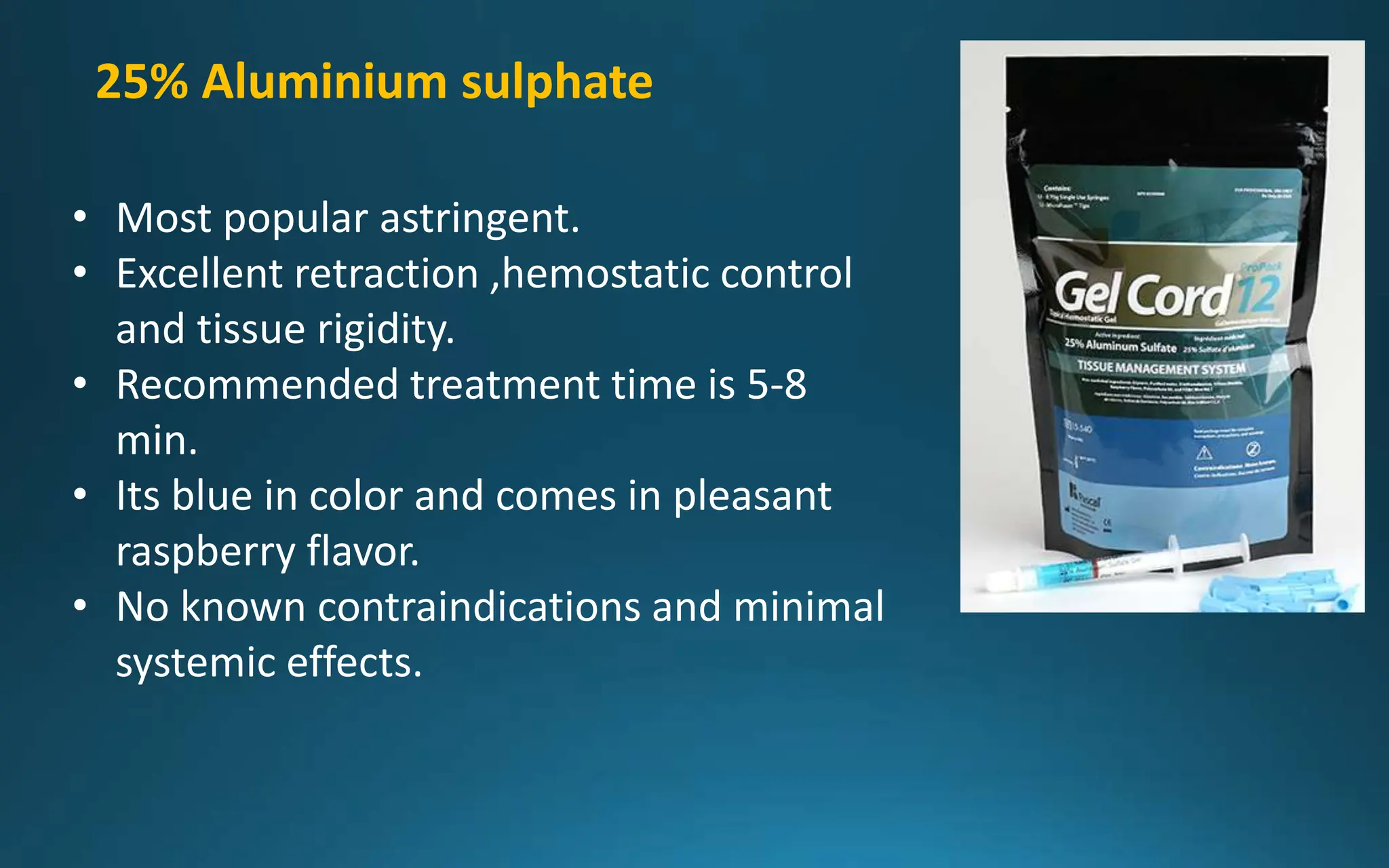
25% Aluminium sulphate
• Most popular astringent.
• Excellent retraction ,hemostatic control
and tissue rigidity.
• Recommended treatment time is 5-8
min.
• Its blue in color and comes in pleasant
raspberry flavor.
• No known contraindications and minimal
systemic effects.
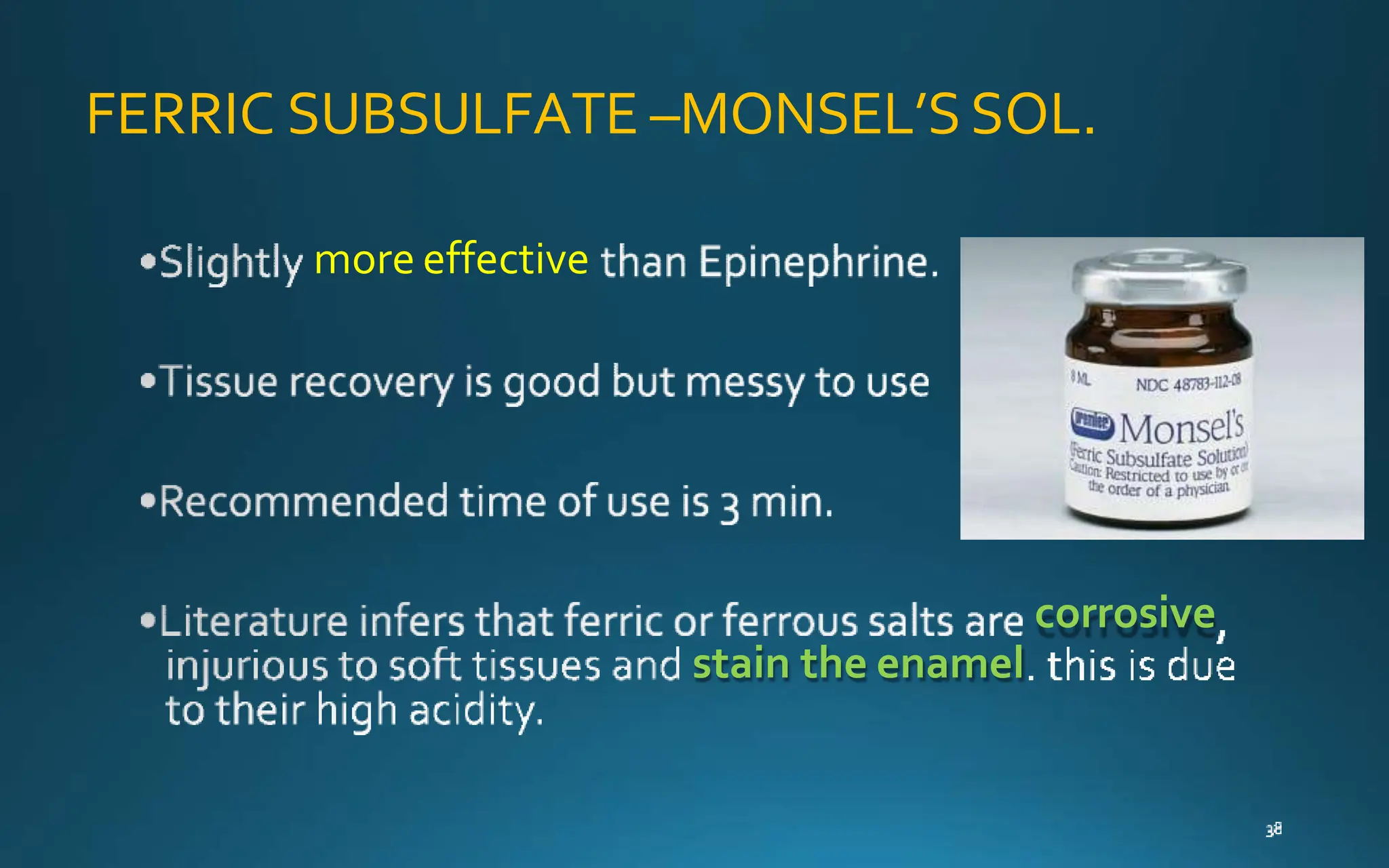
FERRIC SUBSULFATE –MONSEL’SSOL.
more effective
corrosive
stain the enamel
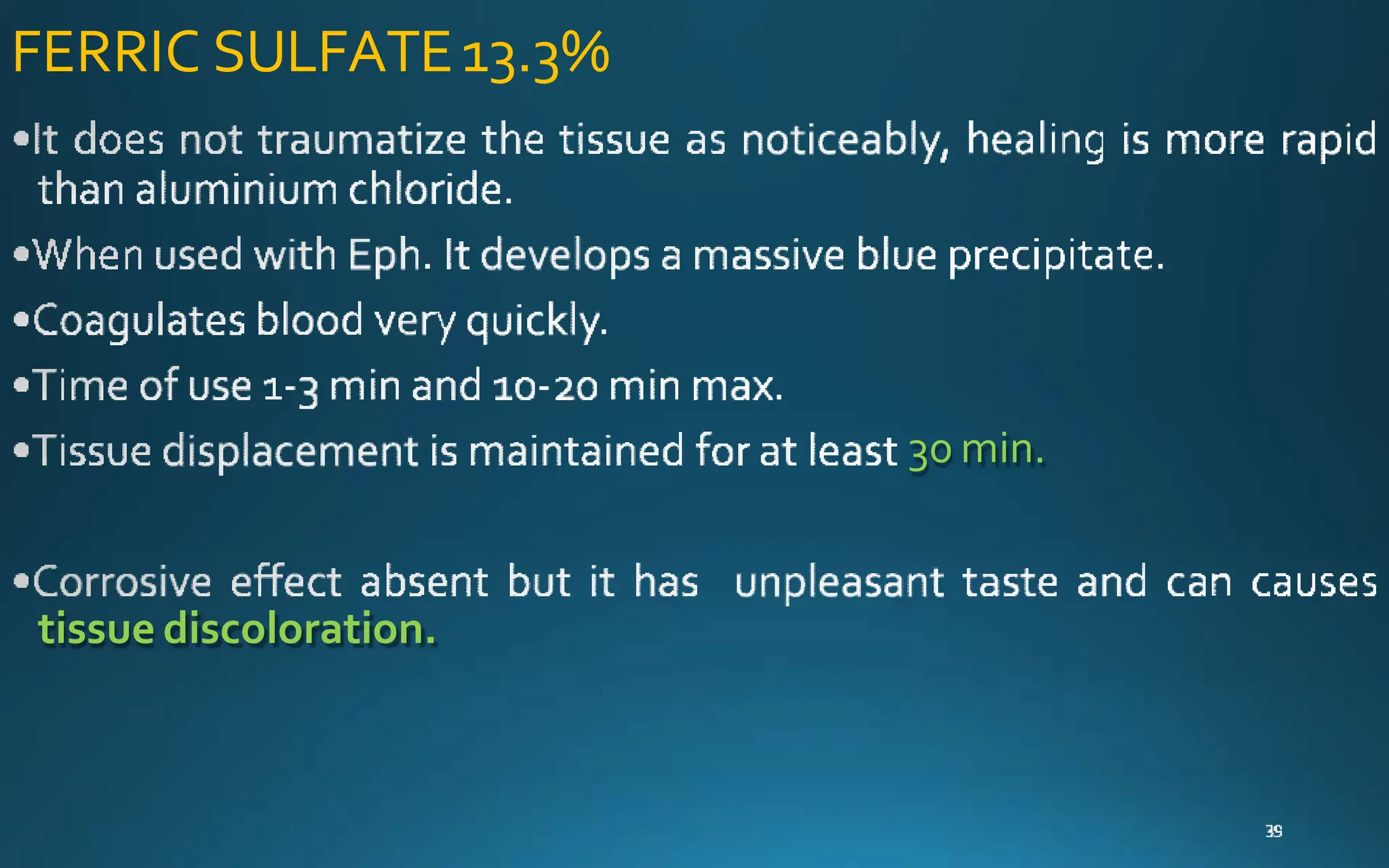
FERRIC SULFATE13.3%
30 min.
tissue discoloration.
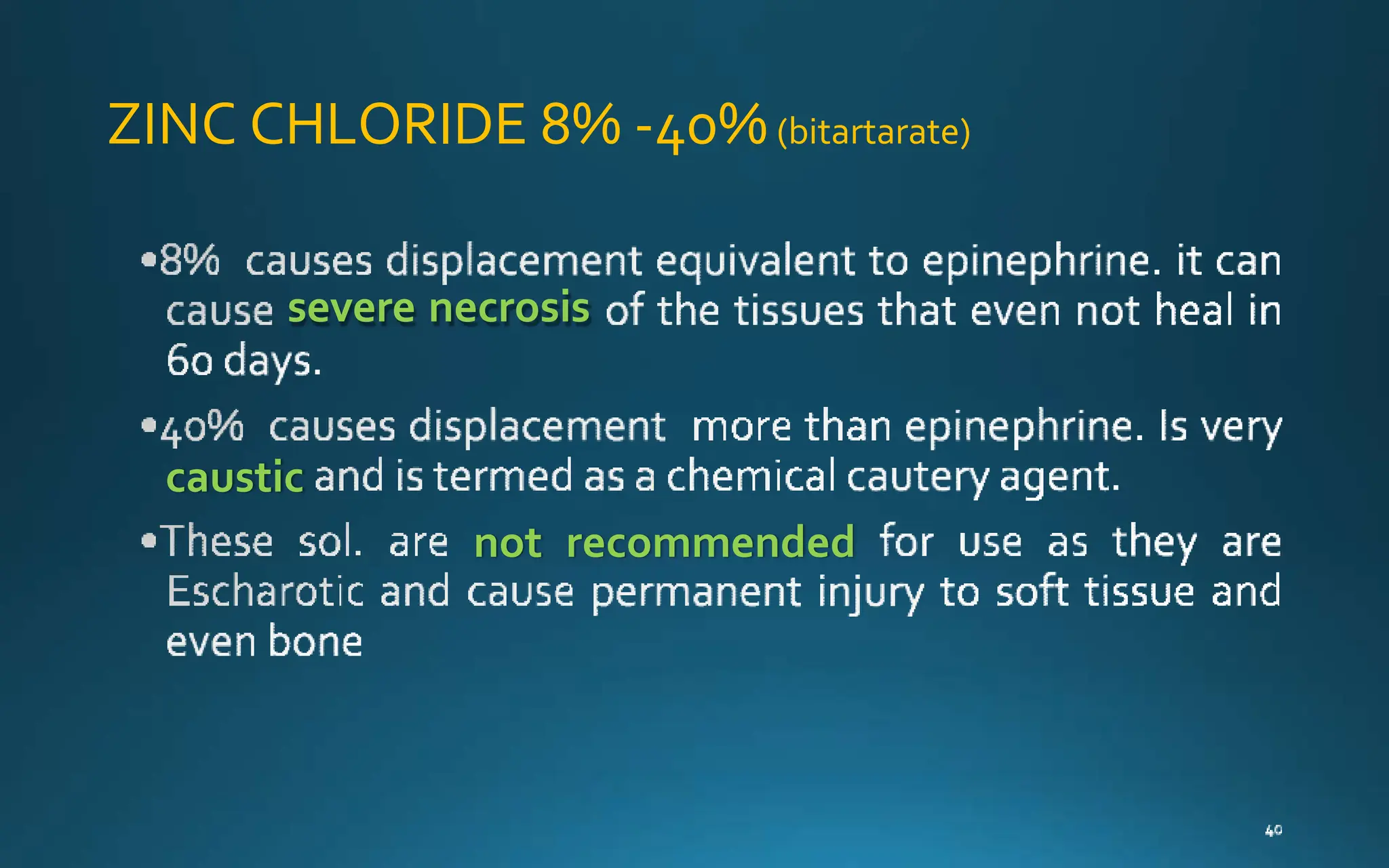
ZINC CHLORIDE 8% -40%(bitartarate)
severe necrosis
caustic
not recommended
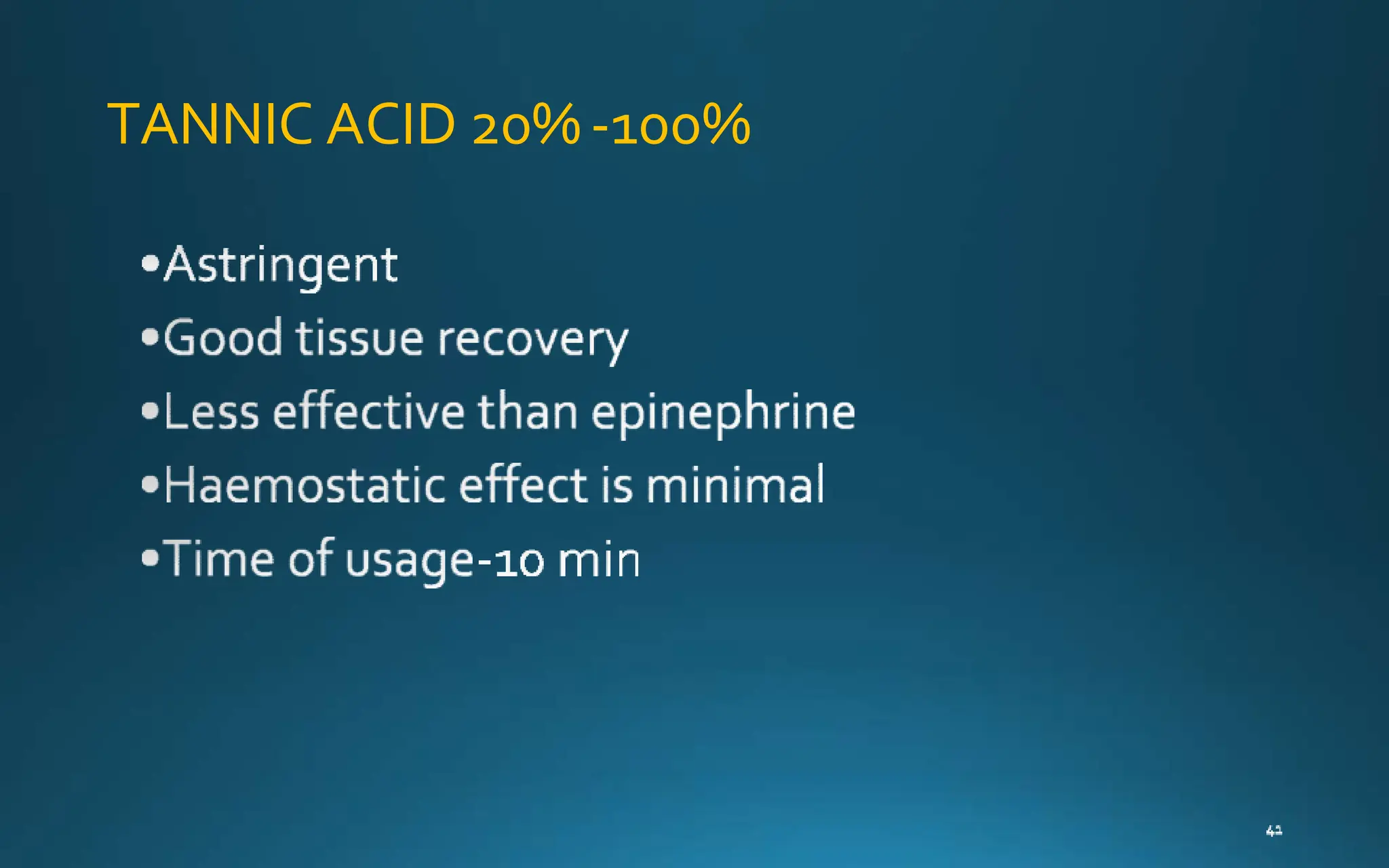
TANNIC ACID 20%-100%
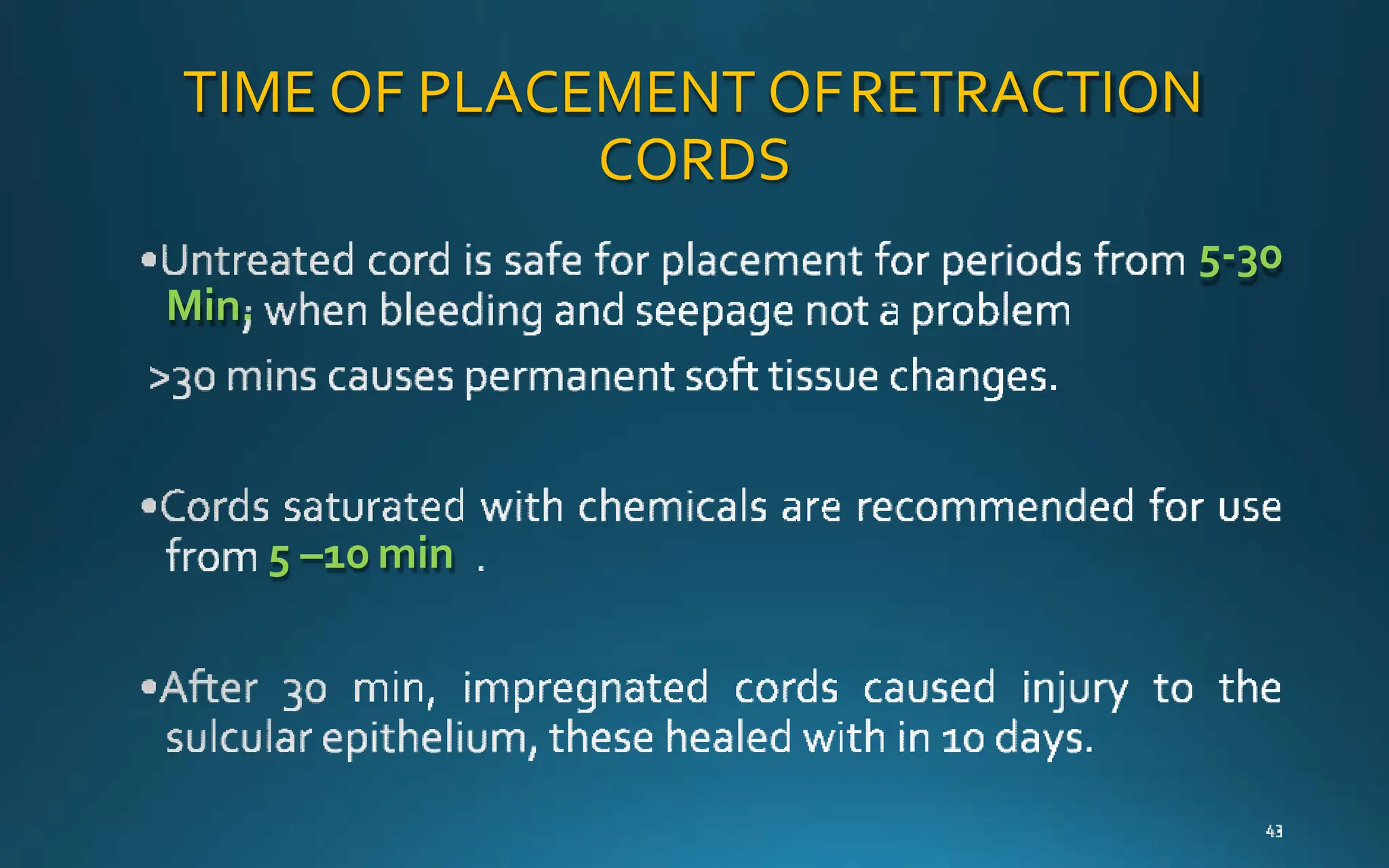
TIME OF PLACEMENT OFRETRACTION
CORDS
5-30
Min.
5 –10 min
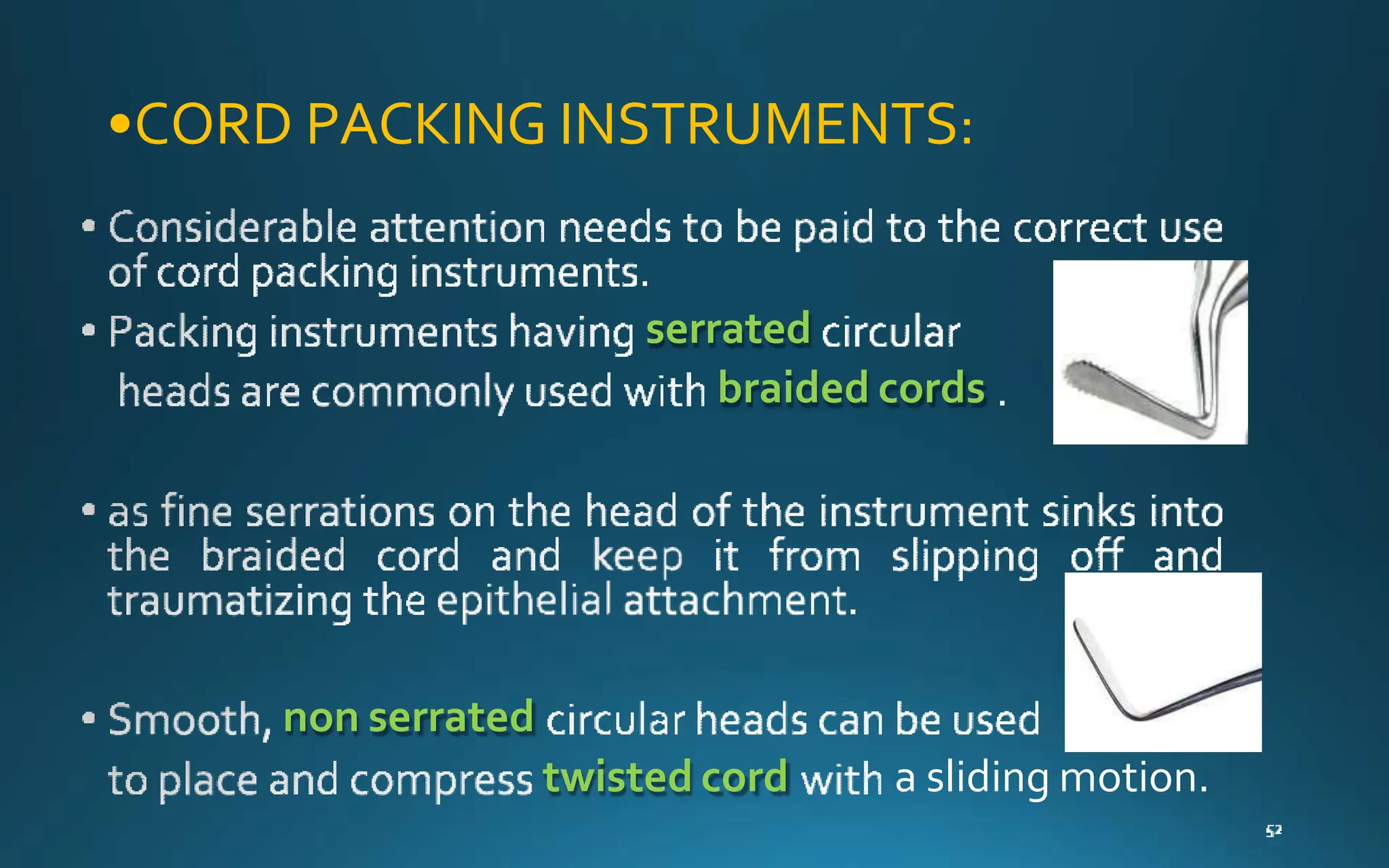
•CORD PACKING INSTRUMENTS:
serrated
braided cords
non serrated
twisted cord a sliding motion.
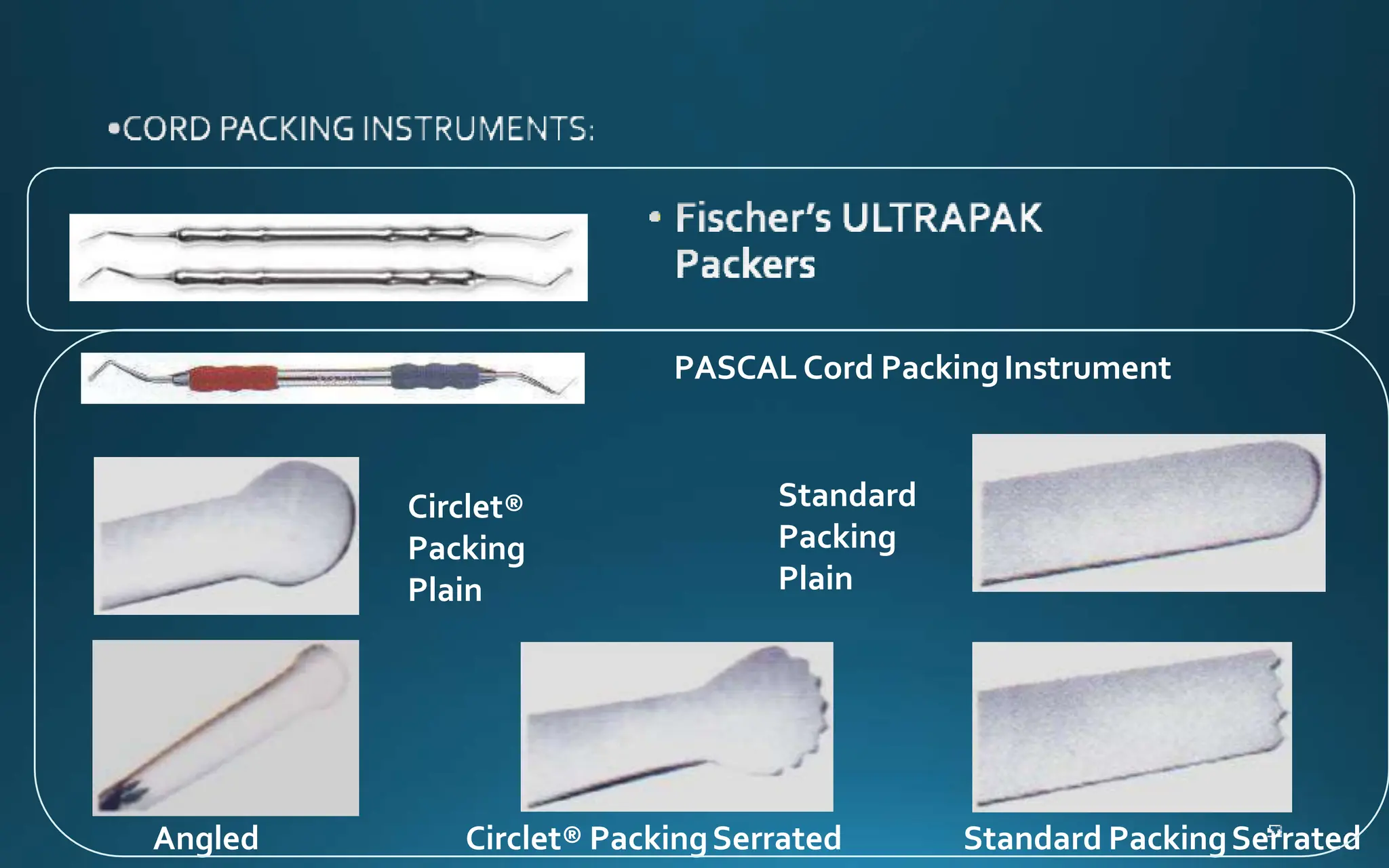
PASCAL Cord PackingInstrument
Circlet®
Packing
Plain
Standard
Packing
Plain
Angled Circlet® PackingSerrated Standard PackingSerrated
Techniques For Gingival DisplacementUsing
RetractionCords
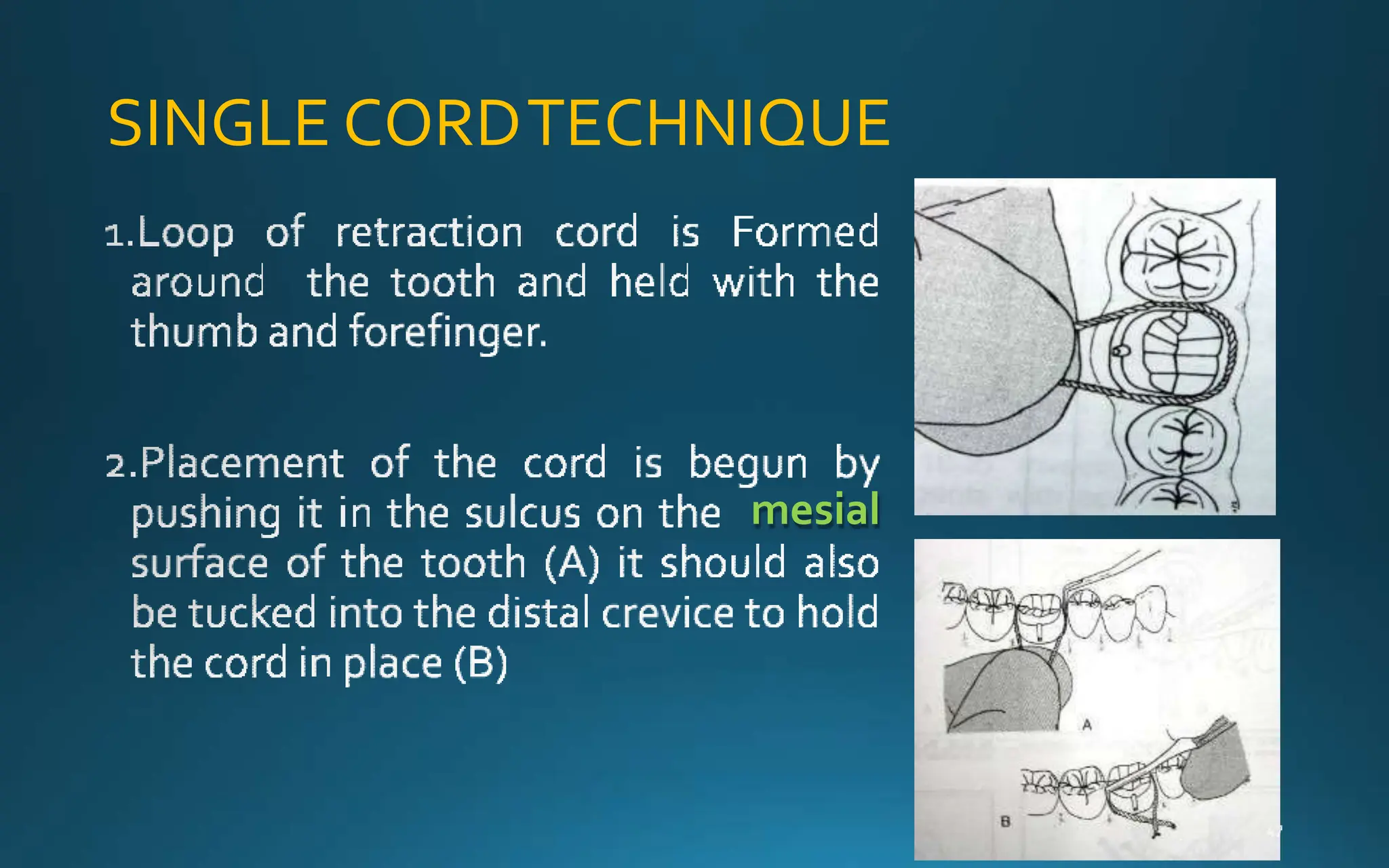
SINGLE CORDTECHNIQUE
mesial
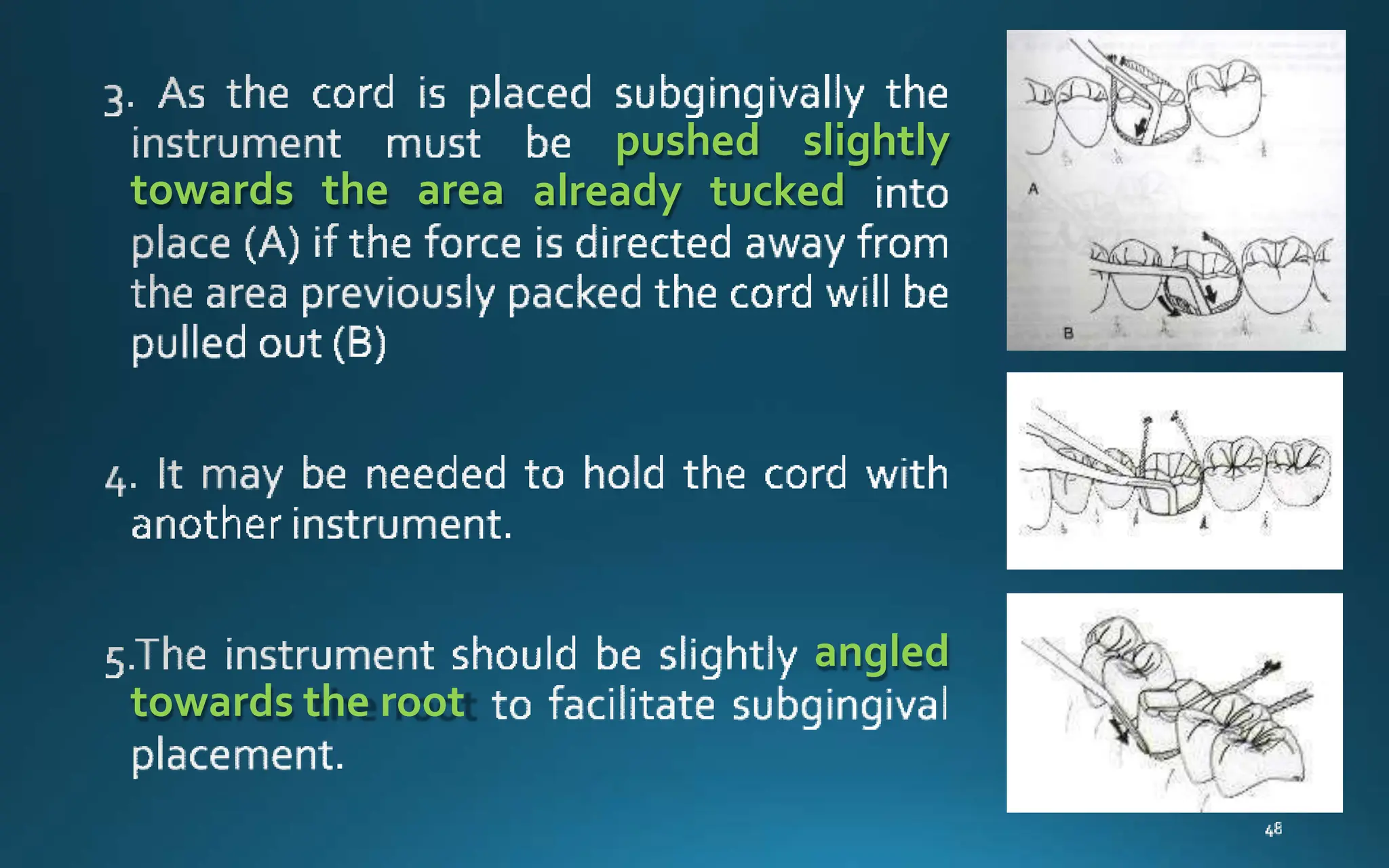
towards the area
pushed slightly
already tucked
angled
towards the root
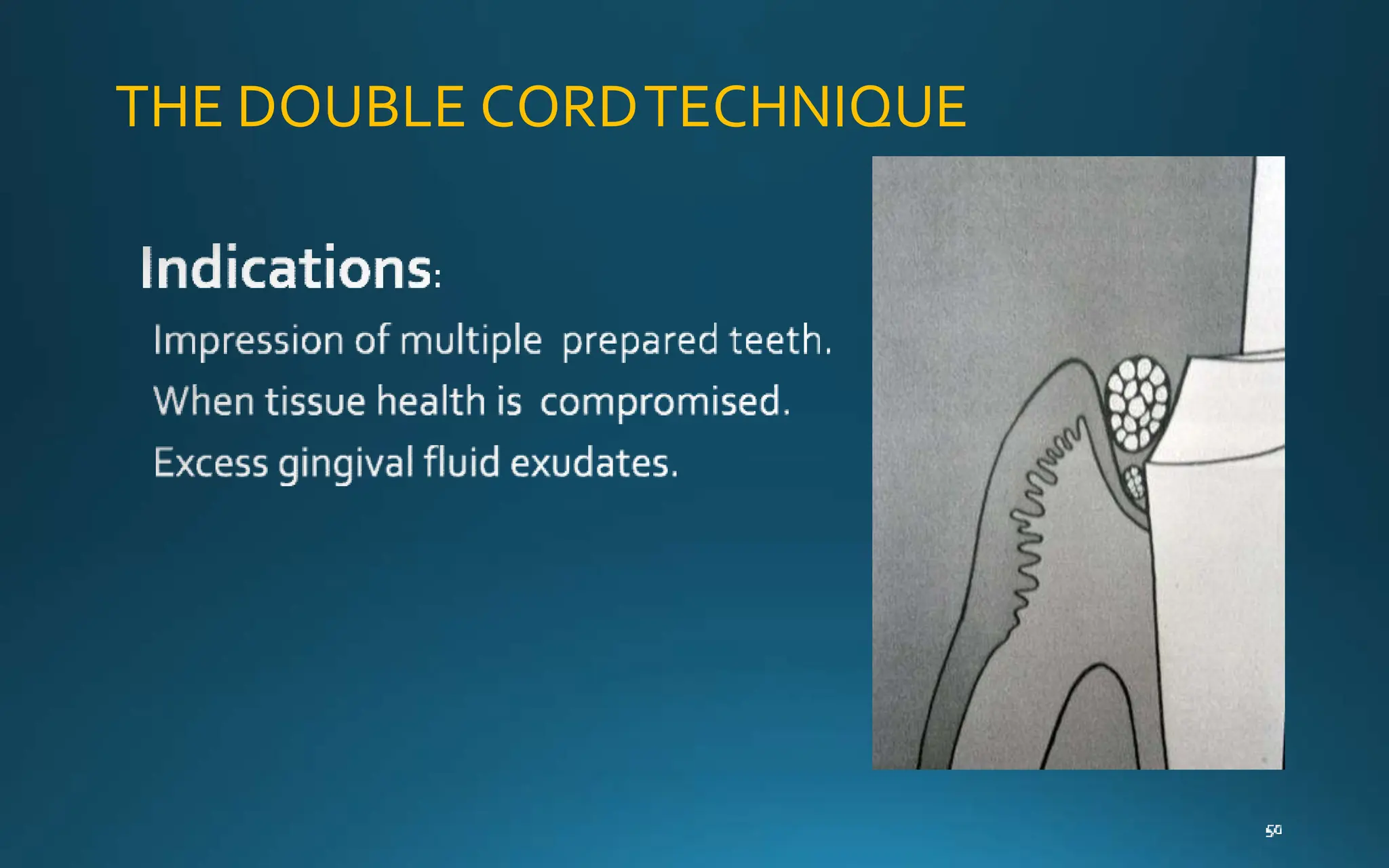
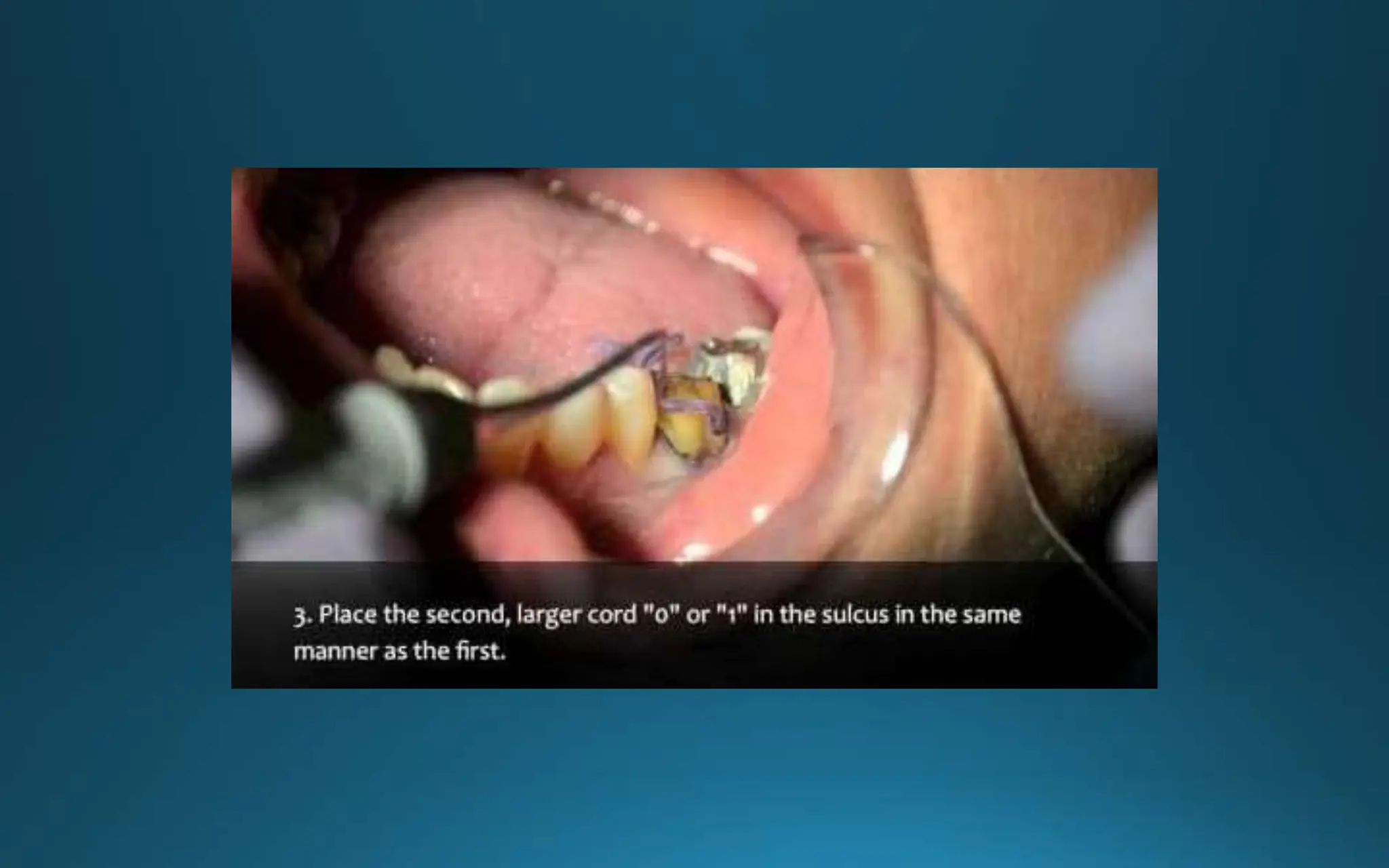
THE DOUBLE CORDTECHNIQUE
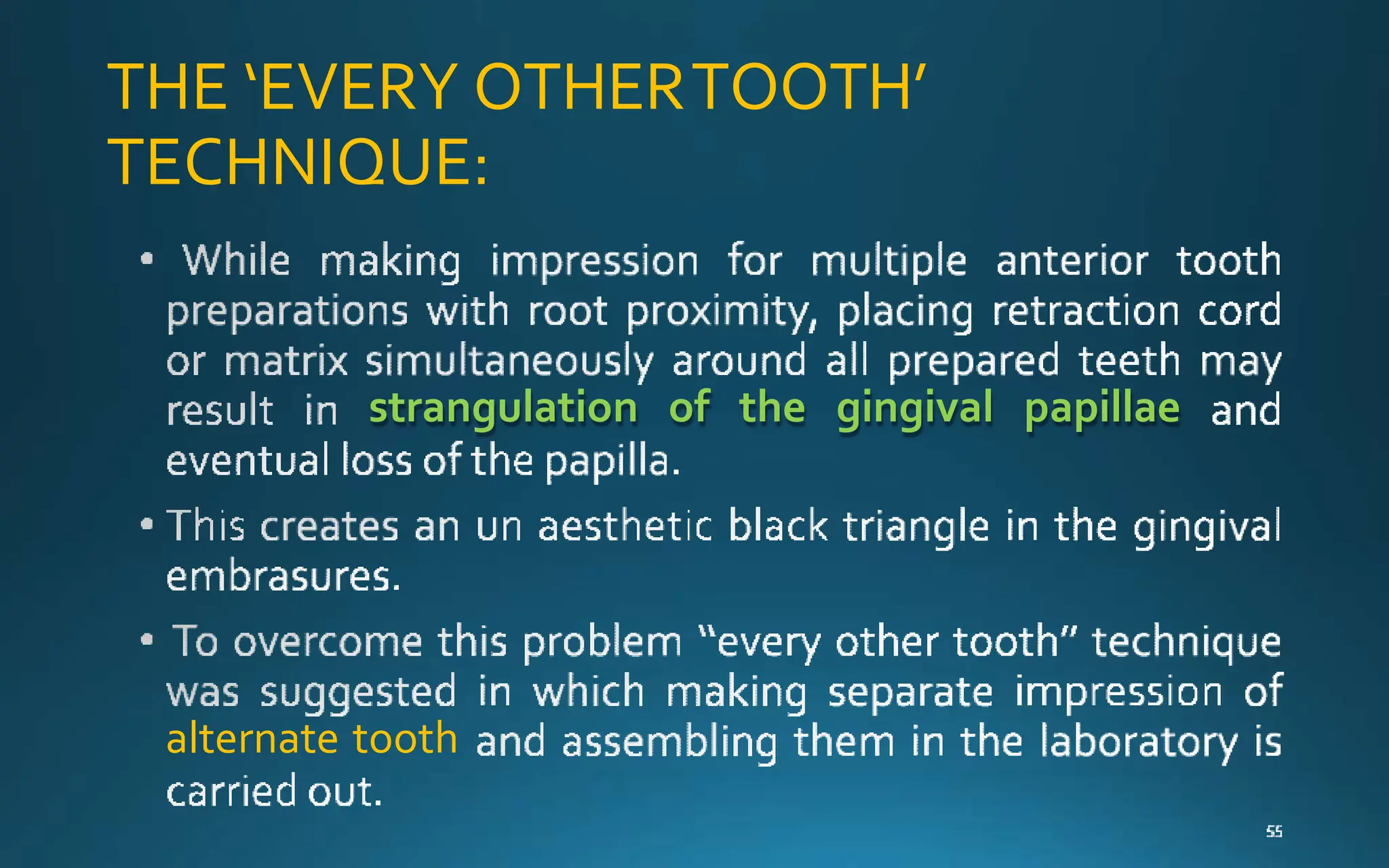
THE ‘EVERY OTHERTOOTH’
TECHNIQUE:
strangulation of the gingival papillae
alternate tooth
ROTARY GINGIVALCURETTAGE
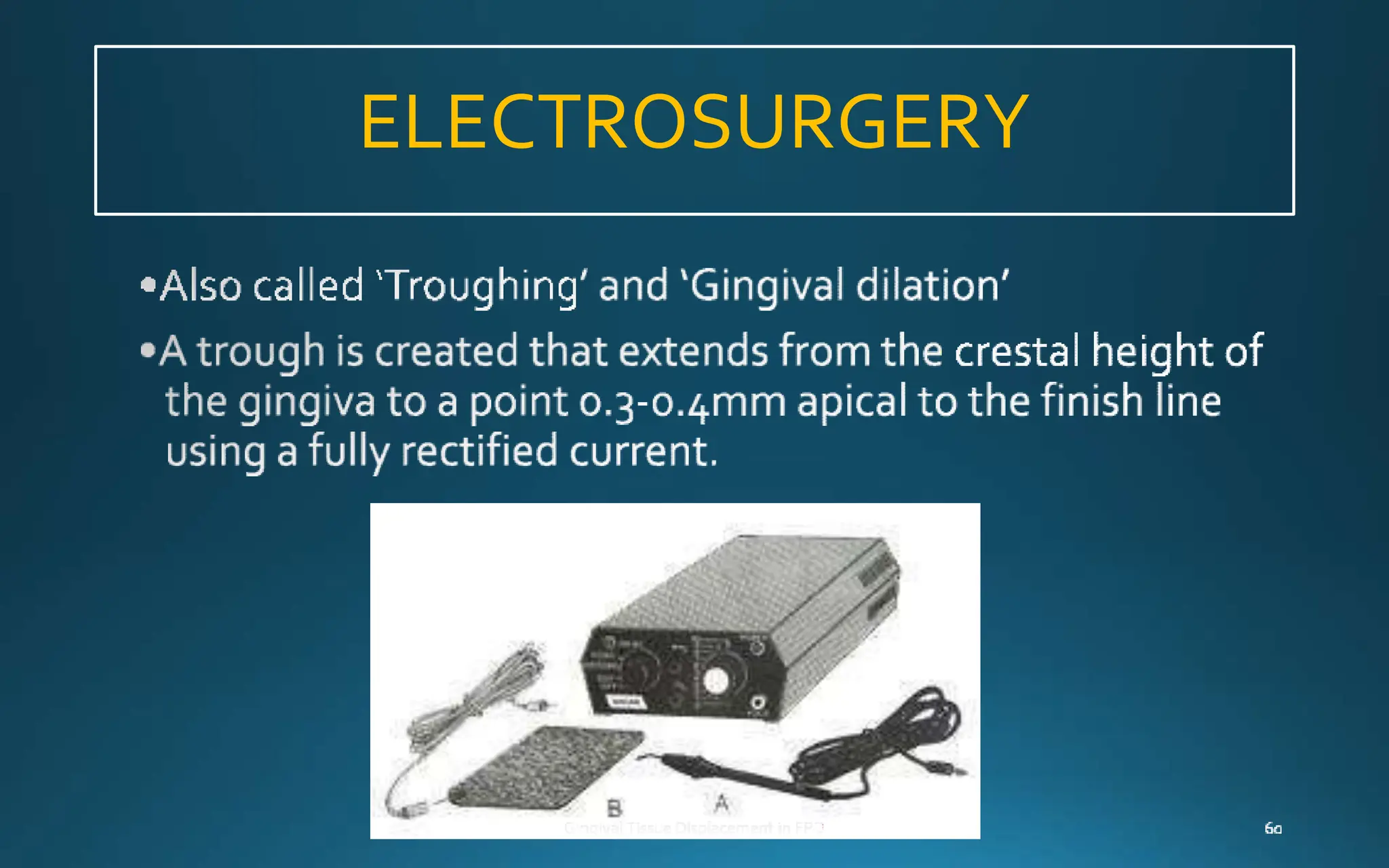
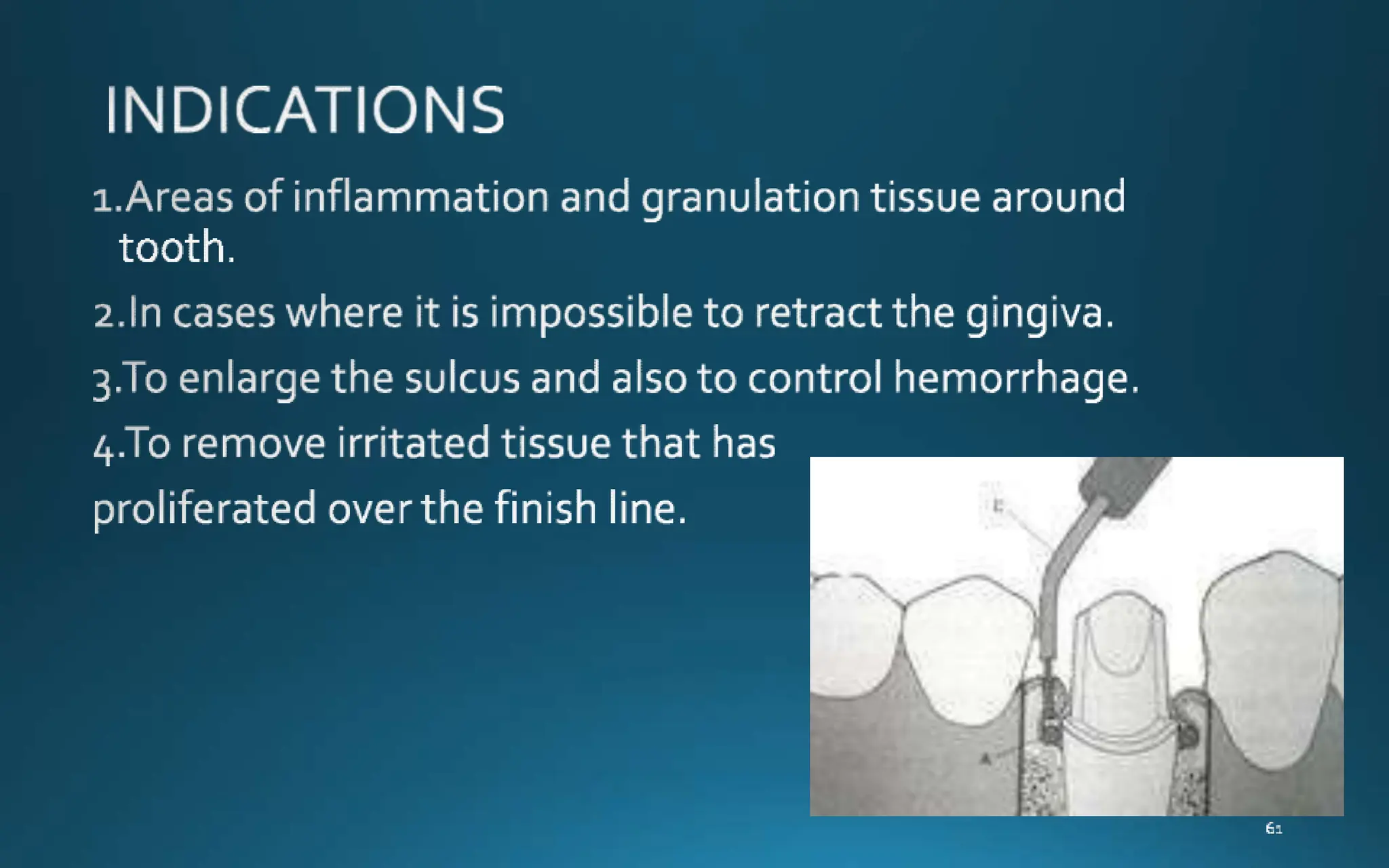
ELECTROSURGERY
CONTRAINDICATIONS:
LASERS
• Lasers may also be employed as they cause tissue-coagulation
facilitating hemostasis tissue removal via vaporization, and sulcular
epithelium is removed.
• Commonly used soft-tissue lasers for gingival displacement include
CO2 lasers, diode lasers, Nd:YAG lasers, erbium lasers, etc.
• These minimally penetrate the soft tissues, so they are fairly safe to use.
• Some of the advantages with lasers include a dry bloodless field of
surgery, sterile working area, less mechanical trauma, minimal pain and
less postoperative swelling and scarring.
• However, cost factor is a drawback and it is technique-sensitive. Er:
YAG laser is not good in hemostasis as CO2 laser. However, CO2 laser
provides no tactile feedback, leading to risk of damage to junctional
epithelium.
Other Methods And New Materials
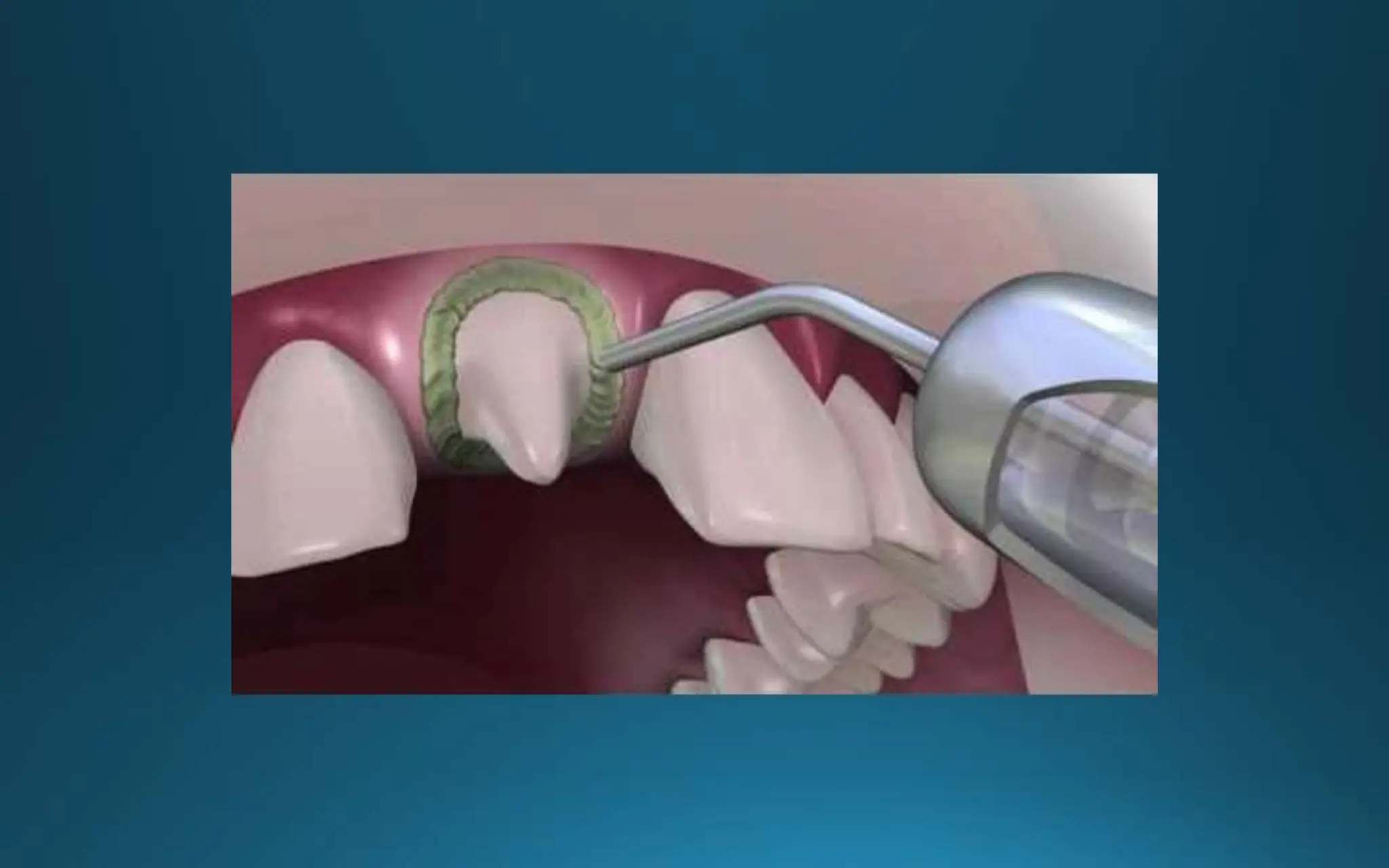
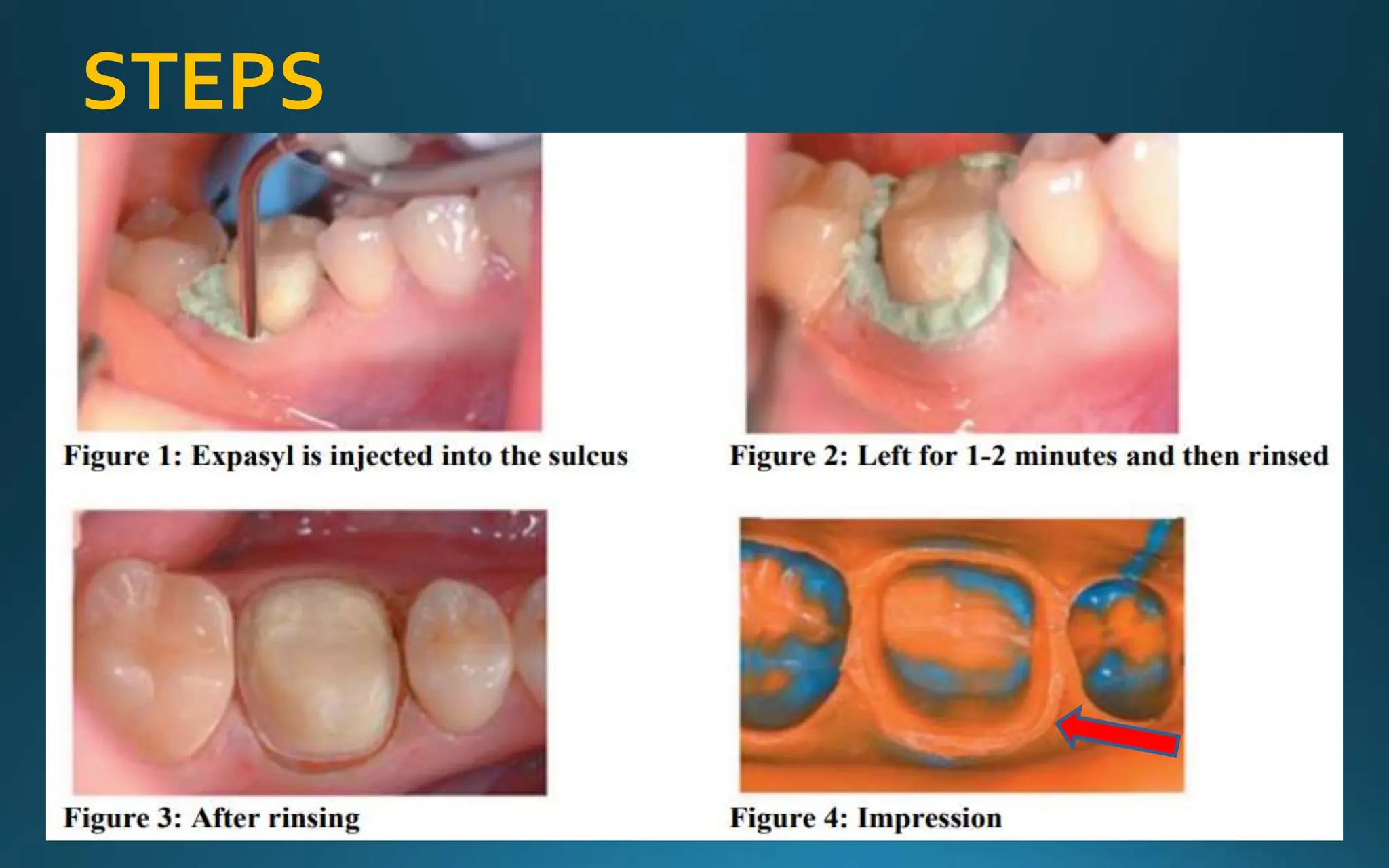
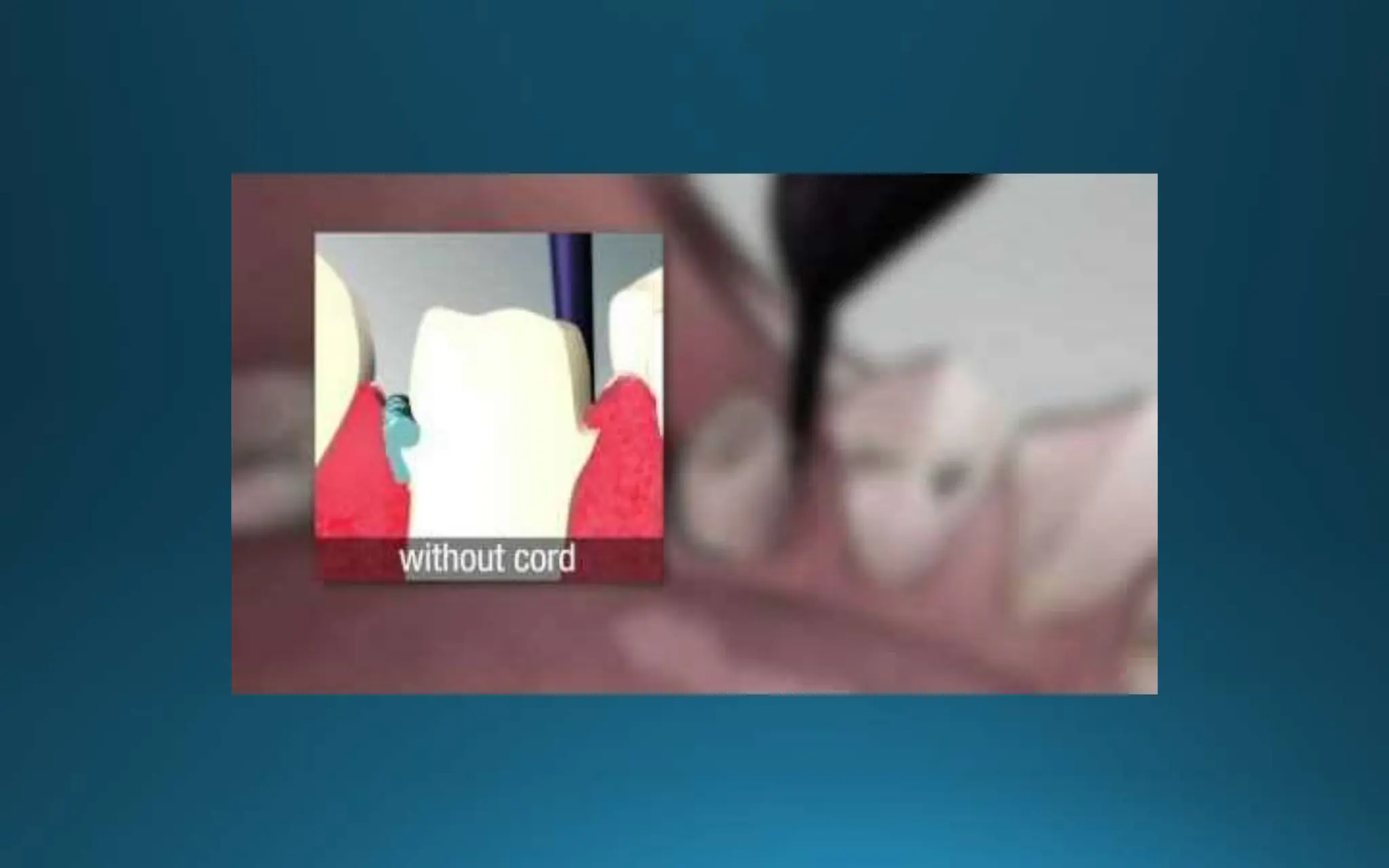
Expa-syl
•The system includes an
injectable material supplied in a
cartridge and delivered with a
specially designed gun.
•The Expasyl material is Kaolin
(natural clay) incorporated into
an organic binder with
aluminium chloride added for
haemostatic action.
STEPS
• Advantages
• Disadvantages
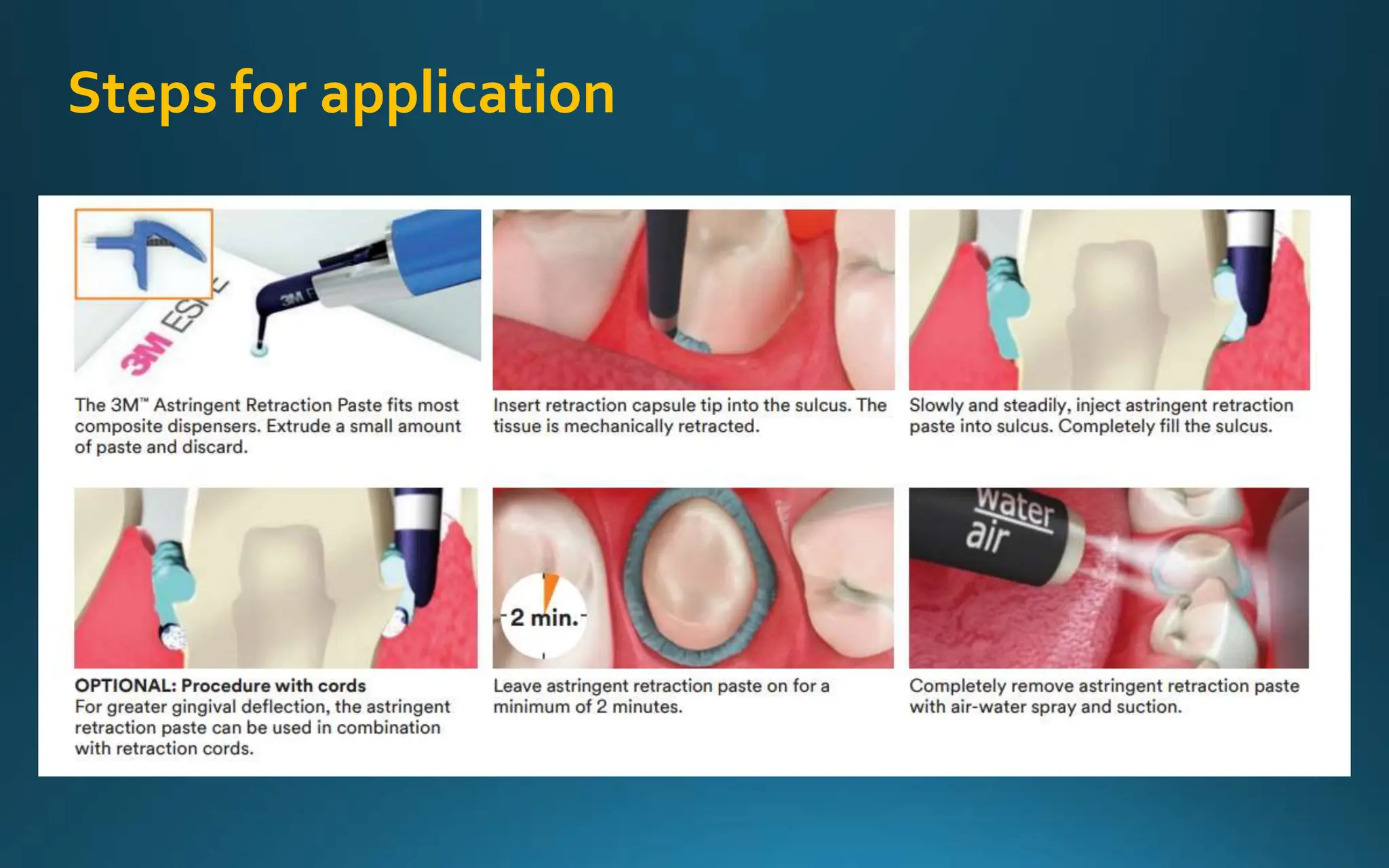
3M Astringent Retraction Paste
15% aluminium chloride
COMPARSION OF THE SIZE OF TIPS
Steps for application
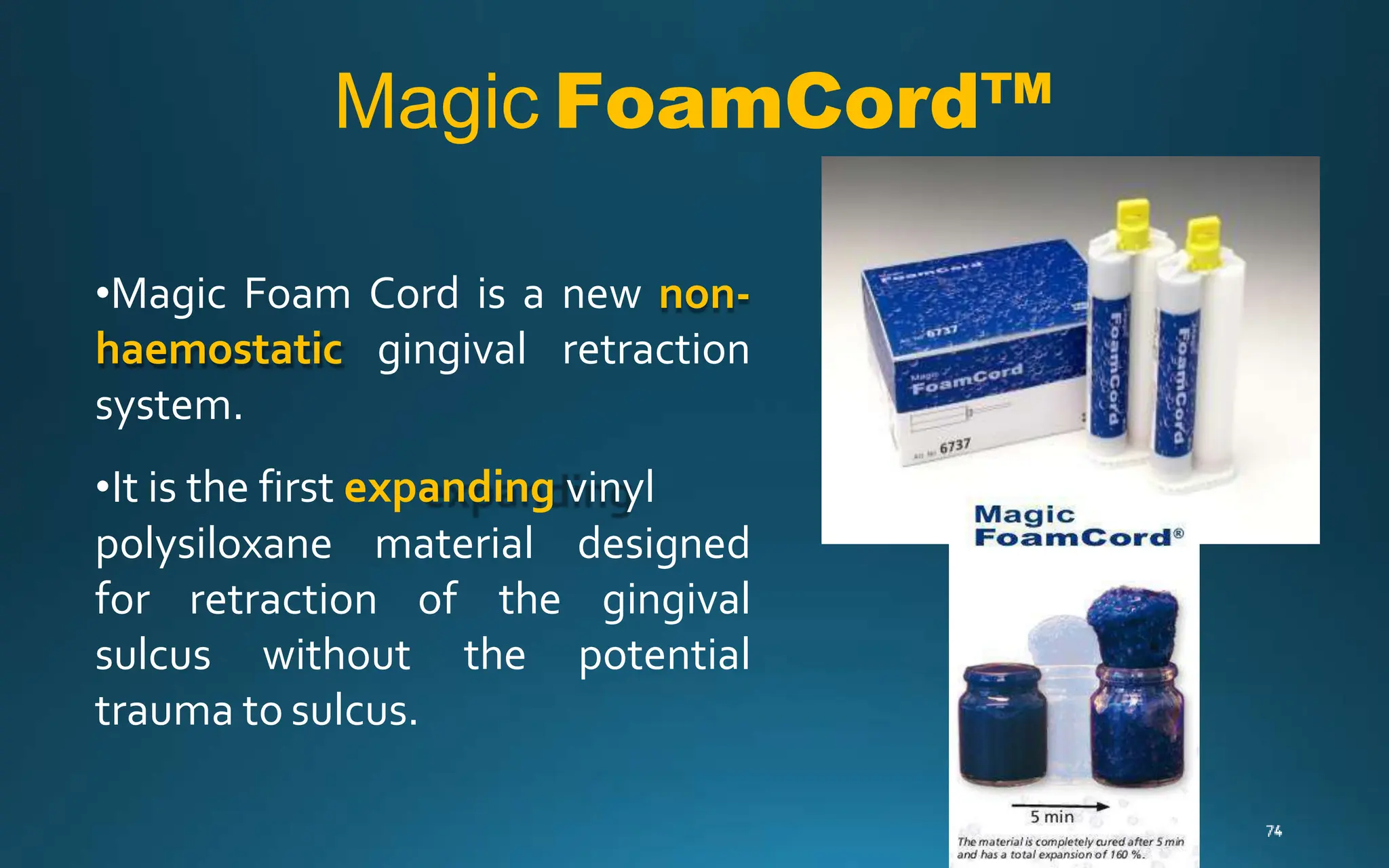
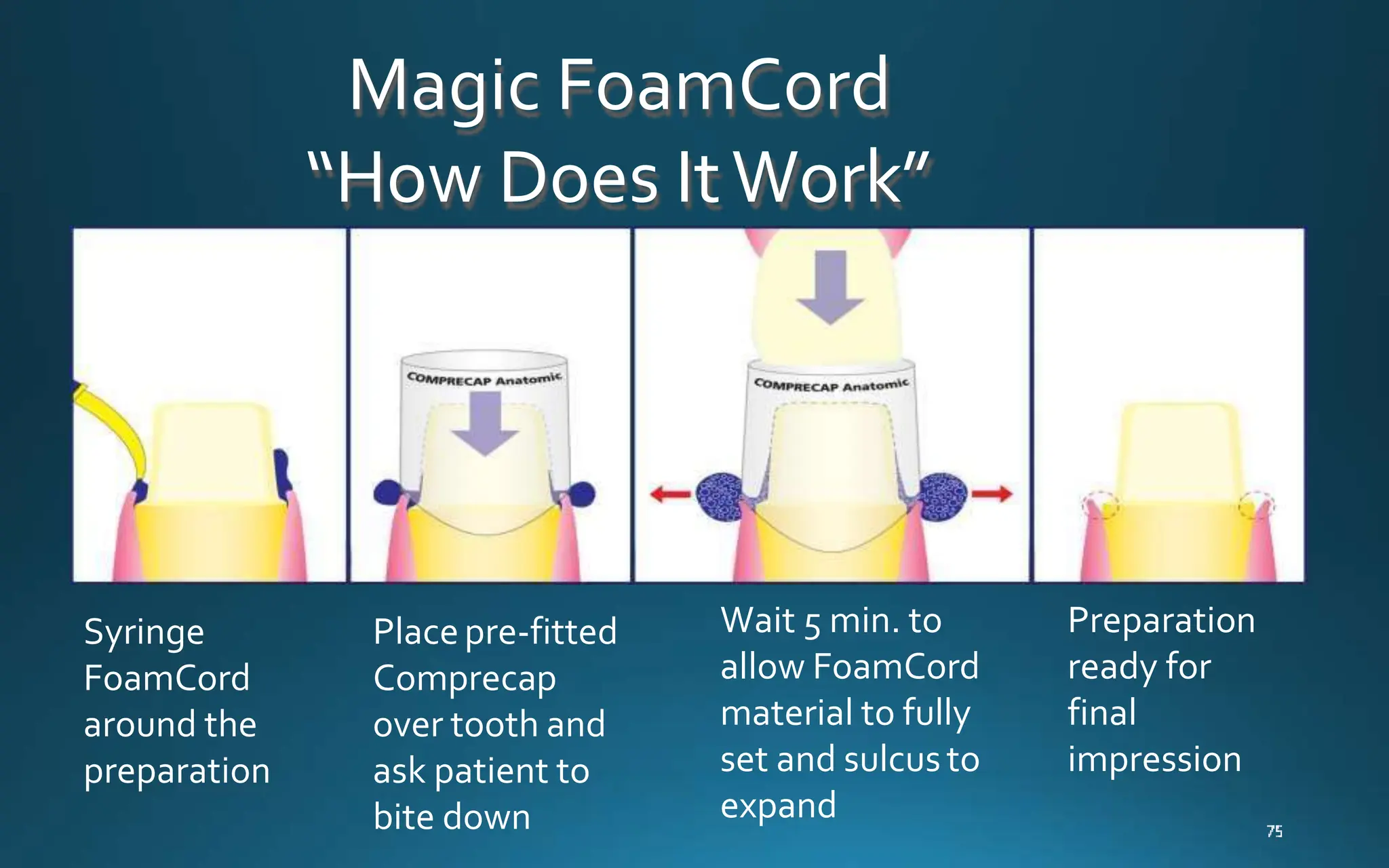
•Magic Foam Cord is a new non-
haemostatic gingival retraction
system.
•It is the first expanding vinyl
polysiloxane material
for retraction of
designed
the gingival
the potential
sulcus without
trauma to sulcus.
Magic FoamCord™
Magic FoamCord
“How Does ItWork”
Syringe
FoamCord
around the
preparation
Placepre-fitted
Comprecap
over tooth and
ask patient to
bite down
Wait 5 min. to
allow FoamCord
material to fully
set and sulcusto
expand
Preparation
ready for
final
impression
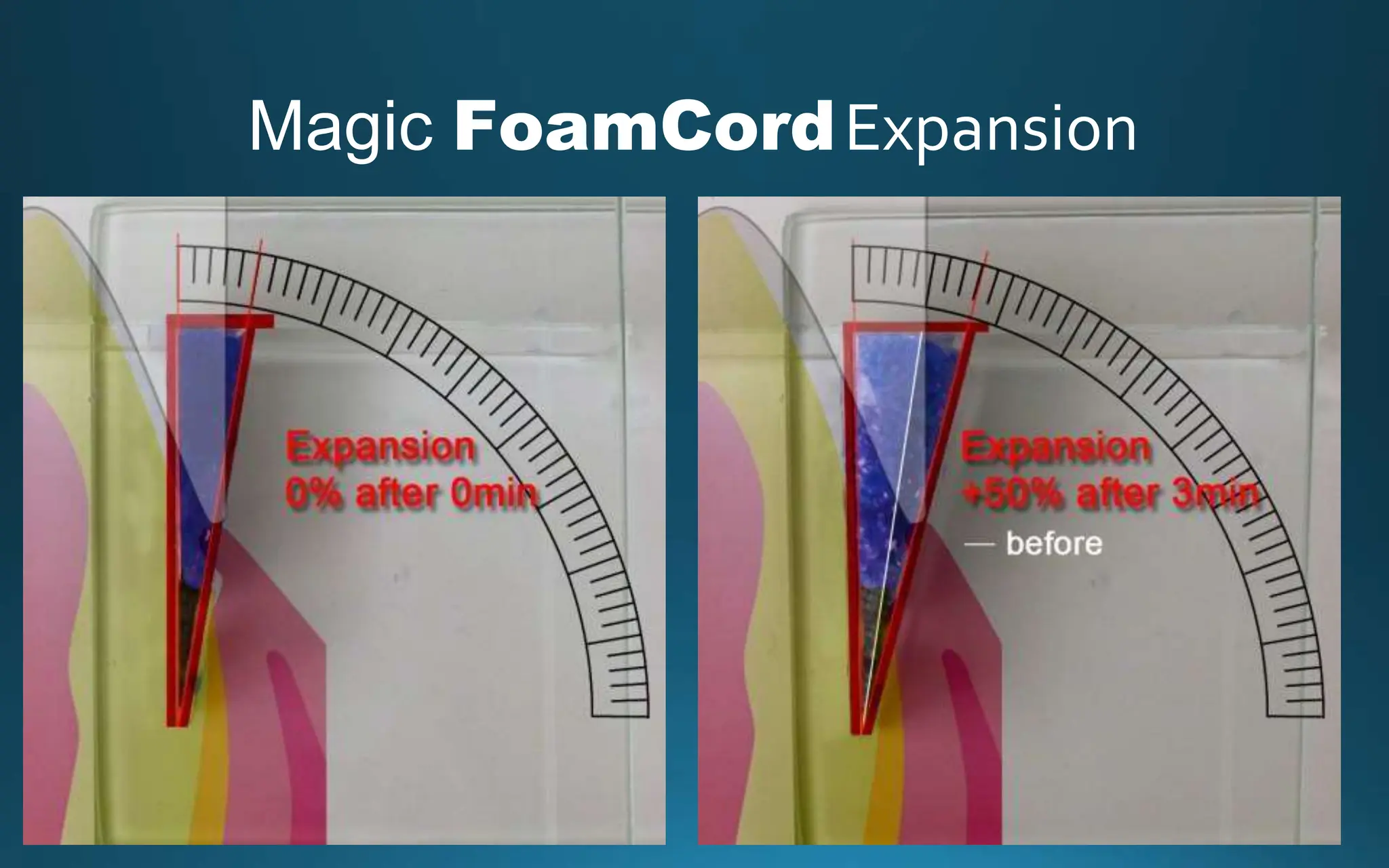
Magic FoamCordExpansion
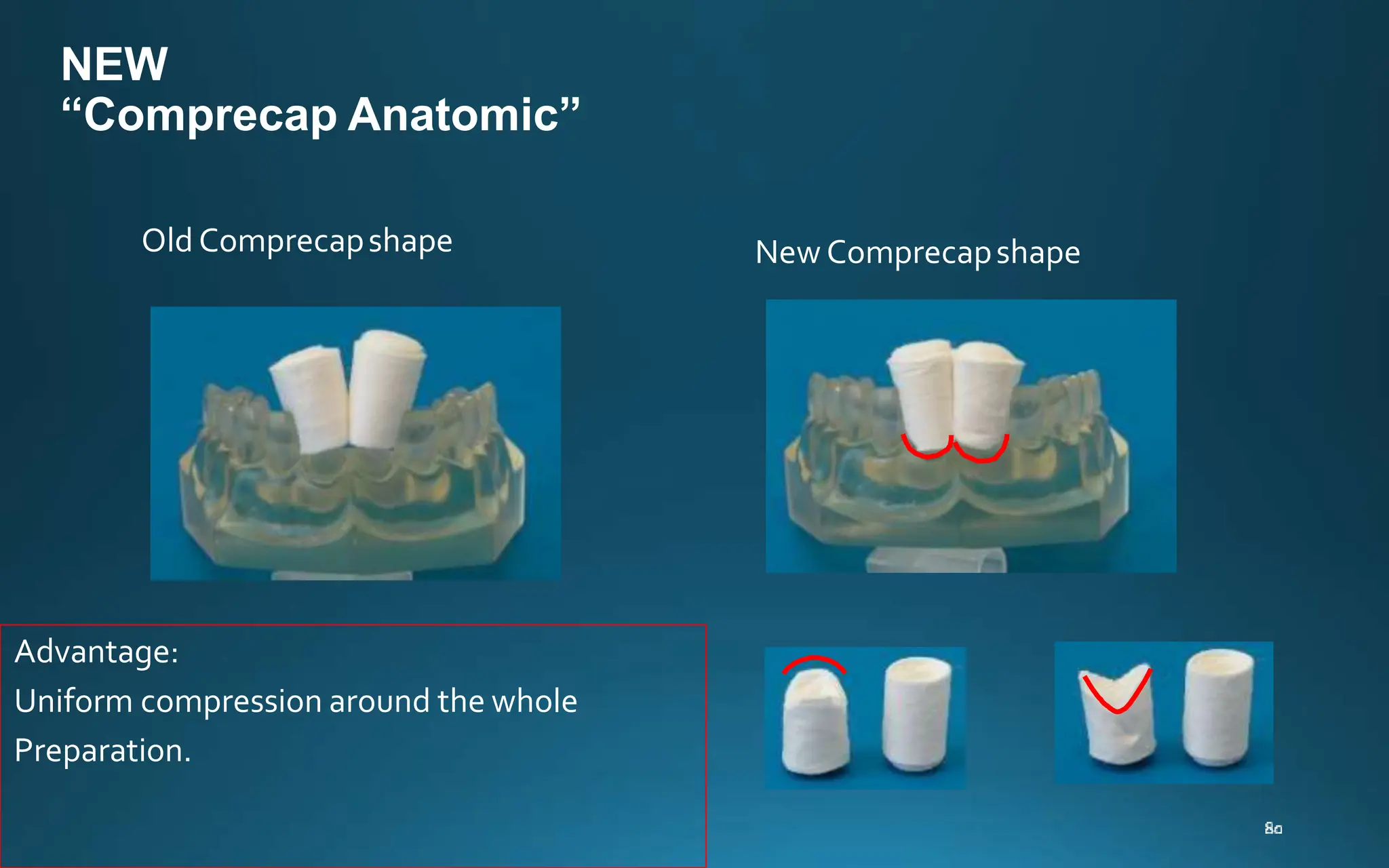
NEW
“Comprecap Anatomic”
Old Comprecapshape New Comprecapshape
Advantage:
Uniform compression around the whole
Preparation.
Advantages of Magic FoamCord
• Astringent is not required – no need to rinse
• More efficient – when doing multiple preparations
• Perfect retraction of the Sulcus, stops bleeding without
invasive materials or techniques
• Easier to use (same as impression making). Flows directly into
the Sulcus. No need for technique sensitive application
technique.
• No trauma (no packing or pressure, no bleeding caused by the
procedure)
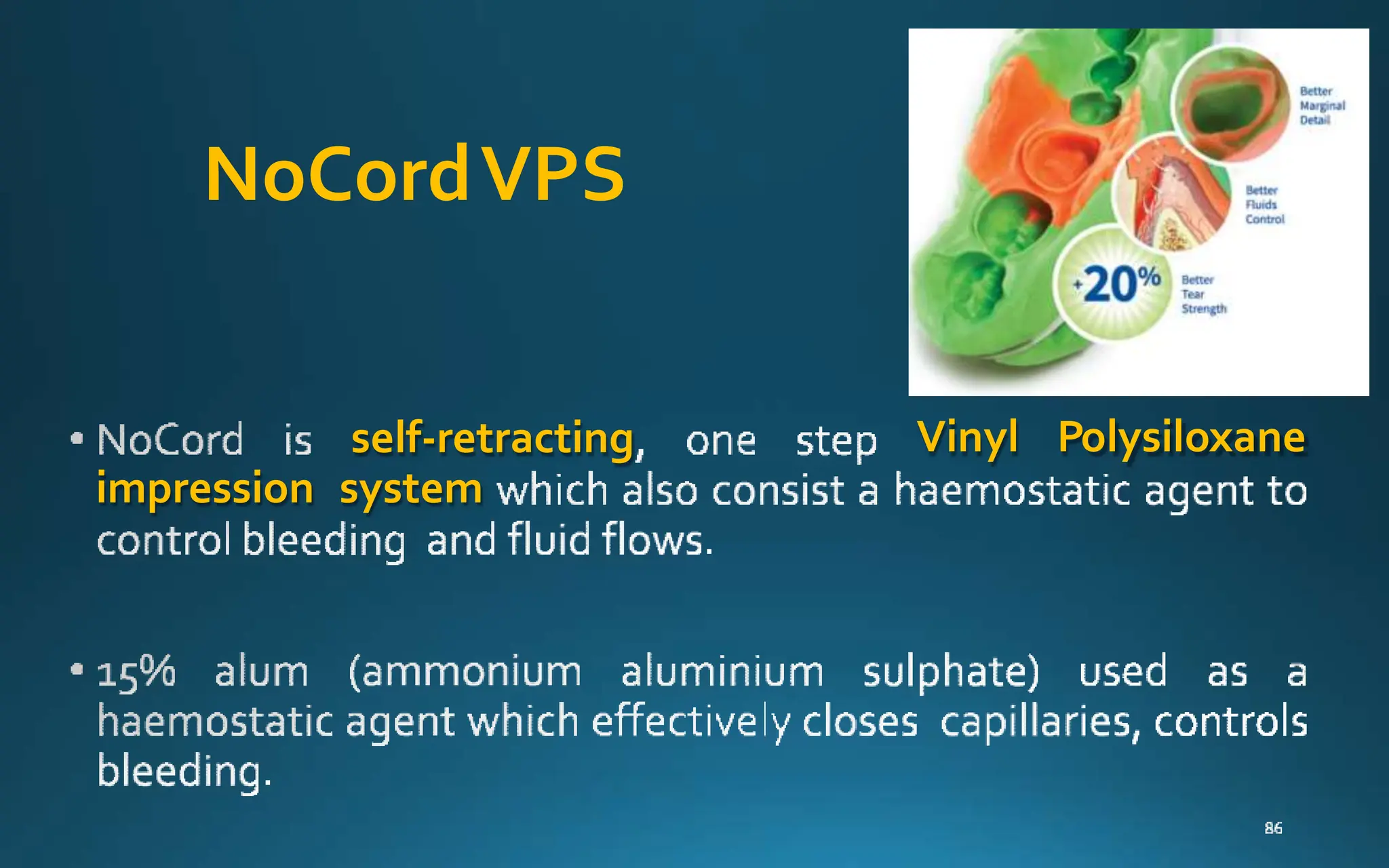
NoCordVPS
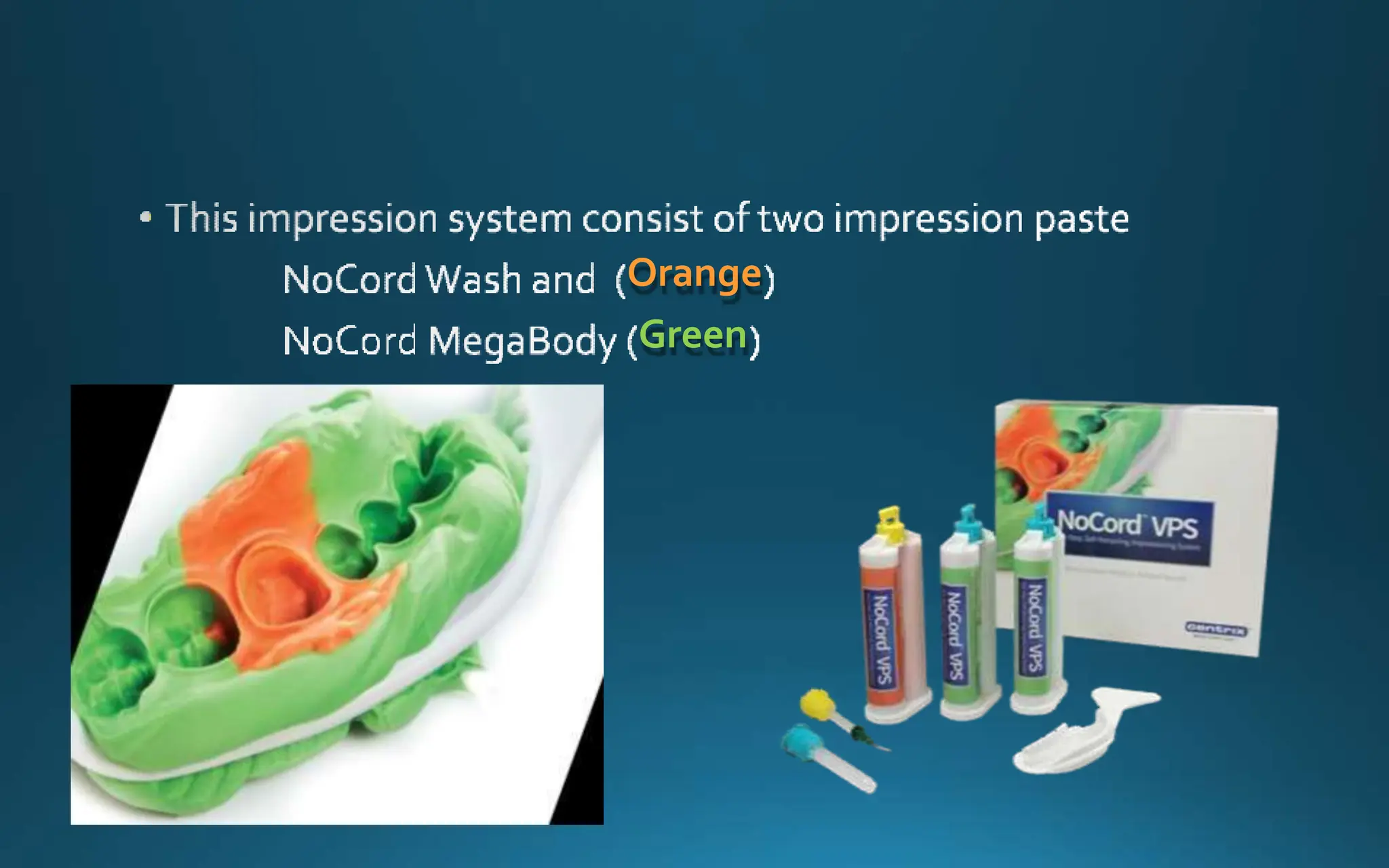
Vinyl Polysiloxane
self-retracting
impression system
Orange
Green
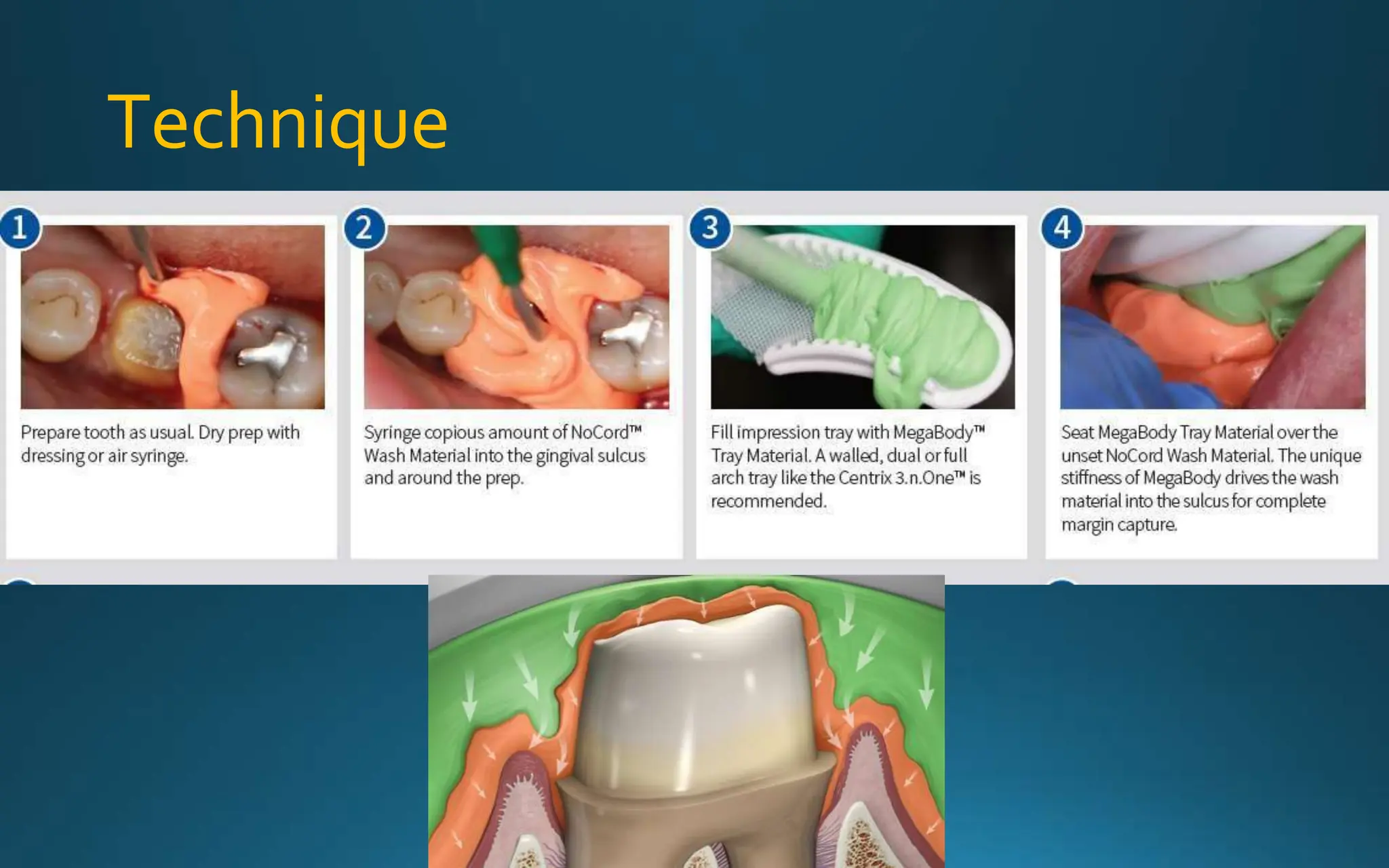
Technique
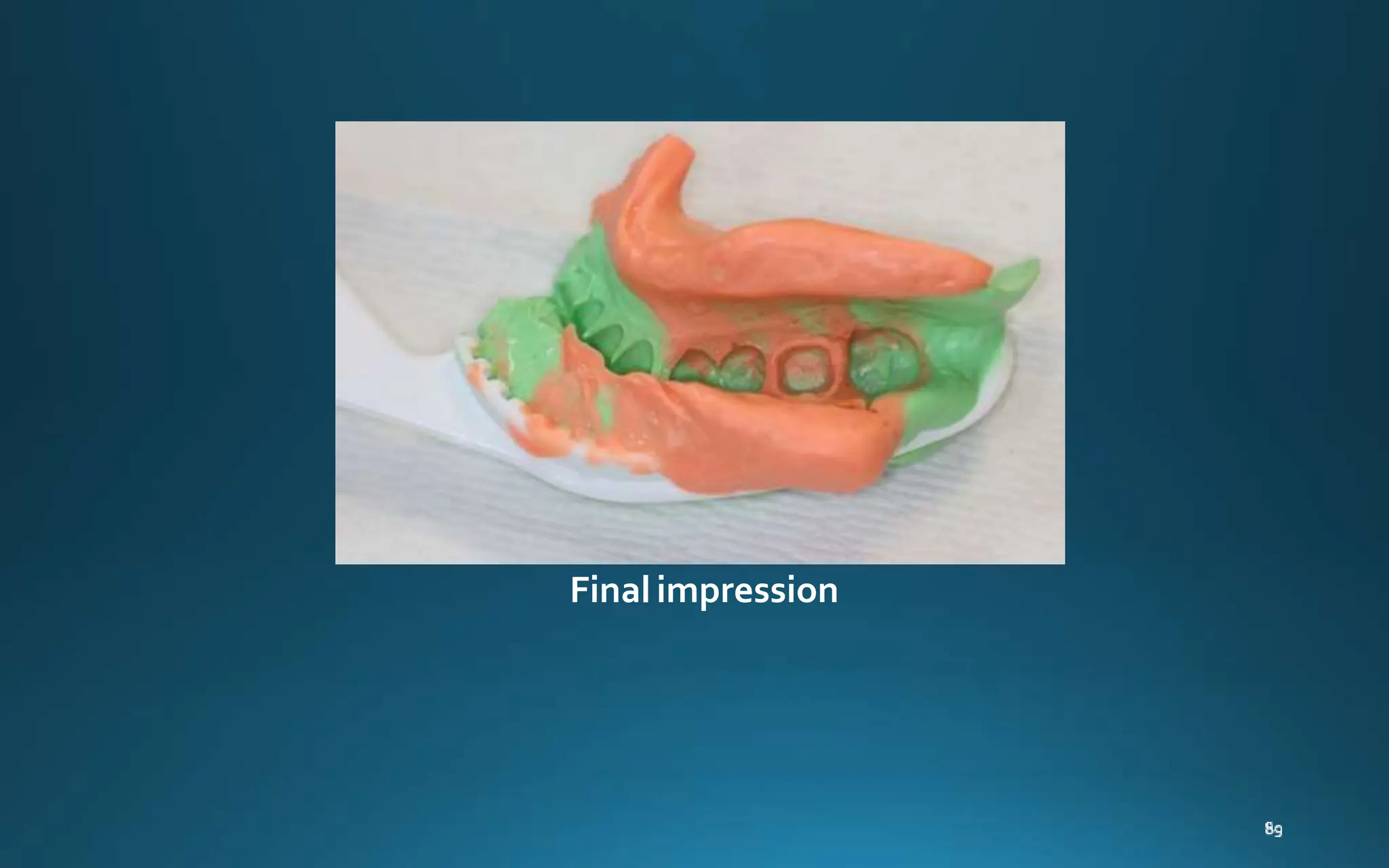
Final impression
Advantages:
• Atraumatic to gingiva as no retraction cords are required
for displacement.
• One stage procedure saves chair side time.
• No use of application of additional haemostatic agent
before impression making which also saves time and
money .
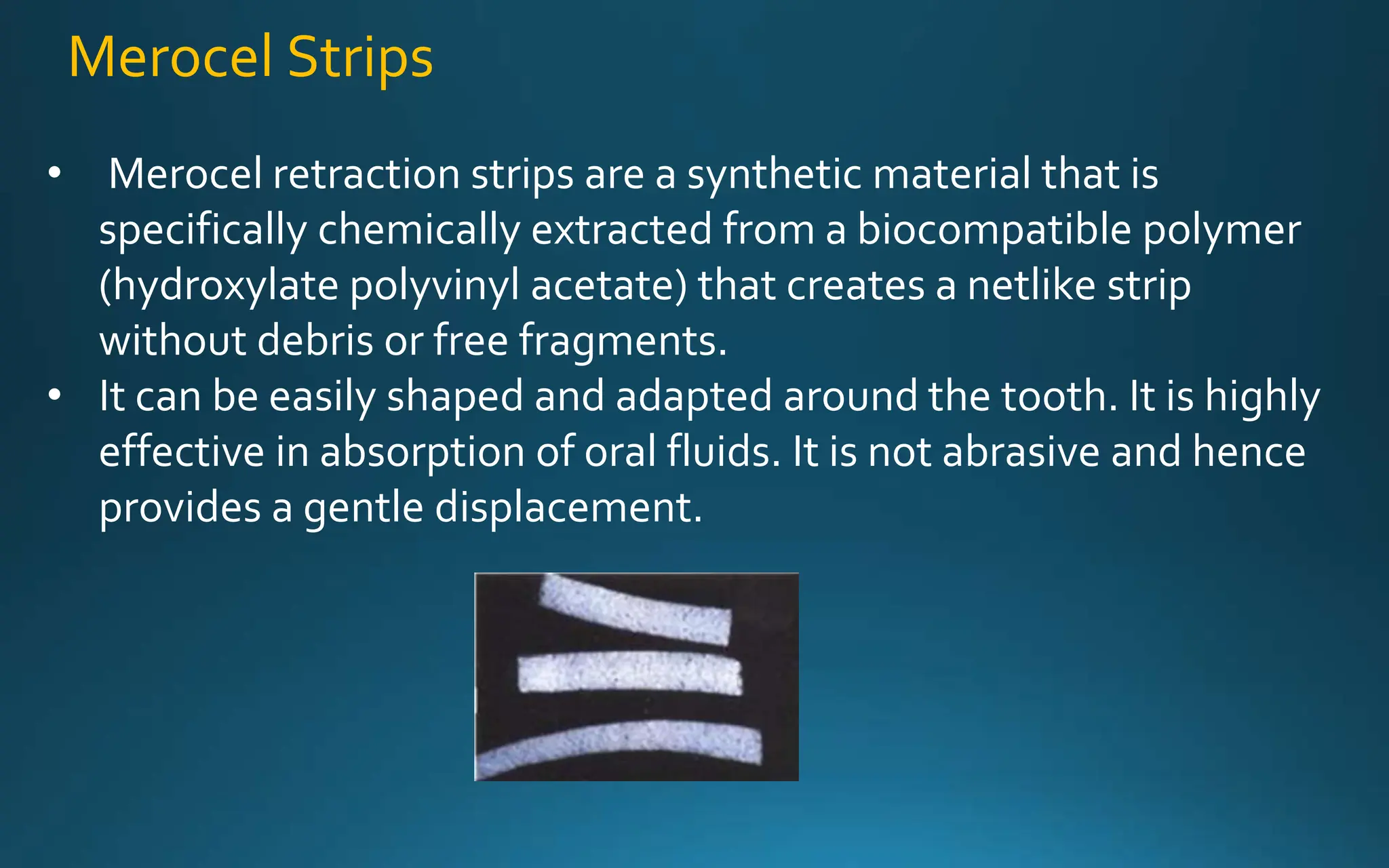
Merocel Strips
• Merocel retraction strips are a synthetic material that is
specifically chemically extracted from a biocompatible polymer
(hydroxylate polyvinyl acetate) that creates a netlike strip
without debris or free fragments.
• It can be easily shaped and adapted around the tooth. It is highly
effective in absorption of oral fluids. It is not abrasive and hence
provides a gentle displacement.
• Tooth is initially prepared at the gingival level without retraction
of the gingival sulcus. A provisional crown is lined with acrylic
resin and then inserted.
• A gingival finish line is prepared within the intracervicular space
during the second appointment, and caution is exercised to avoid
injury to the gingival tissue.
• A 2 mm thick Merocel retraction strip is inserted around the
tooth and the provisional crown is reinserted.
METHOD
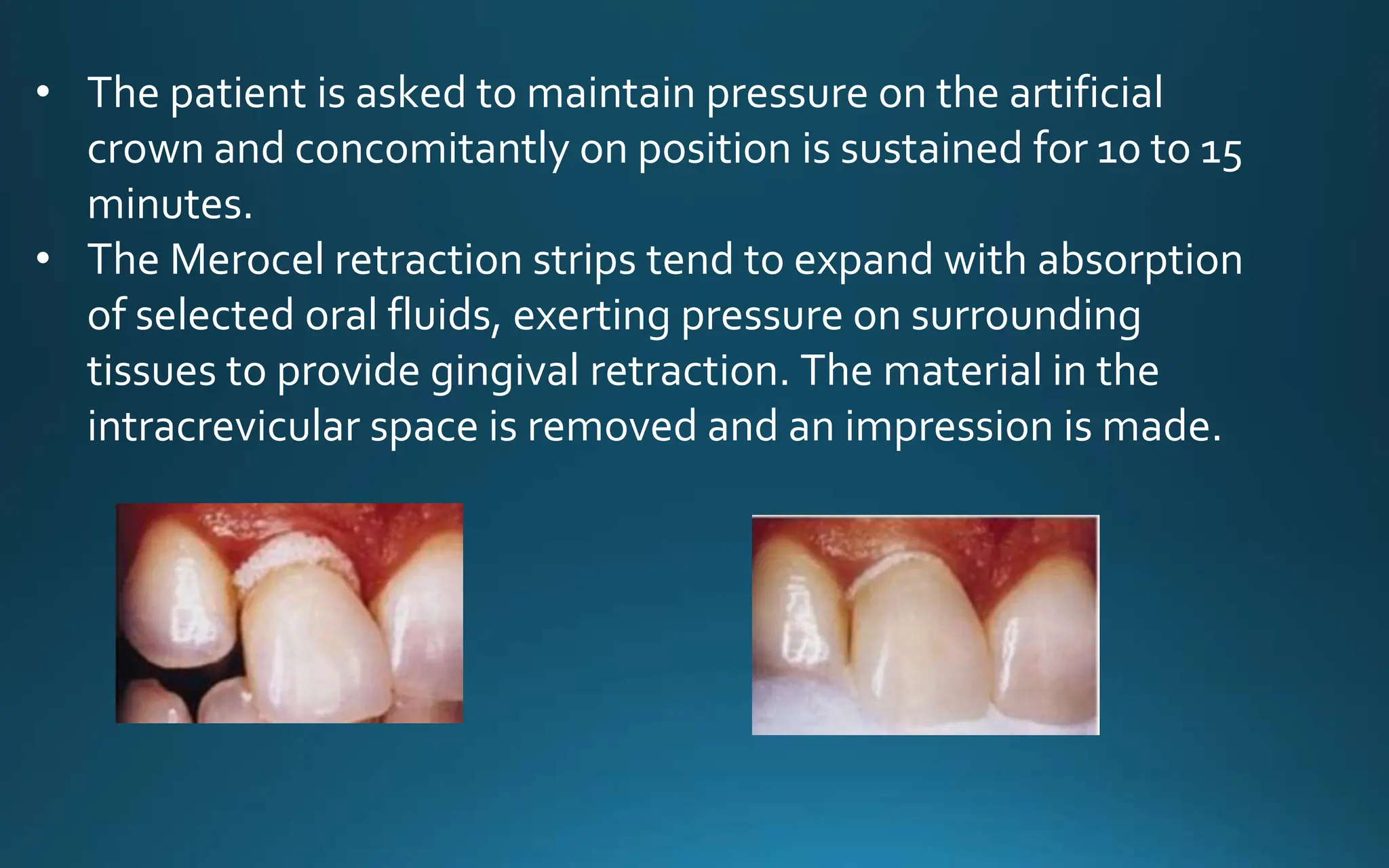
• The patient is asked to maintain pressure on the artificial
crown and concomitantly on position is sustained for 10 to 15
minutes.
• The Merocel retraction strips tend to expand with absorption
of selected oral fluids, exerting pressure on surrounding
tissues to provide gingival retraction. The material in the
intracrevicular space is removed and an impression is made.
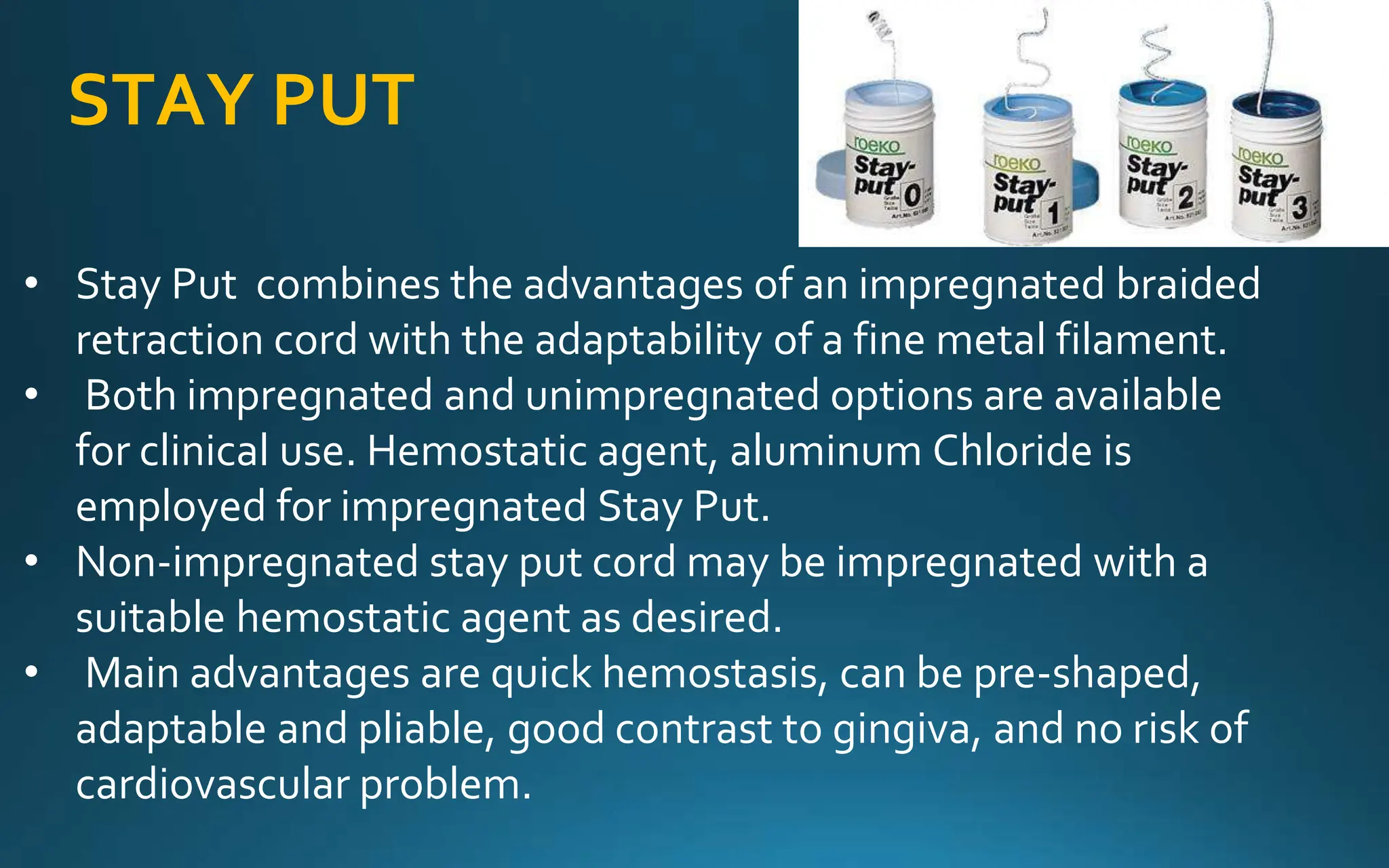
STAY PUT
• Stay Put combines the advantages of an impregnated braided
retraction cord with the adaptability of a fine metal filament.
• Both impregnated and unimpregnated options are available
for clinical use. Hemostatic agent, aluminum Chloride is
employed for impregnated Stay Put.
• Non-impregnated stay put cord may be impregnated with a
suitable hemostatic agent as desired.
• Main advantages are quick hemostasis, can be pre-shaped,
adaptable and pliable, good contrast to gingiva, and no risk of
cardiovascular problem.
retraction cords
chemicals
• Lasers
• Electrosurgery
• Rotary curettage
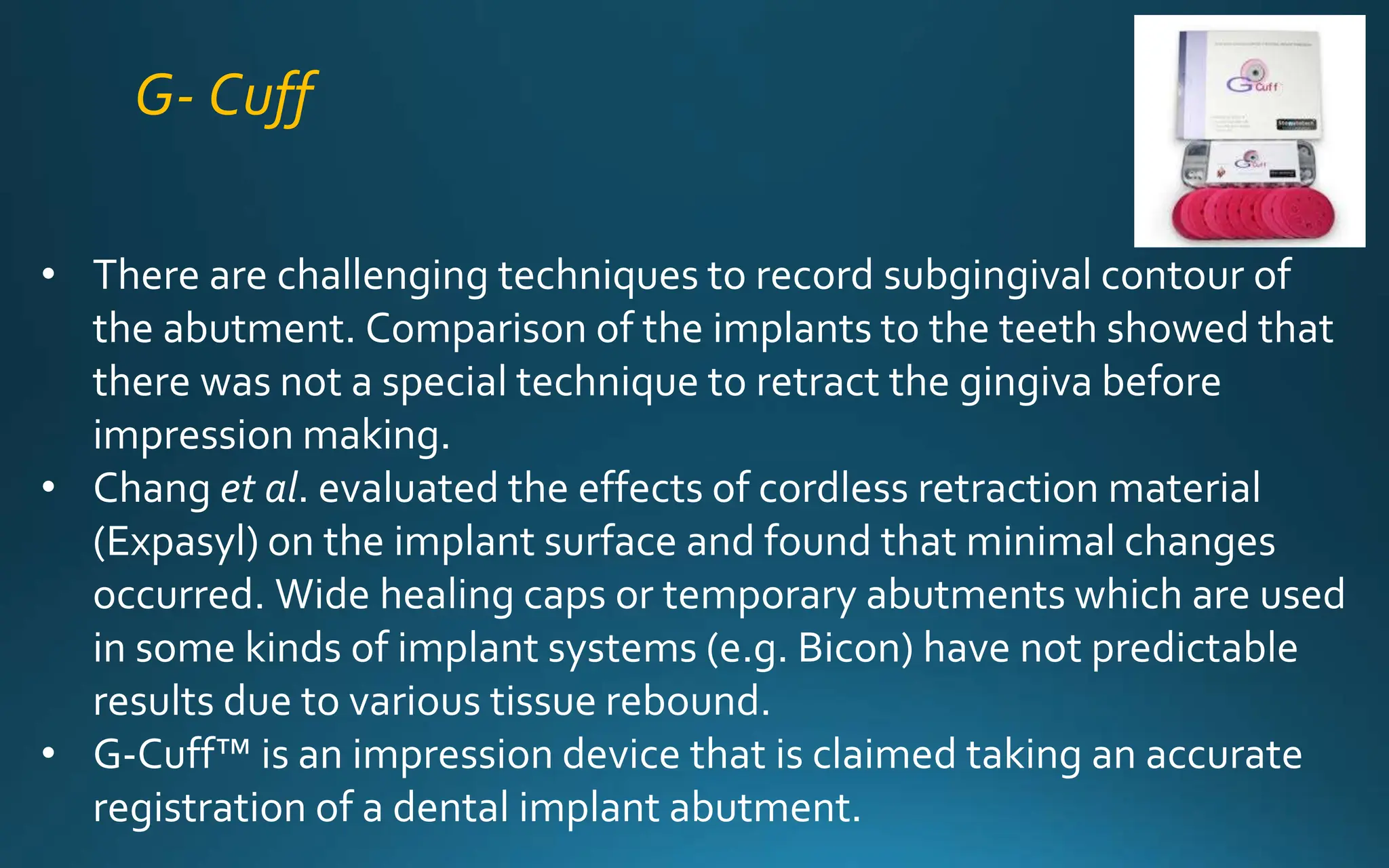
G- Cuff
• There are challenging techniques to record subgingival contour of
the abutment. Comparison of the implants to the teeth showed that
there was not a special technique to retract the gingiva before
impression making.
• Chang et al. evaluated the effects of cordless retraction material
(Expasyl) on the implant surface and found that minimal changes
occurred. Wide healing caps or temporary abutments which are used
in some kinds of implant systems (e.g. Bicon) have not predictable
results due to various tissue rebound.
• G-Cuff™ is an impression device that is claimed taking an accurate
registration of a dental implant abutment.
• The main purpose of G-Cuff is to support the soft tissue that
surrounds the implant abutment. So it retracts the gingiva to allow
the impression material or digital intra-oral scanner recording the
implant abutment, so the final restoration can be accomplished
within two visits.
• The instructor claimed that the restoration using G cuff is more
accurate than open tray and close tray impression techniques.
• It is helpful for unidentified dental implants and eliminates the
need to transfer the copings and analogs. It is not traumatic for
the soft tissue unlike retraction cord .
• However, more studies are recommended to verify its efficiency.
Further research is recommended, especially on abutment level
impressions.
Conclusion
• Gingival retraction holds the merit of being an indispensable
clinical procedure for predictable soft tissue management and
impression making.
• The myriad clinical complications arising out of inadequate
marginal adaptation can be clearly avoided, provided apt
attention is paid to impression-making after due exposure of
finish margins with any of the mentioned methods of gingival
retraction.
• Soft tissues form is a integral part of a restoration/
prosthesis along with hard tissues.
• Proper balance between soft and hard tissue is a essential
pre-requisite for longevity of the restoration as well as for
its success.
Next seminar : Dr. Fauzia
Topic : Current trends in Prosthodontics
Date : 28th may at 12:00pm

gingival retraction seminar pptx gingival displacment methods ppt

  • 1.
  • 2.
  • 3.
    7. Gingival tissuedisplacement around implant
  • 4.
  • 5.
  • 6.
  • 7.
    NeedAnd ImportanceOf GingivalDisplacement exposure of finish line impression material and fluid control. esthetics prevention of periodontal disease
  • 8.
    CRITERIA minimum tissue damage . gingivaldisplacement and hemostasis.
  • 9.
    TYPES OFDISPLACEMENT • Displacesthe tissue so that adequate bulk of the impression material can be interfaced with theprepared tooth. LATERAL • exposes the unprepared portion of the tooth apical to the finish line. May cause trauma to the gingivaltissues followed by recession. APICAL/VERTICAL
  • 10.
    COMBINATION OF DIFFERENT TECHNIQUES Tissue displacementmethods in Fixed Prosthodontics ,BW Benson et al. ,JPD 1986 ,Feb
  • 11.
    MECHANICALTISSUE DISPLACEMENT first and earliest 4.Mechanical pack made from ZOE 5. Retraction cord 6. Strings of fibre.
  • 12.
    Copper Band (Tube)Filled WithImpression Material COPPER BAND •It is used to carry the impression as well as to displace the gingiva to expose the finish line. CopperTubes
  • 13.
    TECHNIQUE OF COPPERBAND DISPLACENENT or MATRIX METHOD
  • 15.
  • 16.
    According to thisarticle gingival recession following use of copper band is 0.1mm to 0.3mm in healthy adolescent population.
  • 17.
  • 18.
    TEMPORARY ACRYLICRESIN COPING 1mm. copings becomes an integral part of the impression. (Lawrence winland ,1964)
  • 19.
    TEMPORARY METAL CROWNFILLEDWITH THERMO-PLASTIC STOPPING MATERIAL
  • 20.
    prolonged or lastingrecession sensitive susceptible to caries same appointment GINGIVALTISSUE RETRACTION-AREVIEW: Syed Shujaulla, SyedaTawkhiraTabasum, Sunil Kumar MVJIDENT ISSUE 1VOLUME 1 OCTOBER 2012
  • 21.
  • 22.
    SterileTwills Of CottonImpregnatedWith Slow Setting Zinc-oxide EugenolCement -
  • 23.
  • 24.
    Size: 000 very sensitiveand thin gingiva Size: 00 Size: 0 Sizes of Retraction cords
  • 25.
  • 26.
  • 27.
    VARIOUS DRUGS USEDFOR GINGIVAL DISPLACEMENT CHEMICALS ANDBRANDS
  • 28.
    Vasoconstrictors They act by: 1.Transient gingival shrinkage. 2. Transient ischemia 3. Controlling seepage of gingival fluid. Ex: Epinephrine (used widely before 1980’s) Epinephrine causes an evaluation in the blood pressure and increased heart rate. Though its effect are minimal in healthy gingiva but it has profound effect on lacerated or inflamed gingiva.
  • 29.
  • 30.
    Baba NZ,GoodacreCJ ,Jekki R,Won J.GingivalDisplacement for Impression Making in Fixed ProsthodonticsContemporary Principles,Materials,andTechniques. DentClin NAm 58 (2014) 45–68 . PhataleS,Marawar, P.P,Kalburge,JV.Effect of Retraction materials on Gingival Health : A Histopathological study.J Indian Soc Periodontol 2010; Jan- Mar; 14(1): pp 35-39.
  • 31.
    BIOLOGIC FLUID COAGULANTS •Astringent agents such as alum, aluminum chloride and zinc chloride are metal salts that inhibit plasma proteins’ inter-capillary immigration, decrease cell permeability, control the moisture in the peripheral tissues through protein precipitation on the superficial layer, and increase the mechanical strength of the mucosa. Thus, protein precipitation has hemostatic effects under physiological condition. • Very safe agent as they induce minimal systemic effects. • Eg. 100% Alum • 15-25% AlSO4 • 15- 20% Fe2 SO4 • 25% AlSO4
  • 32.
  • 33.
    ALUMINIUM CHLORIDE 5%-25% effectof other •Most commonly used • 25% solution approx. doubles the haemostatic chemicals. ADVANTAGES: 1.No known contraindications and minimal side effects. 2.Considered most effective chemical to control bleeding and displace tissue with minimal damage. DISADVANTAGE: More than 10% may causes local tissue destruction.
  • 34.
    25% Aluminium sulphate •Most popular astringent. • Excellent retraction ,hemostatic control and tissue rigidity. • Recommended treatment time is 5-8 min. • Its blue in color and comes in pleasant raspberry flavor. • No known contraindications and minimal systemic effects.
  • 35.
    FERRIC SUBSULFATE –MONSEL’SSOL. moreeffective corrosive stain the enamel
  • 36.
  • 37.
    ZINC CHLORIDE 8%-40%(bitartarate) severe necrosis caustic not recommended
  • 38.
  • 39.
    TIME OF PLACEMENTOFRETRACTION CORDS 5-30 Min. 5 –10 min
  • 40.
    •CORD PACKING INSTRUMENTS: serrated braidedcords non serrated twisted cord a sliding motion.
  • 41.
  • 43.
    Techniques For GingivalDisplacementUsing RetractionCords
  • 44.
  • 45.
    towards the area pushedslightly already tucked angled towards the root
  • 47.
  • 49.
    THE ‘EVERY OTHERTOOTH’ TECHNIQUE: strangulationof the gingival papillae alternate tooth
  • 51.
  • 53.
  • 55.
  • 56.
    LASERS • Lasers mayalso be employed as they cause tissue-coagulation facilitating hemostasis tissue removal via vaporization, and sulcular epithelium is removed. • Commonly used soft-tissue lasers for gingival displacement include CO2 lasers, diode lasers, Nd:YAG lasers, erbium lasers, etc. • These minimally penetrate the soft tissues, so they are fairly safe to use. • Some of the advantages with lasers include a dry bloodless field of surgery, sterile working area, less mechanical trauma, minimal pain and less postoperative swelling and scarring. • However, cost factor is a drawback and it is technique-sensitive. Er: YAG laser is not good in hemostasis as CO2 laser. However, CO2 laser provides no tactile feedback, leading to risk of damage to junctional epithelium.
  • 57.
    Other Methods AndNew Materials
  • 58.
    Expa-syl •The system includesan injectable material supplied in a cartridge and delivered with a specially designed gun. •The Expasyl material is Kaolin (natural clay) incorporated into an organic binder with aluminium chloride added for haemostatic action.
  • 60.
  • 61.
  • 62.
    3M Astringent RetractionPaste 15% aluminium chloride
  • 63.
    COMPARSION OF THESIZE OF TIPS
  • 65.
  • 66.
    •Magic Foam Cordis a new non- haemostatic gingival retraction system. •It is the first expanding vinyl polysiloxane material for retraction of designed the gingival the potential sulcus without trauma to sulcus. Magic FoamCord™
  • 67.
    Magic FoamCord “How DoesItWork” Syringe FoamCord around the preparation Placepre-fitted Comprecap over tooth and ask patient to bite down Wait 5 min. to allow FoamCord material to fully set and sulcusto expand Preparation ready for final impression
  • 68.
  • 69.
    NEW “Comprecap Anatomic” Old ComprecapshapeNew Comprecapshape Advantage: Uniform compression around the whole Preparation.
  • 70.
    Advantages of MagicFoamCord • Astringent is not required – no need to rinse • More efficient – when doing multiple preparations • Perfect retraction of the Sulcus, stops bleeding without invasive materials or techniques • Easier to use (same as impression making). Flows directly into the Sulcus. No need for technique sensitive application technique. • No trauma (no packing or pressure, no bleeding caused by the procedure)
  • 71.
  • 72.
  • 73.
  • 74.
  • 75.
    Advantages: • Atraumatic togingiva as no retraction cords are required for displacement. • One stage procedure saves chair side time. • No use of application of additional haemostatic agent before impression making which also saves time and money .
  • 76.
    Merocel Strips • Merocelretraction strips are a synthetic material that is specifically chemically extracted from a biocompatible polymer (hydroxylate polyvinyl acetate) that creates a netlike strip without debris or free fragments. • It can be easily shaped and adapted around the tooth. It is highly effective in absorption of oral fluids. It is not abrasive and hence provides a gentle displacement.
  • 77.
    • Tooth isinitially prepared at the gingival level without retraction of the gingival sulcus. A provisional crown is lined with acrylic resin and then inserted. • A gingival finish line is prepared within the intracervicular space during the second appointment, and caution is exercised to avoid injury to the gingival tissue. • A 2 mm thick Merocel retraction strip is inserted around the tooth and the provisional crown is reinserted. METHOD
  • 78.
    • The patientis asked to maintain pressure on the artificial crown and concomitantly on position is sustained for 10 to 15 minutes. • The Merocel retraction strips tend to expand with absorption of selected oral fluids, exerting pressure on surrounding tissues to provide gingival retraction. The material in the intracrevicular space is removed and an impression is made.
  • 79.
    STAY PUT • StayPut combines the advantages of an impregnated braided retraction cord with the adaptability of a fine metal filament. • Both impregnated and unimpregnated options are available for clinical use. Hemostatic agent, aluminum Chloride is employed for impregnated Stay Put. • Non-impregnated stay put cord may be impregnated with a suitable hemostatic agent as desired. • Main advantages are quick hemostasis, can be pre-shaped, adaptable and pliable, good contrast to gingiva, and no risk of cardiovascular problem.
  • 80.
    retraction cords chemicals • Lasers •Electrosurgery • Rotary curettage
  • 81.
    G- Cuff • Thereare challenging techniques to record subgingival contour of the abutment. Comparison of the implants to the teeth showed that there was not a special technique to retract the gingiva before impression making. • Chang et al. evaluated the effects of cordless retraction material (Expasyl) on the implant surface and found that minimal changes occurred. Wide healing caps or temporary abutments which are used in some kinds of implant systems (e.g. Bicon) have not predictable results due to various tissue rebound. • G-Cuff™ is an impression device that is claimed taking an accurate registration of a dental implant abutment.
  • 82.
    • The mainpurpose of G-Cuff is to support the soft tissue that surrounds the implant abutment. So it retracts the gingiva to allow the impression material or digital intra-oral scanner recording the implant abutment, so the final restoration can be accomplished within two visits. • The instructor claimed that the restoration using G cuff is more accurate than open tray and close tray impression techniques. • It is helpful for unidentified dental implants and eliminates the need to transfer the copings and analogs. It is not traumatic for the soft tissue unlike retraction cord . • However, more studies are recommended to verify its efficiency. Further research is recommended, especially on abutment level impressions.
  • 83.
    Conclusion • Gingival retractionholds the merit of being an indispensable clinical procedure for predictable soft tissue management and impression making. • The myriad clinical complications arising out of inadequate marginal adaptation can be clearly avoided, provided apt attention is paid to impression-making after due exposure of finish margins with any of the mentioned methods of gingival retraction.
  • 84.
    • Soft tissuesform is a integral part of a restoration/ prosthesis along with hard tissues. • Proper balance between soft and hard tissue is a essential pre-requisite for longevity of the restoration as well as for its success.
  • 86.
    Next seminar :Dr. Fauzia Topic : Current trends in Prosthodontics Date : 28th may at 12:00pm