Esthetics, Use of Attachments and
        Rotational Path RPD’s
      John Beumer III DDS, MS
               Division of Advanced Prosthodontics
                     UCLA School of Dentistry
                                                 and
                          Eugene King DDS
               Section of Dental Oncology
         MD Anderson Hospital and Tumor Institute
This program of instruction is protected by copyright ©. No portion of this
program of instruction may be reproduced, recorded or transferred by any
means electronic, digital, photographic, mechanical etc., or by any
information storage or retrieval system, without prior permission.
Esthetics, Use of Attachments and
      rotational path RPD’s
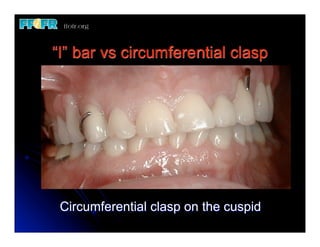
“I” bar vs circumferential clasp


 Circumferential clasp on the cuspid
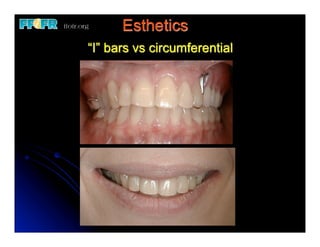
Esthetics
“I” bars vs circumferential
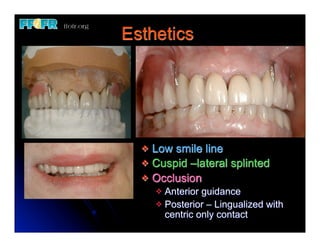
Esthetics


  v Low smile line
  v Cuspid –lateral splinted
  v Occlusion
       v Anterior guidance
       v Posterior – Lingualized with
          centric only contact
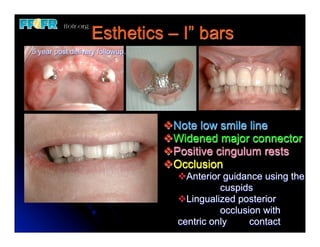
Esthetics – I” bars
5 year post delivery followup.


                                 vNote low smile line
                                 vWidened major connector
                                 vPositive cingulum rests
                                 vOcclusion
                                   vAnterior guidance using the
                                             cuspids
                                   vLingualized posterior
                                             occlusion with
                                   centric only     contact
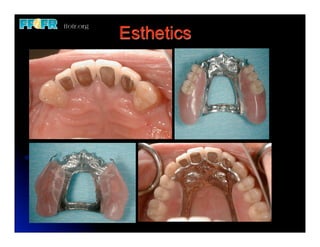
Esthetics
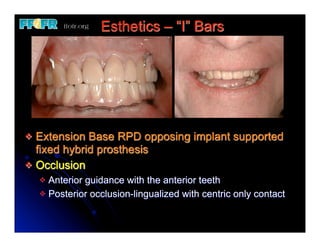
Esthetics – “I” Bars


v Extension Base RPD opposing implant supported
   fixed hybrid prosthesis
v Occlusion
     v Anterior guidance with the anterior teeth
     v Posterior occlusion-lingualized with centric only contact
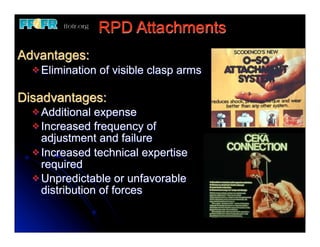
RPD Attachments
Advantages:
  v Elimination   of visible clasp arms

Disadvantages:
  v Additional  expense
  v Increased frequency of
     adjustment and failure
  v Increased technical expertise
     required
  v Unpredictable or unfavorable
     distribution of forces
Attachment Classification
Rigid attachments
  v   No movement is possible between the
       parts. Used in situations where the
       abutment teeth fully support the occlusal
       forces (tooth borne RPD’s and fixed
       partial dentures)


Resilient attachments
  v   Allows movement to take place between
       the parts, thus providing stress-breaking.
       An example is the ERA attachment
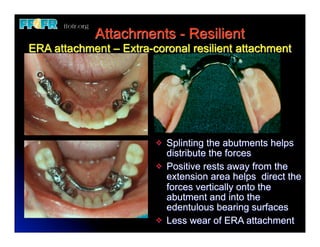
Attachments - Resilient
 ERA attachment – Extra-coronal resilient attachment
The ERA
attachment
permits the RPD
to be displaced
into the
edentulous
extension area
by up to .4 mm
Attachments - Resilient
ERA attachment – Extra-coronal resilient attachment

Plastic burnout pattern   Metal housing


                                          ERA attachment
Attachments - Resilient
ERA attachment – Extra-coronal resilient attachment
   Requirements for use
       vSplinted abutments
       vRest distant from the attachment
       vClose followup to consider relines

                    ERA Attachment
Attachments - Resilient
   ERA attachment – Extra-coronal resilient attachment
                              ERA                 ERA + splinting


Photoelastic analysis - Evaluating the following:
    vSplintedvs unsplinted
    vRest vs no rest
    vRest position

Berg and Caputo et al
Attachments - Resilient
 ERA attachment – Extra-coronal resilient attachment


                      ERA                              ERA+splinting


Summary and conclusions
  vAttachment    best used when:
    v Adjacent  teeth splinted
    v Positive rests
    v Light retention (white and orange attachment)
Attachments - Resilient
ERA attachment – Extra-coronal resilient attachment


                        v   Splinting the abutments helps
                             distribute the forces
                        v   Positive rests away from the
                             extension area helps direct the
                             forces vertically onto the
                             abutment and into the
                             edentulous bearing surfaces
                        v   Less wear of ERA attachment
Overlay denture attachments
Advantages
  v Improved   esthetics
  v Maintain support
  v More favorable biomechanics - Improved crown-
     root ratio
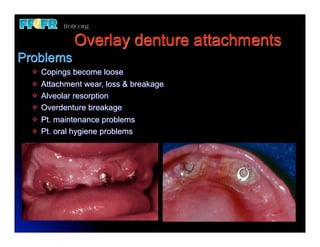
Overlay denture attachments
Problems
  v   Copings become loose
  v   Attachment wear, loss & breakage
  v   Alveolar resorption
  v   Overdenture breakage
  v   Pt. maintenance problems
  v   Pt. oral hygiene problems
Attachments - Resilient
 ERA attachment – Extra-coronal resilient attachment
  This patient is status post partial palatectomy for a benign tumor of the
left hard palate. The left tuberosity remains and it contains a third molar
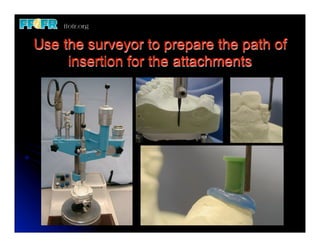
Use the surveyor to prepare the path of
     insertion for the attachments
Use the surveyor to prepare the path of
     insertion for the attachments
Attachments - Resilient
  ERA attachment – Extra-coronal resilient attachment
Note the bracing arm through the proximal of #5 and #6. It is
non- retentive but keeps the RPD framework from being
displaced lingually in this region and with the cingulum rest on
#8, keeps the framework centered over the ERA attachment.

                                 Bracing
                                  arm
 Rest


                   ERA
                attachment
          Cingulum
             rest
Attachments - Resilient
  ERA attachment – Extra-coronal resilient attachment


                      Bracing arm
The two central incisors have
been splinted together. A
cingulum rest is positioned on
the mesial side of #8. The ERA              High smile
attachment is incorporated
within the crown of #9.

                                 Note the bracing arm.
Attachments - Resilient
   ERA attachment – Extra-coronal resilient attachment


                                                             High smile
Note the attachment associated with third molar. This serves as an occlusal
stop and has a retentive attachment incorporated within. The ERA should not
be used unless a positive occlusal stop is present on the defect side,
either from a tooth or an implant.
Attachments - Resilient
ERA attachment – Extra-coronal resilient attachment


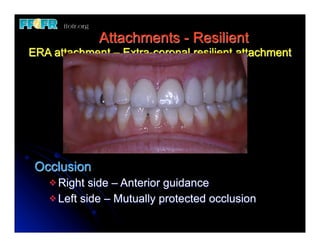
 Occlusion
   v Right  side – Anterior guidance
   v Left side – Mutually protected occlusion
Magnetic Attachments
Advantages :
  v   Ease of insertion and removal
  v   Simple laboratory work &
       economic cost
  v   Reduced lateral forces
  v   No leverage
  v   No fragile parts for fracture
  v   No activation necessary
  v   Do not need special equipment
       (parallelometer etc)
  v   Easy to maintain oral hygiene
Magnetic Attachments
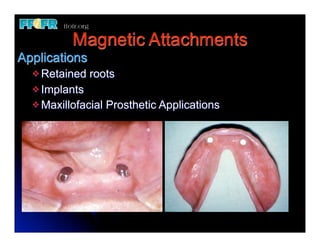
Applications
  v Retained   roots
  v Implants
  v Maxillofacial   Prosthetic Applications
Magnetic Attachments
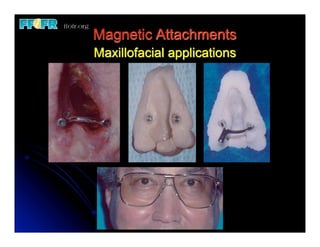
Maxillofacial applications
Magnetic Attachments
Maxillofacial applications
Magnetic Attachments
Maxillofacial applications
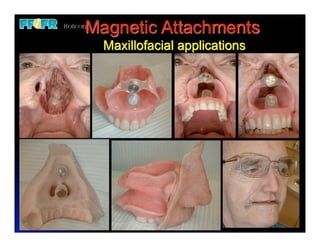
Magnetic Attachments
  Maxillofacial applications
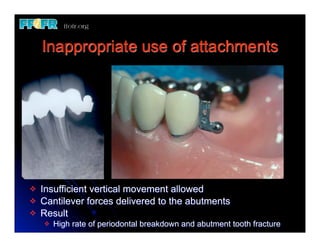
Inappropriate use of attachments


v   Insufficient vertical movement allowed
v   Cantilever forces delivered to the abutments
v   Result
     v   High rate of periodontal breakdown and abutment tooth fracture
Inappropriate use of attachments


v Cantilever forces delivered to the abutments
v Result
     v   High rate of periodontal breakdown and fracture of the
          abutment teeth
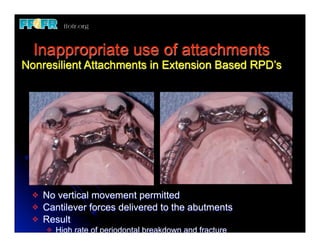
Inappropriate use of attachments
Nonresilient Attachments in Extension Based RPD’s


 v   No vertical movement permitted
 v   Cantilever forces delivered to the abutments
 v   Result
      v   High rate of periodontal breakdown and fracture
Inappropriate use of attachments
Nonresilient Attachments in Extension Based RPD’s


v   No vertical movement permitted
v   Cantilever forces delivered to the abutments
v   Result
     v   High rate of periodontal breakdown and fracture of the abutment
          teeth
Inappropriate use of attachments
     Nonresilient Attachments in Extension Based RPD’s


v   No vertical movement permitted
v   Cantilever forces delivered to the abutments
v   Result
     v   High rate of periodontal breakdown and fracture of the abutment teeth
Kennedy Class IV RPD’s
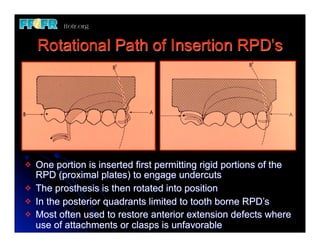
Rotational Path of Insertion RPD’s


v   One portion is inserted first permitting rigid portions of the
     RPD (proximal plates) to engage undercuts
v   The prosthesis is then rotated into position
v   In the posterior quadrants limited to tooth borne RPD’s
v   Most often used to restore anterior extension defects where
     use of attachments or clasps is unfavorable
Rotational Path of Insertion RPD’s


Advantage
  v Elimination   of unesthetic retainers (clasp arms)
     v The clasp arms are replaced by rigid retainers
     v These rigid retainers engage undercuts and consist of
        a positive rest and a minor connector (proximal plate)
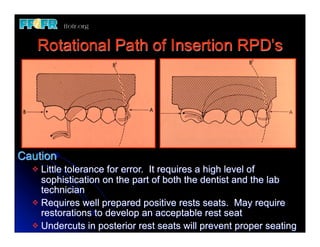
Rotational Path of Insertion RPD’s


Caution
  v Little tolerance for error. It requires a high level of
     sophistication on the part of both the dentist and the lab
     technician
  v Requires well prepared positive rests seats. May require
     restorations to develop an acceptable rest seat
  v Undercuts in posterior rest seats will prevent proper seating
Rotational Path of Insertion RPD’s

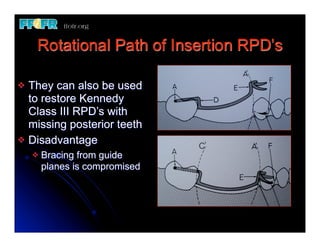
v They can also be used
   to restore Kennedy
   Class III RPD’s with
   missing posterior teeth
v Disadvantage
     v   Bracing from guide
          planes is compromised
Rotational Path of Insertion RPD’s
Treatment planning
  v Patientpresents with moderate periodontal
     bone loss with recent loss of the incisors
  v Options
     v Fixed partial denture
     v Implant supported fixed partial denture
     v Rotational path of insertion RPD
Rotational Path of Insertion RPD’s
Treatment planning
  v Patientpresents with moderate periodontal
     bone loss with recent loss of the incisors
  v Options
     v Fixed   partial denture – Problems
        v Length of span
        v Amount of tooth reduction for PFM’s
        v Long pontics – Compromised esthetic result
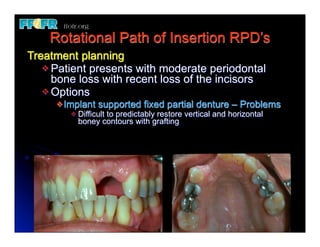
Rotational Path of Insertion RPD’s
Treatment planning
   v Patient presents with moderate periodontal
      bone loss with recent loss of the incisors
   v Options
     v Implant    supported fixed partial denture – Problems
        v   Difficult to predictably restore vertical and horizontal
             boney contours with grafting
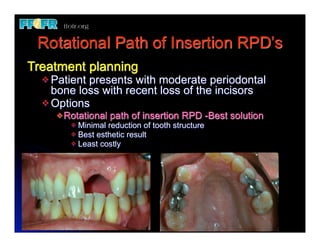
Rotational Path of Insertion RPD’s
Treatment planning
  v Patientpresents with moderate periodontal
     bone loss with recent loss of the incisors
  v Options
     v Rotational   path of insertion RPD -Best solution
        v Minimal reduction of tooth structure
        v Best esthetic result
        v Least costly
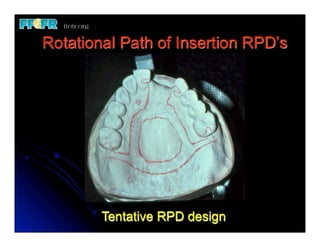
Rotational Path of Insertion RPD’s


        Tentative RPD design
Rotational Path of Insertion RPD’s
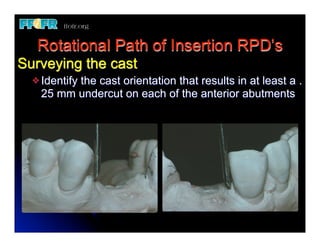
Surveying the cast
  v Identify
          the cast orientation that results in at least a .
    25 mm undercut on each of the anterior abutments
Rotational Path of Insertion RPD’s
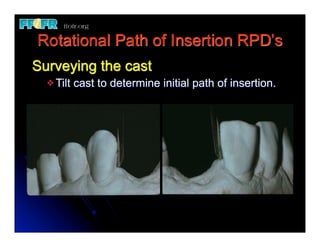
Surveying the cast
  v Tilt   cast to determine initial path of insertion.
Rotational Path of Insertion RPD’s
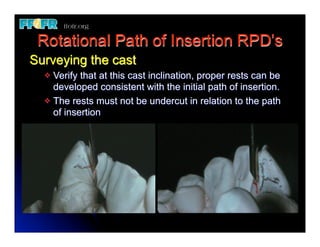
Surveying the cast
  v Verify that at this cast inclination, proper rests can be
     developed consistent with the initial path of insertion.
  v The rests must not be undercut in relation to the path
     of insertion
Rotational Path of Insertion RPD’s
v   Prepare the anterior and posterior rests.
     v   The rests must be positive
v   Beware of excessive buccal inclination of the maxillary
     molars. The rests must be positive but should not be
     undercut in relation to the path of insertion
Rotational Path of Insertion RPD’s
v Fabricatethe RPD casting and verify the
  adaptation
Rotational Path of Insertion RPD’s
Completed RPD
  Important factors for long term success
    v Positive rests
    v Survey for appropriate undercuts and proper rotational
       path of insertion
Rotational Path of Insertion RPD’s


v   In this patient circular
     concave rests were
     used on the cuspids
v   Guidance in lateral
     excursion provided by
     the cuspids and
     premolars
Rotational Path of Insertion RPD’s
v Cingulum   rests prepared on the cuspids
v Positive rests prepared on the distal side of
   the molars
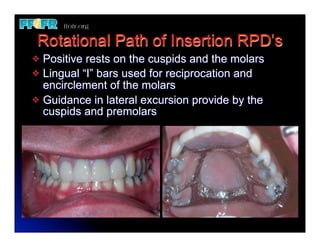
Rotational Path of Insertion RPD’s
v Positive rests on the cuspids and the molars
v Lingual “I” bars used for reciprocation and
   encirclement of the molars
v Guidance in lateral excursion provide by the
   cuspids and premolars
Rotational Path of Insertion RPD’s
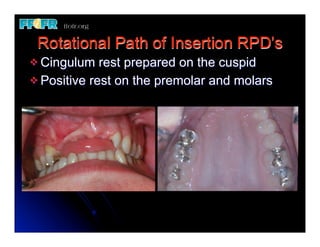
v Cingulum   rest prepared on the cuspid
v Positive rest on the premolar and molars
Rotational Path of Insertion RPD’s
v   Guidance provided by the cuspid and lateral
     incisor on the left the premolar and molar on the
     right
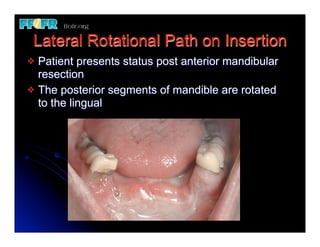
Lateral Rotational Path on Insertion
v Patient presents status post anterior mandibular
   resection
v The posterior segments of mandible are rotated
   to the lingual
Lateral Rotational Path on Insertion
v Retention provided by the lingual surfaces of the
   right molars and the “I” bar on the left
v Reciprocation and encirclement for the right
   molar provided by the trans-occlusal rest
Lateral Rotational Path on Insertion
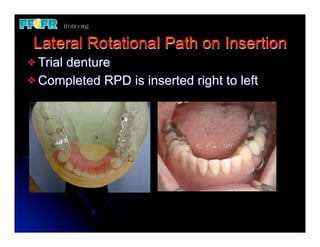
v Trial
      denture
v Completed RPD is inserted right to left
Lateral Rotational Path on Insertion
v Surveying   the cast. Note the lingual
 undercuts
Lateral Rotational Path on Insertion
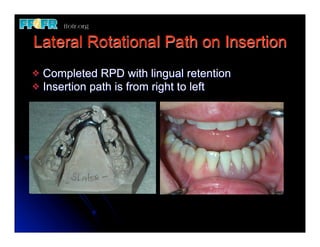
v Completed RPD with lingual retention
v Insertion path is from right to left
v Visit ffofr.org for hundreds of additional lectures
   on Complete Dentures, Implant Dentistry,
   Removable Partial Dentures, Esthetic Dentistry
   and Maxillofacial Prosthetics.
v The lectures are free.
v Our objective is to create the best and most
   comprehensive online programs of instruction in
   Prosthodontics

(Replace) 11.esthetics, rotational path, attachments

  • 1.
    Esthetics, Use ofAttachments and Rotational Path RPD’s John Beumer III DDS, MS Division of Advanced Prosthodontics UCLA School of Dentistry and Eugene King DDS Section of Dental Oncology MD Anderson Hospital and Tumor Institute This program of instruction is protected by copyright ©. No portion of this program of instruction may be reproduced, recorded or transferred by any means electronic, digital, photographic, mechanical etc., or by any information storage or retrieval system, without prior permission.
  • 2.
    Esthetics, Use ofAttachments and rotational path RPD’s
  • 3.
    “I” bar vscircumferential clasp Circumferential clasp on the cuspid
  • 4.
  • 5.
    Esthetics vLow smile line v Cuspid –lateral splinted v Occlusion v Anterior guidance v Posterior – Lingualized with centric only contact
  • 6.
    Esthetics – I”bars 5 year post delivery followup. vNote low smile line vWidened major connector vPositive cingulum rests vOcclusion vAnterior guidance using the cuspids vLingualized posterior occlusion with centric only contact
  • 7.
  • 8.
    Esthetics – “I”Bars v Extension Base RPD opposing implant supported fixed hybrid prosthesis v Occlusion v Anterior guidance with the anterior teeth v Posterior occlusion-lingualized with centric only contact
  • 9.
    RPD Attachments Advantages: v Elimination of visible clasp arms Disadvantages: v Additional expense v Increased frequency of adjustment and failure v Increased technical expertise required v Unpredictable or unfavorable distribution of forces
  • 10.
    Attachment Classification Rigid attachments v No movement is possible between the parts. Used in situations where the abutment teeth fully support the occlusal forces (tooth borne RPD’s and fixed partial dentures) Resilient attachments v Allows movement to take place between the parts, thus providing stress-breaking. An example is the ERA attachment
  • 11.
    Attachments - Resilient ERA attachment – Extra-coronal resilient attachment The ERA attachment permits the RPD to be displaced into the edentulous extension area by up to .4 mm
  • 12.
    Attachments - Resilient ERAattachment – Extra-coronal resilient attachment Plastic burnout pattern Metal housing ERA attachment
  • 13.
    Attachments - Resilient ERAattachment – Extra-coronal resilient attachment Requirements for use vSplinted abutments vRest distant from the attachment vClose followup to consider relines ERA Attachment
  • 14.
    Attachments - Resilient ERA attachment – Extra-coronal resilient attachment ERA ERA + splinting Photoelastic analysis - Evaluating the following: vSplintedvs unsplinted vRest vs no rest vRest position Berg and Caputo et al
  • 15.
    Attachments - Resilient ERA attachment – Extra-coronal resilient attachment ERA ERA+splinting Summary and conclusions vAttachment best used when: v Adjacent teeth splinted v Positive rests v Light retention (white and orange attachment)
  • 16.
    Attachments - Resilient ERAattachment – Extra-coronal resilient attachment v Splinting the abutments helps distribute the forces v Positive rests away from the extension area helps direct the forces vertically onto the abutment and into the edentulous bearing surfaces v Less wear of ERA attachment
  • 17.
    Overlay denture attachments Advantages v Improved esthetics v Maintain support v More favorable biomechanics - Improved crown- root ratio
  • 18.
    Overlay denture attachments Problems v Copings become loose v Attachment wear, loss & breakage v Alveolar resorption v Overdenture breakage v Pt. maintenance problems v Pt. oral hygiene problems
  • 19.
    Attachments - Resilient ERA attachment – Extra-coronal resilient attachment This patient is status post partial palatectomy for a benign tumor of the left hard palate. The left tuberosity remains and it contains a third molar
  • 20.
    Use the surveyorto prepare the path of insertion for the attachments
  • 21.
    Use the surveyorto prepare the path of insertion for the attachments
  • 22.
    Attachments - Resilient ERA attachment – Extra-coronal resilient attachment Note the bracing arm through the proximal of #5 and #6. It is non- retentive but keeps the RPD framework from being displaced lingually in this region and with the cingulum rest on #8, keeps the framework centered over the ERA attachment. Bracing arm Rest ERA attachment Cingulum rest
  • 23.
    Attachments - Resilient ERA attachment – Extra-coronal resilient attachment Bracing arm The two central incisors have been splinted together. A cingulum rest is positioned on the mesial side of #8. The ERA High smile attachment is incorporated within the crown of #9. Note the bracing arm.
  • 24.
    Attachments - Resilient ERA attachment – Extra-coronal resilient attachment High smile Note the attachment associated with third molar. This serves as an occlusal stop and has a retentive attachment incorporated within. The ERA should not be used unless a positive occlusal stop is present on the defect side, either from a tooth or an implant.
  • 25.
    Attachments - Resilient ERAattachment – Extra-coronal resilient attachment Occlusion v Right side – Anterior guidance v Left side – Mutually protected occlusion
  • 26.
    Magnetic Attachments Advantages : v Ease of insertion and removal v Simple laboratory work & economic cost v Reduced lateral forces v No leverage v No fragile parts for fracture v No activation necessary v Do not need special equipment (parallelometer etc) v Easy to maintain oral hygiene
  • 27.
    Magnetic Attachments Applications v Retained roots v Implants v Maxillofacial Prosthetic Applications
  • 28.
  • 29.
  • 30.
  • 31.
    Magnetic Attachments Maxillofacial applications
  • 32.
    Inappropriate use ofattachments v Insufficient vertical movement allowed v Cantilever forces delivered to the abutments v Result v High rate of periodontal breakdown and abutment tooth fracture
  • 33.
    Inappropriate use ofattachments v Cantilever forces delivered to the abutments v Result v High rate of periodontal breakdown and fracture of the abutment teeth
  • 34.
    Inappropriate use ofattachments Nonresilient Attachments in Extension Based RPD’s v No vertical movement permitted v Cantilever forces delivered to the abutments v Result v High rate of periodontal breakdown and fracture
  • 35.
    Inappropriate use ofattachments Nonresilient Attachments in Extension Based RPD’s v No vertical movement permitted v Cantilever forces delivered to the abutments v Result v High rate of periodontal breakdown and fracture of the abutment teeth
  • 36.
    Inappropriate use ofattachments Nonresilient Attachments in Extension Based RPD’s v No vertical movement permitted v Cantilever forces delivered to the abutments v Result v High rate of periodontal breakdown and fracture of the abutment teeth
  • 37.
    Kennedy Class IVRPD’s Rotational Path of Insertion RPD’s
  • 38.
    Rotational Path ofInsertion RPD’s v One portion is inserted first permitting rigid portions of the RPD (proximal plates) to engage undercuts v The prosthesis is then rotated into position v In the posterior quadrants limited to tooth borne RPD’s v Most often used to restore anterior extension defects where use of attachments or clasps is unfavorable
  • 39.
    Rotational Path ofInsertion RPD’s Advantage v Elimination of unesthetic retainers (clasp arms) v The clasp arms are replaced by rigid retainers v These rigid retainers engage undercuts and consist of a positive rest and a minor connector (proximal plate)
  • 40.
    Rotational Path ofInsertion RPD’s Caution v Little tolerance for error. It requires a high level of sophistication on the part of both the dentist and the lab technician v Requires well prepared positive rests seats. May require restorations to develop an acceptable rest seat v Undercuts in posterior rest seats will prevent proper seating
  • 41.
    Rotational Path ofInsertion RPD’s v They can also be used to restore Kennedy Class III RPD’s with missing posterior teeth v Disadvantage v Bracing from guide planes is compromised
  • 42.
    Rotational Path ofInsertion RPD’s Treatment planning v Patientpresents with moderate periodontal bone loss with recent loss of the incisors v Options v Fixed partial denture v Implant supported fixed partial denture v Rotational path of insertion RPD
  • 43.
    Rotational Path ofInsertion RPD’s Treatment planning v Patientpresents with moderate periodontal bone loss with recent loss of the incisors v Options v Fixed partial denture – Problems v Length of span v Amount of tooth reduction for PFM’s v Long pontics – Compromised esthetic result
  • 44.
    Rotational Path ofInsertion RPD’s Treatment planning v Patient presents with moderate periodontal bone loss with recent loss of the incisors v Options v Implant supported fixed partial denture – Problems v Difficult to predictably restore vertical and horizontal boney contours with grafting
  • 45.
    Rotational Path ofInsertion RPD’s Treatment planning v Patientpresents with moderate periodontal bone loss with recent loss of the incisors v Options v Rotational path of insertion RPD -Best solution v Minimal reduction of tooth structure v Best esthetic result v Least costly
  • 46.
    Rotational Path ofInsertion RPD’s Tentative RPD design
  • 47.
    Rotational Path ofInsertion RPD’s Surveying the cast v Identify the cast orientation that results in at least a . 25 mm undercut on each of the anterior abutments
  • 48.
    Rotational Path ofInsertion RPD’s Surveying the cast v Tilt cast to determine initial path of insertion.
  • 49.
    Rotational Path ofInsertion RPD’s Surveying the cast v Verify that at this cast inclination, proper rests can be developed consistent with the initial path of insertion. v The rests must not be undercut in relation to the path of insertion
  • 50.
    Rotational Path ofInsertion RPD’s v Prepare the anterior and posterior rests. v The rests must be positive v Beware of excessive buccal inclination of the maxillary molars. The rests must be positive but should not be undercut in relation to the path of insertion
  • 51.
    Rotational Path ofInsertion RPD’s v Fabricatethe RPD casting and verify the adaptation
  • 52.
    Rotational Path ofInsertion RPD’s Completed RPD Important factors for long term success v Positive rests v Survey for appropriate undercuts and proper rotational path of insertion
  • 53.
    Rotational Path ofInsertion RPD’s v In this patient circular concave rests were used on the cuspids v Guidance in lateral excursion provided by the cuspids and premolars
  • 54.
    Rotational Path ofInsertion RPD’s v Cingulum rests prepared on the cuspids v Positive rests prepared on the distal side of the molars
  • 55.
    Rotational Path ofInsertion RPD’s v Positive rests on the cuspids and the molars v Lingual “I” bars used for reciprocation and encirclement of the molars v Guidance in lateral excursion provide by the cuspids and premolars
  • 56.
    Rotational Path ofInsertion RPD’s v Cingulum rest prepared on the cuspid v Positive rest on the premolar and molars
  • 57.
    Rotational Path ofInsertion RPD’s v Guidance provided by the cuspid and lateral incisor on the left the premolar and molar on the right
  • 58.
    Lateral Rotational Pathon Insertion v Patient presents status post anterior mandibular resection v The posterior segments of mandible are rotated to the lingual
  • 59.
    Lateral Rotational Pathon Insertion v Retention provided by the lingual surfaces of the right molars and the “I” bar on the left v Reciprocation and encirclement for the right molar provided by the trans-occlusal rest
  • 60.
    Lateral Rotational Pathon Insertion v Trial denture v Completed RPD is inserted right to left
  • 61.
  • 62.
    Lateral Rotational Pathon Insertion v Surveying the cast. Note the lingual undercuts
  • 63.
    Lateral Rotational Pathon Insertion v Completed RPD with lingual retention v Insertion path is from right to left
  • 64.
    v Visit ffofr.orgfor hundreds of additional lectures on Complete Dentures, Implant Dentistry, Removable Partial Dentures, Esthetic Dentistry and Maxillofacial Prosthetics. v The lectures are free. v Our objective is to create the best and most comprehensive online programs of instruction in Prosthodontics