Table of Content: -
Title Page No.
Aim of the experiment 3
Introduction 3
Experiment procedure 4
Calculation 5
Discussion 7
Aim of the experiment:-
Measuring the fluid flow rate.
Introduction:-
The basic Hydraulics Bench and the various ancillary modules available form a
comprehensive laboratory facility which enables a detailed Mechanics of Fluids
Laboratory. The hydraulics bench unit provides the basic services for the pumping
and volumetric measurement of the water supply with which all the additional
accessories and experiments are used.
The working surface of the unit is in fiberglass, molded to provide a recessed area
on which to mount experiments. An integral weir tank is provided along with a
volumetric measuring tank. The measuring tank is stepped to enable for accurate
measuring of both high and low flow rates. A level indicator allows convenient read
out of the flow. The measuring tank discharges into a fiberglass sump tank via a
valve. Overflow pipe is provided. An electric motor drives a submersible motor
driven pump which delivers water to the outlet at the working surface for
connection to the individual experiments.
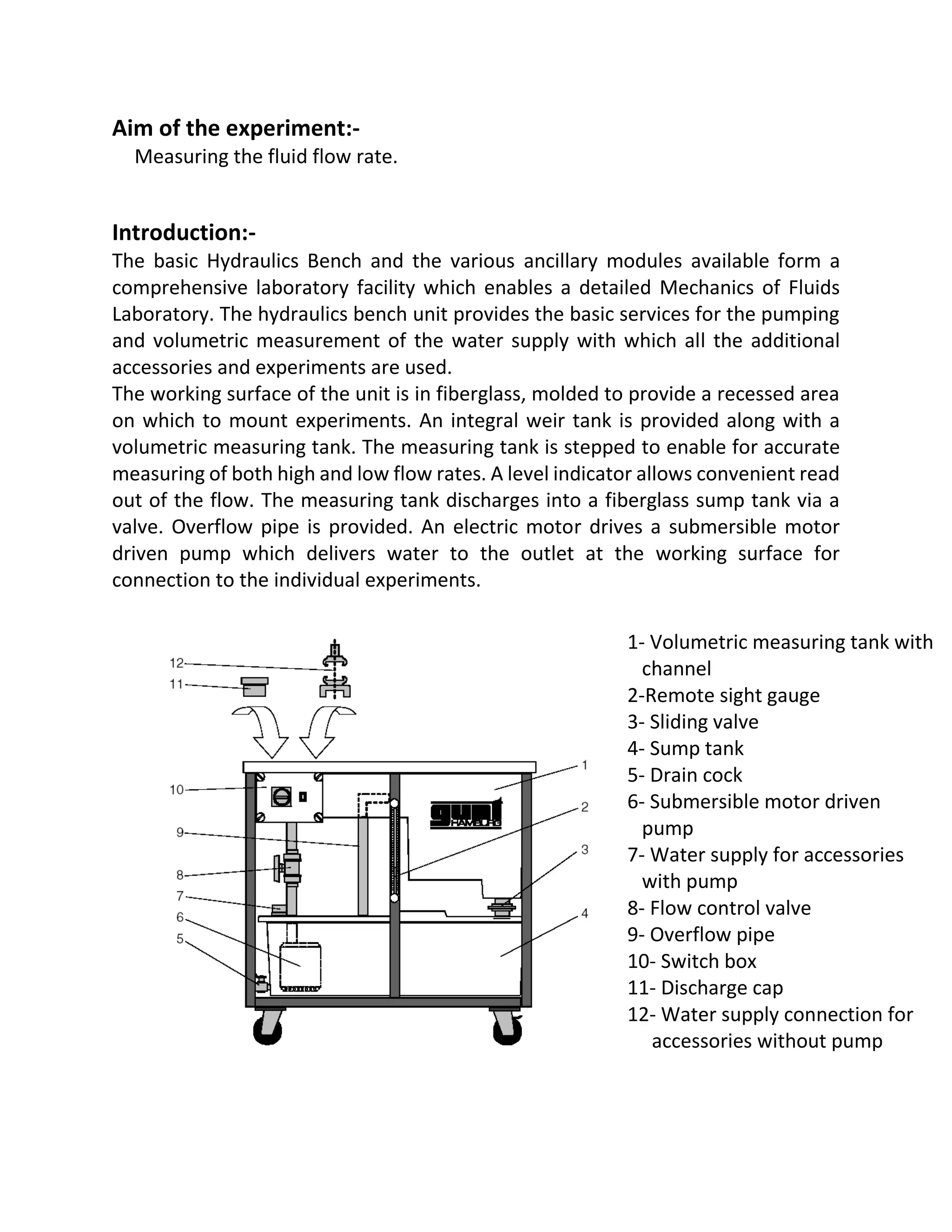
1- Volumetric measuring tank with
channel
2-Remote sight gauge
3- Sliding valve
4- Sump tank
5- Drain cock
6- Submersible motor driven
pump
7- Water supply for accessories
with pump
8- Flow control valve
9- Overflow pipe
10- Switch box
11- Discharge cap
12- Water supply connection for
accessories without pump
Experiment procedure
* Turn on the pump.
* Set the stop watch to zero.
* Close the valve at the bottom of the volumetric tank, wait until
the liquid
reaches a value of 10 liters and at the same start the watch.
* After the liquid reached a value of 20 liters stop the watch.
* Read off and note the measurement time and the high value
of water in tank.
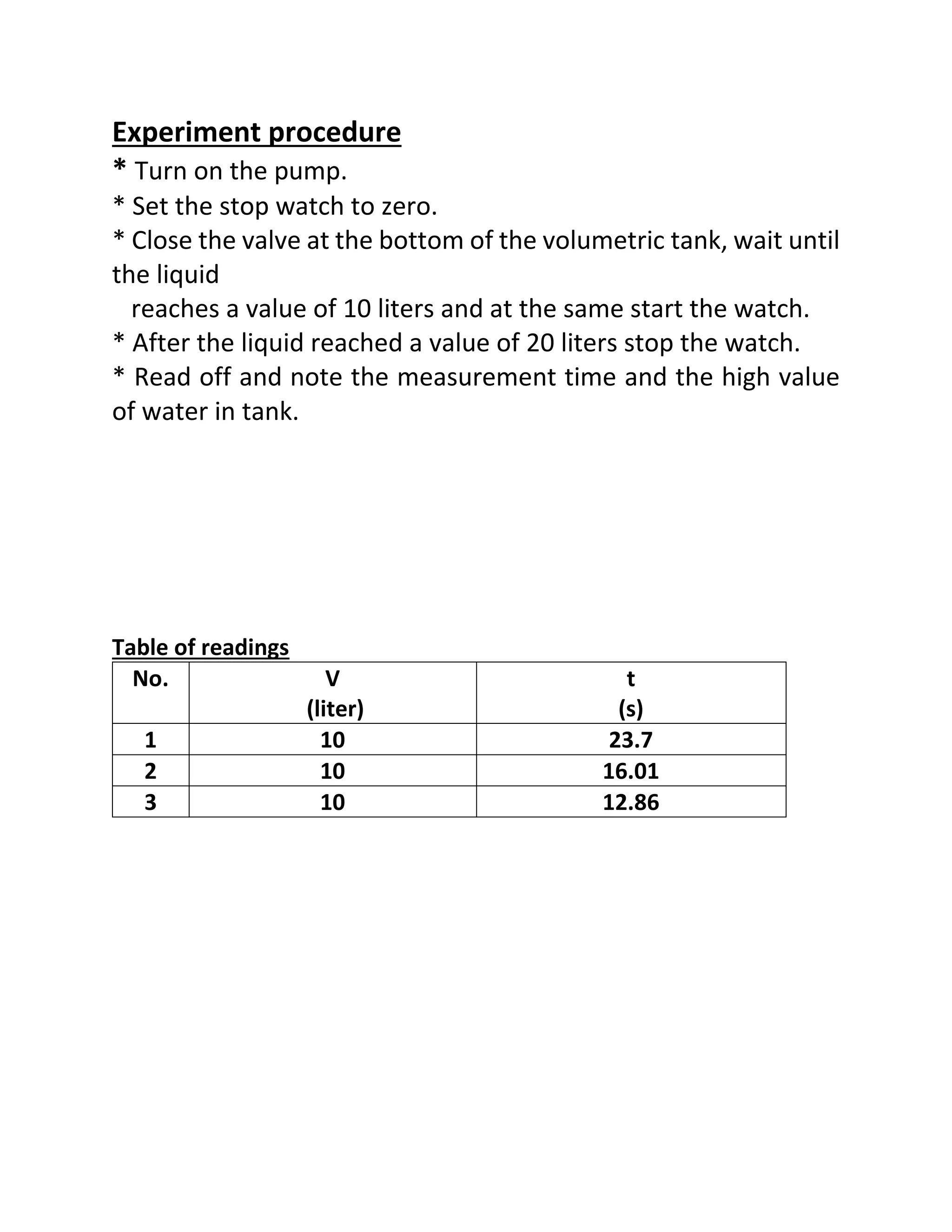
Table of readings
No. V
(liter)
t
(s)
1 10 23.7
2 10 16.01
3 10 12.86
Calculation: -
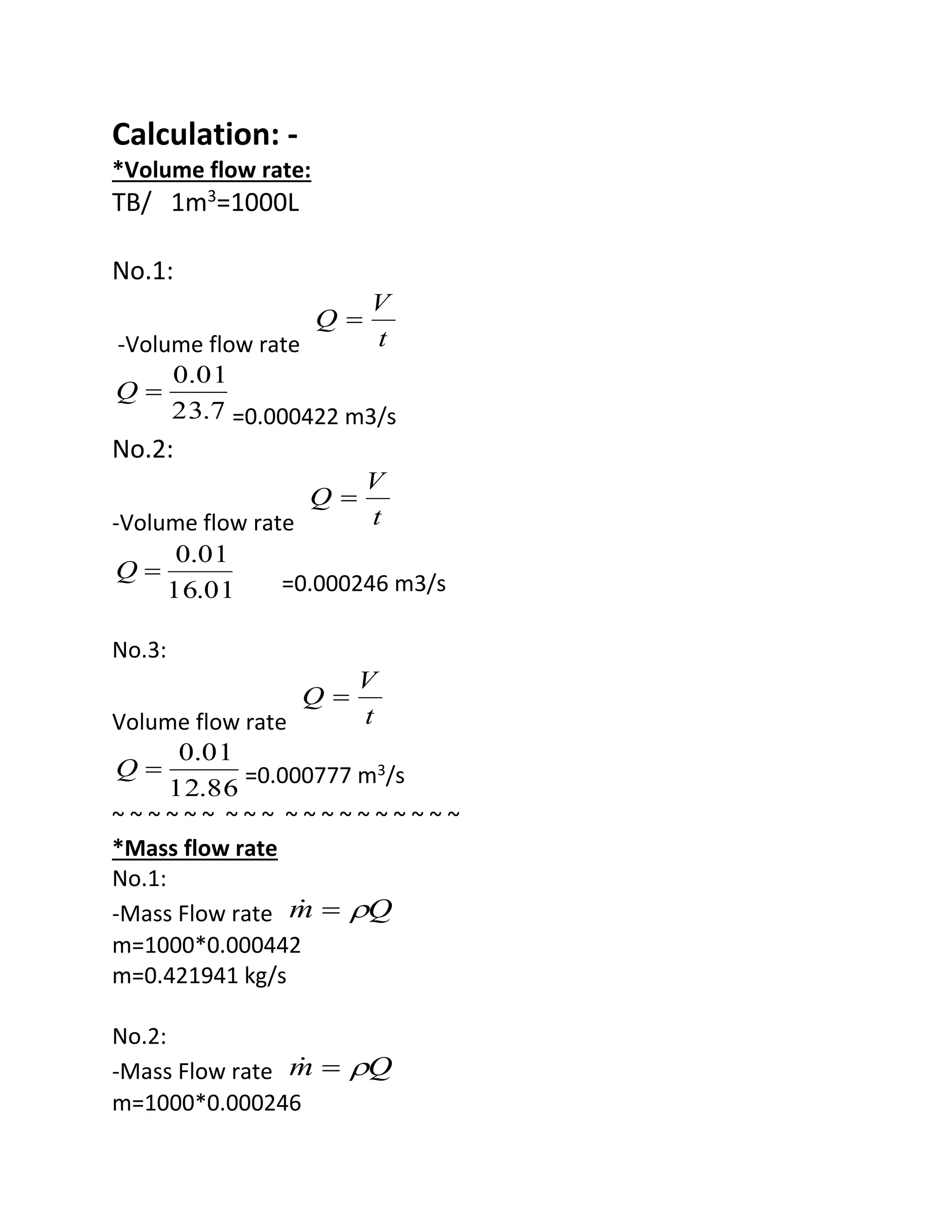
*Volume flow rate:
TB/ 1m3
=1000L
No.1:
-Volume flow rate t
V
Q 
7.23
01.0
Q
=0.000422 m3/s
No.2:
-Volume flow rate t
V
Q 
=0.000246 m3/s
No.3:
Volume flow rate t
V
Q 
86.12
01.0
Q =0.000777 m3/s
~ ~ ~ ~ ~ ~ ~ ~ ~ ~ ~ ~ ~ ~ ~ ~ ~ ~ ~
*Mass flow rate
No.1:
-Mass Flow rate Qm 
m=1000*0.000442
m=0.421941 kg/s
No.2:
-Mass Flow rate Qm 
m=1000*0.000246
01.16
01.0
Q
m=0.6246 kg/s
No.3:
-Mass Flow rate Qm 
m=1000*0.000777
m=0.7776 kg/s
~ ~ ~ ~ ~ ~ ~ ~ ~ ~ ~ ~ ~ ~ ~ ~ ~ ~ ~ ~ ~
*Weight flow rate:
No.1:
- Weight flow rate gQW 
W
=1000*9.81*0.000442
W
= 4.139241 N/s
No.2:
- Weight flow rate gQW 
W
=1000*9.81*0.000442
W
= 6.12374 N/s
No.3:
- Weight flow rate gQW 
W
=1000*9.81*0.000777
W
= 7.6283 N/s
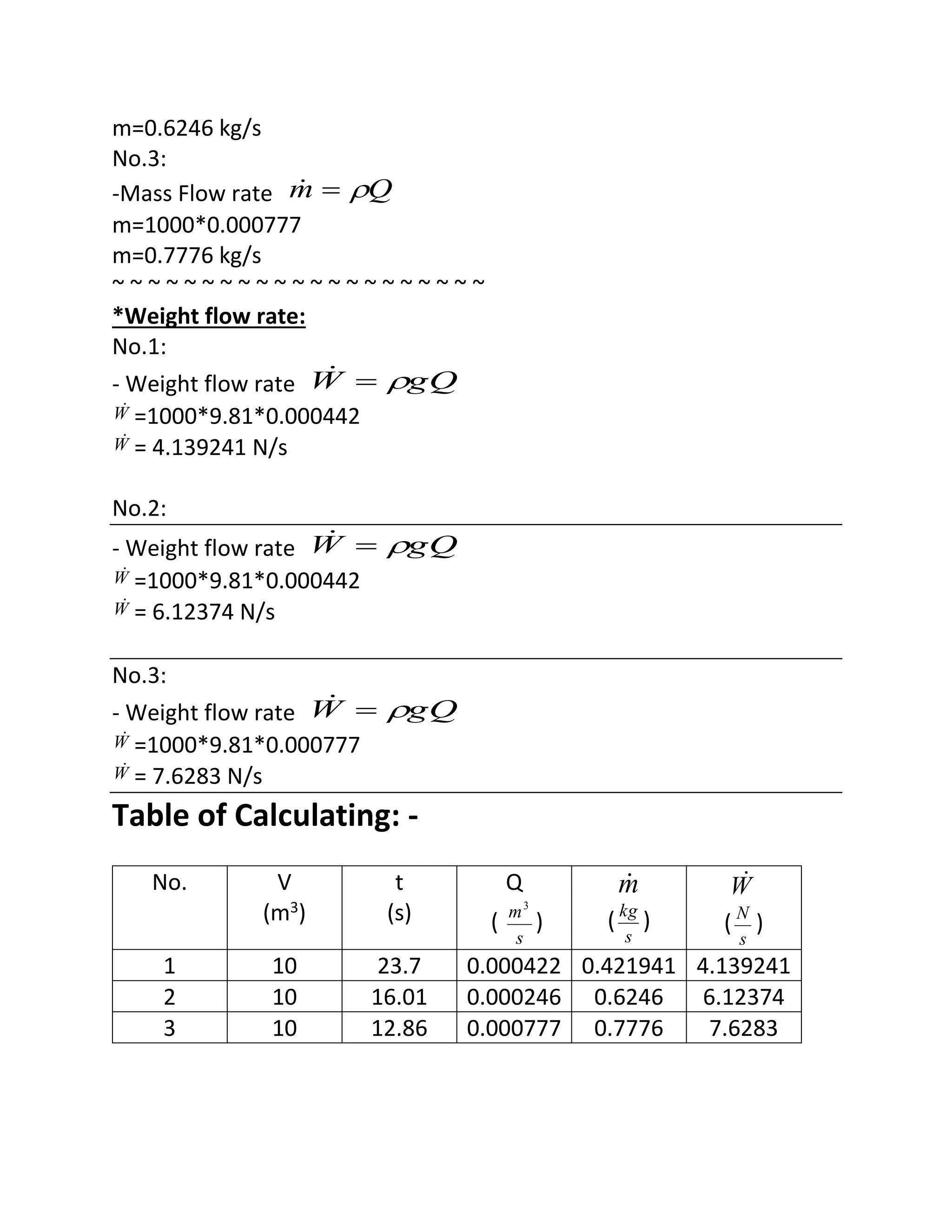
Table of Calculating: -
No. V
(m3)
t
(s)
Q
(
s
m3
)
m
(
s
kg
)
W
(
s
N
)
1 10 23.7 0.000422 0.421941 4.139241
2 10 16.01 0.000246 0.6246 6.12374
3 10 12.86 0.000777 0.7776 7.6283
Discussion: -
Q1/ Draw the relation between Q & m , then find the slop of the
relation?
A/
0.4
0.45
0.5
0.55
0.6
0.65
0.7
0.75
0.8
0.0004 0.00045 0.0005 0.00055 0.0006 0.00065 0.0007 0.00075 0.0008
Volume flow rate (Q)
MassFlowrate(m)
Q2/ Draw the relation between Q & W
, then find the
slop of the relation?
A/
Q3- What do you understand by the slops above?
A/ The relation between discharge (volume flow rate)
and mass flow rate, weight flow rate will increase
together but relationship between discharge end time is
inverse contact.
0.4
0.45
0.5
0.55
0.6
0.65
0.7
0.75
0.8
0.0004 0.00045 0.0005 0.00055 0.0006 0.00065 0.0007 0.00075 0.0008
Volume flow rate (Q)
WeightFlowrate(W)

flow rate

  • 1.
    Table of Content:- Title Page No. Aim of the experiment 3 Introduction 3 Experiment procedure 4 Calculation 5 Discussion 7
  • 2.
    Aim of theexperiment:- Measuring the fluid flow rate. Introduction:- The basic Hydraulics Bench and the various ancillary modules available form a comprehensive laboratory facility which enables a detailed Mechanics of Fluids Laboratory. The hydraulics bench unit provides the basic services for the pumping and volumetric measurement of the water supply with which all the additional accessories and experiments are used. The working surface of the unit is in fiberglass, molded to provide a recessed area on which to mount experiments. An integral weir tank is provided along with a volumetric measuring tank. The measuring tank is stepped to enable for accurate measuring of both high and low flow rates. A level indicator allows convenient read out of the flow. The measuring tank discharges into a fiberglass sump tank via a valve. Overflow pipe is provided. An electric motor drives a submersible motor driven pump which delivers water to the outlet at the working surface for connection to the individual experiments. 1- Volumetric measuring tank with channel 2-Remote sight gauge 3- Sliding valve 4- Sump tank 5- Drain cock 6- Submersible motor driven pump 7- Water supply for accessories with pump 8- Flow control valve 9- Overflow pipe 10- Switch box 11- Discharge cap 12- Water supply connection for accessories without pump
  • 3.
    Experiment procedure * Turnon the pump. * Set the stop watch to zero. * Close the valve at the bottom of the volumetric tank, wait until the liquid reaches a value of 10 liters and at the same start the watch. * After the liquid reached a value of 20 liters stop the watch. * Read off and note the measurement time and the high value of water in tank. Table of readings No. V (liter) t (s) 1 10 23.7 2 10 16.01 3 10 12.86
  • 4.
    Calculation: - *Volume flowrate: TB/ 1m3 =1000L No.1: -Volume flow rate t V Q  7.23 01.0 Q =0.000422 m3/s No.2: -Volume flow rate t V Q  =0.000246 m3/s No.3: Volume flow rate t V Q  86.12 01.0 Q =0.000777 m3/s ~ ~ ~ ~ ~ ~ ~ ~ ~ ~ ~ ~ ~ ~ ~ ~ ~ ~ ~ *Mass flow rate No.1: -Mass Flow rate Qm  m=1000*0.000442 m=0.421941 kg/s No.2: -Mass Flow rate Qm  m=1000*0.000246 01.16 01.0 Q
  • 5.
    m=0.6246 kg/s No.3: -Mass Flowrate Qm  m=1000*0.000777 m=0.7776 kg/s ~ ~ ~ ~ ~ ~ ~ ~ ~ ~ ~ ~ ~ ~ ~ ~ ~ ~ ~ ~ ~ *Weight flow rate: No.1: - Weight flow rate gQW  W =1000*9.81*0.000442 W = 4.139241 N/s No.2: - Weight flow rate gQW  W =1000*9.81*0.000442 W = 6.12374 N/s No.3: - Weight flow rate gQW  W =1000*9.81*0.000777 W = 7.6283 N/s Table of Calculating: - No. V (m3) t (s) Q ( s m3 ) m ( s kg ) W ( s N ) 1 10 23.7 0.000422 0.421941 4.139241 2 10 16.01 0.000246 0.6246 6.12374 3 10 12.86 0.000777 0.7776 7.6283
  • 6.
    Discussion: - Q1/ Drawthe relation between Q & m , then find the slop of the relation? A/ 0.4 0.45 0.5 0.55 0.6 0.65 0.7 0.75 0.8 0.0004 0.00045 0.0005 0.00055 0.0006 0.00065 0.0007 0.00075 0.0008 Volume flow rate (Q) MassFlowrate(m)
  • 7.
    Q2/ Draw therelation between Q & W , then find the slop of the relation? A/ Q3- What do you understand by the slops above? A/ The relation between discharge (volume flow rate) and mass flow rate, weight flow rate will increase together but relationship between discharge end time is inverse contact. 0.4 0.45 0.5 0.55 0.6 0.65 0.7 0.75 0.8 0.0004 0.00045 0.0005 0.00055 0.0006 0.00065 0.0007 0.00075 0.0008 Volume flow rate (Q) WeightFlowrate(W)