Supervised by:
Mr. Pshtewan T. M. Jaf
Mr. Muhammed Jamal
Prepared by:
Muhammed Hassan Aziz
Ahmad Jalal Hassan
Muhammed Fuad Rashid
Safwan Tofiq Ameen
Muhammed AbdulWahab
Group: B
Date of submit: Nov 04,2020
Koya University
Faculty of Engineering
Petroleum Engineering Department
Third stage
Drilling lab
Exp. No:3
Mud Dilution
Academic year (2020-2021)
Contents
Aim of the experiment.............................................................................................................................. 3
Theory...................................................................................................................................................... 4
Test Equipment ........................................................................................................................................ 5
Calibration ............................................................................................................................................... 6
Test procedure.......................................................................................................................................... 6
Discussions .............................................................................................................................................. 7
Discussion by Ahmad Jalal Hasan......................................................................................................... 7
Discussion by Muhammed Fuad Rashid................................................................................................ 8
Discussion by Mohammed AbdulWahab............................................................................................. 10
Discussion by Muhammed Hassan Aziz.............................................................................................. 11
Discussion by Safwan Tofiq Ameen.................................................................................................... 12
References.............................................................................................................................................. 13
Aim of the experiment
Decrese mud density to avoid:
1-lost circulation (mud losses)
2-formation damage
Theory
Dilution refers to the process of adding a liquid phase to a drilling fluid to decrease
the drilled-solids concentration. Dilution is used in several ways. If no solids-
control equipment is used or if the equipment is used ineffectively, dilution
may be the principal method of keeping drilled solids to a reasonably low
level. This is an expensive solution to the problem. For example, to decrease
drilled solids by 50% requires that 50% of the system be discarded and replaced
with clean drilling fluid.
Usually dilution is used after processing by solids-removal equipment to dilute
drilled solids remaining in the drilling fluid. Dilution may be added as a clean
drilling fluid or as the liquid phase of a drilling fluid with the other necessary drilling
fluid ingredients, usually through a chemical barrel and a mud hopper. In this
discussion, dilution will refer specifically to the clean drilling fluid necessary
to decrease drilled-solids concentration. Clean drilling fluid is the liquid phase
with all necessary additives such as barite, polymers, clay, etc.
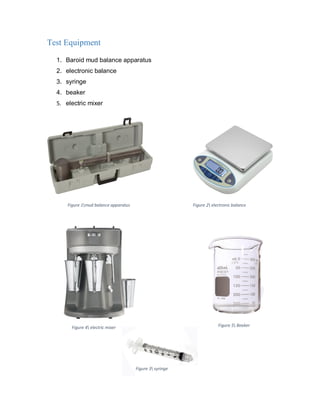
Test Equipment
1. Baroid mud balance apparatus
2. electronic balance
3. syringe
4. beaker
5. electric mixer
Figure 1mud balance apparatus Figure 2 electronic balance
Figure 3 syringe
Figure 4 electric mixer Figure 5 Beaker
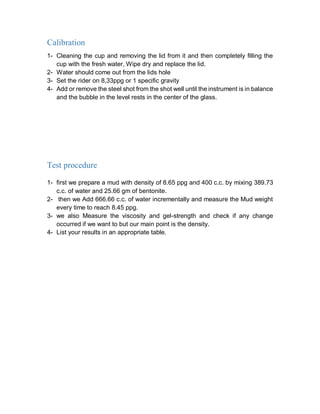
Calibration
1- Cleaning the cup and removing the lid from it and then completely filling the
cup with the fresh water, Wipe dry and replace the lid.
2- Water should come out from the lids hole
3- Set the rider on 8,33ppg or 1 specific gravity
4- Add or remove the steel shot from the shot well until the instrument is in balance
and the bubble in the level rests in the center of the glass.
Test procedure
1- first we prepare a mud with density of 8.65 ppg and 400 c.c. by mixing 389.73
c.c. of water and 25.66 gm of bentonite.
2- then we Add 666.66 c.c. of water incrementally and measure the Mud weight
every time to reach 8.45 ppg.
3- we also Measure the viscosity and gel-strength and check if any change
occurred if we want to but our main point is the density.
4- List your results in an appropriate table.
Discussions
Discussion by Ahmad Jalal Hasan
It is essential that the mud weight of the drilling fluid is continuously be monitored
to ensure that the mud is being pumped the well has correct density and pressure,
so when a drilling fluid (mud) circulates in the well until reaches the reservoir, its
density may increase or need to be decreased ,so we dilute our mud to have
Hydrostatic pressure (𝑃ℎ) lower than fracture pressure (𝑃𝑓𝑟) the rocks of the
formation which is drilled ,usually having a pressure of the mud (𝑃ℎ) About 200-
300 PSI and some references says 100-200 PSI greater the formation
pressure(𝑃𝑓) is enough which is one of the main problems the encounters the
drilling engineers called formation damage, more problem are listed below:
1- lost circulation of the drilling fluid (mud losses).
2- formation damage.
3- High mud viscosity
4- Rate of penetration (ROP) which decreases the horse power required to
circulate the mud.
5- Low velocity of circulation which slows down the drilling process.
6- Cleaning of the hole bore
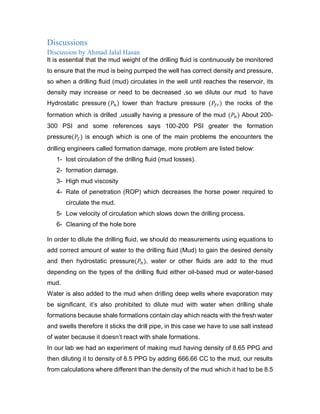
In order to dilute the drilling fluid, we should do measurements using equations to
add correct amount of water to the drilling fluid (Mud) to gain the desired density
and then hydrostatic pressure(𝑃ℎ), water or other fluids are add to the mud
depending on the types of the drilling fluid either oil-based mud or water-based
mud.
Water is also added to the mud when drilling deep wells where evaporation may
be significant, it’s also prohibited to dilute mud with water when drilling shale
formations because shale formations contain clay which reacts with the fresh water
and swells therefore it sticks the drill pipe, in this case we have to use salt instead
of water because it doesn’t react with shale formations.
In our lab we had an experiment of making mud having density of 8.65 PPG and
then diluting it to density of 8.5 PPG by adding 666.66 CC to the mud, our results
from calculations where different than the density of the mud which it had to be 8.5
but our result was 8.45 PPG, we concluded that our results are differ from each
other due to some reason or errors which properly are:
1- we used fresh water instead of pure water therefore it affected specific
gravity of the liquid (mud) which is proportional to density.
2- The quality of barite wasn’t perfect to make the essential mud with the
desired density.
3- Some particle of baraite lost as a light powder in the air while trying to mix
the mud, so it affected the density.
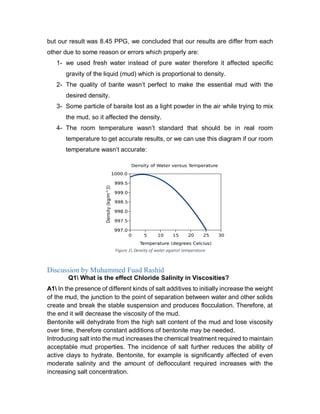
4- The room temperature wasn’t standard that should be in real room
temperature to get accurate results, or we can use this diagram if our room
temperature wasn’t accurate:
Discussion by Muhammed Fuad Rashid
Q1 What is the effect Chloride Salinity in Viscosities?
A1 In the presence of different kinds of salt additives to initially increase the weight
of the mud, the junction to the point of separation between water and other solids
create and break the stable suspension and produces flocculation. Therefore, at
the end it will decrease the viscosity of the mud.
Bentonite will dehydrate from the high salt content of the mud and lose viscosity
over time, therefore constant additions of bentonite may be needed.
Introducing salt into the mud increases the chemical treatment required to maintain
acceptable mud properties. The incidence of salt further reduces the ability of
active clays to hydrate. Bentonite, for example is significantly affected of even
moderate salinity and the amount of deflocculant required increases with the
increasing salt concentration.
Figure 1 Density of water against temperature
Q2 What’s the purpose of that experiment and state your reasons?
A2/Our aim to perform this experiment is decreasing the density of the drilling
mud because we should avoid some problems which we phase during drilling
for instance the losses of the mud circulation or low circulation of the mud or
sometimes we have high viscos mud which cause fracturing and formation
damage or the drilling mud effects on decreasing rate of penetration in another
word it decreases required horsepower to circulate the mud or hole cleaning
problems and there is a rare case that we need to avoid poor log quality.
Q3 What are the errors that we faced in this experiment?
A3There’re some errors that occurred during our experiment whether they
are technical errors or human errors for instance when we wanted to weigh
bentonite on the scientific digital balance some of it lost as a dust or spilled
around the balance and it make some slightly errors or we supposed to
prepare 8.65ppg but we prepared 8.7ppg because we use 26gm of
bentonite instead of 25.66gm or we had to reduce the density of bentonite
from 8.65 ppg to 8.45ppg but ours is from 8.7 ppg to 8.5ppg because we
weren’t as perfectionist as needed to measure it correctly. And the digital
balance didn’t read the decimal points so we have to assume it. And there
are some minor errors that caused errors like the water we used is not
distilled water, it contained some impurities or we couldn’t measure the
volume of the water correctly because of not having suitable scaled
volumetric flask. And the room temperature was not stable. And the tools
we used for the experiment they already used by other groups and they
didn’t clean it properly and their sample’s residual on the tools are mixed
with our sample.
When we wanted to mix the solid with water some of it liberated to the air
as a powder because we put it into the water very fast and some of it
remained on the paper the we carried out the solid on it as a residual and
also some of our sample remained of the tools which will cause error on our
and those who perform the experiment after us. Or when we poured it into
the mud balance some of it remained as a drops on and around it and made
it heavier.
Q4 what does mud dilution is used for?
A4 Dilution is also used to control the mud weight where volume of water
is added incrementally to the water base mud until the desired mud weight
is reached.
And also used to control apparent viscosity of the mud.
Q5 What’s the difference between plastic viscosity and dilution?
A5 The plastic viscosity (PV) is a measure of the internal resistance to fluid
flow attributable to the amount, type and size of solids present in a given
fluid. Accumulations of drilled solids, additions of barite, and presence of
chemical contaminants will increase the plastic viscosity while dilution with
water, effective use of solids control equipment and flow line flocculation to
remove fine size solids will lower the PV.
Discussion by Mohammed AbdulWahab
When we need to reduce our mud weight in hole we dilute the mud by dilution.
Mean The method to reduce mud weight is dilution. The concept of dilution is to
add light weight fluid into heavy fluid and when we mix them together whole
drilling fluid weight will decrease. The light weight fluid frequently used us fresh
water. So we need to do dilution at Formation Pressure smaller than Hydrostatic
pressure then it is under pressured and while pressure fracture greater than
hydrostatic pressure, one of its most important function is to provide the
hydrostatic pressure to balance formation pressure, this is why the mud dilution
is so important and Also, Dilution not only will supply the water needed to wet
these solids, but also will provide the necessary water to keep these particles
dispersed. The further apart the active solids are kept. When a dilatant is
added, the percentage of concentration of solids in a given volume is reduced,
the mechanical friction among particles is decreased.
Q1) when does a kick or a blowout occur
A1) kicks and blow outs occur when the formation fluids (oil and gas) pressure is
bigger than the drilling fluids pressure
Q2) when does formation damage (fracture) occur?
A2) it occurs when the drilling fluids pressure is bigger than the fracture pressure
of the formation rocks.
Q3) in what range the muds hydrostatic pressure should be kept
A3) the hydrostatic pressure must be larger than the formation fluids pressure
and smaller than the fracture pressure and the hydrostatic pressure is controlled
by mud weighting and dilution.
Q4) why water is not very efficient in the field drilling fluid dilution?
A4) because in well drilling operation the mud beside containing bentonite, it
carries out sand, rock cuttings and other solid particles from the bottom hole to
the surface.
Q5) why we don't use hydrometer instated of mud balanced while both
equipment can get can get a density of liquid?
A5) basically hydrometer used for finding a density, but mud balance direct
proportional relationship between density and weight because the weight of mud
working like hydrostatic pressure in drilling useful for a pressure control. The
drilling mud can be the first line of defense against a blowout or loss of well
control caused by formation pressures, or A hydrometer is used to measure the
specific gravity (SG) of liquids. ... For the first test, one of the muds are used to
fill - in the mud balance to calculate the density and followed by ... The test is
repeated by using the other one type, Hydrometer and mud balance are used in
this experiment to determine the density of drilling fluid. The Mud Balance
provides a simple, practical method for the accurate determination of fluid
density. To get the accurate reading of the balance the weight balance should
be adjusted and ensurethe water level to be at the middle when taking the
reading of the mud balance. A hydrometeris used to measure the specific gravity
(SG) of liquids. Specific gravity is the ratio of thedensity of the liquid to the
density of water.
Discussion by Muhammed Hassan Aziz
Q1/What is the dilution?
A/ The dilution is the process of adding a liquid phase to a drilling fluid to
decrease the concentration of the drilled-solids.
Q2/What is the concept of the dilution?
A/The idea of dilution is to add light weight fluid into heavy fluid and when they
combine entire drilling fluid weight will decrease and the hydrostatic pressure of
the mud will decrease.
Q3/What are the causes of the errors?
A/Some of the bentonite powders were lost in the air in the first step of preparing
the first mud when we added it to the blender, and some of it sticks to the steel
vessels, and the electronic balance was not reading the points so maybe we gain
some errors here because we don’t know if we added the exact amount of the
bentonite.
Q4/Why in the case of drilling the shale formations mud dilution with the
fresh water is not acceptable?
A/Shale contains clay and clay is reacting with the fresh water and swells which
stick the drill pipe. That’s why using salt water to dilute the mud is better because
shale doesn’t react with it.
Q5/When the blow out or kick occur?
A/when the formation fluid pressure (gas or oil) is greater than the drilling fluids
pressure
.
Q6/When does the fracture (formation damage) occur?
A/When the fracture pressure of the formation rock is smaller than drilling fluid
pressure.
Q7/The hydrostatic pressure of the muds in what range should be kept?
A/The hydrostatic pressure must be smaller than the fracture pressure and larger
than the formation fluid pressure.
Q8/What is controlling the hydrostatic pressure?
A/The hydrostatic pressure is controlled by mud weighting and mud dilution.
Q9/What are the differences between the mud weighting and mud dilution?
A/The mud weighting is the process to increase the muds density but mud
dilution is to decrease the muds density, mud weighting is increasing the
hydrostatic pressure but mud dilution is to decrease the hydrostatic pressure, we
use a barite to increase the muds density in the mud weighting because the
barites density is more than the first muds density but in the mud dilution we use
water to decrease the muds density because density of the water is smaller than
the density of the first mud.
Discussion by Safwan Tofiq Ameen
References
 Baker Hughes (2006): Drilling Fluids Reference Manual, revised
2006
 Darley, H.C.H. and Gray, G.R. (1988): The composition and
Properties of Drilling and Completion Fluids. 5th
Ed. Gulf
Publishing Company, Houston Texas. pp 110.
 Sadek, Z. K., Ashraf, S.I and Marwan, M. E. (2011): Drilling
Fluid Rheology and Hydraulics for Oilfields. European Journal
of Scientific Research, 57 (1), Pp 6886.
 2005. Drilling Fluids Processing Handbook. Amsterdam: Elsevier.

Mud dilution experiment

  • 1.
    Supervised by: Mr. PshtewanT. M. Jaf Mr. Muhammed Jamal Prepared by: Muhammed Hassan Aziz Ahmad Jalal Hassan Muhammed Fuad Rashid Safwan Tofiq Ameen Muhammed AbdulWahab Group: B Date of submit: Nov 04,2020 Koya University Faculty of Engineering Petroleum Engineering Department Third stage Drilling lab Exp. No:3 Mud Dilution Academic year (2020-2021)
  • 2.
    Contents Aim of theexperiment.............................................................................................................................. 3 Theory...................................................................................................................................................... 4 Test Equipment ........................................................................................................................................ 5 Calibration ............................................................................................................................................... 6 Test procedure.......................................................................................................................................... 6 Discussions .............................................................................................................................................. 7 Discussion by Ahmad Jalal Hasan......................................................................................................... 7 Discussion by Muhammed Fuad Rashid................................................................................................ 8 Discussion by Mohammed AbdulWahab............................................................................................. 10 Discussion by Muhammed Hassan Aziz.............................................................................................. 11 Discussion by Safwan Tofiq Ameen.................................................................................................... 12 References.............................................................................................................................................. 13
  • 3.
    Aim of theexperiment Decrese mud density to avoid: 1-lost circulation (mud losses) 2-formation damage
  • 4.
    Theory Dilution refers tothe process of adding a liquid phase to a drilling fluid to decrease the drilled-solids concentration. Dilution is used in several ways. If no solids- control equipment is used or if the equipment is used ineffectively, dilution may be the principal method of keeping drilled solids to a reasonably low level. This is an expensive solution to the problem. For example, to decrease drilled solids by 50% requires that 50% of the system be discarded and replaced with clean drilling fluid. Usually dilution is used after processing by solids-removal equipment to dilute drilled solids remaining in the drilling fluid. Dilution may be added as a clean drilling fluid or as the liquid phase of a drilling fluid with the other necessary drilling fluid ingredients, usually through a chemical barrel and a mud hopper. In this discussion, dilution will refer specifically to the clean drilling fluid necessary to decrease drilled-solids concentration. Clean drilling fluid is the liquid phase with all necessary additives such as barite, polymers, clay, etc.
  • 5.
    Test Equipment 1. Baroidmud balance apparatus 2. electronic balance 3. syringe 4. beaker 5. electric mixer Figure 1mud balance apparatus Figure 2 electronic balance Figure 3 syringe Figure 4 electric mixer Figure 5 Beaker
  • 6.
    Calibration 1- Cleaning thecup and removing the lid from it and then completely filling the cup with the fresh water, Wipe dry and replace the lid. 2- Water should come out from the lids hole 3- Set the rider on 8,33ppg or 1 specific gravity 4- Add or remove the steel shot from the shot well until the instrument is in balance and the bubble in the level rests in the center of the glass. Test procedure 1- first we prepare a mud with density of 8.65 ppg and 400 c.c. by mixing 389.73 c.c. of water and 25.66 gm of bentonite. 2- then we Add 666.66 c.c. of water incrementally and measure the Mud weight every time to reach 8.45 ppg. 3- we also Measure the viscosity and gel-strength and check if any change occurred if we want to but our main point is the density. 4- List your results in an appropriate table.
  • 7.
    Discussions Discussion by AhmadJalal Hasan It is essential that the mud weight of the drilling fluid is continuously be monitored to ensure that the mud is being pumped the well has correct density and pressure, so when a drilling fluid (mud) circulates in the well until reaches the reservoir, its density may increase or need to be decreased ,so we dilute our mud to have Hydrostatic pressure (𝑃ℎ) lower than fracture pressure (𝑃𝑓𝑟) the rocks of the formation which is drilled ,usually having a pressure of the mud (𝑃ℎ) About 200- 300 PSI and some references says 100-200 PSI greater the formation pressure(𝑃𝑓) is enough which is one of the main problems the encounters the drilling engineers called formation damage, more problem are listed below: 1- lost circulation of the drilling fluid (mud losses). 2- formation damage. 3- High mud viscosity 4- Rate of penetration (ROP) which decreases the horse power required to circulate the mud. 5- Low velocity of circulation which slows down the drilling process. 6- Cleaning of the hole bore In order to dilute the drilling fluid, we should do measurements using equations to add correct amount of water to the drilling fluid (Mud) to gain the desired density and then hydrostatic pressure(𝑃ℎ), water or other fluids are add to the mud depending on the types of the drilling fluid either oil-based mud or water-based mud. Water is also added to the mud when drilling deep wells where evaporation may be significant, it’s also prohibited to dilute mud with water when drilling shale formations because shale formations contain clay which reacts with the fresh water and swells therefore it sticks the drill pipe, in this case we have to use salt instead of water because it doesn’t react with shale formations. In our lab we had an experiment of making mud having density of 8.65 PPG and then diluting it to density of 8.5 PPG by adding 666.66 CC to the mud, our results from calculations where different than the density of the mud which it had to be 8.5
  • 8.
    but our resultwas 8.45 PPG, we concluded that our results are differ from each other due to some reason or errors which properly are: 1- we used fresh water instead of pure water therefore it affected specific gravity of the liquid (mud) which is proportional to density. 2- The quality of barite wasn’t perfect to make the essential mud with the desired density. 3- Some particle of baraite lost as a light powder in the air while trying to mix the mud, so it affected the density. 4- The room temperature wasn’t standard that should be in real room temperature to get accurate results, or we can use this diagram if our room temperature wasn’t accurate: Discussion by Muhammed Fuad Rashid Q1 What is the effect Chloride Salinity in Viscosities? A1 In the presence of different kinds of salt additives to initially increase the weight of the mud, the junction to the point of separation between water and other solids create and break the stable suspension and produces flocculation. Therefore, at the end it will decrease the viscosity of the mud. Bentonite will dehydrate from the high salt content of the mud and lose viscosity over time, therefore constant additions of bentonite may be needed. Introducing salt into the mud increases the chemical treatment required to maintain acceptable mud properties. The incidence of salt further reduces the ability of active clays to hydrate. Bentonite, for example is significantly affected of even moderate salinity and the amount of deflocculant required increases with the increasing salt concentration. Figure 1 Density of water against temperature
  • 9.
    Q2 What’s thepurpose of that experiment and state your reasons? A2/Our aim to perform this experiment is decreasing the density of the drilling mud because we should avoid some problems which we phase during drilling for instance the losses of the mud circulation or low circulation of the mud or sometimes we have high viscos mud which cause fracturing and formation damage or the drilling mud effects on decreasing rate of penetration in another word it decreases required horsepower to circulate the mud or hole cleaning problems and there is a rare case that we need to avoid poor log quality. Q3 What are the errors that we faced in this experiment? A3There’re some errors that occurred during our experiment whether they are technical errors or human errors for instance when we wanted to weigh bentonite on the scientific digital balance some of it lost as a dust or spilled around the balance and it make some slightly errors or we supposed to prepare 8.65ppg but we prepared 8.7ppg because we use 26gm of bentonite instead of 25.66gm or we had to reduce the density of bentonite from 8.65 ppg to 8.45ppg but ours is from 8.7 ppg to 8.5ppg because we weren’t as perfectionist as needed to measure it correctly. And the digital balance didn’t read the decimal points so we have to assume it. And there are some minor errors that caused errors like the water we used is not distilled water, it contained some impurities or we couldn’t measure the volume of the water correctly because of not having suitable scaled volumetric flask. And the room temperature was not stable. And the tools we used for the experiment they already used by other groups and they didn’t clean it properly and their sample’s residual on the tools are mixed with our sample. When we wanted to mix the solid with water some of it liberated to the air as a powder because we put it into the water very fast and some of it remained on the paper the we carried out the solid on it as a residual and also some of our sample remained of the tools which will cause error on our
  • 10.
    and those whoperform the experiment after us. Or when we poured it into the mud balance some of it remained as a drops on and around it and made it heavier. Q4 what does mud dilution is used for? A4 Dilution is also used to control the mud weight where volume of water is added incrementally to the water base mud until the desired mud weight is reached. And also used to control apparent viscosity of the mud. Q5 What’s the difference between plastic viscosity and dilution? A5 The plastic viscosity (PV) is a measure of the internal resistance to fluid flow attributable to the amount, type and size of solids present in a given fluid. Accumulations of drilled solids, additions of barite, and presence of chemical contaminants will increase the plastic viscosity while dilution with water, effective use of solids control equipment and flow line flocculation to remove fine size solids will lower the PV. Discussion by Mohammed AbdulWahab When we need to reduce our mud weight in hole we dilute the mud by dilution. Mean The method to reduce mud weight is dilution. The concept of dilution is to add light weight fluid into heavy fluid and when we mix them together whole drilling fluid weight will decrease. The light weight fluid frequently used us fresh water. So we need to do dilution at Formation Pressure smaller than Hydrostatic pressure then it is under pressured and while pressure fracture greater than hydrostatic pressure, one of its most important function is to provide the hydrostatic pressure to balance formation pressure, this is why the mud dilution is so important and Also, Dilution not only will supply the water needed to wet these solids, but also will provide the necessary water to keep these particles dispersed. The further apart the active solids are kept. When a dilatant is added, the percentage of concentration of solids in a given volume is reduced, the mechanical friction among particles is decreased. Q1) when does a kick or a blowout occur A1) kicks and blow outs occur when the formation fluids (oil and gas) pressure is bigger than the drilling fluids pressure
  • 11.
    Q2) when doesformation damage (fracture) occur? A2) it occurs when the drilling fluids pressure is bigger than the fracture pressure of the formation rocks. Q3) in what range the muds hydrostatic pressure should be kept A3) the hydrostatic pressure must be larger than the formation fluids pressure and smaller than the fracture pressure and the hydrostatic pressure is controlled by mud weighting and dilution. Q4) why water is not very efficient in the field drilling fluid dilution? A4) because in well drilling operation the mud beside containing bentonite, it carries out sand, rock cuttings and other solid particles from the bottom hole to the surface. Q5) why we don't use hydrometer instated of mud balanced while both equipment can get can get a density of liquid? A5) basically hydrometer used for finding a density, but mud balance direct proportional relationship between density and weight because the weight of mud working like hydrostatic pressure in drilling useful for a pressure control. The drilling mud can be the first line of defense against a blowout or loss of well control caused by formation pressures, or A hydrometer is used to measure the specific gravity (SG) of liquids. ... For the first test, one of the muds are used to fill - in the mud balance to calculate the density and followed by ... The test is repeated by using the other one type, Hydrometer and mud balance are used in this experiment to determine the density of drilling fluid. The Mud Balance provides a simple, practical method for the accurate determination of fluid density. To get the accurate reading of the balance the weight balance should be adjusted and ensurethe water level to be at the middle when taking the reading of the mud balance. A hydrometeris used to measure the specific gravity (SG) of liquids. Specific gravity is the ratio of thedensity of the liquid to the density of water. Discussion by Muhammed Hassan Aziz Q1/What is the dilution? A/ The dilution is the process of adding a liquid phase to a drilling fluid to decrease the concentration of the drilled-solids. Q2/What is the concept of the dilution? A/The idea of dilution is to add light weight fluid into heavy fluid and when they combine entire drilling fluid weight will decrease and the hydrostatic pressure of the mud will decrease. Q3/What are the causes of the errors? A/Some of the bentonite powders were lost in the air in the first step of preparing the first mud when we added it to the blender, and some of it sticks to the steel vessels, and the electronic balance was not reading the points so maybe we gain some errors here because we don’t know if we added the exact amount of the bentonite.
  • 12.
    Q4/Why in thecase of drilling the shale formations mud dilution with the fresh water is not acceptable? A/Shale contains clay and clay is reacting with the fresh water and swells which stick the drill pipe. That’s why using salt water to dilute the mud is better because shale doesn’t react with it. Q5/When the blow out or kick occur? A/when the formation fluid pressure (gas or oil) is greater than the drilling fluids pressure . Q6/When does the fracture (formation damage) occur? A/When the fracture pressure of the formation rock is smaller than drilling fluid pressure. Q7/The hydrostatic pressure of the muds in what range should be kept? A/The hydrostatic pressure must be smaller than the fracture pressure and larger than the formation fluid pressure. Q8/What is controlling the hydrostatic pressure? A/The hydrostatic pressure is controlled by mud weighting and mud dilution. Q9/What are the differences between the mud weighting and mud dilution? A/The mud weighting is the process to increase the muds density but mud dilution is to decrease the muds density, mud weighting is increasing the hydrostatic pressure but mud dilution is to decrease the hydrostatic pressure, we use a barite to increase the muds density in the mud weighting because the barites density is more than the first muds density but in the mud dilution we use water to decrease the muds density because density of the water is smaller than the density of the first mud. Discussion by Safwan Tofiq Ameen
  • 13.
    References  Baker Hughes(2006): Drilling Fluids Reference Manual, revised 2006  Darley, H.C.H. and Gray, G.R. (1988): The composition and Properties of Drilling and Completion Fluids. 5th Ed. Gulf Publishing Company, Houston Texas. pp 110.  Sadek, Z. K., Ashraf, S.I and Marwan, M. E. (2011): Drilling Fluid Rheology and Hydraulics for Oilfields. European Journal of Scientific Research, 57 (1), Pp 6886.  2005. Drilling Fluids Processing Handbook. Amsterdam: Elsevier.