Koya University
Faculty of Engineering
Chemical Engineering Department – 2nd Stage
Fluid Mechanics Laboratory
Experiment Name
Aerometer or Hydrometer
Experiment Date
04/11/2020
Submitted on
11/11/2020
Supervised by
Mr. Daban
Group B
Safeen Yaseen Jafar
Table of Content
Aim/Objective of This Experiment....................................................................................................................................1
Theory/Introduction...........................................................................................................................................................2
Apparatus/Tools.................................................................................................................................................................3
Procedure of The Experiment............................................................................................................................................5
Table of Reading................................................................................................................................................................6
Sample of Calculation........................................................................................................................................................7
Table of Calculation...........................................................................................................................................................8
Discussion..........................................................................................................................................................................9
References........................................................................................................................................................................10
1
Aim/Objective of This Experiment
The objective of this experiment is to determining the liquid density. Moreover, it will
provide sufficient information about light and heavy crude oils.
2
Theory/Introduction
Aerometers are relatively uncomplicated instruments that are designed to measure the density
and weight of a gas or liquid. The design for an aerometer is very simple, with the main body
of the device nothing more than a hollow tube. Using a weight and a scale that is included
within the body of the aerometer, it is possible to place the device directly into the element to
be measured and receive an accurate reading. But the principle work of hydrometer is that
body (the aerometer) based on Archimedes principles which immersed in a fluid which
floated up by a force of buoyancy that equals to the weight of the displacement fluid which
basically measures the weight of displaced fluid by the volume of aerometer.
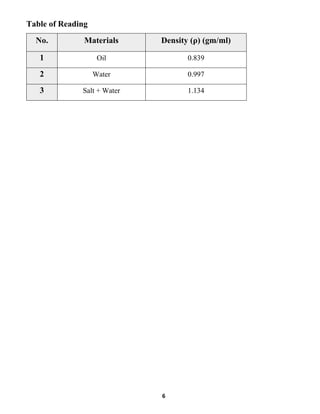
To measure the density ρ of liquids an aerometer is used. It comprises an enclosed glass bulb
1, which is filled with lead shot 2 at the bottom and, above that, with air. The handling is
quite simple: The aerometer is placed in the liquid, and because of the lead filling it always
rights itself vertically. The aerometer sinks more or less deeply into the liquid, depending on
the thickness. Since the aerometer is suspended, its lifting force must be exactly the same as
its force due to weight, i.e. its apparent weight is equal to zero:
FG of liquid = FG - FA = 0
3
Apparatus/Tools
1. Cylinder
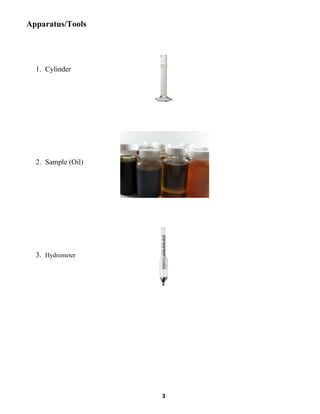
2. Sample (Oil)
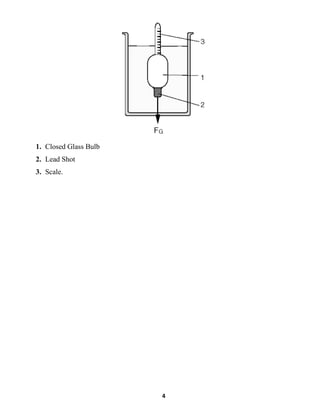
3. Hydrometer
4
1. Closed Glass Bulb
2. Lead Shot
3. Scale.
5
Procedure of The Experiment
So, we have to perform these steps:
1. The first step should three cylinders of 500ml be prepared and each one fill till 500ml
of water, oil, and salt should be mixed with a fresh water inside one of cylinders and
should give 500ml for each one.
2. Now put 0.8-0.9 Hydrometer inside oil carefully and read it when it gets floated on
water. After it stops moving, read the line on hydrometer. It was
0.818x1g/cc=0.818g/cc.
3. Again, do the same procedure as above just use 0.9-1.0 for Fresh water. The calculated
density was 0.996 g/cc.
4. For salt water also the same just use 1.1-1.2 hydrometer and read it. It has 1.134g/cc
when its density calculated.
5. Finally, find mass of each one using density formula which has done in the
calculations.
6
Table of Reading
No. Materials Density (ρ) (gm/ml)
1 Oil 0.839
2 Water 0.997
3 Salt + Water 1.134
7
Sample of Calculation
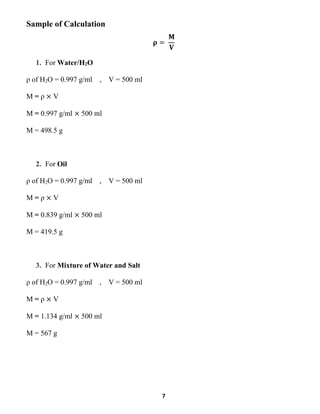
𝛒 =
𝐌
𝐕
1. For Water/H2O
ρ of H2O = 0.997 g/ml , V = 500 ml
M = ρ × V
M = 0.997 g/ml × 500 ml
M = 498.5 g
2. For Oil
ρ of H2O = 0.997 g/ml , V = 500 ml
M = ρ × V
M = 0.839 g/ml × 500 ml
M = 419.5 g
3. For Mixture of Water and Salt
ρ of H2O = 0.997 g/ml , V = 500 ml
M = ρ × V
M = 1.134 g/ml × 500 ml
M = 567 g
8
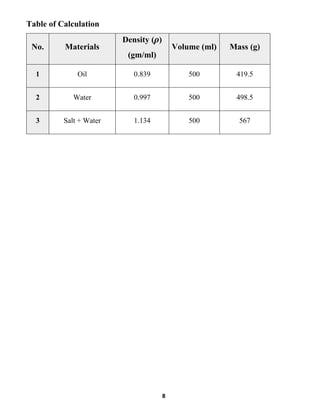
Table of Calculation
No. Materials
Density (ρ)
(gm/ml)
Volume (ml) Mass (g)
1 Oil 0.839 500 419.5
2 Water 0.997 500 498.5
3 Salt + Water 1.134 500 567
9
Discussion
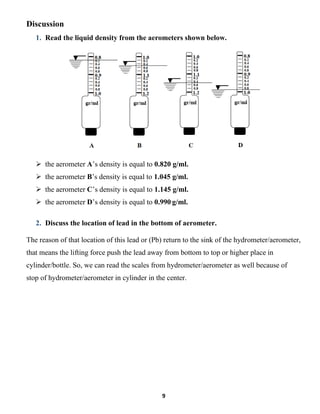
1. Read the liquid density from the aerometers shown below.
➢ the aerometer A’s density is equal to 0.820 g/ml.
➢ the aerometer B’s density is equal to 1.045 g/ml.
➢ the aerometer C’s density is equal to 1.145 g/ml.
➢ the aerometer D’s density is equal to 0.990 g/ml.
2. Discuss the location of lead in the bottom of aerometer.
The reason of that location of this lead or (Pb) return to the sink of the hydrometer/aerometer,
that means the lifting force push the lead away from bottom to top or higher place in
cylinder/bottle. So, we can read the scales from hydrometer/aerometer as well because of
stop of hydrometer/aerometer in cylinder in the center.
10
References
1. Tatum M., 2020. What is an Aerometer?. [online] Wisegeek. Available at:
https://www.wisegeek.com/what-is-an-aerometer.htm [Accessed 9 NOV. 2020].
2. Avogadro's Lab Supply, Inc. (2019). How To Use A Hydrometer. [online] Available at:
https://www.avogadro-lab supply.com/content/How_To_Use_A_Hydrometer/2
[Accessed 9 NOV. 2020].

Fluid mechanics lab experiment 02_aerometer_hydrometer

  • 1.
    Koya University Faculty ofEngineering Chemical Engineering Department – 2nd Stage Fluid Mechanics Laboratory Experiment Name Aerometer or Hydrometer Experiment Date 04/11/2020 Submitted on 11/11/2020 Supervised by Mr. Daban Group B Safeen Yaseen Jafar
  • 2.
    Table of Content Aim/Objectiveof This Experiment....................................................................................................................................1 Theory/Introduction...........................................................................................................................................................2 Apparatus/Tools.................................................................................................................................................................3 Procedure of The Experiment............................................................................................................................................5 Table of Reading................................................................................................................................................................6 Sample of Calculation........................................................................................................................................................7 Table of Calculation...........................................................................................................................................................8 Discussion..........................................................................................................................................................................9 References........................................................................................................................................................................10
  • 3.
    1 Aim/Objective of ThisExperiment The objective of this experiment is to determining the liquid density. Moreover, it will provide sufficient information about light and heavy crude oils.
  • 4.
    2 Theory/Introduction Aerometers are relativelyuncomplicated instruments that are designed to measure the density and weight of a gas or liquid. The design for an aerometer is very simple, with the main body of the device nothing more than a hollow tube. Using a weight and a scale that is included within the body of the aerometer, it is possible to place the device directly into the element to be measured and receive an accurate reading. But the principle work of hydrometer is that body (the aerometer) based on Archimedes principles which immersed in a fluid which floated up by a force of buoyancy that equals to the weight of the displacement fluid which basically measures the weight of displaced fluid by the volume of aerometer. To measure the density ρ of liquids an aerometer is used. It comprises an enclosed glass bulb 1, which is filled with lead shot 2 at the bottom and, above that, with air. The handling is quite simple: The aerometer is placed in the liquid, and because of the lead filling it always rights itself vertically. The aerometer sinks more or less deeply into the liquid, depending on the thickness. Since the aerometer is suspended, its lifting force must be exactly the same as its force due to weight, i.e. its apparent weight is equal to zero: FG of liquid = FG - FA = 0
  • 5.
  • 6.
    4 1. Closed GlassBulb 2. Lead Shot 3. Scale.
  • 7.
    5 Procedure of TheExperiment So, we have to perform these steps: 1. The first step should three cylinders of 500ml be prepared and each one fill till 500ml of water, oil, and salt should be mixed with a fresh water inside one of cylinders and should give 500ml for each one. 2. Now put 0.8-0.9 Hydrometer inside oil carefully and read it when it gets floated on water. After it stops moving, read the line on hydrometer. It was 0.818x1g/cc=0.818g/cc. 3. Again, do the same procedure as above just use 0.9-1.0 for Fresh water. The calculated density was 0.996 g/cc. 4. For salt water also the same just use 1.1-1.2 hydrometer and read it. It has 1.134g/cc when its density calculated. 5. Finally, find mass of each one using density formula which has done in the calculations.
  • 8.
    6 Table of Reading No.Materials Density (ρ) (gm/ml) 1 Oil 0.839 2 Water 0.997 3 Salt + Water 1.134
  • 9.
    7 Sample of Calculation 𝛒= 𝐌 𝐕 1. For Water/H2O ρ of H2O = 0.997 g/ml , V = 500 ml M = ρ × V M = 0.997 g/ml × 500 ml M = 498.5 g 2. For Oil ρ of H2O = 0.997 g/ml , V = 500 ml M = ρ × V M = 0.839 g/ml × 500 ml M = 419.5 g 3. For Mixture of Water and Salt ρ of H2O = 0.997 g/ml , V = 500 ml M = ρ × V M = 1.134 g/ml × 500 ml M = 567 g
  • 10.
    8 Table of Calculation No.Materials Density (ρ) (gm/ml) Volume (ml) Mass (g) 1 Oil 0.839 500 419.5 2 Water 0.997 500 498.5 3 Salt + Water 1.134 500 567
  • 11.
    9 Discussion 1. Read theliquid density from the aerometers shown below. ➢ the aerometer A’s density is equal to 0.820 g/ml. ➢ the aerometer B’s density is equal to 1.045 g/ml. ➢ the aerometer C’s density is equal to 1.145 g/ml. ➢ the aerometer D’s density is equal to 0.990 g/ml. 2. Discuss the location of lead in the bottom of aerometer. The reason of that location of this lead or (Pb) return to the sink of the hydrometer/aerometer, that means the lifting force push the lead away from bottom to top or higher place in cylinder/bottle. So, we can read the scales from hydrometer/aerometer as well because of stop of hydrometer/aerometer in cylinder in the center.
  • 12.
    10 References 1. Tatum M.,2020. What is an Aerometer?. [online] Wisegeek. Available at: https://www.wisegeek.com/what-is-an-aerometer.htm [Accessed 9 NOV. 2020]. 2. Avogadro's Lab Supply, Inc. (2019). How To Use A Hydrometer. [online] Available at: https://www.avogadro-lab supply.com/content/How_To_Use_A_Hydrometer/2 [Accessed 9 NOV. 2020].