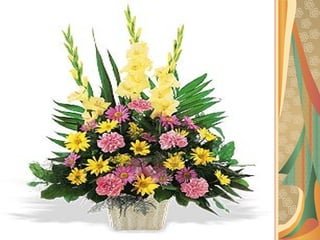
Floral Design
DESINGED BY
Sunil Kumar
Research Scholar/ Food Production Faculty
Institute of Hotel and Tourism Management,
MAHARSHI DAYANAND UNIVERSITY,
ROHTAK
Haryana- 124001 INDIA Ph. No. 09996000499
email: skihm86@yahoo.com , balhara86@gmail.com
linkedin:- in.linkedin.com/in/ihmsunilkumar
facebook: www.facebook.com/ihmsunilkumar
webpage: chefsunilkumar.tripod.com
Types of Design Materials
There are four basic types of design
materials:
Line flowers
Mass flowers
Form flowers
Filler flowers
Line Flowers
Tall spikes of flowers with florets
blooming along the stem
Create the outline for an arrangement
and establish the height and width as
well as the curvilinear lines.
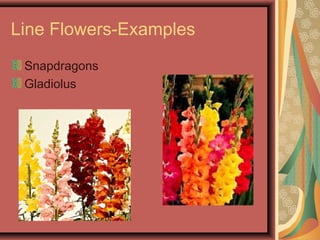
Line Flowers-Examples
Snapdragons
Gladiolus
Mass Flowers
Have the flower head on the terminal
end of the stem
Draw attention to the focal point and
add mass and weight to the
arrangement.
Cover floral foam and help fill in
empty areas with flowers
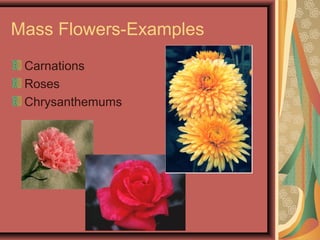
Mass Flowers-Examples
Carnations
Roses
Chrysanthemums
Form Flowers
Unique in shape or color
Create the accent or focal point or
focal area of the arrangement to
attract the viewer’s attention
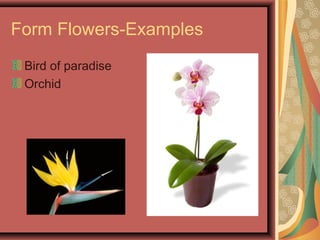
Form Flowers-Examples
Bird of paradise
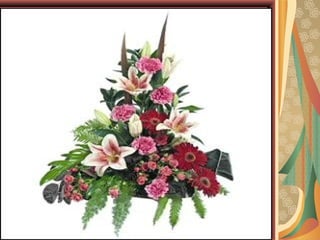
Orchid
Filler Flowers
Have small sprays of flowers or are
like ferns
Used to fill empty spaces and to
accent the other floral materials within
the arrangement
Also used to cover or hide the
mechanics of the arrangement
including the frame, supports, ties,
etc.
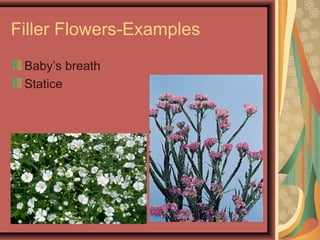
Filler Flowers-Examples
Baby’s breath
Statice
Some common flowers
Orchids
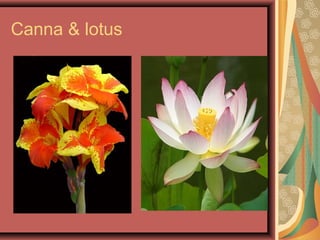
Lotus
Canna
Carnations
Roses
Bird of paradise
Gladioli
anthuriums
Arum lily
Kala lily
Daffodils
Hibiscus
Gerberas
Chrysanthemum
Tulips
Poppies
daisies
Some common leaves & fillers
Baby’s breath
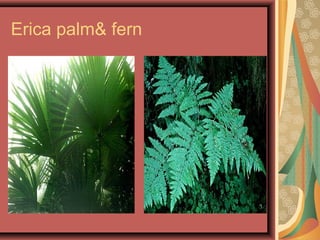
Fern
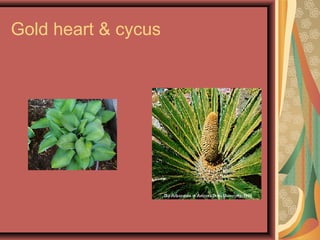
Gold heart
cycus
Gypsum
Erica palm
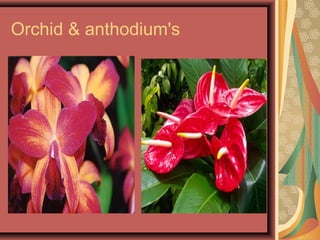
Orchid & anthodium's
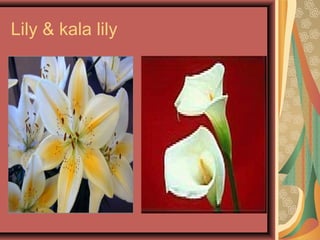
Lily & kala lily
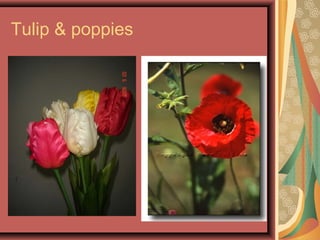
Tulip & poppies
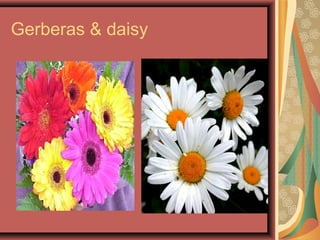
Gerberas & daisy
Canna & lotus
Erica palm& fern
Gold heart & cycus
Different styles in flower
arrangement
Eastern
style or
ikebana or
Japanese
Western
style
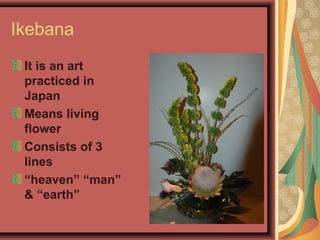
Ikebana
It is an art
practiced in
Japan
Means living
flower
Consists of 3
lines
“heaven” “man”
& “earth”
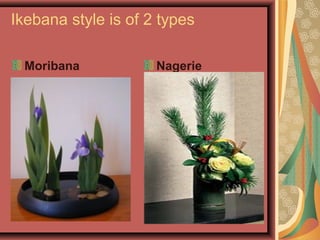
Ikebana style is of 2 types
Moribana Nagerie
Western styles
It is associated with ‘mass’ flowers or
a number of flowers & foliage
arranged together in a graceful
manner
It was first used in England & London
to decorate places, mansions etc.
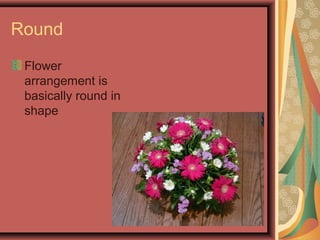
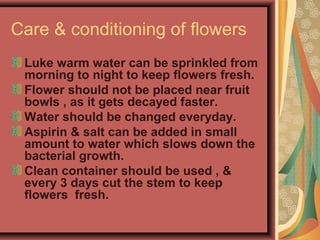
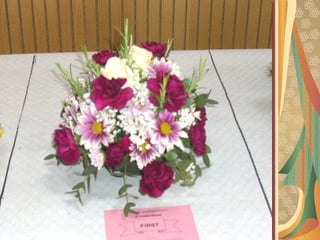
Round
Flower
arrangement is
basically round in
shape
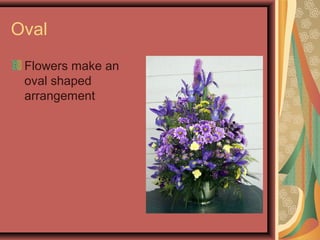
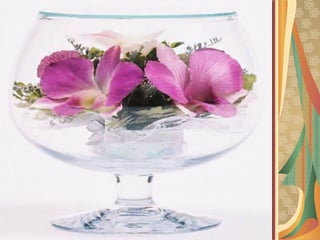
Oval
Flowers make an
oval shaped
arrangement
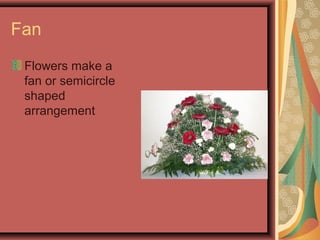
Fan
Flowers make a
fan or semicircle
shaped
arrangement
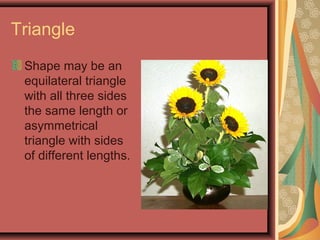
Triangle
Shape may be an
equilateral triangle
with all three sides
the same length or
asymmetrical
triangle with sides
of different lengths.
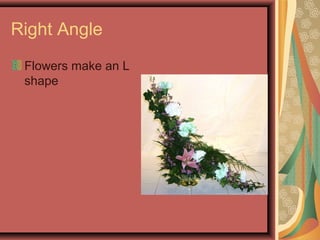
Right Angle
Flowers make an L
shape
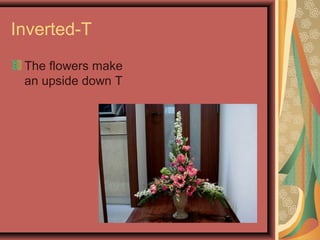
Inverted-T
The flowers make
an upside down T
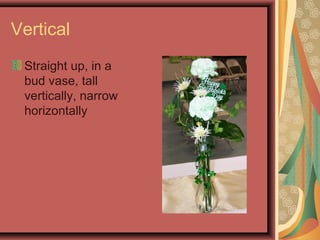
Vertical
Straight up, in a
bud vase, tall
vertically, narrow
horizontally
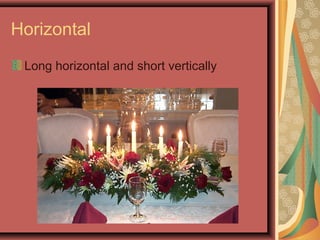
Horizontal
Long horizontal and short vertically
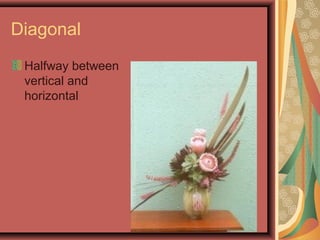
Diagonal
Halfway between
vertical and
horizontal
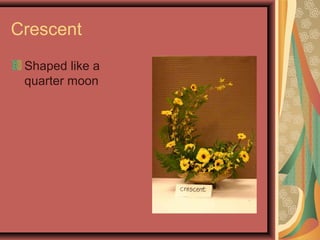
Crescent
Shaped like a
quarter moon
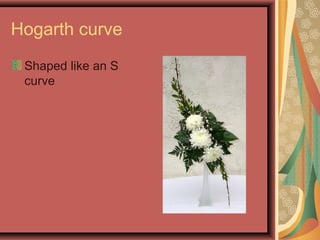
Hogarth curve
Shaped like an S
curve
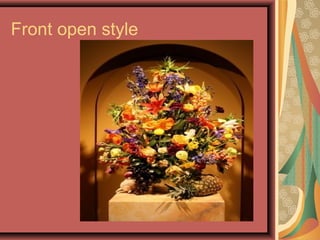
Front open style
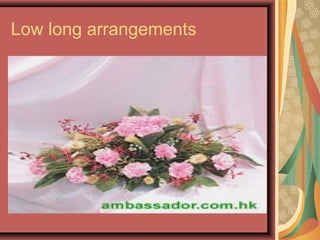
Low long arrangements
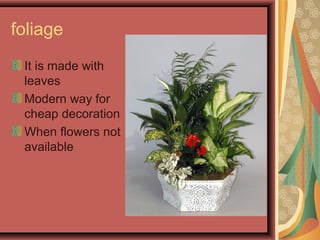
foliage
It is made with
leaves
Modern way for
cheap decoration
When flowers not
available
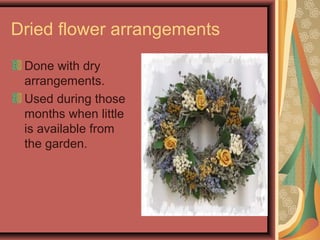
Dried flower arrangements
Done with dry
arrangements.
Used during those
months when little
is available from
the garden.
Principles of flower
arrangement
Balance, focal point,scale ,
accent, repetition ,
proportion,rythym, unity
Balance
When the flower size and container
flow together and complement each
other
Focal Point
Creates the accent and interest to
catch the eye
Scale
The principle that the design must be
in proportion to the surrounding area
where it is placed.
Accent
Used to catch attention and draw
attention to the design
Repetition
Accentuates the flowers and colors
by repeating their use throughout the
design
Proportion
Keeps relative size, color and texture
of the flowers to create a pleasing
arrangement.
Floral designs should be at least 1 ½
to 2 times the height or width of the
container.
Rhythm
Creates a sense of continuity or
flowing together
Harmony
When all parts flow together to give a
completed look to the arrangement
Unity
When the flowers complement each
other through color, size, and shape
Design Techniques
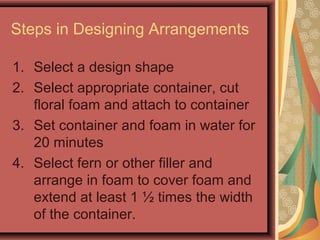
Steps in Designing Arrangements
1. Select a design shape
2. Select appropriate container, cut
floral foam and attach to container
3. Set container and foam in water for
20 minutes
4. Select fern or other filler and
arrange in foam to cover foam and
extend at least 1 ½ times the width
of the container.
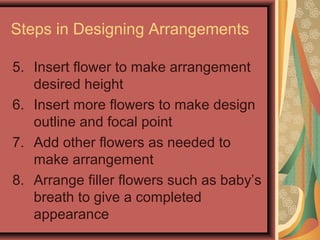
Steps in Designing Arrangements
5. Insert flower to make arrangement
desired height
6. Insert more flowers to make design
outline and focal point
7. Add other flowers as needed to
make arrangement
8. Arrange filler flowers such as baby’s
breath to give a completed
appearance
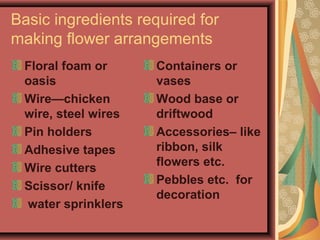
Basic ingredients required for
making flower arrangements
Floral foam or
oasis
Wire—chicken
wire, steel wires
Pin holders
Adhesive tapes
Wire cutters
Scissor/ knife
water sprinklers
Containers or
vases
Wood base or
driftwood
Accessories– like
ribbon, silk
flowers etc.
Pebbles etc. for
decoration
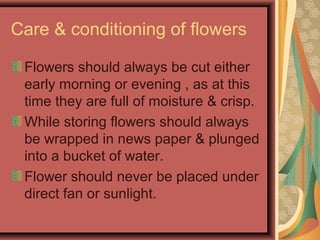
Care & conditioning of flowers
Flowers should always be cut either
early morning or evening , as at this
time they are full of moisture & crisp.
While storing flowers should always
be wrapped in news paper & plunged
into a bucket of water.
Flower should never be placed under
direct fan or sunlight.
Care & conditioning of flowers
Luke warm water can be sprinkled from
morning to night to keep flowers fresh.
Flower should not be placed near fruit
bowls , as it gets decayed faster.
Water should be changed everyday.
Aspirin & salt can be added in small
amount to water which slows down the
bacterial growth.
Clean container should be used , &
every 3 days cut the stem to keep
flowers fresh.
Floral design
Floral design
Floral design
Floral design

Floral design