EQUIPMENT
CONDITIONING OF PLANT MATERIAL
STYLES
PRINCIPLES OF FLOWER
ARRANGEMENT
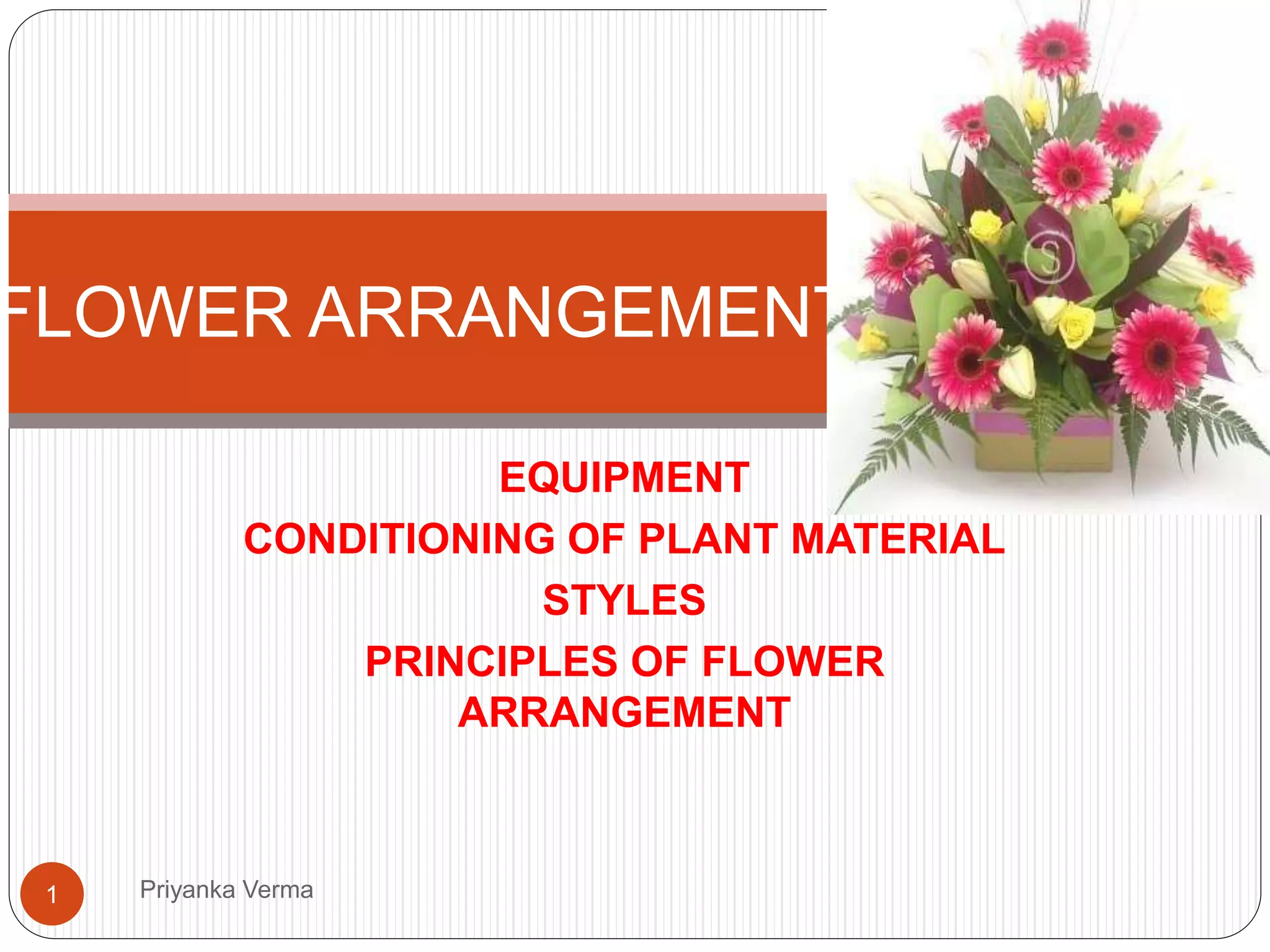
FLOWER ARRANGEMENT
1 Priyanka Verma
Flower arrangement
 Art of organizing and grouping together plant
material to achieve harmony, form, colour, texture
to add cheer, joy, life and beauty to the
surroundings.
2 Priyanka Verma
Basic ingredients
 Mechanics
 Equipments
 Containers
 Bases
 Accessories
 Plant material
 support
3 Priyanka Verma
 Mechanics- used to keep plant material in place with
in container.
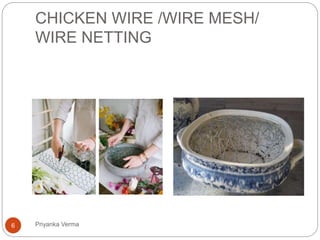
1. Chicken wire
2. Floral foam (Oasis)
3. Setting clay
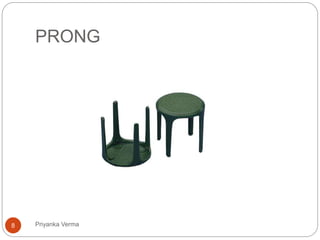
4. Prog
5. Pin holder/kenzan
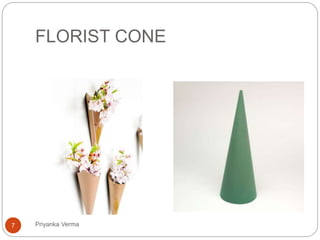
6. Florist cone
7. Pebbles
8. Glue gun
9. Adhesive tape
10. Adhesive clay
4 Priyanka Verma
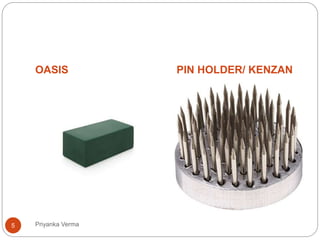
OASIS PIN HOLDER/ KENZAN
5 Priyanka Verma
CHICKEN WIRE /WIRE MESH/
WIRE NETTING
6 Priyanka Verma
FLORIST CONE
7 Priyanka Verma
PRONG
8 Priyanka Verma
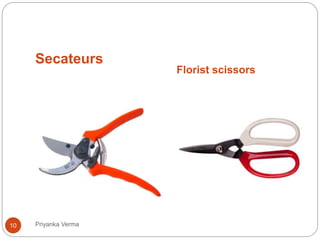
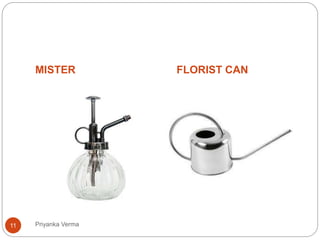
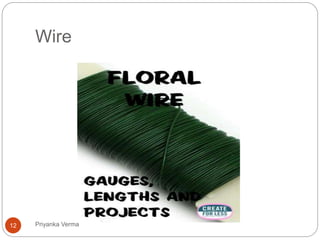
 Equipments – includes tools used to arrange
plant material is created within container.
1. Eg: bucket
2. Florist scissors
3. Mister
4. Secateurs
5. Watering can
6. wire cutter
7. wire
9 Priyanka Verma
Secateurs
Florist scissors
10 Priyanka Verma
MISTER FLORIST CAN
11 Priyanka Verma
Wire
12 Priyanka Verma
 Containers- vase jugs baskets
 Bowls and trays
 Rose bowl
 Wreath frame
Bases- table mat, tree sections, wood base,stone
base.
13 Priyanka Verma
Plant material: 3 types
a) Line material – tall stems, flower spikes, bold
leaves.
 To create framework /skeleton of flower
arrangement.
 It helps in setting height and width of flower
arrangement.
b) Dominant/Focal Point/ point material – bold
flower,eye catching foilage.
c) Filler /secondary material – smaller
flower,filleres, foilage to cover mechanics and
edgeof container, also provide interest and
colour to display.14 Priyanka Verma
Care and conditioning of flower
 Plant material should be cut in slant.
 Best to cut flower before they reach maturity
 Wrap the flowers in newspaper till the neck of
flower.
 Use good knife or scissors
 To revive wilting flowers , cut half an inch of stem
underwater and plunge in water.
 Remove dead flowers
 Remove all leaves from stems that have shorter
life
 flower with hollow stems should have stem ends
seared over candle frame ,thus preventing the
sap from bleeding out.15 Priyanka Verma
Principles of flower arrangement
 Proportion – golden ratio which means the size
of each element –container ,plant, material , base
accessories should result in harmonious
appearance . the arrangement should be in scale
 Background – style of the room
1. Size if the room
2. Type of surface
3. practicality
16 Priyanka Verma
 Texture – glossy , dull, velvety
 Balance – 1) physical balance – plant material
should be securely fixed and container should be
heavy enough to support the plant.
2) Visual balance - the arrangement should look
stable. To increase visual weight :
 Dark flowers look heavier than pale ones
 Round flowers looks heavier than trumpets
17 Priyanka Verma
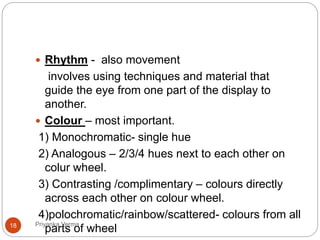
 Rhythm - also movement
involves using techniques and material that
guide the eye from one part of the display to
another.
 Colour – most important.
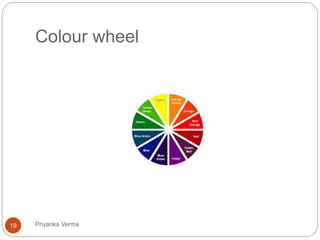
1) Monochromatic- single hue
2) Analogous – 2/3/4 hues next to each other on
colur wheel.
3) Contrasting /complimentary – colours directly
across each other on colour wheel.
4)polochromatic/rainbow/scattered- colours from all
parts of wheel18 Priyanka Verma
Colour wheel
19 Priyanka Verma
 Emphasis/dominance- involves creating foca
pint or point of interest to which the eye drawn
and on which it rest for short time.
20 Priyanka Verma
 placing flower arrangement –
1) Eye level
2) High level
3) Low level
21 Priyanka Verma
STYLE OF FLOWER
ARRANGMENT1) Based On The Angle :
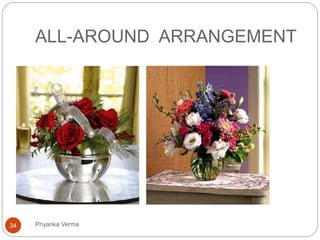
 All Round Arrangement
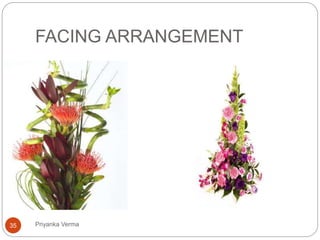
 Facing Arrangement
2) Based On The Space Present In The Arrangement :
 Triangular Shape
 Crescent Shape
 Torch Shape
 Fan Shape
 Hogarth Shape
 Circular Shape
 Christmas Tree
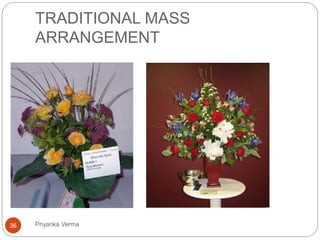
 Mass Style
 Byzantine cone
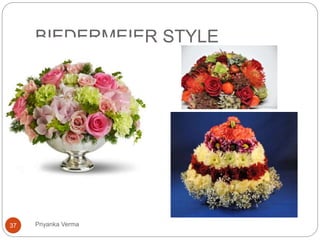
 Biedermeier
 Line mass
22 Priyanka Verma
3) Based on the type of plant material used :
 Foliage arrangement
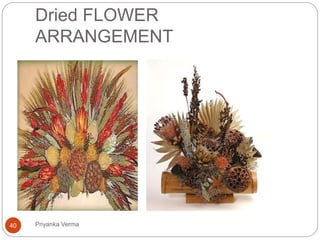
 Dried flower arrangement
4)Based o the effect :
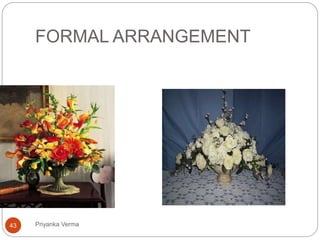
 Formal arrangement
 Semi-formal arrangement
 Informal arrangement
 Modern or abstract or free style
23 Priyanka Verma
 1)WESTERN STYLE /TRADITIONAL
STYLE
 2)ORIENTAL STYLE/JAPANESE
STYLE
 3)MODERN STYLE /ABSTRACT
STYLE
24 Priyanka Verma
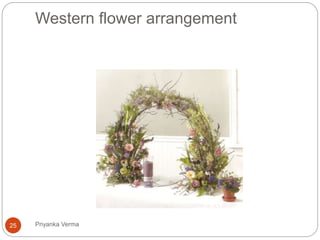
Western flower arrangement
25 Priyanka Verma
 1)WESTERN STYLE:-this style of arrangement
is based on SYMMETRICAL GROUPING of
different flowers.
 it is displayed in a high decorative vase .
 the flower arrangements in this style are large.
 small flowers are concentrated at the center
with large flower surrounding them.
 the center always contains dark coloured
flowers while light coloured flowers and foliages
are used to outline them.
 the overall shape of a traditional arrangement
may be round, oval, triangular or pyramidal.
26 Priyanka Verma
2)oriental style:-this style is better known as ikebana(meaning –arragement of
fress flower.
 based on the principles of flower arragement on the basis of hight of the
steam.
 three types steams use in ikebana :-1-heaven or shin-tallest stem
2-man 0r soi-second tallest
stem
3-earth or hikae –smallest
stem
 ikebana is two styles
 moribana:-made in low ,shallow container.
 nagiere:-which is a tall arrangement made up right in a tall container .
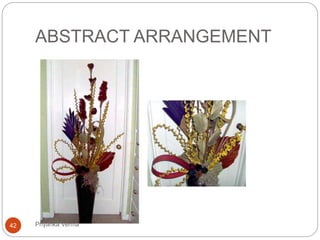
3)modern style:-no fixed rules, the arrangement used both fresh flower and
foliages along with try parts of trees,pieces of wood, etc.
27 Priyanka Verma
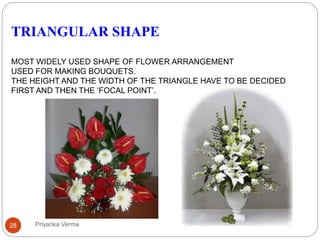
TRIANGULAR SHAPE
MOST WIDELY USED SHAPE OF FLOWER ARRANGEMENT
USED FOR MAKING BOUQUETS.
THE HEIGHT AND THE WIDTH OF THE TRIANGLE HAVE TO BE DECIDED
FIRST AND THEN THE ‘FOCAL POINT’.
28 Priyanka Verma
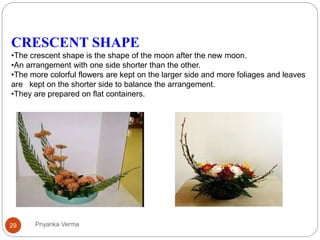
CRESCENT SHAPE
•The crescent shape is the shape of the moon after the new moon.
•An arrangement with one side shorter than the other.
•The more colorful flowers are kept on the larger side and more foliages and leaves
are kept on the shorter side to balance the arrangement.
•They are prepared on flat containers.
29 Priyanka Verma
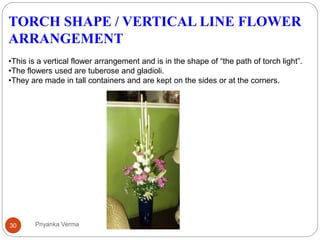
TORCH SHAPE / VERTICAL LINE FLOWER
ARRANGEMENT
•This is a vertical flower arrangement and is in the shape of “the path of torch light”.
•The flowers used are tuberose and gladioli.
•They are made in tall containers and are kept on the sides or at the corners.
30 Priyanka Verma
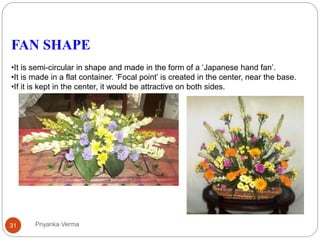
FAN SHAPE
•It is semi-circular in shape and made in the form of a ‘Japanese hand fan’.
•It is made in a flat container. ‘Focal point’ is created in the center, near the base.
•If it is kept in the center, it would be attractive on both sides.
31 Priyanka Verma
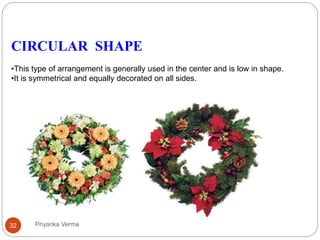
CIRCULAR SHAPE
•This type of arrangement is generally used in the center and is low in shape.
•It is symmetrical and equally decorated on all sides.
32 Priyanka Verma
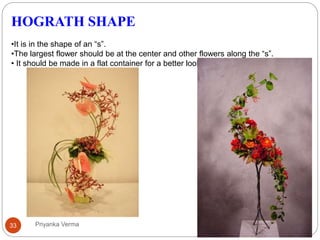
HOGRATH SHAPE
•It is in the shape of an “s”.
•The largest flower should be at the center and other flowers along the “s”.
• It should be made in a flat container for a better look.
33 Priyanka Verma
ALL-AROUND ARRANGEMENT
34 Priyanka Verma
FACING ARRANGEMENT
35 Priyanka Verma
TRADITIONAL MASS
ARRANGEMENT
36 Priyanka Verma
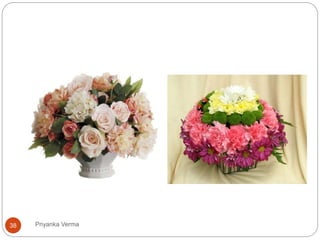
BIEDERMEIER STYLE
37 Priyanka Verma
38 Priyanka Verma
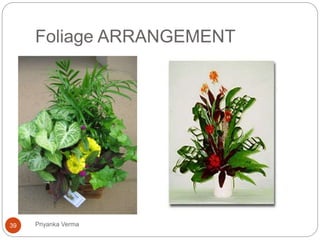
Foliage ARRANGEMENT
39 Priyanka Verma
Dried FLOWER
ARRANGEMENT
40 Priyanka Verma
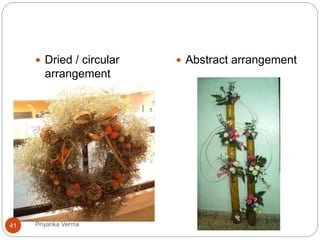
 Dried / circular
arrangement
 Abstract arrangement
41 Priyanka Verma
ABSTRACT ARRANGEMENT
42 Priyanka Verma
FORMAL ARRANGEMENT
43 Priyanka Verma
IKEBANA
 JAPANSESE flower arrangement
 Means making flowers live.
 Characteristic is to give the impression of naturally
growing plants.
 Represent – 1) shin – symbolize heaven(tallest)
2) see - symbolize man (second highest)
3) hikae – denotes earth (lowest)
 Use odd no. of flowers ,consider them lucky and
aesthetic.eg: 3,5,7.
44 Priyanka Verma
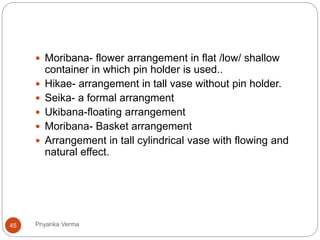
 Moribana- flower arrangement in flat /low/ shallow
container in which pin holder is used..
 Hikae- arrangement in tall vase without pin holder.
 Seika- a formal arrangment
 Ukibana-floating arrangement
 Moribana- Basket arrangement
 Arrangement in tall cylindrical vase with flowing and
natural effect.
45 Priyanka Verma
 Foliage- refers to leafy plant material used in
flower arrangement.
Eg: palm leaves, boxwood, ivy, pine, Cyprus,
goldenrods ,fern , thuja , bamboos.
 Fillers – refers to plant material used to hide
plant stems, container edges, and oasis.
46 Priyanka Verma

Flower arrangements main

  • 1.
    EQUIPMENT CONDITIONING OF PLANTMATERIAL STYLES PRINCIPLES OF FLOWER ARRANGEMENT FLOWER ARRANGEMENT 1 Priyanka Verma
  • 2.
    Flower arrangement  Artof organizing and grouping together plant material to achieve harmony, form, colour, texture to add cheer, joy, life and beauty to the surroundings. 2 Priyanka Verma
  • 3.
    Basic ingredients  Mechanics Equipments  Containers  Bases  Accessories  Plant material  support 3 Priyanka Verma
  • 4.
     Mechanics- usedto keep plant material in place with in container. 1. Chicken wire 2. Floral foam (Oasis) 3. Setting clay 4. Prog 5. Pin holder/kenzan 6. Florist cone 7. Pebbles 8. Glue gun 9. Adhesive tape 10. Adhesive clay 4 Priyanka Verma
  • 5.
    OASIS PIN HOLDER/KENZAN 5 Priyanka Verma
  • 6.
    CHICKEN WIRE /WIREMESH/ WIRE NETTING 6 Priyanka Verma
  • 7.
  • 8.
  • 9.
     Equipments –includes tools used to arrange plant material is created within container. 1. Eg: bucket 2. Florist scissors 3. Mister 4. Secateurs 5. Watering can 6. wire cutter 7. wire 9 Priyanka Verma
  • 10.
  • 11.
    MISTER FLORIST CAN 11Priyanka Verma
  • 12.
  • 13.
     Containers- vasejugs baskets  Bowls and trays  Rose bowl  Wreath frame Bases- table mat, tree sections, wood base,stone base. 13 Priyanka Verma
  • 14.
    Plant material: 3types a) Line material – tall stems, flower spikes, bold leaves.  To create framework /skeleton of flower arrangement.  It helps in setting height and width of flower arrangement. b) Dominant/Focal Point/ point material – bold flower,eye catching foilage. c) Filler /secondary material – smaller flower,filleres, foilage to cover mechanics and edgeof container, also provide interest and colour to display.14 Priyanka Verma
  • 15.
    Care and conditioningof flower  Plant material should be cut in slant.  Best to cut flower before they reach maturity  Wrap the flowers in newspaper till the neck of flower.  Use good knife or scissors  To revive wilting flowers , cut half an inch of stem underwater and plunge in water.  Remove dead flowers  Remove all leaves from stems that have shorter life  flower with hollow stems should have stem ends seared over candle frame ,thus preventing the sap from bleeding out.15 Priyanka Verma
  • 16.
    Principles of flowerarrangement  Proportion – golden ratio which means the size of each element –container ,plant, material , base accessories should result in harmonious appearance . the arrangement should be in scale  Background – style of the room 1. Size if the room 2. Type of surface 3. practicality 16 Priyanka Verma
  • 17.
     Texture –glossy , dull, velvety  Balance – 1) physical balance – plant material should be securely fixed and container should be heavy enough to support the plant. 2) Visual balance - the arrangement should look stable. To increase visual weight :  Dark flowers look heavier than pale ones  Round flowers looks heavier than trumpets 17 Priyanka Verma
  • 18.
     Rhythm -also movement involves using techniques and material that guide the eye from one part of the display to another.  Colour – most important. 1) Monochromatic- single hue 2) Analogous – 2/3/4 hues next to each other on colur wheel. 3) Contrasting /complimentary – colours directly across each other on colour wheel. 4)polochromatic/rainbow/scattered- colours from all parts of wheel18 Priyanka Verma
  • 19.
  • 20.
     Emphasis/dominance- involvescreating foca pint or point of interest to which the eye drawn and on which it rest for short time. 20 Priyanka Verma
  • 21.
     placing flowerarrangement – 1) Eye level 2) High level 3) Low level 21 Priyanka Verma
  • 22.
    STYLE OF FLOWER ARRANGMENT1)Based On The Angle :  All Round Arrangement  Facing Arrangement 2) Based On The Space Present In The Arrangement :  Triangular Shape  Crescent Shape  Torch Shape  Fan Shape  Hogarth Shape  Circular Shape  Christmas Tree  Mass Style  Byzantine cone  Biedermeier  Line mass 22 Priyanka Verma
  • 23.
    3) Based onthe type of plant material used :  Foliage arrangement  Dried flower arrangement 4)Based o the effect :  Formal arrangement  Semi-formal arrangement  Informal arrangement  Modern or abstract or free style 23 Priyanka Verma
  • 24.
     1)WESTERN STYLE/TRADITIONAL STYLE  2)ORIENTAL STYLE/JAPANESE STYLE  3)MODERN STYLE /ABSTRACT STYLE 24 Priyanka Verma
  • 25.
  • 26.
     1)WESTERN STYLE:-thisstyle of arrangement is based on SYMMETRICAL GROUPING of different flowers.  it is displayed in a high decorative vase .  the flower arrangements in this style are large.  small flowers are concentrated at the center with large flower surrounding them.  the center always contains dark coloured flowers while light coloured flowers and foliages are used to outline them.  the overall shape of a traditional arrangement may be round, oval, triangular or pyramidal. 26 Priyanka Verma
  • 27.
    2)oriental style:-this styleis better known as ikebana(meaning –arragement of fress flower.  based on the principles of flower arragement on the basis of hight of the steam.  three types steams use in ikebana :-1-heaven or shin-tallest stem 2-man 0r soi-second tallest stem 3-earth or hikae –smallest stem  ikebana is two styles  moribana:-made in low ,shallow container.  nagiere:-which is a tall arrangement made up right in a tall container . 3)modern style:-no fixed rules, the arrangement used both fresh flower and foliages along with try parts of trees,pieces of wood, etc. 27 Priyanka Verma
  • 28.
    TRIANGULAR SHAPE MOST WIDELYUSED SHAPE OF FLOWER ARRANGEMENT USED FOR MAKING BOUQUETS. THE HEIGHT AND THE WIDTH OF THE TRIANGLE HAVE TO BE DECIDED FIRST AND THEN THE ‘FOCAL POINT’. 28 Priyanka Verma
  • 29.
    CRESCENT SHAPE •The crescentshape is the shape of the moon after the new moon. •An arrangement with one side shorter than the other. •The more colorful flowers are kept on the larger side and more foliages and leaves are kept on the shorter side to balance the arrangement. •They are prepared on flat containers. 29 Priyanka Verma
  • 30.
    TORCH SHAPE /VERTICAL LINE FLOWER ARRANGEMENT •This is a vertical flower arrangement and is in the shape of “the path of torch light”. •The flowers used are tuberose and gladioli. •They are made in tall containers and are kept on the sides or at the corners. 30 Priyanka Verma
  • 31.
    FAN SHAPE •It issemi-circular in shape and made in the form of a ‘Japanese hand fan’. •It is made in a flat container. ‘Focal point’ is created in the center, near the base. •If it is kept in the center, it would be attractive on both sides. 31 Priyanka Verma
  • 32.
    CIRCULAR SHAPE •This typeof arrangement is generally used in the center and is low in shape. •It is symmetrical and equally decorated on all sides. 32 Priyanka Verma
  • 33.
    HOGRATH SHAPE •It isin the shape of an “s”. •The largest flower should be at the center and other flowers along the “s”. • It should be made in a flat container for a better look. 33 Priyanka Verma
  • 34.
  • 35.
  • 36.
  • 37.
  • 38.
  • 39.
  • 40.
  • 41.
     Dried /circular arrangement  Abstract arrangement 41 Priyanka Verma
  • 42.
  • 43.
  • 44.
    IKEBANA  JAPANSESE flowerarrangement  Means making flowers live.  Characteristic is to give the impression of naturally growing plants.  Represent – 1) shin – symbolize heaven(tallest) 2) see - symbolize man (second highest) 3) hikae – denotes earth (lowest)  Use odd no. of flowers ,consider them lucky and aesthetic.eg: 3,5,7. 44 Priyanka Verma
  • 45.
     Moribana- flowerarrangement in flat /low/ shallow container in which pin holder is used..  Hikae- arrangement in tall vase without pin holder.  Seika- a formal arrangment  Ukibana-floating arrangement  Moribana- Basket arrangement  Arrangement in tall cylindrical vase with flowing and natural effect. 45 Priyanka Verma
  • 46.
     Foliage- refersto leafy plant material used in flower arrangement. Eg: palm leaves, boxwood, ivy, pine, Cyprus, goldenrods ,fern , thuja , bamboos.  Fillers – refers to plant material used to hide plant stems, container edges, and oasis. 46 Priyanka Verma