Elements and Principles of
Design in Flower Arrangement
Mrs.S.MATHANGI.M.Sc.,M.Phil.,
Assistant Professor
1. Unity occurs when all the elements of your
design harmonize in a well balanced and well
proportioned arrangement.
2. Harmony is achieved when all the elements,
flowers, foliage and container harmonize and
compliment one another.
Elements and Principles of design in Flower
arrangement
3. Proportion A large, heavy container would be
out of scale with small flowers. First the
height of the arrangement should be at least
one and a half times taller than the height or
width of the container. And secondly, the
height of the arrangement should not be more
than two and half times taller than the
container.
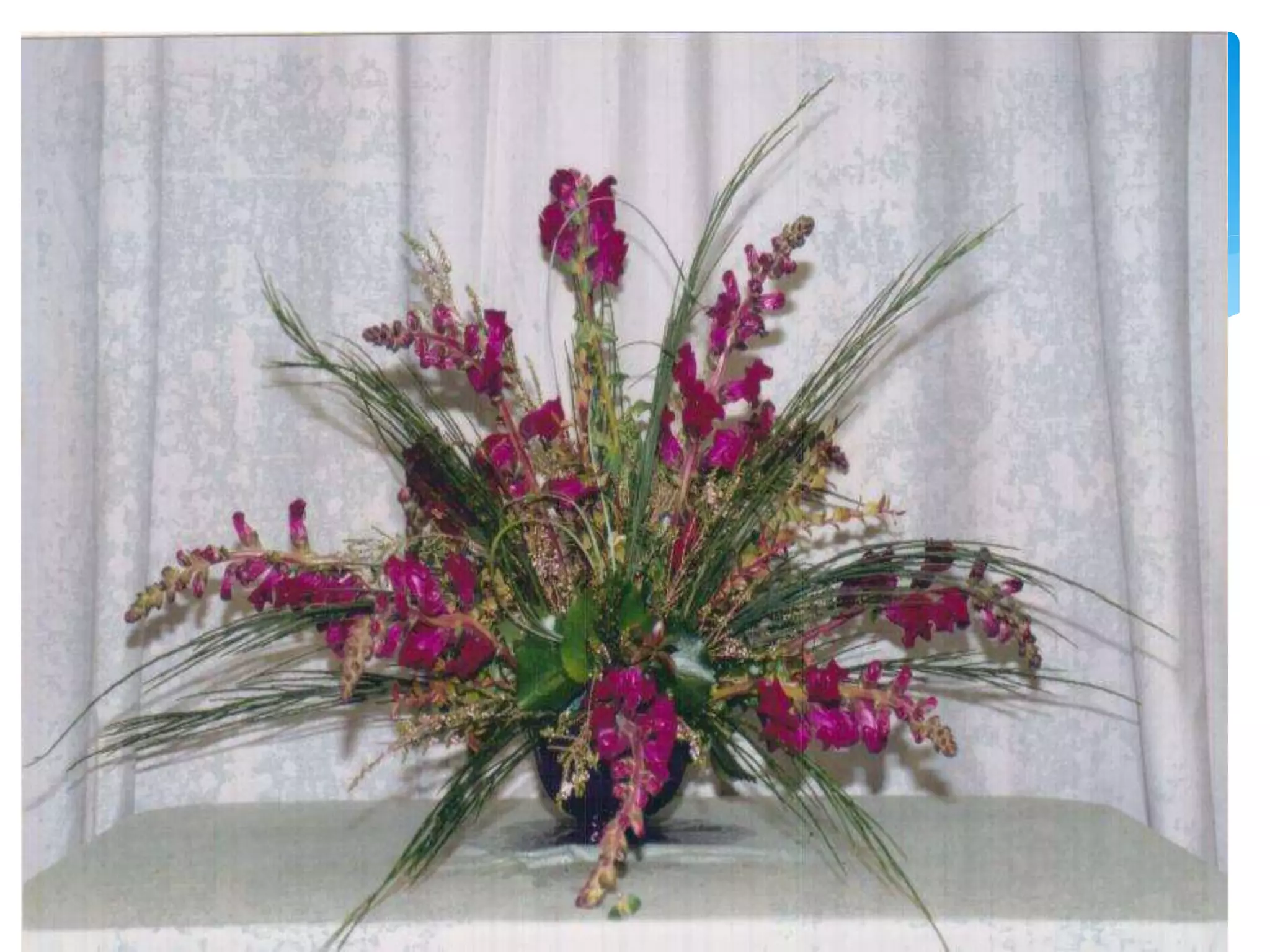
4. Radiation is the illusion that all the
flower stems are radiating from one
point in the arrangement. It is important
not to crisscross stems and thus create
mass confusion. Begin each design by
placing the central stem first and
continue to move outward in all
directions.
5. Repetition helps unify the arrangement, however be
cautious not to overuse repetition, and thus create an
uninteresting arrangement.
6. Depth is achieved by determining the height and width of
the arrangement first, then filling in, making sure to extend
flowers over the edge of the container to create a three
dimensional appearance.
7. Balance is one of the most, if not the most important
principle of floral design. It refers to the sense of
stability in an arrangement. They must also be visually
balanced to be pleasing to the eye. Symmetrical designs
are balanced the same on either side of the
center. Designs are asymmetrical when one side is short
and heavy while the other side is long and
graceful. Colors need to be in balance as well, as dark
flowers appear heavier than light colored ones.
8. Rhythm is the visual line over which the eye moves. This
can be created by using dark to light colors, using heavy
textures with softer ones, or simply by spacing flowers at
regular intervals from the bottom to the top of the arrangement.
9. Focal point is the place that draws your eye by using the
largest, darkest and most flowers, usually in a central location in
the arrangement. Round arrangements do not have a focal point
while contemporary arrangements may have more than one.
10. Transition is created by using filler flowers to
transition from the large flowers to the smaller
ones. Color transition is important as well to keep
the feeling of unity in the arrangement. A medium
colored flower can be used to transition between
light colored flowers to darker ones.
Elements Of Art
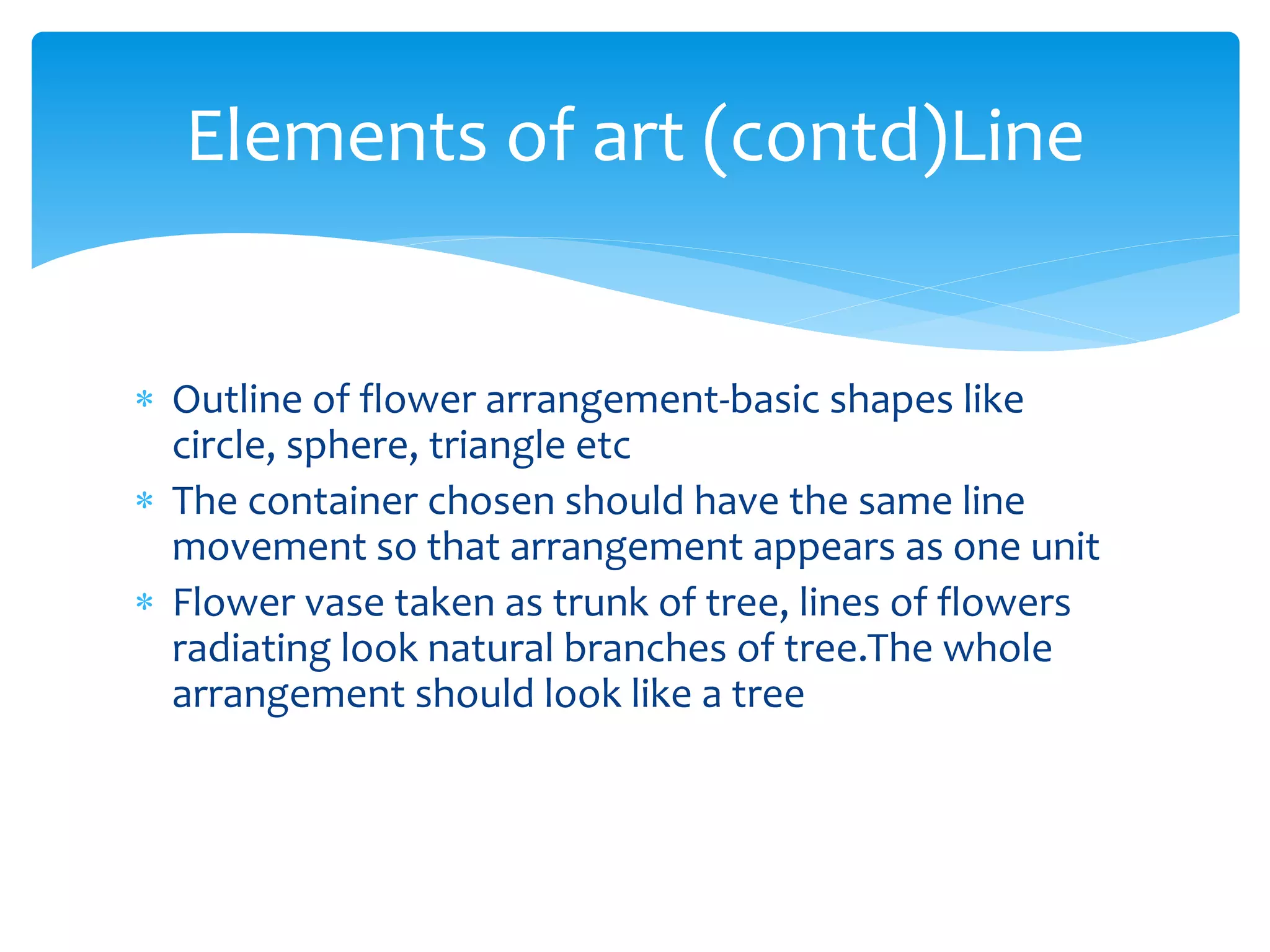
 Line-refers to shapes which move the eye along, up
and down or in different directions.
 Lines have a great power of expression
 Straight lines-sense of dignity
 Horizontal lines peaceful
 Curved lines –grace and sophistication
 Diagonal lines-show speed
 Lines are provided by stems and branches
Elements of art (contd)Line
 Outline of flower arrangement-basic shapes like
circle, sphere, triangle etc
 The container chosen should have the same line
movement so that arrangement appears as one unit
 Flower vase taken as trunk of tree, lines of flowers
radiating look natural branches of tree.The whole
arrangement should look like a tree
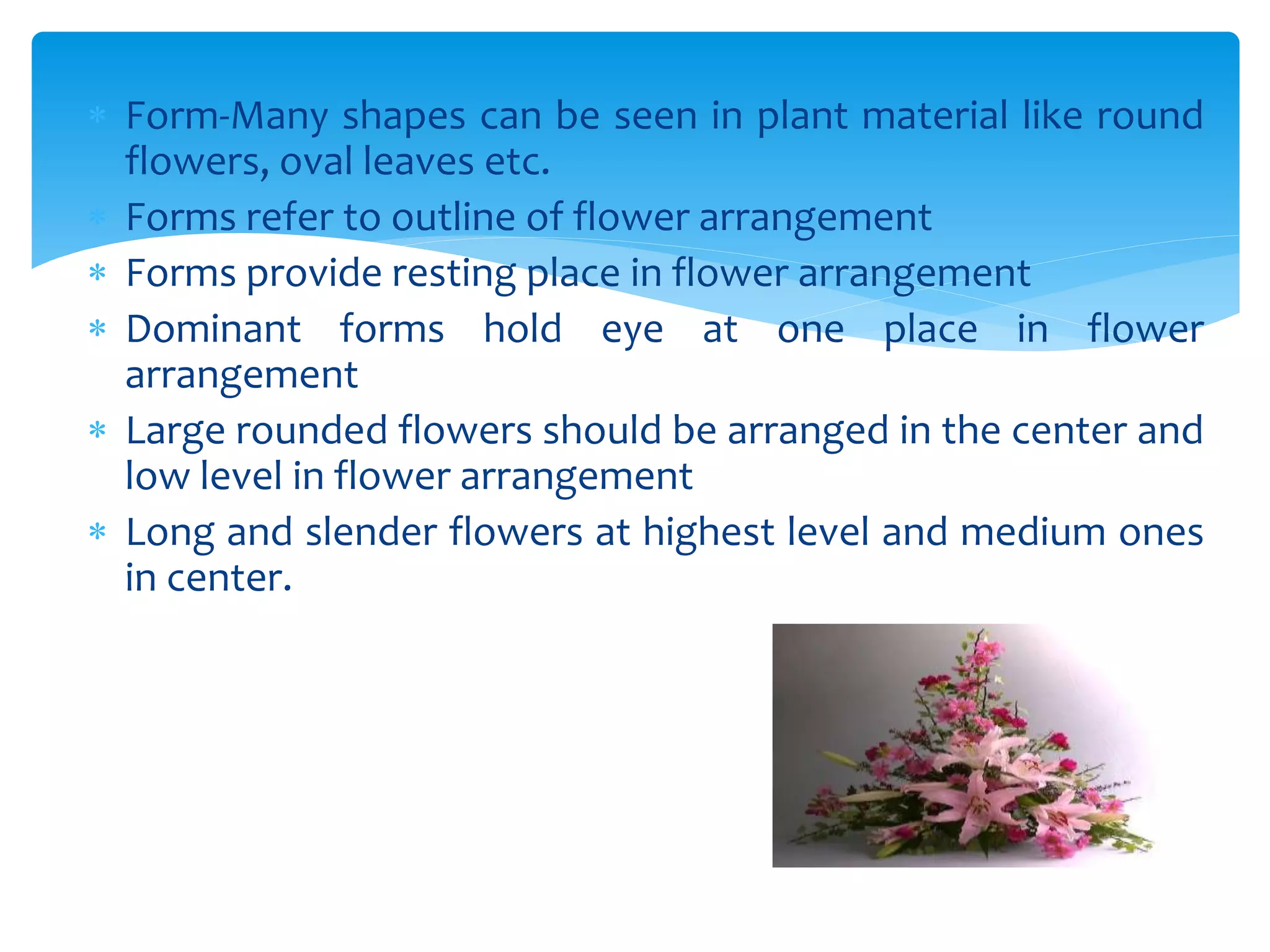
 Form-Many shapes can be seen in plant material like round
flowers, oval leaves etc.
 Forms refer to outline of flower arrangement
 Forms provide resting place in flower arrangement
 Dominant forms hold eye at one place in flower
arrangement
 Large rounded flowers should be arranged in the center and
low level in flower arrangement
 Long and slender flowers at highest level and medium ones
in center.
 Texture –refers to feel of things-surface and
structure of plant material. Unity in texture
between plants themselves and flowers and
containers.
 Flowers with fine texture should be arranged in
delicate containers and rough texture in metal or
clay vases.
 Texture influences color. Rough texture makes
color look darker.
 Texture associated with certain expressions-rough
texture associated with masculinity, informality
and smooth texture with femininity and elegance.
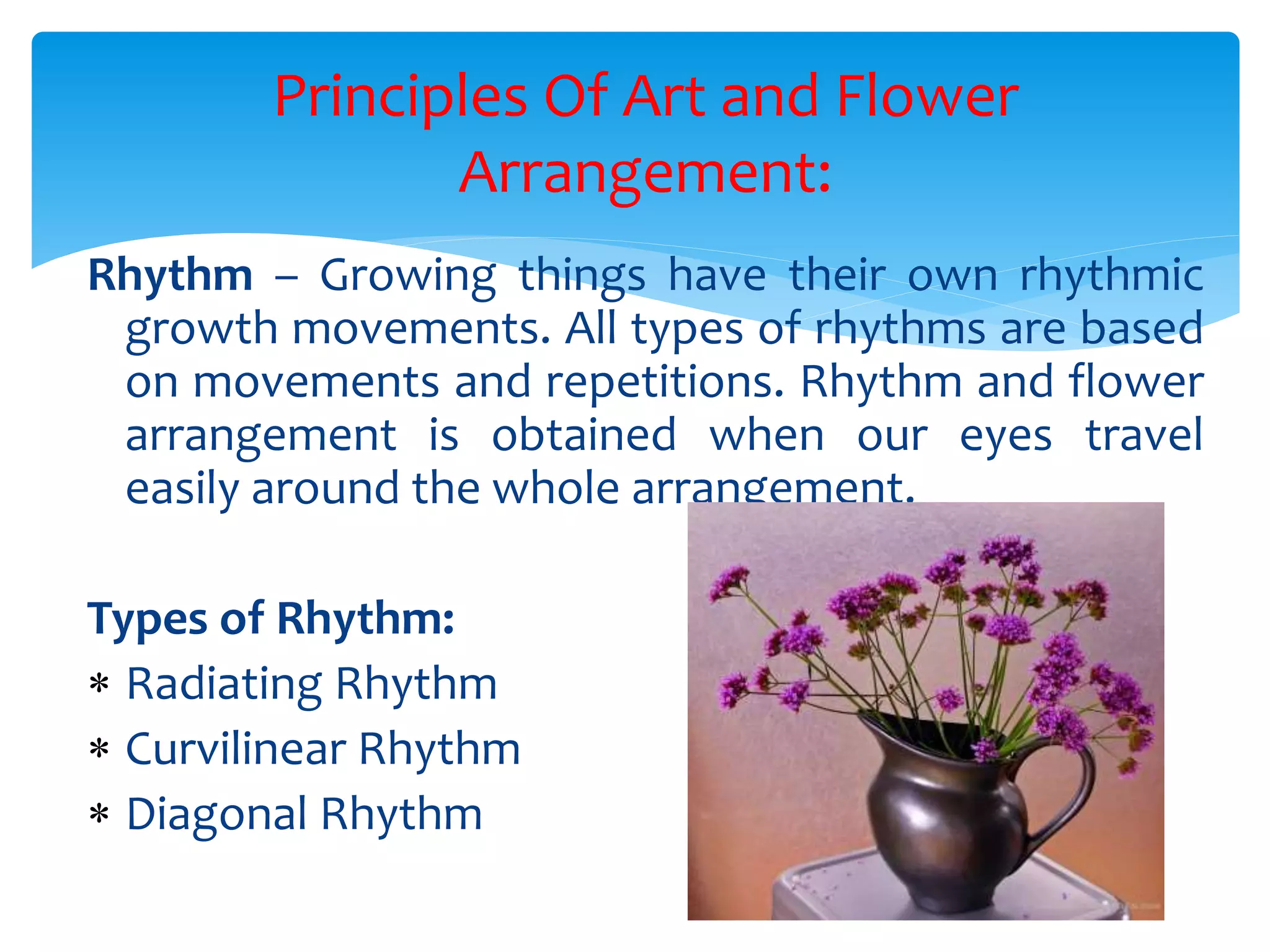
 Colour-Color produces many
types of effects
 Color can appear warm or cool-A
warm colored flower
arrangement having red –
orange flowers will look
wonderful on a cold day and blue
violet on a hot day
 Some colors are more visible in
dim light than others like white
,yellow yellow green are suitable
for dark corners.
 Advancing colors like red suitable
for large rooms and receding
colors like blue, violet for smaller
rooms.
 If three colors are used one
should be dominant and
followed by second and then
third.
 Light colored flowers in upper
part and dark colored towards
bottom and centre.
Principles Of Art and Flower
Arrangement:
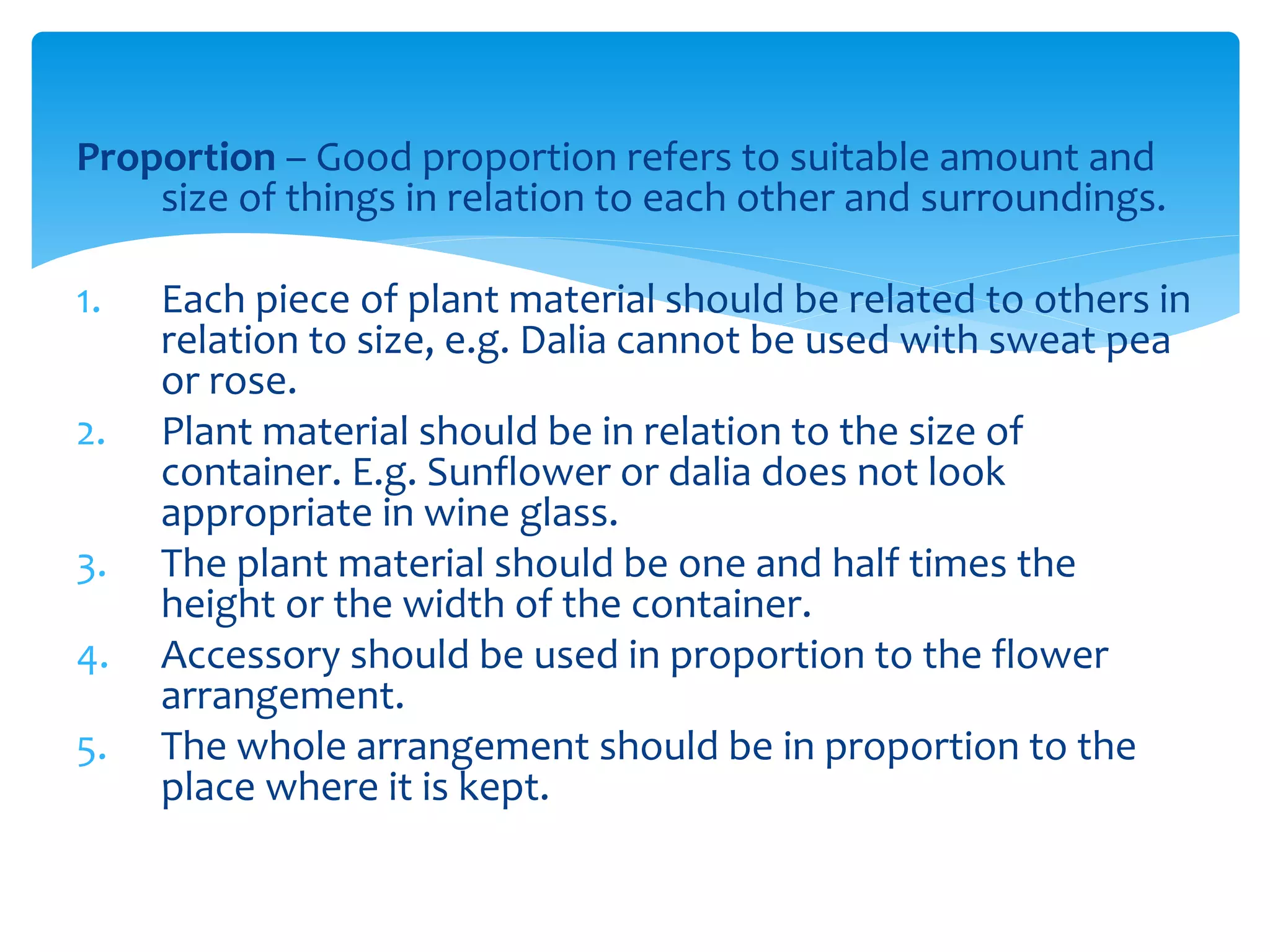
Rhythm – Growing things have their own rhythmic
growth movements. All types of rhythms are based
on movements and repetitions. Rhythm and flower
arrangement is obtained when our eyes travel
easily around the whole arrangement.
Types of Rhythm:
 Radiating Rhythm
 Curvilinear Rhythm
 Diagonal Rhythm
Proportion – Good proportion refers to suitable amount and
size of things in relation to each other and surroundings.
1. Each piece of plant material should be related to others in
relation to size, e.g. Dalia cannot be used with sweat pea
or rose.
2. Plant material should be in relation to the size of
container. E.g. Sunflower or dalia does not look
appropriate in wine glass.
3. The plant material should be one and half times the
height or the width of the container.
4. Accessory should be used in proportion to the flower
arrangement.
5. The whole arrangement should be in proportion to the
place where it is kept.
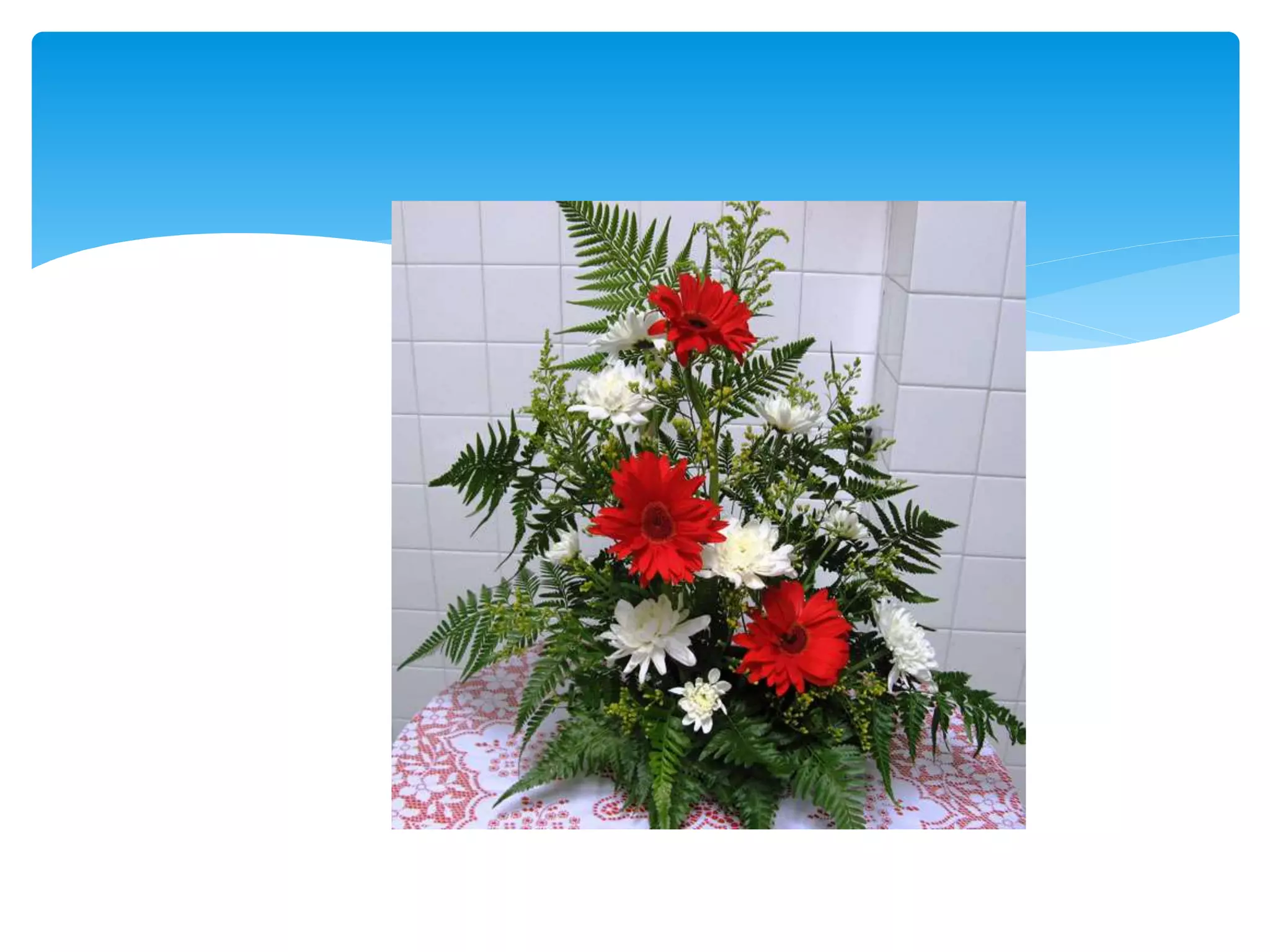
Balance – To achieve good balance in flower arrangement the
eye should be attracted to both sides of the design. Not
necessarily the plant material but maybe flowers on one
side and long branch on the other. To get balance
arrangement, heaviest mass of flower material, largest
flowers and longer stems to be placed in the center of
the container.
Two types of Balance –
1. Formal Balance : When its shape is exactly the same on
either side of the center.
2. Informal Balance : When plant material placed on either
side is not exactly in the same position but attention is
equally attracted on both sides of the design.
Emphasis – For emphasis, attention is drawn to the center of
interest, whether flowers are larger, more numerous,
contrast or brilliant in colour.
Harmony – Means unity
 Signifies that flowers and flower vase should have unity
with respect to shape, colour and texture of the whole unit.
E.g. Roses look nice in glass flower vase.
 Make a definite plan for any arrangement based on the
purpose, room, space and location in the room.
 Select containers, flowers and foliage that express the
mood of the room, the occasion, and the color scheme.
GUIDELINES OR PRINCIPLES TO BE
FOLLOWED IN ARRANGING FLOWERS
 Use flowers with stems of different sizes and select flowers
according to the size of the vases- short or tall, e.g. short
stems in low wide vases.
 Arrange the tallest stems first and then others according to
the type of arrangement- namely mass, line or their
combination, Japanese and so on.
 Large flowers with bright bold colors can be used in small
numbers and at the center in tall vases. Small, short
stemmed flowers may be easy to arrange in groups in low
vases.
 The whole arrangement should keep proper proportion
between size and shape of vases and those of lower stems.
 Cover up the stem holder.
 Pour enough water in the vase.
 To preserve the arrangement change the water every day.
 The basic materials in a flower arrangement are divided
into four categories which are line, dominant, secondary,
and filler materials.
Line materials: are used to set the general line direction of the
arrangement. These materials generally include foliage,
twigs, and tiny flowers. These should be the first materials
placed in the arrangement.
Dominant materials: these are the biggest materials in the
entire arrangement and should be placed right after the line
materials.
Secondary materials: these are slightly smaller than the
dominant materials and are used to help achieve shape and
add to the form of the overall design. These should be placed
after the dominant materials.
Filler materials: generally consist of foliage or small flowers.
These are used to fill up any extra spaces in the arrangement
and should be the last material placed.
Elements and principles of design in flower arrangement

Elements and principles of design in flower arrangement

  • 1.
    Elements and Principlesof Design in Flower Arrangement Mrs.S.MATHANGI.M.Sc.,M.Phil., Assistant Professor
  • 2.
    1. Unity occurswhen all the elements of your design harmonize in a well balanced and well proportioned arrangement. 2. Harmony is achieved when all the elements, flowers, foliage and container harmonize and compliment one another. Elements and Principles of design in Flower arrangement
  • 3.
    3. Proportion Alarge, heavy container would be out of scale with small flowers. First the height of the arrangement should be at least one and a half times taller than the height or width of the container. And secondly, the height of the arrangement should not be more than two and half times taller than the container.
  • 4.
    4. Radiation isthe illusion that all the flower stems are radiating from one point in the arrangement. It is important not to crisscross stems and thus create mass confusion. Begin each design by placing the central stem first and continue to move outward in all directions.
  • 5.
    5. Repetition helpsunify the arrangement, however be cautious not to overuse repetition, and thus create an uninteresting arrangement. 6. Depth is achieved by determining the height and width of the arrangement first, then filling in, making sure to extend flowers over the edge of the container to create a three dimensional appearance.
  • 6.
    7. Balance isone of the most, if not the most important principle of floral design. It refers to the sense of stability in an arrangement. They must also be visually balanced to be pleasing to the eye. Symmetrical designs are balanced the same on either side of the center. Designs are asymmetrical when one side is short and heavy while the other side is long and graceful. Colors need to be in balance as well, as dark flowers appear heavier than light colored ones.
  • 7.
    8. Rhythm isthe visual line over which the eye moves. This can be created by using dark to light colors, using heavy textures with softer ones, or simply by spacing flowers at regular intervals from the bottom to the top of the arrangement. 9. Focal point is the place that draws your eye by using the largest, darkest and most flowers, usually in a central location in the arrangement. Round arrangements do not have a focal point while contemporary arrangements may have more than one.
  • 8.
    10. Transition iscreated by using filler flowers to transition from the large flowers to the smaller ones. Color transition is important as well to keep the feeling of unity in the arrangement. A medium colored flower can be used to transition between light colored flowers to darker ones.
  • 9.
    Elements Of Art Line-refers to shapes which move the eye along, up and down or in different directions.  Lines have a great power of expression  Straight lines-sense of dignity  Horizontal lines peaceful  Curved lines –grace and sophistication  Diagonal lines-show speed  Lines are provided by stems and branches
  • 11.
    Elements of art(contd)Line  Outline of flower arrangement-basic shapes like circle, sphere, triangle etc  The container chosen should have the same line movement so that arrangement appears as one unit  Flower vase taken as trunk of tree, lines of flowers radiating look natural branches of tree.The whole arrangement should look like a tree
  • 12.
     Form-Many shapescan be seen in plant material like round flowers, oval leaves etc.  Forms refer to outline of flower arrangement  Forms provide resting place in flower arrangement  Dominant forms hold eye at one place in flower arrangement  Large rounded flowers should be arranged in the center and low level in flower arrangement  Long and slender flowers at highest level and medium ones in center.
  • 13.
     Texture –refersto feel of things-surface and structure of plant material. Unity in texture between plants themselves and flowers and containers.  Flowers with fine texture should be arranged in delicate containers and rough texture in metal or clay vases.  Texture influences color. Rough texture makes color look darker.  Texture associated with certain expressions-rough texture associated with masculinity, informality and smooth texture with femininity and elegance.
  • 14.
     Colour-Color producesmany types of effects  Color can appear warm or cool-A warm colored flower arrangement having red – orange flowers will look wonderful on a cold day and blue violet on a hot day  Some colors are more visible in dim light than others like white ,yellow yellow green are suitable for dark corners.  Advancing colors like red suitable for large rooms and receding colors like blue, violet for smaller rooms.  If three colors are used one should be dominant and followed by second and then third.  Light colored flowers in upper part and dark colored towards bottom and centre.
  • 15.
    Principles Of Artand Flower Arrangement: Rhythm – Growing things have their own rhythmic growth movements. All types of rhythms are based on movements and repetitions. Rhythm and flower arrangement is obtained when our eyes travel easily around the whole arrangement. Types of Rhythm:  Radiating Rhythm  Curvilinear Rhythm  Diagonal Rhythm
  • 16.
    Proportion – Goodproportion refers to suitable amount and size of things in relation to each other and surroundings. 1. Each piece of plant material should be related to others in relation to size, e.g. Dalia cannot be used with sweat pea or rose. 2. Plant material should be in relation to the size of container. E.g. Sunflower or dalia does not look appropriate in wine glass. 3. The plant material should be one and half times the height or the width of the container. 4. Accessory should be used in proportion to the flower arrangement. 5. The whole arrangement should be in proportion to the place where it is kept.
  • 17.
    Balance – Toachieve good balance in flower arrangement the eye should be attracted to both sides of the design. Not necessarily the plant material but maybe flowers on one side and long branch on the other. To get balance arrangement, heaviest mass of flower material, largest flowers and longer stems to be placed in the center of the container. Two types of Balance – 1. Formal Balance : When its shape is exactly the same on either side of the center. 2. Informal Balance : When plant material placed on either side is not exactly in the same position but attention is equally attracted on both sides of the design.
  • 18.
    Emphasis – Foremphasis, attention is drawn to the center of interest, whether flowers are larger, more numerous, contrast or brilliant in colour. Harmony – Means unity  Signifies that flowers and flower vase should have unity with respect to shape, colour and texture of the whole unit. E.g. Roses look nice in glass flower vase.
  • 20.
     Make adefinite plan for any arrangement based on the purpose, room, space and location in the room.  Select containers, flowers and foliage that express the mood of the room, the occasion, and the color scheme. GUIDELINES OR PRINCIPLES TO BE FOLLOWED IN ARRANGING FLOWERS
  • 21.
     Use flowerswith stems of different sizes and select flowers according to the size of the vases- short or tall, e.g. short stems in low wide vases.  Arrange the tallest stems first and then others according to the type of arrangement- namely mass, line or their combination, Japanese and so on.
  • 22.
     Large flowerswith bright bold colors can be used in small numbers and at the center in tall vases. Small, short stemmed flowers may be easy to arrange in groups in low vases.  The whole arrangement should keep proper proportion between size and shape of vases and those of lower stems.  Cover up the stem holder.  Pour enough water in the vase.  To preserve the arrangement change the water every day.  The basic materials in a flower arrangement are divided into four categories which are line, dominant, secondary, and filler materials.
  • 23.
    Line materials: areused to set the general line direction of the arrangement. These materials generally include foliage, twigs, and tiny flowers. These should be the first materials placed in the arrangement. Dominant materials: these are the biggest materials in the entire arrangement and should be placed right after the line materials.
  • 24.
    Secondary materials: theseare slightly smaller than the dominant materials and are used to help achieve shape and add to the form of the overall design. These should be placed after the dominant materials. Filler materials: generally consist of foliage or small flowers. These are used to fill up any extra spaces in the arrangement and should be the last material placed.