HERBS
&
SPICES
KUMARS RECIPE FILE 1NSK NOTES
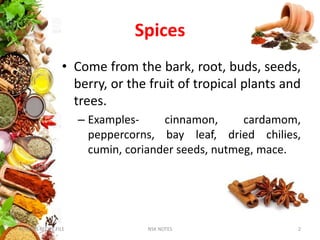
Spices
• Come from the bark, root, buds, seeds,
berry, or the fruit of tropical plants and
trees.
– Examples- cinnamon, cardamom,
peppercorns, bay leaf, dried chilies,
cumin, coriander seeds, nutmeg, mace.
KUMARS RECIPE FILE 2NSK NOTES
Herbs
• Are leaves of low-growing shrubs.
– Examples are parsley, chives, marjoram,
thyme, basil, caraway, dill, oregano,
rosemary, savory, sage and celery leaves.
– These can be used fresh or dried.
Dried forms may be whole, crushed, or
ground.
KUMARS RECIPE FILE 3NSK NOTES
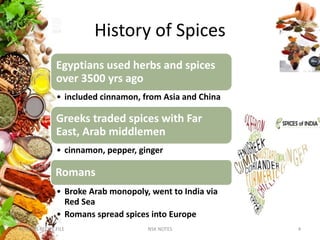
History of Spices
KUMARS RECIPE FILE 4NSK NOTES
Egyptians used herbs and spices
over 3500 yrs ago
• included cinnamon, from Asia and China
Greeks traded spices with Far
East, Arab middlemen
• cinnamon, pepper, ginger
Romans
• Broke Arab monopoly, went to India via
Red Sea
• Romans spread spices into Europe
KUMARS RECIPE FILE 5NSK NOTES
Europe-Asia trade left with the fall of
the empire, 476 AD
Dark ages-Europe mostly uses herbs
Marco Polo-25 yrs in orient, wrote
about it
Age of Exploration
• Trade controlled by Portugal, then the Dutch,
then the English
Columbus was searching for Eastern
spices
• New World spices-only vanilla, chili, allspice
Importance and Uses
KUMARS RECIPE FILE 6NSK NOTES
Flavor, Aroma, Fragrance
Gives warmth to the body
Taste: salty, pungent, astringent
Color
Medicinal properties: for blood pressure, heart , cold,
cough, indigestion, fever, flatulence, Diabetes, Tooth ache,
stomach ache
Garnish
Decides main characteristics of a dish
Aids digestion
KUMARS RECIPE FILE 7NSK NOTES
tightly covered,
air tight
container
away from
moisture.
Dampness
Herbs and spices
can be crushed
with a mortar
and pestle, by
using a rolling
pin with spices
between two
cloths, or by
using the back
of a spoon in a
cup.
Mustard seed
and poppy seed
aromas will be
difficult to
detect.
In hot climates,
store spices such
as paprika, red
pepper, and chili
powder in the
refrigerator to
maintain
quality.
Do not store in a
window or in
sunlight, or near
heat sources
such as the
cooking areas or
the dishwasher.
Asafetida
• It is a gum resin derived from the
milky sap of the plant a native of
Persia and Afghanistan. The sap is
obtained by an incision on its green
matured root.
• Asafetida is acrid and bitter in taste
and emits a strong disagreeable
pungent odour due to the presence
of Sulphur compounds therein.
• Also regarded in Ayurvedic, Chinese
and Western medicine as an
effective remedy for worms and
other intestinal parasites
KUMARS RECIPE FILE 8NSK NOTES
Aniseed
• Mediterranean origin
• It’s a sweet smelling spice
• Used in soups, meats, sweets,
savory, pastries, tarts, liqueurs.
KUMARS RECIPE FILE 9NSK NOTES
Allspice
• New World spice from Jamaica,
Mexico and Honduras
• Has a complicated flavor
• Taste is a combination of
cinnamon, nutmeg and cloves.
• Used in a variety of different
foods such as Cakes, Pies,
Cookies, Soups, Stews, Spiced
Tea Mixes, Pickled Beets, Eggs,
Cucumbers, Corned Beef.
KUMARS RECIPE FILE 10NSK NOTES
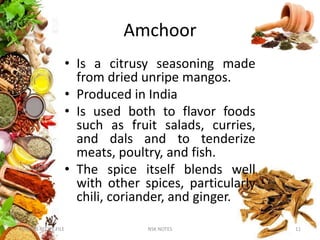
Amchoor
• Is a citrusy seasoning made
from dried unripe mangos.
• Produced in India
• Is used both to flavor foods
such as fruit salads, curries,
and dals and to tenderize
meats, poultry, and fish.
• The spice itself blends well
with other spices, particularly
chili, coriander, and ginger.
KUMARS RECIPE FILE 11NSK NOTES
Anardana
• Dried seeds of pomegranate fruit.
• Mostly used as a condiment for
acidification of chutneys and
certain curries.
• Very good for stomach upsets and
nausea.
KUMARS RECIPE FILE 12NSK NOTES
Cardamom
• Origin: India and Ceylon
• Uses Sauces, pastries, indian
sweets, syrups
• Is a stimulant and an aphrodisiac.
• Was used long ago in perfumes
and as breath freshener.
KUMARS RECIPE FILE 13NSK NOTES
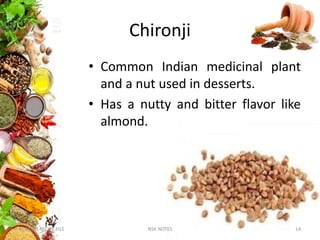
Chironji
• Common Indian medicinal plant
and a nut used in desserts.
• Has a nutty and bitter flavor like
almond.
KUMARS RECIPE FILE 14NSK NOTES
Cinnamon
• Bark of a tree.
• Fine, delicate and aromatic scent.
• Used in pastas, drinks, pies, mixed
spices.
• Cassia bark can also be used
instead of cinnamon.
KUMARS RECIPE FILE 15NSK NOTES
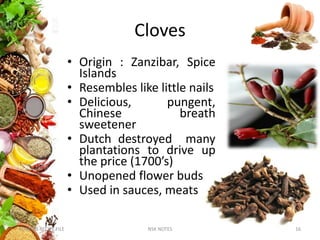
Cloves
• Origin : Zanzibar, Spice
Islands
• Resembles like little nails
• Delicious, pungent,
Chinese breath
sweetener
• Dutch destroyed many
plantations to drive up
the price (1700’s)
• Unopened flower buds
• Used in sauces, meats
KUMARS RECIPE FILE 16NSK NOTES
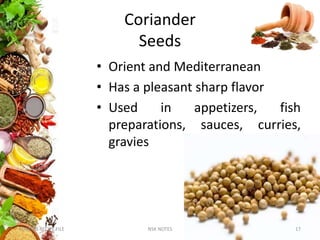
Coriander
Seeds
• Orient and Mediterranean
• Has a pleasant sharp flavor
• Used in appetizers, fish
preparations, sauces, curries,
gravies
KUMARS RECIPE FILE NSK NOTES 17
Caraway
• European spice
• Also known as
Persian cumin
• Used in cakes,
cheese,
vegetables, fish
recipes and
breads, specially
rye bread.
• A tea (tisane)
made from the
seeds is used as a
remedy for colic,
loss of appetite
and digestive
disorders and to
dispel worms.
KUMARS RECIPE FILE NSK NOTES 18
Royal Cumin
seeds
• Indian cooks use
this spice in
many of their
curries and
tandoori
dishes.
• It's darker and
sweeter than
ordinary cumin.
• To bring out its
nutty flavor, it
helps to toast
the seeds briefly
before using
them.
Carom seeds
• Raw ajwain smells almost exactly
like thyme because it also contains
thymol, but is more aromatic and
less subtle in taste, as well as
slightly bitter and pungent. It tastes
like thyme or caraway, only
stronger.
• Even a small amount of raw ajwain
will completely dominate the flavor
of a dish.
• In Indian cuisine, ajwain is almost
never used raw, but either dry-
roasted or fried in ghee or oil. This
develops a much more subtle and
complex aroma, somewhat similar
to caraway but "brighter".
• It is also traditionally known as a
digestive aid and an antiseptic.
KUMARS RECIPE FILE NSK NOTES 19
Cumin
• Known as “Jeera” in Hindi
• Member of parsley family.
• Most popular spice in the
world after black pepper.
• Has a distinctive flavor and a
strong, warm aroma.
• Used in Indian, Spanish,
Italian, Mexican and Middle
Eastern Cuisines.
KUMARS RECIPE FILE NSK NOTES 20
Dried Ginger
• Powdered dry ginger root is
typically used to spice
gingerbread and other recipes.
• Fresh ginger can be substituted
for ground ginger at a ratio of 6
parts fresh for 1 part ground,
although the flavors of fresh
and dried ginger are not
exactly interchangeable.
KUMARS RECIPE FILE NSK NOTES 21
Fennel
• Florence variety is most
delicate and tender
• It has a crisp, nut like flavor
similar to aniseeds
• Used in sauces, liver and
kidney dishes, pates, cold
dishes.
KUMARS RECIPE FILE NSK NOTES 22
Fenugreek
• Asia, Southern Europe
• Has bitter taste
• Pastries, syrups, masalas,
tempering
• Has medicinal qualities
• Known as “Methi” in Hindi
KUMARS RECIPE FILE NSK NOTES 23
Mustard
• All over the world
• Crucifer flower
• Digestive stimulant, forms a sharp
delicious flavor when ground
• Used in pickles, appetizers, salad
dressings, sauces, preserves.
• Various parts used
– seeds for mustard
– roots for horseradish
KUMARS RECIPE FILE NSK NOTES 24
Mace
• East Indies
• It’s the covering of
Nutmeg, which protects
and covers the fruit.
• Has a strong flavor
• Used in potatoes,
forcemeats, syrups,
pastries
KUMARS RECIPE FILE NSK NOTES 25
Nigella
• Also known as onion seeds or
kalonji.
• Used in Indian and Middle
Eastern cuisine.
• dry roasted nigella seeds flavor
curries, vegetables and pulses.
• The seeds taste like oregano and
have a bitterness to them like
mustard-seeds.
• Used to ease bowel and
indigestion problems and are
given to treat intestinal worms
and nerve defects, to reduce
flatulence.
KUMARS RECIPE FILE NSK NOTES 26
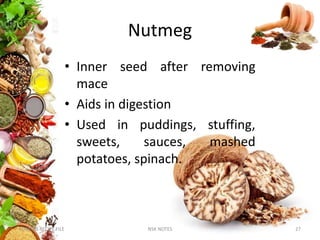
Nutmeg
• Inner seed after removing
mace
• Aids in digestion
• Used in puddings, stuffing,
sweets, sauces, mashed
potatoes, spinach.
KUMARS RECIPE FILE NSK NOTES 27
KUMARS RECIPE FILE
Name the spices
Peppercorns
East Indies, Asia
Valued as most precious spice
From berries of Piper nigrum
In olden days used as a
currency in middle east
Used as seasoning, all types of
vegetable and meat
preparations, can be combined
with other spices
Black pepper from immature
fruits
White pepper from hull-less
mature fruits
KUMARS RECIPE FILE NSK NOTES 29
Poppy seeds
• The white poppy seeds form
part of the Indian spices.
• They are added for thickness,
texture and also give added
flavor to the recipe.
• It is quite hard to grind them
when raw, so they are normally
roasted, and then mixed with a
little water to get the right
paste consistency.
• When roasted the seeds have a
nutty, sweet flavor and add a
crunchy texture.
KUMARS RECIPE FILE NSK NOTES 30
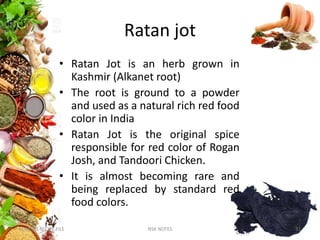
Ratan jot
• Ratan Jot is an herb grown in
Kashmir (Alkanet root)
• The root is ground to a powder
and used as a natural rich red food
color in India
• Ratan Jot is the original spice
responsible for red color of Rogan
Josh, and Tandoori Chicken.
• It is almost becoming rare and
being replaced by standard red
food colors.
KUMARS RECIPE FILE NSK NOTES 31
KUMARS RECIPE FILE
Name the Spice
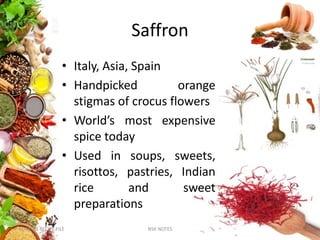
Saffron
• Italy, Asia, Spain
• Handpicked orange
stigmas of crocus flowers
• World’s most expensive
spice today
• Used in soups, sweets,
risottos, pastries, Indian
rice and sweet
preparations
KUMARS RECIPE FILE NSK NOTES 33
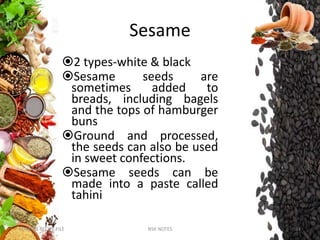
Sesame
2 types-white & black
Sesame seeds are
sometimes added to
breads, including bagels
and the tops of hamburger
buns
Ground and processed,
the seeds can also be used
in sweet confections.
Sesame seeds can be
made into a paste called
tahini
KUMARS RECIPE FILE NSK NOTES 34
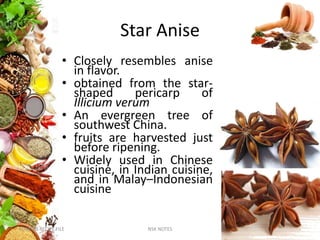
Star Anise
• Closely resembles anise
in flavor.
• obtained from the star-
shaped pericarp of
Illicium verum
• An evergreen tree of
southwest China.
• fruits are harvested just
before ripening.
• Widely used in Chinese
cuisine, in Indian cuisine,
and in Malay–Indonesian
cuisine
KUMARS RECIPE FILE NSK NOTES 35
Chili
• Capsicum annuum and others
• Discovered by Columbus
• Important part of Mexican
diet
• At least 9000 yrs old
• Many varieties
• Fruits very high in vitamin C
KUMARS RECIPE FILE NSK NOTES 36
Turmeric
• Deep orange-yellow powder
commonly used as a spice in
curries and other South Asian and
Middle Eastern cuisine, for
dyeing, and to impart color to
mustard condiments.
• Has a distinctly earthy, slightly
bitter, slightly hot peppery flavor
and a mustardy smell.
• It is used in canned beverages
and baked products, dairy
products, ice cream, yogurt,
yellow cakes, orange juice,
biscuits, popcorn color, sweets,
cake icings, cereals, sauces,
gelatins, etc. It is a significant
ingredient in most commercial
curry powders. Turmeric is mostly
used in savory dishes, as well as
some sweet dishes such as the
cake etc.
• Turmeric is also used fresh, much
like ginger.
KUMARS RECIPE FILE NSK NOTES 37
Basil
• Asia, Europe
• Most delicate and fragrant herb
• Used extensively in Greek, Italian,
French cuisine
• Used in casseroles, sauces, pasta, rice
dishes, vegetables
• Spicy, sweet, anise (licorice) and clove-
like; flavor changes when dried.
• Purple basil (opal, ruffled) has a more
delicate flavor that is clove-like.
• Other varieties include cinnamon basil,
lemon basil, Thai basil and globe basil.
KUMARS RECIPE FILE NSK NOTES 38
Bay leaves
• Asia, Europe
• It’s the leaf of Laurel tree
• Has pleasing aromatic scent
• Used in bouquet garni,
stocks, soups, sauces, spice
mixtures, curries
KUMARS RECIPE FILE NSK NOTES 39
Cilantro
• Citrus and sage flavor.
• Used in chicken, fish, lamb and
rice, pasta or vegetable dishes.
• Also good in salsa, taco fillings,
black bean and corn salad, lentil
or black bean soups; in butters
for vegetables or fish.
• Distinctive flavor found in
Caribbean, Indian, Thai, Chinese,
Mexican or Latin American
dishes.
• Seems to go well with most "hot"
cuisines. Seeds (coriander) also
used, can be collected and
ground.
KUMARS RECIPE FILE NSK NOTES 40
Curry leaves
• Native of India.
• highly valued as seasoning in
South Indian cuisine.
• Also available dried, though the
aroma is much inferior
• Its properties include much
value as an ant diabetic,
antioxidant, antimicrobial, anti-
inflammatory, hepato
protective, anti-hyper
cholesterolemic etc.
KUMARS RECIPE FILE NSK NOTES 41
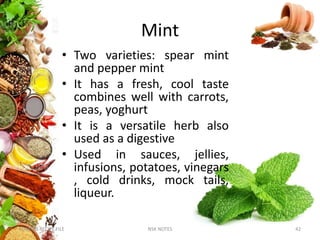
Mint
• Two varieties: spear mint
and pepper mint
• It has a fresh, cool taste
combines well with carrots,
peas, yoghurt
• It is a versatile herb also
used as a digestive
• Used in sauces, jellies,
infusions, potatoes, vinegars
, cold drinks, mock tails,
liqueur.
KUMARS RECIPE FILE NSK NOTES 42
©To view the slide please visit nsk notes @ slideshare.
KUMARS RECIPE FILE NSK NOTES 43

Herbs & spices

  • 1.
  • 2.
    Spices • Come fromthe bark, root, buds, seeds, berry, or the fruit of tropical plants and trees. – Examples- cinnamon, cardamom, peppercorns, bay leaf, dried chilies, cumin, coriander seeds, nutmeg, mace. KUMARS RECIPE FILE 2NSK NOTES
  • 3.
    Herbs • Are leavesof low-growing shrubs. – Examples are parsley, chives, marjoram, thyme, basil, caraway, dill, oregano, rosemary, savory, sage and celery leaves. – These can be used fresh or dried. Dried forms may be whole, crushed, or ground. KUMARS RECIPE FILE 3NSK NOTES
  • 4.
    History of Spices KUMARSRECIPE FILE 4NSK NOTES Egyptians used herbs and spices over 3500 yrs ago • included cinnamon, from Asia and China Greeks traded spices with Far East, Arab middlemen • cinnamon, pepper, ginger Romans • Broke Arab monopoly, went to India via Red Sea • Romans spread spices into Europe
  • 5.
    KUMARS RECIPE FILE5NSK NOTES Europe-Asia trade left with the fall of the empire, 476 AD Dark ages-Europe mostly uses herbs Marco Polo-25 yrs in orient, wrote about it Age of Exploration • Trade controlled by Portugal, then the Dutch, then the English Columbus was searching for Eastern spices • New World spices-only vanilla, chili, allspice
  • 6.
    Importance and Uses KUMARSRECIPE FILE 6NSK NOTES Flavor, Aroma, Fragrance Gives warmth to the body Taste: salty, pungent, astringent Color Medicinal properties: for blood pressure, heart , cold, cough, indigestion, fever, flatulence, Diabetes, Tooth ache, stomach ache Garnish Decides main characteristics of a dish Aids digestion
  • 7.
    KUMARS RECIPE FILE7NSK NOTES tightly covered, air tight container away from moisture. Dampness Herbs and spices can be crushed with a mortar and pestle, by using a rolling pin with spices between two cloths, or by using the back of a spoon in a cup. Mustard seed and poppy seed aromas will be difficult to detect. In hot climates, store spices such as paprika, red pepper, and chili powder in the refrigerator to maintain quality. Do not store in a window or in sunlight, or near heat sources such as the cooking areas or the dishwasher.
  • 8.
    Asafetida • It isa gum resin derived from the milky sap of the plant a native of Persia and Afghanistan. The sap is obtained by an incision on its green matured root. • Asafetida is acrid and bitter in taste and emits a strong disagreeable pungent odour due to the presence of Sulphur compounds therein. • Also regarded in Ayurvedic, Chinese and Western medicine as an effective remedy for worms and other intestinal parasites KUMARS RECIPE FILE 8NSK NOTES
  • 9.
    Aniseed • Mediterranean origin •It’s a sweet smelling spice • Used in soups, meats, sweets, savory, pastries, tarts, liqueurs. KUMARS RECIPE FILE 9NSK NOTES
  • 10.
    Allspice • New Worldspice from Jamaica, Mexico and Honduras • Has a complicated flavor • Taste is a combination of cinnamon, nutmeg and cloves. • Used in a variety of different foods such as Cakes, Pies, Cookies, Soups, Stews, Spiced Tea Mixes, Pickled Beets, Eggs, Cucumbers, Corned Beef. KUMARS RECIPE FILE 10NSK NOTES
  • 11.
    Amchoor • Is acitrusy seasoning made from dried unripe mangos. • Produced in India • Is used both to flavor foods such as fruit salads, curries, and dals and to tenderize meats, poultry, and fish. • The spice itself blends well with other spices, particularly chili, coriander, and ginger. KUMARS RECIPE FILE 11NSK NOTES
  • 12.
    Anardana • Dried seedsof pomegranate fruit. • Mostly used as a condiment for acidification of chutneys and certain curries. • Very good for stomach upsets and nausea. KUMARS RECIPE FILE 12NSK NOTES
  • 13.
    Cardamom • Origin: Indiaand Ceylon • Uses Sauces, pastries, indian sweets, syrups • Is a stimulant and an aphrodisiac. • Was used long ago in perfumes and as breath freshener. KUMARS RECIPE FILE 13NSK NOTES
  • 14.
    Chironji • Common Indianmedicinal plant and a nut used in desserts. • Has a nutty and bitter flavor like almond. KUMARS RECIPE FILE 14NSK NOTES
  • 15.
    Cinnamon • Bark ofa tree. • Fine, delicate and aromatic scent. • Used in pastas, drinks, pies, mixed spices. • Cassia bark can also be used instead of cinnamon. KUMARS RECIPE FILE 15NSK NOTES
  • 16.
    Cloves • Origin :Zanzibar, Spice Islands • Resembles like little nails • Delicious, pungent, Chinese breath sweetener • Dutch destroyed many plantations to drive up the price (1700’s) • Unopened flower buds • Used in sauces, meats KUMARS RECIPE FILE 16NSK NOTES
  • 17.
    Coriander Seeds • Orient andMediterranean • Has a pleasant sharp flavor • Used in appetizers, fish preparations, sauces, curries, gravies KUMARS RECIPE FILE NSK NOTES 17
  • 18.
    Caraway • European spice •Also known as Persian cumin • Used in cakes, cheese, vegetables, fish recipes and breads, specially rye bread. • A tea (tisane) made from the seeds is used as a remedy for colic, loss of appetite and digestive disorders and to dispel worms. KUMARS RECIPE FILE NSK NOTES 18 Royal Cumin seeds • Indian cooks use this spice in many of their curries and tandoori dishes. • It's darker and sweeter than ordinary cumin. • To bring out its nutty flavor, it helps to toast the seeds briefly before using them.
  • 19.
    Carom seeds • Rawajwain smells almost exactly like thyme because it also contains thymol, but is more aromatic and less subtle in taste, as well as slightly bitter and pungent. It tastes like thyme or caraway, only stronger. • Even a small amount of raw ajwain will completely dominate the flavor of a dish. • In Indian cuisine, ajwain is almost never used raw, but either dry- roasted or fried in ghee or oil. This develops a much more subtle and complex aroma, somewhat similar to caraway but "brighter". • It is also traditionally known as a digestive aid and an antiseptic. KUMARS RECIPE FILE NSK NOTES 19
  • 20.
    Cumin • Known as“Jeera” in Hindi • Member of parsley family. • Most popular spice in the world after black pepper. • Has a distinctive flavor and a strong, warm aroma. • Used in Indian, Spanish, Italian, Mexican and Middle Eastern Cuisines. KUMARS RECIPE FILE NSK NOTES 20
  • 21.
    Dried Ginger • Powdereddry ginger root is typically used to spice gingerbread and other recipes. • Fresh ginger can be substituted for ground ginger at a ratio of 6 parts fresh for 1 part ground, although the flavors of fresh and dried ginger are not exactly interchangeable. KUMARS RECIPE FILE NSK NOTES 21
  • 22.
    Fennel • Florence varietyis most delicate and tender • It has a crisp, nut like flavor similar to aniseeds • Used in sauces, liver and kidney dishes, pates, cold dishes. KUMARS RECIPE FILE NSK NOTES 22
  • 23.
    Fenugreek • Asia, SouthernEurope • Has bitter taste • Pastries, syrups, masalas, tempering • Has medicinal qualities • Known as “Methi” in Hindi KUMARS RECIPE FILE NSK NOTES 23
  • 24.
    Mustard • All overthe world • Crucifer flower • Digestive stimulant, forms a sharp delicious flavor when ground • Used in pickles, appetizers, salad dressings, sauces, preserves. • Various parts used – seeds for mustard – roots for horseradish KUMARS RECIPE FILE NSK NOTES 24
  • 25.
    Mace • East Indies •It’s the covering of Nutmeg, which protects and covers the fruit. • Has a strong flavor • Used in potatoes, forcemeats, syrups, pastries KUMARS RECIPE FILE NSK NOTES 25
  • 26.
    Nigella • Also knownas onion seeds or kalonji. • Used in Indian and Middle Eastern cuisine. • dry roasted nigella seeds flavor curries, vegetables and pulses. • The seeds taste like oregano and have a bitterness to them like mustard-seeds. • Used to ease bowel and indigestion problems and are given to treat intestinal worms and nerve defects, to reduce flatulence. KUMARS RECIPE FILE NSK NOTES 26
  • 27.
    Nutmeg • Inner seedafter removing mace • Aids in digestion • Used in puddings, stuffing, sweets, sauces, mashed potatoes, spinach. KUMARS RECIPE FILE NSK NOTES 27
  • 28.
  • 29.
    Peppercorns East Indies, Asia Valuedas most precious spice From berries of Piper nigrum In olden days used as a currency in middle east Used as seasoning, all types of vegetable and meat preparations, can be combined with other spices Black pepper from immature fruits White pepper from hull-less mature fruits KUMARS RECIPE FILE NSK NOTES 29
  • 30.
    Poppy seeds • Thewhite poppy seeds form part of the Indian spices. • They are added for thickness, texture and also give added flavor to the recipe. • It is quite hard to grind them when raw, so they are normally roasted, and then mixed with a little water to get the right paste consistency. • When roasted the seeds have a nutty, sweet flavor and add a crunchy texture. KUMARS RECIPE FILE NSK NOTES 30
  • 31.
    Ratan jot • RatanJot is an herb grown in Kashmir (Alkanet root) • The root is ground to a powder and used as a natural rich red food color in India • Ratan Jot is the original spice responsible for red color of Rogan Josh, and Tandoori Chicken. • It is almost becoming rare and being replaced by standard red food colors. KUMARS RECIPE FILE NSK NOTES 31
  • 32.
  • 33.
    Saffron • Italy, Asia,Spain • Handpicked orange stigmas of crocus flowers • World’s most expensive spice today • Used in soups, sweets, risottos, pastries, Indian rice and sweet preparations KUMARS RECIPE FILE NSK NOTES 33
  • 34.
    Sesame 2 types-white &black Sesame seeds are sometimes added to breads, including bagels and the tops of hamburger buns Ground and processed, the seeds can also be used in sweet confections. Sesame seeds can be made into a paste called tahini KUMARS RECIPE FILE NSK NOTES 34
  • 35.
    Star Anise • Closelyresembles anise in flavor. • obtained from the star- shaped pericarp of Illicium verum • An evergreen tree of southwest China. • fruits are harvested just before ripening. • Widely used in Chinese cuisine, in Indian cuisine, and in Malay–Indonesian cuisine KUMARS RECIPE FILE NSK NOTES 35
  • 36.
    Chili • Capsicum annuumand others • Discovered by Columbus • Important part of Mexican diet • At least 9000 yrs old • Many varieties • Fruits very high in vitamin C KUMARS RECIPE FILE NSK NOTES 36
  • 37.
    Turmeric • Deep orange-yellowpowder commonly used as a spice in curries and other South Asian and Middle Eastern cuisine, for dyeing, and to impart color to mustard condiments. • Has a distinctly earthy, slightly bitter, slightly hot peppery flavor and a mustardy smell. • It is used in canned beverages and baked products, dairy products, ice cream, yogurt, yellow cakes, orange juice, biscuits, popcorn color, sweets, cake icings, cereals, sauces, gelatins, etc. It is a significant ingredient in most commercial curry powders. Turmeric is mostly used in savory dishes, as well as some sweet dishes such as the cake etc. • Turmeric is also used fresh, much like ginger. KUMARS RECIPE FILE NSK NOTES 37
  • 38.
    Basil • Asia, Europe •Most delicate and fragrant herb • Used extensively in Greek, Italian, French cuisine • Used in casseroles, sauces, pasta, rice dishes, vegetables • Spicy, sweet, anise (licorice) and clove- like; flavor changes when dried. • Purple basil (opal, ruffled) has a more delicate flavor that is clove-like. • Other varieties include cinnamon basil, lemon basil, Thai basil and globe basil. KUMARS RECIPE FILE NSK NOTES 38
  • 39.
    Bay leaves • Asia,Europe • It’s the leaf of Laurel tree • Has pleasing aromatic scent • Used in bouquet garni, stocks, soups, sauces, spice mixtures, curries KUMARS RECIPE FILE NSK NOTES 39
  • 40.
    Cilantro • Citrus andsage flavor. • Used in chicken, fish, lamb and rice, pasta or vegetable dishes. • Also good in salsa, taco fillings, black bean and corn salad, lentil or black bean soups; in butters for vegetables or fish. • Distinctive flavor found in Caribbean, Indian, Thai, Chinese, Mexican or Latin American dishes. • Seems to go well with most "hot" cuisines. Seeds (coriander) also used, can be collected and ground. KUMARS RECIPE FILE NSK NOTES 40
  • 41.
    Curry leaves • Nativeof India. • highly valued as seasoning in South Indian cuisine. • Also available dried, though the aroma is much inferior • Its properties include much value as an ant diabetic, antioxidant, antimicrobial, anti- inflammatory, hepato protective, anti-hyper cholesterolemic etc. KUMARS RECIPE FILE NSK NOTES 41
  • 42.
    Mint • Two varieties:spear mint and pepper mint • It has a fresh, cool taste combines well with carrots, peas, yoghurt • It is a versatile herb also used as a digestive • Used in sauces, jellies, infusions, potatoes, vinegars , cold drinks, mock tails, liqueur. KUMARS RECIPE FILE NSK NOTES 42
  • 43.
    ©To view theslide please visit nsk notes @ slideshare. KUMARS RECIPE FILE NSK NOTES 43