FLOOR
PRESENTED BY
GAYATHRY SATHEESAN
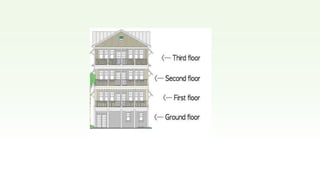
1. Floors divide a building into different levels, one above the other for the
purpose of creating more accommodation within a limited space.
2. Depending upon the position of floors, floor can be divided into 3 types
3. Basement floor-below ground level
4. Ground floor-above ground level.
5. Sub floor : structural component which support floor covering.
6. Floor covering/floor: constructed over sub floor and is intended to provide a
hard, clean, smooth, impervious and durable surface to the floor
34
TYPES OF FLOORS
1. Timber floors
2. Composite floors
3. Choice of a particular type depends upon:
.Span
.Maximum load
.Speed required in construction
.Materials and labour available
TIMBER FLOORS
1. Basement or ground floor of timber
2. Single joist timber floors
3. Double joist timber floors
4. Framed or triple timber floors
1. Basement or ground floor of timber
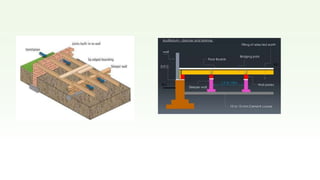
• Sleeper walls of 1 brick or 1.5 brick thick are constructed at centre to centre distance
of 1.2 to 1.8m
• Wall plates are provided along the wall as well as sleeper walls-serve as end supports
• Bridging joists provided at centre to centre distance of about 30cm rests on wall-plates
• Floor boards are provided to finish up the floor
Precautions to be taken
• Soil below timber floor is covered with PCC of thickness 100mm to 150mm
• DPC are provided in the exterior walls and on top of sleeper walls
• Well-seasoned timber is used
• Hollow space between bottom concrete and floor level is filled up with selected earth
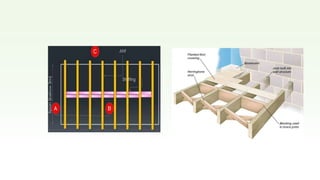
2. Single joist timber floors
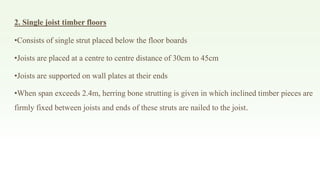
•Consists of single strut placed below the floor boards
•Joists are placed at a centre to centre distance of 30cm to 45cm
•Joists are supported on wall plates at their ends
•When span exceeds 2.4m, herring bone strutting is given in which inclined timber pieces are
firmly fixed between joists and ends of these struts are nailed to the joist.
3. Double joist timber floors
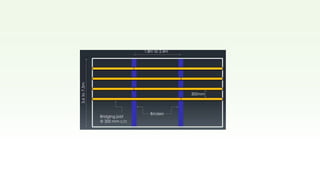
•Intermediate supports known as binders are provided for the bridging joists
•Binders are placed at a centre to centre distance of 1.8m to 2.4m
•Suitable for spans of 3.6m to 7.5m
•To reduce the over all depth of floor, bridging joists are cogged to binders
Disadvantages:
•Weight of floor is thrown on few points in a wall
•Depth of floor is increased by the use of binders and accordingly the height of room is
decreased
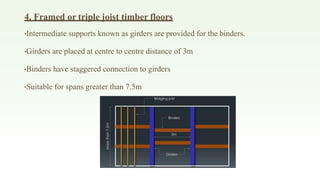
4. Framed or triple joist timber floors
•Intermediate supports known as girders are provided for the binders.
•Girders are placed at centre to centre distance of 3m
•Binders have staggered connection to girders
•Suitable for spans greater than 7.5m
COMPOSITE FLOORS
•Floors composed of more than one material are known as the composite floors
•Advantages over the timber floors :
1.The composite floors resist fire in a better way and they are more sound proof
2.Composite floors can be easily cleaned and hence they possess better hygienic
properties than the timber floors
3.The composite floors can be conveniently adopted for greater span
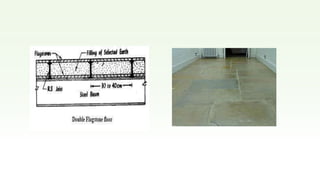
1. Double flagstone floors
▪Flagstones are used in 2 layers
▪If span is about 4m, only RSJ are provided
▪If span exceeds 4m, a framework consisting of Rolled Steel Beams and joists is
formed.
▪Steel beams are placed at a distance of about 3m centre to centre and joists are
placed at right angles to the beams
▪Flagstones of about 40mm thickness and of suitable widths are fixed on the lower
flanges and upper flanges
▪Filling of selected earth or concrete is done in the space between 2 layers of the
flagstones
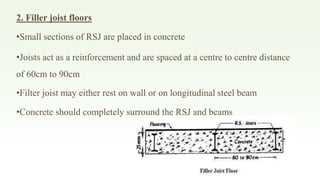
2. Filler joist floors
•Small sections of RSJ are placed in concrete
•Joists act as a reinforcement and are spaced at a centre to centre distance
of 60cm to 90cm
•Filter joist may either rest on wall or on longitudinal steel beam
•Concrete should completely surround the RSJ and beams
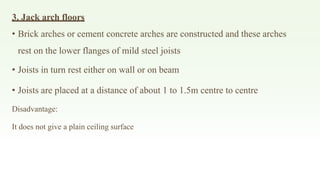
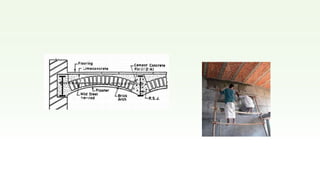
3. Jack arch floors
• Brick arches or cement concrete arches are constructed and these arches
rest on the lower flanges of mild steel joists
• Joists in turn rest either on wall or on beam
• Joists are placed at a distance of about 1 to 1.5m centre to centre
Disadvantage:
It does not give a plain ceiling surface
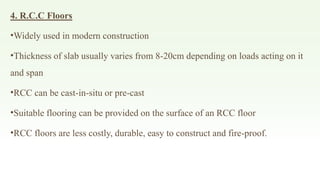
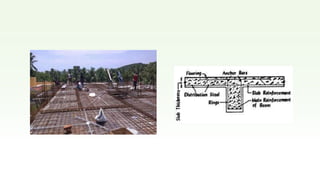
4. R.C.C Floors
•Widely used in modern construction
•Thickness of slab usually varies from 8-20cm depending on loads acting on it
and span
•RCC can be cast-in-situ or pre-cast
•Suitable flooring can be provided on the surface of an RCC floor
•RCC floors are less costly, durable, easy to construct and fire-proof.
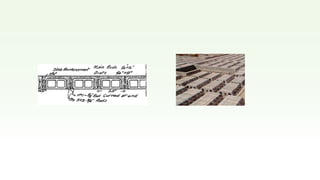
6.Hollow block and rib floors
•Hollow blocks of clay or concrete are used to reduce the total weight of the
floor
•Blocks are placed 100mm apart and in this space, mild steel bars are placed
•Blocks are provided with rough or grooved surface so that they can develop
enough bond with the concrete
•Economical, fireproof and light in weight.
•Plumbing and electrical installations can be conveniently carried through
hollow blocks without affecting the appearence
Thank You..

Floor

  • 1.
  • 2.
    1. Floors dividea building into different levels, one above the other for the purpose of creating more accommodation within a limited space. 2. Depending upon the position of floors, floor can be divided into 3 types 3. Basement floor-below ground level 4. Ground floor-above ground level. 5. Sub floor : structural component which support floor covering. 6. Floor covering/floor: constructed over sub floor and is intended to provide a hard, clean, smooth, impervious and durable surface to the floor
  • 4.
    34 TYPES OF FLOORS 1.Timber floors 2. Composite floors 3. Choice of a particular type depends upon: .Span .Maximum load .Speed required in construction .Materials and labour available
  • 5.
    TIMBER FLOORS 1. Basementor ground floor of timber 2. Single joist timber floors 3. Double joist timber floors 4. Framed or triple timber floors
  • 6.
    1. Basement orground floor of timber • Sleeper walls of 1 brick or 1.5 brick thick are constructed at centre to centre distance of 1.2 to 1.8m • Wall plates are provided along the wall as well as sleeper walls-serve as end supports • Bridging joists provided at centre to centre distance of about 30cm rests on wall-plates • Floor boards are provided to finish up the floor
  • 8.
    Precautions to betaken • Soil below timber floor is covered with PCC of thickness 100mm to 150mm • DPC are provided in the exterior walls and on top of sleeper walls • Well-seasoned timber is used • Hollow space between bottom concrete and floor level is filled up with selected earth
  • 9.
    2. Single joisttimber floors •Consists of single strut placed below the floor boards •Joists are placed at a centre to centre distance of 30cm to 45cm •Joists are supported on wall plates at their ends •When span exceeds 2.4m, herring bone strutting is given in which inclined timber pieces are firmly fixed between joists and ends of these struts are nailed to the joist.
  • 11.
    3. Double joisttimber floors •Intermediate supports known as binders are provided for the bridging joists •Binders are placed at a centre to centre distance of 1.8m to 2.4m •Suitable for spans of 3.6m to 7.5m •To reduce the over all depth of floor, bridging joists are cogged to binders Disadvantages: •Weight of floor is thrown on few points in a wall •Depth of floor is increased by the use of binders and accordingly the height of room is decreased
  • 13.
    4. Framed ortriple joist timber floors •Intermediate supports known as girders are provided for the binders. •Girders are placed at centre to centre distance of 3m •Binders have staggered connection to girders •Suitable for spans greater than 7.5m
  • 14.
    COMPOSITE FLOORS •Floors composedof more than one material are known as the composite floors •Advantages over the timber floors : 1.The composite floors resist fire in a better way and they are more sound proof 2.Composite floors can be easily cleaned and hence they possess better hygienic properties than the timber floors 3.The composite floors can be conveniently adopted for greater span
  • 15.
    1. Double flagstonefloors ▪Flagstones are used in 2 layers ▪If span is about 4m, only RSJ are provided ▪If span exceeds 4m, a framework consisting of Rolled Steel Beams and joists is formed. ▪Steel beams are placed at a distance of about 3m centre to centre and joists are placed at right angles to the beams ▪Flagstones of about 40mm thickness and of suitable widths are fixed on the lower flanges and upper flanges ▪Filling of selected earth or concrete is done in the space between 2 layers of the flagstones
  • 17.
    2. Filler joistfloors •Small sections of RSJ are placed in concrete •Joists act as a reinforcement and are spaced at a centre to centre distance of 60cm to 90cm •Filter joist may either rest on wall or on longitudinal steel beam •Concrete should completely surround the RSJ and beams
  • 18.
    3. Jack archfloors • Brick arches or cement concrete arches are constructed and these arches rest on the lower flanges of mild steel joists • Joists in turn rest either on wall or on beam • Joists are placed at a distance of about 1 to 1.5m centre to centre Disadvantage: It does not give a plain ceiling surface
  • 20.
    4. R.C.C Floors •Widelyused in modern construction •Thickness of slab usually varies from 8-20cm depending on loads acting on it and span •RCC can be cast-in-situ or pre-cast •Suitable flooring can be provided on the surface of an RCC floor •RCC floors are less costly, durable, easy to construct and fire-proof.
  • 22.
    6.Hollow block andrib floors •Hollow blocks of clay or concrete are used to reduce the total weight of the floor •Blocks are placed 100mm apart and in this space, mild steel bars are placed •Blocks are provided with rough or grooved surface so that they can develop enough bond with the concrete •Economical, fireproof and light in weight. •Plumbing and electrical installations can be conveniently carried through hollow blocks without affecting the appearence
  • 24.