1
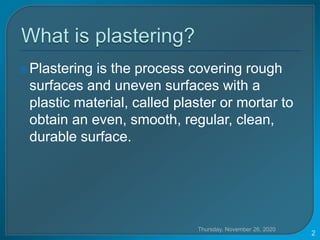
Plastering is the process covering rough
surfaces and uneven surfaces with a
plastic material, called plaster or mortar to
obtain an even, smooth, regular, clean,
durable surface.
Thursday, November 26, 2020
2
Thursday, November 26, 2020
3
• Ordinary Portland Cement (OPC)
• Lime of Clay
• Aggregates
• Water
• Admixture
Thursday, November 26, 2020
4
• It should be hard and durable
• It should be possible to supply it during all
weather conditions.
• It should adhere to the background and
should remain adhered during all climatic
changes.
• It should be cheap and economical.
• It should offer good insulation against sound
and high resistance against fire.
• It should effectively check the penetration of
moisture from the surface.
Thursday, November 26, 2020
5
Thursday, November 26, 2020
6
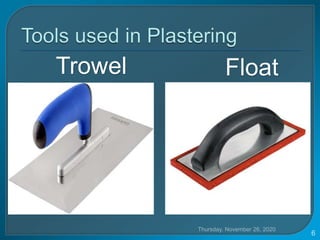
Trowel Float
7
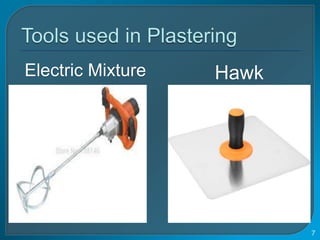
Electric Mixture Hawk
8
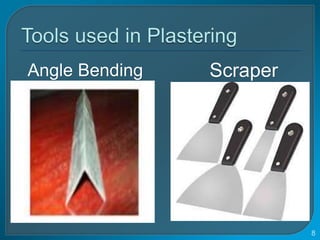
Angle Bending Scraper
Thursday, November 26, 2020
9
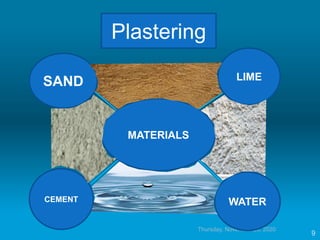
Plastering
MATERIALS
LIME
WATERCEMENT
SAND
Lime Plaster
Cement Plaster
Mud Plaster
Stucco Plaster
Plaster on lathe
Thursday, November 26, 2020
10
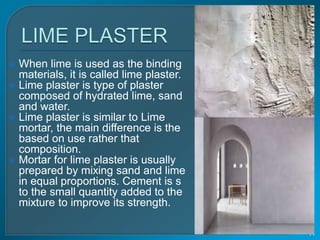
 When lime is used as the binding
materials, it is called lime plaster.
 Lime plaster is type of plaster
composed of hydrated lime, sand
and water.
 Lime plaster is similar to Lime
mortar, the main difference is the
based on use rather that
composition.
 Mortar for lime plaster is usually
prepared by mixing sand and lime
in equal proportions. Cement is s
to the small quantity added to the
mixture to improve its strength.
Thursday, November 26, 2020
11
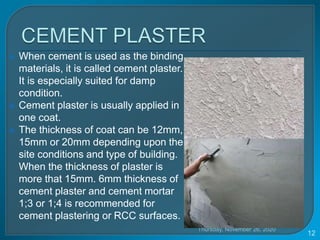
 When cement is used as the binding
materials, it is called cement plaster.
It is especially suited for damp
condition.
 Cement plaster is usually applied in
one coat.
 The thickness of coat can be 12mm,
15mm or 20mm depending upon the
site conditions and type of building.
When the thickness of plaster is
more that 15mm. 6mm thickness of
cement plaster and cement mortar
1;3 or 1;4 is recommended for
cement plastering or RCC surfaces.
Thursday, November 26, 2020
12
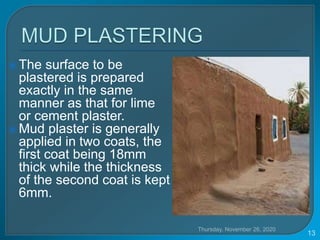
 The surface to be
plastered is prepared
exactly in the same
manner as that for lime
or cement plaster.
 Mud plaster is generally
applied in two coats, the
first coat being 18mm
thick while the thickness
of the second coat is kept
6mm.
Thursday, November 26, 2020
13
Thursday, November 26, 2020
14
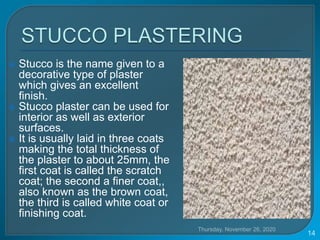
 Stucco is the name given to a
decorative type of plaster
which gives an excellent
finish.
 Stucco plaster can be used for
interior as well as exterior
surfaces.
 It is usually laid in three coats
making the total thickness of
the plaster to about 25mm, the
first coat is called the scratch
coat; the second a finer coat,,
also known as the brown coat,
the third is called white coat or
finishing coat.
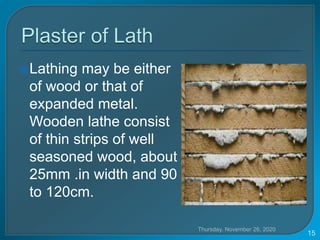
Lathing may be either
of wood or that of
expanded metal.
Wooden lathe consist
of thin strips of well
seasoned wood, about
25mm .in width and 90
to 120cm.
Thursday, November 26, 2020
15
Thursday, November 26, 2020
16
Thursday, November 26, 2020
17
Thursday, November 26, 2020
18
Thursday, November 26, 2020
19
Thursday, November 26, 2020
20
Cracking
Efflorescence
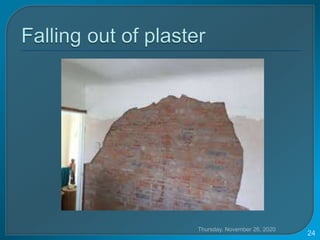
Falling out of plaster
Blowing of plaster
Thursday, November 26, 2020
21
Thursday, November 26, 2020
22
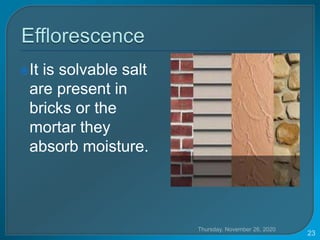
It is solvable salt
are present in
bricks or the
mortar they
absorb moisture.
Thursday, November 26, 2020
23
Thursday, November 26, 2020
24
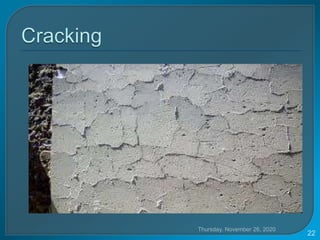
Cracking – Continuous damping of
plaster, in order to slow down any rapid
drying, to prevent cracking from
happening.
Thursday, November 26, 2020
25
Blistering – Usually caused by uneven mixing
of plaster, which could be prevented by
ensuring a sufficient mixing between cement
and its components to form plaster.
Thursday, November 26, 2020
26
Falling out of plaster
a. The adhesion of the plaster to the
back ground may not be perfect.
b. The suction of the backing
materials may not be uniform.
c. Excessive thermal changes in
plaster.
Thursday, November 26, 2020
27
Blowing of plaster
a. This consist of information of small
patches of plaster swelling but
beyond the plastered surface and
chiefly due to improper slaking or
lime particles in the plaster.
Thursday, November 26, 2020
28
Thursday, November 26, 2020
29
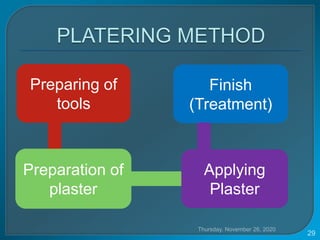
Preparing of
tools
Preparation of
plaster
Applying
Plaster
Finish
(Treatment)
Thursday, November 26, 2020
30

Plastering

  • 1.
  • 2.
    Plastering is theprocess covering rough surfaces and uneven surfaces with a plastic material, called plaster or mortar to obtain an even, smooth, regular, clean, durable surface. Thursday, November 26, 2020 2
  • 3.
  • 4.
    • Ordinary PortlandCement (OPC) • Lime of Clay • Aggregates • Water • Admixture Thursday, November 26, 2020 4
  • 5.
    • It shouldbe hard and durable • It should be possible to supply it during all weather conditions. • It should adhere to the background and should remain adhered during all climatic changes. • It should be cheap and economical. • It should offer good insulation against sound and high resistance against fire. • It should effectively check the penetration of moisture from the surface. Thursday, November 26, 2020 5
  • 6.
    Thursday, November 26,2020 6 Trowel Float
  • 7.
  • 8.
  • 9.
    Thursday, November 26,2020 9 Plastering MATERIALS LIME WATERCEMENT SAND
  • 10.
    Lime Plaster Cement Plaster MudPlaster Stucco Plaster Plaster on lathe Thursday, November 26, 2020 10
  • 11.
     When limeis used as the binding materials, it is called lime plaster.  Lime plaster is type of plaster composed of hydrated lime, sand and water.  Lime plaster is similar to Lime mortar, the main difference is the based on use rather that composition.  Mortar for lime plaster is usually prepared by mixing sand and lime in equal proportions. Cement is s to the small quantity added to the mixture to improve its strength. Thursday, November 26, 2020 11
  • 12.
     When cementis used as the binding materials, it is called cement plaster. It is especially suited for damp condition.  Cement plaster is usually applied in one coat.  The thickness of coat can be 12mm, 15mm or 20mm depending upon the site conditions and type of building. When the thickness of plaster is more that 15mm. 6mm thickness of cement plaster and cement mortar 1;3 or 1;4 is recommended for cement plastering or RCC surfaces. Thursday, November 26, 2020 12
  • 13.
     The surfaceto be plastered is prepared exactly in the same manner as that for lime or cement plaster.  Mud plaster is generally applied in two coats, the first coat being 18mm thick while the thickness of the second coat is kept 6mm. Thursday, November 26, 2020 13
  • 14.
    Thursday, November 26,2020 14  Stucco is the name given to a decorative type of plaster which gives an excellent finish.  Stucco plaster can be used for interior as well as exterior surfaces.  It is usually laid in three coats making the total thickness of the plaster to about 25mm, the first coat is called the scratch coat; the second a finer coat,, also known as the brown coat, the third is called white coat or finishing coat.
  • 15.
    Lathing may beeither of wood or that of expanded metal. Wooden lathe consist of thin strips of well seasoned wood, about 25mm .in width and 90 to 120cm. Thursday, November 26, 2020 15
  • 16.
  • 17.
  • 18.
  • 19.
  • 20.
  • 21.
    Cracking Efflorescence Falling out ofplaster Blowing of plaster Thursday, November 26, 2020 21
  • 22.
  • 23.
    It is solvablesalt are present in bricks or the mortar they absorb moisture. Thursday, November 26, 2020 23
  • 24.
  • 25.
    Cracking – Continuousdamping of plaster, in order to slow down any rapid drying, to prevent cracking from happening. Thursday, November 26, 2020 25
  • 26.
    Blistering – Usuallycaused by uneven mixing of plaster, which could be prevented by ensuring a sufficient mixing between cement and its components to form plaster. Thursday, November 26, 2020 26
  • 27.
    Falling out ofplaster a. The adhesion of the plaster to the back ground may not be perfect. b. The suction of the backing materials may not be uniform. c. Excessive thermal changes in plaster. Thursday, November 26, 2020 27
  • 28.
    Blowing of plaster a.This consist of information of small patches of plaster swelling but beyond the plastered surface and chiefly due to improper slaking or lime particles in the plaster. Thursday, November 26, 2020 28
  • 29.
    Thursday, November 26,2020 29 Preparing of tools Preparation of plaster Applying Plaster Finish (Treatment)
  • 30.