Downloaded 12 times
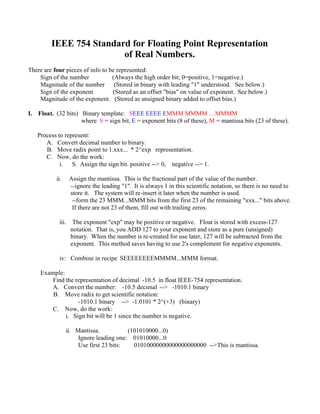


The IEEE 754 standard defines the floating point representation of real numbers. It uses a sign-magnitude format that includes: 1) A sign bit to indicate positive or negative. 2) A biased exponent stored with an offset to allow negative exponents. 3) A mantissa or significant digits with a leading 1 not explicitly stored. For single precision floats, this uses 32 bits broken into an 8-bit exponent and 23-bit mantissa. Doubles use 64 bits with an 11-bit exponent and 52-bit mantissa for greater precision and range.


