Jesus in Light of Mark‘s
Gospel
Roberto Taylor
Spring, 2014
Jesus in Light of Mark‘s Gospel


Mark is the earliest of the four gospels
according to most New Testament
scholars



Date 60-70 AD



Author: believed to be John Mark
Authorship and Date


The Gospel of Mark nowhere mentions the
name of the author. The earliest witness to
identify the author was Papias (A.D. 60-130), a
bishop of Hierapolis in Asia Minor (Turkey).
Papias called him Mark, an interpreter of
Peter. Papias then added that Mark had not
followed Jesus during His lifetime, but later
had written down Peter‘s recollections
accurately, although not always in their proper
order.
Authorship and Date


Mark‘s gospel like all the other NT
gospels is anonymous.



The books of the New Testament
normally required authorship by an
apostle or someone closely related to an
apostle to qualify for acceptance in the
Canon. On this grounds it is likely that
the book was attributed to John Mark.
Background and Settings


Mark‘s gospel is believed to have been
written against the background of the fire
that destroyed Rome in A.D. 64 and the
subsequent persecution of Christians
that followed.
Background and Settings
In A.D. 64 Rome was completely
destroyed by fire. Rumors were rife that
the emperor Nero, officially ordered the
fire.
 In an effort to divert attention from
himself, Nero blamed a group of people
who before were somewhat stigmatized,
i.e., the Christians

Background and Settings
Note before A.D. 64 the Christians were
accused of being ‗haters of humanity,‘
because they did not participate in the
pagan guild feasts and other social
affairs. They were also accused as being
atheists because they did not worship
the popular gods of the empire.
 Nero therefore used them as scapegoat

Background: Theme of Suffering


Against this background many themes and
undertones of suffering appears throughout
the book of Mark. The suffering of Jesus is
seen as a type of the suffering that the
Christians must suffer



The Christians who were thrown to wild beasts
in the arena would be encouraged by the such
statement as 1:12, 13 ―Jesus was with the wild
beast‖ – found only in Mark‘s gospel
Background: Theme of Suffering
Jesus was misrepresented and falsely
labeled 3:21, 30, as the Christians in
Rome were
 For other themes of persecution and
suffering, see 4:17; 10:30 - ―With
persecution‖- unique to Mark
 13.1-13
 8.34-38

Main theme of Mark‘s Gospel:
The Kingdom of God
.
Main theme of Mark‘s Gospel:
The Kingdom of God


The theme of the Gospel is summarized
in chapter 1:15



The time is fulfilled, and the kingdom of
God is at hand repent and believe the
gospel
Main Theme: The Kingdom of God


The Kingdom of God, means the rule or reign
of God



The time is fulfilled: signified prophetic time of
the OT that foretells the coming kingdom




At hand signified that the kingdom is virtually
present. You could almost touch it
 Gospel: that which is about Jesus, salvation in
Jesus
Presence of the Future


This theme signifies that a new era in
salvation‘s history has dawned. God has
made a new intervention on behalf of
humanity.



This was being realized in the life, death
and resurrection of Jesus
The Presence of the Future
In the ultimate kingdom there would be
no death. So Jesus raised the dead…..
 In the ultimate kingdom there would be
no sickness therefore Jesus healed the
sick ……
 In the ultimate kingdom the devils would
be vanquished, therefore Jesus expelled
the demons 1:24-27; 1:29-31; 5:1-43
 Fill in the texts for the above statements

Literary Characteristics of Mark‘s
Gospel


Audience: Christians in Rome, i.e., Gentile
audience . The language usage helps to
identify the audience as a Gentile audience



Mark translates Aramaic phrases such as:
talitha koum or ephpatha into Greek # 5:41;
7:34



Latin was spoken in Rome hence the use of
Latin terms suggests
Latin terms


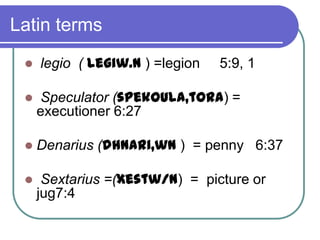
legio ( legiw.n ) =legion

5:9, 1



Speculator (spekoula,tora) =
executioner 6:27



Denarius (dhnari,wn ) = penny 6:37



Sextarius =(xestw/n) = picture or
jug7:4
Greek Explained by Latin Terms


Twice Greek expression are explained
by Latin terms:



12: 42: Two copper coins [lepta] which
make a quadrans



15: 16: The palace - (aule - auvlh) that
is, the Praetorium
Writing Style
His sentences are constructed in a
simple manner and are strung together
by conjunction Kai, i.e. and
 His Greek is Barbarous or unrefined
 Very vivid portrayal of Jesus and events
 Greater length on more details in many
stories (2:1-12; 5:1-20)
 Wild beast in the wilderness (1:13)

Writing Style


Great use of the Historical
present, i.e., the present tense used to
describe the past – purpose for
vividness.



Mark uses this grammatical device 150
times
Historical Present


Mk 1:41: he touched him and legei- say
(English – said)



Mk 6:1 he went out and erchetai- comes(English- came) into his homeland and



His disciples followed follows him 1:40;
See also 3:20; 5:22; 10:1; 14:17
Structure of the Gospel


The Gospel of Mark can be divided
roughly into two parts:
1. Jesus‘ ministry in Galilee (chaps. 1-9)
2. Jesus‘ ministry in Judea (chap10-16)
3. Jesus‘ ministry in Jerusalem (chaps.
10-16).
Structure of the Gospel


Mark begins his gospel with the
appearance of John the Baptist (1:28), followed by the baptism of Jesus (1:911).



Mark commented on the temptation of
Jesus only briefly (1:12-13) and
concludes his introduction by a capsule
of Jesus‘ message.
Structure of the Gospel


First half of gospel reaches a climax in
8:29 with Peter‘s confession

Second half climaxes in 15:39 with the
centurion‘s confession
 A passion narrative with an extended
introduction, as the second half
describes mostly the passion narrative

Characteristics of Jesus in
Mark‘s Gospel
.
Jesus as a Man of Action

Mark portrays the person of Jesus more
by what He does than by what He says.
It is characterized by a vivid, direct style
that leaves the impression of familiarity
with the original events
Jesus a Man of Action


Jesus presented as a man of action
(Roman principle of gravitas)



In Mark everything is done “right away,”
“right then” Immediately: Greek:
euthus, used 41 times
(1:10, 12, 18, 20, 21, 23, 28, 29, 30, 42.
See Kerr, Images, 82)
Jesus a Man of Action


While Matthew records the teachings of Jesus
Mark records his actions, particularly in
miracles



Mark records 18 miracles: (See, Images, 84)



Note: Mark records only four parables of
Jesus- (4:26-29 unique to Mark)



A third of the book is dedicated to the mighty
works of Jesus (Kerr, Images, 81)
Jesus a Man of Action


The last week of Jesus‘ life occupies one third of the
gospel, i.e., chap‘s 11-16



Note: all four gospels devoted between 15-20 percent
of their gospels to the last week of Jesus‘ life



―Similar amounts are given over to their subject‘s
death in biographies by Plutarch, Tacitus Nepos and
Philostratus, since this crisis the hero reveals his true
character, gives his definitive teachings or does his
greatest deed.‖ Kerr, Images, 85
Jesus Presented as a Real Man
If Mark was the only gospel we had then
we would not consider Jesus to be
anything other than a human being
 Jesus‘ chief designation of himself in all
the gospels is SON OF MAN
 Sixteen (16) times in Mark he is
designated as such

Jesus Presented as a Real
Man:


This term is always on the lips of Jesus.
Jesus is hardly ever addressed as such.
It is mostly he who refers to himself as
‗son of man‘



The title ‗Son of man,‘ is used 69 times
in the Synoptics, in John it is used
thirteen (13) times, & the rest of NT only
once (1)


Titles for Jesus Throughout the NT
The titles used to addressed Jesus depends on
the audience to which a particular book is
addressed:
 To Palestine Jewish Christianity, Jesus
addressed as Messiah
 To Hellenistic Jewish Christianity Jesus
addressed as, Son of God
 To Gentile Christianity Jesus addressed as
Lord. Note the term Lord is used mostly in
the Pauline Epistles— 230 times Paul, not in
John‘s gospel
Jesus a Real Man
a)

Got angry: 1:41; 3:5; 10:14
b) Filled with compassion and sorrow
6:34; 4:33
c) Sigh with rejection 7:34; 8:12
Messianic Secret







Jesus conceals the fact that he was the messiah
Demons affirms him as the son of man but Jesus
silences them: (1:21-25; 3:11-12; 5:7)
Commanded persons healed not to announce it: (Mk
1:43-45; 5:43; 7:36)
Secrecy of his whereabouts 1:45; 7:24; 9:30-31
In cryptic speeches, private miracles, few witnesses
1:29-31; 5:40; 7:17; 10:10
Parables the crowd could not comprehend: 4:10-13
(Kerr, Images,83)
Messianic Secret: Purpose


The purpose of this secrecy was that
Jesus never wanted his role as Messiah
to be understood in the popular way that
Messiah was understood among the
Jews in the first century. Messiah was
understood as a political revolutionary,
but Jesus linked his role as Messiah with
that of a suffering servant, not a
revolutionary. See 8: 27-35
Nature of Jesus‘ Disciples
.
Disciples Ignorance, etc


Jesus disciples in Mark are presented as
being dumb and ignorant. They are
always slow of learning, lacking in faith
and never seems to fully understand
Jesus.
Disciples Ignorance, etc.
4.10-20, 13: Ignorance re-the parable of
the seeds on different soil
 7:18: Ignorant re- that which defiles
 8:15-17: Ignorant re- the leaven of the
scribes
 8:31-33: Ignorance re- Jesus’ suffering
 6.51-52: Ignorant the identity of Jesus,
call him a ghost)

Sandwich Stories
Mark is found of beginning a story then,
in the midst of that story he introduces a
new story, then finally returns to the first
story. Thus the stories are sandwiched
between each other. They follow an A:B:
A, pattern
 These stories mutually explains each
other and deepens the meaning of each
other

Sandwich Stories,
Read the following passages and
observer the interlocking of the stories
 3:20-35
 4:1-20
 5:21-43
 6:7-30
 11:12-25
 14:1-11

.


Although Mark is the shortest of the four
gospels, it pays close attention to matters of
human interest. Mark is fond of linking the
episodes of Jesus‘ ministry with catchwords
(for example, ―immediately‖, ―then‖), rather
than editorial comments; and frequently he
interrupts a longer story by inserting a smaller
one within it. Frequently referred to as
sandwich stories (Mark 5:21-43; 6:6-30; 14:111).
Endings of Mark









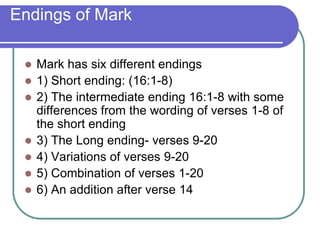
Mark has six different endings
1) Short ending: (16:1-8)
2) The intermediate ending 16:1-8 with some
differences from the wording of verses 1-8 of
the short ending
3) The Long ending- verses 9-20
4) Variations of verses 9-20
5) Combination of verses 1-20
6) An addition after verse 14
x

The End

Gospel of Mark

  • 1.
    Jesus in Lightof Mark‘s Gospel Roberto Taylor Spring, 2014
  • 2.
    Jesus in Lightof Mark‘s Gospel  Mark is the earliest of the four gospels according to most New Testament scholars  Date 60-70 AD  Author: believed to be John Mark
  • 3.
    Authorship and Date  TheGospel of Mark nowhere mentions the name of the author. The earliest witness to identify the author was Papias (A.D. 60-130), a bishop of Hierapolis in Asia Minor (Turkey). Papias called him Mark, an interpreter of Peter. Papias then added that Mark had not followed Jesus during His lifetime, but later had written down Peter‘s recollections accurately, although not always in their proper order.
  • 4.
    Authorship and Date  Mark‘sgospel like all the other NT gospels is anonymous.  The books of the New Testament normally required authorship by an apostle or someone closely related to an apostle to qualify for acceptance in the Canon. On this grounds it is likely that the book was attributed to John Mark.
  • 5.
    Background and Settings  Mark‘sgospel is believed to have been written against the background of the fire that destroyed Rome in A.D. 64 and the subsequent persecution of Christians that followed.
  • 6.
    Background and Settings InA.D. 64 Rome was completely destroyed by fire. Rumors were rife that the emperor Nero, officially ordered the fire.  In an effort to divert attention from himself, Nero blamed a group of people who before were somewhat stigmatized, i.e., the Christians 
  • 7.
    Background and Settings Notebefore A.D. 64 the Christians were accused of being ‗haters of humanity,‘ because they did not participate in the pagan guild feasts and other social affairs. They were also accused as being atheists because they did not worship the popular gods of the empire.  Nero therefore used them as scapegoat 
  • 8.
    Background: Theme ofSuffering  Against this background many themes and undertones of suffering appears throughout the book of Mark. The suffering of Jesus is seen as a type of the suffering that the Christians must suffer  The Christians who were thrown to wild beasts in the arena would be encouraged by the such statement as 1:12, 13 ―Jesus was with the wild beast‖ – found only in Mark‘s gospel
  • 9.
    Background: Theme ofSuffering Jesus was misrepresented and falsely labeled 3:21, 30, as the Christians in Rome were  For other themes of persecution and suffering, see 4:17; 10:30 - ―With persecution‖- unique to Mark  13.1-13  8.34-38 
  • 10.
    Main theme ofMark‘s Gospel: The Kingdom of God .
  • 11.
    Main theme ofMark‘s Gospel: The Kingdom of God  The theme of the Gospel is summarized in chapter 1:15  The time is fulfilled, and the kingdom of God is at hand repent and believe the gospel
  • 12.
    Main Theme: TheKingdom of God  The Kingdom of God, means the rule or reign of God  The time is fulfilled: signified prophetic time of the OT that foretells the coming kingdom   At hand signified that the kingdom is virtually present. You could almost touch it  Gospel: that which is about Jesus, salvation in Jesus
  • 13.
    Presence of theFuture  This theme signifies that a new era in salvation‘s history has dawned. God has made a new intervention on behalf of humanity.  This was being realized in the life, death and resurrection of Jesus
  • 14.
    The Presence ofthe Future In the ultimate kingdom there would be no death. So Jesus raised the dead…..  In the ultimate kingdom there would be no sickness therefore Jesus healed the sick ……  In the ultimate kingdom the devils would be vanquished, therefore Jesus expelled the demons 1:24-27; 1:29-31; 5:1-43  Fill in the texts for the above statements 
  • 15.
    Literary Characteristics ofMark‘s Gospel  Audience: Christians in Rome, i.e., Gentile audience . The language usage helps to identify the audience as a Gentile audience  Mark translates Aramaic phrases such as: talitha koum or ephpatha into Greek # 5:41; 7:34  Latin was spoken in Rome hence the use of Latin terms suggests
  • 16.
    Latin terms  legio (legiw.n ) =legion 5:9, 1  Speculator (spekoula,tora) = executioner 6:27  Denarius (dhnari,wn ) = penny 6:37  Sextarius =(xestw/n) = picture or jug7:4
  • 17.
    Greek Explained byLatin Terms  Twice Greek expression are explained by Latin terms:  12: 42: Two copper coins [lepta] which make a quadrans  15: 16: The palace - (aule - auvlh) that is, the Praetorium
  • 18.
    Writing Style His sentencesare constructed in a simple manner and are strung together by conjunction Kai, i.e. and  His Greek is Barbarous or unrefined  Very vivid portrayal of Jesus and events  Greater length on more details in many stories (2:1-12; 5:1-20)  Wild beast in the wilderness (1:13) 
  • 19.
    Writing Style  Great useof the Historical present, i.e., the present tense used to describe the past – purpose for vividness.  Mark uses this grammatical device 150 times
  • 20.
    Historical Present  Mk 1:41:he touched him and legei- say (English – said)  Mk 6:1 he went out and erchetai- comes(English- came) into his homeland and  His disciples followed follows him 1:40; See also 3:20; 5:22; 10:1; 14:17
  • 21.
    Structure of theGospel  The Gospel of Mark can be divided roughly into two parts: 1. Jesus‘ ministry in Galilee (chaps. 1-9) 2. Jesus‘ ministry in Judea (chap10-16) 3. Jesus‘ ministry in Jerusalem (chaps. 10-16).
  • 22.
    Structure of theGospel  Mark begins his gospel with the appearance of John the Baptist (1:28), followed by the baptism of Jesus (1:911).  Mark commented on the temptation of Jesus only briefly (1:12-13) and concludes his introduction by a capsule of Jesus‘ message.
  • 23.
    Structure of theGospel  First half of gospel reaches a climax in 8:29 with Peter‘s confession Second half climaxes in 15:39 with the centurion‘s confession  A passion narrative with an extended introduction, as the second half describes mostly the passion narrative 
  • 24.
    Characteristics of Jesusin Mark‘s Gospel .
  • 25.
    Jesus as aMan of Action Mark portrays the person of Jesus more by what He does than by what He says. It is characterized by a vivid, direct style that leaves the impression of familiarity with the original events
  • 26.
    Jesus a Manof Action  Jesus presented as a man of action (Roman principle of gravitas)  In Mark everything is done “right away,” “right then” Immediately: Greek: euthus, used 41 times (1:10, 12, 18, 20, 21, 23, 28, 29, 30, 42. See Kerr, Images, 82)
  • 27.
    Jesus a Manof Action  While Matthew records the teachings of Jesus Mark records his actions, particularly in miracles  Mark records 18 miracles: (See, Images, 84)  Note: Mark records only four parables of Jesus- (4:26-29 unique to Mark)  A third of the book is dedicated to the mighty works of Jesus (Kerr, Images, 81)
  • 28.
    Jesus a Manof Action  The last week of Jesus‘ life occupies one third of the gospel, i.e., chap‘s 11-16  Note: all four gospels devoted between 15-20 percent of their gospels to the last week of Jesus‘ life  ―Similar amounts are given over to their subject‘s death in biographies by Plutarch, Tacitus Nepos and Philostratus, since this crisis the hero reveals his true character, gives his definitive teachings or does his greatest deed.‖ Kerr, Images, 85
  • 29.
    Jesus Presented asa Real Man If Mark was the only gospel we had then we would not consider Jesus to be anything other than a human being  Jesus‘ chief designation of himself in all the gospels is SON OF MAN  Sixteen (16) times in Mark he is designated as such 
  • 30.
    Jesus Presented asa Real Man:  This term is always on the lips of Jesus. Jesus is hardly ever addressed as such. It is mostly he who refers to himself as ‗son of man‘  The title ‗Son of man,‘ is used 69 times in the Synoptics, in John it is used thirteen (13) times, & the rest of NT only once (1) 
  • 31.
    Titles for JesusThroughout the NT The titles used to addressed Jesus depends on the audience to which a particular book is addressed:  To Palestine Jewish Christianity, Jesus addressed as Messiah  To Hellenistic Jewish Christianity Jesus addressed as, Son of God  To Gentile Christianity Jesus addressed as Lord. Note the term Lord is used mostly in the Pauline Epistles— 230 times Paul, not in John‘s gospel
  • 32.
    Jesus a RealMan a) Got angry: 1:41; 3:5; 10:14 b) Filled with compassion and sorrow 6:34; 4:33 c) Sigh with rejection 7:34; 8:12
  • 33.
    Messianic Secret       Jesus concealsthe fact that he was the messiah Demons affirms him as the son of man but Jesus silences them: (1:21-25; 3:11-12; 5:7) Commanded persons healed not to announce it: (Mk 1:43-45; 5:43; 7:36) Secrecy of his whereabouts 1:45; 7:24; 9:30-31 In cryptic speeches, private miracles, few witnesses 1:29-31; 5:40; 7:17; 10:10 Parables the crowd could not comprehend: 4:10-13 (Kerr, Images,83)
  • 34.
    Messianic Secret: Purpose  Thepurpose of this secrecy was that Jesus never wanted his role as Messiah to be understood in the popular way that Messiah was understood among the Jews in the first century. Messiah was understood as a political revolutionary, but Jesus linked his role as Messiah with that of a suffering servant, not a revolutionary. See 8: 27-35
  • 35.
    Nature of Jesus‘Disciples .
  • 36.
    Disciples Ignorance, etc  Jesusdisciples in Mark are presented as being dumb and ignorant. They are always slow of learning, lacking in faith and never seems to fully understand Jesus.
  • 37.
    Disciples Ignorance, etc. 4.10-20,13: Ignorance re-the parable of the seeds on different soil  7:18: Ignorant re- that which defiles  8:15-17: Ignorant re- the leaven of the scribes  8:31-33: Ignorance re- Jesus’ suffering  6.51-52: Ignorant the identity of Jesus, call him a ghost) 
  • 38.
    Sandwich Stories Mark isfound of beginning a story then, in the midst of that story he introduces a new story, then finally returns to the first story. Thus the stories are sandwiched between each other. They follow an A:B: A, pattern  These stories mutually explains each other and deepens the meaning of each other 
  • 39.
    Sandwich Stories, Read thefollowing passages and observer the interlocking of the stories  3:20-35  4:1-20  5:21-43  6:7-30  11:12-25  14:1-11 
  • 40.
    .  Although Mark isthe shortest of the four gospels, it pays close attention to matters of human interest. Mark is fond of linking the episodes of Jesus‘ ministry with catchwords (for example, ―immediately‖, ―then‖), rather than editorial comments; and frequently he interrupts a longer story by inserting a smaller one within it. Frequently referred to as sandwich stories (Mark 5:21-43; 6:6-30; 14:111).
  • 41.
    Endings of Mark        Markhas six different endings 1) Short ending: (16:1-8) 2) The intermediate ending 16:1-8 with some differences from the wording of verses 1-8 of the short ending 3) The Long ending- verses 9-20 4) Variations of verses 9-20 5) Combination of verses 1-20 6) An addition after verse 14
  • 42.