1
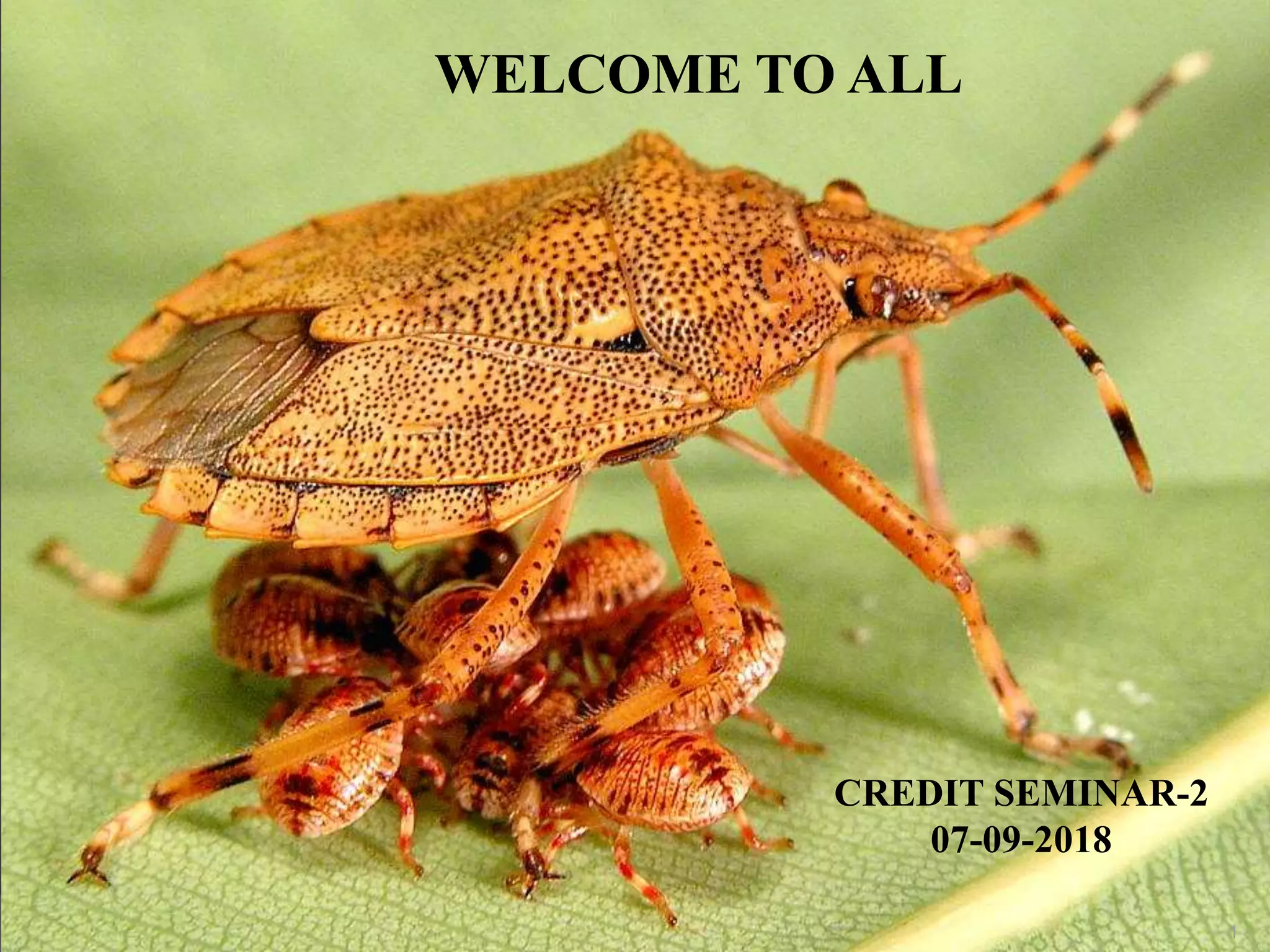
WELCOME TO ALL
CREDIT SEMINAR-2
07-09-2018
2
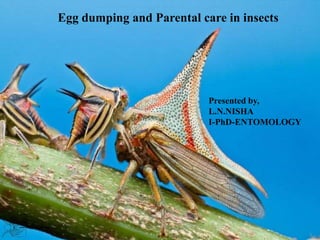
Egg dumping and Parental care in insects
Presented by,
L.N.NISHA
I-PhD-ENTOMOLOGY
3
OUTLINE
1. Egg dumping- Introduction
2. Egg dumping in insects
3. Why dump???
4. Parental care- Definition
5. Parental care- Introduction
6. Socio-ecology of insects
7. Parental care with solitary nesting
8. Parental care without nesting
9. Parental care with communal nesting
10. Forms of parental care
11. Communication b/w parent and off-spring
12. In what way they care their child???
13. Cost & benefit of parental care
14. Case study (1,2 & 3)
15. Conclusion
4
Egg dumping- Introduction
Avian literature- To describe the behavior of females
that regularly or occasionally parasitize the maternal
behavior of other females by laying eggs in their nests
Females that place the eggs under the care of
conspecifics have been labeled egg dumpers
5
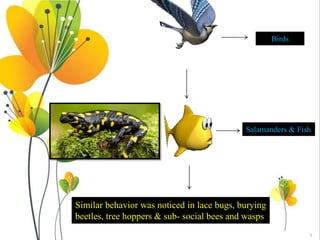
Similar behavior was noticed in lace bugs, burying
beetles, tree hoppers & sub- social bees and wasps
Birds
Salamanders & Fish
6
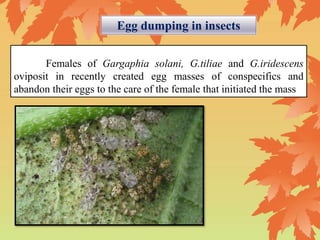
Egg dumping in insects
Females of Gargaphia solani, G.tiliae and G.iridescens
oviposit in recently created egg masses of conspecifics and
abandon their eggs to the care of the female that initiated the mass
7
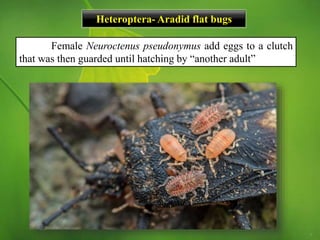
Heteroptera- Aradid flat bugs
Female Neuroctenus pseudonymus add eggs to a clutch
that was then guarded until hatching by “another adult”
8
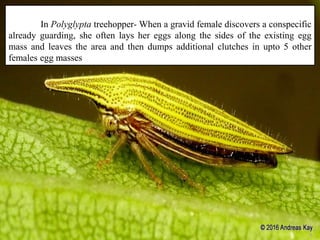
In Polyglypta treehopper- When a gravid female discovers a conspecific
already guarding, she often lays her eggs along the sides of the existing egg
mass and leaves the area and then dumps additional clutches in upto 5 other
females egg masses
9
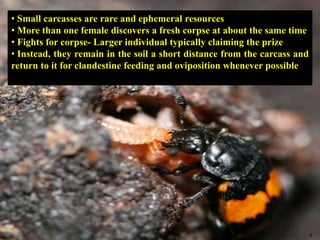
• Small carcasses are rare and ephemeral resources
• More than one female discovers a fresh corpse at about the same time
• Fights for corpse- Larger individual typically claiming the prize
• Instead, they remain in the soil a short distance from the carcass and
return to it for clandestine feeding and oviposition whenever possible
10
Why Dump????
• Careless laying by unfit female
• Aberrant breeding habitats
• Degenerative reproductive habits
• Is a conditional strategy to which females resort only
when there is a shortage of nesting sites (or) if their
own nests are destroyed
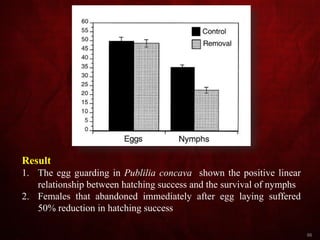
11
Parental care- Definition
Any post- ovipositional behavior that promotes survival, growth
and development of off-spring
(Tallamy et al., 1984)
Altruistic trait evolved to enhance the fitness of the recipients
(off-spring) at the expense of the donor (parents)
(Royle et al., 2012)
12
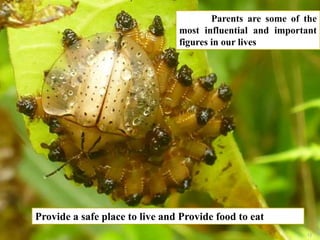
Parents are some of the
most influential and important
figures in our lives
Provide a safe place to live and Provide food to eat
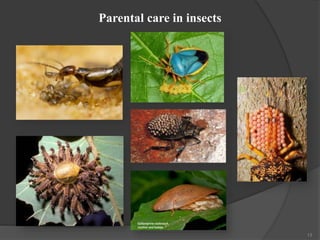
Parental care in insects
13
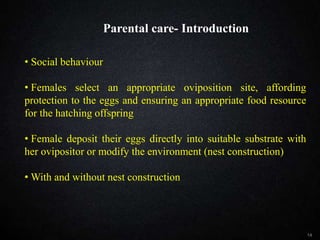
Parental care- Introduction
14
• Social behaviour
• Females select an appropriate oviposition site, affording
protection to the eggs and ensuring an appropriate food resource
for the hatching offspring
• Female deposit their eggs directly into suitable substrate with
her ovipositor or modify the environment (nest construction)
• With and without nest construction
Parental care- Introduction
15
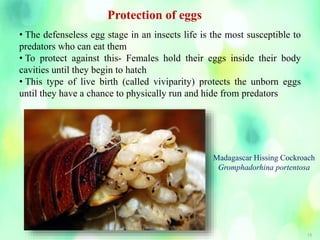
Protection of eggs
• The defenseless egg stage in an insects life is the most susceptible to
predators who can eat them
• To protect against this- Females hold their eggs inside their body
cavities until they begin to hatch
• This type of live birth (called viviparity) protects the unborn eggs
until they have a chance to physically run and hide from predators
Madagascar Hissing Cockroach
Gromphadorhina portentosa
16
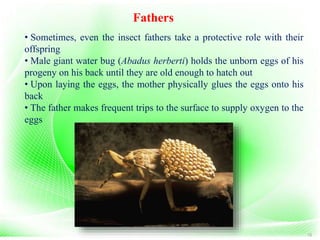
Fathers
• Sometimes, even the insect fathers take a protective role with their
offspring
• Male giant water bug (Abadus herberti) holds the unborn eggs of his
progeny on his back until they are old enough to hatch out
• Upon laying the eggs, the mother physically glues the eggs onto his
back
• The father makes frequent trips to the surface to supply oxygen to the
eggs
17
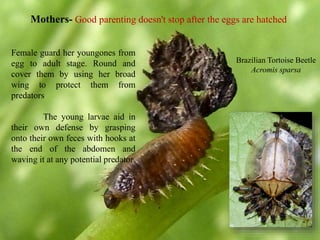
Mothers- Good parenting doesn't stop after the eggs are hatched
Brazilian Tortoise Beetle
Acromis sparsa
Female guard her youngones from
egg to adult stage. Round and
cover them by using her broad
wing to protect them from
predators
The young larvae aid in
their own defense by grasping
onto their own feces with hooks at
the end of the abdomen and
waving it at any potential predator
18
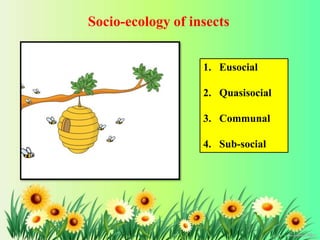
Socio-ecology of insects
1. Eusocial
2. Quasisocial
3. Communal
4. Sub-social
Parental care with solitary nesting
19
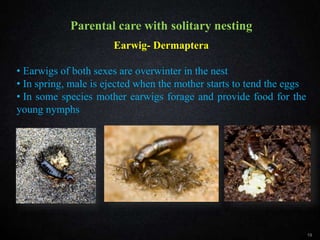
Earwig- Dermaptera
• Earwigs of both sexes are overwinter in the nest
• In spring, male is ejected when the mother starts to tend the eggs
• In some species mother earwigs forage and provide food for the
young nymphs
Parental care with solitary nesting
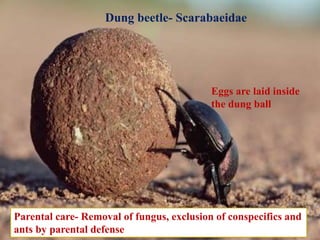
Dung beetle- Scarabaeidae
20
Eggs are laid inside
the dung ball
Parental care- Removal of fungus, exclusion of conspecifics and
ants by parental defense
Dung beetle- Scarabaeidae
Hymenoptera
21
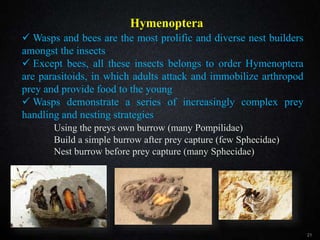
 Wasps and bees are the most prolific and diverse nest builders
amongst the insects
 Except bees, all these insects belongs to order Hymenoptera
are parasitoids, in which adults attack and immobilize arthropod
prey and provide food to the young
 Wasps demonstrate a series of increasingly complex prey
handling and nesting strategies
Using the preys own burrow (many Pompilidae)
Build a simple burrow after prey capture (few Sphecidae)
Nest burrow before prey capture (many Sphecidae)
Hymenoptera
• The primitive nest site was probably a pre- existing burrow, with
the construction medium later being soil or sand
22
• Further specializations involved the use of plant materials like
1. Stems
2. Rotten wood
3. Solid wood (carpenter bees, Xylocopini)
4. Free standing constructions of chewed vegetation
(Megachilinae)
5. Mud (Eumeninae)
•A range of natural materials are used in making and sealing cells
including muds, resins and oils secreted by plants
• The primitive nest site was probably a pre- existing burrow,
with the construction medium later being soil or sand
23
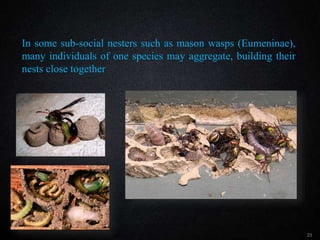
In some sub-social nesters such as mason wasps (Eumeninae),
many individuals of one species may aggregate, building their
nests close together
24
Parental care without nesting
• Minimum protection
• High mortality occurs
25
Hemiptera- Belostomatidae
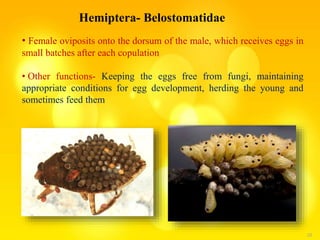
• Female oviposits onto the dorsum of the male, which receives eggs in
small batches after each copulation
• Other functions- Keeping the eggs free from fungi, maintaining
appropriate conditions for egg development, herding the young and
sometimes feed them
26
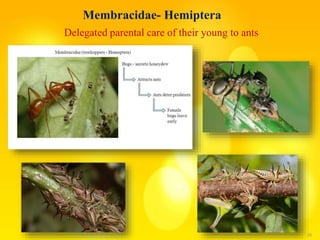
Membracidae- Hemiptera
Delegated parental care of their young to ants
27
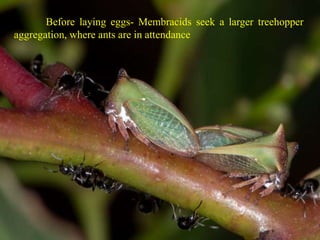
Before laying eggs- Membracids seek a larger treehopper
aggregation, where ants are in attendance
28
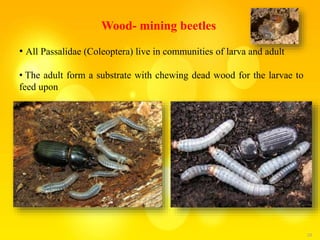
Wood- mining beetles
• All Passalidae (Coleoptera) live in communities of larva and adult
• The adult form a substrate with chewing dead wood for the larvae to
feed upon
29
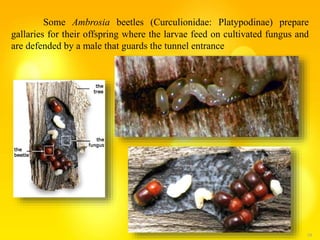
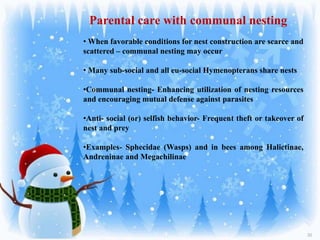
Some Ambrosia beetles (Curculionidae: Platypodinae) prepare
gallaries for their offspring where the larvae feed on cultivated fungus and
are defended by a male that guards the tunnel entrance
30
Parental care with communal nesting
• When favorable conditions for nest construction are scarce and
scattered – communal nesting may occur
• Many sub-social and all eu-social Hymenopterans share nests
•Communal nesting- Enhancing utilization of nesting resources
and encouraging mutual defense against parasites
•Anti- social (or) selfish behavior- Frequent theft or takeover of
nest and prey
•Examples- Sphecidae (Wasps) and in bees among Halictinae,
Andreninae and Megachilinae
31
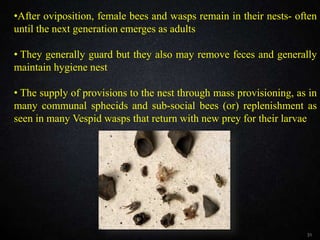
•After oviposition, female bees and wasps remain in their nests- often
until the next generation emerges as adults
• They generally guard but they also may remove feces and generally
maintain hygiene nest
• The supply of provisions to the nest through mass provisioning, as in
many communal sphecids and sub-social bees (or) replenishment as
seen in many Vespid wasps that return with new prey for their larvae
32
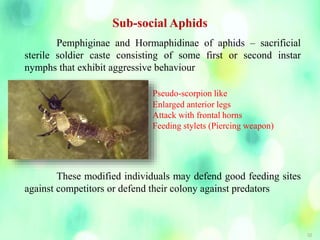
Sub-social Aphids
Pemphiginae and Hormaphidinae of aphids – sacrificial
sterile soldier caste consisting of some first or second instar
nymphs that exhibit aggressive behaviour
Pseudo-scorpion like
Enlarged anterior legs
Attack with frontal horns
Feeding stylets (Piercing weapon)
These modified individuals may defend good feeding sites
against competitors or defend their colony against predators
33
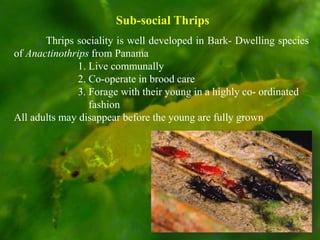
Sub-social Thrips
Thrips sociality is well developed in Bark- Dwelling species
of Anactinothrips from Panama
1. Live communally
2. Co-operate in brood care
3. Forage with their young in a highly co- ordinated
fashion
All adults may disappear before the young are fully grown
34
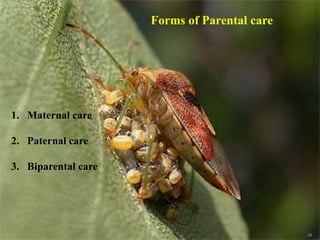
Forms of Parental care
1. Maternal care
2. Paternal care
3. Biparental care
MATERNAL CARE
35
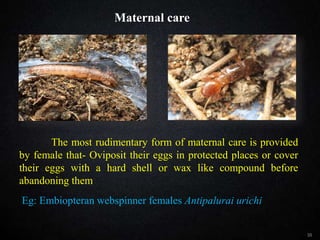
The most rudimentary form of maternal care is provided
by female that- Oviposit their eggs in protected places or cover
their eggs with a hard shell or wax like compound before
abandoning them
Eg: Embiopteran webspinner females Antipalurai urichi
Maternal care
36
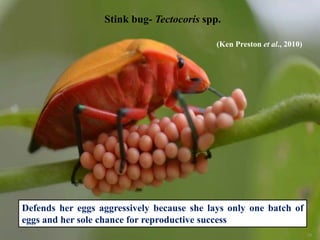
Stink bug- Tectocoris spp.
Defends her eggs aggressively because she lays only one batch of
eggs and her sole chance for reproductive success
(Ken Preston et al., 2010)
Many species of insects guard their youngones
against predators by using defensive behaviour
37
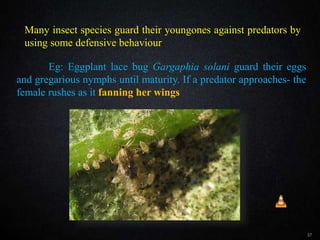
Eg: Eggplant lace bug Gargaphia solani guard their eggs
and gregarious nymphs until maturity. If a predator approaches- the
female rushes as it fanning her wings
Many insect species guard their youngones against predators by
using some defensive behaviour
38
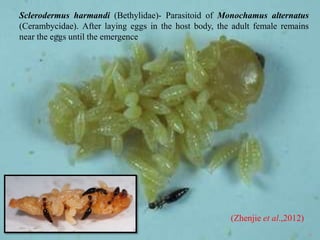
Sclerodermus harmandi (Bethylidae)- Parasitoid of Monochamus alternatus
(Cerambycidae). After laying eggs in the host body, the adult female remains
near the eggs until the emergence
(Zhenjie et al.,2012)
39
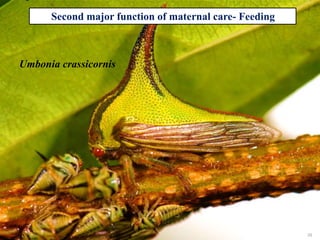
Second major function of maternal care- Feeding
Umbonia crassicornis
40
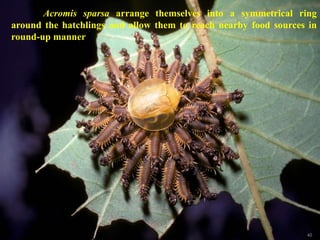
Acromis sparsa arrange themselves into a symmetrical ring
around the hatchlings and allow them to reach nearby food sources in
round-up manner
41
Paternal care
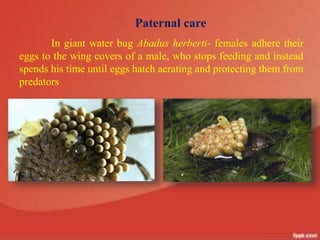
In giant water bug Abadus herberti- females adhere their
eggs to the wing covers of a male, who stops feeding and instead
spends his time until eggs hatch aerating and protecting them from
predators
42
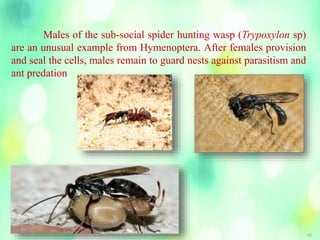
Males of the sub-social spider hunting wasp (Trypoxylon sp)
are an unusual example from Hymenoptera. After females provision
and seal the cells, males remain to guard nests against parasitism and
ant predation
43
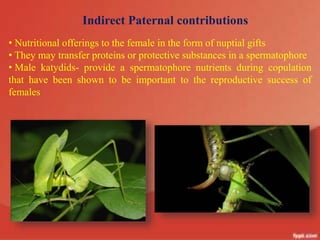
Indirect Paternal contributions
• Nutritional offerings to the female in the form of nuptial gifts
• They may transfer proteins or protective substances in a spermatophore
• Male katydids- provide a spermatophore nutrients during copulation
that have been shown to be important to the reproductive success of
females
44
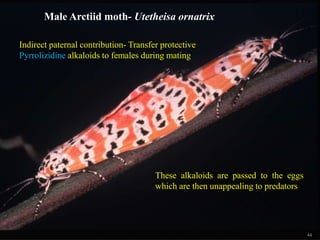
Male Arctiid moth- Utetheisa ornatrix
Indirect paternal contribution- Transfer protective
Pyrrolizidine alkaloids to females during mating
These alkaloids are passed to the eggs
which are then unappealing to predators
45
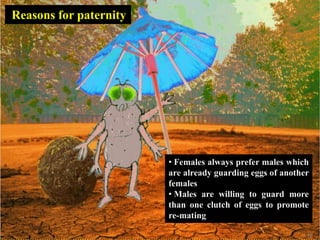
Reasons for paternity
• Females always prefer males which
are already guarding eggs of another
females
• Males are willing to guard more
than one clutch of eggs to promote
re-mating
46
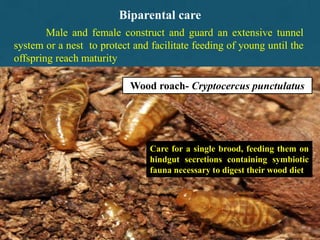
Biparental care
Male and female construct and guard an extensive tunnel
system or a nest to protect and facilitate feeding of young until the
offspring reach maturity
Wood roach- Cryptocercus punctulatus
Care for a single brood, feeding them on
hindgut secretions containing symbiotic
fauna necessary to digest their wood diet
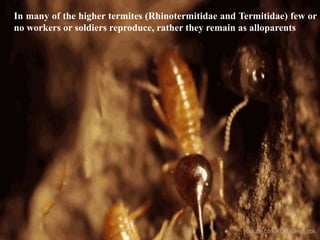
47
In many of the higher termites (Rhinotermitidae and Termitidae) few or
no workers or soldiers reproduce, rather they remain as alloparents
48
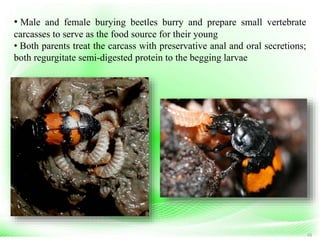
• Male and female burying beetles burry and prepare small vertebrate
carcasses to serve as the food source for their young
• Both parents treat the carcass with preservative anal and oral secretions;
both regurgitate semi-digested protein to the begging larvae
49
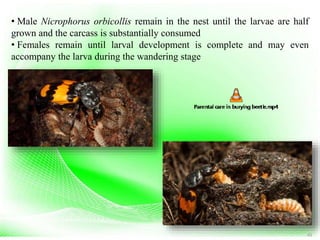
• Male Nicrophorus orbicollis remain in the nest until the larvae are half
grown and the carcass is substantially consumed
• Females remain until larval development is complete and may even
accompany the larva during the wandering stage
50
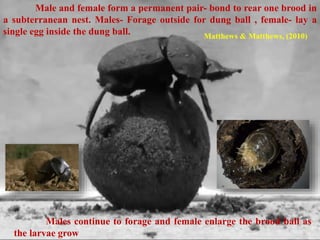
Male and female form a permanent pair- bond to rear one brood in
a subterranean nest. Males- Forage outside for dung ball , female- lay a
single egg inside the dung ball.
Males continue to forage and female enlarge the brood ball as
the larvae grow
Matthews & Matthews, (2010)
51
Communication between Parent & Off-spring
• Chemical signalling
• By direct internal chemical signals- Hormones
• By indirect external chemical signals- Pheromones
• It influence the maternal reproductive physiology and future reproduction
• Apis mellifera larvae produce brood pheromone that influences the care
behaviour of workers
(Kolliker et al., 2007)
(Mas et al., 2008)
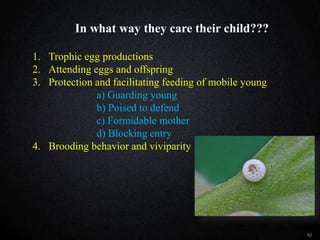
In what way they care their child?????
52
1. Trophic egg productions
2. Attending eggs and offspring
3. Protection and facilitating feeding of mobile young
a) Guarding young
b) Poised to defend
c) Formidable mother
d) Blocking entry
4. Brooding behavior and viviparity
In what way they care their child???
53
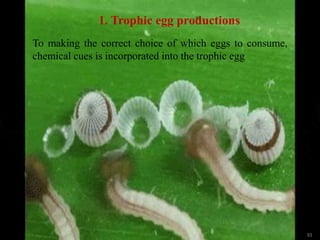
1. Trophic egg productions
To making the correct choice of which eggs to consume,
chemical cues is incorporated into the trophic egg
54
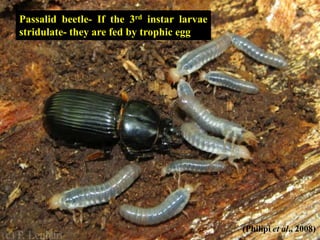
Passalid beetle- If the 3rd instar larvae
stridulate- they are fed by trophic egg
(Philipi et al., 2008)
55
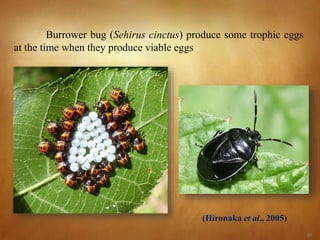
Burrower bug (Sehirus cinctus) produce some trophic eggs
at the time when they produce viable eggs
(Hironaka et al., 2005)
2. Attending eggs & offspring
56
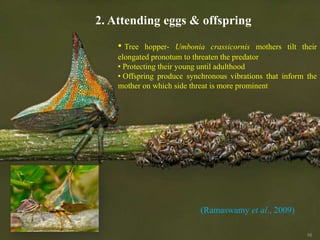
• Tree hopper- Umbonia crassicornis mothers tilt their
elongated pronotum to threaten the predator
• Protecting their young until adulthood
• Offspring produce synchronous vibrations that inform the
mother on which side threat is more prominent
(Ramaswamy et al., 2009)
2. Attending eggs & offspring
3. Protection of mobile young
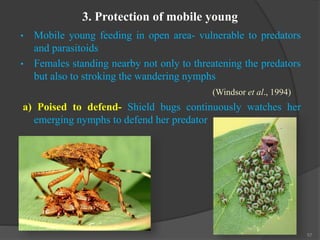
• Mobile young feeding in open area- vulnerable to predators
and parasitoids
• Females standing nearby not only to threatening the predators
but also to stroking the wandering nymphs
(Windsor et al., 1994)
a) Poised to defend- Shield bugs continuously watches her
emerging nymphs to defend her predator
57
58
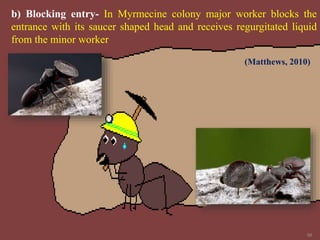
b) Blocking entry- In Myrmecine colony major worker blocks the
entrance with its saucer shaped head and receives regurgitated liquid
from the minor worker
(Matthews, 2010)
59
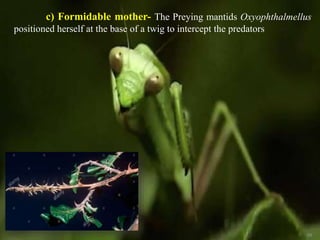
c) Formidable mother- The Preying mantids Oxyophthalmellus
positioned herself at the base of a twig to intercept the predators
60
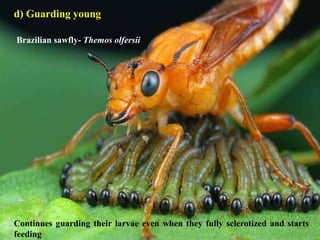
d) Guarding young
Brazilian sawfly- Themos olfersii
Continues guarding their larvae even when they fully sclerotized and starts
feeding
61
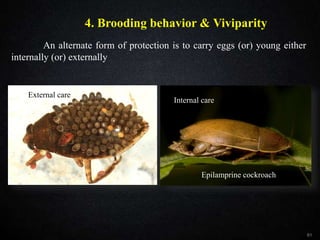
4. Brooding behavior & Viviparity
An alternate form of protection is to carry eggs (or) young either
internally (or) externally
External care
Epilamprine cockroach
Internal care
62
Cost & Benefit of parental care
• Parental investment benefits a current progeny
at the expense of future reproductive success
• Protection of eggs is one of the most basic
forms of parental care seen in many insects
(Clutton et al., 1991)
63
• Egg guarding represents an investment in terms
of time, energy and reduced fecundity
• Opportunities for laying additional clutches
will be reduced
• Egg guarding by adults acts to increase the
hatching success
• Off-spring survival in guarded clutch will
increased
64
Case Study-1
Quantifying the costs & benefits of
parental care in female treehoppers
Andrew G. Zink (2003)
65
• In this article he reported on a field study with tree-hopper Publilia
concava that specifically quantified these costs & benefits of egg
guarding
• Off- spring protection sometimes involves elaborate mechanisms for
deterring predators such as kicking/ wing fanning
• These guarding behavior has proven to be important for protection
and survival of eggs
• In the tree-hopper Entylia bactriana early abandonment of eggs was
correlated with 47% reduction in hatching success
66
Result
1. The egg guarding in Publilia concava shown the positive linear
relationship between hatching success and the survival of nymphs
2. Females that abandoned immediately after egg laying suffered
50% reduction in hatching success
67
Case Study- 2
Effect of parental care on off-spring survival
& adult emergence in Nicrophorus mexicanus
(Silphidae: Coleoptera)
(Sofia et al., 2011)
68
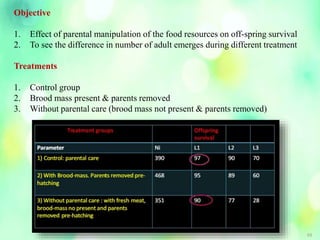
Objective
1. Effect of parental manipulation of the food resources on off-spring survival
2. To see the difference in number of adult emerges during different treatment
Treatments
1. Control group
2. Brood mass present & parents removed
3. Without parental care (brood mass not present & parents removed)
69
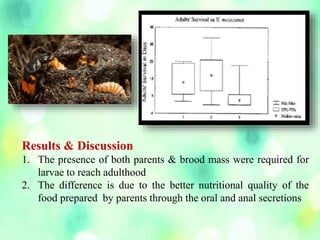
Results & Discussion
1. The presence of both parents & brood mass were required for
larvae to reach adulthood
2. The difference is due to the better nutritional quality of the
food prepared by parents through the oral and anal secretions
70
CASE STUDY- 3
Reversed sex roles in the giant
waterbug (Abedus spp)
(Robert smith, 1970)
71
• An egg encumbered male is placed in an aquarium, highest
number (97%) of the eggs will hatch
• Removing egg pads from the back of six males and placed
each egg pad in a separate fingerbowl in the laboratory- none
of the eggs were survived
• He killed egg bearing males and left them with eggs intact
but these eggs also failed to hatch
• He noticed that male keep egg pad at (or) above the water
surface
• Perhaps regular exposure to atmospheric air is required for
development
72
CONCLUSION
1. Effective plan to protect the young
2. Makes their species survives to the next generation
3. Many adaptive advantage for off-spring
4. Synchronous hatching promote aggregation of youngone
5. Large scale aggregation of off-spring act as co-operative
defense
73
THANK YOU

Egg dumping and parental care in insects

  • 1.
    1 WELCOME TO ALL CREDITSEMINAR-2 07-09-2018
  • 2.
    2 Egg dumping andParental care in insects Presented by, L.N.NISHA I-PhD-ENTOMOLOGY
  • 3.
    3 OUTLINE 1. Egg dumping-Introduction 2. Egg dumping in insects 3. Why dump??? 4. Parental care- Definition 5. Parental care- Introduction 6. Socio-ecology of insects 7. Parental care with solitary nesting 8. Parental care without nesting 9. Parental care with communal nesting 10. Forms of parental care 11. Communication b/w parent and off-spring 12. In what way they care their child??? 13. Cost & benefit of parental care 14. Case study (1,2 & 3) 15. Conclusion
  • 4.
    4 Egg dumping- Introduction Avianliterature- To describe the behavior of females that regularly or occasionally parasitize the maternal behavior of other females by laying eggs in their nests Females that place the eggs under the care of conspecifics have been labeled egg dumpers
  • 5.
    5 Similar behavior wasnoticed in lace bugs, burying beetles, tree hoppers & sub- social bees and wasps Birds Salamanders & Fish
  • 6.
    6 Egg dumping ininsects Females of Gargaphia solani, G.tiliae and G.iridescens oviposit in recently created egg masses of conspecifics and abandon their eggs to the care of the female that initiated the mass
  • 7.
    7 Heteroptera- Aradid flatbugs Female Neuroctenus pseudonymus add eggs to a clutch that was then guarded until hatching by “another adult”
  • 8.
    8 In Polyglypta treehopper-When a gravid female discovers a conspecific already guarding, she often lays her eggs along the sides of the existing egg mass and leaves the area and then dumps additional clutches in upto 5 other females egg masses
  • 9.
    9 • Small carcassesare rare and ephemeral resources • More than one female discovers a fresh corpse at about the same time • Fights for corpse- Larger individual typically claiming the prize • Instead, they remain in the soil a short distance from the carcass and return to it for clandestine feeding and oviposition whenever possible
  • 10.
    10 Why Dump???? • Carelesslaying by unfit female • Aberrant breeding habitats • Degenerative reproductive habits • Is a conditional strategy to which females resort only when there is a shortage of nesting sites (or) if their own nests are destroyed
  • 11.
    11 Parental care- Definition Anypost- ovipositional behavior that promotes survival, growth and development of off-spring (Tallamy et al., 1984) Altruistic trait evolved to enhance the fitness of the recipients (off-spring) at the expense of the donor (parents) (Royle et al., 2012)
  • 12.
    12 Parents are someof the most influential and important figures in our lives Provide a safe place to live and Provide food to eat
  • 13.
    Parental care ininsects 13
  • 14.
    Parental care- Introduction 14 •Social behaviour • Females select an appropriate oviposition site, affording protection to the eggs and ensuring an appropriate food resource for the hatching offspring • Female deposit their eggs directly into suitable substrate with her ovipositor or modify the environment (nest construction) • With and without nest construction Parental care- Introduction
  • 15.
    15 Protection of eggs •The defenseless egg stage in an insects life is the most susceptible to predators who can eat them • To protect against this- Females hold their eggs inside their body cavities until they begin to hatch • This type of live birth (called viviparity) protects the unborn eggs until they have a chance to physically run and hide from predators Madagascar Hissing Cockroach Gromphadorhina portentosa
  • 16.
    16 Fathers • Sometimes, eventhe insect fathers take a protective role with their offspring • Male giant water bug (Abadus herberti) holds the unborn eggs of his progeny on his back until they are old enough to hatch out • Upon laying the eggs, the mother physically glues the eggs onto his back • The father makes frequent trips to the surface to supply oxygen to the eggs
  • 17.
    17 Mothers- Good parentingdoesn't stop after the eggs are hatched Brazilian Tortoise Beetle Acromis sparsa Female guard her youngones from egg to adult stage. Round and cover them by using her broad wing to protect them from predators The young larvae aid in their own defense by grasping onto their own feces with hooks at the end of the abdomen and waving it at any potential predator
  • 18.
    18 Socio-ecology of insects 1.Eusocial 2. Quasisocial 3. Communal 4. Sub-social
  • 19.
    Parental care withsolitary nesting 19 Earwig- Dermaptera • Earwigs of both sexes are overwinter in the nest • In spring, male is ejected when the mother starts to tend the eggs • In some species mother earwigs forage and provide food for the young nymphs Parental care with solitary nesting
  • 20.
    Dung beetle- Scarabaeidae 20 Eggsare laid inside the dung ball Parental care- Removal of fungus, exclusion of conspecifics and ants by parental defense Dung beetle- Scarabaeidae
  • 21.
    Hymenoptera 21  Wasps andbees are the most prolific and diverse nest builders amongst the insects  Except bees, all these insects belongs to order Hymenoptera are parasitoids, in which adults attack and immobilize arthropod prey and provide food to the young  Wasps demonstrate a series of increasingly complex prey handling and nesting strategies Using the preys own burrow (many Pompilidae) Build a simple burrow after prey capture (few Sphecidae) Nest burrow before prey capture (many Sphecidae) Hymenoptera
  • 22.
    • The primitivenest site was probably a pre- existing burrow, with the construction medium later being soil or sand 22 • Further specializations involved the use of plant materials like 1. Stems 2. Rotten wood 3. Solid wood (carpenter bees, Xylocopini) 4. Free standing constructions of chewed vegetation (Megachilinae) 5. Mud (Eumeninae) •A range of natural materials are used in making and sealing cells including muds, resins and oils secreted by plants • The primitive nest site was probably a pre- existing burrow, with the construction medium later being soil or sand
  • 23.
    23 In some sub-socialnesters such as mason wasps (Eumeninae), many individuals of one species may aggregate, building their nests close together
  • 24.
    24 Parental care withoutnesting • Minimum protection • High mortality occurs
  • 25.
    25 Hemiptera- Belostomatidae • Femaleoviposits onto the dorsum of the male, which receives eggs in small batches after each copulation • Other functions- Keeping the eggs free from fungi, maintaining appropriate conditions for egg development, herding the young and sometimes feed them
  • 26.
  • 27.
    27 Before laying eggs-Membracids seek a larger treehopper aggregation, where ants are in attendance
  • 28.
    28 Wood- mining beetles •All Passalidae (Coleoptera) live in communities of larva and adult • The adult form a substrate with chewing dead wood for the larvae to feed upon
  • 29.
    29 Some Ambrosia beetles(Curculionidae: Platypodinae) prepare gallaries for their offspring where the larvae feed on cultivated fungus and are defended by a male that guards the tunnel entrance
  • 30.
    30 Parental care withcommunal nesting • When favorable conditions for nest construction are scarce and scattered – communal nesting may occur • Many sub-social and all eu-social Hymenopterans share nests •Communal nesting- Enhancing utilization of nesting resources and encouraging mutual defense against parasites •Anti- social (or) selfish behavior- Frequent theft or takeover of nest and prey •Examples- Sphecidae (Wasps) and in bees among Halictinae, Andreninae and Megachilinae
  • 31.
    31 •After oviposition, femalebees and wasps remain in their nests- often until the next generation emerges as adults • They generally guard but they also may remove feces and generally maintain hygiene nest • The supply of provisions to the nest through mass provisioning, as in many communal sphecids and sub-social bees (or) replenishment as seen in many Vespid wasps that return with new prey for their larvae
  • 32.
    32 Sub-social Aphids Pemphiginae andHormaphidinae of aphids – sacrificial sterile soldier caste consisting of some first or second instar nymphs that exhibit aggressive behaviour Pseudo-scorpion like Enlarged anterior legs Attack with frontal horns Feeding stylets (Piercing weapon) These modified individuals may defend good feeding sites against competitors or defend their colony against predators
  • 33.
    33 Sub-social Thrips Thrips socialityis well developed in Bark- Dwelling species of Anactinothrips from Panama 1. Live communally 2. Co-operate in brood care 3. Forage with their young in a highly co- ordinated fashion All adults may disappear before the young are fully grown
  • 34.
    34 Forms of Parentalcare 1. Maternal care 2. Paternal care 3. Biparental care
  • 35.
    MATERNAL CARE 35 The mostrudimentary form of maternal care is provided by female that- Oviposit their eggs in protected places or cover their eggs with a hard shell or wax like compound before abandoning them Eg: Embiopteran webspinner females Antipalurai urichi Maternal care
  • 36.
    36 Stink bug- Tectocorisspp. Defends her eggs aggressively because she lays only one batch of eggs and her sole chance for reproductive success (Ken Preston et al., 2010)
  • 37.
    Many species ofinsects guard their youngones against predators by using defensive behaviour 37 Eg: Eggplant lace bug Gargaphia solani guard their eggs and gregarious nymphs until maturity. If a predator approaches- the female rushes as it fanning her wings Many insect species guard their youngones against predators by using some defensive behaviour
  • 38.
    38 Sclerodermus harmandi (Bethylidae)-Parasitoid of Monochamus alternatus (Cerambycidae). After laying eggs in the host body, the adult female remains near the eggs until the emergence (Zhenjie et al.,2012)
  • 39.
    39 Second major functionof maternal care- Feeding Umbonia crassicornis
  • 40.
    40 Acromis sparsa arrangethemselves into a symmetrical ring around the hatchlings and allow them to reach nearby food sources in round-up manner
  • 41.
    41 Paternal care In giantwater bug Abadus herberti- females adhere their eggs to the wing covers of a male, who stops feeding and instead spends his time until eggs hatch aerating and protecting them from predators
  • 42.
    42 Males of thesub-social spider hunting wasp (Trypoxylon sp) are an unusual example from Hymenoptera. After females provision and seal the cells, males remain to guard nests against parasitism and ant predation
  • 43.
    43 Indirect Paternal contributions •Nutritional offerings to the female in the form of nuptial gifts • They may transfer proteins or protective substances in a spermatophore • Male katydids- provide a spermatophore nutrients during copulation that have been shown to be important to the reproductive success of females
  • 44.
    44 Male Arctiid moth-Utetheisa ornatrix Indirect paternal contribution- Transfer protective Pyrrolizidine alkaloids to females during mating These alkaloids are passed to the eggs which are then unappealing to predators
  • 45.
    45 Reasons for paternity •Females always prefer males which are already guarding eggs of another females • Males are willing to guard more than one clutch of eggs to promote re-mating
  • 46.
    46 Biparental care Male andfemale construct and guard an extensive tunnel system or a nest to protect and facilitate feeding of young until the offspring reach maturity Wood roach- Cryptocercus punctulatus Care for a single brood, feeding them on hindgut secretions containing symbiotic fauna necessary to digest their wood diet
  • 47.
    47 In many ofthe higher termites (Rhinotermitidae and Termitidae) few or no workers or soldiers reproduce, rather they remain as alloparents
  • 48.
    48 • Male andfemale burying beetles burry and prepare small vertebrate carcasses to serve as the food source for their young • Both parents treat the carcass with preservative anal and oral secretions; both regurgitate semi-digested protein to the begging larvae
  • 49.
    49 • Male Nicrophorusorbicollis remain in the nest until the larvae are half grown and the carcass is substantially consumed • Females remain until larval development is complete and may even accompany the larva during the wandering stage
  • 50.
    50 Male and femaleform a permanent pair- bond to rear one brood in a subterranean nest. Males- Forage outside for dung ball , female- lay a single egg inside the dung ball. Males continue to forage and female enlarge the brood ball as the larvae grow Matthews & Matthews, (2010)
  • 51.
    51 Communication between Parent& Off-spring • Chemical signalling • By direct internal chemical signals- Hormones • By indirect external chemical signals- Pheromones • It influence the maternal reproductive physiology and future reproduction • Apis mellifera larvae produce brood pheromone that influences the care behaviour of workers (Kolliker et al., 2007) (Mas et al., 2008)
  • 52.
    In what waythey care their child????? 52 1. Trophic egg productions 2. Attending eggs and offspring 3. Protection and facilitating feeding of mobile young a) Guarding young b) Poised to defend c) Formidable mother d) Blocking entry 4. Brooding behavior and viviparity In what way they care their child???
  • 53.
    53 1. Trophic eggproductions To making the correct choice of which eggs to consume, chemical cues is incorporated into the trophic egg
  • 54.
    54 Passalid beetle- Ifthe 3rd instar larvae stridulate- they are fed by trophic egg (Philipi et al., 2008)
  • 55.
    55 Burrower bug (Sehiruscinctus) produce some trophic eggs at the time when they produce viable eggs (Hironaka et al., 2005)
  • 56.
    2. Attending eggs& offspring 56 • Tree hopper- Umbonia crassicornis mothers tilt their elongated pronotum to threaten the predator • Protecting their young until adulthood • Offspring produce synchronous vibrations that inform the mother on which side threat is more prominent (Ramaswamy et al., 2009) 2. Attending eggs & offspring
  • 57.
    3. Protection ofmobile young • Mobile young feeding in open area- vulnerable to predators and parasitoids • Females standing nearby not only to threatening the predators but also to stroking the wandering nymphs (Windsor et al., 1994) a) Poised to defend- Shield bugs continuously watches her emerging nymphs to defend her predator 57
  • 58.
    58 b) Blocking entry-In Myrmecine colony major worker blocks the entrance with its saucer shaped head and receives regurgitated liquid from the minor worker (Matthews, 2010)
  • 59.
    59 c) Formidable mother-The Preying mantids Oxyophthalmellus positioned herself at the base of a twig to intercept the predators
  • 60.
    60 d) Guarding young Braziliansawfly- Themos olfersii Continues guarding their larvae even when they fully sclerotized and starts feeding
  • 61.
    61 4. Brooding behavior& Viviparity An alternate form of protection is to carry eggs (or) young either internally (or) externally External care Epilamprine cockroach Internal care
  • 62.
    62 Cost & Benefitof parental care • Parental investment benefits a current progeny at the expense of future reproductive success • Protection of eggs is one of the most basic forms of parental care seen in many insects (Clutton et al., 1991)
  • 63.
    63 • Egg guardingrepresents an investment in terms of time, energy and reduced fecundity • Opportunities for laying additional clutches will be reduced • Egg guarding by adults acts to increase the hatching success • Off-spring survival in guarded clutch will increased
  • 64.
    64 Case Study-1 Quantifying thecosts & benefits of parental care in female treehoppers Andrew G. Zink (2003)
  • 65.
    65 • In thisarticle he reported on a field study with tree-hopper Publilia concava that specifically quantified these costs & benefits of egg guarding • Off- spring protection sometimes involves elaborate mechanisms for deterring predators such as kicking/ wing fanning • These guarding behavior has proven to be important for protection and survival of eggs • In the tree-hopper Entylia bactriana early abandonment of eggs was correlated with 47% reduction in hatching success
  • 66.
    66 Result 1. The eggguarding in Publilia concava shown the positive linear relationship between hatching success and the survival of nymphs 2. Females that abandoned immediately after egg laying suffered 50% reduction in hatching success
  • 67.
    67 Case Study- 2 Effectof parental care on off-spring survival & adult emergence in Nicrophorus mexicanus (Silphidae: Coleoptera) (Sofia et al., 2011)
  • 68.
    68 Objective 1. Effect ofparental manipulation of the food resources on off-spring survival 2. To see the difference in number of adult emerges during different treatment Treatments 1. Control group 2. Brood mass present & parents removed 3. Without parental care (brood mass not present & parents removed)
  • 69.
    69 Results & Discussion 1.The presence of both parents & brood mass were required for larvae to reach adulthood 2. The difference is due to the better nutritional quality of the food prepared by parents through the oral and anal secretions
  • 70.
    70 CASE STUDY- 3 Reversedsex roles in the giant waterbug (Abedus spp) (Robert smith, 1970)
  • 71.
    71 • An eggencumbered male is placed in an aquarium, highest number (97%) of the eggs will hatch • Removing egg pads from the back of six males and placed each egg pad in a separate fingerbowl in the laboratory- none of the eggs were survived • He killed egg bearing males and left them with eggs intact but these eggs also failed to hatch • He noticed that male keep egg pad at (or) above the water surface • Perhaps regular exposure to atmospheric air is required for development
  • 72.
    72 CONCLUSION 1. Effective planto protect the young 2. Makes their species survives to the next generation 3. Many adaptive advantage for off-spring 4. Synchronous hatching promote aggregation of youngone 5. Large scale aggregation of off-spring act as co-operative defense
  • 73.