Background

Alternative
Residual Management
Conclusion
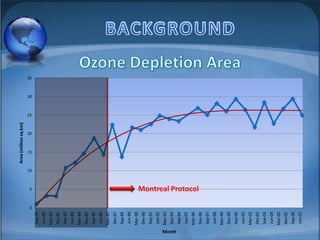
Month
Jun-07

Sep-06

Des-05

Mar-05

Jun-04

Sep-03

Des-02

Mar-02

Jun-01

Sep-00

Des-99

Mar-99

Jun-98

Sep-97

Des-96

Mar-96

Jun-95

Sep-94

Des-93

Mar-93

Jun-92

Sep-91

Des-90

5

Mar-90

Jun-89

Sep-88

Des-87

Mar-87

Jun-86

Sep-85

Des-84

Mar-84

Jun-83

Sep-82

Des-81

Mar-81

Jun-80

Sep-79

Area (million sq.km)
35

30

25

20

15

10

Montreal Protocol

0
Halon-1301

10

Halon-1211

3

Carbon Tetrachloride

1.1

CFC-12

1

CFC-114

1

CFC-11

1

CFC-113

0.8

CFC-115

0.6

Methyl Bromide

0.6

HCFC-141b

0.11

Methyl Chloroform

0.1

HCFC-142b

0.065

HCFC-22

0.055

HCFC-124

0.022

HFC-32
HFC-134a
11000 10000 9000

8000

7000

6000

5000

4000

3000

2000

1000

0

Global Worming Potential (20 Year, CO2 = 1)
(Source: Scientific Assessment of Ozone Depletion)

0
0
0

1

2

3

4

5

6

7

8

9

10

Ozone Depletion Potential (CFC-11 = 1)
(Source: The Montreal Protocol)

11
Summary of Montreal Protocol control measures
Ozone depleting substances
Chlorofluorocarbons (CFCs)
Halons
Carbon tetrachloride
Methyl chloroform
Hydrochlorofluorocarbons (HCFCs)

Developed countries
Phased out end of 1995a
Phased out end of 1993
Phased out end of 1995a
Freeze from beginning of 1996b
35% reduction by 2004
75% reduction by 2010
90% reduction by 2015
Total phase out by 2020c

Hydrobromofluorocarbons (HBFCs)
Methyl bromide
(horticultural uses)

Phased out end of 1995
Freeze in 1995 at 1991 base levele
25% reduction by 1999
50% reduction by 2001
70% reduction by 2003
Total phase out by 2005
Phase out by 2002

Bromochloromethane (BCM)

Developing countries
Total phase out by 2010
Total phase out by 2015
Freeze in 2013 at a base level calculated as
the average of 2009 and 2010 consumption levels
10% reduction by 2015
35% reduction by 2020
67.5% reduction by 2025
Total phase out by 2030d
Phased out end of 1995
Freeze in 2002 at average 1995-1998 base levele
20% reduction by 2005
Total phase out by 2015

Phase out by 2002
“without significant subsequent action, the
world environment would surely have been in
grave jeopardy”
Back
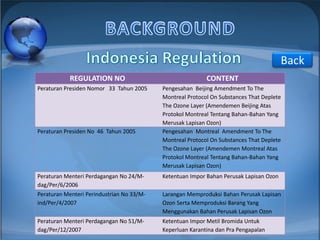
REGULATION NO
Peraturan Presiden Nomor 33 Tahun 2005

Peraturan Presiden No 46 Tahun 2005

CONTENT
Pengesahan Beijing Amendment To The
Montreal Protocol On Substances That Deplete
The Ozone Layer (Amendemen Beijing Atas
Protokol Montreal Tentang Bahan-Bahan Yang
Merusak Lapisan Ozon)
Pengesahan Montreal Amendment To The
Montreal Protocol On Substances That Deplete
The Ozone Layer (Amendemen Montreal Atas
Protokol Montreal Tentang Bahan-Bahan Yang
Merusak Lapisan Ozon)

Peraturan Menteri Perdagangan No 24/Mdag/Per/6/2006

Ketentuan Impor Bahan Perusak Lapisan Ozon

Peraturan Menteri Perindustrian No 33/Mind/Per/4/2007

Larangan Memproduksi Bahan Perusak Lapisan
Ozon Serta Memproduksi Barang Yang
Menggunakan Bahan Perusak Lapisan Ozon

Peraturan Menteri Perdagangan No 51/Mdag/Per/12/2007

Ketentuan Impor Metil Bromida Untuk
Keperluan Karantina dan Pra Pengapalan
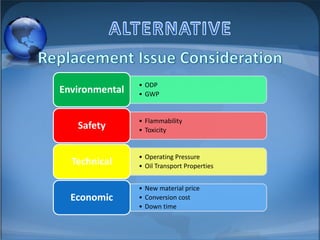
Environmental

Safety

• ODP
• GWP

• Flammability
• Toxicity

Technical

• Operating Pressure
• Oil Transport Properties

Economic

• New material price
• Conversion cost
• Down time
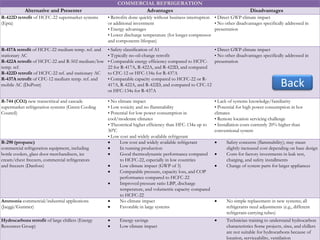
COMMERCIAL REFRIGERATION
Advantages

Alternative and Presenter

Disadvantages

R-422D retrofit of HCFC-22 supermarket systems
(Epta)

• Retrofits done quickly without business interruption • Direct GWP climate impact
or additional investment
• No other disadvantages specifically addressed in
• Energy advantages
presentation
• Lower discharge temperature (for longer compressor
and components lifespan)

R-417A retrofit of HCFC-22 medium temp. ref. and
stationary AC
R-422A retrofit of HCFC-22 and R-502 medium/low
temp. ref.
R-422D retrofit of HCFC-22 ref. and stationary AC
R-437A retrofit of CFC-12 medium temp. ref. and
mobile AC (DuPont)

• Safety classification of A1
• Direct GWP climate impact
• Typically no-oil-change retrofit
• No other disadvantages specifically addressed in
• Comparable energy efficiency compared to HCFC- presentation
22 for R-417A, R-422A, and R-422D, and compared
to CFC-12 or HFC-134a for R-437A
• Comparable capacity compared to HCFC-22 or R417A, R-422A, and R-422D, and compared to CFC-12
or HFC-134a for R-437A

R-744 (CO2) new transcritical and cascade
supermarket refrigeration systems (Green Cooling
Council)

• Lack of systems knowledge/familiarity
• Potential for high power consumption in hot
climates
• Remote location servicing challenge
• Installation costs currently 20% higher than
conventional system

Ammonia commercial/industrial applications
(Jaeggi/Guntner)

• No climate impact
• Low toxicity and no flammability
• Potential for low power consumption in
cool/moderate climates
• Theoretical higher efficiency than HFC-134a up to
30°C
• Low cost and widely available refrigerant

Low cost and widely available refrigerant

In running production

Good thermodynamic performance compared
to HCFC-22, especially in low countries

Low climate impact (GWP of 3)

Comparable pressure, capacity loss, and COP
performance compared to HCFC-22

Improved pressure ratio LBP, discharge
temperature, and volumetric capacity compared
to HCFC-22

No climate impact

Favorable in large systems



No simple replacement in new systems; all
refrigerants need adjustments (e.g., different
refrigerant-carrying tubes)

Hydrocarbons retrofit of large chillers (Energy
Resources Group)






Technician training to understand hydrocarbon
characteristics Some projects, sites, and chillers
are not suitable for hydrocarbons because of
location, serviceability, ventilation

R-290 (propane)
commercial refrigeration equipment, including
bottle coolers, glass door merchandisers, ice
cream/chest freezers, commercial refrigerators
and freezers (Danfoss)

Back

Energy savings
Low climate impact





Safety concerns (flammability); may mean
slightly increased cost depending on base design
Costs for factory investments in leak test,
charging, and safety installments
Change of system parts for larger appliances
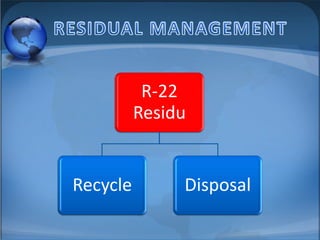
R-22
Residu

Recycle

Disposal
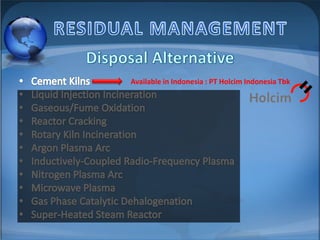
Available in Indonesia : PT Holcim Indonesia Tbk
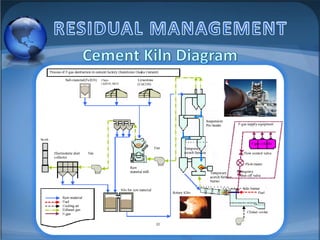
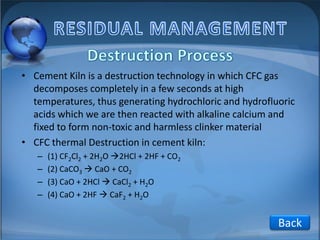
• Cement Kiln is a destruction technology in which CFC gas
decomposes completely in a few seconds at high
temperatures, thus generating hydrochloric and hydrofluoric
acids which we are then reacted with alkaline calcium and
fixed to form non-toxic and harmless clinker material
• CFC thermal Destruction in cement kiln:
–
–
–
–

(1) CF2Cl2 + 2H2O 2HCl + 2HF + CO2
(2) CaCO3  CaO + CO2
(3) CaO + 2HCl  CaCl2 + H2O
(4) CaO + 2HF  CaF2 + H2O

Back
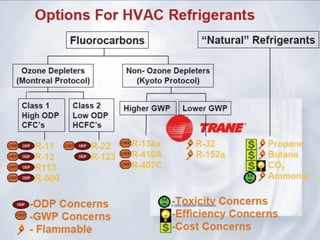
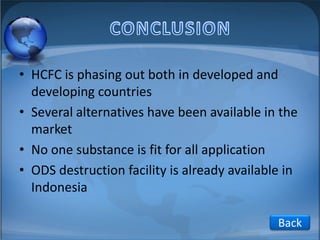
• HCFC is phasing out both in developed and
developing countries
• Several alternatives have been available in the
market
• No one substance is fit for all application
• ODS destruction facility is already available in
Indonesia
Back

R-22 Phase Out in Indonesia

  • 2.
  • 4.
  • 6.
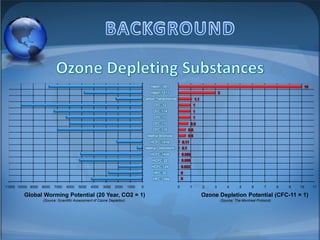
    Halon-1301 10 Halon-1211 3 Carbon Tetrachloride 1.1 CFC-12 1 CFC-114 1 CFC-11 1 CFC-113 0.8 CFC-115 0.6 Methyl Bromide 0.6 HCFC-141b 0.11 MethylChloroform 0.1 HCFC-142b 0.065 HCFC-22 0.055 HCFC-124 0.022 HFC-32 HFC-134a 11000 10000 9000 8000 7000 6000 5000 4000 3000 2000 1000 0 Global Worming Potential (20 Year, CO2 = 1) (Source: Scientific Assessment of Ozone Depletion) 0 0 0 1 2 3 4 5 6 7 8 9 10 Ozone Depletion Potential (CFC-11 = 1) (Source: The Montreal Protocol) 11
  • 7.
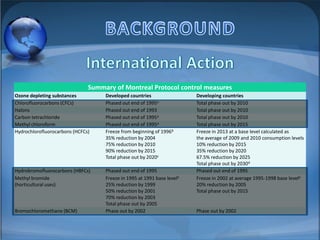
    Summary of MontrealProtocol control measures Ozone depleting substances Chlorofluorocarbons (CFCs) Halons Carbon tetrachloride Methyl chloroform Hydrochlorofluorocarbons (HCFCs) Developed countries Phased out end of 1995a Phased out end of 1993 Phased out end of 1995a Phased out end of 1995a Freeze from beginning of 1996b 35% reduction by 2004 75% reduction by 2010 90% reduction by 2015 Total phase out by 2020c Hydrobromofluorocarbons (HBFCs) Methyl bromide (horticultural uses) Phased out end of 1995 Freeze in 1995 at 1991 base levele 25% reduction by 1999 50% reduction by 2001 70% reduction by 2003 Total phase out by 2005 Phase out by 2002 Bromochloromethane (BCM) Developing countries Total phase out by 2010 Total phase out by 2010 Total phase out by 2010 Total phase out by 2015 Freeze in 2013 at a base level calculated as the average of 2009 and 2010 consumption levels 10% reduction by 2015 35% reduction by 2020 67.5% reduction by 2025 Total phase out by 2030d Phased out end of 1995 Freeze in 2002 at average 1995-1998 base levele 20% reduction by 2005 Total phase out by 2015 Phase out by 2002
  • 8.
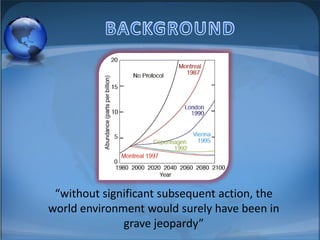
    “without significant subsequentaction, the world environment would surely have been in grave jeopardy”
  • 10.
    Back REGULATION NO Peraturan PresidenNomor 33 Tahun 2005 Peraturan Presiden No 46 Tahun 2005 CONTENT Pengesahan Beijing Amendment To The Montreal Protocol On Substances That Deplete The Ozone Layer (Amendemen Beijing Atas Protokol Montreal Tentang Bahan-Bahan Yang Merusak Lapisan Ozon) Pengesahan Montreal Amendment To The Montreal Protocol On Substances That Deplete The Ozone Layer (Amendemen Montreal Atas Protokol Montreal Tentang Bahan-Bahan Yang Merusak Lapisan Ozon) Peraturan Menteri Perdagangan No 24/Mdag/Per/6/2006 Ketentuan Impor Bahan Perusak Lapisan Ozon Peraturan Menteri Perindustrian No 33/Mind/Per/4/2007 Larangan Memproduksi Bahan Perusak Lapisan Ozon Serta Memproduksi Barang Yang Menggunakan Bahan Perusak Lapisan Ozon Peraturan Menteri Perdagangan No 51/Mdag/Per/12/2007 Ketentuan Impor Metil Bromida Untuk Keperluan Karantina dan Pra Pengapalan
  • 13.
    Environmental Safety • ODP • GWP •Flammability • Toxicity Technical • Operating Pressure • Oil Transport Properties Economic • New material price • Conversion cost • Down time
  • 15.
    COMMERCIAL REFRIGERATION Advantages Alternative andPresenter Disadvantages R-422D retrofit of HCFC-22 supermarket systems (Epta) • Retrofits done quickly without business interruption • Direct GWP climate impact or additional investment • No other disadvantages specifically addressed in • Energy advantages presentation • Lower discharge temperature (for longer compressor and components lifespan) R-417A retrofit of HCFC-22 medium temp. ref. and stationary AC R-422A retrofit of HCFC-22 and R-502 medium/low temp. ref. R-422D retrofit of HCFC-22 ref. and stationary AC R-437A retrofit of CFC-12 medium temp. ref. and mobile AC (DuPont) • Safety classification of A1 • Direct GWP climate impact • Typically no-oil-change retrofit • No other disadvantages specifically addressed in • Comparable energy efficiency compared to HCFC- presentation 22 for R-417A, R-422A, and R-422D, and compared to CFC-12 or HFC-134a for R-437A • Comparable capacity compared to HCFC-22 or R417A, R-422A, and R-422D, and compared to CFC-12 or HFC-134a for R-437A R-744 (CO2) new transcritical and cascade supermarket refrigeration systems (Green Cooling Council) • Lack of systems knowledge/familiarity • Potential for high power consumption in hot climates • Remote location servicing challenge • Installation costs currently 20% higher than conventional system Ammonia commercial/industrial applications (Jaeggi/Guntner) • No climate impact • Low toxicity and no flammability • Potential for low power consumption in cool/moderate climates • Theoretical higher efficiency than HFC-134a up to 30°C • Low cost and widely available refrigerant  Low cost and widely available refrigerant  In running production  Good thermodynamic performance compared to HCFC-22, especially in low countries  Low climate impact (GWP of 3)  Comparable pressure, capacity loss, and COP performance compared to HCFC-22  Improved pressure ratio LBP, discharge temperature, and volumetric capacity compared to HCFC-22  No climate impact  Favorable in large systems  No simple replacement in new systems; all refrigerants need adjustments (e.g., different refrigerant-carrying tubes) Hydrocarbons retrofit of large chillers (Energy Resources Group)    Technician training to understand hydrocarbon characteristics Some projects, sites, and chillers are not suitable for hydrocarbons because of location, serviceability, ventilation R-290 (propane) commercial refrigeration equipment, including bottle coolers, glass door merchandisers, ice cream/chest freezers, commercial refrigerators and freezers (Danfoss) Back Energy savings Low climate impact    Safety concerns (flammability); may mean slightly increased cost depending on base design Costs for factory investments in leak test, charging, and safety installments Change of system parts for larger appliances
  • 16.
  • 17.
    Available in Indonesia: PT Holcim Indonesia Tbk
  • 19.
    • Cement Kilnis a destruction technology in which CFC gas decomposes completely in a few seconds at high temperatures, thus generating hydrochloric and hydrofluoric acids which we are then reacted with alkaline calcium and fixed to form non-toxic and harmless clinker material • CFC thermal Destruction in cement kiln: – – – – (1) CF2Cl2 + 2H2O 2HCl + 2HF + CO2 (2) CaCO3  CaO + CO2 (3) CaO + 2HCl  CaCl2 + H2O (4) CaO + 2HF  CaF2 + H2O Back
  • 20.
    • HCFC isphasing out both in developed and developing countries • Several alternatives have been available in the market • No one substance is fit for all application • ODS destruction facility is already available in Indonesia Back