HRM Flexi-time work schedule
Flexi-time Flex-time refers to variations in starting and quitting times but assumes that a constant number of hours (8 hours) are worked each day In other words, the employees can work any time they choose, but per day they have to put in 8 hours of effort or 48 hours per week
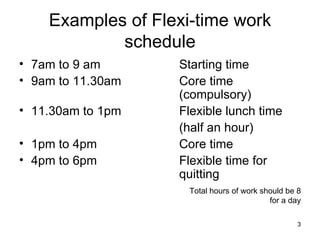
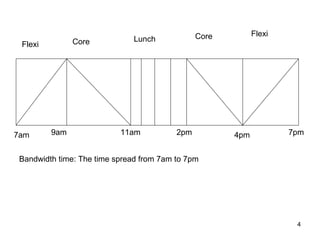
Examples of Flexi-time work schedule 7am to 9 am Starting time 9am to 11.30am Core time  (compulsory) 11.30am to 1pm Flexible lunch time (half an hour) 1pm to 4pm Core time 4pm to 6pm  Flexible time for  quitting Total hours of work should be 8 for a day
Flexi Core Lunch Core Flexi Bandwidth time: The time spread from 7am to 7pm 7am 9am 11am 2pm 4pm 7pm
Advantages of Flexi-Time Better productivity and morale Reduced tardiness and absenteeism Employees decide their duty timings, their morale could be improved Reduced employee turnover Increase in work-consciousness rather than time-consciousness No late-coming Better equipment and facilities utilization Less over-time pay Recruiting will be easier, even housewives and part-time employees will be attracted Less supervision Outside impact—No rush in shop, traffic jam, rush in canteen, cinema house etc.
Disadvantages of Flexi-Time Utility costs are increased since the plant is open for longer periods of time Difficulties in recording time Confusion to suppliers and customers who are not used to flexi-time Long supervision A communication may not reach all the employees Communication gap may exist Scheduling of delivery may be affected
Managers’ Checklist:  Would Flexi-Time help you better? Do some employees prefer to come to work early while others prefer to work after closing hours? If your workgroup or dept has to communicate with clients or employees in different time-zones, would expanding the range of hours that employees are working facilitate this? Is tardiness or absenteeism a problem in your dept? Are the modes of transportation, particularly during commuting hours, congested in your town/city?
Managers’ Checklist:  Would Flexi-Time help you better? Does your dept have a significant number of employees with family responsibilities? Would you like to offer your employees a benefit that is known to be popular but costs nothing? Do you think that an individual-specific benefit/concession will ensure productivity and morale?

Flexi Time

  • 1.
  • 2.
    Flexi-time Flex-time refersto variations in starting and quitting times but assumes that a constant number of hours (8 hours) are worked each day In other words, the employees can work any time they choose, but per day they have to put in 8 hours of effort or 48 hours per week
  • 3.
    Examples of Flexi-timework schedule 7am to 9 am Starting time 9am to 11.30am Core time (compulsory) 11.30am to 1pm Flexible lunch time (half an hour) 1pm to 4pm Core time 4pm to 6pm Flexible time for quitting Total hours of work should be 8 for a day
  • 4.
    Flexi Core LunchCore Flexi Bandwidth time: The time spread from 7am to 7pm 7am 9am 11am 2pm 4pm 7pm
  • 5.
    Advantages of Flexi-TimeBetter productivity and morale Reduced tardiness and absenteeism Employees decide their duty timings, their morale could be improved Reduced employee turnover Increase in work-consciousness rather than time-consciousness No late-coming Better equipment and facilities utilization Less over-time pay Recruiting will be easier, even housewives and part-time employees will be attracted Less supervision Outside impact—No rush in shop, traffic jam, rush in canteen, cinema house etc.
  • 6.
    Disadvantages of Flexi-TimeUtility costs are increased since the plant is open for longer periods of time Difficulties in recording time Confusion to suppliers and customers who are not used to flexi-time Long supervision A communication may not reach all the employees Communication gap may exist Scheduling of delivery may be affected
  • 7.
    Managers’ Checklist: Would Flexi-Time help you better? Do some employees prefer to come to work early while others prefer to work after closing hours? If your workgroup or dept has to communicate with clients or employees in different time-zones, would expanding the range of hours that employees are working facilitate this? Is tardiness or absenteeism a problem in your dept? Are the modes of transportation, particularly during commuting hours, congested in your town/city?
  • 8.
    Managers’ Checklist: Would Flexi-Time help you better? Does your dept have a significant number of employees with family responsibilities? Would you like to offer your employees a benefit that is known to be popular but costs nothing? Do you think that an individual-specific benefit/concession will ensure productivity and morale?