Building
A Flexible
Workplace

   01 May 2012
What is workplace flexibility?


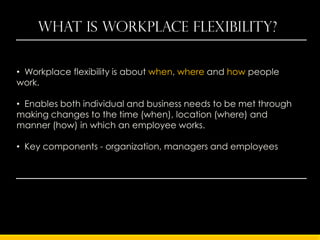
• Workplace flexibility is about when, where and how people
work.

• Enables both individual and business needs to be met through
making changes to the time (when), location (where) and
manner (how) in which an employee works.

• Key components - organization, managers and employees
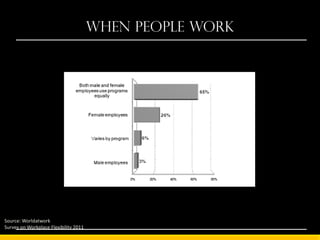
When people work

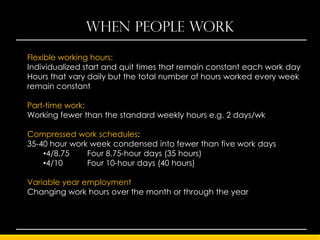
Flexible working hours:
Individualized start and quit times that remain constant each work day
Hours that vary daily but the total number of hours worked every week
remain constant

Part-time work:
Working fewer than the standard weekly hours e.g. 2 days/wk

Compressed work schedules:
35-40 hour work week condensed into fewer than five work days
    •4/8.75    Four 8.75-hour days (35 hours)
    •4/10      Four 10-hour days (40 hours)

Variable year employment
Changing work hours over the month or through the year
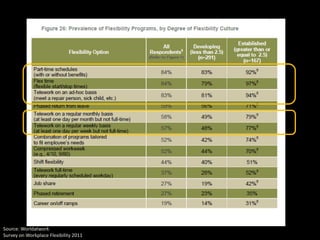
When people work


Source: Worldatwork
Survey on Workplace Flexibility 2011
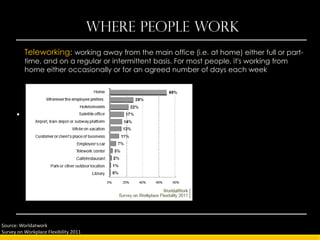
Where people work
          Teleworking: working away from the main office (i.e. at home) either full or part-
          time, and on a regular or intermittent basis. For most people, it's working from
          home either occasionally or for an agreed number of days each week


      •


Source: Worldatwork
Survey on Workplace Flexibility 2011
How people work

• Job-sharing - two people sharing one full-time job on an ongoing
  basis. For example, working two and a half days each, a two/three
  day split or one week on and one week off

• Phased retirement - reducing a full-time work commitment over a
  number of years (e.g. from 4 days to 3 days per week) before moving
  into retirement. It can also mean becoming an "alumni", i.e. that a
  "retired" employee returns to the workplace to cover peak work
  periods or to provide specialist knowledge

• Annualised hours - working a set number of hours per year instead
  of a number of hours per week.
Why is this
important?
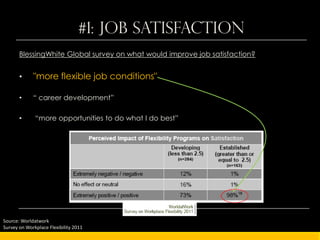
#1: Job Satisfaction
       BlessingWhite Global survey on what would improve job satisfaction?


       •     "more flexible job conditions"

       •     “ career development”

       •      “more opportunities to do what I do best”


Source: Worldatwork
Survey on Workplace Flexibility 2011
#1: Job Satisfaction
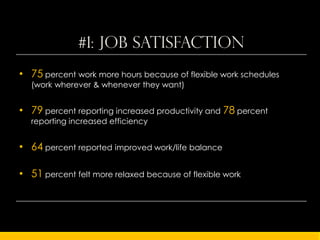
• 75 percent work more hours because of flexible work schedules
  (work wherever & whenever they want)


• 79 percent reporting increased productivity and 78 percent
  reporting increased efficiency


• 64 percent reported improved work/life balance

• 51 percent felt more relaxed because of flexible work
#2: Engagement & Motivation
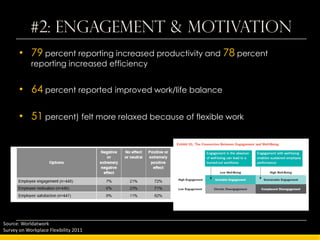
       • 79 percent reporting increased productivity and 78 percent
            reporting increased efficiency


       • 64 percent reported improved work/life balance

       • 51 percent) felt more relaxed because of flexible work


Source: Worldatwork
Survey on Workplace Flexibility 2011
#3: Changing demographics
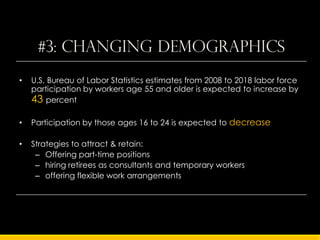
•   U.S. Bureau of Labor Statistics estimates from 2008 to 2018 labor force
    participation by workers age 55 and older is expected to increase by
    43 percent

•   Participation by those ages 16 to 24 is expected to decrease

•   Strategies to attract & retain:
     – Offering part-time positions
     – hiring retirees as consultants and temporary workers
     – offering flexible work arrangements
CONSIDERATIONS
     FOR A
flexibility plan
#1: Unique culture
Control vs. Flexibility
•   Do you want to allow your workers to control their work/life balance
•   Would you rather prescribe certain modes of working and allow your workers to
    have freedom within those bounds?

Self Service vs. Full Service
What is flexible about your work style?
•   Self Service mobile officing environments make assets available for employees
    with little oversight & admin support
•   Full Service environments go to great lengths to insure employees have
    everything they need – catering, supplies, little amenities, etc.

Who is applicable & why?
•   Reward driven?
•   Demographic driven?
•   Roles driven?
Source: Worldatwork
Survey on Workplace Flexibility 2011
Examples: context based
Parents with Dependent Care Responsibilities
• Traditional flextime
• Last-minute flexibility
• Reduced work hours
• Leave for caregiving
• Fathers?

Low wage and hourly workers
• Reduced work hours
• Traditional flextime
• Shift flexibility
• Break arrangements
• Leave for caregiving

Workers with Disabilities
• Reduced work hours
• Traditional flextime
• Telecommuting/working from home options
• Break arrangements
#2: Mobility across departments
 Mobility cuts across departments & vary: Study departments
 and include all your work style analyses


 Psychological Patterns vary: sales persons don’t want a office
 as compared to consultants who do


 Don’t assume that teleworkers can always work from home and
 will never need to return to the office: Your mobile officing
 program must accommodate them in their need to return to the
 office in order to keep their satisfaction high.
#3: managers'
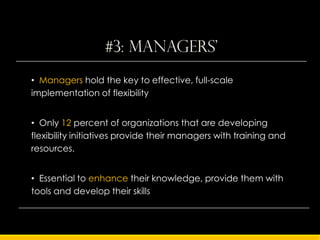
• Managers hold the key to effective, full-scale
implementation of flexibility


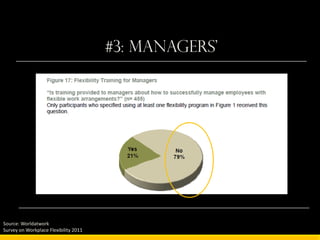
• Only 12 percent of organizations that are developing
flexibility initiatives provide their managers with training and
resources.


• Essential to enhance their knowledge, provide them with
tools and develop their skills
#3: managers'


Source: Worldatwork
Survey on Workplace Flexibility 2011
#3: managers'

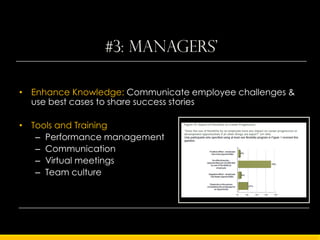
• Enhance Knowledge: Communicate employee challenges &
  use best cases to share success stories

• Tools and Training
   – Performance management
   – Communication
   – Virtual meetings
   – Team culture
Lessons Learnt
Flex Policy obstacles

The main obstacles to implementing flexible work arrangements:

 equal treatment for employees
 ensuring that the work is done
 the impracticality of such arrangements given the nature of jobs in
  the organization’s industry
 the difficulty in supervising employees working off site
 possible co-worker resentment
•   Question your assumptions: Do employees really need two
    workplaces?
•   Develop metrics to measure success
•   One Size does not fit all
•   Home based work attracts
•   Incorporate different domains
•   Executive champions needed
•   Change is complicated
•   Remain Flexible
The END


questions

Building a flexible workplace

  • 1.
  • 2.
    What is workplaceflexibility? • Workplace flexibility is about when, where and how people work. • Enables both individual and business needs to be met through making changes to the time (when), location (where) and manner (how) in which an employee works. • Key components - organization, managers and employees
  • 3.
    When people work Flexibleworking hours: Individualized start and quit times that remain constant each work day Hours that vary daily but the total number of hours worked every week remain constant Part-time work: Working fewer than the standard weekly hours e.g. 2 days/wk Compressed work schedules: 35-40 hour work week condensed into fewer than five work days •4/8.75 Four 8.75-hour days (35 hours) •4/10 Four 10-hour days (40 hours) Variable year employment Changing work hours over the month or through the year
  • 4.
    When people work Source:Worldatwork Survey on Workplace Flexibility 2011
  • 5.
    Where people work Teleworking: working away from the main office (i.e. at home) either full or part- time, and on a regular or intermittent basis. For most people, it's working from home either occasionally or for an agreed number of days each week • Source: Worldatwork Survey on Workplace Flexibility 2011
  • 6.
    How people work •Job-sharing - two people sharing one full-time job on an ongoing basis. For example, working two and a half days each, a two/three day split or one week on and one week off • Phased retirement - reducing a full-time work commitment over a number of years (e.g. from 4 days to 3 days per week) before moving into retirement. It can also mean becoming an "alumni", i.e. that a "retired" employee returns to the workplace to cover peak work periods or to provide specialist knowledge • Annualised hours - working a set number of hours per year instead of a number of hours per week.
  • 7.
  • 8.
    #1: Job Satisfaction BlessingWhite Global survey on what would improve job satisfaction? • "more flexible job conditions" • “ career development” • “more opportunities to do what I do best” Source: Worldatwork Survey on Workplace Flexibility 2011
  • 9.
    #1: Job Satisfaction •75 percent work more hours because of flexible work schedules (work wherever & whenever they want) • 79 percent reporting increased productivity and 78 percent reporting increased efficiency • 64 percent reported improved work/life balance • 51 percent felt more relaxed because of flexible work
  • 10.
    #2: Engagement &Motivation • 79 percent reporting increased productivity and 78 percent reporting increased efficiency • 64 percent reported improved work/life balance • 51 percent) felt more relaxed because of flexible work Source: Worldatwork Survey on Workplace Flexibility 2011
  • 11.
    #3: Changing demographics • U.S. Bureau of Labor Statistics estimates from 2008 to 2018 labor force participation by workers age 55 and older is expected to increase by 43 percent • Participation by those ages 16 to 24 is expected to decrease • Strategies to attract & retain: – Offering part-time positions – hiring retirees as consultants and temporary workers – offering flexible work arrangements
  • 12.
    CONSIDERATIONS FOR A flexibility plan
  • 13.
    #1: Unique culture Controlvs. Flexibility • Do you want to allow your workers to control their work/life balance • Would you rather prescribe certain modes of working and allow your workers to have freedom within those bounds? Self Service vs. Full Service What is flexible about your work style? • Self Service mobile officing environments make assets available for employees with little oversight & admin support • Full Service environments go to great lengths to insure employees have everything they need – catering, supplies, little amenities, etc. Who is applicable & why? • Reward driven? • Demographic driven? • Roles driven?
  • 14.
    Source: Worldatwork Survey onWorkplace Flexibility 2011
  • 15.
    Examples: context based Parentswith Dependent Care Responsibilities • Traditional flextime • Last-minute flexibility • Reduced work hours • Leave for caregiving • Fathers? Low wage and hourly workers • Reduced work hours • Traditional flextime • Shift flexibility • Break arrangements • Leave for caregiving Workers with Disabilities • Reduced work hours • Traditional flextime • Telecommuting/working from home options • Break arrangements
  • 16.
    #2: Mobility acrossdepartments Mobility cuts across departments & vary: Study departments and include all your work style analyses Psychological Patterns vary: sales persons don’t want a office as compared to consultants who do Don’t assume that teleworkers can always work from home and will never need to return to the office: Your mobile officing program must accommodate them in their need to return to the office in order to keep their satisfaction high.
  • 17.
    #3: managers' • Managershold the key to effective, full-scale implementation of flexibility • Only 12 percent of organizations that are developing flexibility initiatives provide their managers with training and resources. • Essential to enhance their knowledge, provide them with tools and develop their skills
  • 18.
    #3: managers' Source: Worldatwork Surveyon Workplace Flexibility 2011
  • 19.
    #3: managers' • EnhanceKnowledge: Communicate employee challenges & use best cases to share success stories • Tools and Training – Performance management – Communication – Virtual meetings – Team culture
  • 20.
  • 21.
    Flex Policy obstacles Themain obstacles to implementing flexible work arrangements:  equal treatment for employees  ensuring that the work is done  the impracticality of such arrangements given the nature of jobs in the organization’s industry  the difficulty in supervising employees working off site  possible co-worker resentment
  • 22.
    Question your assumptions: Do employees really need two workplaces? • Develop metrics to measure success • One Size does not fit all • Home based work attracts • Incorporate different domains • Executive champions needed • Change is complicated • Remain Flexible
  • 23.