





COMPRESSED WORKWEEK
Rohana K Amarakoon : WWW.uncopyrightables2011.blogspot.com / 2013
DEFINITION
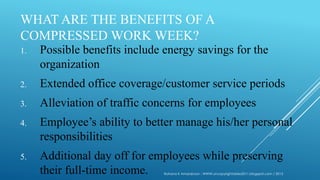
Alternative work arrangement where a standard workweek
is reduced to fewer than five days, and employees make up
the full number of hours per-week by working longer hours.
10-hour days, 12-hour days, week of five 9-hour
days followed by a week of four 9-hour days.
Rohana K Amarakoon : WWW.uncopyrightables2011.blogspot.com / 2013
WHAT ARE THE BENEFITS OF A
COMPRESSED WORK WEEK?
1. Possible benefits include energy savings for the
organization
2. Extended office coverage/customer service periods
3. Alleviation of traffic concerns for employees
4. Employee’s ability to better manage his/her personal
responsibilities
5. Additional day off for employees while preserving
their full-time income. Rohana K Amarakoon : WWW.uncopyrightables2011.blogspot.com / 2013
EMPLOYER ADVANTAGES
1. Helps achieve TRP goals
2. Gains hours of coverage for business services without
paying overtime wages
3. Provides a recruitment tool
4. Reduces employee absenteeism and tardiness
5. Increases employee morale
Rohana K Amarakoon : WWW.uncopyrightables2011.blogspot.com / 2013
EMPLOYEE ADVANTAGES
1. Can provide three or four day weekends
2. Offers an opportunity to help "clear the air"
3. Increases morale, employee loyalty
4. Decreases absenteeism and tardiness
5. Provides better balance between work/personal time
6. One of the most coveted benefits an employer can offer
7. Reduces vacation time used
Rohana K Amarakoon : WWW.uncopyrightables2011.blogspot.com / 2013
WHAT CONSIDERATIONS ARE THERE FOR
NEGOTIATING THIS TYPE OF WORK
SCHEDULE?
Challenges may include limited access to public transportation
and dependent care options and figuring out coverage of
responsibilities during the off hours of the employee.
Extended workdays can also be physically/mentally draining
for some employees.
Rohana K Amarakoon : WWW.uncopyrightables2011.blogspot.com / 2013
ELIGIBILITY
All exempt employees with the understanding that:
1. A compressed workweek is not appropriate for all positions,
or in all settings, or for all employees.
2. A compressed workweek during the probationary period is
not advisable because of the need to clarify job
responsibilities, establish relationships with co-workers and
clients, and assess suitability for continued employment.
3. Employees who have problems with punctuality, attendance,
and/or performance, or who require close supervision, are
not good candidates.
Rohana K Amarakoon : WWW.uncopyrightables2011.blogspot.com / 2013
PROCEDURES
• Determining if Compressed Workweek are Appropriate
Review the Alternative (Flexible) Work Schedule
Considerations document
• Managing Compressed Workweek Schedules
1. determine which day will be the flex day
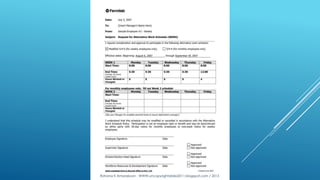
2. complete a written Alternative (Flexible) Work Schedule
Agreement.
Rohana K Amarakoon : WWW.uncopyrightables2011.blogspot.com / 2013
HOW IS A COMPRESSED WORK WEEK
ARRANGEMENT SUCCESSFULLY
IMPLEMENTED?
To successfully implement a compressed work week arrangement, the
employee and department should take into account the following concerns.
For non-exempt staff, supervisors must pre-approve all hours to be worked
in excess of the regularly scheduled 39 in any workweek. In order to avoid
overtime concerns, non-exempt staff opting to work a compressed work
week should plan to take the time off earned within the week it was
earned. For example, a bargaining unit staff member may be required to
work 4-10 hour days and take one day off per week vs. work 4-9 hour
days and take one day off once every two weeks. In the second scenario,
the employee must be paid overtime during the first week.
Rohana K Amarakoon : WWW.uncopyrightables2011.blogspot.com / 2013
HOW ARE LEAVE TIMES AND HOLIDAY PAY
MANAGED?
A staff member on a flextime schedule who is granted paid leave
time, such as a vacation or sick leave, will deduct the number of
hours scheduled to work on the day(s) off. For example, 10 hours
of vacation would be deducted if a staff member uses vacation on
a day with 10 scheduled work hours. This method of using paid
leave time applies to all paid leave time options.
Any regular staff member will receive pro-rated pay equal to 1/5
of his or her standard workweek for a university holiday.
Rohana K Amarakoon : WWW.uncopyrightables2011.blogspot.com / 2013
IS A COMPRESSED WORK WEEK RIGHT FOR
YOU?
1. Document how your job duties and goals could be squeezed
into a shorter two-week work cycle. It reduced hour schedule,
job sharing and flex time.
2. Talk to other people who have experience with a compressed
work week to see what they consider the pros and cons.
3. Before you jump into a compressed work week, however,
please consider whether it's right for you.
Rohana K Amarakoon : WWW.uncopyrightables2011.blogspot.com / 2013
THANK YOU…
Rohana K Amarakoon :
WWW.uncopyrightables2011.blogspot.com / 2013

Compressed workweek

  • 1.
    COMPRESSED WORKWEEK Rohana KAmarakoon : WWW.uncopyrightables2011.blogspot.com / 2013
  • 2.
    Rohana K Amarakoon: WWW.uncopyrightables2011.blogspot.com / 2013
  • 3.
    DEFINITION Alternative work arrangementwhere a standard workweek is reduced to fewer than five days, and employees make up the full number of hours per-week by working longer hours. 10-hour days, 12-hour days, week of five 9-hour days followed by a week of four 9-hour days. Rohana K Amarakoon : WWW.uncopyrightables2011.blogspot.com / 2013
  • 4.
    Rohana K Amarakoon: WWW.uncopyrightables2011.blogspot.com / 2013
  • 5.
    WHAT ARE THEBENEFITS OF A COMPRESSED WORK WEEK? 1. Possible benefits include energy savings for the organization 2. Extended office coverage/customer service periods 3. Alleviation of traffic concerns for employees 4. Employee’s ability to better manage his/her personal responsibilities 5. Additional day off for employees while preserving their full-time income. Rohana K Amarakoon : WWW.uncopyrightables2011.blogspot.com / 2013
  • 6.
    EMPLOYER ADVANTAGES 1. Helpsachieve TRP goals 2. Gains hours of coverage for business services without paying overtime wages 3. Provides a recruitment tool 4. Reduces employee absenteeism and tardiness 5. Increases employee morale Rohana K Amarakoon : WWW.uncopyrightables2011.blogspot.com / 2013
  • 7.
    EMPLOYEE ADVANTAGES 1. Canprovide three or four day weekends 2. Offers an opportunity to help "clear the air" 3. Increases morale, employee loyalty 4. Decreases absenteeism and tardiness 5. Provides better balance between work/personal time 6. One of the most coveted benefits an employer can offer 7. Reduces vacation time used Rohana K Amarakoon : WWW.uncopyrightables2011.blogspot.com / 2013
  • 8.
    Rohana K Amarakoon: WWW.uncopyrightables2011.blogspot.com / 2013
  • 9.
    WHAT CONSIDERATIONS ARETHERE FOR NEGOTIATING THIS TYPE OF WORK SCHEDULE? Challenges may include limited access to public transportation and dependent care options and figuring out coverage of responsibilities during the off hours of the employee. Extended workdays can also be physically/mentally draining for some employees. Rohana K Amarakoon : WWW.uncopyrightables2011.blogspot.com / 2013
  • 10.
    ELIGIBILITY All exempt employeeswith the understanding that: 1. A compressed workweek is not appropriate for all positions, or in all settings, or for all employees. 2. A compressed workweek during the probationary period is not advisable because of the need to clarify job responsibilities, establish relationships with co-workers and clients, and assess suitability for continued employment. 3. Employees who have problems with punctuality, attendance, and/or performance, or who require close supervision, are not good candidates. Rohana K Amarakoon : WWW.uncopyrightables2011.blogspot.com / 2013
  • 11.
    PROCEDURES • Determining ifCompressed Workweek are Appropriate Review the Alternative (Flexible) Work Schedule Considerations document • Managing Compressed Workweek Schedules 1. determine which day will be the flex day 2. complete a written Alternative (Flexible) Work Schedule Agreement. Rohana K Amarakoon : WWW.uncopyrightables2011.blogspot.com / 2013
  • 12.
    Rohana K Amarakoon: WWW.uncopyrightables2011.blogspot.com / 2013
  • 13.
    HOW IS ACOMPRESSED WORK WEEK ARRANGEMENT SUCCESSFULLY IMPLEMENTED? To successfully implement a compressed work week arrangement, the employee and department should take into account the following concerns. For non-exempt staff, supervisors must pre-approve all hours to be worked in excess of the regularly scheduled 39 in any workweek. In order to avoid overtime concerns, non-exempt staff opting to work a compressed work week should plan to take the time off earned within the week it was earned. For example, a bargaining unit staff member may be required to work 4-10 hour days and take one day off per week vs. work 4-9 hour days and take one day off once every two weeks. In the second scenario, the employee must be paid overtime during the first week. Rohana K Amarakoon : WWW.uncopyrightables2011.blogspot.com / 2013
  • 14.
    HOW ARE LEAVETIMES AND HOLIDAY PAY MANAGED? A staff member on a flextime schedule who is granted paid leave time, such as a vacation or sick leave, will deduct the number of hours scheduled to work on the day(s) off. For example, 10 hours of vacation would be deducted if a staff member uses vacation on a day with 10 scheduled work hours. This method of using paid leave time applies to all paid leave time options. Any regular staff member will receive pro-rated pay equal to 1/5 of his or her standard workweek for a university holiday. Rohana K Amarakoon : WWW.uncopyrightables2011.blogspot.com / 2013
  • 15.
    IS A COMPRESSEDWORK WEEK RIGHT FOR YOU? 1. Document how your job duties and goals could be squeezed into a shorter two-week work cycle. It reduced hour schedule, job sharing and flex time. 2. Talk to other people who have experience with a compressed work week to see what they consider the pros and cons. 3. Before you jump into a compressed work week, however, please consider whether it's right for you. Rohana K Amarakoon : WWW.uncopyrightables2011.blogspot.com / 2013
  • 16.
    Rohana K Amarakoon: WWW.uncopyrightables2011.blogspot.com / 2013
  • 17.
    THANK YOU… Rohana KAmarakoon : WWW.uncopyrightables2011.blogspot.com / 2013

Editor's Notes

  • #4 Most common options in a compressed workweek are: four 10-hour days, three 12-hour days, or a week of five 9-hour days followed by a week of four 9-hour days.What is a compressed work week? A compressed work schedule allows an employee to work a traditional 35-40 hour workweek in less than five workdays. Many compressed work schedule options may be negotiated. For example, a full-time employee scheduled for 39 hours per week could work four 9.75-hour days instead of five 7.8-hour days. Or, an employee could opt to work 8.6 hours per day, and take one full day off every two weeks (ideal for exempt employees).
  • #12 Determining if Compressed Workweek are AppropriateReview the Alternative (Flexible) Work Schedule Considerations document.A compressed workweek schedule should not negatively affect the workload or productivity of coworkers either by shifting burdens or creating delays and additional steps in the work flow.  The supervisor/department head should ensure that other employees in the same unit/department understand how and why compressed workweek schedules function.In the event that more employees request compressed workweek schedule arrangements than a unit/department can reasonably manage, the supervisor/department head shall respond to requests that are consistent with these guidelines in ways that are equitable to all employees and in the best interest of the University. Among the measures that might be adopted are rotating turns between employees, staggering schedules, and establishing core work hours.Managing Compressed Workweek SchedulesThe employee should initiate a request for a compressed workweek by submitting a proposal to her/his supervisor/department head.  If the employee and supervisor/department head agree to a compressed workweek arrangement, the  employee and supervisor shall: determine which day will be the flex daycomplete a written Alternative (Flexible) Work Schedule Agreement.The supervisor/department head shall maintain open communication, ensure that the employee’s hours of work do not fall below the normal workweek hours and discuss with the employee any concerns as they arise.Modifications and/or renewals also shall be documented appropriately.The employee must note their specific compressed workweek schedule (i.e., 9/80, 4/10, etc.) on their timesheet each month.The original Alternative (Flexible) Work Schedule Agreement shall be maintained in the employee’s personnel file, with copies to the employee and the supervisor/department head.Compressed workweek arrangements shall be initiated on a trial basis, and may be discontinued at any time at the request of either the employee or supervisor/department head.  The unit/department reserves the right to suspend the arrangement in the event of unanticipated circumstances regarding employee performance or operational needs, provided 30 days notice is given.Flex Day Switching: Since there is no limitation on the hours worked by an exempt employee, and no overtime pay is required by law, upon department approval, an exempt employee may switch their flex day to another day within the same pay period.  Holidays - Occurring on an Employee’s Regularly Scheduled Workday:When a paid holiday falls on an employee’s regularly scheduled workday, the employee will be paid eight hours of holiday pay for the holiday, similar to employees on regular work schedules.  No additional day off will be given. Holidays - Occurring on an Employee’s Regularly Scheduled Flex Day:  When a paid holiday falls on an employee’s regularly scheduled day off, the employee will be paid eight hours holiday pay for the holiday AND be given an alternate day off during the same pay period (e.g., the month the holiday occurs in).Vacations and Sick Leave – Absencesof at Least One Full Day, But Less Than a Full Week:Full day absences that occur as a result of vacation or illness will require charging the number of hours the employee was normally scheduled to work on the specified day (e.g., an employee is scheduled to work 10 hours and is absent due to a vacation or illness, must have 10 hours of vacation or sick time deducted from his/her leave accruals). Vacations and Sick Leave – Absences of a Full Week: When leave time is taken for an entire standard workweek, the employee may make an advance request to temporarily revert back to a traditional schedule to ensure no more than 40 hours in any given week is docked from leave accruals.Jury Duty – Occurring on an Employee’s Regularly Scheduled Workday:  Jury duty shall be paid for the number of hours in the employee’s regularly scheduled workday.  If jury duty continues for an extended period (longer than one week), the employee will revert back to a standard workweek schedule.  Jury Duty – Occurring on an Employee’s Regularly Scheduled Flex Day:  Jury duty shall not be paid for time spent during an employee’s regularly scheduled flex day, since the employee is not scheduled to work on that day.
  • #16 Some companies offer a compressed work week as part of their regular menu of flexible work options, alongside telecommuting, a reduced hour schedule, job sharing and flex time. Implementing it for yourself can be as simple as a visit to the human resources manager and filling out some paperwork.But even if your employer doesn't proactively offer a compressed work week, you can make the business case for this arrangement. Document how your job duties and goals could be squeezed into a shorter two-week work cycle. Explain how a longer work day might actually increase your productivity because you'll have longer stretches of focused time to work.Before you jump into a compressed work week, however, please consider whether it's right for you. Working parents might not want to trade those fleeting morning and evening hours with young children for a full day off when the kids are in school, anyway. Or perhaps you have a physically or mentally intense job that would drain you if you set up a longer work day. Talk to other people who have experience with a compressed work week to see what they consider the pros and cons.On the plus side, you'll continue to earn full-time income while gaining more flexibility. You'll also limit the number of days you have to commute. The downsides include more difficulty matching child care to your work schedule, and the previously mentioned exhaustion factor. Only you can make the decision for you and your family.